One Confusing Slide, Three Tally Marks, and a Return to Question One

Finding Clarity at 8:06 p.m.
I knew the pattern before Maya (name changed for privacy) finished describing it. She had sat down after work genuinely intending to study, but one problem without an obvious first step had sent her from the course tab to group chats, short videos, and a better planner before she attempted a single answer.
She took me back to 8:06 p.m. in her shared Toronto apartment. A lecture recording waited beside a half-cold mug of tea; the radiator clicked, her flatmate's TV murmured through the wall, and one confusing slide made her shoulders rise toward her ears. Her fingers touched the warm phone beside the trackpad before she had consciously decided to leave.
The work mattered, but the moment it asked for uncertain effort, her brain offered easier digital relief. Forty-five minutes later, the lecture had not moved, her Notion page looked immaculate, and the lost session had become another judgment about her discipline. Her frustration felt like trying to follow a melody while every app struck a brighter, louder note half a beat early.
“I care about the work,” she said, rubbing her thumb along the edge of her phone case. “So why do I act like I don't? I keep taking breaks before I've actually started.”
I could hear the real conflict beneath the question: Maya wanted to give her studies sustained attention, but the instant the work became difficult or unclear, immediate relief felt safer than staying. The guilt arrived afterward, when relief had already spent the evening.
“I don't think you're taking breaks from studying,” I told her. “I think you're taking breaks from the discomfort of beginning. That distinction matters, because one is a character accusation and the other is a pattern we can examine. Let's give this fog a map and see where your attention actually changes direction.”

Choosing the Four-Step Staircase
I invited Maya to place both feet on the floor, take one ordinary breath, and hold the question in mind while I shuffled. I use this brief pause as a transition into focused observation, not as a test of spirituality or a mysterious ritual.
I chose the Four-Layer Insight Ladder, a four-card RWS tarot spread arranged like an ascending staircase. The first two cards would diagnose the visible pattern and its psychological root. The next two would identify a corrective inner resource and turn it into a practical study rhythm.
I chose this spread because Maya was not asking me to predict a grade or academic outcome. She needed to understand why phone distraction while studying became so persuasive at one specific moment. A larger predictive spread would have added noise; these four positions were enough to trace behavior, belief, transformation, and action.
For me, this is how tarot works at its most useful: card meanings in context externalize a pattern so shame does not get the only vote. The first position would show what Maya visibly did. The second would reveal the belief that made difficulty feel like lost control. The third would show how she could relate differently to the urge to escape. The final position would ground that insight in actionable next steps.
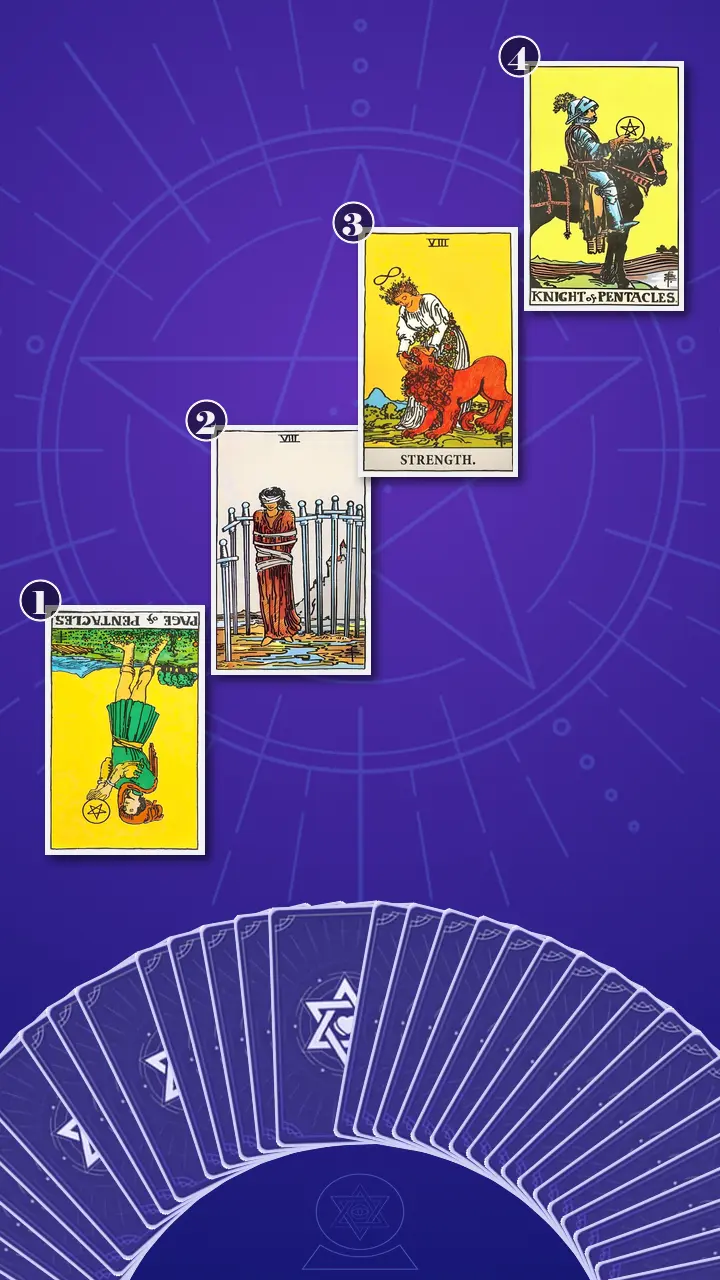
The Assignment Still Open in the Main Tab
Position One: The Interrupted Apprentice
I turned the card representing Maya's observable study-distraction pattern: the Page of Pentacles, reversed.
In the upright image, the Page's attention is absorbed by the pentacle while cultivated ground waits behind the figure. Reversed, the valuable object remains visible, but practical contact with it is blocked. I saw Maya's lecture tab in that pentacle: important, open, and technically in front of her, while her actual concentration moved through Messages, YouTube, Spotify, and a color-coded planner.
“At eight o'clock, you open the lecture because you genuinely mean to learn,” I said. “Then one confusing slide appears. You tell yourself, ‘I care about this, so I need to start properly. I'll just fix one thing first.' The playlist, timer, desk reset, or StudyTok advice becomes preparation for preparation. Forty-five minutes later, the goal is still on the screen, but the small patch of work in front of you is untouched.”
I described the reversed Page as blocked earth energy. Maya's interest was real, but it could not take root because attention left before effort accumulated. Each escape was also training an internal recommendation algorithm: the more often confusion led to scrolling, the faster scrolling was served at the next hint of difficulty.
Maya gave one short laugh, but there was no amusement in it. “That's too accurate. Almost cruel.”
I let the reaction settle. “Cruel would be using this card to call you lazy. I see something more specific. Your degree has value, but valuing it has not yet been translated into a small enough definition of beginning. This Page separates disrupted follow-through from lack of care.”
Her grip on the phone case loosened. She did not look relieved yet, but her expression had shifted from defensive to attentive, as if I had named the app running in the background without blaming the person holding the device.
Position Two: The Open Fence That Feels Closed
I turned the card representing the mechanism beneath the behavior: the Eight of Swords, upright.
A cloud moved across the window as I placed it down, muting the room into the card's gray palette. Then a thin line of light caught the gap in the sword enclosure. I pointed to the blindfold, the loose bindings, and the incomplete fence rather than treating the figure as permanently trapped.
“This is the moment at Robarts Library when question three has no obvious first formula,” I said. “Your stomach drops, your fingers hover, and a thought arrives: ‘If I were actually disciplined and capable, I'd know how to begin.' One unsolved problem becomes a verdict on the entire evening. You check the course forum, then Reddit, then email, because the session already feels lost.”
The Eight showed an excess of restrictive air: one thought expanding until it occupied every available route. Maya could still list the variables she recognized, inspect one example, underline the exact point where understanding broke, or draft one precise question. The situation was not fully closed, but the story in her head made those choices difficult to see.
The image brought back a lesson from my years of sound-energy research: a small feedback tone can become the loudest sound in a room when the system keeps returning it to the speaker. Maya's first flash of uncertainty was small. The loop amplified it into “I cannot control my attention,” then treated that amplified message as objective fact.
“One hard step is not proof that the whole session is unavailable,” I told her. “What did the last confusing slide make you believe about yourself before you opened another app?”
Her breathing paused. Her eyes moved away from the card and lost focus for a moment, as if she were replaying Tuesday evening frame by frame. Then she pressed her lips together and said, more quietly, “That if I really tried and still couldn't understand it, I'd have no excuse. I might find out I'm not in control of this at all.”
I nodded. “So planning protects you from direct contact with not knowing. It keeps you close enough to studying to feel responsible, but far enough away that the material cannot challenge your image of how a serious student should perform. That protection works for a few minutes. Then guilt sends the bill later.”
When Strength Put a Hand on the Urge
Position Three: Calm Authority at the Turning Point
I turned the card representing the shift from punitive willpower to deliberate redirection: Strength, upright. At that exact moment, Maya's face-down phone buzzed once against the table. She looked at it, then at the lion on the card, and left the phone where it was.
I showed her the woman's hands resting calmly around the lion's mouth. She neither runs from the animal nor attacks it. In Maya's daily life, the lion was the hot physical pull of novelty: the hand moving toward the phone, the burst of agitation in her chest, and the promise that one quick check would make the difficult task easier to face.
At first, Maya was still measuring every evening against the fantasy of a perfectly focused two-hour session. If that ideal state failed to appear, she assumed discipline had failed before any useful work could begin. Strength asked her to stay with one smaller contact point instead.
I ran what I call a Focus Disruption Audit. The dissonant chord was not simply “phone equals bad.” It was the precise sequence of an unclear slide, tightened shoulders, a warm device within reach, a notification offering closure, autoplay removing the endpoint, and guilt turning the detour into an identity judgment.
Then I used Cognitive Tempo Calibration to examine the rhythm she was demanding from herself. Maya kept asking her attention to perform like an uninterrupted two-hour track after lectures, commuting, and a café shift. Her actual nervous system was asking for a clearer downbeat: one defined task, one short interval, one visible finish. The problem was not that she had no rhythm. Pressure had pushed her rhythm and her study design out of sync.
“The urge is real,” I said. “It is not an instruction. You do not have to prove that you can focus for two hours. You only have to guide yourself through the next contact with difficulty.”
Discipline is not the absence of an urge to leave. It is a structure that helps you notice the urge, stay kind, and finish the next visible step anyway.
Discipline is not defeating the lion; it is placing a steady hand on the urge and guiding it toward the next small task.
I stopped speaking and let the sentence remain in the room.
Maya's inhale caught halfway. For a second her fingers froze above the phone case, and her eyes widened as if the card had contradicted a rule she had obeyed for years. Then her brow tightened. “But doesn't that mean I've been doing this wrong the whole time?” she asked, with a flash of anger that sounded close to grief. “I've spent so much energy trying to become stricter.” I told her that a mismatched method was not a moral failure and that recognizing it did not erase the evenings she had lost. Her gaze dropped to the lion. Her clenched hand slowly opened, finger by finger; her shoulders descended, but the release left her briefly unsteady, like someone stepping off a moving escalator onto still ground. Her eyes shone. She released a long, trembling breath and said, “So I don't have to stop wanting to leave. I have to get better at what I do when I notice it.”
“Now, using that new perspective, think back to last week,” I said. “Was there a moment when this could have made the experience feel different?”
She returned to the confusing Tuesday slide. “I could have written down the sentence I didn't understand before touching my phone. Even if I still needed help, I would have had a real question instead of forty-five minutes of random tabs.”
I invited her to rehearse the alternative immediately. She wrote “annotate one page” on an index card, chose a ten-minute timer, and decided where the phone would go. If an urge appeared, she would make one tally mark and return to the exact line she had left. At the timer, she could stop without calling the attempt a failure. If ten minutes felt inaccessible, two minutes and one sentence would still count.
This was the central emotional movement of the reading: not instant confidence, but a first step from restless frustration and guilt-driven avoidance toward cautious self-trust. Strength did not promise that difficult work would become comfortable. It restored the possibility of choice while discomfort was still present.
The Knight's Quiet Repetition
Position Four: A Routine That Does Not Need to Feel Inspiring
I turned the card representing practical integration: the Knight of Pentacles, upright.
The horse is stationary, the pentacle is held steadily in both hands, and the prepared fields stretch into the distance. I read this as earth energy returning to balance. The Knight does not need an exciting new identity or a dramatic burst of motivation. The Knight arrives, protects one unit of work, completes it, records it, and decides deliberately what happens next.
I translated the image into a scene Maya could actually repeat. She would return to the same area of Robarts after class, write one fifteen-minute finish line on an index card, place her phone inside her zipped bag with priority contacts still allowed, and open directly to a bookmarked problem. At the end, she would record “one problem attempted” or “two pages annotated” rather than rating whether she had felt focused.
“Same cue, one unit, visible finish,” I said. “Anything after that is optional. Measure the page marked, the problem attempted, the paragraph summarized, not the fantasy of perfect focus.”
Maya leaned closer to the Knight. Her mouth tilted into a small, rueful smile. “That sounds almost boring.”
“It is allowed to be boring,” I said. “Reliability is often quieter than guilt. The reversed Page wanted to feel like a perfect student before beginning. The Knight lets completed work provide the evidence afterward.”
The Syncopated Study Session
I gathered the four cards into one sequence. The reversed Page showed a student whose goal remained important while practical attention was diverted. The Eight of Swords revealed why: temporary confusion was being amplified into a story of lost control. Strength restored compassionate self-command, and the Knight grounded that inner shift in routine, boundaries, and visible completion.
The core pattern reminded me of a song whose rhythm kept collapsing at the same difficult bar. Maya had been restarting the whole composition, changing the instruments, and blaming the musician. The cards showed a more useful intervention: isolate the bar, slow the tempo, reduce the competing noise, and practise the next beat.
Her cognitive blind spot was the belief that focus had to arrive before action could begin. That belief made every urge feel like evidence against her discipline. The transformation was simpler and more demanding: complete one predefined fifteen-minute task before accessing a digital reward, then let observable output become evidence of a process she could repeat.
I shaped the next steps through my Syncopated Study Session, a rhythm protocol designed to keep one difficult academic task from becoming an enormous, undifferentiated block.
Two Beats for the Next Study Block
- Set one visible downbeat.Before one study block this week, spend no more than sixty seconds writing a finish line such as “annotate pages 42-44” or “attempt problem 3.” Set a fifteen-minute timer on a laptop, watch, or physical timer, and place the phone in a bag, drawer, or across the room with priority contacts allowed.If fifteen minutes feels too loaded, use five minutes or one attempted line. The smaller version is still the real protocol.
- Mark the offbeat and return.Keep a scrap of paper beside the laptop. When the urge to switch apps appears, make one tally mark, say “urge, not instruction,” and stay with the exact sentence, slide, or problem for sixty more seconds. At the timer, record only visible output.If an app does open, close it when you notice and continue with the remaining time. Do not punish the lapse by redesigning the session.
I reminded Maya that a phone boundary had to respect real needs. A device used for work, accessibility, safety, calendars, or urgent contacts did not need to be treated as morally bad. The goal was not total digital purity. It was enough friction to protect one chosen beat.

A Week Later: Three Tally Marks
Six days later, Maya sent me a short message from the library: “I wrote ‘attempt question 1,' put my phone in my bag, and made three tally marks. I wanted to leave the whole time. I finished the question anyway. It wasn't an amazing session, but it happened.”
She slept through that night. In the morning, her first thought was, “What if it stops working?” Then she smiled, made tea, and wrote the next index card.
I did not see that message as proof that tarot had fixed her attention. The cards had done something more honest: they had helped Maya observe the distraction-procrastination loop without turning it into a verdict, identify the moment where choice narrowed, and design a response she could test. The proof belonged to her hands, her index card, her three tally marks, and her return to question one.
When the first confusing step makes your shoulders tighten and your hand reach for the fastest digital exit, the painful part is not only losing time. It is wondering whether the escape proves you cannot trust yourself with something that matters. I would remember Strength here: the lion can be present without being placed in charge.
If focus did not have to arrive before you began, what one visible piece of work could become your next fifteen-minute beat while you place a steady hand on the urge and choose the direction?