Conflicting Study Advice Leaves Six Tabs Open, Then a Seven-Day Trial
When Six Open Tabs Became Advice-Overload Study Paralysis
If you have downloaded three study templates, duplicated the same Google Calendar week, and still have not completed one block, you may be caught in advice-overload study paralysis rather than a lack of care.
I met Jordan, a 21-year-old Toronto undergraduate and part-time service worker, through a video call at 10:40 p.m. From my side of the screen, I could see a lecture recording paused on their laptop and blue light washing over six study-method tabs. The laptop fan hummed while Jordan dragged Wednesday's flashcard block across a color-coded calendar for the third time. Their phone, warm from a long group-chat thread, stayed pressed against one palm.
“I keep planning how to study instead of studying,” Jordan said. “A friend says Anki, my tutor says practice exams, and StudyTok has a new system every day. Every method sounds right until someone recommends another one. Then choosing feels like admitting all the other advice might have been better.”
I watched their jaw lock each time they switched tabs. The feeling seemed to move through them like standing on a crowded TTC platform while every display named a different train, each announcement sounded urgent, and their feet refused to cross the yellow line. They wanted to begin a workable plan, but they also wanted the choice to be impossible to regret.
“I don't think you're avoiding studying because you don't care,” I said. “I think you're trying to protect yourself from what a disappointing result might appear to say about your judgment. Let's give that fog a structure. We are not asking the cards to choose a study method for you. We are using them to see what keeps taking the steering wheel away from you.”
Choosing the Four-Layer Insight Ladder
I asked Jordan to put both feet on the floor, close the comparison videos, and take one slow breath while holding a single question: “Why do I keep delaying when everyone suggests a different study plan?” I shuffled slowly. The pause was not a mystical performance; it was a deliberate transition from reacting to observing.
I chose the Four-Layer Insight Ladder, a four-card reflective tarot spread designed to move from a visible behavior to its hidden root, then toward a transformational lever and a grounded practice. Jordan was not asking which method would guarantee the best grade. They were asking why conflicting study advice made any beginning feel unsafe.
For anyone wondering how tarot works in this kind of study procrastination reading, I use the cards as an externalized cognitive map. Symbol, position, and conversation help separate observable facts from the identity stories attached to them. The cards do not issue a verdict or remove uncertainty. They make the decision mechanics easier to inspect.
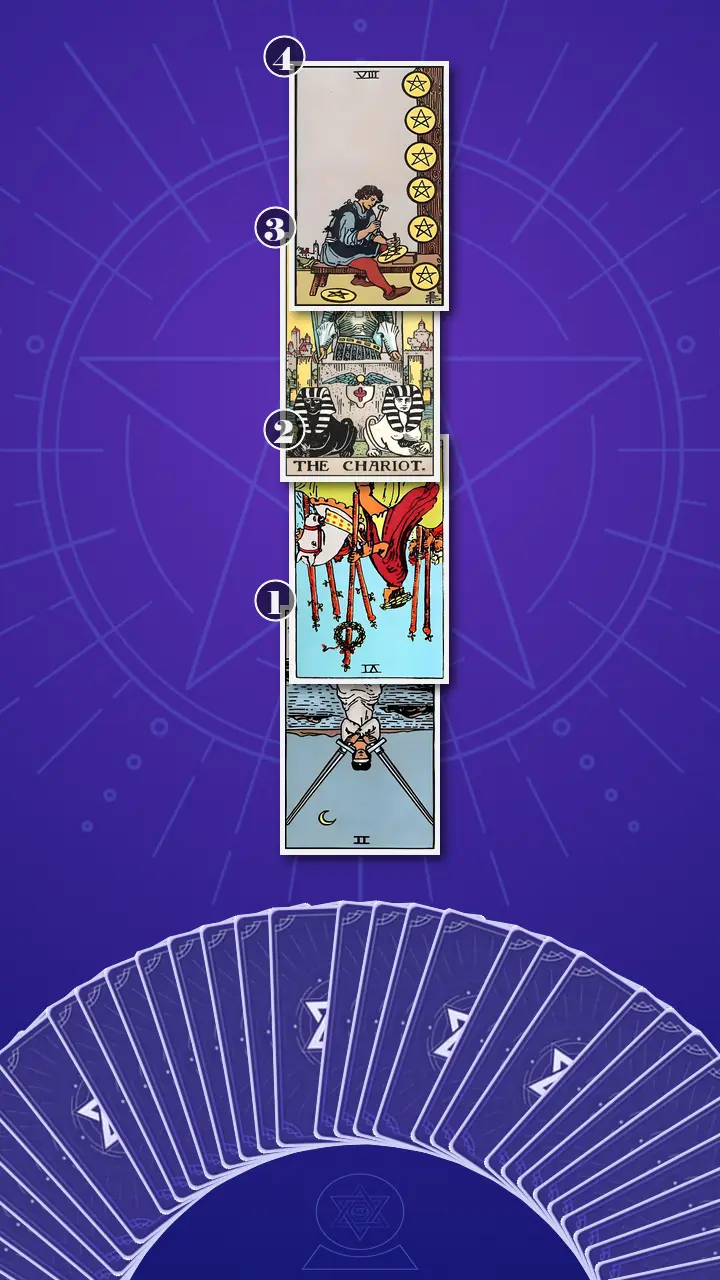
I arranged the cards in a narrow vertical line, like a staircase. The first position would show Jordan's observable study-delay loop. The second would reveal why an ineffective choice felt like proof of poor judgment. The third would identify the shift from waiting for consensus to steering a bounded experiment. The fourth would translate that insight into a repeatable study block and a fixed review point.
I explained that this surface-to-practice structure suited the question better than a broad Celtic Cross. A larger spread might have added future possibilities and environmental detail, but Jordan already had more possibilities than they could use. We needed the minimum structure capable of answering one focused question: what turns conflicting advice into paralysis, and what restores movement?
Reading the Staircase from Stalemate to Evidence
Position 1: The Calendar That Looked Like Progress
I began with the card representing Jordan's observable study-delay loop: collecting plans, redesigning the timetable, and reaching bedtime without completing a study block. I turned it over. It was The Two of Swords, reversed.
I pointed to the blindfolded figure holding two swords tightly across the chest. Behind the figure, the sea remained exposed beneath a crescent moon. Upright, the card can show a controlled pause between alternatives. Reversed in this position, its Air energy had become both excessive and blocked: too much comparison was circulating, but none of it could move into a decision.
I connected the image directly to what I had seen on Jordan's screen. A lecture sat paused at 10:40 p.m. Six study-plan tabs remained open. Flashcards, rewritten notes, and practice questions were all being preserved as possibilities, so none received a full twenty-minute test. The calendar could look productive while the evidence stayed at zero.
The sea behind the blindfold mattered as much as the swords. Jordan had been treating the problem as if more logic could eliminate every tradeoff, but deadline pressure, guilt, and fear of missing the better method were still moving underneath. The more uncomfortable those feelings became, the more detailed the timetable became. In practical terms, the reversal called for less input: compare no more than two options, choose one tiny task, and test it before reopening the debate.
Jordan gave a short laugh, but there was no amusement in it. Their hand left the mouse, their lips tightened, and they looked away from the calendar. “That is so accurate it's almost cruel,” they said.
“Then I want to be careful with the accuracy,” I replied. “This card is describing a protection strategy, not accusing you of laziness. Keeping every option open gives you a few minutes of relief from being responsible for one imperfect choice. It also keeps you from producing the evidence you say you need.”
Position 2: When the Group Chat Became the Crowd
I moved to the card representing the hidden root: Jordan's fear that an ineffective plan would expose poor judgment and weaken their sense of worth as a capable student. The card was The Six of Wands, reversed.
I showed Jordan the rider, the laurel wreath, and the surrounding crowd. Upright, the card's Fire can be sustained by visible recognition. Reversed here, that Fire showed a deficiency and a blockage. Motivation could not hold its direction without public confirmation. A plan felt safe only after somebody else made it look officially correct.
I asked Jordan to remember the group-chat scene they had mentioned. They posted a timetable. One friend recommended Anki, another insisted on practice exams, and a third sent a color-coded time-blocking reel. Instead of receiving the hoped-for certification, Jordan received three incompatible votes and quietly deleted the draft.
I described the inner operating system I could hear beneath that sequence: “If they disagree, I must have missed something. If I choose alone and it fails, everyone will know I should have known better.” A group-chat poll had become a steering wheel, even though none of the people voting had Jordan's exact lectures, commute, service shifts, energy limits, or shared-apartment noise.
Jordan's breath caught. Their fingers curled under the edge of the desk, their gaze went distant as if the deleted timetable had reappeared, and then one hand settled over their stomach. “That's the drop I get,” they said quietly. “It isn't just, what if this plan doesn't work? It's, what if it proves I'm not as capable as everyone thinks?”
“That is the distinction this card is making,” I said. “A study method can be a poor fit without being a character report. Other people's methods can be data without becoming your command. Before asking for another opinion, you need private criteria that belong to the life you are actually living.”
When The Chariot Chose a Departure Time
Position 3: Two Routes, One Purpose
I reached the card representing the transformational lever: the shift from seeking unanimous approval to choosing and steering one bounded study experiment. Through Jordan's speakers, I heard a streetcar bell cut cleanly through the apartment noise. Then I turned over The Chariot, upright.
I centered the black and white sphinxes in the image. They remain visibly different. Neither one defeats the other, and neither needs to become identical to its counterpart. The charioteer establishes direction by coordinating them beneath one purpose. In this position, the energy was balanced: self-trust, directional focus, and flexible self-discipline were available without requiring perfect certainty.
Two genuinely useful but incompatible study suggestions could remain in the same browser window. Jordan did not have to prove that flashcards were universally better than notes, or that a tutor, friend, or creator was wrong. Like several valid routes on a TTC map, the options could remain valid while Jordan chose one departure time based on the destination and the week in front of them.
Before I gave the card's full message, I brought the scene back into focus: 10:40 p.m., a paused lecture, six tabs, a calendar busy with revisions, and the first practice question untouched. Jordan was still trying to make the first choice impossible to regret.
At that point, my mind flashed to a lesson from my years on Wall Street: scenario analysis eventually reaches a limit. A decision has to be sized so that being wrong produces useful information without creating an intolerable cost. Demanding certainty from a reversible experiment is how analysis becomes its own form of risk.
I applied my Academic ROI Auditing lens to The Chariot. The investment was not a permanent commitment to one method; it was seven days. The potential return was not a promised grade. It was firsthand evidence about three things: whether the routine fit around lectures and service shifts, whether it produced completed practice, and whether Jordan could recover well enough to repeat it. The downside was capped, and the decision remained reversible.
I gave Jordan the card's plainest message: A study plan becomes trustworthy through a bounded test, not through unanimous approval. Their first imperfect week would not be a verdict on their ability. It would be the evidence that made the next choice more informed.
Stop treating disagreement as proof that no move is safe; choose a seven-day direction, gather your own evidence, and let The Chariot's opposing sphinxes move under one purpose.
For a beat, Jordan did not move. Their breath stopped high in their chest, and one finger hovered above the trackpad. Their eyes lost focus as if the previous week were replaying behind them. Then their eyebrows pulled together and the stillness broke. “But doesn't that mean I've been doing all of this wrong?” they said, sharper than before. “I've wasted so much time.”
I let the anger land before answering. “It means the planning was trying to protect you, and the protection has become expensive. Recognizing that now does not turn the past into a moral failure. It gives you authority over what happens next.”
Their fist slowly opened. Their shoulders dropped, then lifted again with a slightly unsteady breath. Their eyes shone, but their mouth softened into the beginning of a relieved smile. I could see the release and the new vulnerability underneath it: if no consensus was required, the next move really was theirs. I asked, “Now, using this new perspective, think back to last week. Was there a moment when this insight might have made the experience feel different?”
“Thursday after my shift,” Jordan said. Their voice had lowered, but it no longer sounded pinned in place. “I had twenty minutes. I rejected two plans because neither fit perfectly, then spent the whole window comparing them. I could have tested the practice questions for twenty minutes. Not forever. Just that night.”
“Exactly,” I said. “The new sentence is: I am not choosing forever; I am choosing what to observe.”
I marked the change carefully. This was not instant confidence, and it was not certainty about the best study method. It was the first crossing from anxious comparison and approval-dependent indecision to evidence-based self-direction and steadier confidence. Jordan could feel discomfort and still make a bounded choice. That was The Chariot's bridge.
Position 4: One Pentacle, One Completed Block
I turned to the final card, representing grounded integration: a repeatable study block, simple observation, and an evidence-based review after seven days. It was The Eight of Pentacles, upright.
I showed Jordan the craftsperson attending to one pentacle while completed pieces remained visible nearby. The figure was not redesigning the entire workshop after one uneven attempt. Upright Earth brought balance through repetition, material constraints, and visible units of work. The Chariot supplied direction; the Eight of Pentacles made that direction repeatable.
In Jordan's life, the card looked like completing the same twenty- or twenty-five-minute study block across several days, then recording two facts: what was completed and where friction appeared. One hard question would not trigger a switch from practice exams to rewritten notes. One late shift would not become proof of failed discipline. Jordan would wait until the fixed review point, look for a pattern, and adjust one variable.
I compared it to a small version-control workflow. Make one controlled change, observe the result, and avoid rewriting the whole system after every imperfect run. A difficult session is information about the setup, not a final ruling on ability.
Jordan looked at the row of pentacles, then closed two study tabs while I watched. The empty space on the screen made them inhale sharply. After a moment, they nodded. “It feels weirdly exposed,” they said. “But I can see how five completed blocks would tell me more than five new templates.”
The Seven-Day Evidence Trial
I read the four cards back as one coherent story. Recent weeks of incompatible advice had filled Jordan's mind with maps. The reversed Two of Swords showed them refusing to walk until every map agreed. The reversed Six of Wands revealed why: disagreement did not feel like ordinary uncertainty; it felt like a threat to their reputation as a capable student. The Chariot restored the missing act of self-direction, and the Eight of Pentacles converted that direction into evidence-producing practice.
The central blind spot was not a lack of intelligence or discipline. Jordan had been treating the quality of one study choice as a measure of personal worth. They were also assuming that enough comparison could remove responsibility from the decision. It could not. The absence of firsthand evidence then appeared to justify even more comparison.
I also noted what the spread did not show. There was no Cups card giving Jordan's felt needs a direct voice; emotion appeared only in the background sea of the Two of Swords. Their actual fatigue, limited quiet time, and post-shift concentration had been given less authority than a creator's immaculate morning routine. The transformation was therefore practical and emotional at once: move from unanimous approval to a seven-day experiment shaped by real constraints, then review the results at a fixed time.
I used a compact version of my Research Sunk-Cost Audit to protect the experiment from two opposite mistakes. Jordan would not keep an elaborate routine merely because they had spent hours designing it. They would also not abandon a workable routine because one session felt uncomfortable. At the review point, only completed work, repeated friction, schedule fit, and recovery would earn a vote.
- Choose a two-criteria route.On the next available study day, Jordan would open one private note and list three real constraints: lecture times, service shifts, and the quietest available window. They would choose one routine that satisfied at least two constraints, label it “7-day trial,” and complete one twenty-minute task before opening another study-method video, template, or group-chat poll.Tip: Keep the unused plans bookmarked. After a late shift, shorten the block to ten minutes instead of redesigning the entire week.
- Run the private evidence log and fixed review.Immediately after each block for seven days, Jordan would write only two lines: “What I completed” and “Where the friction was.” On day eight, they would set a fifteen-minute review appointment, perform the Research Sunk-Cost Audit, identify one repeated pattern, and change only one variable in the routine.Tip: Do not rate intelligence, discipline, or future performance. Keep the record private unless sharing it is genuinely useful, and reduce the log to a two-minute version if the exercise feels too activating.
“You do not need to defend this experiment to the group chat,” I told Jordan. “You can pause, shorten, or revise it. The goal is not obedience to a system. The goal is to let completed work produce enough evidence for your next decision.”
Jordan created the note before our call ended. At the top, they wrote: “Fits around Thursday shift. Produces practice questions.” Beneath it, they typed: “I am not choosing forever. I am choosing what to observe.”

A Week Later, One Block Stayed Put
Eight days later, I received a message from Jordan. They had completed five of the planned seven blocks. One service shift ran late, so they reduced that night's session to ten minutes. Another block felt unfocused, but instead of downloading a new template, they wrote “too tired for long questions after closing shift” in the evidence log and waited for the review.
The pattern was modest but useful. Short practice sets worked in the late evening; longer sets fit better between lectures. Jordan changed one variable and left the rest of the routine alone. They had not discovered a universally correct study system, and I had never promised that they would. They had produced a small personal dataset from the life they actually had.
Jordan later told me they slept through the night after the review. Their first thought in the morning was still, “What if I chose wrong?” They laughed, opened the log, and found an answer made of five completed blocks rather than reassurance.
I did not credit the cards with those completed sessions. The cards had made the loop visible, but Jordan closed the tabs, chose the route, did the work, and reviewed the evidence. That was the real Journey to Clarity: not receiving certainty from outside, but recovering enough self-trust to move while uncertainty remained.
I know that when your jaw tightens over six open study tabs, it can feel safer to keep every option alive than to choose one and risk discovering that a poor result might say something about your worth. Simply noticing that hidden verdict means the calendar no longer gets to disguise it as planning.
If one seven-day study experiment could be information rather than a verdict, what is the smallest Chariot route you would feel curious enough to board before every line on the map agrees?