Waiting for Interest Before Studying? Let One Page Offer Evidence

Waiting for Interest at 8:47 PM
If you are a Toronto university student returning after a pause, you may open the course portal after work, read the assignment title twice, and reach for your phone because the material does not spark immediate interest. That is the motivation-before-action trap in real time, and I recognized it the moment Alex (name changed for privacy) joined our session.
I could still picture the scene Alex had described from the previous evening on the Line 1 subway: fluorescent lights flickering across the dark window, the warm phone screen pressed into one palm, and one thumb hovering over social media while the course portal waited behind an untouched reading. I watched Alex's shoulders draw upward as they told me, "I keep waiting for the version of me who wants this."
They wanted to restart an undergraduate degree while working part-time, but they were treating interest as permission to begin. The emotional flatness had weight: heavy eyelids, restless hands, and a body that seemed to sink toward the desk whenever the first page appeared. It was like a Toronto subway train held at the platform while everyone waited for the perfect destination announcement; the pause felt thoughtful, but no new information could arrive until the doors closed and the train moved.
"You are not saying, 'I refuse to study,'" I said. "You are saying, 'I will begin when it feels like the kind of thing I can still be good at.' That is a painful place to stand, especially when the backlog and other people's polished progress updates keep making the first page feel like a test of belonging. We do not have to turn that feeling into a verdict. Let us draw a map through it together and see what direct evidence can tell you."

Choosing a Compass for the Procrastination Loop
I asked Alex to take one slow breath and name the question exactly as it was: "Why do I wait to feel interested before I start studying again?" Then I shuffled slowly, using the movement to mark a transition from scrolling, comparing, and planning into focused observation. The cards were not going to decide whether Alex belonged in university. They were a structured way to notice a pattern and make the next choice more visible.
For this consultation, I chose the Four-Layer Insight Ladder - Context Edition, a four-card tarot spread for academic procrastination and rebuilding a study rhythm. I explained to the reader as well as to Alex why it fit: this was not a choice between two degrees or a prediction about an academic outcome. It was a self-reinforcing loop, where waiting for interest created delay, delay enlarged the backlog, and the backlog seemed to prove that waiting had been sensible.
The upper row would show the current loop: first the visible moment when study became emotionally flat, then the hidden mechanism that kept the pause in place. The lower row would show movement out of it: the key shift that allowed a small beginning, followed by a grounded action that could become repeatable practice. In the language of the spread, we would move from visible manifestation to underlying mechanism, from key shift to grounded next step.
The Desk Where Neutrality Became a Verdict
Position 1: The Offered Cup Nobody Had to Earn
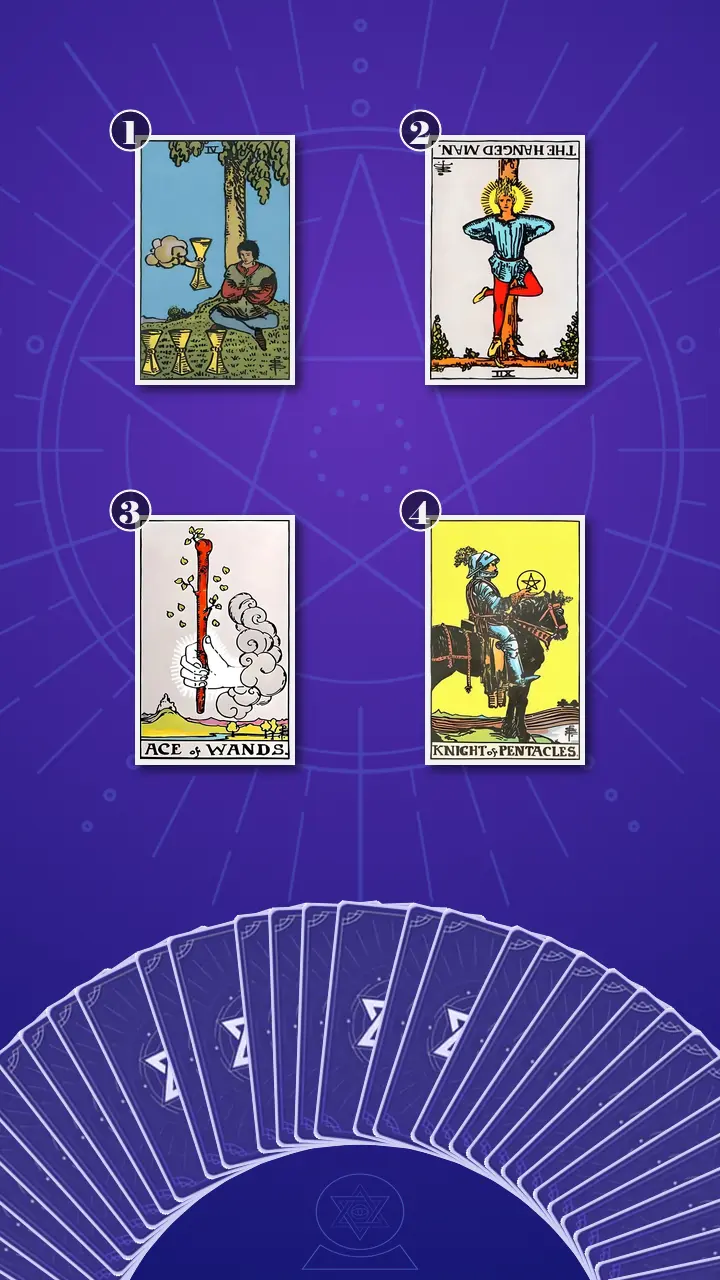
"Now I am turning over the card for the visible manifestation: the specific moment you wait for interest, delay opening the study materials, and convert emotional flatness into a reason not to start." I turned over the Four of Cups, upright.
In the Rider-Waite-Smith image, the seated figure's arms are crossed beneath a tree. Three cups are already on the ground, while a fourth is offered from a cloud. I connected that image to the scene I had heard from Alex: the course portal open beneath the desk lamp, unfinished readings and notes already visible, and one fresh ten-minute experiment available but dismissed because it did not arrive with a dramatic feeling of meaning.
Upright, this card shows a blockage of contact rather than an absence of opportunity. The available material is not locked away. The excess is inward evaluation: the mind keeps asking whether the experience feels compelling before permitting the hand to touch it. A neutral mood is then treated as useful evidence that the task, the degree, or the self has somehow become wrong. This is how emotional withdrawal can maintain academic procrastination after a break.
I said, "The fourth cup is not a promise that the reading will suddenly become fascinating. It is one modest study opportunity. What might ten minutes of contact reveal before your feeling gets to make the decision?"
Alex gave a short, bitter laugh instead of nodding. "That is exactly it. It is almost rude." Their fingers tightened around the edge of their phone, then loosened. I let the laugh stand. Recognition does not always feel comforting at first; sometimes it feels like seeing the browser tab you have kept open for three weeks suddenly display your own name.
Position 2: The Pause That Started Calling Itself Preparation
"Now I am turning over the card for the underlying mechanism: the Fairytale Readiness Trap and the procrastination loop that keep a temporary pause in place by demanding a perfect internal signal." The second card was The Hanged Man, reversed.
The suspended figure and the halo around the head usually invite a deliberate pause, a change of perspective, and a willingness to release the old angle. Reversed here, the pause has become stuckness. I saw it in the pattern Alex described: checking Canvas, rereading the deadline, building a colour-coded Notion dashboard, downloading active-recall videos, and reorganizing folders while the assigned reading remained unopened. The system looked ready; contact with the actual work stayed postponed.
This is a blockage of perspective. Alex had been asking, "When will I feel ready enough to begin?" I invited a sharper question: "What is the feeling of readiness supposed to prove about your ability, your belonging, or your future in academic work?"
For a few seconds, Alex went completely still. Their breath paused halfway in, their eyes lost focus as if replaying the last Sunday evening, and their hand hovered above the phone without scrolling. Then they said quietly, "I am waiting for a sign that I am ready, but what if waiting is the sign I keep protecting?" A long exhale followed.
I answered carefully: "Waiting can look like preparation when it is really protecting you from finding out. It gives short-term relief from dullness and possible inadequacy, but it also keeps the backlog growing. I am not calling this laziness, and I am not asking you to shame yourself into motion. I am showing you the rule so you can decide whether to keep obeying it." The difference mattered. Reflection can offer perspective; postponement only repeats the same question without adding evidence.
When the Ace of Wands Asked for One Page
Position 3: The Handhold Before the Spark
The room became unusually quiet when I reached for the third card. Even the faint city noise beyond the window seemed to recede. "Now I am turning over the card for the key shift: the first spark or permission to begin before interest is guaranteed." I revealed the Ace of Wands, upright.
The Ace of Wands is initiative, curiosity, and potential made tangible. The hand emerging from the cloud does not wait for a complete academic identity to return; it reaches for a living wand. In Alex's life, that hand could open one specified page, attempt one problem, or highlight one sentence. The energy is not an excess of forced enthusiasm or a guarantee that interest will follow. It is a balanced beginning: enough contact to gather honest information.
I used my signature lens, Cognitive Tempo Calibration, because this was the precise point where Alex had been misreading their own rhythm. I said, "I do not hear a permanent lack of ability here. I hear a severe mismatch between the task demands you imagine and the natural neurological rhythm available after a work shift. You are asking your system to produce a full emotional soundtrack before it is allowed to play the first note. The first note may be quiet. We can still learn from it."
Alex frowned. "But if I have to force myself to begin, maybe I am choosing the wrong path."
"Beginning is not the same as endorsing the whole path," I said. "It is a test of contact. A first page is an experiment, not a verdict on who you are."
You do not have to wait for a perfect spark to begin; place one hand on the Ace of Wands through a small study action and let direct contact, rather than readiness, show you what has energy.
I stopped speaking and let the sentence remain between us. Alex's face went blank first. Their breathing paused, and the thumb that had been rubbing the phone screen froze above it. Then their eyes moved from the card to the laptop, and I could see the thought travelling through an old memory: the first paragraph closed after ten seconds, the phone unlocked, the relief of not having to discover whether the work still mattered. Their jaw softened by degrees. A breath left them with a faint tremor, not quite a sob and not quite a laugh, while their shoulders dropped as if someone had quietly taken a heavy bag from them.
For a moment, the release made Alex look almost dizzy. A clear path can feel vulnerable because it returns responsibility without supplying certainty. They were not suddenly transformed into a passionate student; they were facing a smaller, kinder choice with no guarantee attached. Alex reached toward the laptop, then stopped and looked at me.
"I could test this without committing to the whole degree, the whole subject, or the whole night," they said.
"Exactly," I replied. "Now use this new view to remember last week. Was there a moment when direct contact, rather than another plan, could have given you a different kind of information?" This was the first step from emotionally flat waiting and readiness-based self-judgment toward curious experimentation. Not a personality change. Not a guarantee. Just contact.
Position 4: The Patient Builder's Still Horse
"Now I am turning over the card for the grounded next step: a repeatable, modest study behaviour that turns intention into evidence without demanding a dramatic return of motivation." The final card was the Knight of Pentacles, upright.
The knight holds the pentacle with steady attention while the horse stands still in a cultivated field. I connected that image to a realistic study window after a part-time shift: one reading or problem set in view, a defined stopping point, and no demand to feel captivated. The still horse does not mean nothing is happening. It represents deliberate pacing, the kind that lets effort become dependable instead of dramatic.
Here the energy is balanced through practical follow-through. The Ace of Wands supplies the first spark, but the Knight of Pentacles gives that spark a container. Alex does not need a six-hour catch-up plan that collapses at the first dull hour. They need repeated evidence that they can show up for one agreed task. "I can move slowly and still be moving," Alex murmured, looking at the card.
I nodded. "Measure the session by contact, not by how inspired you felt. Curiosity may appear, or you may learn that the reading needs a different explanation, a shorter block, or support from an instructor. Every result is information. None of it has to decide your worth."
From the Readiness Trap to a Repeatable Rhythm
The Pattern Beneath the Four Cards
When I placed the cards back into their two-by-two ladder, the story was coherent. The Four of Cups showed the visible withdrawal: available coursework was being judged by its emotional temperature before contact. The Hanged Man reversed exposed the mechanism underneath: a pause had turned into a readiness test, and preparation, scrolling, and comparison offered relief while quietly enlarging the backlog. The Ace of Wands provided the bridge, shifting the question from "Do I feel interested enough?" to "What can I learn from twelve minutes of direct contact?" The Knight of Pentacles grounded that shift in a practice that could fit around work and ordinary human energy.
I told Alex, "Your cognitive blind spot may be that you are treating interest as a prerequisite when it is also an observation. You are asking for proof before allowing the experiment that could produce proof. The transformation direction is not from apathy to constant enthusiasm. It is from waiting and self-judgment to a small test, then from a small test to grounded confidence built through repeatable study practice."
I also named the comparison loop. Instagram Stories and study-with-me videos show polished snapshots, not the full rhythm of another student's life. The apparent consistency of classmates cannot be used as a pass-or-fail score for Alex's return. The useful measure is smaller and more honest: did Alex meet one defined piece of material for the agreed time, and what did that contact reveal?
The Syncopated Study Session
To make the advice workable, I introduced my personal strategy, the Syncopated Study Session. I use it when a task feels too large for the available energy: I break the academic demand into harmonious micro-beats, each with a clear beginning, a short duration, and a stopping point. It is not a productivity performance. It is a rhythm protocol designed to reduce friction between intention and contact.
- Touch the materialOn one chosen day this week, open the exact course reading before planning or method research. Set a 12-minute timer, read one specified page or attempt one problem, and finish by writing one sentence beginning, "I noticed..."Define success as contact, not motivation. Stop when the timer ends if you choose; this is an experiment, not a six-hour catch-up block.
- Give the week two beatsChoose two realistic study windows around part-time work, such as Wednesday at 7:30 PM and Saturday at 11:00 AM. Put one concrete task beside each window: "Read pages 4-5 and note one unfamiliar term," rather than "study biology."Keep only the relevant material on the desk, put the phone in Focus mode or across the room, and allow a lower-energy version such as reading the headings.
- Record neutral evidenceAfter each block, write one observable result: "showed up," "completed one page," "felt flat," "found one question," or "stopped after the agreed block." Notice whether curiosity, resistance, tiredness, or a clearer next choice appeared.Give preparation a five-minute boundary. If you catch yourself searching for another study method, name it gently and return to the chosen page once the boundary ends.
Alex looked at the list and immediately raised a practical objection. "What if twelve minutes feels too small to matter? Or what if stopping proves I failed?"
"Then we decide the definition of success before you begin," I said. "Opening the specified material, staying for the agreed time, and recording one observation is the complete assignment. You can continue, reschedule, or stop. A smaller version still counts because the purpose is to gather evidence without making your identity carry the whole weight."
I could feel my old research habits flicker in the background as I said it. Years of studying sound energy had taught me to listen for dissonance rather than punish it. When pressure demands a grand, sustained note from a tired system, the answer is often a better rhythm, not a harsher command. I was not asking Alex to become a different person. I was helping them hear where the next beat could begin.
A Small Light Left on the Desk
One Week Later: The Quiet Proof
Four days later, I received a message from Alex after a Wednesday shift: "I opened the chapter before I searched for a new method. I did twelve minutes and wrote down that I was tired, but the example on page five made more sense than I expected. I am still not magically interested. I am going again Saturday."
I pictured the same desk, the same unfinished folders, and the same ordinary evening, but with one page open beneath the lamp and a timer near the keyboard. The change was light and specific, not a dramatic return to academic certainty. Alex had met the material, learned something about their energy, and chosen a next step. There was still a little sadness for the version of university they had hoped would feel effortless; this time, the sadness did not close the tab.
That was the quiet proof I wanted Alex to own. The cards had not restored a lost identity or predicted an academic outcome. Alex had used them as an objective reflection tool, noticed the readiness rule, and chosen a small action. The Journey to Clarity had moved from emotionally flat waiting to curiosity, then toward grounded confidence and a repeatable study rhythm. You can move slowly without making your pause your identity.
When you sit in front of the course portal with heavy eyelids and a phone-ready hand, wanting academic progress but fearing that a flat first paragraph will expose you as someone who no longer belongs, waiting can feel safer than finding out. I would never use a card to frighten you into beginning. I would use it to help you see the choice that was already yours.
If you did not have to prove that you were ready, what small piece of the material might you be willing to meet for a few minutes, just to see what it tells you?