One Private Baseline Interrupted the Streak Loop and Set the Next Task

The Streak Was Intact; the Answer Was Still Untested
If you are finishing university while stacking an online certificate beside coursework and part-time shifts, and you still choose the shortest familiar lesson when the midnight warning turns red, you may know study streak anxiety better than you admit.
At 11:42 p.m. on a Tuesday, Alex joined my call from a narrow desk in their Toronto apartment. Streetcar brakes hissed below the window. Their laptop was warm beneath their palms, a red streak warning glowed beside an unopened practice-quiz tab, and their jaw tightened each time their eyes moved between the two.
“I studied every day this month, but I still don't want to take the practice test,” they told me. “Why do I keep chasing study streaks before checking what I know?”
I watched them complete the familiar five-minute review while we spoke. When the celebration animation flashed, their shoulders dropped almost automatically. The relief was real, but so was the contradiction: Alex wanted competence they could use, yet when an unaided test might reveal where they stood, they chose a visible, countable task because the metric offered immediate safety. The streak was intact; the answer was still untested.
The feeling in their body looked like a blinking cursor lodged behind the ribs, small but impossible to ignore. I told them, “I don't think this is a laziness problem, and I'm not going to make the app or the streak into a villain. Your effort is real. Let's find out why protecting the record feels safer than consulting the evidence. We can make a map of the fog without turning anything we find into a verdict.”

Choosing the Switchback Map
I asked Alex to place both feet on the floor and take one slow breath. It was not a mystical test; it was simply a transition that allowed their attention to catch up with the question. I shuffled slowly, keeping the focus on the sequence that happened between seeing a warning and postponing a knowledge check.
I chose the Transformation Path Grid · Context Edition, a six-card tarot spread for study streak anxiety and retrieval-practice avoidance. I arranged it as a two-row switchback: three cards across the top to show the blocked system, then a turn through three cards below to show review, action, and integration.
I chose this spread because Alex's question was not really a choice between keeping or deleting the app. It was a feedback loop. Streak protection led to an easy activity; the activity triggered a competence signal; the signal relieved the pressure; and that relief delayed the knowledge check that could expose and correct the illusion of competence. A smaller spread would miss part of that chain, while a larger one would add noise to a focused behavioral question.
I explained that the first position would show the observable streak-first behavior. The second would identify why badges and visible consistency carried so much emotional weight. The third would uncover the deeper belief beneath the pattern. The fourth, our catalyst, would locate the point where the loop could be interrupted without attacking Alex's self-worth. The fifth would turn insight into a repeatable action, and the sixth would redefine what genuine completion could look like.
This is how tarot works in my practice: I do not use the cards to predict whether someone will pass an exam or to pronounce them capable or incapable. I use their images to externalize a pattern so we can examine it with less shame and more precision. Card meanings in context become a cognitive map, but the person in front of me decides what to do with that map.
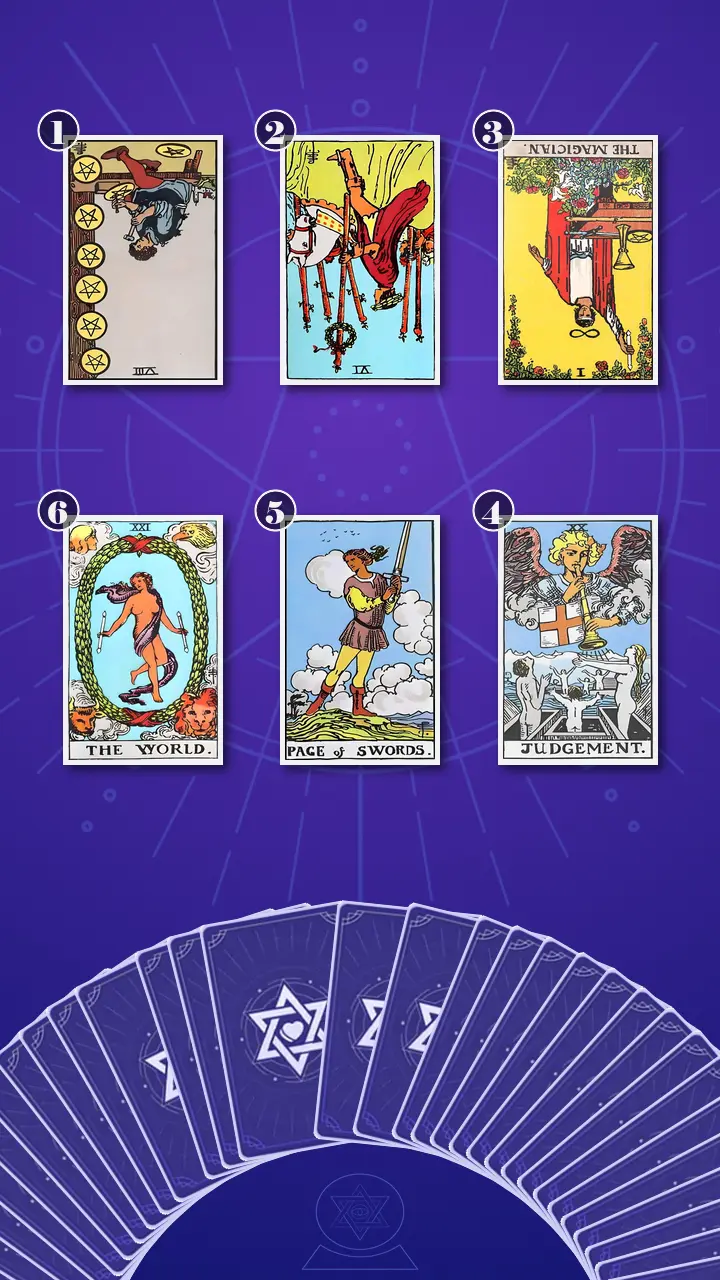
The Production Line of Completed Lessons
Position One: Eight of Pentacles Reversed
The first card I turned occupied the position showing Alex's observable current-state behavior: completing easy, countable app activities before attempting unaided recall. It was the Eight of Pentacles, reversed.
I pointed to the column of finished pentacles. “Upright, this card can describe deliberate repetition that develops a craft. Reversed, the production line keeps moving, but nobody is checking the quality of what it produces.” At 11:42 p.m., another familiar review joined Alex's completed history, but the practice quiz never reached the workbench. The activity was real. What remained missing was evidence that the repetition had improved independent recall.
I read this as blocked Earth energy, not an absence of discipline. Alex was showing up, but the effort was poorly grounded in the skill their assessments required. A study streak can resemble a GitHub contribution graph: it proves that activity occurred, but it cannot tell me whether the code runs. The danger was not the streak itself. The danger was letting activity stand in for demonstrated learning.
I gave voice to the quiet bargain beneath the ritual: “I did study today, so the harder check can wait until tomorrow.” The completed lesson tiles became a neat production line while the exam paper stayed face down.
Alex let out a short laugh, but there was no amusement in it. Their fingers tightened around the mug and then loosened. “That is accurate enough to feel kind of brutal,” they said.
“I hear that,” I replied. “So let's be precise about what the card is not saying. It is not erasing the hours you put in. It is asking whether each repeated task creates new evidence of understanding or simply another visible unit of effort. We don't need to destroy the routine. We need to reconnect it to its purpose.”
Position Two: Six of Wands Reversed
The next card represented the immediate blockage: the way badges, streak continuity, and visible achievement prevented Alex from receiving a knowledge check as neutral information. I turned over the Six of Wands, reversed.
The rider's laurel wreath and the crowd around him looked uncannily like an app badge surrounded by group-chat reactions. I asked Alex to return to a familiar commute: TTC Line 1, wet coats, cold coffee balanced against a backpack, and three classmates posting streak screenshots beneath a celebration GIF. Alex had opened their own dashboard before reviewing yesterday's quiz errors. A bright number supplied the quick feeling of being on track, while a low private score felt like a defeat.
Here, Fire was blocked and bent toward recognition. The desire to achieve had not disappeared, but the sign of achievement had become easier to protect than the substance behind it. The inner line was simple: “If the number stays intact, I can still feel like the disciplined one.” Public legibility was stabilizing an identity that private evidence might complicate.
“Which result would still matter if there were no badge, leaderboard, LinkedIn post, or Discord reaction attached to it?” I asked.
Alex's breath shortened. Their gaze moved away from the card and settled on the red warning in the corner of the screen. After a few seconds they said, “Probably being able to explain the topic without reopening my notes. I just don't get the same immediate proof from that.”
I nodded. “Exactly. The Six of Wands isn't telling you that recognition is shallow or forbidden. It is showing us that recognition has been asked to carry more emotional weight than it can safely hold. A badge can acknowledge effort. It cannot determine whether you are competent, and it cannot make a missed question into a personal defeat.”
Position Three: The Magician Reversed
The third card occupied the root position, revealing the illusion of competence and the deeper fear that exposed gaps might invalidate Alex's identity as a disciplined learner. I turned over The Magician, reversed.
The four tools on the Magician's table became Alex's polished Notion dashboard, Anki deck, highlighted lecture notes, saved active-recall videos, and finished course path. Then I placed one blank sheet beside the card. That single empty page changed the emotional temperature of the entire desk.
Alex knew this scene. At 4:26 p.m. in the campus library, with fluorescent lights humming and their fingers tense against the cool keyboard, they could recognize every highlighted paragraph. When the blank document asked for the core explanation without prompts, they reopened the source instead of attempting a first answer. Access had been mistaken for ability; familiarity had been mistaken for retrieval.
“Familiar is not the same as retrievable,” I said. “Autocomplete makes the next sentence look obvious when the system supplies the beginning. A blank document shows what you can generate without that cue.”
Through my Jungian lens, I did not see a deceptive Magician trying to trick Alex. I saw a protective part trying to preserve a coherent identity: the fully equipped, organized, complete learner. I thought of the curtain reveal in The Wizard of Oz. The impressive display could organize attention, but only direct experience could show which capacities were genuinely available.
I used my Draft Paralysis Deconstruction framework to make the mechanism visible. Perfectionism was not merely demanding a better answer; it was preventing the first answer from existing, because a nonexistent draft could not be criticized. Reorganizing tools, rereading sources, and completing guided work all protected Alex from the vulnerable moment when knowledge had to appear without support.
“I have all the tools, so why does one blank page make me feel unprepared?” Alex murmured. Their eyes moved across the tabs on their screen as if they were inventorying every resource they had collected. Then they closed the Notion dashboard. It was a tiny movement, but I felt their defensiveness begin to loosen.
I clarified the energy dynamic. The Magician's agency was blocked, not absent. Alex did not need another app, template, or elaborate study system. They already had enough tools. They needed one honest organizing aim: use the tools to respond to evidence, rather than using their display to postpone evidence.
When Judgement's Trumpet Cut Through the Notification Noise
Position Four: Judgement Upright
The card I turned next occupied the catalyst position, the leverage point where a brief recall check could interrupt the streak-first cycle without turning the result into a judgment of personal worth. It was Judgement, upright.
As I placed it on the table, the study app chimed through Alex's laptop speakers. A streetcar bell sounded outside a moment later. For a few seconds, the room on both sides of our call seemed to narrow around the angel's trumpet on the card. I read Judgement as balanced, candid self-review: the willingness to let remembered fragments and visible blanks rise into awareness so they could be examined.
I watched the old sequence gather in Alex's face: the red warning, the easy lesson, the animation, the promise to test tomorrow. They were still caught inside the question, “What if the baseline proves the whole month was cosmetic?” Judgement asked a different question.
A perfect streak does not certify mastery; answer Judgement's trumpet by testing first and letting the revealed gaps choose the next lesson.
I let the sentence remain between us before I added, “A streak can record that you showed up; only retrieval shows you what arrived with you. The gap is not a verdict. It is the map for what to study next.”
For one beat, Alex stopped breathing. Their thumb hovered above the trackpad while their other hand tightened around the mug; even the red notification seemed to hold still. Then their eyes lost focus, as if the last month were replaying behind them: the shortened lessons, the unopened quiz tabs, the screenshots in the group chat. Their eyebrows drew together and their voice came out sharper than before. “But doesn't that mean I spent the whole month doing it wrong?” The question carried anger first, then grief. Their jaw trembled once. Finally, they released a long breath from low in the chest, set the mug down, and opened both hands on the desk. Their shoulders descended, but relief did not arrive cleanly. I could also see the slight dizziness of being handed a clearer path and realizing that they, not the metric, would now have to choose it.
“No,” I said. “It means the month gave you consistency, and now you can decide what that consistency serves. We are not putting your work on trial. We are changing the acceptance criteria.”
I drew two columns on a card and used the diagnostic frame I call Performance Anxiety Decoupling. One column was labeled “Measurement”; the other was labeled “Identity.” Under Measurement, I wrote: “At this time, under closed-book conditions, this answer became incomplete at step two.” Under Identity, I crossed out: “Therefore I am not capable.”
“The app has been bundling these two signals like cables in the same port,” I told Alex. “Judgement lets us unplug them. A recall result measures access to specific knowledge in specific conditions. It does not measure your worth, your intelligence, your right to be here, or your future capacity to improve. A gap can direct the next task without defining the learner.”
I leaned a little closer to the camera. “Now, with this new perspective, think back: was there a moment last week when this insight could have made you feel different?”
Alex looked down and pressed their fingertips flat against the desk. “Sunday after my shift,” they said. “I opened a practice question, blanked halfway through the first sentence, and went straight to flashcards. If I had called the blank a break point instead of proof that I knew nothing, I could have checked that one part. I didn't need to fix the entire course.”
I offered a deliberately small baseline: set an eight-minute timer before opening the app; spend five minutes writing three things from memory; spend two minutes comparing the answer with the source; use the final minute to circle one specific gap and turn it into a question. If that felt too activating after a shift, the minimum version would be one sentence from memory followed by one comparison. The result could remain completely private.
This was the first movement from apprehensive metric-checking and badge-dependent relief to curious, evidence-based self-trust and grounded confidence. It was not confidence built from always being right. It was confidence built from discovering that an incomplete answer could be survived, examined, and used.
From One Sharp Question to a Complete Cycle
Position Five: Page of Swords Upright
The fifth card represented the practical behavior that would carry the transformation forward: test before reviewing, identify one specific gap, and choose the next task from that evidence. I turned over the Page of Swords, upright.
I read the Page's sword as one sharply worded recall question. The wind around the figure did not imply perfectly calm study conditions; it showed curiosity operating while the mind was still unsettled. This was balanced Air energy: precise enough to investigate uncertainty without turning uncertainty into a global story about the self.
In everyday terms, Alex could begin with five unaided questions, mark the exact phrase or step where each answer stopped, and choose one gap to investigate. Instead of asking, “Am I finally ready?” they could ask, “What is missing here, and what is the smallest source I need to check?” A private test would become frequent information rather than a rare performance event.
Alex frowned. “Five questions after a late shift still sounds like something I'll avoid.”
“Then five is too many for that window,” I replied. “Use one question, or one sentence. The Page is curious, not punitive. The exercise has to be small enough that you can actually meet the evidence.”
I watched Alex type a question into a blank note: “What are the three stages, and why does stage two matter?” Their fingers paused, their eyes tracked the sentence once, and then their shoulders settled. The inner stance had shifted from “I need to know everything before I begin” to “I do not need to know everything before I ask the first useful question.”
Position Six: The World Upright
The final card occupied the integration position, defining a sustainable learning cycle in which the streak became a supporting metric rather than proof of mastery. I turned over The World, upright.
I placed it where Alex could compare its living wreath with the smaller victory wreath on the reversed Six of Wands. The first wreath had depended on a crowd announcing success. The World surrounded an active figure and a wider field. I read its energy as integration and balance: effort, retrieval, feedback, correction, and application working together.
For Alex, a topic would count as complete after they attempted it from memory, compared the attempt with the source, reviewed the relevant gap, and used the concept in a new question. The streak could remain visible. It would simply record participation in that larger process instead of certifying mastery by itself.
“Completion is a cycle, not a celebration screen,” I said. “The World does not require you to know everything perfectly or appear finished. It asks whether the parts of your learning process can work together.”
I also noted that Cups were absent among the numbered and court cards. I did not treat that as a prediction. I treated it as a practical reminder: Alex would need to make room for the bodily feelings triggered by not knowing. If the jaw tightened or the stomach dropped, the emotion could be noticed before the next task was chosen. Evidence becomes useful only when it is allowed to arrive without being converted immediately into shame.
Alex looked back over the six cards, from three reversals to three upright responses. “So I don't have to lose the streak,” they said. “I have to stop asking it to prove something it can't prove.”
“Exactly,” I replied. “Consistency can support mastery. It just cannot impersonate mastery.”
Let Evidence Earn the Streak
I gathered the six-card Transformation Path Grid into one coherent story. Alex's real capacity for repetition had become mechanical because visible continuity offered quick relief. The reversed Six of Wands showed why the relief mattered: recognition had become a condition for feeling competent. The reversed Magician revealed the root defense, where tools and familiarity protected the image of readiness from a blank-page test. Judgement interrupted that system through candid review. The Page of Swords turned one gap into one useful question. The World widened completion into a verified cycle.
The cognitive blind spot was not simply “streaks are bad.” It was the belief that assessment either certifies or invalidates the learner. That belief made the dashboard feel like emotional protection and the practice test feel like a verdict. Our key shift was quieter and more practical: begin with a brief closed-book retrieval check, then let the observed gap determine the work that earns the streak. The scorecard could become a dashboard rather than an identity.
I translated that insight into two pieces of actionable advice. Neither required Alex to overhaul their life, abandon a useful app, or find a perfect uninterrupted study block.
- Run the Inner-Critic Mute ProtocolFor the next three study sessions, put the phone face down and open a blank note titled “Private Baseline” before opening the learning platform. Write, “This checks what I can retrieve right now; it does not measure my worth.” Set an eight-minute timer: recall for five minutes, compare with the source for two, and circle one gap in the final minute.On a depleted day, use the minimum version: one sentence from memory and one comparison. Success means producing honest evidence, not getting the sentence right.
- Use the One-Gap Next-Step LoopAfter one baseline this week, turn the first break point into a direct question in Notes, Anki, or on an index card. Use that question to select one ten-minute section of the next lesson. Close the source afterward and record a sixty-second, no-notes answer to the same question.Do not fix every gap or build a new system. Choose one narrow break point. If energy is low, review for two minutes and give a single-sentence re-answer.
I asked Alex to keep the streak only if it still helped them return to the work. The new rule was not “never enjoy the animation.” It was “let evidence earn the streak.” That preserved the useful structure of consistency while returning authority to Alex's own observation and choice.

A Week Later, the Quiet Proof
A week later, I received a message from Alex. They had written a rough baseline, found one missing step, reviewed it, and answered again. They slept through the night, then woke thinking, “What if I'm still wrong?” This time, they smiled, opened the blank note, and checked.
I did not see tarot give Alex mastery, discipline, or a guaranteed result. I saw it help them separate a metric from an identity and turn a private intuition into a testable next step. The cards supplied a map; Alex supplied the choice, the eight minutes, and the second answer. That was their Journey to Clarity: not certainty, but ownership supported by evidence.
I know many of us recognize the jaw-tightening moment when the streak still glows but the practice page stays blank. The fear is rarely only that we forgot the material. It is that one honest answer might make a disciplined month, and the capable self attached to it, feel suddenly less real. Noticing that fusion already begins to loosen it.
If your next blank page could be a bug report rather than a verdict, what one honest question might you write before the dashboard gets the first word?