A Weak Question, a Closed Tab; Six Days Later, Alex Retested

The Weak Chapter Outside Every Practice Test
Your Notion dashboard says 92% complete, your Anki streak is intact, and the one topic missing from every timed set is also the one behind your practice-test anxiety. That was the pattern Alex, a 22-year-old third-year student in Toronto, brought into our reading.
At 11:18 p.m. on a Tuesday, I met them in a study room on an upper floor of their university library. A cold paper cup stood beside four uncapped highlighters. Fluorescent lights buzzed overhead, and the laptop fan pushed warm air across their hands as they opened a cumulative mock and reached the first question from the module they kept postponing.
I watched their shoulders lift. Their cursor drifted toward the close icon. A highlighted summary waited in the next tab, offering the cleaner feeling of being nearly finished.
“I know it when I see it, so I probably know it,” Alex said. Then they looked down at the unanswered question. “But why do I keep assuming I am ready before I test the topics I am worst at? I want the relief of feeling prepared. I just do not want one bad set to prove that I have completely misjudged myself.”
The confidence I heard in their voice was a note held on too little breath: steady while familiar material supplied the accompaniment, then suddenly thin when recall had to sing alone. I said, “You keep preparing to measure your preparation. That does not make you lazy or incapable. It tells me the measurement has started carrying more emotional weight than it was designed to hold. Let us use the cards to map what happens between seeing the weak question and leaving it for later.”

Choosing a Map for the Blind Corner
I asked Alex to close the mock, put their phone face down, and say the question once without trying to solve it. I shuffled slowly while they took two ordinary breaths. I use this kind of preparation as a transition from reaction into observation, not as a mystical test of whether someone is concentrating correctly.
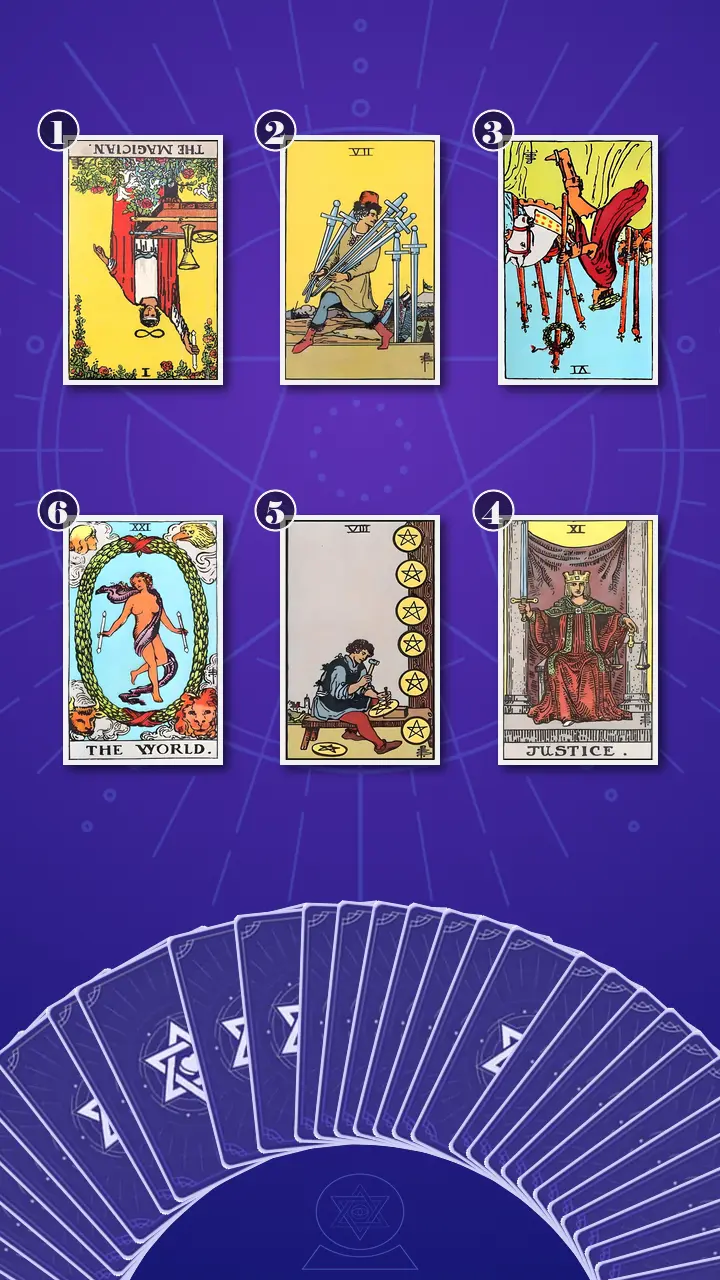
I chose the Transformation Path Grid (6) · Context Edition, a six-card tarot spread for evidence-based exam-readiness reflection. For a reader wondering how tarot works in this setting, I am not asking the cards to predict a grade. I am using their symbols as a structured cognitive mirror: each position isolates one part of a repeating feedback loop so that a vague feeling can become something observable and changeable.
I laid the cards in two rows of three. The top row would show the presenting behaviour, the defensive study strategy, and the fear underneath it. The lower row would answer those patterns with a catalyst, a practical response, and an integrated definition of readiness. The switchback layout mattered because Alex's difficulty was not one isolated belief. Familiarity led to selective practice; selective practice withheld corrective evidence; missing evidence preserved the feeling of familiarity. The spread let me follow that system without turning it into a character judgment.
The Complete Desk and the Missing Evidence
Position 1: The System That Looked Ready
I began with the position representing Alex's present condition: the visible behaviour of assuming readiness from familiar review before weak-topic recall had been tested. I turned over The Magician, reversed.
On the card, the four suit emblems covered the Magician's table. I saw the visual equivalent of Alex's study stack: lecture slides on the laptop, Anki on the phone, saved explainers, a colour-coded calendar, a Notion tracker at 92%, and four highlighters lined up beside an unanswered closed-book question. All the resources were real. So was the work that had gone into gathering them. The reversal simply interrupted the channel between having the tools and producing an answer without them.
I read that reversal as a Blockage of agency. Alex's skill was not absent, but it was being demonstrated through organisation, recognition, and supported examples rather than tested execution. A complete-looking system can still contain an untested gap. Like the control-panel reveal in The Wizard of Oz, an impressive display may be operating perfectly while still being different from the power it appears to prove.
“The question here is not whether your notes are good,” I told them. “It is whether the evidence you are using can support the claim you are making. When you mark a topic reviewed, have you recognised it, organised it, or retrieved it? Those are three different achievements.”
Alex glanced at the open dashboard, then at the cards. A bitter laugh escaped before they could stop it. “That is too accurate. Honestly, it is a little brutal. I have all the material, so why does starting without it feel like a completely different subject?”
I kept my voice level. “Because recognition and unaided recall place different demands on the brain. The card is not dismissing the work you have completed. It is showing us that resource access cannot stand in for closed-book evidence.”
Position 2: The Filter That Optimised for Confidence
I moved to the position identifying the immediate blockage: the concrete defence strategy that kept weak material outside Alex's evidence set while allowing each study session to remain active and complete. I revealed the Seven of Swords, upright.
The figure carried five swords while two remained planted behind. I asked Alex to picture their Monday TTC commute: a crowded southbound train, brakes squealing, a damp coat brushing their sleeve, classmates' mock scores appearing in the course Discord, and a question bank open on their phone. The difficult module appeared in the topic menu. They filtered it out, answered twelve familiar questions, and never restored the filter.
I did not interpret the Seven of Swords as dishonesty. In this position, it showed strategic Air in Excess: a clever selection process optimised for immediate relief rather than representative information. Selective practice can feel efficient because it protects both time and identity, at least for tonight.
“Your question bank has started behaving like a recommendation algorithm,” I said. “It keeps serving the topics that reward engagement, so the study feed feels productive while the weak material disappears from view. The score may be accurate for the selected questions. It just cannot speak for the chapters the filter removed.”
I asked Alex to review their last three sessions and name the chapter that had been filtered out, moved to Friday, or replaced with a stronger topic. Their fingers tightened around the cold cup, then slowly released.
“The Week 7 statistics module,” they said. “I keep telling myself the other questions build momentum first. But Week 7 is always still waiting when I stop.”
“Then we have found an observable behaviour,” I replied. “That is useful. We no longer have to solve the huge question, 'Why am I like this?' We can examine the smaller question, 'What happens when Week 7 enters the sample?'”
Position 3: The Successful-Student Identity Without an Audience
The third position exposed the root mechanism beneath that selective practice: the fear that evidence of an academic gap could become evidence of inadequate personal worth. I turned over the Six of Wands, reversed.
The upright image places a laurel-crowned rider above a supportive crowd. Reversed, the platform became unstable. I connected it to the private timed diagnostic Alex had opened at their kitchen table. The fridge hummed, cold tea tasted bitter, and two red marks appeared before the score had fully loaded. No lecturer, classmate, or employer could see the result. Even so, heat rose into their face, their chest tightened, and they closed the tab.
I read the card as a Deficiency of secure Fire. Confidence depended on remaining elevated as the capable student, so an ordinary training result felt like a fall. The course group chat amplified the pattern, but the most demanding audience had already moved inside. The underlying question was not merely, “Do I remember this rule?” It had become, “If even I see a low number, can I still call myself capable?”
“What would remain true about your capacity to learn if today's private score were poor?” I asked.
Alex's breathing paused. Their eyes moved away from the spread and settled on the black window, where the room's fluorescent reflection floated over the Toronto night.
“I would still be the person who got through the last two years,” they said eventually. “I would still know how to learn. But I would not get to say I was basically done.”
I nodded. “That last sentence is the pressure point. The score threatens a completion story, not your actual capacity. The card is asking us to let competence become a developing skill instead of an identity that must remain undefeated.”
When Justice Put Readiness on the Scales
Position 4: A Fair Measure, Not a Verdict
The room seemed to narrow as I reached the position directly beneath the Six of Wands. This was the catalyst: the insight that could separate performance evidence from identity judgment. The ventilation clicked off, and for the first time that evening, the fluorescent hum no longer filled every pause. I turned over Justice, upright.
I placed my finger beside the balanced scales. For Alex, they represented a fair sample containing both comfortable and weak topics. The upright sword represented discrimination in its cleanest sense: the ability to turn “I am not ready” into one precise finding, such as “I cannot yet retrieve this rule under time pressure.” Justice carried Balance, proportionate accountability, and evidence-based self-honesty. Its task was not to punish a gap. Its task was to establish what the gap could and could not legitimately mean.
I used what I call a Focus Disruption Audit to identify the dissonant chord hidden inside Alex's tab-switching. The weak question was only the first note. The full chord also contained an exhausted late-night brain, classmates' visible mock scores, the expectation that a capable student should already be finished, and the instant conversion of “missed” into “not intelligent enough.” Once those notes sounded together, closing the tab felt like restoring harmony. In reality, it only muted the most informative part of the track.
My years of sound-energy research surfaced in my mind as I looked at Justice's scales. An audio meter can show that a signal is clipping without accusing the musician of being a bad person. It locates distortion in the current run. Justice offered the same boundary: the metric could describe Alex's present recall without being granted authority over their worth.
At 11:18 p.m., under the library lights, Alex had been caught between a weak-module question and the highlighted summary promising the cleaner feeling of being nearly done. They were not simply avoiding difficulty. They were trying to protect a readiness claim before any representative evidence could revise it.
You do not have to look whole before you test; place the weakest topic on Justice's scales, accept the evidence, and let the upright sword define one precise next task.
For one beat, Alex stopped breathing. Their index finger stayed suspended above the trackpad, their jaw fixed, and their pupils widened as if the card had pulled the earlier library scene onto the table. Then their gaze slipped past me toward the dark window. I watched recognition move in slowly: first the frozen hand, then the unfocused replay, then a flush rising from their collar. Instead of immediate relief, their voice sharpened. “But doesn't that mean I have been doing this wrong for weeks? That I wasted the time I was supposed to be preparing?” Their eyes reddened, not quite with tears, but with the sting of seeing the loop clearly. A few seconds later, their fist opened. Their shoulders descended unevenly, one before the other, and a breath left them with a small tremor. The release did not look triumphant. It looked slightly dizzy, as though setting down the ready-student identity had exposed both more room and more responsibility.
“No,” I said. “Your notes, assignments, and practice on strong topics still count. Justice is not rewriting those hours as failure. It is narrowing one unsupported conclusion: touching the course is not the same as retrieving the course. You do not need to condemn the old method in order to collect better evidence now. A score can locate a gap without locating your worth.”
I gave the silence a few seconds, then asked, “Now, with this new perspective, think back to last week. Was there a moment when this insight could have made you feel different?”
Alex rubbed one thumb across the side of the cup. “Sunday night. I missed two questions and closed the quiz before the result loaded. If I had treated each miss as an address instead of a verdict, I might have stayed long enough to see what kind of mistake it was.”
I heard the key shift in that answer. Alex was moving from fragile confidence protected by familiar revision toward steadier self-trust grounded in tested recall. It was not complete certainty, and I did not present it that way. It was the first willingness to let evidence update the study map without allowing the map to define the person holding it.
The Workbench and the Completed Loop
Position 5: One Error Under the Chisel
I moved left to the position representing the practical response: translating diagnostic evidence into one bounded piece of deliberate practice. I turned over the Eight of Pentacles, upright.
The craftsperson worked on one pentacle while completed iterations remained visible nearby. I read the card as stabilising Earth in Balance. Justice had identified what required work; the Eight of Pentacles refused to turn that finding into a demand to reread the entire course, rebuild the timetable, or download a perfect new resource.
I described a twenty-minute workshop. Alex would take one missed question from the diagnostic, write the underlying rule or decision step in one sentence, complete one related example with notes, and attempt a fresh version closed-book. Then they would place a retest in their phone calendar for forty-eight hours later.
“The useful inner line is this,” I said. “I do not need to repair the whole course tonight; I need to work the error in front of me.”
Alex reached for their phone, opened the notes app, and typed “one error, one rule, one fresh attempt.” Their movements were still cautious, but the restless clicking had stopped. The card had converted a threat to identity into a task small enough to fit on a workbench.
Position 6: The Wreath That Included Unfinished Work
The final position represented cognitive integration: an evidence-based form of readiness that could hold strengths, gaps, and a repair plan without performing flawless wholeness or predicting an exam result. I revealed The World, upright.
I drew Alex's attention to the open central figure inside the completed wreath and the four watchful figures in the corners. I did not read the wreath as a promise of a perfect score. I read it as an integrated cycle: test, locate, practise, retest, update. The World held the spread's energies in coordinated Balance. It answered the reversed Magician directly. The first card displayed every tool; the last card showed the tools participating in a completed feedback loop.
I asked Alex to imagine a one-page evidence map with three headings: secure under closed-book conditions, needs retrieval practice, and not yet tested. Each claim would carry a date and a source of evidence. An unfinished module could remain visible without turning the entire page into failure.
“So readiness is not one clean percentage,” Alex said. Their shoulders lowered as they looked across all six cards. “I can have secure areas and unfinished areas in the same honest picture.”
“Exactly,” I replied. “The World is not asking you to know everything. It is asking you to relate to the whole picture. Readiness is a map you update, not an identity you defend.”
The Syncopated Study Session
I gathered the spread into one coherent account. Solid coursework marks had taught Alex that supported performance could look like reliable mastery, while peer trackers made visible completion socially reassuring. The reversed Magician showed the present confusion between owning a study system and demonstrating recall. The Seven of Swords showed how selective sampling protected that claim. The reversed Six of Wands revealed why the protection felt necessary: an academic gap had been fused with the fear of losing personal worth.
Justice, the Eight of Pentacles, and The World offered the corrective sequence already available within Alex's existing system: collect fair evidence, practise one specific weakness, and complete the loop with a retest. Alex had been mistaking a well-lit lobby for the whole building. The answer was not to shame them for staying near the light. It was to enter one unlit room with a small torch, identify what was actually there, and update the floor plan.
I named the cognitive blind spot plainly: Alex treated familiarity, visible activity, and syllabus contact as evidence of recall, while treating an imperfect diagnostic as evidence about identity. The transformation direction was equally plain: before making any readiness judgment, complete a timed, closed-book sample from the weakest topic and let the result choose one practice target.
I also noted that no active Cups card carried the reading. Thought, achievement drive, measurement, and practical work were all visible, but emotional tolerance for disappointing evidence could not be assumed. I therefore asked Alex to record both the result and the first feeling or body reaction it triggered. Evidence would remain evidence, and emotion would be acknowledged without being allowed to covertly choose the sample.
“I understand the eight-minute check,” Alex said, “but after a cafe shift, I sometimes do not have eight good minutes. That is when I end up reorganising everything.”
I used Cognitive Tempo Calibration to address the practical obstacle. Alex had been assigning the highest-demand retrieval task to the most depleted part of their day, then reading the resulting resistance as a personal failure. That was a severe mismatch between task demand and neurological rhythm. I suggested placing the first weak-topic question at the beginning of an alert study window, not saving it as the punishment at the end. On shift days, the minimum version would be one question for two minutes.
I shaped the plan through my Syncopated Study Session: instead of one heavy block demanding total mastery, the work would move through short, distinct beats. A diagnostic beat would create evidence. A pause would name the reaction. A workshop beat would repair one error. A return beat forty-eight hours later would test what had changed.
- Opening Beat: The Weakest-First Evidence Check. Before opening notes in one library or home study session this week, select three representative questions from the topic you most often postpone. Set an eight-minute timer, answer closed-book, and label each response correct, guessed, or missed. Add one line: “This sample shows ___ needs practice; it does not show ___ about my worth.” Beside it, write the first body reaction or feeling in one or two words. Keep the result private and ungraded. On a depleted day, use one question and a two-minute timer. Stop and return later if the reaction exceeds what you are willing to sit with.
- Return Beat: The One-Error Workshop. Choose one missed question, write its underlying rule in one sentence, complete one related example with notes, and attempt a fresh version closed-book. Use the textbook or question bank already open and stop after twenty minutes. Before leaving the desk, schedule a three-question retest for forty-eight hours later. Repair only one error pattern. The minimum version is one corrected example followed by one fresh attempt; there is no need to redesign the full revision plan.
I reminded Alex that neither exercise could guarantee an exam result, and neither was intended to. Their value was narrower and more useful: each would replace a protected assumption with a small piece of actionable evidence. Alex, not the cards and not the score, would decide how to respond to that evidence.
Six Days Later, One Honest Update
Six days later, I received a message from Alex after their afternoon class. They had completed the Weakest-First Evidence Check before opening the highlighted summary. Of the three questions, one was correct, one was guessed, and one was missed. Beside the result, they had written, “Stomach drop. Urge to switch tabs.” Underneath that, they added, “This sample shows I need to practise choosing the correct condition; it does not show that I am incapable.”
They had put the missed question through the One-Error Workshop and taken a fresh set forty-eight hours later. The retest was not perfect: two answers were correct and one was still uncertain. Instead of hiding the uncertain item or repainting the whole tracker, Alex moved that question type into “needs retrieval practice” and added another retest date.
That night, they slept through. Their first thought the next morning was, “What if the exam finds another gap?” Then they smiled, checked the retest date, and got up.
I did not see that message as proof that tarot had fixed Alex's studying. I saw it as proof that Alex had used the spread to notice a pattern, test an alternative, and make a choice. The six-card Transformation Path Grid had offered a route through the fog, but they were the one who opened the weak-topic set and stayed long enough to learn from it.
For me, that was the real Journey to Clarity: not a sudden feeling of perfect readiness, but a move from protected confidence toward cautious curiosity and tested self-trust. When a week has been built around being nearly ready, one weak-topic question can make the stomach drop because the gap feels less like missing material and more like losing proof of capability. Noticing that difference already changes the next beat.
If one private score could sit on Justice's scales as a map rather than a verdict, which three questions from the chapter you keep postponing would you let it show you first?