Friendship Drift After University: One Invitation Toward Belonging

When Campus Goes Quiet: Finding Clarity in Friendship Drift After University
I met Maya (name changed for privacy), a junior content designer in London, in the quiet version of adult friendship drift: after work, she kept reopening the old university WhatsApp group, waiting for someone else to make friendship feel automatic again.
Maya later described the scene to me: at 8:52 p.m. on Sunday in her London flat, she scrolled past a friend’s weekend photo. The phone warmed her palm, the radiator clicked, and rain tapped the window; she typed “coffee sometime?” and deleted it.
“Why did I lose touch with friends after campus life changed?” she asked. Her friends were now across London and other cities, so staying close required calendars, Tube journeys, money, and follow-through. “I miss when friendship happened without project-managing it,” she said. She wanted connection, but waited for a meaningful enough plan or immediate reassurance before making the next effort.
I could feel her longing as a weight tied to the phone: every scroll offered a glimpse of company, while every unsent message pulled the weight tighter around her chest. A late or brief reply made her stomach drop, and a full workday left her with just enough energy to watch Stories but not enough to coordinate a plan.
“That makes sense,” I told her. “You miss the people, but you also miss the infrastructure that made friendship automatic. I use a Jungian lens to notice the story beneath a behavior, not to decide what your friends secretly feel. Let’s draw a map through this fog and look for clarity together.”

Choosing a Compass for a Changed Social Map
I asked Maya to place her phone face down, feel both feet on the floor, and take one slow breath. I shuffled at an unhurried pace; the repetition marked a move from collecting digital clues to asking a clear question.
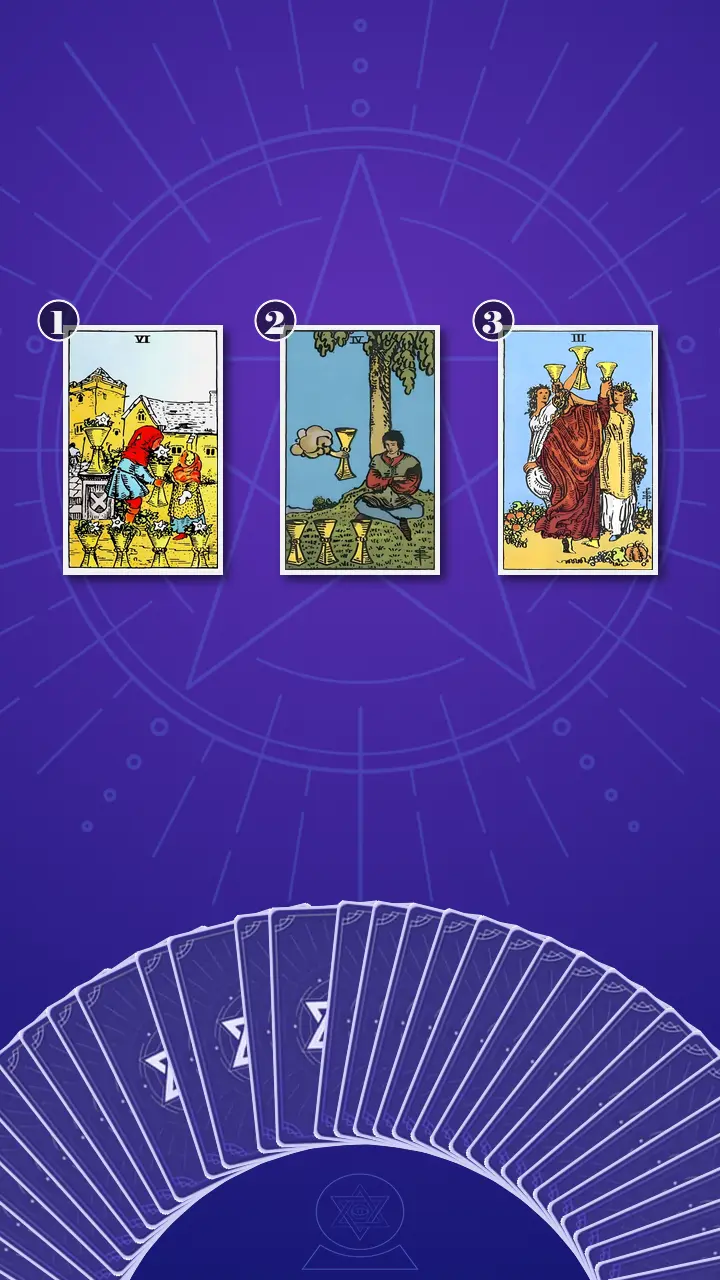
I chose the Past-Present-Future · Context Edition, a three-card Past-Present-Future tarot spread for self-reflection on friendship drift after university. When I explain how tarot works in a reading like this, I describe the cards as a structured mirror: I read card meanings in context, compare the timeline, and let the querent test each insight against lived evidence. This is not a forecast of another person’s feelings.
Because Maya’s question was causal and temporal, the layout kept the sequence clean: what changed, what happens now, and what she can choose next. For anyone wondering why friendships fade after graduation when everyone gets busy, that distinction matters; changed routines are real, but they do not automatically explain the story attached to a quiet chat.
The left card would show how campus proximity made friendship feel automatic and what that earlier attachment pattern carried forward. The centre card would show the present pause-and-wait loop: what happens between a delayed reply and a withheld message. The right card would be a self-directed next phase, a small reciprocal practice Maya could choose rather than an outcome the cards could promise.
Reading the Map of a Friendship That Changed Shape
I placed the three cards in a horizontal line, left to right. Their water imagery offered a simple sequence I could return to: warmth held in memory, feeling made still by withdrawal, and feeling brought back into circulation through shared participation.
The Six of Cups: The Campus Doorway
“Now I’m turning over the card for the past influences: it shows how campus proximity made friendship feel automatic, and how the earlier pattern associated safety with familiar people and shared routines.”
The card was the Six of Cups, in upright position.
In the RWS image, an older child offers a flower-filled cup to a younger child while a village path recedes behind them. I pointed to the exchange, the six cups, and the ordinary path: the warmth is not imaginary, but neither was the five-minute walk that used to turn one lecture into an entire evening in the café.
Maya told me that reopening the old WhatsApp group brought that memory back. The upright energy held affection in balance, but memory had become excessive as a comparison standard: she was asking a planned coffee, a different borough, or a delayed voice note to recreate the effortless setting that had carried the friendship. I asked, “Which part of that closeness came from genuine care, and which part came from seeing the same people every day?”
A short, bitter laugh escaped her. “That is too accurate. Almost cruel.” Her fingers tightened around her mug, then loosened. I did not argue with the reaction or turn nostalgia into a problem. I said, “You miss the people, but you also miss the infrastructure that made friendship automatic.” I have carried friendships across cultures myself, and I recognized the strange grief of losing a familiar route and mistaking its disappearance for the disappearance of the bond.
The Four of Cups: The Message Beneath the Scroll
“Now I’m turning over the card for present circumstances: it shows the observable pause-and-wait behavior in which delayed replies and low immediate reward make a simple check-in feel unrewarding, so contact is postponed and silence expands.”
The card was the Four of Cups, in upright position.
Its seated figure has crossed arms and a lowered gaze; three cups rest within reach while a fourth appears from a cloud. I connected that overlooked cup to a scene Maya had lived: a friend replied the next afternoon, “Sorry, work has been wild. Hope you’re good x,” and Maya left the message unanswered while checking the friend’s Instagram Story.
She said, “If this reply is flat, I will know I matter less now, so I should wait until I have something better to say.” I treated the delayed reply as one fact and the verdict about belonging as a story added afterward. The upright energy was a blockage, not an absence of feeling: attention had locked onto missing campus ease, immediate reassurance, and a perfect invitation. Checking Stories was like staring at a saved location pin; it brought the familiar place back on screen but could not move anyone into the same café. The pause protected her from a lukewarm answer for a few minutes, then gave the silence more room to grow.
When I named the loop, I saw three small changes: her breath caught; her gaze drifted to the empty space beside the cards as if replaying the chat; then she rubbed her sternum and looked back at me. “I do this too,” she said. “I keep checking for signs of closeness instead of creating one small chance for contact.” I let the admission stand without making it a diagnosis. A quiet group chat is not the same thing as a finished friendship.
When Three Cups Became a Bridge
As I reached for the third card, the rain thinned to a hush and the radiator clicked once. The line on the table no longer felt like a record of what had happened; it pointed toward a choice Maya could make without asking the cards to speak for her friends.
The Three of Cups: A New Circle Beyond Campus
“Now I’m turning over the card for the self-directed next phase: it reveals the small, reciprocal friendship practice that can replace campus proximity without making a prediction about what any particular friend will do.”
The card was the Three of Cups, in upright position. This was the key card at position three, and its strategic role was Bridge.
Three figures raise cups in a linked circle, with fruit and flowers at their feet. I read the raised cups as reciprocity, warm initiative, flexible belonging, and patience with connection that grows through repeated shared moments. In present-day London, that could be two friends choosing a 20-minute walk near a Tube station, Tuesday or Thursday, with an easy no or later. It would not recreate campus; it would make one shared moment possible.
The upright energy was circulation and balance. Water moved from the Six of Cups’ warm memory, through the Four of Cups’ still pool, toward a social rhythm that other people could actually join. The missing Wands, Swords, and Pentacles did not point to a lack of feeling; they highlighted the need to translate feeling into initiative, clear communication, and a repeatable real-world rhythm.
Here I used my signature lens, Savior Complex Auditing, as a question rather than a diagnosis. I asked, “Are you trying to rescue the entire friendship in one message, manage every calendar, supply all the emotional meaning, and guarantee the reply, so no one else has to show what they can genuinely offer?” The audit made the boundary plain: Maya could invite; she could not fix another person’s availability or carry the relationship alone. An unsent message kept the answer perfectly controllable, because it could never be declined.
The Sentence That Changed the Weight
I brought Maya back to 8:52 p.m. on Sunday: she had opened the old WhatsApp group after work, watched a friend’s Story, typed “coffee sometime?”, and deleted it because the plan felt too ordinary. She missed them, but she was also waiting for proof that missing them was still mutual.
“Stop treating the end of effortless campus contact as proof that closeness is over; build a new circle through the Three of Cups' raised, shared invitations.”
Maya froze first: her pupils widened, her thumb hovering above the table, breath held high in her chest. Then her gaze went from the raised cups to the quiet phone and lost focus, replaying the unread group chat, the deleted draft, and the Tube rides spent watching Stories instead of making contact. Her mouth opened, closed; the skin around her eyes grew bright. Finally, she let out a low “Oh,” and her shoulders dropped. The hand curled inside her sleeve released one finger at a time. The relief was real, but it carried a small, dizzying blankness: if closeness could be rebuilt, she would have to participate without controlling the answer. “I do not have to recreate campus in one message; I can see whether there is room for one shared moment,” she said. Her voice trembled on “room,” then steadied. I waited with her, letting the invitation belong to both people rather than to the cards.
“Now, use this new perspective to remember: was there a moment last week when this insight could have made you feel different?” I asked.
The Three of Cups did not promise a reunion. It gave Maya a way to gather present-day evidence without turning one ordinary invitation into a test. This was the first small movement from nostalgic, reassurance-seeking withdrawal toward grounded belonging through intentional, reciprocal connection: not certainty, but permission to participate.
From Insight to Action: The Two-Option Invitation
When I stepped back from the line, the story became causal. The Six of Cups preserved genuine warmth but made campus ease look like the required size of closeness. The Four of Cups showed the pause: delayed reward and fear of a lukewarm reply turned longing into checking, drafting, and waiting. The Three of Cups supplied the resource: connection could circulate again through small, mutual participation.
The cognitive blind spot was not that Maya cared too little. It was that she treated the effort required by adult friendship as evidence that something was wrong, while treating her own pause as neutral. She was measuring belonging by immediate replies and effortless proximity, then outsourcing her confidence to a friend’s response speed. The transformation direction was clearer: grounded belonging built through intentional, reciprocal connection, one present-day contact at a time.
I wanted the next steps to be actionable advice, not a demand to try harder. I adapted my Compassionate Detachment Protocol: validate the other person’s real constraints, state a clean request, and refuse to absorb the response as a verdict about worth. “I know work has been wild” could acknowledge a friend’s life; “I miss you, Tuesday or Thursday?” could name desire; “No pressure if neither works” could leave room for a genuine answer. Compassion stayed intact, and the outcome stopped being Maya’s burden to manage.
- Send one ordinary invitationBy Wednesday evening, I asked Maya to choose one former campus friend and send a three-line WhatsApp message: “I miss our chats. Want to take a 20-minute walk near your station next week, Tuesday or Thursday? Totally okay if neither works.”Keep it under three lines and set a one-invitation, one-follow-up limit. A reply is information about present availability, not a verdict on worth; if her body tightens, she can save the draft or stop.
- Build a small friendship ritualI asked Maya to invite two friends to a 10-minute voice-note exchange on the first Sunday of each month for the next two months, then add a tentative “friendship time” block to Google Calendar without assigning anyone a duty.Start with the smallest sustainable version. Let the format change or end if participation stays one-sided; repeatable contact matters more than recreating a campus afternoon.
I framed both actions as experiments, not obligations. Maya could send, draft, pause, or let a one-sided thread rest. The purpose was not to force a reunion; it was to let present evidence replace mind-reading, one small shared moment at a time. Do not make one text carry the weight of an entire friendship.

A Week Later, the Quiet Proof
A week later, Maya sent me a WhatsApp: “She couldn’t do Thursday, but she offered Sunday.” She told me she slept through the night, yet at breakfast “What if I’m wrong?” still arrived first. She smiled anyway, left the question unanswered for the moment, and added the walk to her calendar.
The reply did not recreate a campus afternoon, and it did not need to. A no to one date could coexist with a yes to another. For once, Maya was letting a response be information about current availability instead of a referendum on whether she mattered. The change was small, and that was why I trusted it.
I did not restore the friendship, and the Three of Cups did not command a result. Maya made a bounded choice and let reciprocity answer at its own pace. That was our Journey to Clarity: a movement from nostalgic, reassurance-seeking withdrawal toward grounded belonging through intentional, reciprocal connection.
I told her, “Closeness can change shape without becoming imaginary.” I had used a three-card Past-Present-Future · Context Edition spread for self-reflection, but the authority stayed with her. The cards made the pause visible; Maya supplied the choice, the boundary, and the next piece of evidence.
When the group chat goes quiet and your chest grows heavy with the phone warm in your hand, I know how easily the speed of a reply can start measuring your place in someone’s life. Losing the old campus rhythm can brush against rejection without proving it, and you are allowed to notice the weight before deciding what it means.
If one ordinary invitation could be evidence rather than a verdict, what small, honest kind of contact would you feel curious enough to imagine this week: the twenty-minute walk, the ten-minute voice note, or your own version of the Three of Cups' shared circle?