An Unfinished Job Application Led to a Present-Evidence Check

The Sunday-Night Tab That Never Closed
If your job is stable enough to protect, stagnant enough to question, and always one review away from becoming worth the wait, I suspect this scene will feel uncomfortably familiar.
At 9:17 on a Sunday evening, Jordan appeared on my screen from their modest Toronto apartment. Indeed sat open beside a Google Sheet of salaries, benefits, and possible timelines. I heard the refrigerator hum through the call. A mug of coffee had gone cold beside the laptop, and a rent reminder glowed on Jordan’s phone as they typed two lines of a cover letter, stopped, and switched back to Monday’s familiar operations tracker.
“I’m not stuck. I’m being strategic,” Jordan said, rubbing the hinge of their jaw. Then their voice dropped. “But I’ve been saying I can tolerate one more quarter for nearly two years. What if the payoff is real and I leave just before it arrives?”
What I saw was not dramatic panic. It looked more like someone holding two elevator doors apart with bare hands: one door marked predictable pay and benefits, the other marked a life with more air. Their shoulders were carrying the weight of both doors, while neither one was allowed to move.
“I’m not going to use the cards to tell you to quit or stay,” I said. “Your rent, income, and benefits are real. Let’s use tarot as a mirror for the pattern around them. We’re not looking for a verdict tonight. We’re drawing a map through the fog so that your next choice belongs to you.”

Choosing a Map for a Moving Deadline
I invited Jordan to place both feet on the floor, take one ordinary breath, and hold the question in mind while I shuffled. I use this small pause as a transition from mental noise into focused attention, not as a mystical performance.
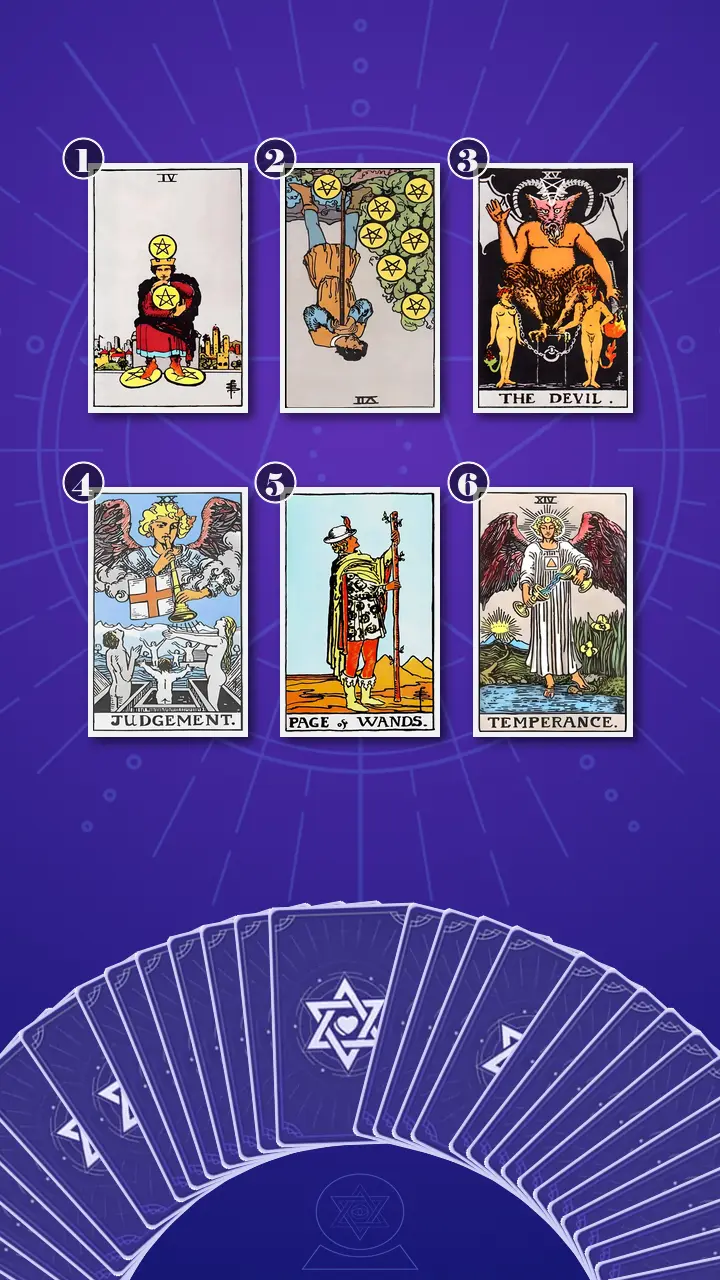
I chose the Transformation Path Grid (6) · Context Edition, a two-by-three career tarot spread. I laid the cards face down in two rows, with the upper row forming a diagnostic band and the lower row showing how each layer might be answered. The arrangement looked like a locked room opening onto a measured path.
For anyone wondering how tarot works in my practice, I do not treat a card as proof of a hidden external fact. I use the images to separate behaviours, assumptions, constraints, and available choices that have become mentally bundled together. Card meanings in context can make a vague feeling observable, and observable patterns can be questioned without surrendering authority to the cards.
I selected this spread because Jordan did not yet have two concrete job offers to compare. A simple decision spread would have created a false stay-or-leave binary, while a broad ten-card reading would have added more information to a situation already crowded with analysis. This six-card grid was designed for the actual mechanism: present behaviour, blocking loop, root fear, turning point, bounded experiment, and integrated clarity.
I told Jordan that the first card would show how protection had become contraction. The second and third would examine the moving deadline and the fear beneath it. The fourth, our catalyst, would restore present agency without deciding the employment outcome. The final two would translate insight into practical next steps that could coexist with financial stability.
The Grip That Looked Like Strategy
Position 1: Four of Pentacles and the Protected Paycheck
The first card I turned represented the present condition: the specific postponement behaviour and the contracted energy created by holding onto a familiar job for a possible later payoff. It was the Four of Pentacles, upright.
I pointed to the figure pressing one pentacle against the chest, with another above the head and two beneath the feet. “This card does not criticise you for protecting resources,” I said. “It shows what happens when protection spreads beyond the resources themselves and begins controlling every direction you might move.”
The scene on the card closely matched the one Jordan had shown me. At 9:17 on Sunday, an unfinished application had been open beside a salary-and-benefits sheet. The rent notification appeared, and Jordan returned immediately to the operations tracker. Their paycheck and benefits were genuine supports. The difficulty was that holding those supports had expanded into a rule that even gathering outside information was unsafe.
I read the card’s Earth energy as an excess of protective contraction. The strength underneath it was responsibility, planning, and resource awareness. The blockage appeared when those strengths were asked to prevent every encounter with uncertainty. It was like keeping a phone permanently in low-power mode: the battery remained protected, but the functions that made the device useful were never permitted to run.
“Last Sunday,” I asked, “what did switching back to familiar work seem to protect?”
Jordan gave a short laugh with a bitter edge. “That’s so accurate it’s almost rude. I told myself I wasn’t refusing change. I was protecting rent, benefits, and routine until the next review.”
I did not challenge the need behind that sentence. “Then we keep those needs on the table,” I replied. “Rent is not a character flaw. Wanting extended health coverage is not cowardice. The question is narrower: must every low-risk experiment threaten those things, or has the mind started treating an application draft as if it were already a resignation letter?”
Jordan stopped rubbing their jaw. Their hand remained around the mug, but the grip loosened slightly. The first distinction had landed: safeguarding stability and refusing all movement were not the same act.
Position 2: Seven of Pentacles Reversed and the Harvest That Kept Moving
The next card represented the blocking loop: the way delayed gratification and the Stagnation Lock made repeated waiting look reasonable in the short term. I turned the Seven of Pentacles, reversed.
In the traditional image, a gardener pauses beside a crop and evaluates the return on their labour. Reversed, I read that pause as blocked assessment. Effort continues, but the definition of a worthwhile harvest remains unwritten. Measurement becomes a substitute for decision.
I asked Jordan about their most recent review. They described leaving the meeting with a note that said “possible growth next quarter,” but no role, compensation range, date, or criterion. In the stairwell, with an elevator chime echoing through the door, they had moved the reminder marked Finish application forward by ninety days. Career Options v7 gained another projection column; the current job gained another automatic renewal.
“After this review,” I said. “After this quarter. Once the payoff is clearer. The deadline keeps moving because certainty was given the job of ending uncertainty.”
This was blocked Earth rather than healthy patience. Healthy patience has a defined claim, an evidence standard, and a review date. Jordan’s version had none of those. The current role could remain vague while Jordan supplied another cycle of competent labour, and the momentary relief of postponing an application felt like proof that waiting was sensible.
I call one part of my work Seasonal Energy Diagnostics. I use it when someone has mistaken an energy mismatch for a personal failure. Jordan was expecting an exhausted Sunday night, after five days of urgent office work, to produce a spring harvest. Meanwhile, the employer’s possible reward was allowed to remain underground through season after season without showing a date for growth.
At sixty-seven, after a life measured by Highland winters and springs, I do not mistake dormancy for failure. I remembered the frost calendars kept in the healing family that raised me. No one dug up a sleeping bulb every evening to demand progress. But winter was still a season with conditions and an end, not an indefinitely renewing contract.
“What exact evidence,” I asked, “is the next quarter expected to produce?”
Jordan’s fingers went still against the mug. They looked toward the salary sheet and then away from it. “I don’t know,” they admitted. “I keep thinking the review will make things obvious, but I’ve never written down what obvious would actually look like.”
The admission did not bring immediate relief. I watched their chest rise and hold for a beat, as if naming the missing criterion had exposed both the cost of waiting and the responsibility of setting a boundary. Then they exhaled through their nose and quietly repeated, “A date, a claim, and a way to check the claim.”
Position 3: The Devil and the Work Badge That Became a Lock
The third card represented the root belief and fear: the security-based attachment beneath the golden-handcuffs feeling, and the fear that changing before the hoped-for payoff arrived would threaten safety or prove poor judgment. I turned The Devil, upright.
I addressed the name before interpreting it. “This is not an omen, a punishment, or a claim that your job is evil,” I said. “In this position, I read The Devil as an attachment that has become psychologically larger than conscious choice.”
I drew Jordan’s attention to the loose chains around the figures’ necks. The card did not suggest that every constraint was imaginary. Toronto rent, an unexpected bill, contractual terms, and employer benefits could all impose real limits. The loose chains asked a more precise question: which limit was factual, and which rule had never been tested?
Jordan told me about archiving a recruiter’s email after opening their banking app one wet Tuesday night. They had not checked the salary, benefits, interview process, or expectations. The existence of the email itself had felt like a threat. Their work badge, once a key to reliable income, had begun to feel like both access card and lock.
I read the card as an excess of material attachment combined with blocked choice. Predictable pay, benefits, prior investment, and a possible future reward had fused into one compulsory bargain. Questioning any piece of it felt equivalent to risking everything.
“Finish this sentence,” I said. “If I leave before the possible payoff arrives, it means…”
Jordan’s voice became quieter. “It means I wasted the last three years. It means I’m not as careful as I thought. Maybe I can’t trust myself to keep my life safe.”
That was the root of the loop. Jordan was not merely waiting for a promotion. They were waiting for the current job to protect them from ever having to revise an investment. The price of that bargain was present participation.
I used a modern image to make the mechanism visible. Every time Jordan clicked a worst-case scenario, treated an exploratory conversation as an exit, and retreated into familiar work, their personal algorithm received more fear-of-loss training data. It responded by serving them even more reasons that exploration was unsafe. The algorithm was not fate. It had learned from repetition, which meant a different kind of input could begin to update it.
Jordan looked down at their employee badge on the desk. Their thumb ran once along its plastic edge, tightened, and then released. “I thought the job was the chain,” they said. “But some of the chain is the meaning I’ve attached to leaving.”
“Some of it,” I agreed. “Our work is to separate that part from the conditions you genuinely need to respect. Clarity is not pretending the real chain is loose. It is no longer calling every untested belief a locked clasp.”
When Judgement’s Trumpet Replaced the Snooze Button
Position 4: Judgement and the Next Honest Question
The refrigerator’s hum stopped on Jordan’s side of the call, and the sudden quiet seemed to widen the room. I turned the card representing the key turning point: the present-tense insight that could interrupt postponement and restore agency without deciding whether Jordan must stay or leave.
It was Judgement, upright.
I pointed to the trumpet and the figures rising with open arms from enclosed spaces. “Judgement is not passing a verdict on you,” I said. “Its balanced energy is honest reckoning, awakening, and willingness to answer what is true now. It asks you to participate in the review instead of waiting for an employer, a future reward, or a tarot card to grant permission.”
The modern scene was the Thursday stairwell after Jordan’s performance review. The promised payoff remained vague. Their throat had tightened before their mind supplied another reason to wait. Judgement interrupted that sequence by asking the current role to account for what it was actually providing, costing, teaching, and promising today.
Here I used my second diagnostic lens, Social Clock Decoupling. I separated three clocks that Jordan had allowed to chime as one. The employer clock said “next quarter.” The LinkedIn clock flashed peers’ new titles as polished proof that Jordan was behind. The living clock registered dull pressure behind the eyes, recurring Sunday-night tension, and a quiet wish to learn what else might fit.
“Judgement’s trumpet is not your manager announcing a promotion,” I said. “It is not an ‘I’m thrilled to announce’ post grading your pace. It is the sound of your own present evidence asking to be included.”
I distilled the shift into one sentence: “A possible payoff is data to evaluate, not permission you must wait for.”
Jordan was still caught inside the demand to make the correct five-year decision before taking a ten-minute step. The job board, spreadsheet, and unfinished draft all remained open in their mind, followed by the familiar relief of moving the deadline again.
You do not need to keep postponing change until its payoff is guaranteed; answer Judgement's trumpet by turning waiting into a time-boxed experiment and letting present evidence guide the next step.
I let the sentence remain between us without filling the silence.
Jordan’s breath stopped first. Their fingers, which had been circling the mug, hung above the rim. Then their gaze drifted past the screen; I could almost see the Thursday stairwell replaying in the delay before they blinked. Their eyebrows pulled together, not with relief but with a flash of anger. “But doesn’t that mean I was wrong for the last three years?” they asked, their voice suddenly sharper. The question landed, and their shoulders rose as if bracing for a verdict. I waited. Their lower lip pressed inward; their hand closed once, then slowly opened on the desk. When I said that revising an investment in response to current evidence could be an act of sound judgment, not proof that judgment had failed, their eyes reddened. A breath left them in a rough, unsteady stream. Their shoulders dropped, but their face went briefly blank, the slight dizziness of discovering that agency also brings responsibility. “Oh,” they said quietly. “Then I don’t need the whole answer. I need a real next question.”
“Now, with that new perspective, think back to last week,” I said. “Was there a moment when this could have felt different?”
Jordan returned to the stairwell. They remembered moving the application reminder by ninety days after receiving another vague promise. “I kept asking the job to make the decision obvious,” they said. “I could have asked what the extra ninety days were supposed to prove.”
I set an eight-minute timer and opened a blank page. Together, we made a four-line Present-Evidence Check. The payoff Jordan was waiting for was a clearer role with better compensation. The current evidence was one vague phrase about possible growth. Another three months would cost twelve more Sunday evenings and at least one postponed outside conversation. The smallest reversible experiment was drafting a three-sentence message to a former colleague.
I stopped the exercise when the timer rang. No resignation, application, or final decision was required. The point was to let one piece of present reality enter a system dominated by imagined futures.
I named the emotional crossing carefully. This was not instant certainty about leaving. It was a first movement from flat ambivalence and resigned waiting toward grounded confidence and evidence-based career clarity. Jordan’s new confidence belonged to their ability to ask, test, and review, not to any outcome promised by the card.
The Small Flame and the Two Cups
Position 5: Page of Wands and an Experiment Allowed to Stay Small
The fifth card represented the action experiment: one reversible behaviour that could create current evidence instead of extending an undefined waiting period. I turned the Page of Wands, upright.
I showed Jordan the Page studying a sprouting wand against an open landscape. The wand was alive, but it was not a completed career path. The Page did not know the destination. The card’s balanced Fire appeared as curiosity, beginner-level contact, and willingness to learn through experience.
In Jordan’s life, the Page could be one three-sentence message to a former colleague requesting a twenty-minute informational conversation. Jordan could keep their job, make no promise to apply, and ask about the role’s daily work, salary range, training, and energy demands. The final career decision would remain deliberately open.
“You do not need a resignation plan to run an information-gathering experiment,” I said. “This is not a commitment to leave. It is permission to learn.”
I also pointed out that no Swords had appeared in the six-card spread. I did not treat that absence as a supernatural decree. I used it as a useful design clue: Jordan already had plenty of abstract analysis. Another salary projection might add a variable without changing the loop. The Page’s Fire suggested one direct contact with reality, carefully bounded so that curiosity would not become impulsive pressure.
“Think of the difference between maintaining Career Options v7 and running one live beta test,” I said. “The dashboard is not useless, but it cannot tell you how an actual conversation feels or what an actual role requires.”
Jordan opened a blank message on their personal phone. Their thumb hovered over the keyboard, then typed a former colleague’s name. “I can draft it,” they said. “Sending can remain a separate choice.”
“Exactly,” I replied. “A boundary is not a loophole. It is what keeps the experiment from pretending to be a life verdict.”
Their mouth lifted at one corner, still tentative. I could see curiosity appearing beside the fear rather than replacing it, a small flame with enough air to live but not enough fuel to burn down the practical structure around it.
Position 6: Temperance and a Rhythm for Stability and Movement
The final card represented integrated clarity: the way Jordan could combine practical stability with deliberate exploration so that patience became active and time-bound. I turned Temperance, upright.
I traced the water moving between the two cups, then the angel’s placement with one foot on land and one in water. I read this as balanced energy: practical Earth remaining available while Water created movement, adaptation, and exchange. The card did not ask Jordan to abandon solid ground. It asked them to stop treating solid ground as the only place where attention could exist.
In modern life, the two cups could become two modest calendar blocks. One block would protect stability by reviewing salary, benefits, commute, and energy limits. The other would test possibility through one application, conversation, or short skills trial. Each would have a time limit and an exit point.
“Stability and movement are not opposites; indefinite waiting and present evidence are,” I said. “Temperance turns patience from an automatic delay into a pace you can choose and review.”
Jordan looked at the two cups for a long moment. Their shoulders lowered enough for their back to meet the chair. Outside their window, rain that had been striking the glass in hard taps softened into a fine, steady sound.
“So I don’t have to blow up my life,” they said. “I can keep what supports me and still make room for information.”
“Yes,” I replied. “And after the information arrives, staying, revising, pausing, or leaving can all remain legitimate outcomes. Temperance is not a prediction that another role will be better. It is a structure that prevents either fear or excitement from taking the whole calendar.”
Jordan glanced from the Four of Pentacles in the upper-left corner to Judgement beneath it, then from the reversed Seven to the Page, and finally from The Devil to Temperance. The vertical pairs made the path visible: protection could be answered by conscious review, stalled measurement by a small experiment, and compulsory attachment by a balanced relationship with security.
A Winter With an End Date
I gathered the six cards into one coherent story. Prior investment had taught Jordan to protect stability through competent, familiar work. In the present, that protection had contracted into a glass box: Jordan could see other paths, but each possible later payoff became another reason not to test them. The moving deadline maintained the box, and the deeper fear gave it weight. Leaving too soon did not merely threaten income in Jordan’s mind; it threatened their identity as someone capable of making safe decisions. Yet the spread also revealed unused resources: honest self-assessment, curiosity, careful planning, and the ability to create a sustainable pace.
The cognitive blind spot was now clear. Jordan had been treating the final career decision as a prerequisite for gathering the information that could help them make it. Applying had become resigning. Talking had become committing. Revising an investment had become admitting failure. The transformation direction was not from caution to recklessness. It was from automatic postponement to conscious participation, replacing “wait until the payoff is guaranteed” with one bounded experiment that could produce evidence this week.
I adapted my Winter Dormancy Ritual for Jordan. In its traditional form, I ask someone to stop forcing progress on a blocked goal for seven days so that guilt and depletion no longer consume the energy needed for organic movement. Here, the blocked goal was not “change jobs.” It was “solve my entire career future.” For one week, Jordan would stop trying to answer that oversized question. Dormancy would have an end date, while small evidence-gathering actions could remain separate from the demand for a final answer.
- Set a Seven-Day Dormancy Boundary. For the next seven days, do not decide whether to stay or leave, build a five-year forecast, or compare your pace with LinkedIn announcements. When the loop starts, write the unanswered question in one line and close the tab. Treat the boundary as energy protection, not avoidance. The ritual ends on a specific date, and no unfinished research becomes debt.
- Run the Eight-Minute Present-Evidence Check. On one evening this week, set an eight-minute phone timer and write four headings: Current Facts, Promises, Costs of Waiting, and Missing Evidence. Add no more than three bullets under each, using only information available today. Label unknowns as unknown instead of researching them. If energy is low, complete only: “The payoff I am waiting for is…” and “The evidence I currently have is…”
- Try One Page-Sized Career Experiment. During one twenty-minute block on a personal device, draft or send a three-sentence message to a trusted former colleague asking for a twenty-minute informational conversation. In a separate ten-minute review, note what raised energy, what created friction, and what practical question remains. The minimum version is an unsent draft. Stop after one experiment; no application, resignation, second message, or public explanation is automatically required.
“Choose only what fits your actual capacity,” I told Jordan. “The cards do not award points for speed. If the evidence supports staying for another quarter, you can stay with a named reason and a checkable review date. If the experiment costs too much energy, pausing is also evidence. Your next step remains yours.”

Seven Days Later, the Quiet Proof
A week later, I received a message from Jordan. It read: “I did the check, and the promotion promise had one bullet. The costs of waiting had six. I drafted the message to my old colleague, left it overnight, and sent it the next morning. We’re talking Thursday. I still have my job. Nothing exploded.”
Jordan had not solved their career or received a new offer. They had created one source of firsthand information while protecting their income and benefits. Their employer’s possible payoff still mattered, but it no longer held exclusive authority over when exploration could begin.
They also told me they had slept through the night after sending the message. Their first thought the next morning was still, “What if I’m wrong?” This time, they smiled, made coffee, and let the question remain a question.
I saw that as the real proof of our Journey to Clarity. Tarot had not changed Jordan’s career by magic. It had given us an objective symbolic map, but Jordan had separated facts from promises, set a boundary around waiting, and chosen the experiment. The agency had been theirs at every point.
If your jaw tightens over another unfinished application, it may be hard to tell whether you are protecting the life you have built or protecting yourself from the fear that one uncertain move could prove you cannot keep yourself safe. I hope Jordan’s two cups remind you that noticing this tension already places you somewhere beyond the starting point.
If no trumpet were demanding a resignation and no LinkedIn clock were grading your pace, what one Page-sized experiment could you let count as new evidence this week?