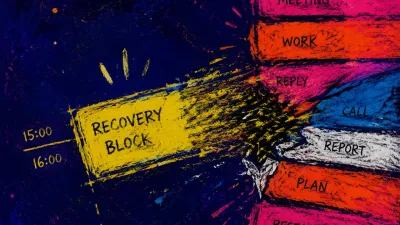
Three Rough Bullets in 20 Minutes: Starting Before Pressure Shouts

Finding Clarity in the 6:20 p.m. Scroll
I have learned that when a manager changes a deadline without explaining what the work will unlock, career disengagement rarely looks like doing nothing. It looks like clearing Slack, polishing notes, and leaving the one consequential document untouched.
Jordan joined our video session at 6:20 p.m. on a Tuesday from a nearly empty digital-agency office near Old Street. On my screen, a grey project brief sat beside an Asana board crowded with red overdue labels. I could hear the ventilation humming and Slack pings leaking through their headphones; they lifted a mug of reheated coffee, tasted it, and grimaced.
As I watched, Jordan answered one message, renamed a task column, and then returned to the same paragraph of the brief for the third time. Their laptop was warm beneath their wrists. Their shoulders had folded so far toward the desk that the posture seemed to be answering the question before they could.
'If the date is arbitrary, why should today matter?' they said. 'I want the deliverable finished. I just cannot make myself care once the deadline moves. Then I spend all day being technically busy until somebody follows up twice, and suddenly I can do three days of work in one night.'
That was the contradiction I wanted us to examine: Jordan genuinely wanted to complete the required work, but starting it before the deadline felt consequential seemed like donating scarce time to something that might mean nothing. Their disengagement had the physical weight of a wet winter coat left on indoors: heavy across the shoulders, irritating enough to notice, but somehow still easier to tolerate than taking the next uncertain step.
'I do not hear laziness in that,' I told them. 'I hear a system that has learned to wait for pressure because pressure ends the debate. Let us make that system visible and see where your choice can return. We are not asking the cards to order you around. We are using them to draw a map through the fog.'

Choosing the Switchback Map
I invited Jordan to put both feet on the floor, take one ordinary breath, and hold one question in mind: 'Why does my impulse to act disappear when a deadline stops feeling meaningful?' I shuffled slowly, using the movement as a transition from reacting to the backlog toward inspecting it.
I chose the Transformation Path Grid · Context Edition, a six-card tarot spread for procrastination and deadline pressure. I do not use tarot here to predict whether someone will meet a deadline. How tarot works in this kind of consultation is closer to structured due diligence: each position isolates one part of the situation so that feelings, assumptions, incentives, and practical choices do not remain bundled together.
This question needed a systemic spread because Jordan was not facing one simple choice. They were caught in a feedback loop: an arbitrary-feeling deadline led to postponement; postponement created immediate relief; the growing backlog manufactured urgency; and urgency finally produced action, teaching the same loop to repeat.
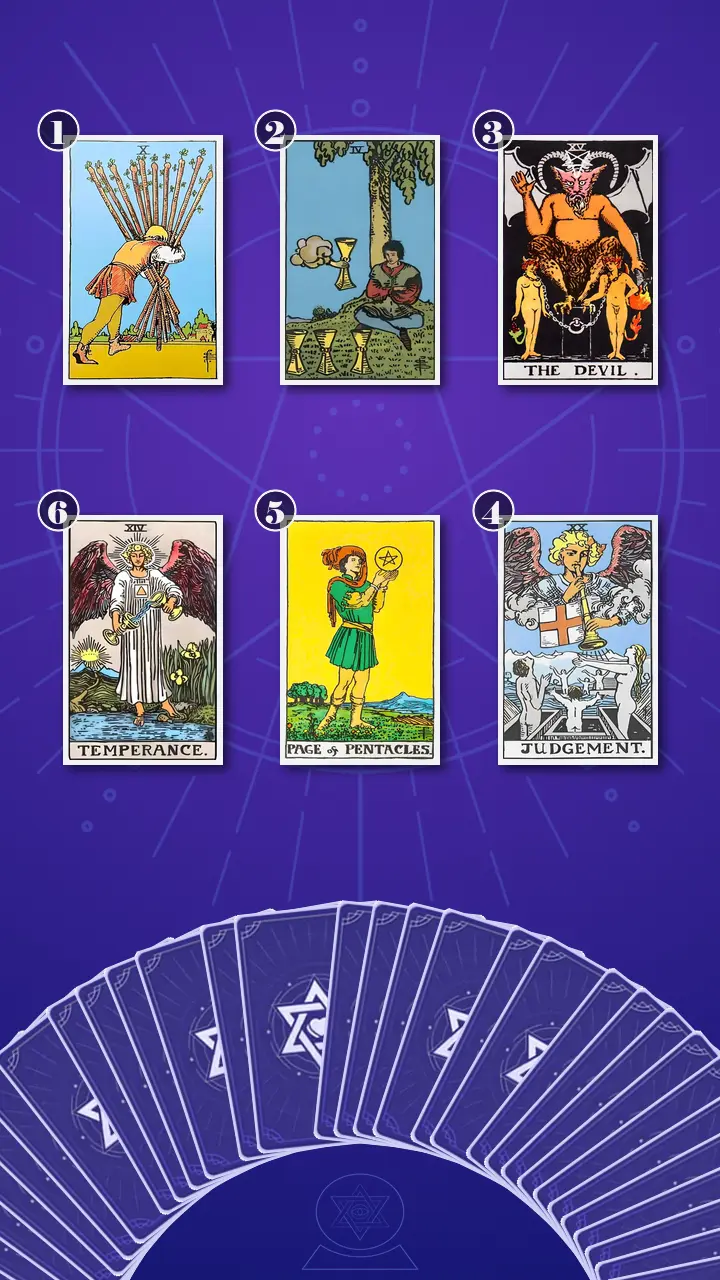
I arranged the cards in two rows of three. The upper row would show the visible pile-up, the immediate collapse of meaning, and the reinforcing mechanism beneath it. From the third card, my eye would drop directly to the catalyst below it, then travel back through one practical experiment and a more sustainable rhythm. The layout formed a switchback path: we would walk all the way into the loop before looking for a credible route out.
I told Jordan that the most important positions would be the third, exposing why relief becomes attachment; the fourth, introducing a conscious interruption; and the fifth, turning insight into one bounded action. The cards would not decide whether every task deserved completion. They would help us distinguish beginning from clarifying, renegotiating, delegating, or deliberately pausing.
The Backlog That Blocked the View
Position 1: The Board Called 'Everything I Am Behind On'
The card I turned over first occupied the position that surfaces the observable deadline pile-up: accumulated tasks, compressed effort, and the way workload narrows attention. It was the Ten of Wands, upright.
In the Rider-Waite-Smith image, a figure bends beneath ten bundled wands. The destination is close, but the load blocks the carrier's sightline. I pointed from that image to the Asana board still glowing beside Jordan's brief. At 6:20 p.m., six separate tasks had stopped looking like six separate decisions. They had merged into one object called 'everything I am behind on.'
The card showed fire in excess: plenty of eventual effort, but no clean direction for it. Jordan was not short of the capacity to work hard. The problem was that the total burden had become louder than each task's owner, consequence, dependency, or first step. Their inner equation was easy to recognise: there was too much to do, so they needed to identify what mattered most; yet the pile was so visually loud that they could no longer see the purpose of any single item.
Jordan gave a brief, bitter laugh. 'That is accurate enough to be a bit brutal.'
I let the laugh land before answering. 'The card is not calling you inadequate. It is separating overload from identity. A crowded board can distort perception in the same way carrying six grocery bags in one trip can leave the doorway visible while the bags block your view of it.'
Their laugh faded into a long exhale. I saw their fingers stop moving over the trackpad. When I asked which item had become hardest to see clearly because of the total overdue count, they named the client summary immediately. The speed of the answer told me that some clarity was already present beneath the visual noise.
Position 2: When the Calendar Stopped Persuading Them
The next card occupied the position identifying the immediate Meaning-Collapse Split: the moment a due date loses credibility and emotional engagement with the task drops beside it. I turned over the Four of Cups, upright.
The figure on the card sits with crossed arms and a lowered gaze while another cup is offered from a cloud. The image did not suggest that nothing of value existed. It suggested that available value was not being examined because the current offer had stopped feeling persuasive.
Jordan had described the modern version perfectly. A manager changed Friday's deadline to 'flexible next week' without explaining what consequence had changed. Jordan closed the deck, mentally marked the work as unreal, and switched to Slack approvals because those tasks supplied immediate completion signals. The deck might still have unblocked a teammate, prepared a client decision, reduced next week's stress, or revealed that the scope needed renegotiation. None of those possibilities received attention once the calendar lost authority.
This was water in a blocked, stagnant state. It was not proof that Jordan lacked care in general. Their emotional energy had withdrawn from a task whose stated reason no longer felt credible. The blockage came from treating the due date as the task's only possible source of value.
'The calendar stopped persuading you, so the task stopped feeling real,' I said. 'That reaction makes sense. But a moved date and a meaningless task are not always the same thing. We have to inspect the useful detail below the fold.'
Jordan rubbed a thumb along the mug's rim, then said, 'I think I decide that if they can move it, it cannot matter. And if it does not matter, starting now means giving away my evening.'
'That may be true for some tasks,' I replied. 'The invitation is not to invent a noble purpose for pointless work. It is to check whether a practical reason exists before the calendar makes the entire decision for you.'
Position 3: The Loan Against Tuesday Night
The third card occupied the position that exposes the underlying procrastination loop, including the short-term reward of reclaiming autonomy and the fear of losing control over how effort is spent. I turned over The Devil, upright.
I watched Jordan's jaw tighten at the name, so I addressed that before going further. 'This is not a moral verdict, and it is not saying you are trapped by fate. I am interested in the loose chains in the image. They show a repeated bargain whose force comes partly from continuing to accept its rule.'
I laid out the bargain in two scenes Jordan had already given me. At 5:45 p.m. on Friday, closing the ambiguous document returned the evening to them. Their jaw unclenched. The immediate relief felt like autonomy. By 9:50 p.m. the following Tuesday, the same report, two newer deliverables, and escalating reminders dictated when they worked and how fast. The room was hot, their leg shook the desk, and the thought had changed from 'I choose not to give this my time' to 'I have no choice now.'
The Devil showed energy caught in a blockage and redirected reactively, like the downward torch on the card. Jordan's system had become an algorithm trained on crisis sprints. Every last-minute completion told it, once again, that pressure was the most reliable recommendation for starting.
'You are not waiting for motivation,' I said. 'You are waiting for pressure to end the meaning debate. Postponement protects tonight by giving the backlog control of tomorrow.'
A memory from my years on Wall Street flashed through my mind. I had seen positions that looked profitable at the point of entry because the immediate return was visible and the tail risk was hidden. Jordan's delay worked in a similar way: the relief arrived now, while the cost was booked against a future evening.
I explained that comparison without turning their life into a balance sheet. The Devil was not arguing that every task should be started immediately. It was asking whether protecting one evening still counted as freedom when the accumulated work gained authority over several later evenings.
Jordan's breath paused. Their hand went still against their chest; their gaze drifted away from the screen as if replaying the Friday relief and Tuesday-night sprint together. Then their fingers loosened, and a low 'Oh' left them with the exhale.
'I keep calling the first moment a boundary,' they said. 'But I do not set an actual boundary. I just send the cost to future me.'
'Exactly,' I said. 'And the loose chain means there is an earlier decision point. The next card sits directly beneath this one.'
When Judgement Rose Above the Red Badges
Position 4: A Call Jordan Could Stand Behind
The office ventilation clicked off just as I turned the fourth card. For the first time since our session began, the background fell quiet. This position introduced the key shift from waiting for pressure to manufacture meaning toward consciously naming, clarifying, or renegotiating the reason for action. The card was Judgement, upright.
I placed the trumpet at the centre of the interpretation. Unlike the noise of overdue badges, Slack reminders, and calendar alerts, the trumpet represented one clear signal that Jordan could evaluate consciously. The rising figures showed a changed posture: not bending beneath every obligation and not closing their arms to all of it, but deciding what call deserved a response.
In practical terms, I saw Jordan pausing before moving the delayed report to tomorrow again and writing, 'This matters because the account lead needs one reliable summary for Monday's decision.' If no credible sentence appeared, Jordan could ask what the task unlocked and when it was actually useful. They could then choose to begin, clarify, renegotiate, delegate, or pause. Accountability would become a decision they could explain, not blind obedience to a provisional date.
This was where I used a diagnostic lens I call Time-Asset Valuation. I asked Jordan to audit the full return on their current routine. Closing the file on Friday appeared to save twenty or thirty unrewarding minutes. The hidden sunk costs arrived later: renewed decision fatigue every time the tab reopened, a Tuesday evening consumed by emergency work, poorer sleep, and less freedom to question the scope once somebody was waiting.
The audit did not automatically conclude, 'Do the task.' It asked a more useful set of questions: Who benefits? What changes if this moves? What is the latest genuinely useful date? What amount of effort is proportionate? If those questions produced no credible return, clarification or renegotiation could be the responsible response. If they produced one practical reason, that reason could authorise a bounded beginning.
At that point, Jordan was still inside the familiar 6:20 p.m. scene: the main document open, three Slack replies completed first, a renamed task column, heavy shoulders, and tomorrow waiting like the only day the work might become real. I could see them trying to turn Judgement into another command to comply.
'Urgency ends the argument about whether a task matters,' I said. 'A reason you choose lets you begin before pressure starts shouting.'
Stop treating urgency as the only valid call to action; answer Judgement's trumpet by naming your own reason and beginning before pressure shouts.
I stopped speaking. Jordan's inhale caught high in their chest, and their fingertips remained suspended above the keyboard. Their eyes lost focus for several seconds, as though an entire week were replaying behind them: the moved deadline, the protected Friday evening, the red reminders, the Tuesday-night sprint. Then their eyebrows drew together and a flash of anger replaced the stillness.
'But does that not mean I have been doing it wrong this whole time?' they asked. Their voice was sharper than before. 'Like I created the exact pressure I complain about?'
I kept my answer steady. 'It means the pattern served a real short-term function. It protected your sense of control when the task had no credible reason. We are not shaming the protection. We are noticing its price and giving you more than two options.'
The anger did not vanish at once. I watched it move through a three-part reaction: their shoulders held rigid; their gaze returned to the card as the distinction began to register; then their hands slowly opened on the desk. Their eyes brightened, and one unsteady breath left them. Relief was present, but so was the slight disorientation that comes when a familiar excuse becomes an available choice. Clarity had given Jordan responsibility without giving them certainty.
'Now, with that new perspective, think back to last week,' I said. 'Was there a moment when this insight could have changed how the task felt?'
Jordan looked toward the rain-dark window. 'Thursday. When the manager moved the date, I could have asked what the deck was still for. I did not need to either obey the old deadline or pretend the deck had disappeared.'
I set a ten-minute timer and asked Jordan to make a three-line Decision Note for that delayed task: 'This matters because...'; 'A 20-minute start could produce...'; and 'If the purpose is still unclear, I will ask...'. They used the final two minutes to open the file and write the roughest possible first line.
I made the boundary explicit. They did not have to finish, continue after the timer, or pretend the task was meaningful. If writing the note felt too exposing, or if asking for clarification would be unsafe in their workplace, privately saving the note was enough. The exercise was an optional point of contact, not another demand disguised as empowerment.
When the timer ended, Jordan looked at the line on screen and gave a small, surprised nod. The shift was modest but important: from flat disengagement and guilt toward cautious agency through self-authored purpose. The task had not become inspiring. Jordan had simply stopped outsourcing the whole decision to urgency.
One Pentacle, Then Two Cups
Position 5: The 20-Minute Evidence Start
The fifth card occupied the position that translates renewed meaning into one concrete, twenty-minute start, allowing evidence to emerge through action rather than demanding complete motivation first. I turned over the Page of Pentacles, upright.
The Page holds one pentacle at eye level while the wider landscape remains present but secondary. I translated that image directly into Jordan's workspace: hide the full task board, open only the delayed report, set one timer, and name one visible artifact that can exist when the timer ends.
For Jordan, the artifact was not 'finish client summary.' It was 'draft three rough findings with placeholders.' One document would fill the screen. The red labels could remain elsewhere without being denied or solved all at once.
The Page brought grounded earth into a system that had been swinging between excessive fire and stagnant water. Its energy was steady, practical, and deliberately modest. A small start was evidence, not a pledge of unlimited effort. It could reveal that the task had value, that the scope was wrong, that a dependency was missing, or that a better question needed to be asked.
'Twenty minutes still feels weirdly large when I am already behind,' Jordan said. 'And if I start, I worry I will have to keep going.'
'Then make the minimum version five minutes and define the exit before you begin,' I said. 'The timer is a boundary, not bait. Stopping is allowed. Continuing is an option, not a test of whether you care enough.'
I watched Jordan type 'three rough findings' beside the task. The gesture was almost comically small compared with the crowded board, which was precisely why it mattered. The Page did not ask them to solve their entire relationship with work. It asked them to meet one concrete object long enough to learn something true.
Position 6: Temperance and the Week That Did Not Need a Fire Drill
The final card occupied the position defining the integrated direction: self-chosen purpose, realistic boundaries, and steadier pacing before deadlines become emergencies. I turned over Temperance, upright.
I traced the measured stream passing between the two cups. One foot rests on land and one in water, keeping practical structure and emotional credibility in contact. For Jordan, this looked like moving a realistic amount of work across the week instead of pouring the entire backlog into Thursday night.
The modern-life version was a fifteen-minute Friday review using three questions: 'Why does this matter? What is enough for now? What needs clarification?' A clear task could receive one small starter block. An ambiguous task could receive a question. An overloaded period could trigger a scope or priority conversation before an evening boundary was breached.
Temperance showed energy in balance. It did not ask Jordan to love every deliverable or surrender to every date. It held two valid needs at once: the agency's practical requirements and Jordan's need for credible purpose, proportionate effort, and personal time that remained genuinely their own.
I also pointed out what the spread did not contain: there were no Swords. The missing air function suggested that purpose, consequences, dependencies, and boundaries had remained unspoken. Jordan had been reorganising the task system when what the system needed was one explicit sentence or one direct question.
Their shoulders softened. 'So the weekly review is not another productivity reset,' they said.
'Right,' I replied. 'It is a calibration. More like a weekly software patch than reinstalling your entire life every Sunday night.'
An Energy Portfolio with Breathing Room
I read the spread back to Jordan as one continuous story. The Ten of Wands showed delayed responsibilities bundled into a burden that blocked sequence. The Four of Cups showed why engagement vanished when the calendar lost credibility. The Devil revealed the hidden exchange: postponement bought immediate autonomy by borrowing against a future evening. Judgement interrupted that exchange with a reason Jordan could consciously stand behind. The Page converted the reason into one bounded artifact, and Temperance turned the experiment into a rhythm that could be adjusted before panic.
The cognitive blind spot was the assumption that a task had only two states: obey the due date blindly or ignore the task until urgency made resistance irrelevant. The spread opened a wider decision set: begin, clarify, renegotiate, delegate, document, or pause. The transformation direction was not from 'undisciplined' to 'productive.' It was from urgency-dependent motivation to self-authored accountability, where deadlines became planning information rather than the only proof that effort mattered.
I also ran what I call a Bandwidth Bankruptcy Prediction across Jordan's week. Their calendar showed 'rest' after work, but much of that time was spent reopening Asana, checking Slack, feeling the unfinished report in the background, and never fully recovering. That was fake resting: work was not moving, but it was still charging interest against attention.
I gave Jordan three next steps. Each was designed to preserve choice, produce information, and remain small enough to test without turning the reading into another performance-management system.
- Run the Three-Line Decision NoteOn Monday morning, choose one repeatedly moved task in Asana and spend no more than ten minutes completing: 'This matters because...'; 'A 20-minute start could produce...'; and 'If the purpose is still unclear, I will ask...'. If no credible reason appears after five minutes, move the item to 'Needs clarification' instead of rescheduling it unchanged, then ask the owner who uses it, what it unlocks, and the latest date it is genuinely useful.Tip: A credible reason can be ordinary, such as unblocking a teammate or reducing Friday stress. Do not invent an inspiring purpose, and do not ask a workplace question that would be unsafe in your role.
- Book One 20-Minute Evidence StartIn the first half of the workday, open only the required file and create one starter artifact: three outline bullets, one rough slide, one checked source, or one paragraph with placeholders. Label the calendar block 'test the next step,' and record what exists and what remains unclear when the timer ends.Tip: Reduce the block to five minutes if needed. Decide the stopping point before starting; continuation is optional, and the result can support clarification or renegotiation rather than completion.
- Use Energy Portfolio Restructuring for 48 HoursFor two evenings, subtract one high-friction habit that looks like control but does not create progress or recovery, such as reopening the task board after shutdown or checking Slack from bed. Reinvest that exact time in one protected recovery block: a walk, dinner away from the laptop, a shower, music, or an earlier bedtime. Before the first evening begins, clarify or reduce any work that would otherwise breach the boundary.Tip: Cut one habit only. The aim is to recover usable bandwidth, not to build a perfect routine or conceal an unreasonable workload.

A Week Later, Three Rough Bullets
At 4:32 p.m. the following Friday, I received a short message from Jordan. They had minimised the full task board, opened the delayed report, and written: 'This matters because the account lead needs one reliable summary for Monday's decision.' Rain tapped the agency window while a twenty-minute timer ran. When it ended, three rough bullets existed.
The report was not finished. One dependency was still unclear, so Jordan sent a concise Slack message asking when the summary was actually useful and what decision it needed to support. They then stopped at the boundary they had chosen instead of stretching the session into another unplanned evening.
The message ended: 'Not inspired, not magically fixed. But I started before anyone chased me, and I knew why I was doing that piece.'
That night Jordan slept through, but their first thought on waking was still, 'What if I do this again next week?' They told me they smiled at the question. It no longer sounded like a verdict; it sounded like something they could review.
I did not credit the cards with rescuing Jordan. The cards made the structure visible. Jordan supplied the reason, asked the clarifying question, honoured the timer, and decided where their effort would go. That was the real Journey to Clarity: not certainty, but enough self-trust to make one conscious move before pressure removed the alternatives.
I know that when a deadline stops feeling real, many of us feel our shoulders drop and our attention slide away, caught between wanting the task finished and refusing to hand over another evening to work that may mean nothing. If that is where you are, noticing the hidden loan against your future time already places you somewhere other than the beginning.
So I will leave you with the same quiet question I left beside Jordan's Decision Note: if you named one reason you could genuinely stand behind, what tiny first artifact would you be curious to hold at eye level before the red badges start shouting?