The Headline on the Overground
I had seen this particular kind of composure before: Alex (name changed for privacy), a 28-year-old junior communications coordinator in London, could make a client update sound polished, then freeze when a close friend asked how they were really doing. At 8:47 PM on the London Overground, the carriage lights buzzed above them, the rails clicked beneath the seat, and their phone felt warm against their palm.
Alex showed me the message they had been editing. The honest draft said, 'I feel like I have no direction.' They deleted that sentence, sent 'Work has been a lot, but I am okay,' and quickly asked about their friend's weekend. Then they looked at me and said, 'I give people the headline, not the messy draft.'
The question underneath was direct: why reveal just enough to keep friends close when feeling lost? Alex wanted emotional support but feared that showing the full extent of their uncertainty would make friends worry, step back, or wonder whether Alex still belonged beside them. Their throat tightened before personal questions, their breathing went shallow during honest conversations, and a heavy chest followed every change of subject. The feeling was like carrying a carefully edited map through London while hiding every blank space from the people walking beside them.
I told Alex that privacy was not a failure, and that this reading would not predict whether any friend stayed or left. 'We can look at the difference between a boundary you choose and a concealment fear chooses for you,' I said. 'Our Journey to Clarity starts by giving the blank spaces a name, without forcing you to hand over the whole map.'

Choosing a Map That Leaves Room to Breathe
I asked Alex to place the phone face down, take one slow breath, and hold the question in plain language. I shuffled slowly. The small ritual was a transition out of the Overground and into focused observation, not a supernatural verdict.
For this five-card Relationship Spread tarot reading, I chose the Relationship Spread · Context Edition. It fits because the problem is relational: selective disclosure, available friendship support, the communication pattern created between people, the fear underneath it, and one action Alex can choose. This is how tarot works in this setting: the cards organize attention so card meanings in context can be compared with actual behavior.
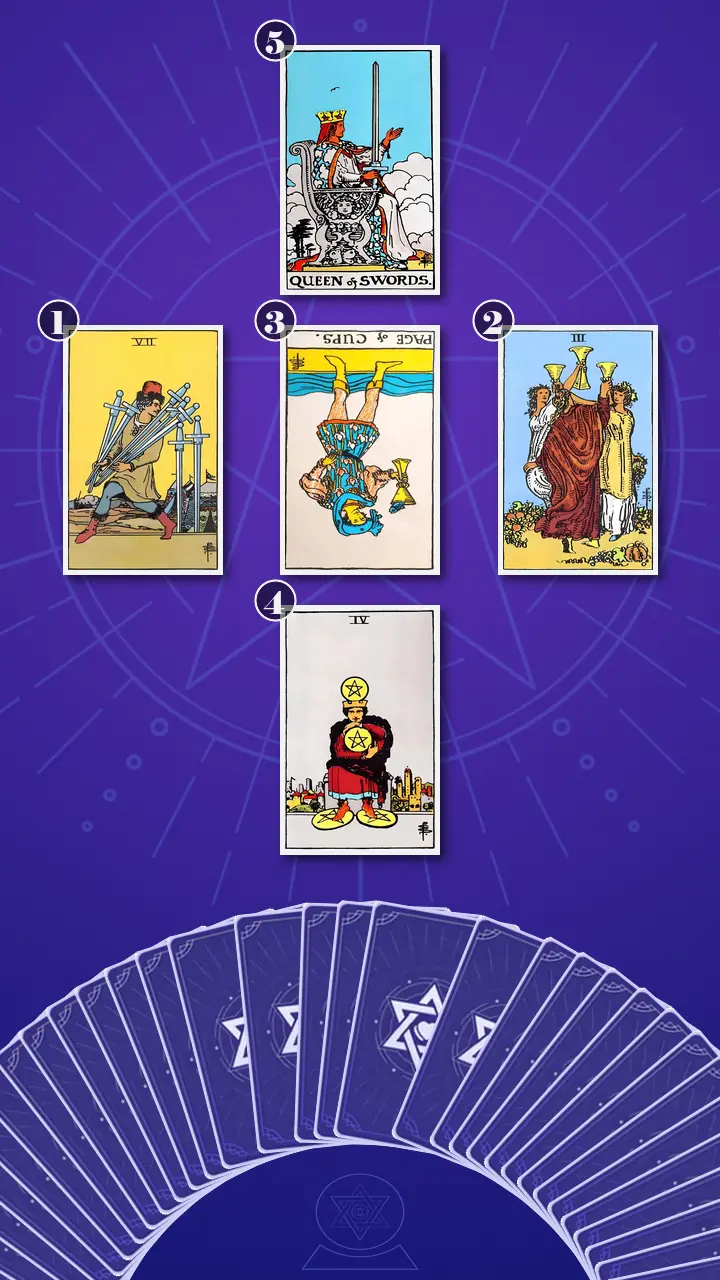
The first position would show Alex's current stance and the controlled portion of truth being carried into friendship. The second would show the relational field and the support that might already be available. The center would map the shared interaction pattern, the lower card the hidden block, and the upper card the self-directed next step.
The Message That Looked Like Honesty
The Seven Swords and the Backward Glance
For Self and current stance: reveal the concrete behavior of sharing a controlled portion of the truth while keeping the central experience of existential drift private, I turned over the Seven of Swords, upright.
Its modern scene was Alex on the London Overground, editing a vulnerable WhatsApp message. Five lines about feeling directionless survived as a neat update; the two sentences that might invite a serious follow-up disappeared. The backward glance on the card matched the moment Alex reread the text and monitored how much truth could leave the phone while the most exposing part stayed behind. The Seven of Swords carried an excess of strategic Air: thought had become surveillance, and privacy had become a carefully managed narrative.
I did not call the edit dishonest. I asked, 'Which sentence are you keeping private because it belongs to you, and which sentence are you hiding because you are trying to control what your friend's concern might mean?' Alex gave a small, bitter laugh. 'That is too accurate. Almost cruel.' Their thumb stopped moving over the phone, and their eyes dropped to the two lines still sitting in the deleted draft.
The Three Cups Across the Cafe Table
For Relational field and available support: identify what genuine friendship can offer when Alex is honest without asking friends to solve the entire uncertainty, I turned over the Three of Cups, upright.
The three raised cups became one trusted friend across a cafe table, not a public confession to the entire group chat. I pictured Alex saying, 'I have been feeling directionless lately, and I do not need you to fix it tonight,' then allowing a few seconds of silence. This Water card offered balance to the solitary Seven of Swords: friendship could be a circle that held an unfinished truth, rather than an audience Alex had to impress.
Alex remembered a friend who had listened before without rushing to problem-solve. Their shoulders lowered by a fraction, and their hand released the edge of the chair. 'What if I let this be a statement, not a test?' they asked. I said that was the experiment: not proving the friendship was safe, but allowing one ordinary truth to exist inside it.
The Fish in the Voice Note
For Shared interaction pattern: map how Performative Vulnerability turns emotional disclosure into a carefully managed exchange that creates contact without full clarity, I turned over the Page of Cups, reversed.
The fish rising from the cup looked like the genuine feeling that appeared in Alex's voice note, while the Page's absorbed gaze reflected the editing around it. Alex recorded the note four times, removed every pause and uncertain sentence, sent a sincere fragment, then added a joke in the quick, self-protective style of a Fleabag moment and asked about the friend's weekend. The feeling was real, but the delivery was blocked and mediated. A controlled confession created contact without creating the feeling of being known.
I told Alex this was not emotional immaturity or a character flaw. It was a learned way to keep the room comfortable. The card asked for one unpolished feeling without a complete explanation. Alex's fingers tightened around their phone, then loosened. They looked toward the window, as if replaying every time they had turned a serious question into a practical update.
The Four of Pentacles and the Grip Around Safety
For Hidden block and underlying fear: expose the control strategy that links revealing more with the risk of losing belonging or being seen as directionless, I turned over the Four of Pentacles, upright.
The coin pressed to the figure's chest became Alex's phone held face down at a dinner near Borough Market, while an unfinished Notes folder called 'Later' stayed private until the fragments looked coherent enough to earn an audience. This Earth energy was a blockage: control offered short-term security, but the grip itself kept support from reaching the place that needed it.
I use what I call a Boundary Permeability Diagnosis when I work with emotional space. As a perfumer, I know the difference between a scent that belongs in a room and one that has spread farther than anyone chose. With Alex, I was not looking for a bad friend whose lack of limits was bleeding into their space. I was checking whether the friends had actually demanded access, or whether Alex was sealing every door in anticipation of an intrusion. Alex inhaled sharply, held the breath, and then said quietly, 'If I give them the unfinished part, will they stay close, or will I become a problem to manage?'
When the Queen of Swords Cleared the Air
The Upright Blade Between Truth and Exposure
The room grew still as I reached for the upper card. For Self-directed integration and next step: translate the key shift into a bounded act of clear communication that allows privacy and honesty to coexist, I turned over the Queen of Swords, upright.
Her sword was not a demand for total exposure. It was a clean sentence with two edges. Alex could say, 'I have been feeling more lost than I have let on, and I am not ready to unpack the whole situation tonight.' The Queen restored Air to its mature form: discernment, direct language, and a boundary that made honesty safer rather than colder.
It was 8:47 PM on the London Overground. Alex had typed the honest reply, deleted the lines about feeling directionless, sent the manageable version, and asked about their friend's weekend instead. I brought the opening scene back into the room so Alex could see the pattern rather than be judged by it.
I said, 'You do not have to trade privacy for closeness. One honest uncertainty, paired with one clear boundary, can be more real than a perfectly edited confession.'
Stop treating a carefully edited confession as the price of belonging; speak one clear truth and one clear boundary, like the Queen of Swords using her upright blade to separate honesty from overexposure.
Alex's face went still first. Their breath paused halfway in, and their fingers hovered above the phone as if the message might change by itself. Then their gaze lost focus; I could see the deleted sentence, the repeated voice notes, and the dinners where they had laughed at the right moment moving through memory. Finally, their jaw unclenched and their shoulders dropped. A breath left them with a faint tremor. 'I thought closeness required access to everything,' they said. 'Maybe it requires access to something true, clearly offered.' There was relief in their voice, but also a brief, dizzying blankness: a clear path meant Alex would now choose the next step. I asked, 'Using this new angle, can you remember a moment last week when one honest sentence and one limit might have made the conversation feel different?'
This was the first crossing from guarded disorientation and reaction-monitoring toward discerning honesty and steadier self-trust. The Queen of Swords did not tell Alex what a friend would do. She returned the decision to Alex.
The One-Sentence Boundary
When I connected the five cards, the story was precise. The Seven of Swords showed Alex carrying a manageable headline while glancing back at the reaction it might receive. The Three of Cups showed that ordinary friendship could hold an unfinished feeling. The reversed Page of Cups showed how a sincere message became a performance when every pause was edited out. Beneath it, the Four of Pentacles revealed the fear that losing control meant losing belonging. Above it, the Queen of Swords offered the bridge: one honest uncertainty plus one clear boundary.
The blind spot was not that Alex needed to tell friends everything. It was that Alex had been treating friendship as an audience and a test at once, trying to make another person's response prove that belonging was secure. I used a second perfumer's lens, Vibe Contamination Auditing, carefully and without labeling anyone toxic. We separated the actual evidence of a friend's behavior from the residue of LinkedIn comparisons, milestone-heavy group chats, and an imagined verdict about being directionless.
My conclusion was simple: privacy is a choice; concealment is what happens when fear makes the choice for you. The practical answer to 'How can I tell a friend I feel lost without oversharing?' was not a dramatic confession. It was a small communication practice that let honesty and privacy occupy the same room.
The Space Calibration Ritual
I gave Alex my Space Calibration Ritual: create specific digital and physical blank spaces so the nervous urge to monitor, explain, or retract does not take over. The blank space was not avoidance. It was room to notice what Alex wanted to say before another person's reaction began writing the message.
- Send one bounded truthBefore Friday, choose one trusted friend and send: 'I have been feeling more directionless than I have let on. I am not looking for a solution tonight; I just wanted to say it plainly.'Use the smallest version. The friend is not owed the full backstory, and Alex is not required to manage the response.
- Keep a five-minute read-receipt pauseAfter sending, put the phone face down for five minutes. Walk to the kettle, look out of the window, and notice the throat, shoulders, and breath without checking WhatsApp or rewriting the message.If five minutes feels too much, start with sixty seconds. The pause is a digital and physical blank space, not a test of whether the friend replies.
- Name the limit in the same conversationIf the friend asks for more detail, say, 'I can talk about the feeling, but I am not ready to explain the whole situation yet.' Later, write one private note beginning 'The true thing I can say today is...' and another beginning 'The part I am choosing to keep private is...'For one detail only, ask whether it is private because Alex chooses it or hidden because Alex fears rejection. Stop after ten minutes; clarity does not require a finished identity.

The Blank Space They Chose to Keep
Four days later, Alex sat alone in a cafe after sending the bounded message. They felt lighter, but not triumphant; the empty chair beside them still carried a little of the old fear. They finished their coffee, left the phone untouched for five minutes, and let the unanswered future remain unanswered.
That evening, Alex messaged me: 'I told them I felt more lost than I had admitted. They listened. I still do not know my direction, but I did not have to turn it into a press release.'
I did not read that as the cards solving Alex's life. I read it as the first physical evidence of the Journey to Clarity: a chosen sentence, a protected limit, and a little more air between uncertainty and reaction. Closeness does not require a finished map, and a five-card Relationship Spread for friendship boundaries is useful only when it returns authorship to the person holding the cards.
When your throat closes around an answer and you feel tempted to turn your uncertainty into a polished headline, it can seem safer to stay just out of reach than to risk proving that being lost makes you harder to keep close. But clarity can begin with one true sentence and one clean boundary, not with a complete explanation.
If one honest uncertainty could remain yours, without becoming a full explanation or a request for rescue, what might you let a trusted friend hear, and what clear line would you choose to leave in the quiet space behind it?
Every reading at AceTarot is a journey to connect with inner wisdom and empower the path ahead. This reading shared here is a psychological mirror, not a private record—crafted to reflect universal emotional loops and help restore personal clarity. Please note that these insights do not replace professional psychological, medical, legal, or financial advice, and should not serve as the sole basis for major life decisions.
Learn more about our Journey to Clarity.
How did this insight land for you?
🫂 This Resonates Deeply
🌀 Living This Story
✨ Now I See Clearly
🌱 Seeing New Possibilities
🧰 Useful Framework
🔮 The Confirmation I Needed
💪 Feeling Empowered
🚀 Ready for My Next Step
Author Profile
 AI
AI Luca Moreau
835 readings | 512 reviews
“As a perfumer for fifteen years, I’ve learned to perceive human boundaries through the delicate metaphor of scent. Relationships need the right amount of space to breathe, and I've seen too many kind souls exhaust themselves trying to please everyone. I’m here with warmth and understanding—not to teach you to be guarded, but to help you gently clear the air and rediscover the comforting, safe boundaries that are rightfully yours.”
In this Friendship Tarot Reading :
Core Expertise
- Boundary Permeability Diagnosis: Identifying friends whose lack of limits is metaphorically 'bleeding into your space' and causing emotional suffocation.
- Vibe Contamination Auditing: Recognizing when a highly sensitive or negative friend is unconsciously polluting your personal psychological atmosphere.
Service Features
- The Space Calibration Ritual: A behavioral directive to implement specific 'digital and physical blank spaces', preventing enmeshment and restoring breathable boundaries.
Also specializes in :
Explore Related Patterns:
Control CopingAlex turns an unstructured experience into a polished headline, keeps an unfinished Notes folder private until it feels coherent, and wonders whether revealing it would make them a problem to manage. You are using control as a safety strategy, trying to manage both the story and the friend's possible response before either can become unpredictable. The short-term result is composure, but the grip also keeps support away from the part that needs it. Control does not have to disappear for honesty to become possible. One sentence about feeling lost, paired with one limit on further detail, lets you retain authorship without requiring the uncertainty to be solved before it can be shared.
Emotional Self-CensorshipAlex's direct sentence about having no direction is deleted before the message goes out, and every pause or uncertain line is removed from the voice note. You are not lacking a truth to share; you are filtering it until it appears safe, coherent, and socially manageable. The editing is a defense mechanism that reduces immediate exposure while silencing the part that could invite accurate support. Because the same filtering appears in text, voice notes, and changes of subject, the pattern forms a loop. Each edit offers brief relief, but it also teaches the conversation that the polished headline is safer than the messy draft. One bounded sentence interrupts that loop without requiring total disclosure, allowing you to decide what belongs in the conversation and what remains private for now.
Performative VulnerabilityAlex deletes the sentence 'I feel like I have no direction,' keeps a manageable work update, and asks about the friend's weekend. Later, the voice note is recorded four times, stripped of pauses, and softened with a joke. You are offering a real feeling, but packaging it tightly enough to manage what the other person might do with it. That controlled sincerity creates contact without the experience of being fully known. The defense protects closeness from the feared consequences of uncertainty, yet it also makes the friendship carry an edited version of what needs support. You can keep privacy without staging openness by naming one true feeling and one limit, so disclosure becomes a choice rather than a test of whether you are still easy to keep close.
Relational HypervigilanceAlex watches how much truth can leave the phone and predicts worry, distance, or a question about belonging before a friend has made that response. Your attention is scanning for relational threat, so a possible reaction begins to carry the weight of evidence. The tight throat and shallow breathing show the cost of this monitoring, while the remembered friend who listened without fixing provides information that does not fit the feared outcome. The useful shift is to separate observed behavior from imagined verdicts. You do not have to predict whether a friend will stay close in order to speak one accurate sentence. A clear limit such as not being ready to unpack the whole situation gives the relationship real information while keeping the decision about further disclosure in your hands.
Boundary DiscernmentAlex is given a sentence that names feeling lost while clearly saying the whole situation is not ready to be unpacked, and the message is directed to one trusted friend rather than the entire group chat. You are learning to distinguish privacy that you choose from concealment that fear chooses for you. The later insight makes the distinction behavioral rather than abstract. You can offer access to something true while retaining ownership of the unfinished map. This creates a boundary with two clear edges, an honest opening and a limit on further explanation, so closeness no longer depends on either complete exposure or a perfectly edited confession.
Cognitive DissonanceAlex wants emotional support but fears the disclosure that might make support necessary, and friendship becomes both an audience and a test. You are holding two conflicting rules at once. One rule says closeness requires being known, while the other says being fully seen as uncertain could make you harder to keep. The conflict stays active because the story also contains counterevidence. A friend has listened before, yet the fear still organizes the message. The resolution is not total exposure or total withdrawal. It is the ability to hold privacy and connection as compatible, then choose a specific truth and a specific limit without asking the friend's response to settle your belonging.
Explore Related Struggles:
Clarity-Exposure SplitAlex deletes the line about having no direction and keeps the Notes folder private until the fragments look coherent enough to earn an audience. The polished client update can move forward, while the personal answer stalls at the point where uncertainty would become visible. You can speak from an unfinished place instead of waiting for a finished account. Naming the uncertainty first and reserving the backstory protects your agency, because clarity can develop after the conversation rather than serving as the admission price for it.
Privacy-Belonging SplitWhen Alex deletes "I feel like I have no direction," sends "Work has been a lot, but I am okay," and asks about the friend's weekend, the same message is made to protect privacy and secure belonging. The manageable update keeps the conversation moving, but it also asks the friendship to stay close to a version of Alex that has not been given the unfinished truth. You can keep the rest of the map private without making access to it the proof of whether you belong. Saying that you feel directionless and adding that you are not ready to unpack the whole situation gives the friend something real to meet while leaving the boundary in your hands.
Truth-Connection SplitAlex records the voice note four times, removes every pause, sends a sincere fragment, adds a joke, and asks about the friend's weekend. The exchange makes contact, yet the editing keeps the friend from meeting the uncertainty itself, so being in touch and being known pull apart in the same conversation. You do not need a complete explanation for connection to be real. One sentence about feeling lost, followed by a clear limit on details, lets support reach the present fact without turning the friend into a solver or your disclosure into a test.
Explore Related Emotions:
Cautious VulnerabilityAlex tells one trusted friend that they have been feeling more lost than they admitted, while making clear that they are not asking for a solution or offering the whole backstory. The disclosure is small enough to remain chosen and honest enough to let the friend meet something real. Cautious Vulnerability allows openness to have edges. You can offer one unfinished feeling without turning the conversation into total access, using a clear limit to keep the truth connected to your own judgment rather than to pressure, performance, or a test of whether someone stays.
Conditional Belonging FearAlex deletes 'I feel like I have no direction' and wonders whether sharing the unfinished part would make a friend step back or turn them into a problem to manage. Once another person's response is made to carry proof of belonging, an honest sentence can feel like a possible eviction from the relationship. Conditional Belonging Fear lives in the pressure to remain coherent, undemanding, and easy to keep close. Naming that pressure helps you separate a friend's actual behavior from the verdict you are anticipating, so privacy can remain your decision instead of becoming a condition you believe you must satisfy.
Guarded LongingAlex wants emotional support, keeps a folder of unfinished truths called 'Later,' and redirects close friends toward safer subjects whenever they ask a personal question. The movement toward connection is real, but it stops just before the part that would allow support to meet the actual need. Guarded Longing holds both impulses at once: the wish to be accompanied and the urge to stay just beyond reach. You are not required to surrender every private detail to honour that wish; the important distinction is whether the distance reflects a boundary you chose or a rejection you are trying to prevent before it happens.
Imperfection Exposure DreadAlex's throat tightens before personal questions, their breathing becomes shallow during honest conversations, and every uncertain sentence is removed from the voice note. The body treats an unfinished account of the self as something that must be cleaned up before another person can safely see it. Imperfection Exposure Dread is the felt risk of appearing directionless without a polished explanation to contain the impression. It can make you confuse being honestly unfinished with being unfit for closeness, even though a bounded truth gives you room to be seen without handing over the entire situation.
Polished AlienationAlex turns 'I have no direction' into 'Work has been a lot, but I am okay,' then quickly asks about the friend's weekend. The exchange maintains contact, but the sentence that would let the friend encounter Alex's actual uncertainty never leaves the draft. Polished Alienation is the distance created when a message looks intimate while its most meaningful truth remains inaccessible. You can be responsive, articulate, and socially present while still feeling unseen, because the version receiving companionship is the edited headline rather than the person carrying the blank map.
Cautious Self-TrustAlex identifies one true sentence, names one limit, sends the bounded message, and leaves the phone alone instead of immediately managing its reception. Each action places the decision about disclosure back with the person who actually owns the experience. Cautious Self-Trust is built through that sequence rather than through certainty about how a friend will respond. You can judge what is ready to be spoken, what remains private, and when to pause, allowing your boundary to express authorship instead of serving as camouflage for an anticipated verdict.
Existential VertigoAlex carries a carefully edited map through London while hiding every blank space, and milestone-heavy group chats make those blanks feel socially legible. Their uncertainty about direction begins to affect not only where they are going, but whether they still occupy a credible place beside their friends. Existential Vertigo is the inner sensation of moving through a recognisable life without a stable point of orientation. You do not need to manufacture a finished map to restore authorship; naming one true uncertainty can locate you in the present even while the larger route remains unresolved.
Liberating UncertaintyAlex finishes their coffee, leaves the phone untouched for five minutes, and lets the unanswered future remain unanswered. The friend has heard something true, while Alex still does not know which direction their life will take. Liberating Uncertainty appears when not knowing stops functioning as evidence that you must hide or hurry. You can remain unfinished and still participate in closeness, allowing the next step to emerge from your own observation rather than forcing a polished identity to fill every blank space.
Truth ReliefAlex's shoulders lower when they remember a friend who has listened without rushing to fix things, and their jaw unclenches when honesty is separated from total exposure. Four days later, saying they feel more lost than they had admitted leaves them lighter even though their direction is still unresolved. Truth Relief comes from ending the labour of making the central feeling look more manageable than it is. You are not relieved because every outcome has been secured; the release arrives because one accurate sentence has finally been allowed to exist without carrying the burden of a complete explanation.
Self-Betrayal AcheA heavy chest follows every time Alex deletes the central sentence, changes the subject, or turns a serious question into a practical update. The immediate interaction stays manageable, but the truth Alex wanted someone to hear is left behind in the draft. Self-Betrayal Ache emerges when anticipated rejection repeatedly speaks in place of your own chosen boundary. The ache does not mean privacy is wrong; it marks the difference between deliberately keeping something yours and watching a meaningful truth disappear because someone else's imagined reaction took control of the edit.
Explore Related Contexts:
Friendship Privacy NegotiationAlex says, "I have been feeling more lost than I have let on," while also stating that the whole situation is not available for discussion yet. The friend is offered a meaningful truth, a clear limit, and a defined role that does not include solving the uncertainty. Those terms turn privacy from an invisible barrier into an explicit part of the friendship. You can remain connected without making unrestricted access the price of closeness, because both people know what is being shared, what is being retained, and what kind of support is welcome. The negotiation is therefore not about choosing between secrecy and complete exposure. It is about keeping authorship over your private material while allowing something real to enter the relationship.
Friendship Spotlight TestAlex rereads the edited message, monitors how much truth can leave the phone, and asks whether sharing the unfinished part will preserve closeness or make them a problem to manage. The story later identifies the same structure directly: friendship has become an audience and a test at the same time. When a friend's response is asked to prove that belonging is secure, an ordinary conversation starts functioning like an evaluation. You are no longer only deciding what to disclose; you are also trying to control the disclosure well enough to prevent a reply from becoming evidence about your social worth or place in the relationship. Recognizing the test changes what the response is allowed to mean. A friend can listen, hesitate, ask a question, or need time without any single reaction becoming a final verdict on whether your unfinished life remains welcome beside theirs.
Performative Intimacy CircleAlex records the same voice note four times, removes the pauses and uncertain sentences, adds a joke, and quickly asks about the friend's weekend. The resulting message contains genuine feeling, but every element that could invite sustained attention has been edited into a manageable social update. Repeated across texts, voice notes, and dinners, that delivery turns friendship into a performance space where contact continues without full clarity. You may be saying something true while still organizing the exchange so carefully that support cannot reach the unresolved part of your situation. The relevant distinction is not honesty versus dishonesty. It is the difference between privacy you deliberately retain and presentation work that pre-manages the other person's response, leaving you socially present but only partially available to be known.