When Breakup Pain Became the Membership Fee: One Direct Request

The 11:40 p.m. Voice Note That Tried to Keep Her in the Group
I met Maya during a week when she had calmly defended a design decision in a Monday UX critique, yet one quiet WhatsApp chat after a breakup had made her question whether she still belonged anywhere outside work.
She brought me back to 11:40 p.m. on Tuesday, in the small bedroom of her rented Dalston flat. The boiler clicked through the wall. Her phone had grown warm against her palm as she watched the conversation move from her first breakup update to loose Saturday plans.
She had recorded a second four-minute voice note, deleted it twice, and finally pressed send. Then she kept the chat open while reaction icons appeared. Her chest tightened; a hollow drop moved through her stomach like a lift descending before the doors had closed.
“I know I’m repeating myself,” she told me. “But silence feels worse. Sometimes I don’t know whether they miss me or just feel sorry for me. If I’m fine, what reason do they have to check in?”
I heard genuine grief in her voice. I also heard the private social calculation running beneath it: I wanted to ask for company, but I sent evidence of distress instead. She wanted ordinary inclusion, but she offered extraordinary pain because pain had received the fastest reply.
It was as if the group-chat algorithm had learned that crisis produced engagement. Every quiet spell prompted a more emotionally intense post, even though the engagement never fully answered the question she was asking: Would you still choose me if I arrived without a crisis?
“The pain can be real and still be doing a social job,” I said. “I’m not here to judge the way you have survived this transition, and I’m not going to claim that the cards can tell us what your friends secretly think. I want us to see the pattern clearly enough that you can choose what happens next.”
I placed the deck between us. “Let’s make a map of the fog: what you do when belonging feels uncertain, what you can actually observe from the group, what fear sits underneath the loop, and where your own agency begins.”
Choosing the Footbridge: A Five-Card Relationship Spread
I asked Maya to take one slower breath and notice where the question lived in her body. She rested a hand near her sternum. I shuffled while she focused on one sentence: “Why do I keep sharing breakup pain to stay in the friend group?” The pause was not a mystical performance; it was a way to move from reacting to observing.
I chose a classic five-card Relationship Spread in a cross layout because this was not only an internal struggle. The behaviour was being activated through a relational exchange: Maya sent a disclosure, observed replies or silence, interpreted those responses, and changed what she shared next. I needed a structure that could examine both the inner fear and the visible social pattern without pretending to read anyone else’s mind.
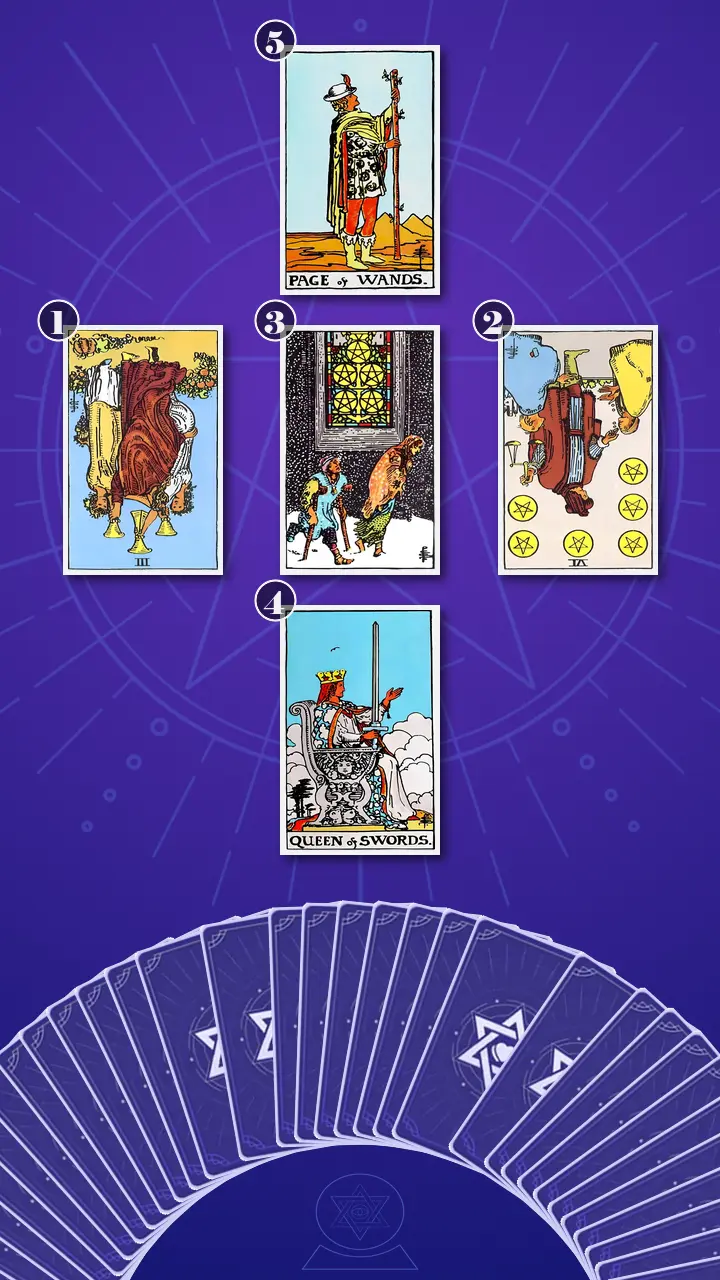
I laid the first two cards opposite each other. The card on the left would show Maya’s current behaviour; the card on the right would examine observable group responses and her interpretation of them. The centre would reveal the hidden glue holding the pattern together. Below it, the fourth card would name the relational challenge. Above it, the fifth would show a constructive direction.
The arrangement looked like a footbridge: two social banks on either side, a central support, then a vertical route leading from fear through discernment toward renewed participation. Tarot, in this kind of reading, does not decide who stays. It gives us a stable picture against which assumptions, needs, boundaries, and next steps can be tested.
The Social Loop Hidden in the Cards
Position One: Three Cups Around a Voice-Note Waveform
I began with the card representing the presenting symptom: how Maya currently used repeated breakup disclosures to test whether she still had a place in the friend group.
I turned over the Three of Cups, reversed.
In its upright form, the card shows friendship as shared pleasure: three figures raising their cups inside a close, interlaced circle. Reversed, that Water energy was blocked. The desire for closeness remained genuine, but the circle no longer felt naturally available. Maya had begun trying to manage her way back into it through emotional intensity.
I returned to the scene she had described. At 11:40 p.m., the WhatsApp conversation moved from her first breakup update to Saturday plans. She recorded another four-minute voice note, deleted it twice, sent it, and watched the reactions. In this position, the reversed Three of Cups was not simply loneliness. It was the moment friendship became something she tried to re-enter by making pain visible enough to turn the circle back toward her.
“The useful question isn’t whether your grief is sincere,” I told her. “It is. The question is whether this particular disclosure contains something new that you want witnessed, or whether it has become a membership test.”
Maya gave a short laugh, but there was no humour in the exhale. “That’s so accurate it feels a bit brutal.”
I let the reaction stand without correcting it. “It can hurt to recognise a coping pattern because recognition removes some of its privacy. But I’m not calling you manipulative. You found a message that reliably brought people toward you during a frightening transition. The problem is that the short-term relief may be teaching you that only the most wounded version of you deserves a response.”
Her thumb rubbed the edge of her mug. She looked at the three overturned cups for several seconds, then said, “I wanted to ask whether anyone was free. I just didn’t think that was enough to send.”
Position Two: When WhatsApp Became Splitwise
I moved to the card representing the friend-group side of the exchange: the observable responses Maya received and the meanings she attached to reassurance, silence, and uneven attention.
I turned over the Six of Pentacles, reversed.
The card’s scales immediately brought me to Maya’s mental dashboard. On the Northern line, she counted who replied, how quickly they replied, whether someone used a heart reaction, and whether anyone converted sympathy into an invitation. When the apparent balance looked low, she sent extra context to the friend most likely to answer.
It was like turning WhatsApp into Splitwise. Replies, reaction icons, invitations, screenshots, and disclosures entered an emotional account as credits and debts. The reversed Earth energy showed reciprocity becoming distorted by anxious scorekeeping: If the balance is low, I must offer more.
“This card doesn’t prove your friends are consciously charging you pain in exchange for care,” I said. “It asks us to separate what appeared on the screen from the conclusion your nervous system produced.”
I asked her for one recent example. She described three heart reactions, no follow-up question, and a birthday message elsewhere in the chat that received six full replies.
“Those are the observable facts,” I said. “What did you conclude?”
“That they know how to comfort me, but they don’t actually want me there.”
Her fingers stopped moving. Her eyes shifted away from the cards as if she were seeing the cracked corner of her phone beneath the Northern line’s fluorescent light. Then she released a slow breath through her nose.
“That conclusion may eventually contain useful information,” I told her. “Some friendships do become unequal. But reaction counts alone cannot settle the entire question of your belonging. Right now, the analysis is producing more monitoring, not more clarity.”
Position Three: The Lit Window Maya Had Not Knocked On
I turned inward to the card representing the hidden foundation of the pattern: Maya’s fear that losing the breakup role would place her outside the group.
The card was the Five of Pentacles, upright.
Two injured figures walked through falling snow beneath an illuminated window. Support might have existed beyond the glass, but the figures did not appear to be entering or even asking whether entry was possible. Here, Earth was experienced as deficiency: not necessarily proof that no relationships were available, but a profound lack of secure ground beneath Maya’s sense of belonging.
I described the Saturday scene she had shared with me. She had been sitting outside a cafe near London Fields while Instagram showed two mutual friends already at brunch. The espresso machine hissed behind the door; cold metal pressed against her wrist. The bright Story on her screen became the card’s stained-glass window.
“I have not asked whether the door is open because I am already bracing for it to be closed,” Maya said quietly.
I used my Group Archetype Decoding lens here. I was not claiming to know which role her friends had consciously assigned her. I was examining the role the social system had begun rewarding and the role Maya felt forced to keep playing: The Wounded Friend, the newly single person everyone knew how to check on during a crisis.
That role had offered care, but it had also crowded out her humour, her work stories, her opinions about terrible app redesigns, the music she liked, and the Design Museum link still sitting in her drafts. Every repetition made the breakup role more visible while making the rest of her harder for the group to encounter.
“When you imagine going one week without giving them a breakup update, what exact outcome do you fear by the weekend?” I asked.
Her breath paused first. Her hand remained suspended above the table, fingers slightly curled. Then her gaze lost focus, as if she were replaying several quiet chats at once. Finally, her shoulders folded and a small “Oh” escaped from somewhere low in her chest.
“They’d stop asking,” she said. “And I’d find out the breakup was the only thing connecting me to them.”
I kept my voice steady. “That fear deserves to be taken seriously. It also explains why the current strategy cannot give you the evidence you need. If pain is always sent ahead to reopen the door, you never get to learn which relationships can respond to an ordinary invitation from the rest of you.”
When the Queen’s Sword Separated Need from Proof
Position Four: The One-Sentence Truth
I reached for the card representing the central relational challenge and the transformation available through clearer emotional boundaries. The room had grown quiet. Outside the window, a pale break appeared between two banks of London cloud, and a clean strip of light crossed the table as I turned over the Queen of Swords, upright.
The Queen held her sword vertically at eye level. Her other hand remained open. I read the sword as discernment rather than coldness: a clear division between “I am genuinely grieving” and “I must display grief to earn contact.” The open hand preserved warmth, invitation, and relationship without surrendering authority over what Maya shared.
Her Air energy was balanced. She did not demand emotional independence or perfect detachment. She asked for precision. In Maya’s life, that looked like deleting the explanatory paragraphs, screenshots, and apology while keeping one sentence: “I miss spending time with you. Are you free for coffee on Saturday?”
I then brought in my Persona Fatigue Diagnosis. Through a Jungian lens, a persona is not automatically false; it is the social face that helps us move through a group. Fatigue begins when one narrow persona must be maintained so continuously that it drains the energy needed to live as a fuller self.
Maya’s exhausting mask was not “the vulnerable person.” Vulnerability was part of her truth. The mask was The Friend Who Must Remain Visibly Broken to Remain Legible. Maintaining it required reviewing old messages, polishing grief into increasingly persuasive narratives, monitoring reactions, and hiding ordinary interests that did not seem urgent enough to deserve attention.
For a moment, I remembered conversations I had held across different cultures, in cities where the social rules looked completely different on the surface. Again and again, I had seen the same Jungian tension: a persona begins as a bridge into belonging, then quietly becomes a uniform the person is afraid to remove.
I brought Maya back to the exact setup: at 11:40 p.m., the chat had already moved to Saturday plans. Her phone was warm, her chest tight, and a second voice note felt easier to send than the five honest words beneath it: “I want to see you.”
Your pain is not the membership fee; ask for connection in plain language, and let the Queen's upright sword separate an honest need from performed suffering.
I left a full breath of silence, then gave her the same insight in the form of a boundary she could carry into WhatsApp:
Your pain is not the membership fee: name the connection you want, and let the response be information rather than a verdict on your worth.
Maya’s breath stopped. Her fingers tightened around the mug and remained there, white at the knuckles. Her pupils widened slightly; then her eyes moved away from me, unfocused, as if the late-night waveform were replaying in the air beside us.
“But doesn’t that mean I was doing it wrong the whole time?” she said. The words came out sharper than anything she had said before. Anger arrived first, then hurt. “Like I made all of this embarrassing for no reason?”
“No,” I said. “It means the strategy protected you from a frighteningly direct question. It brought short-term reassurance when you needed contact. The grief was not fake, and your need was not shameful. The strategy can have been intelligent and still have become expensive.”
Her jaw trembled once. Her grip loosened; one finger at a time, her hand opened against the table. Her eyes reddened, and her shoulders dropped so suddenly that she looked briefly unsteady, as if putting down a heavy bag had changed her balance. A thin, shaky breath became a longer exhale.
“That feels worse and better,” she said. “If I ask plainly, I have to hear the answer.”
“Yes,” I replied. “The answer may be warm, delayed, awkward, or disappointing. Clarity is not a guarantee that every relationship will meet you. It is the ability to receive information without turning one reply into a verdict on whether you deserve belonging.”
I asked her, “Now, with this new perspective, think back to last week. Was there a moment when this insight could have made you feel different?”
She remembered the Design Museum listing blinking beside an unsent message after her UX stand-up. She had wanted to share the exhibition and ask whether anyone fancied going. Instead, she had decided the invitation would sound needy unless she first explained how lonely the weekend felt.
“The honest message was already there,” she said. “I just didn’t trust it without the pain story.”
I invited her to set a ten-minute timer and open Notes. She wrote the painful explanation she felt pulled to send, then placed one line beneath it: “The connection I actually want is...” She completed the sentence with “coffee with one friend where we talk about normal life too.”
We turned that line into one request addressed to one person, with one place and time. I reminded her that drafting counted, that she could choose whether to send it, and that she did not need to include screenshots, sexual details, or another person’s private information to make the request legitimate. The minimum version was three words: “Coffee this week?”
This was the pivotal movement of the reading: not from grief to indifference, and not from dependence to perfect self-sufficiency, but from fear-driven social vigilance toward direct relational clarity and self-respect. Maya still wanted connection. The Queen simply returned authorship of the request to her.
The Page’s Unfinished Weekend
Position Five: A New Interest Before a Finished Identity
I turned over the final card, representing the constructive direction available when Maya experimented with connection, interests, and identity beyond the breakup role.
It was the Page of Wands, upright.
The Page studied a budding staff in an open, unmapped landscape. Fire entered the spread as curiosity and movement. It did not promise that the old group would return to its previous shape. It showed Maya’s underused capacity to begin before certainty was available.
In modern life, the card looked like Maya saving a free gallery event, asking a colleague about a design talk, or inviting one friend for a weekend walk because the activity interested her now. The interaction could be a small social experiment rather than a referendum on the future of the whole friend group.
“You do not need a finished new self to make one new plan,” I told her. “Think of it as moving something out of an overloaded Notion backlog and into a ten-minute prototype: one interest, one invitation, one observable result.”
She looked at the Page’s yellow tunic and then back at the Queen. “So the Queen writes the message, and the Page lets it be a bit awkward?”
“Exactly,” I said. “The Queen makes the request honest. The Page stops demanding that the first attempt solve your entire social identity.”
Maya’s mouth lifted at one corner. She mentioned a colleague who had already asked whether she wanted to see a new exhibition. I watched her recognise that ordinary interest had offered a doorway she had almost ignored because it did not arrive wrapped in crisis.
The answer to an invitation could tell her something about that invitation and that relationship. It did not get to define all of her. The budding staff was enough: an interest already alive, even if its future shape remained unknown.
A Reply Is Information, Not a Verdict
I read the whole spread back to Maya as one connected story. The reversed Three of Cups showed her using distress to pull an unstable social circle toward her. The reversed Six of Pentacles turned the resulting attention into an emotional reply ledger. The Five of Pentacles revealed the scarcity rule beneath both cards: if she stopped looking visibly hurt, she feared the social door would close.
The Queen of Swords interrupted that loop by separating authentic grief from the indirect task assigned to the disclosure. The Page of Wands then moved her toward an identity built through curiosity, ordinary participation, and small experiments rather than one dramatic reinvention.
Her cognitive blind spot was not simply “overthinking.” She had begun treating crisis attention as the only trustworthy evidence of belonging while overlooking a harder but more useful test: whether a friendship could respond to a direct request, an ordinary joke, a work story, a shared interest, or reciprocal care.
I was careful not to promise that every direct invitation would succeed. Some responses might reveal warmth; others might reveal inconsistency or limits. That information could be painful, but it would be cleaner than repeatedly reopening a wound to postpone the question. A reply can be information without becoming a verdict.
The Mask Detachment Protocol
I adapted my Mask Detachment Protocol into three small experiments. Its purpose was not to suppress Maya’s grief or force her to act unaffected. It was to separate her core truth from the group role she felt compelled to perform, then help her choose a bounded action from a less depleted place.
- Pause and detach the role.Before the next vulnerable message, set a twenty-minute timer. In Notes, write three lines: “What I genuinely feel,” “What the Wounded Friend role says I must perform,” and “What connection I actually want.” Then choose one label: witnessing, advice, or company.Drafting counts. Stop if the exercise feels too exposing, and leave out private details that are not yours to share.
- Make the one-sentence connection ask.On Wednesday at 6:00 p.m., message one relatively safe friend: “I miss hanging out with you. Are you free for coffee near Old Street on Saturday morning?” Send it without a breakup preface if it still expresses what you want.Ask for the connection, not permission to deserve it. The minimum version is “Coffee this week?”
- Reset the reply ledger and prototype something new.After sending, put the phone in Focus mode for ten minutes and wash a mug or walk to the end of the street. Record one fact and one conclusion separately. By Friday lunch, save one free Design Museum, BFI, gallery, or Meetup event and send it to one interested friend or colleague.A delayed reply, decline, or neutral outing still counts as information. Curiosity does not require overcommitting, overspending, or staying somewhere uncomfortable.
I told Maya that the key shift was deliberately small: instead of offering another breakup disclosure when contact faded, she would make one direct, bounded request for connection or initiate one shared-interest plan. She could let grief remain real without making it the admission price for friendship.

A Week Later: The Quiet Proof
Six days later, I received a message from Maya. She had opened the chat at 5:58 p.m., pasted the coffee invitation, deleted the apology beneath it, and pressed send. Then she put the phone in a kitchen drawer and washed the mug that had been sitting beside the sink since breakfast.
The reply came later than she wanted. Her friend said Saturday was difficult but suggested a quick drink the following Tuesday. Maya noticed the familiar drop in her stomach, wrote “The fact is: she suggested another day,” and resisted turning the delay into a ruling on the whole group.
She also sent the Design Museum listing to her colleague with one line: “You mentioned this the other day. Fancy going next week?” She did not explain her loneliness. She did not need the outing to become a new best friendship. She allowed it to be one ordinary signal from a self that was still developing.
That night she slept through. In the morning, her first thought was still, “What if they stop asking?” This time she noticed it, smiled without fully believing the fear or dismissing it, and got dressed.
I did not see this as tarot predicting a happy social outcome. The cards had helped us externalise a loop, but Maya created the change: she recognised the mask, named the connection she wanted, tolerated an imperfect response, and made room for curiosity beside grief.
That was her Journey to Clarity. She had not solved the future of the friend group. She had taken one step from fear of exclusion and reassurance-seeking toward direct communication, self-respect, and an identity larger than the breakup.
When the WhatsApp screen stays quiet, a tight chest and hollow stomach can still make one more painful voice note feel like the only way to keep a seat in the room. If that moment is familiar, I would want you to remember this: noticing that pain is being asked to perform a social job does not make the pain less real. It means you are no longer entirely trapped inside the pattern.
If your pain did not have to introduce you, what small, ordinary invitation could your own Queen’s sword clear space for this week?