From Acting Healed Around Friends to Honest, Steadier Belonging

The 6:40 p.m. Audition for the Old You
If you can turn a rough season into a polished three-part update before the first round arrives, this may be why acting healed around friends feels easier than arriving unfinished.
Casey, a 27-year-old marketing coordinator, set a screenshot beside my card cloth. As they told it, at 6:40 p.m. on a Friday, they had stood outside a crowded Ossington bar while bass thudded through the door and cold traffic air stung their nose. Their phone felt warm in one hand as they rewrote their answer to “How are you really?” from “It is still uneven” to “Honestly, so much better now.”
“I genuinely wanted to go in,” Casey said. “I miss them. But if I show up, I feel like I have to be the version of me who is fine.”
Inside, the group had cheered about having the “old Casey” back. Casey joined the toast, delivered a neat story about what the difficult period had taught them, and turned the ending into a Fleabag-style joke before anyone could ask what remained difficult. Their planned 9:30 departure became 11:20. On the fluorescent-lit Line 2 train home, with the wheels shrieking around a curve, they muted the group chat beneath a stream of smiling photos from the night.
Their apprehension felt less like a thought than like carrying a glass filled to the rim through a packed subway car: jaw locked, shoulders lifted, breath rationed, every movement calculated to prevent a spill. Shame appeared in the effort to smile on cue. Longing pulled them toward the table. Resentment arrived later, as a heavy ache behind the eyes, once nobody was watching.
“You are not faking that you miss them,” I said. “You are editing what it costs you to return. The conflict is that you want your friends back, but you fear the unfinished version of you might not be welcomed as easily as the recovered one.”
I told Casey I would not use tarot to predict whether their friends would accept or reject a boundary. Cards cannot supply evidence about conversations that have not happened. What they can do is slow a pattern down, separate fear from fact, and help us find the moment where Casey still has a choice. “Let us make a map of the audition,” I said, “and then see where you can stop performing.”

Choosing the Shadow Spread as Our Map
I invited Casey to place both feet on the floor, take one ordinary breath, and notice their jaw, shoulders, and stomach without trying to fix any of them. I shuffled slowly while they held the question in mind. The preparation was not a mystical test; it was a transition out of rapid self-monitoring and into deliberate attention.
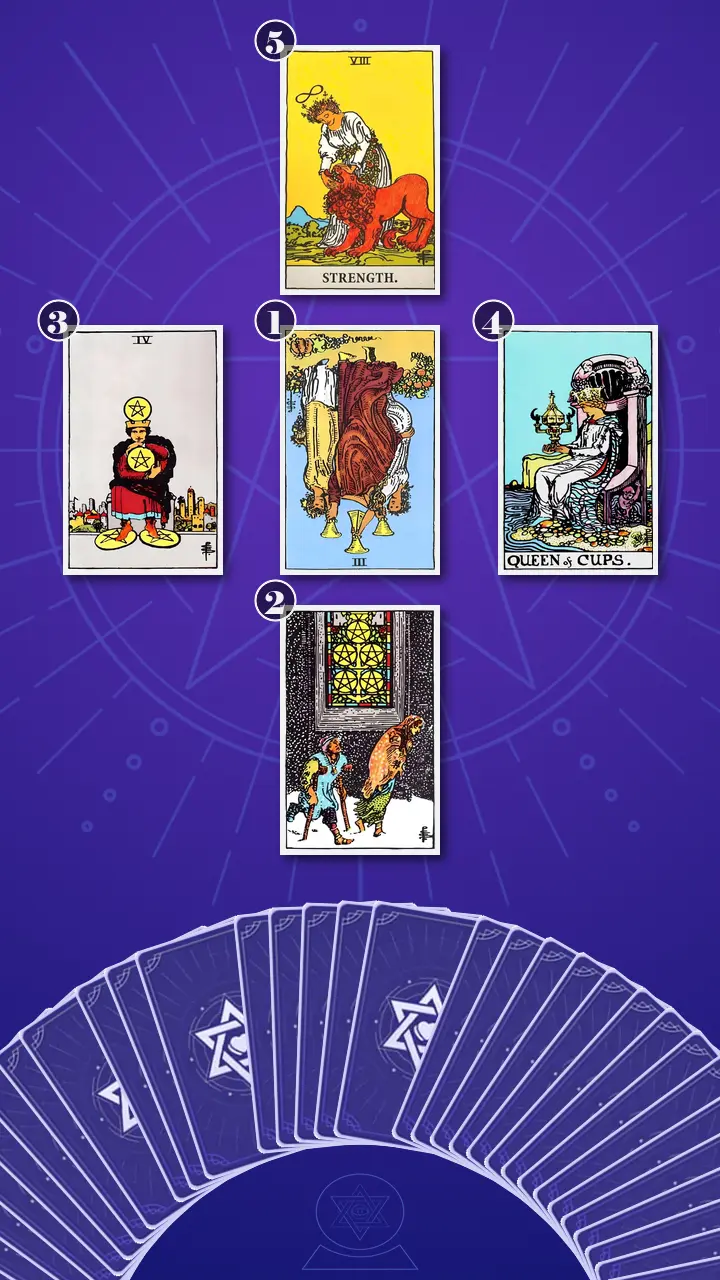
I chose The Shadow Spread, a focused five-card tarot spread for social re-entry and emotional boundaries. For anyone wondering how tarot works in a consultation like this, I use the layout as a structured reflection tool. Its value lies in comparing card meanings in context with lived evidence, not in treating the cards as an authority over the person sitting with me.
The spread was right for Casey because the question was not primarily, “What are my friends thinking?” It was, “Why does this performance keep happening inside me?” The first position would show the visible social pattern. The second would uncover the fear giving it force. The third would explain the protective payoff. The fourth would reveal the disowned need and available resource. The fifth would offer a method of integration: one proportionate truth, one clear limit, and participation matched to actual capacity.
I placed the first card at the center, the root below it, the defense to the left, the hidden resource to the right, and the integration card above. On the table, the cross resembled a person standing over their own shadow, one hand gripping an old script while the other reached toward a different scene.
Where the Comeback Story Started to Fray
Position 1: The Toast That Mistook Attendance for Readiness
I turned over the card representing the observable shadow expression: the polished version of healing Casey performed while visibly rejoining the group. It was the Three of Cups, reversed.
Three figures normally raise their cups in a synchronized celebration. Reversed, their shared rhythm no longer guarantees emotional alignment. I connected that image directly to Casey’s first pub night back: joining the toast, saying they were “so much better now,” making the difficult period sound funny and resolved, and staying an extra hour while their shoulders remained lifted. The reunion was real. The warmth was real. But visible participation was being mistaken for emotional readiness.
I read the reversed Water as a blockage in natural emotional exchange, followed by an excess of adaptation to the group’s visible mood. Casey’s internal line sounded like this: “I do want to be here, but if I show that I am still struggling, then everyone’s relief might disappear.” The card did not accuse them of deception. It showed the strain of matching a shared toast while privately checking the time and monitoring every answer.
Casey let out a short laugh, but no amusement reached their eyes. “That is so accurate it is almost rude,” they said. Their thumb pressed into the side of their mug, then released. “The joke, the extra hour, muting the chat afterward. That is literally the sequence.”
“Then the first distinction matters,” I said. “Attendance tells us that you wanted contact. It does not tell us how much contact your body could sustain. What did you do to signal that you were back, and what was your body communicating at the same time?”
Casey glanced at the card. “My mouth said, ‘I am back.’ My jaw said, ‘Please do not ask another question.’”
Position 2: The Lit Window on the Other Side of the Snow
I turned over the card representing the root fear beneath performative vulnerability, especially the belief that unfinished pain might threaten Casey’s inclusion. It was the Five of Pentacles, upright.
I pointed to the two struggling figures moving through snow beneath an illuminated stained-glass window. For Casey, the window became the bright group chat on the TTC: photos from gatherings they had missed, heart reactions, new plans, and cheerful messages about having the “old Casey” back. Nobody had explicitly demanded a completed recovery story. Still, Casey had read the visible closeness as evidence that continued invitations depended on returning quickly and being easy to host.
The upright card held an excess of scarcity vigilance and a deficiency of tested evidence. Fear had converted several posts and casual comments into a verdict: “Nobody has said I am too much, but what if my unfinished pain is the thing that finally leaves me outside?” I was careful to distinguish anticipated exclusion from actual rejection. The Five of Pentacles described the expectation Casey was responding to; it did not prove what their friends would do.
Casey’s breath caught high in their chest. Their gaze moved from the bright window in the card to the dark pane beside my table, where rain had begun to silver the glass. After a long pause, they said, “I keep treating every invitation like it might be the last one unless I handle it correctly.”
“When you imagine saying, ‘It is still uneven,’ what outcome flashes up first?” I asked.
“Fewer invitations,” they said. “Or everyone becoming careful around me. Like I have stopped being a friend and become a situation.”
I nodded. “That feared outcome deserves to be named. It also deserves to remain a hypothesis until real interactions give you evidence.”
Position 3: The Live Need Hidden Behind the Campaign Update
I turned over the card representing the shadow’s protective function: how curated disclosure and over-functioning reduced immediate uncertainty while keeping Casey’s recovery at a standstill. It was the Four of Pentacles, upright.
The figure held one pentacle over the chest, balanced another at the crown, and pinned two beneath the feet. I saw Casey’s polished campaign update in that posture: context, challenge, lesson learned, reassuring close. Before dinner, they selected which difficult details could be shared, attached a takeaway to each one, and prepared jokes for follow-up questions. They appeared open, but the live sentence, “I still need a slower pace,” stayed locked away because another person’s response could not be edited in advance.
This was an excess of protective control. The instinct to conserve emotional energy was legitimate, but it had hardened into a system where every disclosure had to be safe, complete, and unable to require anything from another person. Curated vulnerability lets people see the wound only after it has stopped asking anything of them.
I used my Typecasting Analysis here. I asked Casey to imagine the group as a film set and name the role they believed had already been assigned to them. I was not claiming their friends had deliberately trapped them in a character. I was looking for a role reinforced by group comments, old habits, and Casey’s own fear of losing the part.
“The funny, capable one,” Casey said immediately. “The one who can talk about something awful and somehow make everyone feel better.”
That answer reminded me of an editing room, where a complicated performance can be cut until only the most audience-friendly arc remains. In my work as an artist, I have learned that a clean ending can be technically impressive and emotionally false. Casey’s life was still in production, but they were publishing the campaign case study while the project was still breaking behind the scenes.
As I described the instant after an unscripted question, Casey went still. Their fingers hovered above the mug as though a memory had paused beneath them. Then their jaw tightened and their eyes shifted away. “I can tell them what happened,” they said, “as long as I can control what they might need to do with it.”
“That is the protective logic,” I said. “It keeps the room predictable. It also keeps current support structurally impossible. Privacy chooses access. Performance tries to control the response.”
Position 4: The Queen’s Private Cup by the Window
I turned over the card representing Casey’s unmet emotional need and hidden resource: private self-attunement, selective honesty, and intentional boundaries before social re-entry. It was the Queen of Cups, upright.
The Queen studied an ornate, enclosed cup at the water’s edge. She did not deny what it held, broadcast it to a crowd, or pour it out to prove her authenticity. Her gaze suggested chosen dosage, audience, and purpose. I read her Water as balance: an available emotional capacity that Casey had been underusing because analysis and presentation kept arriving before self-recognition.
I asked Casey to picture the quiet moment before the next invitation: sitting near their apartment window, phone in hand, checking what was actually true before replying. The private script became, “This is real. This part is private. This one sentence is shareable.” In that scene, Casey could write three lines: what was true now, what should remain private, and what response would feel useful. One trusted friend might hear, “I am doing better in some ways, but it is still uneven. I do not need advice tonight.” The rest could stay inside the Queen’s enclosed cup.
Casey released a breath long enough to lower their shoulders. “So I do not have to choose between saying I am completely fine and telling the whole group everything?”
“Exactly,” I said. “Total disclosure is not the price of honesty. The Queen’s gift is containment, not secrecy. She recognizes the truth before choosing who, if anyone, receives access.”
Outside, the rain softened to a fine tapping against the window. The room seemed to follow the card’s instruction: less noise, less display, more room to hear a single sentence clearly.
When Strength Put a Gentle Hand on the Script
Position 5: Courage Without the Comeback Performance
The room became noticeably still before I turned the final card. This position represented integration: how Casey could bring unfinished healing and friendship into the same room through one proportionate truth, one clear limit, and attendance matched to actual capacity.
The card was Strength, upright.
I pointed to the woman’s calm hands at the lion’s jaw. She did not abandon the lion, overpower it, or force it to look harmless. For Casey, the lion was the raw urge to joke, reassure, and stay beyond capacity. Strength meant noticing that urge without obeying or attacking it, then saying, “I am happy to be here, and I am not fully back yet. I am heading off around 9:30.” It meant allowing ten uncertain seconds to pass without converting the boundary into a punchline.
I read this upright Fire as balance: warm, disciplined courage rather than force. Casey had been caught in the same ten-second crisis again and again: the phone glowed with “How are you really?”, their jaw locked, and “so much better” appeared because getting through the door seemed to require a story whose hard part already had an ending.
You do not have to muzzle what is still tender to qualify as healed; choose one honest boundary, and let Strength's gentle hand on the lion model courage without performance.
I let the sentence remain in the quiet.
For one beat, Casey stopped breathing. Their fingers froze around the mug, and their pupils widened as though the card had moved closer. Then their gaze lost focus. I watched them replay something: the toast, the joke, the 9:28 alert buzzing against their thigh, the extra round, the train home. Their mouth tightened before the recognition turned sharp. “But does that mean everything I did before was wrong?” they asked, louder than they had spoken all evening. I kept my voice level. “No. It means those choices had protective intelligence and a cost. We are not putting your survival strategy on trial. We are deciding whether it still deserves every line in the next scene.” Their fist loosened first. Then their shoulders dropped. Their eyes reddened, and a shaky breath left their chest. Relief appeared, followed by a blank, almost dizzy look: if the script was optional, Casey would now have to choose what to say without the old guarantee of smoothness.
“Now, with this new view, think back to last week,” I said. “Was there a moment when this insight could have made the night feel different?”
Casey looked down. “The alert at 9:28. I felt it buzz, and I knew I wanted to leave. I thought staying proved the night had gone well.”
“Strength would measure success differently,” I said. “Your exit time can be a boundary, not a review of how well the night went.”
I then used my Group Dynamic Rewriting lens to make the invisible script visible. I drew four lines on a page: cue, assigned line, stage direction, and hidden cost. The cue was, “We finally have the old Casey back.” The assigned line was, “Honestly, I am so much better.” The stage direction was, “Stay until everyone else leaves.” The hidden cost was, “Crash alone and mute the chat.”
We did not try to rewrite the whole group or predict anyone’s reaction. We changed one line and one stage direction. The new line was, “I am glad to be here, and I am still finding my footing.” The new direction was, “Leave at the time already chosen.” That was Strength as a practical bridge: Casey could let the interaction feel awkward for ten seconds without turning themself into a problem.
“You do not need a finished healing story to earn your seat back,” I said. “And you do not need the cards’ permission. The card is showing you a form of courage you can choose, test, revise, or decline.”
That was the central crossing in the reading: from fear-driven performance of being fully healed toward honest, capacity-matched belonging that allows unfinished feelings. It separated attendance from readiness, privacy from performance, and composure from courage. The spread contained no Swords, so I also noted the missing Air: Casey did not need more internal analysis. They needed one clear sentence capable of carrying the Queen’s self-knowledge into Strength’s action.
The Recasting Exercise for the Next Invitation
I drew the five cards together as one film still. The Three of Cups showed a reunion scene played out of sync. The Five of Pentacles revealed the fear of losing access to the group. The Four showed how that fear tightened into a polished, highly controlled performance. The Queen restored a private relationship with the truth. Strength placed the pen back in Casey’s hand for one small rewrite.
The cognitive blind spot was not that Casey wanted connection too much. It was that they treated a smooth group mood as proof of secure belonging, their depleted body as an inconvenient critic, and any present-tense need as evidence that the comeback had failed. They were trying to control a response before gathering evidence about what their friends could actually hold.
I translated the Shadow Spread for social re-entry and emotional boundaries into two actionable next steps. Both were experiments, not tests of whether Casey was “healed enough.”
- The Seven-Minute Private Cup Check Before replying to one group invitation this week, Casey would set a seven-minute timer in their Notes app and finish three one-sentence lines: “What is true today is…”, “If I share, I would prefer…”, and “My limit for the next plan is…”. They would then choose one support preference: listen without fixing, keep tonight normal, check in tomorrow, or no follow-up needed. Keep the first line under twelve words. Nothing has to be sent. If the exercise feels too exposing, use only the capacity line, such as “I have about ninety minutes in me tonight.”
- The Recasting Exercise: Break One Stage Direction For one low-stakes plan, Casey would choose an arrival and departure window before accepting. They would text one trusted friend, “I am glad to come. I am still finding my footing, so I am planning to head out around 9:30.” At 9:30, they would say, “I am really glad I came, and I am going to call it here tonight,” then leave without adding a recovery explanation. Check the TTC route in advance and cap the message at two edits. Success means saying the chosen line and following the limit, not receiving a perfectly reassuring response.
Casey looked at the second step and said, “The hard part is that leaving early will feel dramatic.”
“Then let us make it smaller,” I said. “Tell one person before the event instead of announcing it to the table. The boundary is information about your participation, not a demand that everyone approve. If ninety minutes is too much, recast the scene as a twenty-minute coffee or decline this plan without promising a replacement date.”
I asked Casey to keep one final note after the interaction: what the friend actually said, what Casey’s body did, and whether the limit was respected. Facts would go in one column; feared meanings would go in another. That separation would keep one surprised expression from becoming an entire story about rejection.

9:30 p.m., Without a Closing Argument
Five days later, Casey sent me a message. Before a birthday gathering, they had sat on the edge of their bed with one shoe on while streetcar bells sounded beyond the apartment window. They completed the Private Cup Check, chose “keep tonight normal” as their support preference, and texted one trusted friend that they planned to leave at 9:30.
At the gathering, Casey used only one present-tense truth: “I am doing better in some ways, and it is still uneven.” They did not turn it into a joke. Their friend paused, looked surprised, and said, “Okay. Thanks for telling me. Want me to check in tomorrow, or leave it?” Casey chose tomorrow. The room did not transform into perfect understanding; it simply continued with one more honest piece of information inside it.
At 9:30, Casey’s shoulders had begun to rise. They said their prepared line, hugged two friends, and left while another round was being ordered. On the train home, they did not mute the group chat. They also did not answer the next poll. Both choices were allowed.
They slept through the night. In the morning, their first thought was, “What if I made it weird?” Then they smiled, because the question no longer changed the fact that they had listened to their own limit.
I did not call that a completed recovery story. I called it evidence of authorship. The cards had not changed Casey’s friendships or guaranteed anyone’s response; they had made the old script visible long enough for Casey to choose a different line.
That was our Journey to Clarity: not certainty, and not a flawless comeback, but the first movement from performing recovery toward belonging at an honest pace. Casey remained the person deciding what was true, what stayed private, who received access, and when the scene ended.
If you miss your friends but fear unfinished pain could cost you your place, even a simple “How are you?” can lock your jaw and turn the whole night into an audition for the old you. Noticing the audition means you are already holding the pen again.
At the next invitation, if showing up did not have to prove anything, what single unpolished line or 9:30 boundary would you give the real you permission to speak?