Ten Messages Deep in a Group Chat: Choosing a Pause at Dinner

Finding Clarity After the 9:42 p.m. Group-Chat Pile-On
'You are a Toronto communications coordinator who closes your work laptop but keeps your phone in hand after a sarcastic group-chat reply starts collecting reactions, the exact shape of group-chat pile-on anxiety,' I said to Maya (name changed for privacy).
At 9:42 p.m. in her Toronto apartment kitchen, I watched Maya stand beside a closed work laptop and rewrite the same two-paragraph reply while her takeout cooled in its paper container. The refrigerator hummed behind her, three typing dots appeared and vanished on the screen, and the phone warmed her palm as her jaw locked and her shoulders rose.
'I want my evening back,' she said. 'But if I stop before the thread is settled, it feels like I am handing them the accepted version of me. I keep saying one final reply, and then I am ten messages deep. By the time I have proved my point, I have lost the whole evening.'
I could see the alarm in the way her attention snapped toward every vibration. It was like a smoke detector with a dying battery: sharp enough to interrupt every quiet minute, too erratic to tell her whether there was a real fire. Anger stood in front of shame and fear of exclusion, trying to protect her from being misunderstood.
'You are not failing at discipline,' I told her. 'Your phone has become the command center of the evening because silence feels like surrender when belonging is being measured in real time. We can look at why the loop feels necessary, then build a small pause that gives the night back to you without asking you to abandon the people in it. Our Journey to Clarity starts with making the pattern visible.'

Choosing a Compass for a Noisy Evening
I asked Maya to put both feet on the floor, take one slow breath, and name the question without trying to solve it. I shuffled steadily while the refrigerator continued its low hum. The preparation was a transition, not a supernatural test: a way to move from the rush of notifications into careful observation.
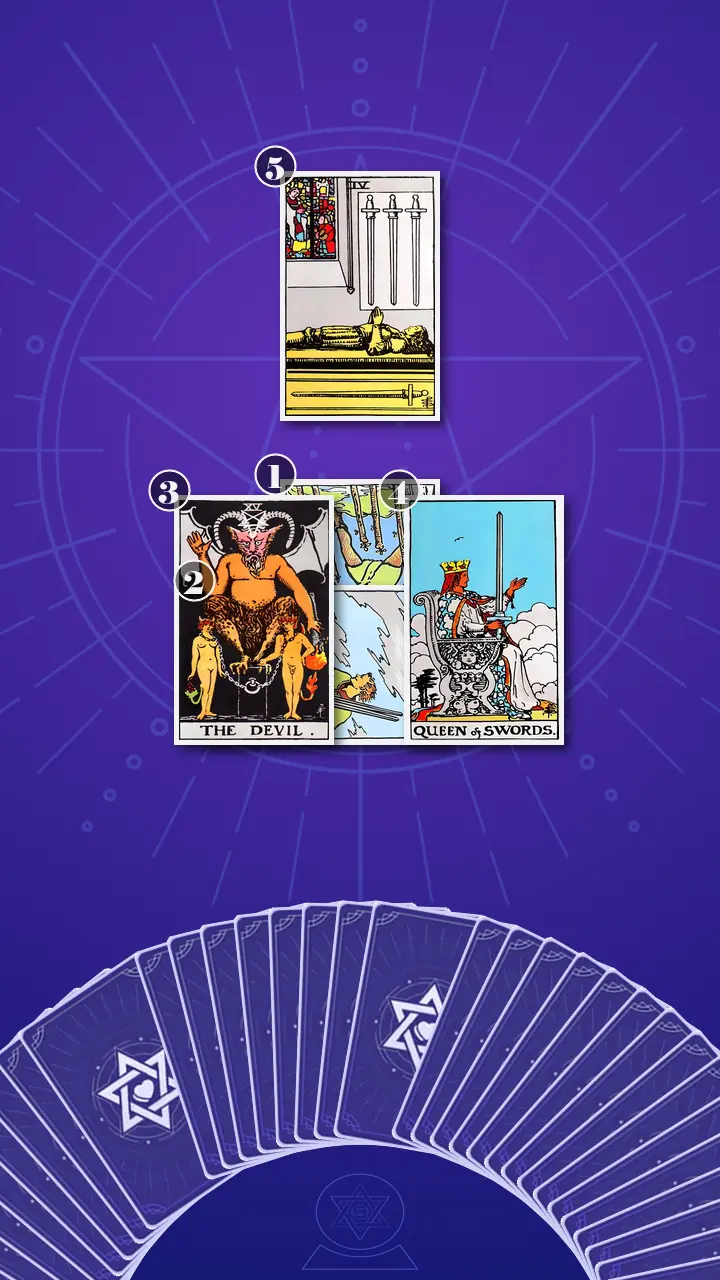
I chose the Five-Card Cross · Context Edition because this is a repeating system, not a request to predict what Maya's friends will do or to decode their private motives. When people search for how tarot works in a friendship conflict, I think the most useful answer is that card meanings become a visual reasoning tool. The symbols help us separate the visible symptom from the force crossing it, the root pattern that keeps returning, the point where choice can re-enter, and the routine that can make that choice sustainable.
This focused spread is a form of systemic deconstruction. The center would show the present symptom: what losing her footing looks like on a screen and in her body. The crossing card would reveal the contest keeping the thread active. The card to the left would name the carried root. The card to the right would offer a non-predictive cycle-interruption lever, and the card above would turn the insight into an integration practice for protected evening rest.
I reminded her that no card could make a decision for her. The point was to make the next decision easier to see. The reader questions underneath the spread were practical: Is the next message for clarity, a boundary, connection, or only relief from uncertainty? Can a chat keep moving without taking the whole night with it?
The Screen Filled with Raised Wands
Position 1: The Footing That Disappears
Now I turned over the card representing the present symptom: the observable way Maya loses her footing and remains engaged when the group chat becomes a pile-on.
The card was the Seven of Wands, in reversed position.
The lone defender on the card became Maya facing a screen where six separate replies seemed to rise at once. She saw several people responding to the same message, answered each notification, drafted evidence-heavy explanations, and treated every jab as a separate challenge that had to be defeated before she could eat or rest. The card's mismatched footwear captured the physical truth of it: she was trying to sound composed while her body was already braced for impact.
Reversed Fire is not absent strength. It is defensive energy that has become depleted, reactive, and blocked. Maya kept trying to stand on higher ground by explaining more, but each explanation gave the thread another sentence to challenge. Her rule had become, 'If I answer every point, nobody can dismiss me.' The result was the opposite of stability: a warm phone in one hand, cold food beside her, and attention divided into six directions before she had finished one thought.
Maya did not nod. She gave a short, bitter laugh and looked at the paper container instead of the card. 'That is painfully accurate,' she said. 'It is almost rude.'
'I will let the card be precise without turning it into a verdict,' I said. 'The useful question is not whether you can defend yourself better. It is which one claim, if any, genuinely needs a response, and whether the rest can remain unanswered for one hour.' Her fingers loosened around the phone, but she kept it face up on the counter. The first defense had not disappeared; it had simply become visible.
Position 2: The Scoreboard That Keeps Adding Rounds
Now I turned over the card representing the crossing mechanism: the force that keeps winning, defending, or preventing humiliation active after the original issue has become secondary.
The card was the Five of Swords, in upright position.
The central figure gathering swords became Maya collecting screenshots, exact wording, read receipts, and the last reply while the rest of the group seemed to move away from the connection she actually wanted. She might secure the final response in the thread, but her phone would still be lit, her shoulders would still be raised, and dinner would still be cold. This was conflict organized around winning, not mutual understanding.
The group chat had turned into a scoreboard that kept adding rounds after nobody was playing for connection anymore. I heard the inner line underneath her careful edits: 'If I can just answer this one detail, the whole story will be corrected.' But correcting one detail often invited three more. This was overactive Air, sharp and fast, turning language into a contest. A last-word victory could protect a version of events for a moment while costing her the entire evening.
'Can you separate 'I made my point' from 'I feel safe now'?' I asked. 'They may be related, but they are not the same result.'
Maya's gaze moved to the dark window, where the reflection of her phone floated over the Toronto night. She pressed her lips together, then said, 'I have definitely won a reply and still felt like I was waiting for a verdict.' The recognition had no triumph in it. It was quieter, closer to noticing an empty room after the crowd has left.
The Pull-to-Refresh Loop
Position 3: The Chain That Looks Like a Choice
Now I turned over the card representing the carried root: the established pattern that makes Repetition Compulsion and Survival Mode feel necessary for safety or belonging.
The card was The Devil, in upright position.
I did not read this as a prediction, a moral judgment, or a claim that Maya was permanently trapped. I pointed to the loose chains around the figures' necks. The image showed a binding arrangement maintained partly by a reward. In modern life, that reward could be the thirty-second drop in exposure Maya received each time she reopened a muted iMessage, WhatsApp, or Discord thread. Checking was technically optional, but the relief made the next check feel compulsory.
Maya had muted the chat, placed the phone face down, and picked it up less than three minutes later because not knowing what was being said felt more dangerous than staying activated. The dark pedestal became the belief that the chat controlled access to belonging. The lowered torch became the attention pulled away from food, sleep, the radiator clicking in the room, and the physical evening around her.
'Silence feels less like a boundary and more like surrender when belonging is on the line,' Maya said, almost before I finished. Then she looked at her own hand. 'I already decided to stop, so why does checking feel necessary?'
Her thumb hovered above the muted thread, and her breath paused halfway in. Her eyes lost focus as if the last argument were replaying behind the screen; I could see her jaw tighten and her shoulders lift toward her ears. Then she exhaled through her nose, lowered the phone, and let out a small, surprised 'Oh.' The chain was still there, but she could now see the brief relief that kept it in place. Choice had not arrived as a grand act of willpower. It appeared as a precise pause between the urge and the next tap.
'That is the opening,' I said. 'We do not need to shame the behavior that tried to protect you. We need to notice what it promises for thirty seconds, then decide whether that promise is worth another hour of your night.' I asked her to remember the last time she reopened the chat and name the feeling the check gave her before naming what it demanded next.
When the Queen of Swords Cut Through the Typing Dots
Position 4: The Boundary That Does Not Need a Closing Argument
The room became unusually quiet before I touched the fourth card. The refrigerator hummed, but the sound seemed farther away, and the typing dots on Maya's phone disappeared. This was the point where the reading moved from explaining the loop to locating a deliberate exit.
Now I turned over the card representing the cycle-interruption lever: the self-directed boundary or cognitive shift that can change the trajectory without predicting an outcome.
The card was the Queen of Swords, in upright position.
The Queen held one upright sword in a field of open air, while her other hand remained open. Her message was not 'win the debate.' It was 'separate the purpose of communication from the pressure to remain available.' Before typing, Maya could ask whether the message was for clarity, a boundary, or connection. If one concise response genuinely served that purpose, she could send it and stop litigating every side comment. If no purpose was clear, a pause was already information.
This is the point where I used my signature diagnostic lens, Spatial Boundary Scenting. After fifteen years as a perfumer, I have learned to notice when two environmental atmospheres overlap. I do not mean that a card carries a literal scent or that I can smell someone else's emotions. I mean I track which atmosphere follows a person from one room into another. Maya had closed her work laptop, but the output mode of her hybrid communications job had crossed into her friendship chat. The same screen, the same rapid interpretation, and the same demand to respond kept the office and the evening sharing one air.
'The problem is not only the message,' I said. 'Your recovery space has no closing door. The group chat is using the same attention channel as your work, so your evening becomes an unpaid second shift in reputation management. The Queen gives you an access policy, not a locked door: one clear message can preserve honest contact without granting unlimited access to your attention.'
Maya looked down at the two-paragraph draft in Notes. She had written it to cover every context, every possible misreading, and every reaction that might follow. I asked her to replace the question 'How do I make them understand everything?' with 'What is the one purpose of this message?'
She was caught in the old bargain: if she kept explaining, she might keep control; if she stopped, the group could turn silence into a verdict. The perfect paragraph promised safety, but its length kept the argument in the center of her evening. Her need was not another better defense. It was permission to choose timing, purpose, and length before the thread chose them for her.
You do not need to answer every message to remain legitimate; choose one clean boundary, like the Queen of Swords holding a single upright blade above the noise.
For a second, Maya's thumb froze above the screen and her breath stopped halfway in. Her eyes moved to the card but did not seem to see it; I could almost watch last week's thread replay in the blank space between us. Her brow tightened. 'But doesn't this mean I was wrong?' she asked, anger arriving before the sadness underneath it.
'No,' I said. 'It means the old rule was trying to protect your legitimacy by demanding constant proof. You can have been misunderstood and still decide that more explanation will not help tonight.'
Her fingers opened one at a time around the phone. The tight line of her mouth softened, her jaw released, and her shoulders lowered with a small tremor. Her eyes grew wet, not with panic now but with the strain of recognizing how long she had been treating other people's reactions as an emergency she had to personally contain. She took one shaky breath, then another, and gave a low, disbelieving 'Oh.' Relief moved through her, followed by a brief, lightheaded blankness. With the burden lifted, even slightly, there was suddenly a responsibility she could not outsource: she would have to choose.
'Now use this new perspective to remember last week,' I said. 'Was there a moment when naming one purpose, instead of defending every detail, could have changed how the evening felt?'
This was the first step from alarm-driven conflict vigilance and defensive overexplaining toward discerning self-trust, chosen availability, and protected evening rest. The card did not make Maya legitimate. It showed her that legitimacy had never been something the thread could grant or revoke.
The Phone Resting in Another Room
Position 5: Rest as a Deliberate Boundary
Now I turned over the card representing the integration practice: the repeatable evening routine that can stabilize the new boundary and support rest.
The card was the Four of Swords, in upright position.
The recumbent figure beneath three suspended swords became Maya placing her phone on the kitchen counter, enabling Do Not Disturb, and allowing the unread count to remain unresolved while she reheated food, showered, watched an episode, or prepared for sleep. The conflict had not been erased, and nobody had necessarily changed their mind. It simply was not being actively handled during that defined hour.
This was balanced Air: thought held in awareness without being forced into another exchange. The fourth sword lay still below the resting figure, a reminder that a pause does not deny the existence of conflict. It limits when the conflict can access the body. 'Nothing has been settled, and I am still allowed to rest,' I said.
Maya placed her phone face down on the counter while I spoke. She did not slide it across the room dramatically. She moved it just far enough that standing up would be required to retrieve it. That small distance mattered. It changed the room from a place where the chat could summon her instantly into a place where her dinner, water, lights, and body could register too.
'A chat can keep moving without taking your whole night with it,' I told her. 'The Queen chooses the boundary. The Four of Swords gives the boundary a physical form.'
From the Five-Card Cross to Actionable Advice
When I laid the five cards back into their cross, the answer to Maya's question became a sequence rather than a sentence. The reversed Seven of Wands opened the loop with overwhelmed defense. The Five of Swords crossed it with a scoreboard that promised safety through the last word. The Devil showed why the pattern repeated: checking briefly reduced exposure, so the hand learned to check again. The Queen of Swords offered the interruption, and the Four of Swords made that interruption livable.
The spread contained one Wands card, three Swords cards, no Cups, and no Pentacles. I did not treat that as a prediction or a deficiency in Maya. I treated it as useful context. The evening had become almost entirely language, interpretation, anticipation, and reaction management. Feelings and embodied routines had been pushed outside the field. Finding clarity therefore required more than writing better words. It required bringing attention back to food, water, the room, sleep, and the physical limits of the phone.
I then ran what I call a Sensory Overload Audit. I asked Maya to identify the environmental stressors quietly draining her focus: typing dots, notification previews quoting her, the screen's warmth against her palm, read receipts, the closed work laptop beside the active phone, and the fact that the device remained within reach even when she said she was logging off. None of these signals proved that an emergency existed. Together, they trained her nervous system to treat ordinary online conflict as a live briefing.
The cognitive blind spot was clear: Maya believed that being understood required immediate, exhaustive explanation, and that visibility was the same thing as belonging. The transformation direction was more practical. She would move from answering messages in real time to using a pre-set pause, identify whether one clear boundary was needed, and respond once only if that response served a purpose she had chosen.
These were the next steps I gave her. Each one was deliberately small, measurable, and reversible. A pause was an experiment, not a command to disappear from the group. For a genuine urgent safety issue, she would use her own judgment about staying reachable. The boundary was for ordinary pile-on drama, not a substitute for common sense.
The 72-Hour Physical Boundary Protocol
- Name the purpose before replyingAt the first sign of a group-chat pile-on, open Notes and write: 'This message is for clarity, a boundary, or connection.' If you cannot name one purpose, set a ten-minute pause before typing. During the pause, name one body signal out loud, such as 'my jaw is tight' or 'my shoulders are up.'Use the phone's built-in ten-minute Do Not Disturb timer. Call it an experiment rather than a permanent rule, so the pause remains yours to extend, end, or change.
- Send one clean boundaryIf one clear boundary is needed, draft a maximum two-sentence reply in Notes, save it for twenty minutes, and send it only if the purpose still feels true. Leave side accusations, reactions, and invitations to litigate unanswered for that same pause instead of replying to each notification separately.Try: 'I have said what I need to say, and I am stepping away for tonight.' One clean boundary can say what ten defensive paragraphs keep trying to prove.
- Use the Physical Boundary ProtocolWithin 72 hours, choose a sensory trigger for the usual evening transition. At 9:40 p.m., before the familiar 'one final reply,' Maya can apply a familiar citrus hand cream, enable a one-hour Focus mode, and place the phone in the kitchen drawer. For that hour, the phone creates an absolute physical partition from recovery: it does not travel to dinner, the shower, or the bedroom, and no second device replaces it.Choose a scent, hand-washing ritual, kettle sound, or lamp that already feels natural to you. The trigger is not magic; it is a consistent signal that high-pressure output mode has closed and deep recovery has begun.

A Week Later: The Quiet Proof
Four days later, I received a message from Maya: 'I set Focus before the chat got weird. I slept a full night, though I still woke thinking, What if I am wrong? I smiled, made coffee, and left my phone charging in the kitchen while I showered.'
The change was small enough to trust. The question had not vanished, the friend group had not become perfectly easy, and Maya had not discovered a flawless way to prevent anyone from misreading her. But there was now a gap between notification, interpretation, and response. Her evening had become hers before the chat had finished moving.
I kept thinking about the way she had first held the phone, as if every incoming message were a raised wand and every silence a threat. The Five-Card Cross had not settled the group chat for her. It had given her a map from present symptom through crossing conflict and carried survival pattern toward a chosen boundary and restorative routine. Maya, the querent, remained the author of the decision. Tarot had only helped return the decision to her.
When a group chat quotes you and your jaw locks, going quiet can feel like handing the group the only version of you, even as proving yourself keeps your whole evening on trial. Seeing that pressure clearly does not make you surrender; it gives you a little room to choose.
If one clear Queen of Swords boundary could speak for you while the chat kept moving, what small part of tonight would you want it to give back: the first warm bite of dinner, the shower without a screen, or the hour before bed?