Autopilot Achievement: Three Late-Night Tabs, Then One Honest Test

Autopilot Achievement at 11:40 p.m.
I often recognize Career Pivot Anxiety in this exact scene: a 29-year-old account coordinator in Toronto opens a promotion rubric, a graduate-course page, and three LinkedIn profiles after midnight instead of sending one curious email.
That was how I welcomed Taylor into my reading room. At 11:40 p.m. on a Tuesday, their apartment desk held the same three browser tabs: a promotion rubric, a graduate-course page, and friends’ polished LinkedIn announcements. The laptop fan hummed against the quiet, the phone warmed their palm, and the email attached to a personally meaningful idea remained unsent. I watched their shoulders rise each time they switched tabs, as though the next comparison might finally authorize a decision.
I asked what had brought them in. Taylor looked at the floor and said, “What risk do I keep accepting by following the life script? I keep choosing the next option that sounds sensible, then spending late evenings comparing every other path instead of trying the one thing I actually care about.”
Their unease was not a vague cloud. I could see it as a tight coil beneath the collarbones, a breath held just before every choice, and a heavy stone settling below the ribs. Self-doubt sat beside resentment, while longing kept tapping quietly from inside the locked room of the five-year plan.
“You tell yourself you’re being practical,” I said, “but the plan may be asking you to accept a risk you haven’t named yet. A respectable path can still be a borrowed path. We don’t have to reject stability or force a dramatic answer tonight. Let’s give the uncertainty a shape, then draw a map toward clarity that leaves the choice in your hands.”

Choosing a Compass for the Career Crossroads
I invited Taylor to place both feet on the floor, take one slow breath, and hold the question without trying to improve it. I shuffled slowly, not as a performance of mystery, but as a physical boundary between the day’s noise and the attention this question deserved.
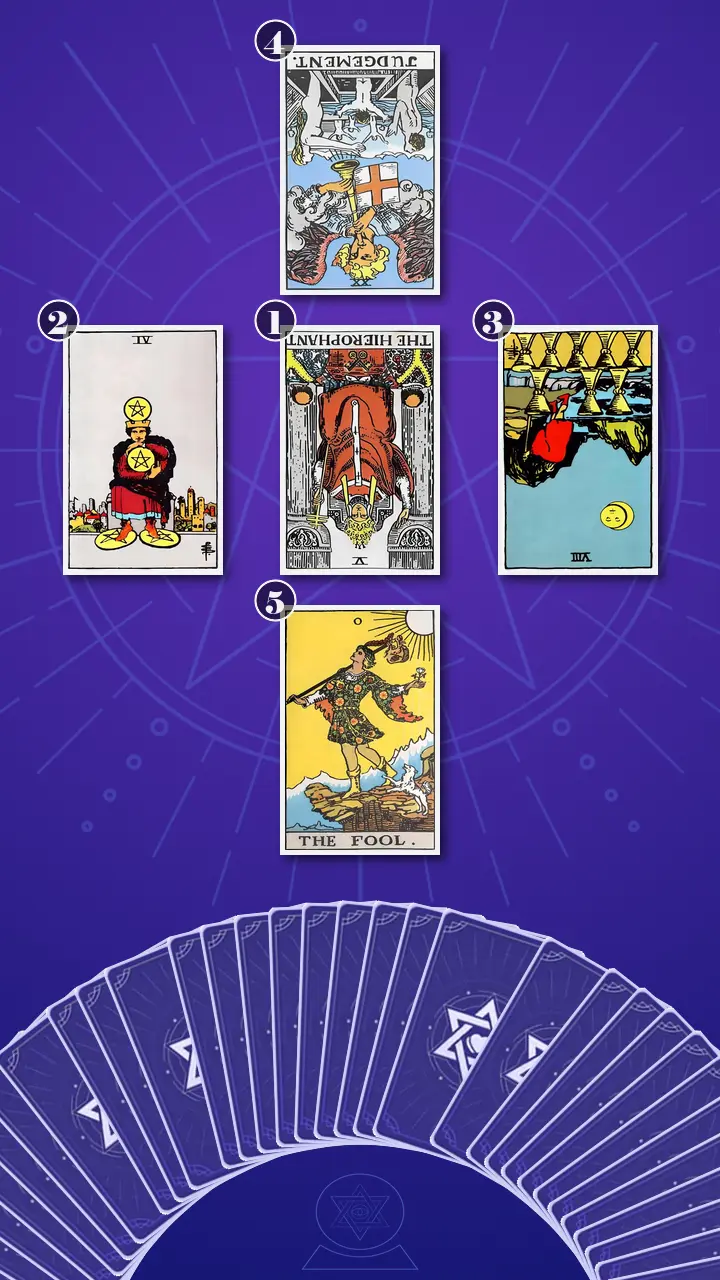
For this reading, I used The Shadow Spread · Context Edition. I explained that the spread is designed for an inner-pattern question rather than a prediction about which external path Taylor must take. Its five positions separate the visible life-script behavior, the protective holding beneath it, the personal cost of leaving that pattern unchallenged, the fear that makes compliance persuasive, and one grounded self-authored experiment.
This is how tarot works in my room: the images offer a structured language for noticing what ordinary planning can conceal. The point is not to hand the querent a verdict. It is to place card meanings in context, slow the reflex to obey the loudest social signal, and make the next honest question easier to hear.
I told Taylor that the first card would show the respectable or expected choice they perform when uncertainty appears. The second would reveal what they grip for safety and control. The third would name the risk normalized by staying. The fourth would bring the inner verdict into view, and the fifth would turn the reading toward a small, reversible experiment rather than a total life redesign.
Reading the Map Beneath the Default Route
The Hierophant Reversed and the Polished Answer
“Now turned over is the card representing the visible life-script behavior: the respectable or expected choice Taylor keeps performing when uncertainty appears,” I said. “In the standard meaning, this position shows the conscious face of the issue, the pattern most visible in daily life.”
The card was The Hierophant, in reversed position. In this context, the reversed energy was a blockage around authority and permission. The need for external approval had become excessive, while Taylor’s own authority had been pushed into the background. This was not a warning against institutions, promotions, credentials, relationships, or financial stability. It was a question about who had been allowed to decide what those things meant.
I connected the card to the Toronto agency lunch break Taylor had described. A former coworker’s promotion appeared on LinkedIn, carrying the familiar phrases excited for this next chapter and grateful for the journey. Taylor’s body translated the announcement into an assignment: pursue the next title, collect the right credential, and produce an acceptable answer about the future. The raised blessing hand became the silent approval prompt: Would a sensible person approve of this? The crossed keys became salary data, career ladders, and social milestones treated as keys to legitimacy.
I returned to the dinner scene I had heard about, where someone asked what Taylor saw themselves doing in five years. I asked them to complete two sentences without editing either one: “The answer I can defend is…” and “The answer I have not said yet is…”
Taylor’s mouth tightened. They looked at the card, then laughed once, softly and bitterly. “Damn, that’s exactly what I do. I call it research, but I’m really waiting for permission to want something.” Their fingers stopped moving over the edge of the cup.
“That recognition doesn’t mean every conventional choice is false,” I said. “It means you can sort useful structure from borrowed rule. A career ladder can be a reference point without becoming a mandatory onboarding flow that tells you which screen you’re allowed to open next. The question is not whether the route looks respectable. It is whether you have personally chosen the values it is serving.”
The Four of Pentacles and the Security Grip
“Now turned over is the card representing the protective pattern beneath the visible behavior: what Taylor grips to create a sense of security and control,” I said. “This position traditionally shows the defended or less conscious pattern influencing the situation.”
The card was the Four of Pentacles, in upright position. Its earth energy was in excess. Grounding had hardened into immobility, and practical preparation had become emotional armor. The figure presses one pentacle against the chest, fixes two beneath the feet, and balances another on the head. I saw Taylor’s promotion plan, savings spreadsheet, stable title, and carefully maintained routine in that posture.
At 11:40 p.m., the color-coded Google Sheet had offered immediate relief. If every salary, tuition cost, rent scenario, and possible career path remained arranged in neat columns, no new information had to enter and no preference had to become visible. Taylor could say, “I’m still evaluating,” and avoid the sharper exposure of saying, “I want to find out whether this matters to me.”
The protective energy was understandable, but it was also narrowing the room. Taylor’s private thought sounded like this: “If I keep the current plan intact, I cannot be accused of being careless.” I asked what the plan protected them from feeling for the next hour. Their shoulders lifted again, and they stared at the pentacle pressed to the figure’s chest.
“If I loosen my grip,” Taylor said, “I might discover I don’t know what I’m doing.”
“That is the difference between safety as flexible grounding and safety as a body that cannot move,” I replied. “A plan can support you without getting to speak for you. The short-term relief is real, but it cannot be the only evidence that the plan is right.”
Taylor went quiet. I noticed their hand leave the phone and rest flat on the table, as if they were testing whether the surface would still hold them without the spreadsheet in their grip.
The Reversed Eight of Cups and the Cost of Waiting
“Now turned over is the card representing the normalized risk of compliance: the personal cost of repeatedly staying with an option that no longer feels fully alive,” I said. “In the standard meaning, this position reveals the shadow lesson or consequence that becomes visible when a defended pattern remains unchallenged.”
The card was the Eight of Cups, in reversed position. Its water energy was blocked. Taylor could recognize that the familiar route was emotionally incomplete, but movement toward a different experience kept becoming circular. The card did not show someone escaping a disaster. It showed a figure turning away from eight intact cups beneath a moonlit path, which made the risk more precise: nothing had to be unbearable before investigation became legitimate.
I brought Taylor to the Sunday kitchen scene they had described. At 6:18 p.m., they had refreshed Google Calendar, checked an automatic rent payment, and color-coded another week of agency work. The refrigerator clicked on. Reheated takeout smelled faintly of garlic. Three saved opportunities sat in browser tabs while every task on the next week’s calendar supported a direction Taylor had never consciously selected.
“I keep waiting for it to become bad enough to justify leaving,” Taylor said, “while learning to ignore the fact that it is already incomplete.”
That was the normalized risk. The risk was not only choosing wrong; it was practicing not choosing yourself. Repeated postponement could teach Taylor to distrust the original signal because the signal had been left unattended for so long. At work, this might look like accepting another manageable account task. In a creative or educational interest, it might look like reopening the same course page every few weeks without taking the smallest introductory step.
I did not ask Taylor to abandon a job, a routine, or a financial commitment. I asked, “What is one reversible movement toward the unfinished feeling? Not an exit. Not a public announcement. Just enough direct contact to learn whether the imagined alternative has any real energy.”
Taylor’s gaze moved from the stacked cups to the blank space beside the calendar. Their breath came out slowly, but their expression held both relief at being named and grief for the hours spent treating dissatisfaction as background noise.
Judgement Reversed and the Inner Hearing
“Now turned over is the card representing the underlying fear that makes the pattern persuasive: the inner verdict Taylor fears hearing if they depart from the script,” I said. “This position reaches the root belief or formative inner pressure feeding the shadow pattern.”
The card was Judgement, in reversed position. The energy of awakening was present but filtered through self-criticism. Gabriel’s trumpet looked less like an alarm announcing failure and more like an invitation Taylor had learned to mute. The red cross on the white banner became an impossible standard: every private preference had to survive a public hearing before it could count as information.
I connected it to the TTC Line 1 ride home. Taylor had once recorded a private voice memo saying they might want to try a different kind of communications project. Before the train reached their stop, they had replayed the note, listed salary objections, imagined a manager’s reaction, and deleted it. The brakes squealed, the carriage lights flickered, and their jaw tightened around the sentence: “If I cannot explain this perfectly, it must not be real.”
“What verdict are you afraid someone would reach if you chose a less predictable route?” I asked.
Taylor’s fingers curled against their knee. “That I’m directionless. Or that I’ve mistaken wanting something for having a plan.”
“Then let the preference exist before the defence,” I said. “A preference is allowed to be a first draft. You can acknowledge it privately without promising it forever, and you can gather practical information later without making other people’s approval the entrance fee.”
For a few seconds, Taylor’s eyes stayed on the trumpet. First their breathing caught. Then their focus drifted, as if they were replaying the deleted voice memo. Finally, their jaw loosened and their thumb stopped pressing into their palm. I watched the difference between hearing an inner call and submitting it for judgment become visible in the body.
When The Fool Opened the Unapproved Road
The Small Bundle at the Threshold
The room grew unusually still before I turned the final card. Even the traffic beyond my window seemed to recede, leaving only the soft movement of the deck beneath my hands.
“Now turned over is the card representing the self-authored experiment: a grounded first expression of choice that turns insight into lived self-trust,” I said. “This is the integration point, where the reading becomes a next step that belongs to you.”
The card was The Fool, in upright position. Its energy was open but not careless, balanced by the small bundle on the wand and the white rose held close to the body. The bright sun did not guarantee an outcome. It illuminated a threshold. The Fool asked Taylor to carry enough preparation to begin without turning preparation into a condition that postponed beginning forever.
I connected the card to the unsent email, but changed only one detail. Taylor could send a bounded inquiry, reserve one hour for a personal project, attend one introductory event, or ask one neutral question without converting that action into a five-year commitment. The modern-life version of The Fool was a beta test, not a product launch.
At this point, I used one of my signature lenses, Decision Timing Calibration. I do not ask whether a crossroads choice is universally safe. I ask whether the current cyclical environment is structurally suitable for a high-stakes decision. Taylor’s late-night comparison cycle, peer updates, fatigue, and pressure to look on track were not an ideal environment for quitting, enrolling, or making a public declaration. They were, however, a useful environment for a contained experiment that could interrupt the loop.
I then applied Cyclical Variable Filtering. I separated temporary situational friction—the promotion post, the Sunday heaviness, the dinner question, the tired body—from the variables likely to matter over a longer orbit: whether Taylor enjoyed the actual work, wanted more contact with that field, had enough time for a small test, and could explore without endangering financial stability. That distinction made the card unusually practical. Curiosity could provide information that another comparison sheet could not.
The Threshold Is Smaller Than the Fear
At 11:40 p.m., the promotion rubric, graduate-course page, and LinkedIn profiles were still open, while the email tied to a real curiosity remained unsent. The spreadsheet was polished; Taylor’s shoulders were not. Planning offered immediate safety, but the unchosen life was growing quieter, and every alternative had to pass a test no preference could survive.
The Fool does not ask you to burn down the sensible path or leap without care. It asks you to stop treating certainty as the entry fee for authorship. You do not need a guaranteed replacement for the life script before you are allowed to test a choice that is genuinely yours. One honest experiment can give you evidence that approval never could.
Taylor’s index finger stopped above the phone. For one breath, their body froze and their eyes widened. Then their gaze went unfocused, moving through the memory of the LinkedIn announcement, the unopened email, and the many nights spent updating a plan instead of touching the question underneath it. Their mouth parted on a silent exhale. Their shoulders lowered, their hand unclenched, and a small, unsteady laugh moved through their chest. “But if I can begin without knowing,” they said, “does that mean I’ve wasted all this time?” I told them that the old plan had provided real structure; it simply did not have to own the next chapter. Then I asked, “Now, use this new perspective to recall whether there was a moment last week when this insight could have made you feel different.”
Taylor looked down at The Fool’s white rose and small bundle. The relief did not arrive as certainty. It arrived beside a brief, almost dizzying blankness, the sensation of putting down a heavy bag and realizing the hand still expected its weight. That was the first movement from uneasy compliance toward evidence-based self-trust: not a solved future, but permission to learn from direct experience. The cards had not chosen for Taylor. Taylor had recovered the right to test what was theirs.
The One Honest Piece of Evidence
When I placed the five cards together, the story became coherent. The reversed Hierophant showed an inherited itinerary being mistaken for personal direction. The Four of Pentacles showed why the itinerary was hard to question: it supplied short-term relief from uncertainty and social scrutiny. The reversed Eight of Cups showed the cost of waiting for dissatisfaction to become dramatic enough to justify movement. Reversed Judgement revealed the fear beneath the delay: that a less predictable preference would expose Taylor as unsafe, careless, or directionless. The Fool offered the missing bridge—curiosity, proportionate risk, self-trust, and a willingness to learn through a bounded beginning.
The cognitive blind spot was treating non-choice as neutral and compliance as safe. Every time Taylor postponed a small experiment, the decision still had a consequence: personal priorities became quieter, direct experience was replaced by research, and the approved route gained authority simply because it remained untouched. The transformation direction was not rebellion against the life script. It was a shift from treating the script as proof of safety to treating it as one reference point while a self-authored map developed through evidence.
I gave Taylor three forms of actionable advice. Each one was deliberately small. None required resigning, enrolling, moving, making a public announcement, or pretending to know the final destination.
- Use the Orbital PauseWhen a LinkedIn promotion, dinner question, rent discussion, or major job or course decision makes your shoulders brace, record the decision in a private note at your desk or on the TTC and delay any irreversible action for 72 hours. During the pause, use Decision Timing Calibration to ask whether the pressure is temporary macro-friction or a stable concern.Implementation tip: Set a calendar reminder for the end of the 72 hours. Let the pause interrupt impulsive comparison without turning it into three more days of spreadsheet research.
- Run a Ten-Minute Curiosity TestChoose one personally meaningful idea from a saved course, role, project, or event and take one reversible step on Tuesday evening: send one inquiry to an event host, register for one free introduction, or create one private sample. Write the narrow question the action is meant to answer, such as whether you enjoy the actual work.Implementation tip: Set a hard ten-minute stop. If the step feels too exposed, draft the inquiry without sending it, observe one relevant project, or ask one neutral question. The aim is direct evidence, not a new identity.
- Separate Structure from RuleOn Wednesday, create two columns in a private note titled Useful structure and Borrowed rule. Add five rules shaping your choices, such as needing the next promotion or a complete plan before beginning. Name the value each rule serves, then pause one nonessential script-driven task for seven days.Implementation tip: Keep the audit private and limited to five entries. A familiar routine may remain in place temporarily, but its status can change from must to one option you are consciously choosing.
I asked Taylor to judge the experiment by what it taught, not by whether it immediately proved a new career or a permanent purpose. That distinction mattered. The goal was not to turn a small action into another performance. It was to let one personally chosen contact with reality become more trustworthy than a perfect-looking theory.

A Quiet Proof, Not a Perfect Answer
Four days later, I received a message from Taylor while I was making tea. They had used ten minutes to send one inquiry about an introductory creative communications session, then written three observations about their energy, curiosity, and practical fit. The reply from the organizer had not solved anything. It had simply made the possibility real enough to evaluate.
The next morning, the old thought—What if I’m wrong?—arrived with the coffee. Taylor smiled, opened the note, and wrote, “I can learn without promising forever.” The relief was real, but so was the small ache of realizing how long they had waited to be allowed a beginning.
I call that Journey to Clarity because it was not a prediction and not a dramatic escape. It was a quieter change in ownership. Taylor kept the salary spreadsheet, the reliable work, and the useful parts of the plan. They also stopped letting those tools speak as though they were the author of the whole life.
When you have a sensible answer ready for everyone else but your shoulders still rise and your stomach drops, staying on the approved path can feel safer than admitting how little of your own life you are choosing. I hope the cards leave you with the same gentle distinction I offered Taylor: a life script can remain useful information without becoming a verdict.
If the life script could stay one reference point rather than a verdict, what small, reversible curiosity might you let yourself test this week simply to notice what it teaches you?