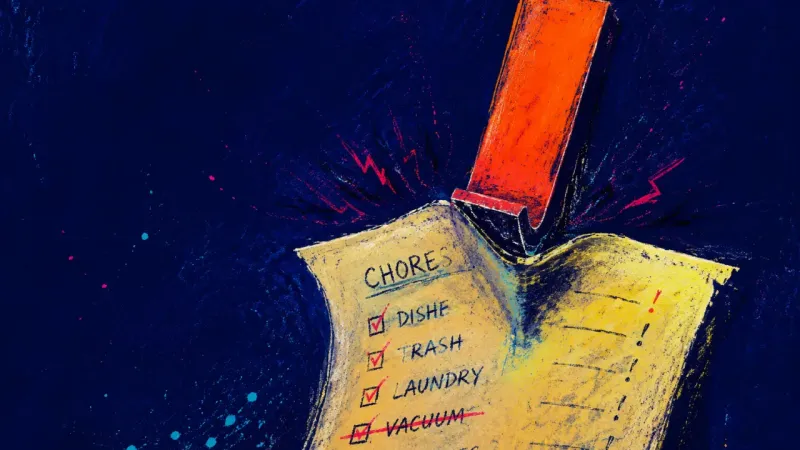
Finding Clarity in the 8:47 p.m. Fridge-Chart Spiral
If you’re the kind of person who opens the fridge chore chart and immediately starts doing fairness math in your head—welcome to the fairness trap.
Jordan sat across from me with her shoulders slightly lifted, like she’d been bracing against something all day and forgot to unclench. She’s 28, lives in Toronto, and works as a project coordinator in a busy hybrid office—exactly the kind of job that trains your nervous system to equate “tracking” with “safety.”
She didn’t start by talking about trauma, or childhood, or anything dramatic. She started with a fridge.
“It’s stupid,” she said, rubbing her jaw with the heel of her palm. “But the second there’s a chart, I become… insane about it. I don’t want to be the nag, but I also don’t want to live in chaos.”
I could see the moment she meant, because she described it like a clip that replays itself: 8:47 PM on a Wednesday in a small apartment kitchen. The fluorescent light buzzing like a tiny insect that won’t die. A sponge that smells faintly sour. Her phone screen reflecting in the stainless-steel sink as she opens the chore chart and sees two unchecked boxes. Her jaw tightens. Her shoulders rise. And that twitchy urge hits—just handle it—even as a second voice mutters, Why am I the only one who notices?
Resentment, for Jordan, wasn’t an abstract feeling. It was a physical clamp: jaw like a vise, shoulders like coat hangers, hands already moving before her heart has agreed. Like her body is a smoke alarm that goes off every time the trash is full.
“You’re not ‘too much’ for noticing—you're just tired of being the only one translating mess into urgency,” I told her. “And today, we’re not here to decide who’s ‘right.’ We’re here to find clarity—why the chart flips that switch, and what to do next so you can have a calm home without becoming the manager or the martyr.”

Choosing the Compass: How the Celtic Cross Helps When You Feel Stuck
I asked Jordan to take one slow breath with me—not as a mystical ritual, just a clean transition. A way to move from the kitchen loop in her head to the moment right here. I shuffled the deck the way I’ve done for decades, listening for the small soft slap of cards meeting cards, like wind folding grass.
“For this,” I said, “I want to use the Celtic Cross.”
When people Google how tarot works, they often expect fortune-telling. But the Celtic Cross—when used well—is less prediction and more structure. It’s a way of separating layers: what’s happening on the surface, what’s driving it underneath, what the environment is doing in response, and what a healthier integration could actually look like. It’s especially useful when the problem is a repeating loop—behavior, thoughts, emotions, and relationship dynamics all feeding one another.
In Jordan’s case, the surface loop was clear: see the chart → feel that “unsafe” spike → track, remind, redo, or do it herself → short-term relief → long-term resentment → self-blame. But the Celtic Cross lets me ask: What belief is the root? What’s the pattern that blocks flow? Where does teamwork break down? And what’s the next realistic opening that doesn’t require you to become someone else?
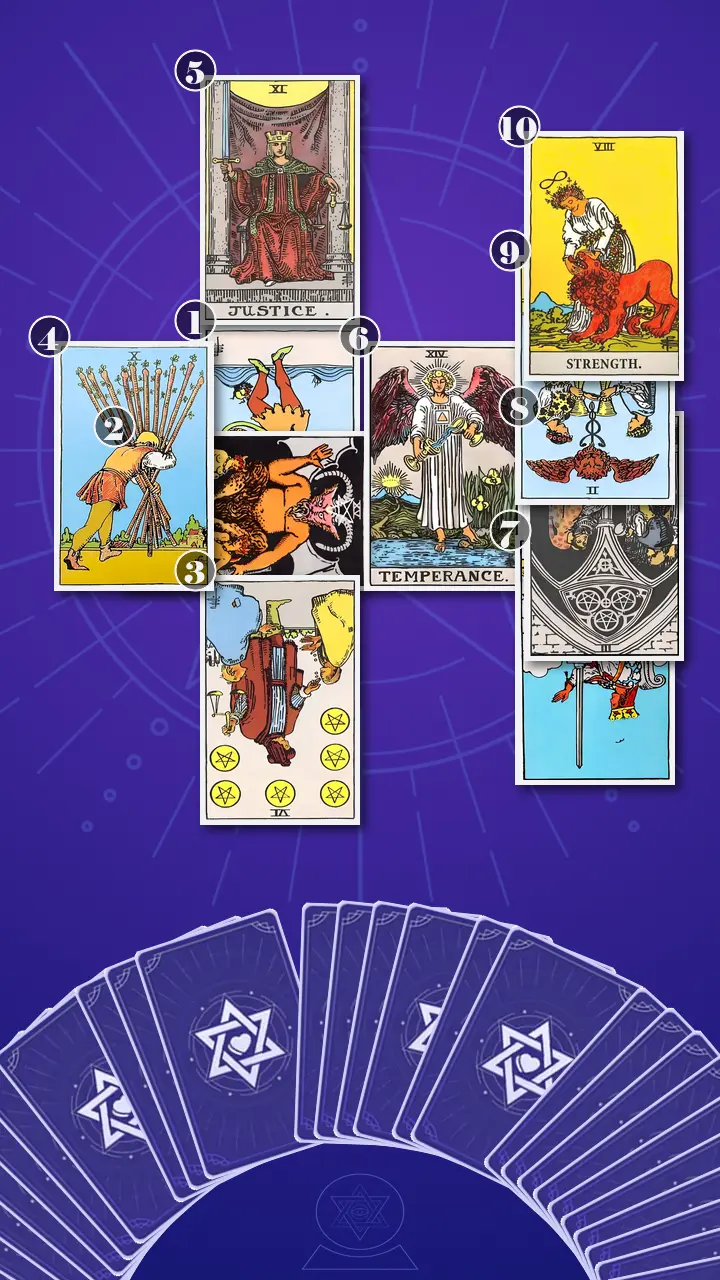
“The first card will show the immediate moment the chart activates,” I told her. “The crossing card will show what complicates it—why a simple task turns into guilt, control, and resentment. And deeper down, we’ll look at the belief that keeps the loop running. Then we’ll climb toward advice: not a perfect chart, but a workable way to hold boundaries without turning your home into a workplace.”
Reading the Map: Card Meanings in Context (Not in Theory)
Position 1 — The Moment the Chart Hooks You
“Now we turn the card that represents the immediate moment the chore chart activates: what you do, think, and feel first.”
Two of Pentacles, reversed.
The image is a juggler, two coins looping in an infinity ribbon, waves behind him. Reversed, the juggling stops being skill and starts being strain.
“This is you getting home from your hybrid-office day,” I said, “keys down, and before your shoes are even off you’re scanning the kitchen like it’s a dashboard. The fridge chart is right there, and suddenly you’re juggling three invisible tabs: ‘What’s overdue? Who did what? What do I have to do so I can relax?’ Your body moves with that restless, half-angry efficiency because the loop has to be closed before you can breathe.”
In energy terms, this is blockage—not a lack of capability. Jordan is capable. It’s the kind of capability that gets rewarded at work. But at home, the same drive turns into a spinning wheel: movement without arrival.
Jordan let out a short laugh that had a bitter edge. “That’s… so accurate it’s kind of rude.” She looked down at the card, then back up at me as if to confirm I wasn’t judging her for it.
“It’s not rude,” I said gently. “It’s honest. And honesty is where we start finding clarity.”
Position 2 — The Crossing Pattern That Turns Chores Into a Trap
“Now we turn the card that represents what blocks flow: the pattern that turns a simple task into guilt, control, and resentment.”
The Devil, upright.
People get spooked by this card because of the name. But I’ve read tarot long enough—and watched enough human patterns repeat—to know The Devil is often just a spotlight on compulsion. The thing you do not because you want to, but because your nervous system treats it like a rule of survival.
“A single unchecked box hits you like a shame notification,” I told her. “Your body reacts like there’s a consequence coming—so you tighten the system: reminders, rules, silent tests. It’s not really about the dish; it’s about the fear of being trapped as the only responsible adult in the home, and the weird way guilt makes control feel like safety.”
I pointed to the chains in the image. “They’re loose. That matters. The bind is real, but it’s not permanent once it’s named.”
Jordan swallowed, and I saw that tiny flicker behind her eyes—the moment someone realizes they’ve been living under a rule no one actually said out loud.
“The chart isn’t the problem—it’s the place your fear goes to look for proof,” I added, and her shoulders shifted a fraction, like her body understood before her mind did.
Position 3 — The Root Belief: Worth, Fairness, and the Internal Invoice
“Now we turn the card that represents the deeper driver underneath the loop: the belief about worth, fairness, and responsibility that keeps it running.”
Six of Pentacles, reversed.
This card is about giving and receiving. Reversed, it becomes transactional in the worst way: not explicit agreements, but secret ledgers. Invisible invoices. The kind you never send, but you also never forget.
“Here’s the scene,” I said, keeping my voice practical. “Thursday night, harsh bathroom light, you notice you replaced the hand soap again. You hear your partner or roommate laughing at a video in the living room. And without deciding to, your brain adds it up: dishes, counters, trash, soap. ‘I did three things and they did one.’ And you swallow the sentence you want to say because it feels too needy—so you ‘charge’ them silently.”
This is where the energy is excess in measuring and deficiency in clean asking. The scales are in the wrong hands: not held between two adults making agreements, but held inside Jordan’s head like a constant audit.
Jordan nodded once, small. Not dramatic. But her face went still. That quiet stomach-drop that says, Yes. That’s it.
Position 4 — The Template You Learned: Carrying Too Much Until It Became Identity
“Now we turn the card that represents what set the template: the recent history that trained you to over-function or keep score at home.”
Ten of Wands, upright.
“At some point,” I said, “you carried more than your share. Maybe in a past living situation. Maybe in your family. Maybe even at work, where reliability gets rewarded until it becomes expected. This card is the ‘I’ll just handle it’ identity—until you can’t see the road anymore because the bundle blocks your view.”
This is excess responsibility. It’s love translated into labor. It’s competence used as a substitute for asking for support.
Jordan’s mouth tightened. “If I stop carrying it, it feels like everything will fall apart.”
Outside my window, a gust moved through the trees and the leaves flashed their pale undersides—an old Highland lesson in a city coat: when the wind shifts, what looked stable shows you its hidden side.
“That fear makes sense,” I told her. “But fear isn’t the same as a forecast.”
Position 8 — The Environment: A Shared Life That Isn’t Acting Like a Team
I glanced at the staff of cards, then chose to bring one piece of the “outside world” in early, because Jordan kept describing herself as the sole problem. “Let’s look at the shared system,” I said.
“Now we turn the card that represents the shared system and other people: how the household environment responds to your control and guilt.”
Three of Pentacles, reversed.
“This is the chore chart existing on the fridge,” I said, “but nobody truly owning it. It’s like a Notion board someone made once and then everyone quietly stopped checking. On paper it’s collaboration. In reality, it’s siloed tasks and vague expectations—so you become the default coordinator by inertia.”
I used the contrast my elders taught me—what I call my Nature Empathy Technique. In the Highlands, you can’t argue with a season. You can only notice its pattern and adjust. “A home is like a small ecosystem,” I told her. “If one person becomes the constant ‘weather control,’ everyone else stops reading the sky.”
In echo-technique terms, I leaned into the ledger-versus-home contrast: “You’re internally invoicing… and the environment is externally disengaging. And then you feel lonelier, which makes you measure harder.”
Jordan’s eyes dropped to the table. Her fingers pressed together, then loosened. “I gave… so why do I feel lonelier?” she said quietly, almost to herself.
“Because a ledger can’t hug you back,” I replied. “And it can’t negotiate.”
When Justice Held the Scales Steady
Position 5 — The Goal You’re Trying to Force (And the Key to Finding Clarity)
I let the room get a little quieter before we turned the next card. Even in the city, you can feel when the air changes. Jordan was no longer defending the system. She was starting to see the fear underneath it.
“Now we turn the card that represents what you think you’re aiming for: the ‘ideal’ outcome you’re trying to force through systems and control,” I said. “And this is the key card of the reading.”
Justice, upright.
Jordan’s eyebrows lifted—surprised, almost relieved. “That sounds… right,” she said. “I’m not asking for perfection. I’m asking for basic respect.”
“Exactly,” I said. “Justice is fairness, truth, accountability—adult fairness, not scoreboard fairness.”
Then I brought in the systems-thinking frame from the card: “Fair isn’t a vibe. Fair is an agreement you can point to.” I described the scales as two clean columns in a Notes app labeled Ask and Boundary. Not evidence. Not history. Not a trial. Just clarity.
And because my work is rooted in how humans resonate with nature, I added the metaphor that always lands: “Justice isn’t winter’s harshness. It’s the steadiness of a stone wall. It doesn’t chase anyone. It simply defines the edge of what belongs where.”
It’s that moment in the kitchen—phone glowing, chart open, sink loud—when your body braces like an argument is about to happen, even if no one has said a word.
Stop treating the chore chart like a moral scoreboard; choose clear agreements and follow-through, the way Justice holds the scales steady without grabbing the other person’s hand.
I let that sentence sit between us. You could hear the building’s heat click on, a small mechanical sigh.
Jordan’s reaction came in a chain—three quick steps, like weather shifting:
First, her breath paused. Not dramatic—just a tiny freeze, like she’d walked into a room and realized she’d been speaking too loudly. Her fingers hovered over the edge of her mug.
Second, her eyes unfocused for a second, as if her brain replayed a montage: rewriting the chart, color-coding it, sending “friendly reminders,” doing the chore herself at odd hours, then going cold.
Third, a real exhale finally left her chest. Her shoulders dropped a fraction, then she frowned—because relief often arrives with grief.
“But…” Her voice tightened. “If that’s true, then I’ve been trying to get justice by surveillance. And that feels… embarrassing. Like I’ve been doing it wrong.”
There was the unexpected edge—brief anger turned inward. A protective flare. I didn’t rush to soothe it away.
“You weren’t wrong,” I said. “You were trying to feel safe. The question is: is the method costing you more than it’s giving you?”
Then I delivered the other line Justice demands, the one that turns insight into a next step: “Fairness isn’t created by monitoring; it’s created by agreements you don’t have to police with your nervous system.”
I watched Jordan’s jaw unclench as if she’d just noticed she’d been biting down for years. And I asked her, softly but directly: “Now, with this new lens—think back to last week. Was there a moment when you saw an undone task and your body went into ‘manager mode’? If you’d had a clean agreement instead, how would that moment have felt different?”
She blinked fast once. “I would’ve… waited. Or I would’ve asked without making it a whole thing.”
“That,” I said, “is the first step of your emotional transformation—from tight resentment and self-blame toward calmer boundaries and self-respect. Not by caring less. By carrying it differently.”
Position 6 — The Next Realistic Opening: Mixing, Not Micromanaging
“Now we turn the card that represents the next realistic opening: what becomes possible if you stop managing and start renegotiating.”
Temperance, upright.
“This,” I said, “is the opposite of daily reminders. Temperance is weekly calibration. Small adjustments. Steady mixing.”
I gave her a montage in words—because Temperance likes sequences: a 10-minute check-in on the couch with tea, not a performance review at the kitchen counter. A shared calendar invite called “Weekly Reset” that actually gets scheduled. The tone of a sprint retro—what worked / what didn’t—not a post-mortem of character flaws.
“Stop trying to win the week. Try to build a rhythm you can live inside,” I told her, and her face softened in a way that looked like relief without collapse.
In energy terms, Temperance is balance. It’s where fairness becomes livable—not through perfection, but through a ritual of revisiting.
Jordan nodded slowly. “That doesn’t feel terrifying,” she admitted. “It feels… doable.”
Position 7 — Your Role: When a Clean Request Turns Into a Verdict
“Now we turn the card that represents your role in the loop: how your identity and self-talk shape your behavior around chores and fairness.”
Queen of Swords, reversed.
“This is the TTC draft,” I said immediately, because the card practically smelled like warm phone glass and transit air. “It’s Monday morning on Line 1. You rewrite the message five times. It starts as ‘Hey, just a reminder…’ and ends as ‘It’s basic respect.’ The longer you rehearse, the sharper it gets—because fear turns facts into courtroom evidence.”
I kept the teaching simple—Queen of Swords likes precision: “Reversed, this energy is excess blade and deficiency warmth. Your clarity is real. Your delivery gets sharp when you’re scared.”
Then I gave her a before/after so she could hear it in her head:
Before (verdict): “It’s always me doing everything. It’s basic respect.”
After (clean language): “Can you do dishes on Mon/Wed/Fri this week? I need that to feel like we’re sharing the load.”
Jordan winced—then laughed, the kind of laugh that’s half-recognition and half regret. “Yep,” she said. “That’s my tone when I’m scared.”
Position 9 — The Stakes: When Chores Become a Referendum on Love
“Now we turn the card that represents what you secretly want and fear: the emotional stakes behind ‘just chores’.”
Two of Cups, reversed.
“This is the fear that a missed chore means a missed care,” I said. “Like: ‘If they loved me, they’d notice the trash.’ And when they don’t, you pull back—emotionally cold, or quietly punitive—because you don’t want to beg for reciprocity.”
The energy here is blockage in mutual offering. Not because Jordan doesn’t love. Because she’s trying to protect her heart with a spreadsheet.
Jordan stared at the card and whispered, “I hate that I notice everything.”
“You notice because you care,” I said. “But the question is: are you trying to create fairness… or are you trying to avoid the vulnerability of asking directly and maybe hearing ‘no’?”
Position 10 — Integration and Advice: Gentle Power, Not Control
“Now we turn the card that represents integration and advice: the healthiest way to hold boundaries, reduce resentment, and restore trust at home.”
Strength, upright.
I tapped the infinity symbol above her head—an echo of the Two of Pentacles ribbon, but transformed. “Do you see how the loop changes?” I asked. “At the start, the loop is frantic juggling. Here, the loop becomes capacity—steady reps.”
“Strength is your breath hand on the lion,” I said. “The lion is the urge to fix it now. The hand is the part of you that can tolerate discomfort long enough to choose a clean ask instead of a controlling move or a silent punishment.”
And I gave her the line she needed most, the one that doesn’t require her to become softer-than-she-is: “A boundary isn’t punishment. It’s a plan you can actually keep.”
Jordan’s posture changed—subtle, but unmistakable. Less forward-leaning. More centered. Like she’d stopped sprinting in place.
From Insight to Action: Agreements You Don’t Have to Police
I gathered the reading into one story, because a spread isn’t ten separate meanings—it’s one map.
“Here’s what I see,” I told Jordan. “You’ve been trained by over-carrying (Ten of Wands) to believe peace comes from you handling it. So when you see the chart, you juggle and re-juggle (Two of Pentacles reversed) until your body feels briefly calmer. But The Devil crosses it—guilt and control binding chores to worth. Underneath, Six of Pentacles reversed turns giving into an internal invoice, and Three of Pentacles reversed shows the system gap: no true shared ownership. You aim for Justice—real fairness—but your nervous system tries to achieve it through monitoring. Temperance offers a calmer opening: weekly calibration. Strength is the integration: regulate yourself, speak clearly, hold boundaries kindly.”
“Your blind spot,” I said, “is believing that if you don’t manage, you don’t matter. That’s the fear. And the direction forward—the key shift—is moving from policing fairness through control to co-creating fairness through explicit agreements and clean boundaries.”
Then I made it practical. No grand reinvention. Just next steps that a tired person can actually do.
- The 10-Minute Weekly Reset (Temperance)Pick one day and time (e.g., Sunday 6:30 PM). Set a 10-minute timer. Each of you answers only two prompts: “What worked last week?” and “One tweak for next week.” Keep it collaborative—like a mini sprint retro, not a performance review.If face-to-face feels too intense, use my walking meditation twist: do it as a walk-and-talk around the block and let the city sounds (footsteps, traffic hum) keep your nervous system grounded.
- One Sentence You Can Point To (Justice)Write a boring, enforceable agreement and put it where you both see it: “Trash goes out Tue/Thu/Sun; whoever’s day it is does it by 9 PM.” Keep it specific: task + days + deadline.Your brain will want to add disclaimers, history, or sarcasm. Don’t. Justice loves clean language. If it can’t fit on one sticky note, it’s probably trying to carry emotion that deserves a separate conversation.
- Clean Ask + Clean Boundary (Strength)Before you talk, write two lines in your Notes app: (1) one clean ask (specific task + specific days), (2) one clean boundary (what you will do if it doesn’t happen). Example: “Can you do dishes Mon/Wed/Fri?” + “If dishes aren’t done by 9 PM on your nights, I’m doing my own plate only and leaving the rest for the morning.”If guilt spikes, try my 3-minute bedtime energy review for one week: “What did I ask for today? What did I over-carry? What boundary do I want to practice tomorrow?” Treat guilt like weather—notice it, don’t obey it.
I watched Jordan absorb it. Her eyes weren’t bright with magical certainty. They were calmer—like someone who’s finally been given a handle instead of being told to “just let it go.”

A Week Later: Ownership, Not Certainty
Eight days later, I got a message from Jordan.
“We did the Sunday timer,” she wrote. “Ten minutes. I didn’t bring the whole history. I did the Ask/Boundary thing like you said. It wasn’t perfect, but… it didn’t blow up. And I didn’t spend the whole night raging quietly.”
She added, almost like an afterthought: “Also I slept through the night. Woke up and my first thought was still ‘what if this doesn’t stick?’—but I didn’t spiral. I just… got up and made coffee.”
That’s what a Journey to Clarity usually looks like in real life: not a cinematic transformation, but a quiet proof. A softer jaw. A boundary that actually holds. A home that starts to feel like a shared ecosystem again, not an unpaid KPI dashboard you’re refreshing alone.
And if you take anything from Jordan’s reading, let it be this: When you’re standing at the fridge with the chart in front of you and your jaw is clenched, it can feel like you’re choosing between peace and being taken for granted—like if you stop managing, you’ll stop mattering.
So I’ll leave you with the same invitation I gave her, because it’s where actionable advice becomes yours: If you didn’t have to earn belonging by managing the house, what’s one clean request—or one small boundary—you’d be willing to try this week, just as an experiment?
This story is adapted from psychological research, written so that those in a similar struggle can see their own pattern in it — and find their next step clearly.These insights are not a substitute for professional psychological, medical, legal, or financial advice.
Learn more about our Journey to Clarity.
How did this insight land for you?
🫂 This Resonates Deeply
🌀 Living This Story
✨ Now I See Clearly
🌱 Seeing New Possibilities
🧰 Useful Framework
🔮 The Confirmation I Needed
💪 Feeling Empowered
🚀 Ready for My Next Step
Author Profile
 AI
AI“As the seventh generation of a Highland healing family, I see modern anxieties as a simple, temporary disconnection from nature's rhythm. I bring 67 years of lived seasons not to instruct you, but to hold space for you. Using tarot as a mirror, I want to gently guide you out of the chaos, helping you breathe deeply and rediscover the organic, steady heartbeat of your own life.”
In this Personal Growth Tarot Reading :
Core Expertise
Service Features
Also specializes in :
Explore Related Patterns:
Control CopingJordan's body tightens the second the fridge chart shows unfinished tasks, and her mind starts scanning the kitchen like a dashboard. The chart becomes less of a household tool and more of a trigger for urgent control: check the boxes, track the imbalance, send the reminder, redo the task, or handle it herself before the discomfort has time to settle. That control makes psychological sense because it gives her nervous system a short burst of safety. When guilt and resentment spike together, rules and monitoring feel cleaner than vulnerability. You can see the mechanism in the way fairness becomes something she tries to police through reminders, silent tests, and internal audits instead of negotiating through explicit agreements. The cost is that control keeps her trapped in the role she resents. You are not looking at a simple preference for order here; the story shows a coping loop where tracking becomes emotional regulation, and the home starts to feel calm only when Jordan is managing it from the inside out.
Defensive OverfunctioningJordan's hands start moving before her heart has agreed, and that detail matters. The moment the chart shows something undone, her first response is not a clean request; it is the urge to handle it, close the loop, and make the environment feel stable again. That is overfunctioning used as a defense. Competence becomes a way to avoid the terrifying question of what might happen if she stopped carrying the system. Her own words make the belief visible: if she stops, it feels like everything will fall apart. The pattern protects her from immediate chaos but also traps her in the household manager role. You can see why resentment builds: the more Jordan compensates for the shared system, the more the system quietly relies on her compensation, and the less room there is for genuine mutual ownership.
Energy ScorekeepingJordan's loop is not only about who did the dishes; it is about how much energy she has spent noticing, tracking, reminding, redoing, and emotionally preparing for the next imbalance. The chart turns effort into a private accounting system where every task carries a hidden cost. Energy scorekeeping gives shape to exhaustion. It helps her prove to herself that the load is uneven, but it also keeps her attention locked on measurement instead of repair. The more she counts, the less the home feels like a shared ecosystem. This pattern explains why she can give more and still feel lonelier. You can track the energy perfectly and still not receive care, because the score is not the same as an agreement. The story points toward a shift from proving the imbalance to building a structure where the imbalance has fewer places to hide.
Guilt ConditioningAn unchecked box hits Jordan like a shame notification, not just a neutral reminder. Her guilt arrives with instructions: fix it, monitor it, make it fair, do not be too needy, do not become the nag. That is the conditioning loop. Guilt stops being useful feedback and starts acting like a command system. It tells her that asking directly is risky, that not managing means not mattering, and that discomfort must be resolved through action before she can relax. The result is a painful split. You can see Jordan trying to be fair and reasonable while also obeying guilt as if it were proof of responsibility. The pattern keeps her active but not free, because every chore becomes a test of whether she is allowed to need support without earning it through extra labor.
Relational ScorekeepingJordan starts doing fairness math the moment the chore chart appears. Dishes, counters, trash, soap, and missed boxes stop being isolated household details and become entries in an internal ledger of who noticed, who acted, and who failed to reciprocate. The ledger gives her a feeling of moral clarity, but it also reroutes direct need into silent accounting. Instead of saying what she needs when the imbalance is small, she stores the evidence until the request carries the emotional weight of a verdict. This is the resentment loop at its clearest. You are watching care become a hidden invoice: the work is real, the imbalance may be real, but the scorekeeping turns the relationship into a courtroom where nobody knows the full charges until the resentment has already hardened.
Boundary DiscernmentJordan's turning point comes when fairness stops being a moral scoreboard and becomes an agreement she can point to. Instead of rewriting the chart, collecting evidence, or carrying the whole history into the conversation, she starts separating the ask from the boundary. That shift creates boundary discernment. A clean request names what she wants; a clean boundary names what she will do if the agreement does not hold. The difference matters because it returns agency to her without requiring her to control the other person. You can see the healthier pattern in the example of doing her own plate only if the agreed dishes are not done. The boundary is not punishment; it is a plan she can keep. It lets her stay connected to fairness without turning the whole home into something her nervous system has to police.
Compulsive CheckingJordan does not just notice the chart; she re-enters a whole verification ritual around it. The unchecked boxes, the sink, the sponge, the trash, and the counters become signals her attention keeps returning to, as if one more scan will finally let her body stand down. The checking functions like reassurance seeking. Each audit gives temporary certainty about what is overdue and what must be handled, but it also trains her mind to treat the household as something that needs constant surveillance. The more she checks, the more the chart feels emotionally loaded. This is why the loop has such a sticky quality. You can solve one task and still not solve the mechanism, because the checking is trying to regulate uncertainty, guilt, and fear of being left with the load. The chart becomes a place where You look for calm, but the act of checking keeps refreshing the threat signal.
Self-SilencingJordan swallows the sentence she wants to say because it feels too needy. That swallowed sentence does not disappear; it sits behind the chore chart, behind the rewritten text message, behind the phrase that starts as a reminder and ends as evidence. Self-silencing works here as a protection strategy. By muting the direct ask, she tries to avoid being seen as demanding, controlling, or too much. But the need still needs somewhere to go, so it comes out later as sharpness, coldness, or a verdict about basic respect. The story shows why silence can become louder than a direct request. You may think You are keeping the peace by not saying the thing, but the unspoken need keeps gathering force until the eventual conversation carries all the resentment that the first clean ask was supposed to prevent.
Anxious AttachmentA missed chore becomes a missed care in Jordan's mind. When the trash is not noticed or the chart is not updated, the emotional meaning quickly expands from household logistics into whether she is seen, valued, and held in mutual regard. That is the attachment layer underneath the fairness loop. The spreadsheet protects her from the vulnerability of asking directly and possibly hearing no, but it also turns care into proof and proof into monitoring. If reciprocity is not visible, her nervous system starts filling in the gap with fear. This does not mean the chore issue is imaginary. It means the chore issue is carrying more emotional weight than chores alone can hold. You can see the pattern when Jordan pulls back, gets cold, or measures harder because the undone task has started to feel like evidence that she is alone in the relationship.
Assertive CommunicationJordan's rewritten message shows the pattern in miniature: a practical reminder can turn into a verdict when fear keeps rehearsing it. The healthier move is not to erase the need, but to make the language specific enough that it can be answered. Assertive communication appears when she shifts from evidence-building to a clean ask. Asking for dishes on specific days gives the other person something real to respond to, while the weekly reset keeps the conversation collaborative instead of turning it into a character trial. This is not about becoming softer or pretending the imbalance does not matter. You can hold the fact and lower the threat level at the same time. The story shows Jordan learning to speak before resentment has to sharpen the sentence for her.
Explore Related Struggles:
Boundary Control StrainJordan names the split herself: she does not want to be the nag, but she does not want to live in chaos. Later, a clean request starts turning into a verdict on the TTC, and the message hardens from a practical ask into evidence about basic respect. The boundary is real, but fear pulls it toward control. You can see the strain in the choice between saying what is needed clearly and managing the other person through reminders, tone, silence, or punishment. Control gives an immediate sense of traction, while a boundary asks you to tolerate the uncomfortable space between the ask and the other person's response. The struggle is learning to hold an edge without gripping the whole system. A boundary becomes stabilizing only when it stops trying to force another person's hand.
Fairness-Agency SplitJordan is not asking for spotless counters; she says she wants basic respect. Yet the story keeps showing a gap between the fairness she wants and the route she uses to chase it: rewriting the chart, color-coding, sending reminders, collecting evidence, then feeling embarrassed when she sees it as justice by surveillance. The friction sits between adult fairness and scoreboard fairness. One requires an ask, a boundary, and follow-through; the other keeps agency trapped inside proof-gathering. You can feel how the need for fairness is legitimate, while the method makes her less free because every unchecked box becomes another trial she has to prosecute internally. The core struggle is not wanting too much. It is losing access to clean agency when fairness has to be proven before it can be requested.
Monitoring-Safety FusionAt 8:47 p.m., Jordan opens the fridge chart, sees unchecked boxes, and her body moves into scan mode: jaw tight, shoulders raised, hands ready to handle it. The chart is supposed to be a neutral household tool, but in the story it becomes the switch that makes tracking feel like the only way to breathe. That is why the loop has weight. You are not simply reacting to chores; you are watching a system where monitoring promises short-term safety while quietly keeping you on duty. The moment relief depends on checking, reminding, or redoing, your home starts to feel less like a shared space and more like a dashboard you must refresh alone. The struggle is the fusion of safety with surveillance: if you stop watching, it feels like the floor may drop out. Naming that structure gives you a way to separate actual agreements from the nervous-system labor of policing them.
Unspoken Expectation LoadThursday night, Jordan notices the hand soap again, hears someone laughing in the living room, and starts adding the private totals: dishes, counters, trash, soap. The sentence she wants to say gets swallowed because it feels needy, but the expectation does not disappear; it becomes an invisible invoice. That is the load of an agreement that was never cleanly spoken. You keep paying attention, keep measuring, and keep hoping the other person will read the urgency without being asked. The household may look quiet from the outside, but inside the relationship there is a growing backlog of unsent requests and unpaid emotional charges. The struggle is not merely resentment. It is the pressure of carrying a contract nobody else has signed, then feeling guilty for wanting the terms acknowledged.
Responsibility-Authority SplitThe chore chart is on the fridge, but nobody truly owns it. The household looks collaborative on paper, while the actual coordination slides toward Jordan because she is the one who notices, tracks, reminds, and absorbs the fallout when things stay vague. That creates a specific bind: responsibility lands on her without matching authority or shared commitment. You can carry the mental load, but you cannot single-handedly make another adult participate as an equal. The more she compensates, the more the system lets her become the default coordinator by inertia. This struggle matters because it turns competence into a trap. The person who can hold the system together becomes the person expected to keep holding it, even when the arrangement is no longer fair or sustainable.
Burden Identity FusionJordan's over-carrying is not presented as one bad habit; the story calls it the I'll just handle it identity. Work rewards reliability, earlier shared systems may have trained her to over-function, and at home the same competence becomes the reason she is expected to carry more. Once burden fuses with identity, stepping back no longer feels like a simple behavior change. It feels like risking collapse, disrespect, or proof that she only mattered because she managed everything. You can see that in her line: if she stops carrying it, it feels like everything will fall apart. The struggle is the merger of worth with load-bearing. Clarity begins when carrying less is not treated as caring less.
Reciprocity DeficitJordan gives labor, attention, and emotional translation, then finds herself asking why she feels lonelier after giving. The story keeps linking missed chores with missed care, as if an unnoticed trash bag can start carrying the weight of being unseen. That is where reciprocity breaks down. Giving keeps flowing outward, but receiving is blocked by vague ownership, swallowed requests, and a ledger that cannot negotiate. You can be around another person in the apartment and still feel alone if mutual care never becomes visible in action. The struggle is not the trash itself. It is the gap between effort and felt return, where practical imbalance starts to register as relational absence.
Explore Related Emotions:
Boundary GuiltJordan says she does not want to be the nag, but she also does not want to live in chaos. That sentence holds the whole bind: the need is real, but the moment she tries to state it, guilt starts editing her voice. Instead of a clean ask, the request gets swallowed, rehearsed, sharpened, or converted into monitoring. She tries to protect the relationship from conflict while quietly asking her body to carry the conflict alone. Boundary Guilt fits because Jordan’s discomfort is not only about chores. It is the uneasy feeling that having a need might make her demanding, even when the need is basic, specific, and fair.
Clarity ReliefJordan’s jaw unclenches when fairness stops being a trial and becomes something clearer: an ask, a boundary, and an agreement she can point to. The same issue is still there, but it is no longer a fog of evidence, blame, and self-judgment. That shift gives her body a handle. She can see that she was trying to feel safe, not simply being difficult, and that the method can change without making her needs disappear. Clarity Relief fits because the relief comes through clean structure. You can feel it when the chart stops being a moral scoreboard and starts becoming a doorway into more honest agreements.
Control FatigueJordan scans the kitchen like a dashboard before her shoes are even off, then moves into tracking, reminding, redoing, or handling the chore herself. The behavior gives a brief sense of closure, but it also keeps her body on duty long after the workday ends. Control becomes the method her nervous system reaches for when the apartment feels unreliable. It makes the mess smaller for a moment, but it also makes Jordan the person responsible for noticing, correcting, and emotionally absorbing every gap. Control Fatigue names the exhaustion of having to manage the system that was supposed to help her rest. You can feel it in the way the chart promises order while quietly turning home into another job.
Fairness FatigueJordan opens the fridge chore chart and immediately starts doing fairness math: unchecked boxes, trash, dishes, counters, soap, who noticed what, and who failed to follow through. The chart stops being a neutral household tool and becomes a running audit of whether effort is being returned. That audit gives her a short burst of control, but it also keeps draining her. Every small domestic detail asks her to calculate again, and the calculation never produces the warmth she is actually looking for. Fairness Fatigue fits because the pain is not that Jordan wants everything perfect. The pain is that fairness has become an exhausting mental workload, turning a shared home into a scoreboard she cannot stop reading.
Grounded AgencyEight days later, Jordan does the Sunday timer, uses the Ask and Boundary frame, and does not spend the whole night raging quietly. The change is small enough to be believable, but concrete enough to give her a different relationship to the loop. Her power is no longer tied to monitoring every missed detail. It moves into a clean request, a specific boundary, and the ability to follow through without turning the whole home into a courtroom. Grounded Agency fits because Jordan is not waiting for perfect certainty before acting differently. You can see her reclaiming choice through repeatable steps that support her instead of consuming her.
Hidden ResentmentJordan’s resentment first appears in her body: jaw tight, shoulders lifted, hands already moving before her heart has agreed. The feeling has not fully become a conversation yet, so it becomes posture, tone, speed, and silence. Because she does not want to beg for reciprocity, the anger goes underground. It turns into coldness, quiet punishment, and the internal charge sheet she keeps but never sends. Hidden Resentment is the right emotional weather because the strongest feeling is not openly explosive. It is compressed, physical, and private, building pressure every time she notices what others are not noticing.
Hypervigilant AnxietyBefore Jordan’s shoes are even off, she is already scanning the kitchen like a dashboard. The fridge chart, the sink, the unchecked boxes, and the trash all become signals her body reads before she has time to think. That scanning is not calm problem-solving. It is a braced state where an ordinary domestic detail can feel like a warning that she is about to be left carrying everything again. Hypervigilant Anxiety fits because the chart keeps pulling her attention into threat-detection mode. You can feel it in the way her body prepares for an argument even when no one has said a word.
Mutuality HungerJordan says she is not asking for perfection; she is asking for basic respect. That distinction matters because the desire underneath the chart is not dominance, moral victory, or spotless counters. She wants a home where responsibility is visible between adults, where care does not have to be extracted through reminders, and where she can stop choosing between being the manager and being the martyr. Mutuality Hunger captures the longing underneath the loop. You can hear it in her question, “I gave… so why do I feel lonelier?” because what she wants back is not just labor, but shared presence.
Unseen Effort GriefJordan notices she replaced the hand soap again while someone else is laughing at a video in the living room. The contrast is small but sharp: her care is active, practical, and constant, while the recognition she wants does not arrive. Under the resentment is a quieter ache. She gave, she noticed, she kept the household moving, and still found herself asking why she felt lonelier. Unseen Effort Grief names that ache without reducing it to a chore dispute. You are looking at the sadness of care that has become invisible because it works too well in the background.
Rulebook ShameA single unchecked box hits Jordan like a shame notification. The chart is on the fridge, but the rulebook it activates is mostly internal: mess means danger, asking means neediness, and noticing too much means she might be doing something wrong. Because the rules are not fully spoken, she cannot negotiate them cleanly. She can only obey them, resent them, or feel embarrassed when she realizes how much they have been shaping her behavior. Rulebook Shame fits the moment where insight turns inward and stings. You can see Jordan beginning to name the rule, then briefly punishing herself for having lived under it.
Guilt-Free RestAfter the Sunday timer, Jordan sleeps through the night and wakes up with the old “what if this doesn’t stick?” thought, but she does not spiral. She gets up and makes coffee, which is ordinary on the surface and emotionally significant underneath. Rest becomes possible because she is no longer trying to earn it by closing every loop herself. The home has not become perfect, but her nervous system has a little more room to stand down. Guilt-Free Rest fits because the relief is not dramatic escape. It is the quiet experience of resting without immediately converting that rest into another debt she has to repay.
Explore Related Contexts:
Emotional Labor ImbalanceJordan is not only washing a dish or replacing soap; she is managing the atmosphere around the task. She rewrites reminders, worries about becoming the nag, swallows direct requests, and then tries to keep the household running without turning the kitchen into an argument. That pattern points to Emotional Labor Imbalance because the external load includes coordination, tone control, timing, and repair, not just physical chores. You are dealing with a shared-home setup where one person is expected to preserve peace and create accountability at the same time, which makes every unchecked box carry more weight than the task itself.
Invisible Domestic LaborJordan notices the trash, the soap, the dishes, the counters, and the sour sponge before the shared system has actually moved. The visible chore is only one layer; underneath it sits the work of scanning the home, converting mess into urgency, deciding what matters, and carrying the timing of action. You are seeing Invisible Domestic Labor because the burden is not limited to doing chores. The heavier external structure is that one person becomes the household's detection system while everyone else can wait for a reminder, a chart, or someone else's irritation to make the task real.
Unspoken Expectations GapThe chore chart is physically present on the fridge, but the story keeps returning to the same missing piece: nobody truly owns the system. The boxes exist, the tasks exist, and the shared home exists, yet the expectations behind the chart are vague enough that Jordan ends up interpreting every gap herself. You are facing an Unspoken Expectations Gap when a household has tools without agreements. The chart can record tasks, but it cannot define respect, timing, ownership, or follow-through unless the people using it have made those rules explicit.
Scorekeeping RelationshipThursday night, Jordan notices she replaced the hand soap again while the other person is laughing at a video in the living room. The story names the ledger clearly: dishes, counters, trash, soap, three things on one side, one thing on the other, with no clean conversation to settle the account. That is the structure of a Scorekeeping Relationship. You are not simply wanting fairness; you are living inside a shared exchange where fairness has moved into private accounting, so every missed chore becomes another entry in a record no one else has agreed to read.