"What I Actually Want" Stayed Blank; One Workshop Became Evidence

The 10:47 p.m. Plan Written in Someone Else’s Voice
I often meet the late-twenties corporate professional whose Sunday Scaries come from a calendar that looks productive but personally meaningless. Alex was twenty-nine, successful by every visible measure, and quietly losing touch with her own preferences while following an inherited career and adulthood script.
At 10:47 p.m. on a Tuesday, she joined my video consultation from the small kitchen table in her rented Toronto apartment. Blue laptop light sharpened the tired planes of her face. The fan whirred through her microphone, a mug of cold coffee sat beside the trackpad, and her fingers kept moving even when the rest of her body looked weighted to the chair.
When Alex shared her screen, I saw a color-coded promotion framework, a postgraduate course page, and a blank document titled What I Actually Want. She closed the blank document first.
“I have a good plan,” she said, pressing her palm against the centre of her chest, “but I cannot tell whether it is mine. I know how to be impressive. I don’t know what I want when nobody is watching.”
Her disorientation had the physical logic of sitting on a fast-moving streetcar after realizing her stop was in the opposite direction: momentum beneath her feet, cold glass at her shoulder, and no clean place to get off. She was torn between choosing a life that felt personally meaningful and following the script that protected her salary, social approval, and identity as the reliable one.
“Whose life am I choosing when I follow the script I was given?” she asked.
I let the question settle before answering. “Nothing about asking that makes you ungrateful or irresponsible. We are not going to use tarot to order you into a dramatic reinvention. I want us to make the pattern visible, protect the stability that genuinely matters, and find one place where your own voice can re-enter the conversation. Let’s draw a map through this fog, then hand the pen back to you.”

Choosing the Compass: The Five-Card Shadow Spread
I invited Alex to take one ordinary breath and hold the question in mind without forcing an answer. I shuffled slowly beneath the desk camera. The pause was not a mystical performance; it was a deliberate transition from reflexive planning into focused observation.
I chose the five-card Shadow Spread because Alex’s career crossroads was not primarily a shortage of options. It was a conflict involving inherited beliefs, concealed rewards, personal values, and the fear beneath compliance. A larger spread could have produced more information, but more information was already part of her defense. I wanted the smallest map that could show why the loop persisted and where movement could begin.
For anyone wondering how tarot works in a consultation like this, I treat the cards as structured prompts rather than fixed predictions. Their symbols create enough distance for a person to examine a pattern without being swallowed by it. Card meanings in context can reveal relationships among behavior, motivation, history, insight, and action, but the person remains the decision-maker.
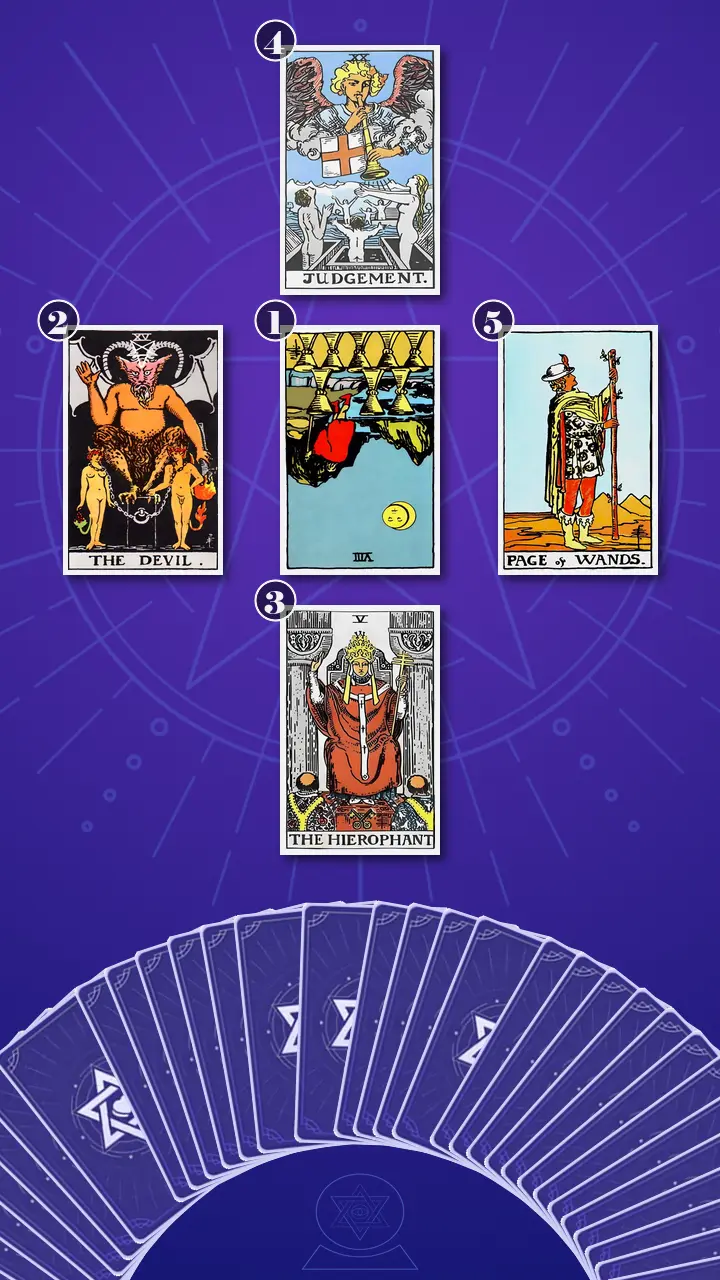
I arranged the spread as a cross. The centre would surface the visible symptom. The card to the left would reveal the hidden attachment pulling Alex backward. The card below would locate the inherited root. Above the centre, the integrating insight would show how to interrupt automatic compliance. The final card on the right would convert that insight into one grounded, reversible action.
“Think of it as a compass whose centre has stalled,” I told her. “The lower and left arms will help us understand the drift. The upper and right arms will help us restore an authored direction.”
The Traveler Who Kept Returning
Position 1: The Planning Loop That Looked Like a Decision
I began at the centre. “The card now turning over represents the observable symptom of your existential drift: where you keep performing the respectable plan while postponing small tests of what you personally want.”
I revealed the Eight of Cups, reversed. In the Rider-Waite-Smith image, a traveler leaves eight arranged cups and faces a difficult mountain path beneath an eclipsed moon. Reversed, the movement folds back toward the apparently complete stack. I pointed to the visible gap among the cups: outward coherence with something unnamed still missing.
“This is your 10:47 p.m. loop,” I said. “You close What I Actually Want, leave the creative-course page unbooked, and return to color-coding promotion criteria. The familiar plan lowers the immediate uncertainty, but the heaviness remains. Returning to what is easiest to justify is an action. It is not proof that you have consciously chosen to stay.”
The Water energy here was in Blockage, not absence. Alex could feel that the current path was emotionally insufficient, but feeling had not become movement. Each time interest appeared, she demanded certainty from it. When certainty failed to arrive, she reopened the safe option like the same browser tab whenever an unfamiliar page took too long to load.
“What do you usually tell yourself has to happen before exploration becomes responsible?” I asked.
Alex gave a short laugh with a bitter edge. Her fingers stopped above the trackpad, and she stared at the blank-document tab as if I had turned over something more private than a card. “That’s too accurate. Honestly, it feels a little brutal. I always say I’ll come back after the next deadline. There is always another deadline.”
“I hear the sting,” I said. “But the card is not accusing you of cowardice. Planning has helped you maintain income, housing, and professional trust. We are only distinguishing a settled decision from a retreat into familiarity. That distinction gives you more choice, not less.”
Her mouth tightened, then softened. She nodded once, slowly. I could see that the first defense had loosened, although the recognition carried grief: the plan she had worked so hard to perfect had also kept the private question safely blank.
The Rewards Hidden Inside the Respectable Script
Position 2: The Loose Chain With a Promotion Attached
I moved to the card on the left. “This position reveals the hidden fear and protective payoff beneath the script: the approval, predictability, and temporary sense of worth that make returning feel safer.”
I turned over The Devil, upright. I immediately pointed to the loose chains around the two figures. “I do not read this as an outside force controlling you, and I certainly do not read it as a warning that something terrible will happen. The card asks where a real reward has become fused with identity so thoroughly that the arrangement feels compulsory.”
I brought the image into Alex’s Monday morning. A former colleague posts a “thrilled to announce” promotion while Alex is riding a mirrored elevator in the Financial District. Before the doors reach her floor, she is checking internal openings, salary bands, and postgraduate credentials. The activity provides a quick burst of control: if she keeps advancing, her life remains legible and nobody can accuse her of wasting her potential.
I described it as a personal algorithm trained on comparison. A LinkedIn milestone unsettles her, so she clicks on conventional markers of success. The algorithm interprets the click as preference and serves more titles, credentials, and five-year plans as the cure for the discomfort those comparisons intensified. Soon, the feed is not merely showing success; it is narrowing what success is allowed to mean.
The card’s upright energy showed an Excess of attention flowing toward status, approval, salary, and predictability, producing a Blockage around private desire. Those rewards were not fake. Toronto rent was real. Financial independence mattered. Praise felt good. That honesty was important because attachments are harder to examine when they deliver genuine benefits.
“The chain is harder to see when it comes with a promotion,” I said. “The question is not whether ambition is bad. It is whether a title has started doing a second job as proof that you are safe and worthwhile.”
Alex’s breath shortened. Her gaze dropped from the card to the mug, and she rubbed her thumb along its chipped rim. After several seconds, she said, “If I stop chasing the next level, what proves I’m doing well?”
“That is the shadow this position wanted us to hear,” I replied. “Not a moral flaw. Not vanity. A fear that an unscripted choice would place your worth on public trial. Once we name the payoff, you can decide how much of it you genuinely value and where it has been given too much authority.”
Position 3: The Approved Template for Adulthood
I moved to the card below the centre. “The card now turning over locates the root: how institutional standards, peer comparison, and recognizable milestones became an internal rule about what a legitimate adult life should look like.”
I revealed The Hierophant, upright. Two acolytes face an institutional teacher. Crossed keys rest beneath the central figure, and stone pillars frame the sanctioned route. I saw in that image the glass performance-review room Alex had described: a leadership rubric, a salary band, a blue marker circling the next level, and a five-year-plan question defining which answers counted as serious.
Alex had told her manager, “That is definitely the direction I want,” before checking her own response. Later, she copied the recognized sequence into her personal plan: visible assignment, leadership competency, promotion, postgraduate credential. It was coherent, rewarded, and easy for other people to validate.
The Hierophant’s energy was not harmful in itself. At its Balance, it offers accumulated knowledge, useful structure, mentorship, and belonging. The distortion appeared when institutional authority moved into Excess and became the only acceptable author. A stable career, education, partnership, or home can be deeply authentic choices. The card was asking whether Alex had endorsed each milestone or simply learned to call it adulthood.
“I learned how to give the valid answer before I learned how to hear my answer,” Alex said.
Her thumbnail released the pressure it had been making against her palm. She gave one long exhale and looked briefly sad, not because every lesson she had received was false, but because usefulness and universality had become tangled together.
“Exactly,” I said. “Belonging and authorship do not have to be enemies. Not every should is wrong; every should deserves a source check.”
When Judgement’s Trumpet Cut Through the Laptop Noise
Position 4: The Call Back Into Conscious Participation
I reached for the card above the centre. At that moment, the laptop fan that had filled every pause clicked into silence. A streetcar bell sounded once below Alex’s window. I did not treat it as an omen, but the clean note made the room feel newly attentive, echoing the trumpet on the card before I had even named it.
“This position identifies the integrating truth,” I said, “the perspective that can separate personally chosen values from borrowed shoulds and interrupt automatic compliance.”
I revealed Judgement, upright, the catalyst of the spread. An angel sounds a trumpet above figures rising from open coffins. I explained that the trumpet does not prescribe a destination. It interrupts sleep. Its upright energy was in Balance: honest self-evaluation, self-permission, and the courage to respond to values Alex could personally recognize.
At 10:47 p.m., the promotion framework was color-coded, the course page was still open, and What I Actually Want remained blank. Alex was working hard, but the question her work avoided was getting louder. Her problem was not insufficient effort. It was that productivity had become an effective mute button.
As an artist, I thought of a scene kept in a film because everyone had already spent money building the set, not because the scene still served the story. I took a sheet of paper and drew two frames. This was my Narrative Fork Analysis: I treated Alex’s options as competing plotlines and asked which one supported her growth as the protagonist rather than merely preserving continuity.
In the first plotline, Alex accepted the promotion automatically because it was the next approved scene. In the second, she did not resign, reject ambition, or announce a reinvention. She paused long enough to review the promotion as chosen, negotiable, or borrowed, then tested one private interest before deciding what deserved the next scene.
That distinction activated what I call Safe-Choice Sabotage Recognition. The promotion was not automatically the sabotage; Alex might consciously want it. The sabotage was using the respectable option to prevent every low-risk encounter with her own preference. Safety had expanded from protecting rent and independence into avoiding the necessary inciting incident of direct experience.
Following every inherited should is not safety; naming what is truly yours and taking one responsive step is the Judgement trumpet that calls you back into your own life.
I stopped speaking.
For one beat, Alex did not move. Her breath stopped high in her chest; her right thumb hovered over the edge of her mug, and her pupils widened before her gaze slipped past the screen. I watched recognition arrive before agreement. Her jaw hardened. Then she said, very quietly, “But doesn’t that mean I have been wrong about my whole life?” The last words rose with anger, not relief. Her fingers curled into her palm, loosened, then curled again. I let the question stand. “No,” I said. “It means some choices may have been useful, protective, or genuinely yours, and some may need review. Conscious review is not a verdict on your past.” Her eyes reddened at the rims. She exhaled in two uneven stages; her shoulders dropped, then she leaned back as if the lighter posture itself felt unfamiliar. Relief crossed her face, followed by a brief blankness: if the script was reviewable, responsibility was hers now. Her voice trembled when she said, “That is almost scarier, but it is also the first thing that feels honest.”
I leaned closer to the camera. “Now, with this new perspective, think back to last week. Was there a moment when this insight could have made you feel differently?”
Alex returned to the performance review. “When my manager circled the leadership band, I thought I had to answer yes or no about my whole future. I could have said I was interested in the salary and unsure about the work. Both things were true.”
“That is conscious participation,” I said. “You do not have to reject the institution to stop letting it answer for you.”
Self-authorship starts when ‘should’ stops being a command: name it as chosen, negotiable, or borrowed, then test what still feels alive.
I set an eight-minute timer for a live version of the exercise. Alex chose one sentence: I should apply for the promotion. She named its sources: financial stability, her manager’s confidence, peer comparison, and a genuine wish for more influence. She labeled it negotiable, not borrowed. During the final two minutes, she found one reversible creative workshop she could test for an hour.
I kept the boundaries explicit. She would keep her job, budget, privacy, and existing commitments intact. No resignation, public announcement, permanent identity, or tarot-approved rebellion was required. If the exercise felt exposing, she could stop after naming the source and return only if she chose.
I could see the emotional movement then: not a leap from confusion to certainty, but a small crossing from numb disorientation and approval-driven planning toward grounded self-trust. Alex had not solved her career. She had heard herself make one distinction that the inherited script had previously flattened.
One Wand, One Honest Data Point
Position 5: The Experiment That Did Not Need to Become an Identity
I turned to the final card on the right. “This position converts self-authorship into one bounded experiment. Its purpose is to gather lived evidence without demanding an irreversible decision.”
I revealed the Page of Wands, upright. The Page studies one wand in a broad yellow landscape. The figure is not surveying every destination, defending a polished plan, or proving expertise. Attention rests on one live possibility.
“In your life, this is one workshop, one community project, one introductory conversation, or one two-week personal project,” I said. “You choose a trial that takes sixty minutes or less, set a maximum cost of thirty Canadian dollars, and record your energy before, during, and after. You do not update LinkedIn. You do not call it a career pivot. You let the experience answer a smaller question: what happens when you participate?”
The Page brought upright Fire into Balance as emerging curiosity and voluntary movement. I also noted what the spread lacked. No Swords card supplied concise language automatically, and no Pentacles card supplied a practical container. Alex would need to add both: one clear decision criterion and firm limits around time, money, work, health, and privacy. That structure would keep curiosity from becoming either another abandoned tab or an impulsive escape.
“You do not need a new identity,” I told her. “You need one honest data point.”
Alex’s shoulders loosened. She glanced toward the workshop tab and smiled, then winced at her own smile as if visible interest were still slightly embarrassing. “So it can just be an hour? I don’t have to decide whether it’s useful?”
“Correct. The Page is a beginner, not a branding exercise. You are evaluating the experience, not asking it to reveal a true calling. Interest, boredom, resistance, relief, and the wish for more are all valid data.”
I did not promise that the workshop would make Alex happier or reveal a hidden destiny. Tarot could show the planning-return loop, the rewarding chain, the inherited template, and an available mode of response. Only Alex’s lived experience could tell her which choices she wanted to claim.
Editing the Script Without Burning the Set
I drew the five cards together into one coherent story. The Hierophant showed how Alex learned that a linear, externally recognizable path was the responsible path. The Devil showed why that lesson remained powerful: salary, approval, predictability, and professional legitimacy offered real protection. The reversed Eight of Cups showed the present consequence, a planning-return loop in which dissatisfaction was repeatedly redirected toward familiar achievements. Judgement supplied conscious review, and the Page of Wands turned that review into a contained encounter with curiosity.
To me, the spread resembled a film in which an old supporting script had quietly taken over the protagonist’s dialogue. It also resembled a GPS guiding Alex efficiently toward a destination someone else had entered. The problem was not that the route contained nothing valuable. The problem was assuming that efficient movement proved the destination was hers.
I named the cognitive blind spot plainly: Alex had been treating a return to familiarity as a conscious decision and using the real need for stability as a blanket veto against experiments that posed no meaningful threat to that stability. Her transformation direction was not convention versus rebellion. It was automatic compliance becoming conscious participation, one reviewed commitment and one bounded test at a time.
“I understand the idea,” Alex said, “but my whole week is full. Even a protected hour sounds like one more thing I could fail to maintain.”
I asked her to open her calendar, not to prove that she had spare time, but to design the smallest version around reality. We found a Saturday block she had routinely left for more course research. I reminded her that the experiment could shrink to a free twenty-minute tutorial at home and a one-line observation. Curiosity did not have to earn an hour by defeating every other obligation first.
Finding Clarity With Two Bounded Next Steps
I gave Alex two pieces of actionable advice. Both were small enough to begin without quitting, disclosing private plans at work, or turning uncertainty into another total life audit.
- The Chosen-Negotiable-Borrowed Audit.On Wednesday at 8:30 p.m., Alex would sit at her kitchen table, set a ten-minute phone timer, and write five current sentences beginning with “I should.” Beside each one, she would name the loudest source, such as personal value, her manager, peer comparison, cost-of-living reality, family expectation, or social media. She would mark each statement chosen, negotiable, or borrowed, then circle the one producing the clearest mix of discomfort and relief.If the exercise starts becoming a complete life audit, she will stop at five statements when the timer ends. “Chosen” is a fully valid answer, and “borrowed” does not require immediate rejection.
- The Protagonist Pivot Action.Within twenty-four hours, Alex would open one saved Eventbrite, Toronto Public Library, community-centre, or course link and take one micro-action toward the most daunting but authentic plotline: register, send one question to the organizer, or place a free session in her calendar. The pilot would happen within the week, last no more than sixty minutes, cost no more than CAD 30, and require no more than thirty minutes of travel each way. She would record her energy from one to ten before, halfway through, and ten minutes afterward, then add one sentence about what she wanted more or less of.If sixty minutes is unrealistic, the minimum valid version is a free twenty-minute tutorial at home. She may leave or stop without explaining, monetizing the interest, announcing a pivot, or converting it into a new five-year plan.
“Curiosity does not have to defeat stability,” I said. “It only needs a protected hour.”
Before we ended, I made the transfer of authority explicit. “These cards have not chosen a promotion, course, or creative path for you. They have helped us externalize the mechanism that kept every option trapped in future simulation. You will decide what remains, what changes, and what stays unresolved. Your observations are the evidence. Your values set the criteria. You are the author.”

A Week Later: The Quiet Proof of Self-Authorship
Six days later, I received a message from Alex with a photograph of an ink-smudged energy log beside a paper collage. She had marked the promotion negotiable, protected her salary, and booked a sixty-minute introductory printmaking workshop at a neighbourhood community arts centre for eighteen dollars.
Her energy score had been four before the session, seven halfway through, and eight ten minutes afterward. Beneath the numbers she had written: I wanted more time to make something badly without needing it to improve my résumé.
“I still don’t know what this means,” her message continued. “I just noticed I didn’t ask whether it was useful until I was already walking home.”
She had slept through the night afterward. Her first thought on waking was, What if this is pointless? She told me she laughed, left the question unanswered, and made coffee before work.
I did not see a solved life in that message. I saw the first credible proof of movement from approval-driven planning toward grounded ownership of the next choice. Alex had not burned down the set. She had written one line of her own and watched what changed when she performed it.
For me, that was the heart of her Journey to Clarity. Tarot had not delivered certainty about the future. It had helped her recognize the difference between a life that looked coherent and a life she was consciously choosing, then supported one practical experiment through which her inner wisdom could become observable evidence.
When the respectable answer makes your chest heavy but the unscripted option makes your stomach flip, choosing what you want can feel like placing your worth on public trial. I have found that simply noticing whose voice the plan is using already means the old script is no longer running without review.
If no experiment had to become your new identity, which single wand among your saved tabs could you give one private, protected hour this week?