When an Old Post Feels Like a Verdict: Choose What Counts Now
The Digital Memory Loop on the TTC
I recognized the pattern before Jordan (name changed for privacy) had finished taking off their coat. They worked in junior communications in Toronto, and one old caption on the TTC had turned a harmless comment thread into evidence about who they were now.
At 8:47 PM on a Tuesday, they had been riding northbound on Line 1 after work. Jordan tapped an Instagram Memory to check one caption, then kept scrolling after their stop. The fluorescent carriage light buzzed overhead, the phone felt warm against their palm, and the brakes shrieked at the platform while their thumb kept moving. The communications task waiting in their apartment remained untouched.
Jordan sat across from me and said, 'Why does one caption from three years ago get to speak louder than who I am today?' They wanted the present self to be real and free to move forward, but feared that an old post could still define, expose, or invalidate them. They told me they kept rereading the wording, the comments, and the nearby uploads as if one more review might finally prove that they had changed.
I could see the shame-tinged nostalgia in the way their hands kept returning to the phone, even after they had placed it face down. It was not simply sadness. It was like an outdated browser tab loading over the page they were actually trying to use, flooding the screen with old shame while the current task waited underneath.
I told Jordan that I understood why the archive felt so persuasive. I had spent years on Wall Street, where uncertainty could make a quiet room feel heavier than a trading floor, but I had learned that more analysis did not always produce more truth. I was not there to tell them whether to delete, restore, or preserve a post. I was there to help them see the pattern clearly enough to choose. 'Let us draw a map of this digital memory loop,' I said. 'The goal is not to make your past disappear. It is to help your present self take the next step.'
A Grid That Turns Browser History into a Way Out
I asked Jordan to take one slow breath and name the question without editing it. Then I shuffled the cards slowly, giving their attention a clean transition from the bright phone screen to the table between us. The shuffle was not a supernatural test. It was a deliberate pause, a way to make the familiar reaction visible before we examined it.
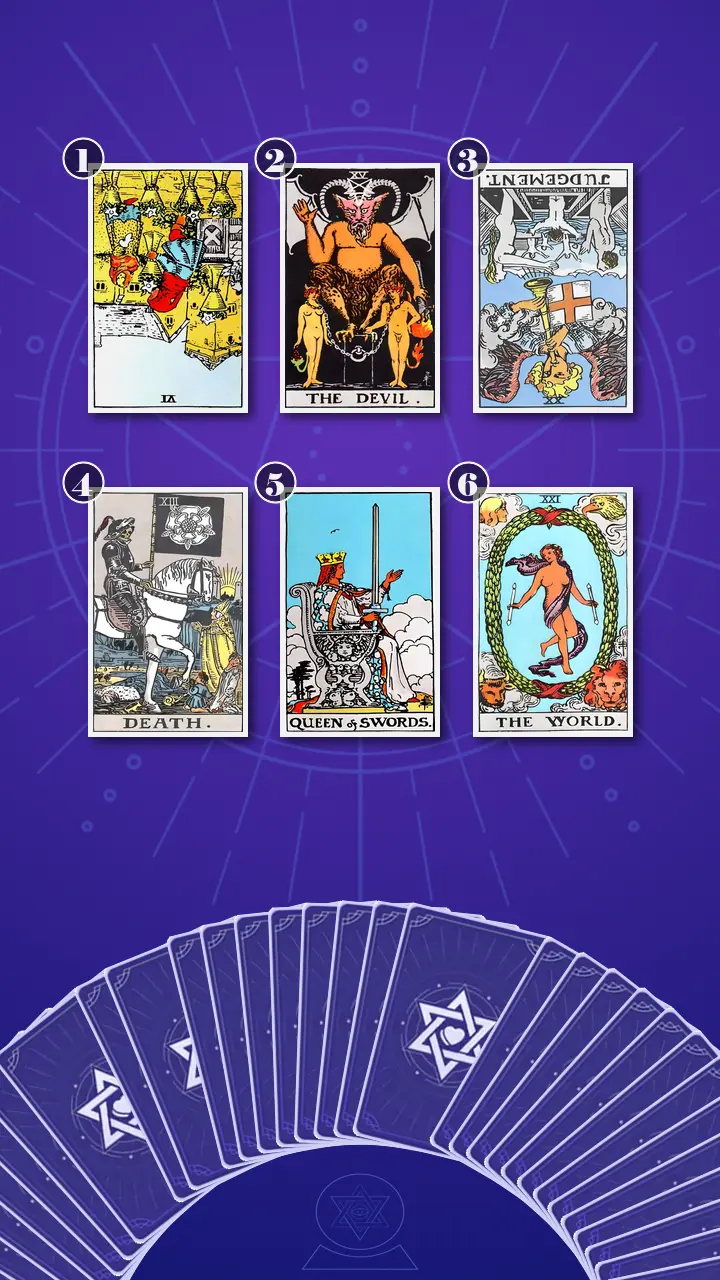
I chose the Transformation Path Grid (6) - Context Edition. For anyone wondering how tarot works in a situation like this, I use the cards as an objective cognitive tool: a symbolic structure that helps separate facts, interpretations, habits, and choices that may be tangled together in ordinary life. I read card meanings in context, not as fixed predictions.
This six-card tarot spread fit because Jordan was not facing a single decision with a simple past, present, and future. They were caught in a recurring trigger-response loop. The grid was the smallest structure that could hold the resurfaced post, the maintaining compulsion, the hidden self-verdict, the interruption, the practical boundary, and the wider integration. Its two rows looked almost like browser history rearranged into a path out of its own loop.
The top row would show the present surface, the maintaining loop, and the shadow story underneath it. The lower row would show the key interruption, the present-day boundary, and the integrated identity available when the insight was practiced. I explained that the fourth card was the catalyst, while the fifth was the practical hinge rather than a prediction point. The cards could not decide who Jordan was. They could help Jordan ask better questions of what was already happening.
Reading the Map: When Memory Takes the Wheel
The Flower-Filled Cup in the Active Tab
Now I turned over the card representing Present surface: the observable trigger and behavior from the diagnosis, including what happened when a digital memory placed an old post in front of Jordan.
The card was the Six of Cups, reversed position.
In the Rider-Waite-Smith image, one child offers another a flower-filled cup inside an enclosed village, while a distant adult figure moves away. I saw the modern version immediately: Jordan opened an Instagram Memory expecting a neutral glimpse of the past, then felt the old caption and its familiar reactions become emotionally present in the current room. The post was dated evidence, but the nostalgia, embarrassment, and faces around it began acting like a verdict about who Jordan still was.
Reversed, the Six of Cups showed memory in a stagnant, poorly integrated state. The blockage was not the existence of the memory. It was the moment remembering became reenacting. The energy moved from noticing a former context to using that context to judge the present. I asked, 'What is this post recording, and what are you making it mean about you today?'
Jordan did not nod. A dry, bitter laugh escaped first; their breath paused, and their thumb hovered above the invisible next scroll. Their eyes lost focus as if the Line 1 ride were replaying behind them. Then their shoulders shifted, and they said, 'Damn, this is exactly what happens. I tell myself I am reflecting, but I am still waiting for one old caption to prove I have changed.'
I did not treat the recognition as a confession or a diagnosis. I asked Jordan to test the distinction in real time. Remembering could preserve information about that day. Reenacting the shame asked the post to grade the whole person. That difference was small in language and enormous in consequence.
The Loose Chain of One More Scroll
Now I turned over the card representing Maintaining loop: how Repetition Compulsion turns the resurfaced post into repeated rereading, comparison, and temporary certainty.
The card was The Devil, upright position.
The Devil's loose chains were a precise image of the repeated scroll. Jordan could technically close the app, but the promise of one more piece of evidence made the familiar loop feel binding. The old comment thread became a place where the earlier identity kept requesting another review, while the present communications task, message, or conversation waited.
In this position, the Devil's energy was blocked agency with an excess of attachment. The scroll offered a first-minute promise: useful context, a clear explanation, maybe even certainty about how other people had seen Jordan. The cost arrived later as a warm face, a tight chest, restless hands, and an hour spent reopening the same case. I said, 'Reflection asks what happened; the loop asks for one more scroll.'
I returned us to the late-night kitchen Jordan had described: 11:18 PM, a radiator clicking beside a half-finished takeout container, blue screen light across the counter, and the Delete and Archive buttons sitting there like two doors neither one could make an identity decision. I placed two sentences beside each other: 'I open it to understand' and 'I keep going because I want the archive to absolve or condemn me clearly.'
Jordan winced at the second sentence. Their fingers tightened around the edge of the chair, their jaw set, and their eyes dropped to the table. After a moment, they rubbed the centre of their chest and gave a small, embarrassed exhale. I could see the shame, grief for a former self, and longing for certainty arrive together, without asking Jordan to force any of them away.
I told them that the chain was not a moral failure and that an app was not the sole author of the pattern. The more useful question was what the review actually returned. If it brought no new information and no present-day action, its emotional intensity did not make it productive. The loop had become an app with no natural stopping point, but Jordan could decide where a stopping point belonged.
The Draft Stuck in Internal Review
Now I turned over the card representing Shadow story: the hidden belief that the earlier self still has authority to define worth and present identity.
The card was Judgement, reversed position.
Judgement reversed showed the inner verdict beneath the scrolling. Jordan treated an old caption like courtroom evidence and postponed present action until the former self had been perfectly explained or fully absolved. They imagined how a stranger, former friend, or current coworker might judge the wording, then collected more comments as if the archive could issue a final ruling.
The energy here was a blocked awakening and an excess of self-review. The angel's trumpet called toward renewal, but the gray coffins kept opening onto the same question. Jordan was not short of evidence. They were asking evidence from one particular year to answer a question it could never answer: whether the person writing today's Slack message had worth.
I asked, 'When you imagine someone seeing that old post, what does it seem to prove about your identity, and what present-day evidence are you refusing to count?' Jordan looked toward the window. They mentioned the current work they had learned to do, the direct feedback they now gave, and the friendships they had chosen more carefully, then said, 'Those things feel less real because nobody can scroll back and verify them.'
I heard the unfinished self-verdict in that sentence. It was like a draft stuck forever in internal review, with every old comment treated as a request for another revision while the current version waited for approval. I reminded Jordan that an archive can show what happened in a particular context. It cannot certify the total meaning of a life, and it cannot withdraw someone's worth.
When Death Retired the Old Verdict
The White Rose at the Threshold
The room became quieter when I reached the card representing Key interruption: the transformation that ends the old post's authority without requiring history to be erased. I turned it over as the central catalyst of the reading.
It was Death, upright position.
The card did not predict literal death, an external loss, or anything Jordan needed to fear. In a self-exploration reading, Death marked a conscious transition. The skeleton in armor crossed the threshold on a white horse, the white rose banner held its ground, and the sun rose between two towers. The old interpretation could end without the record disappearing and without Jordan disowning the person who had lived that earlier chapter.
The Threshold Between Record and Verdict
I asked Jordan to remember the 8:47 PM Line 1 ride: one harmless notification, a warm phone, brakes squealing, and a thumb still moving after the stop. The scene held the tension between answering today's life and asking an old caption to certify that their growth was real.
Jordan's brow tightened. 'But if I stop reviewing it, doesn't that mean I was wrong about who I was?' they asked. I heard the fear underneath the resistance: perhaps compassion for the former self would become an excuse, or keeping the history would mean remaining loyal to its shame.
I used my Pseudo-Growth Eradication lens, the Wall Street habit I bring to personal development when self-help language gets too soft to be useful. I stripped away the promise that one more insight would magically settle everything and audited the actual return on the review. It delivered temporary certainty, no new information, no completed present-day task, and a lower execution rate on the values Jordan said mattered now. That was not proof that Jordan had failed to grow. It was proof that the old review process had a terrible return.
You do not have to keep reenacting an old identity to honor it; let Death's fallen crown mark the end of the old verdict while the white rose points toward a living, present-day self-definition.
An old post can be true about then without being in charge of now. You can let an outdated self-story end without erasing the person who lived it, keeping the context and choosing your own present-tense description.
Jordan's thumb stopped first. Their breath caught, and for a second the blue rectangle of the phone held their face in place. Their eyes lost focus as the Line 1 carriage returned: fluorescent buzzing, brakes shrieking, the stop announced while the scrolling continued. Then their jaw worked once, their hand tightened around the phone, and I saw the old trial replaying. The radiator click and rain against the glass brought the current room back. Their shoulders dropped before they seemed to notice. A small, shaky exhale left their chest. Their eyes shone, not with a magical release, but with the grief of admitting that no amount of rereading could give them the answer they had assigned to the archive. Their fingers opened. When they spoke, their voice was low and slightly shaken. 'So the post can stay, but it does not get to keep talking?' I said, 'Exactly. You can keep history without obeying it.'
I asked, 'Now, use this new lens to think back to last week. Was there a moment when this distinction could have made your next choice feel different?' Jordan lowered the phone to the table. The shift was modest, but it was real: the question had moved from 'Who was I really?' to 'What value am I practicing now?'
This was the emotional crossing in the reading: from shame-tinged nostalgia, compulsive self-review, and identity doubt toward present-tense agency. The purpose was not to become a person with no unresolved memories. It was to grieve an outdated self-story, withdraw its authority, and choose continuity without erasure.
The Boundary That Leaves History Intact
The Upright Sword and the Five-Minute Window
Now I turned over the card representing Present-day boundary: the small, observable action that separates facts from judgement and protects attention from repeated digital review.
The card was Queen of Swords, upright position.
The Queen held her sword upright, one open hand extended, seated high beneath moving clouds. Her energy was balanced clarity: direct enough to create a boundary, receptive enough not to turn that boundary into punishment. I translated her into a practical scene. Jordan could read an old post once, record its date, caption, people present, and visible context, then write the interpretation on a separate line. After that, they could close it, mute related reminders, archive it, or leave it visible. No single digital boundary was morally correct. The important thing was choosing it rather than entering the automatic next step.
I said, 'A record can have history without having authority.' Then I used my Potential Actionability Assessment to turn the insight into something observable. A good idea had to answer three questions: What will Jordan do, when will they do it, and what will show that the present self has received the attention back? Inspiration was welcome, but the milestone had to fit inside a real evening, a real commute, and a real body with a tight jaw.
Jordan ran a finger along the edge of the card. Their expression was still tender, but the restless movement had slowed. 'That sounds less dramatic than deleting everything,' they said. 'It also sounds like something I might actually be able to do.'
'Exactly,' I replied. 'A proportionate boundary is not a performance of being healed. It is a way of giving your attention a say.'
A Larger Profile Than the Archive
The World Inside the Chaptered Timeline
Now I turned over the card representing Integrated identity: how the former self can be included as context while the present self becomes the active reference point.
The card was The World, upright position.
The dancing figure inside the oval wreath gave the archive a different shape. The four figures in the corners did not erase one another; they created a wider frame. The two wands suggested authorship and movement. The World showed an integrated identity, not a spotless one. Jordan could hold a 2021 work-and-friends chapter inside the larger timeline without letting it take possession of the whole profile.
The energy was grounded completion and a more spacious perspective. The former self could contain an honest feeling, an awkward sentence, a useful lesson, or a relationship that mattered at the time. None of those facts had to become the current homepage. I asked Jordan, 'What quality belongs to who you are now, and what single lesson from that chapter would you willingly carry forward?'
Jordan looked at the six cards and answered slowly. They wanted to carry forward curiosity, but not the habit of using curiosity to avoid action. They wanted to practice direct communication in their work now. Their hand moved away from the phone and toward the notebook. For the first time that evening, the archive sat on the table as an object instead of a live authority.
'Continuity is not proof that nothing changed,' I said. Jordan wrote it down. The sentence did not demand that the past become irrelevant. It gave the past a place, and it gave the present a voice.
The One-Page Record, Not Verdict
I laid the six cards in their full sequence and told Jordan the story they made together. The reversed Six of Cups showed a memory notification changing from a dated record into an emotionally charged portal. The Devil revealed the maintaining loop, where one more scroll promised certainty while consuming the attention needed for current life. Judgement reversed exposed the unfinished inner verdict beneath the loop: the belief that growth had to be proven by condemning the former self.
Death interrupted that logic. The interpretation that had to end was not 'I was once awkward' or 'I made choices I would make differently now.' It was 'This proves I am still that person, and I am not allowed to act until the archive clears me.' The Queen of Swords supplied language and a proportionate boundary. The World placed the former self inside a larger story, with the present self once again at the centre of meaning and choice.
I named the cognitive blind spot plainly. Jordan had been confusing repeated review with reflection and confusing emotional intensity with accuracy. They were also treating preservation and obedience as the same thing: if they kept the post, they believed they had to keep answering to it; if they deleted it, they feared they were lying. The key shift was to name the resurfaced post as a dated record, extract one honest lesson, and return attention to a present-day choice.
I explained that the transformation was not a demand to stop caring about the past. It was a move from letting old-post identity spirals set the terms of the present to using current values as the active reference point. The tarot reading had not released Jordan from anything. It had helped make the loop legible. Jordan would be the one deciding what to carry, what to close, and what to do next.
The Evolution KPI Framework
To keep the insight from becoming another beautiful idea saved in Notes and never opened again, I offered my Evolution KPI Framework: a 30-day strict execution challenge that turns a philosophical realization into measurable, real-world behavior. I made one adjustment explicit. The KPI would not score whether Jordan felt calm, forgave the former self, or completed a perfect streak. It would record whether they made a chosen boundary and returned to a current value when the old post was loud.
I ran the plan through my Potential Actionability Assessment once more. Each action had to be small enough for a Toronto commute or a late work night, specific enough to complete without a new identity overhaul, and gentle enough that Jordan could stop if the exercise became too activating. The archive could wait. No delete or restore decision needed to be made with a hot face, tight chest, or automatic scroll.
- Name the recordOnce this week, when Instagram Memories or another platform resurfaces an old post, open the Notes app and write three lines: 'What happened then,' 'What it does not show,' and 'What I choose now.' Use one post only.Write for five minutes or less. If the charge rises, put the phone down and write only one present-day value. Continuing is always optional.
- Set a single-post boundaryOn one weekday evening, set a five-minute timer before viewing the resurfaced post. Separate the visible facts, such as date, caption, and people present, from the judgement attached to them, then choose whether to close, mute, archive, or leave the post visible.Do not enter adjacent years, tagged-photo grids, or comment threads while the charge is high. Prepare a current task or draft reply beside the phone before the timer starts.
- Return to the active tabAfter the three lines and the boundary, spend two minutes on the present task the archive displaced: finish a Slack reply, answer a message, open the personal project document, or join the current conversation.The goal is not to solve the whole task. A two-minute return is enough evidence that the present self can act without a perfect explanation of the past.
For 30 days, Jordan could mark each trigger with three simple notes: whether they named the record, whether they chose a boundary, and whether they returned for two minutes. At the end, they could review the pattern as data, not as a character judgement. The question would be, 'How often did my current values get the next move?' That was the Evolution KPI, and the answer belonged to Jordan.
A Week Later, the App Was Still There
Six days later, I received a message from Jordan while I was making coffee. 'Memory popped up on the train,' they wrote. 'I did the three lines, closed it, and sent the Slack reply before I got home. I still wanted to check the comments, but I noticed that wanting to check was not an instruction.'
That night, they slept a full night; at breakfast, the first thought was still, 'What if I am wrong?' They smiled, opened the current draft, and made the first edit before checking the archive.
That was the quiet proof I had hoped for. The old post had not become harmless, and Jordan had not solved an entire identity transition in a week. Something more credible had happened: a resurfaced memory had remained part of the history while the present-tense self made the next choice.
When I look back at the Transformation Path Grid, I see a Journey to Clarity built from attention rather than prediction. The cards gave Jordan a sequence for seeing the trigger, naming the loop, questioning the verdict, ending its authority, setting a boundary, and integrating the chapter. Jordan supplied the courage and the action.
When an old post makes your chest tighten and your face heat up, I know why analysing who you were can feel safer than trusting who you are becoming. Analysis gives the past a job and postpones the risk of letting the present self count. But a record can stay honest without becoming your judge, and your current life can begin before every old sentence has been explained.
If that old caption could stay a record rather than a verdict, what small present-tense choice might you quietly notice yourself making tonight?