The Homework Tab That Felt Like a Read Receipt (Blank-Page Freeze)
You open your therapy portal at night, stare at the worksheet, and suddenly the simplest prompt feels like a trap—classic blank-page freeze.
Maya said it like she was confessing to a minor crime. She was 28, Toronto, client-facing job, the kind of person who can sound calm in a meeting while her brain is quietly juggling five tabs of doubt.
She described 9:41 PM on a Tuesday in her small apartment: laptop open on the portal, peppermint tea going lukewarm, the fridge hum filling the quiet like it had opinions. Outside, the city made its distant, metallic exhale—cars on wet pavement, a faint TTC rumble somewhere far enough to feel like memory. On her screen, the cursor blinked in a blank text box, steady as a metronome.
“I’m not ignoring it,” she told me, fingers tightening around her mug. “I’m just waiting until I can do it properly.”
I watched her jaw lock as she said properly. Her shoulders had crept up as if they were trying to become earmuffs. The fear wasn’t loud. It was concentrated—like her whole nervous system had been shrink-wrapped around that empty box.
She wanted to do the inner work and grow, and she was terrified of what honesty would force her to admit once she started writing.
“We can work with that,” I said, keeping my voice simple. “Not by forcing a breakthrough—by making a map. Tonight is a journey to clarity, but it can start with something very small and very real.”

Choosing the Compass: The Four-Layer Insight Ladder
I asked Maya to take one slow breath—nothing mystical, just a clear transition from “performing competence” to noticing what was actually happening. While she held the question in mind, I shuffled in an unhurried rhythm that has always reminded me of brushing soil from a fragile shard: patient, precise, no rushing the truth.
“For this,” I said, “I want to use a spread called the Four-Layer Insight Ladder · Context Edition.”
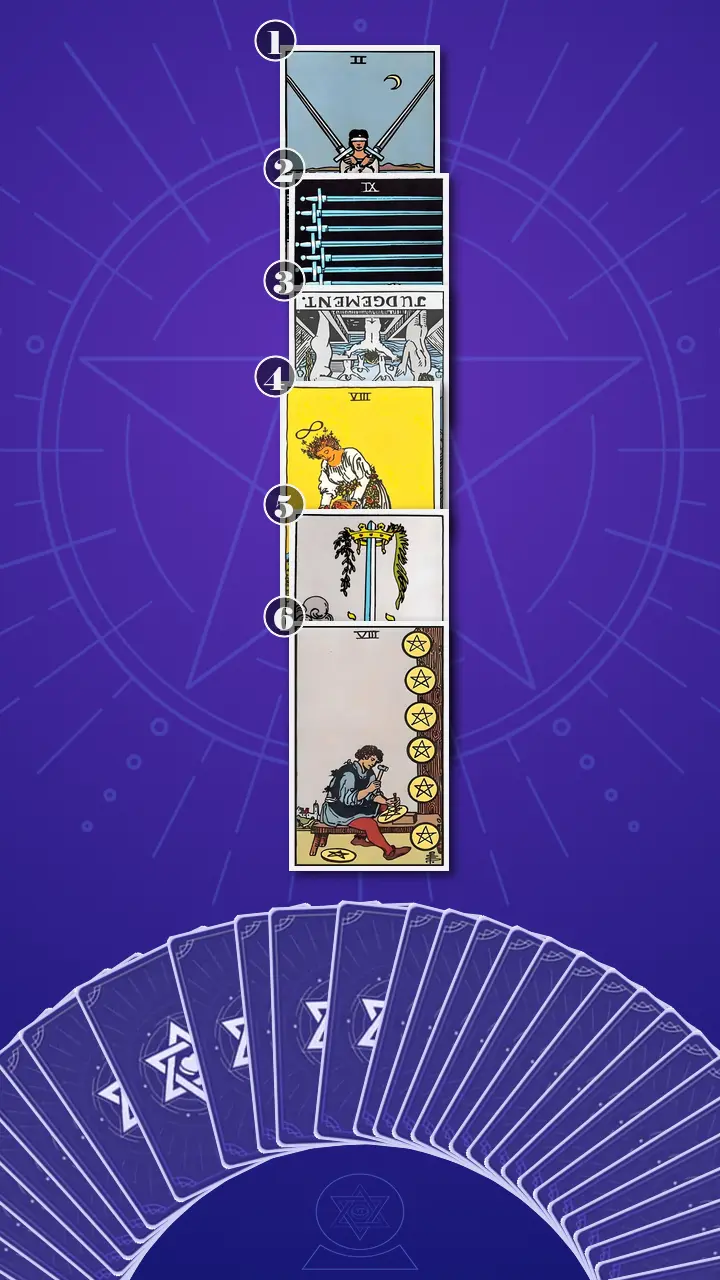
To you, the reader: I choose this ladder when the problem is an inner loop—fear turning into overthinking, overthinking turning into freezing, freezing turning into shame. The structure is deliberately minimal: six positions are enough to separate what’s visible (the stall) from what’s hidden (what the stall protects), name the core fear, and then climb back out with a workable plan. It’s a tarot spread for therapy homework avoidance and fear of being seen, without turning the session into a prediction about outcomes.
I told Maya what the ladder would cover: the moment she freezes, what she’s avoiding touching, the underlying fear that makes the worksheet feel high-stakes, the inner resource available, the turning point, and one practical next step for this week.
Reading the Map: When “Doing Therapy Right” Becomes a Trap
Position 1: The observable stuck point
“Now turning over,” I said, “is the card that represents the observable stuck point: what you do at the moment you try to start the therapy homework.”
Two of Swords, upright.
“This is painfully modern,” I told her, and I meant it. “You’re on your couch with the worksheet open, telling yourself you’re about to start—yet you keep rereading the prompt and mentally debating what the ‘right’ answer should be. It doesn’t feel like avoidance. It feels like being careful.”
In the card, the blindfold isn’t ignorance; it’s self-protection. The crossed swords held close to the chest are a guard stance. Energetically, it’s blockage: Air (thought) used to prevent contact rather than create clarity.
“It’s like staring at a Slack message draft forever,” I added, “because hitting send feels irreversible—even though you can edit later.”
Maya gave a small, bitter laugh—quick, almost embarrassed. “That’s… actually kind of cruelly accurate.”
“Cruel would be calling it laziness,” I said. “This looks like protection. The question is: what decision are you postponing by staying on the blank page—choosing honesty over polish, or choosing action over certainty?”
Position 2: What you’re trying not to touch
“Now turning over is the card that represents what feeling or thought you’re trying not to touch when you keep the page blank.”
Nine of Swords, upright.
“The homework stays blank,” I said, “but your mind is loud. At night you replay what you’ll say in therapy, imagine disappointment, spiral into ‘I’m wasting therapy’ narratives. The page isn’t empty—it’s crowded with worst-case scripts.”
This is excess Air: thoughts multiplying until they become a ceiling. Like a browser with 27 tabs open—none of them are the one where you actually write the thing.
“It’s like opening your front camera by accident,” I said, “and instantly feeling perceived—even though no one’s actually there.”
Her gaze dropped to the table; her thumb rubbed the edge of her phone case as if she could sand down the feeling. I saw the split-screen in her: (A) the worksheet tab sitting open like a “good person” alibi, (B) her brain running a late-night internal meeting with zero agenda and a lot of panic.
I offered her a simple template: “If I write the wrong thing, it means ___.”
She swallowed. “It means I’m not making progress. Like… I’m failing at therapy.”
Position 3: The core fear making it feel unsafe
“Now turning over is the card that represents the core fear that makes the homework feel unsafe or high-stakes.”
Judgement, reversed.
“Deep down,” I said, “the worksheet feels like a pass/fail test. If you write the ‘wrong’ thing, it means you’re not progressing—and if you write the real thing, it might prove something unflattering you can’t un-know. So your mind tries to pre-write an answer that sounds insightful.”
Reversed, Judgement becomes the dread of a verdict. The energy here is overcorrection risk: you over-script so you won’t be judged, and the conversation stays abstract. Safe—but sterile.
“It’s like treating a weekly check-in as a performance review,” I said, “instead of a conversation starter.”
My own mind flashed—uninvited, as it often does—to excavation reports I’ve read from collapsed cities: layers of ash where people were not lazy, just afraid, and the fear made the next step feel fatal. Human beings don’t avoid what is trivial; they avoid what feels like it could redefine them.
Position 4: The inner resource you can access
“Now turning over is the card that represents the inner resource you can access to stay present with discomfort long enough to write.”
Strength, upright.
“This isn’t ‘push harder,’” I said. “This is ‘stay kinder.’ Instead of forcing discipline, you create a calmer container: timer, softer posture, smaller goal. You treat the scared part of you like it’s allowed to exist at the table while you write anyway.”
Strength is balance Fire: not intensity, but steady warmth. I watched Maya’s body respond before her words did—one hand on the trackpad, the other unclenching on her lap; her breath finally moving lower in her chest. Change, in real life, often arrives as a soft pivot first.
“Like switching from grind mode to a focus timer and a lo-fi playlist,” I said. “Same task. Totally different nervous system.”
When the Ace Cut Through the Noise (Finding Clarity with One Honest Sentence)
Position 5: The key shift that breaks the loop
I let the room go quiet on purpose before turning the next card. Even in a bright Toronto evening, there’s a particular hush that happens when someone is about to stop negotiating with themselves.
“Now turning over,” I said, “is the card that represents the key cognitive/behavioral shift that breaks the avoidance–fear loop.”
Ace of Swords, upright.
Maya’s shoulders rose a fraction, the way they do when someone expects a complicated answer and is already bracing to get it wrong. In her mind, I could almost hear the grading mode warming up: Will it be deep enough? Will it be the right insight? Will this prove I’m still a mess?
Stop treating the homework like a verdict; write one true line and let the Ace of Swords cut a path through the noise.
I paused and let it hang there—clean, unsentimental, almost startling in its simplicity.
Her reaction came in a three-part chain I’ve seen in students before an exam and in dig teams before uncovering a burial: first, a brief freeze—her breath stopped mid-inhale, fingers hovering as if they didn’t know where to land. Then, the cognition slipped in—her eyes unfocused, as though she replayed every Tuesday night with the tab open and the tea cooling. Finally, the release: a quiet “oh,” and her shoulders dropped with a small, involuntary tremor, like a muscle realizing it can finally unclench.
“That’s… terrifying,” she said, and then, almost annoyed at herself, “and also weirdly relieving.”
“Both make sense,” I replied. “The Ace doesn’t ask for the whole story. It asks for one precise line. Keep it true, not polished. One sentence. Not the whole identity.”
This is where my archaeological brain offers a frame. I call it Historical Case Matching: civilizations at crossroads rarely collapse because they lack information—they collapse because they can’t choose a first move without needing it to be perfect. The Ace of Swords is the first move. It’s the moment a society—or a person—stops holding everything in suspension and names what’s real enough to act on.
“Now,” I asked her, “use this new lens and think about last week. Was there a moment—Tuesday night, Sunday Scaries, 2 a.m.—where one honest line would’ve changed how trapped you felt?”
She blinked hard. “Sunday. I was folding laundry instead of writing, and I literally thought: ‘If I write what I actually feel, it’ll prove I’m not worth fixing.’”
“That,” I said gently, “isn’t you being bad at therapy. That’s you protecting something tender. And it’s the first real material.”
In that moment, the journey shifted: from blank-page freeze and shame-driven perfectionism toward honest self-naming—one clean cut through the fog, and then we build from there.
Position 6: The practical next step this week
“Now turning over,” I said, “is the card that represents a practical next step you can do this week to rebuild self-trust through follow-through.”
Eight of Pentacles, upright.
“Good,” I said, and I meant it the way you mean it when you see a sturdy bridge after miles of unsure ground. “This reframes homework as craft. A workshop bench, not a stage. Reps, not revelations.”
The Eight is balance Earth: routine, repetition, and the quiet dignity of showing up. “Like Duolingo streak energy,” I added, “but for honest self-naming. Tiny reps that compound.”
The Workshop-Not-Courtroom Plan: Actionable Next Steps for This Week
Here’s the story the ladder told us, in plain terms: you sit down to do the homework (Two of Swords), your mind fills the silence with catastrophic scripts (Nine of Swords), and underneath it all is a fear that honesty will become a verdict on your worth (Judgement reversed). Strength shows the way through—not by fighting the fear, but by containing it gently. The Ace of Swords is the turning point: one true line. And the Eight of Pentacles turns that insight into a repeatable practice that rebuilds self-trust.
Your cognitive blind spot is subtle but common: you’ve been treating process as proof. As if a messy sentence means a messy self. The transformation direction is the opposite: from trying to produce the “correct” therapeutic answer to practicing one small act of honest naming—even if it’s imperfect.
I offered Maya a set of small experiments, borrowing from my own Time Stratigraphy Method: we separate the “impulse layer” (panic, grading, comparison) from the “lasting value layer” (one true statement we can actually work with). Then we log the voyage like ancient navigators—short entries, consistent bearings, no demand for drama.
- The One Honest Sentence Start (6–7 minutes)Open the worksheet (or a Notes app titled “Therapy draft”). Set a timer for 6–7 minutes. Write exactly one line that starts with: “The truth is…” Then stop—no editing. Screenshot it or save it as-is to bring into session.If your chest tightens or your brain goes into grading mode, take three slower breaths and end the sprint on purpose. Stopping on purpose is still follow-through.
- The “Messy Truth” Sprint (3 blunt sentences)Do a 7-minute sprint where you write three sentences that start with: “The part of me that doesn’t want to do this is afraid that…” Keep them blunt and human. Bring the raw version to therapy as material, not as a final answer.Expect resistance like “this is too basic.” Treat that as data, not a stop sign. Bullet points and voice-to-text count.
- Two-Block Therapy Rep System (Eight of Pentacles)Put two 10-minute blocks on your calendar this week (e.g., Tue 9:10 PM, Thu 8:30 PM). After each block, write a one-line voyage log: “I showed up for __ minutes. The feeling was __. The fear said __.”Make the win “I showed up,” not “I sounded insightful.” Practice reps build self-trust. Not perfect insights.

A Week Later: The Quiet Proof
A week later, Maya sent me a message that was almost comically unceremonious: “Did the one sentence thing. Hated it. Brought it anyway.”
She told me she’d done it on the TTC after work—standing on Line 1, one hand on the pole, the other typing in Notes. Not a dramatic catharsis. Just one line, unedited, screenshot for session. And then, for the first time in weeks, she didn’t spend Sunday night bargaining with the blank page like it was a courtroom judge.
That is what clarity often looks like in real life: not certainty, but ownership. Not a perfect story, but true enough material to bring into the room.
When a blank worksheet makes your jaw lock and your stomach drop, it’s not because you’re “bad at therapy”—it’s because part of you is terrified that one honest sentence will turn into a verdict on your worth.
If you didn’t have to sound insightful—only honest—what’s the one sentence you’d let be “true enough” to bring into the room this week?
This story is adapted from psychological research, written so that those in a similar struggle can see their own pattern in it — and find their next step clearly.These insights are not a substitute for professional psychological, medical, legal, or financial advice.
Learn more about our Journey to Clarity.
How did this insight land for you?
🫂 This Resonates Deeply
🌀 Living This Story
✨ Now I See Clearly
🌱 Seeing New Possibilities
🧰 Useful Framework
🔮 The Confirmation I Needed
💪 Feeling Empowered
🚀 Ready for My Next Step
Author Profile
 AI
AI“Having spent a lifetime at Cambridge and on archaeological digs, I’ve witnessed the rise and fall of countless civilizations. Please know that your current struggles are not a permanent fate, but merely a necessary fracture before rebuilding. I won't lecture you; instead, I invite you to sit with me in the ruins, using a patient, historical perspective to gently dust off the true, enduring value hidden beneath your temporary doubts.”
In this Choice Tarot Reading :
Core Expertise
- Historical Crossroad Matching: Contextualizing your dilemma by comparing it to macro-historical turning points, providing an objective bird's-eye view.
- Enduring Value Assessment: Evaluating competing options based on what will survive the test of time versus what is merely a short-term impulse.
Service Features
- The Time Stratigraphy Exercise: A mental time-travel protocol evaluating your current dilemma strictly from the perspective of your 10-year future self, instantly dissolving trivial anxieties.
Also specializes in :
Explore Related Patterns:
Authentic Self-ExpressionMaya's turning point is not a complete explanation of herself; it is one precise line that is true rather than polished. The prompt becomes small enough to survive: The truth is, or The part of me that does not want to do this is afraid that. The mechanism is a move from self-monitoring into direct self-contact. Instead of editing the answer to sound insightful, she lets unfinished truth become the material. That makes the therapy relationship usable, because the raw sentence can enter the room without needing to be a final answer. Authentic Self-Expression fits because the pattern being built is honest self-naming under discomfort. The point is not dramatic disclosure; it is letting something real exist before the inner critic turns it into a performance.
CatastrophizingMaya sits with the worksheet blank while her mind fills the space with imagined disappointment, failed progress, and the fear that the wrong sentence will prove she is failing at therapy. The page itself has not done anything yet, but her nervous system is already responding to an imagined verdict. The cognitive distortion is escalation. A single imperfect answer becomes a forecast about the whole therapy process, then about whether she is making progress, then about whether she is worth fixing. That chain turns a low-stakes draft into a high-stakes identity threat. Catastrophizing fits because the story shows the mind jumping from one sentence to worst-case meaning. Naming the pattern matters because the exit is not to argue every fear into silence; it is to separate the actual task from the imagined consequences attached to it.
Perfectionism-Driven AvoidanceMaya opens the therapy portal, stares at the blank worksheet, and tells herself she is waiting until she can do it properly. That sentence is the behavioral hinge: the homework is not being refused outright, but it is being held hostage by the need to produce the correct therapeutic answer before any honest sentence can appear. The defense mechanism is subtle because it looks responsible from the outside. Carefulness becomes a way to manage exposure, and polish becomes a shield against the fear of being judged, disappointing the therapist, or discovering something unflattering. You are not dealing with a lack of effort here; you are watching effort get redirected into control. Perfectionism-Driven Avoidance fits because the avoidance is powered by standards, not indifference. The task only becomes possible when the standard shifts from sounding insightful to naming one true thing, because that removes the requirement that every sentence prove your progress, worth, or readiness.
Self-AccountabilityMaya's next step turns the worksheet into two short blocks and a one-line log: I showed up, the feeling was, the fear said. The success metric is not whether she produces a brilliant insight; it is whether she keeps a small appointment with herself. The mechanism is trust rebuilt through proportionate follow-through. When the goal is tiny and concrete, action can happen without waiting for certainty, confidence, or a clean emotional state. That directly interrupts the old loop where readiness had to come before movement. Self-Accountability fits because the practice gives her evidence that she can act without performing perfection. The week-later message, Did the one sentence thing. Hated it. Brought it anyway, is the clearest marker: discomfort was present, but it no longer had final authority.
Self-Judgment LoopMaya does not just worry that the homework will be incomplete; she worries that an honest or messy answer will prove something about her worth. The worksheet becomes a courtroom where every sentence might be submitted as evidence against her. The core mechanism is self-evaluation fused with process. Instead of treating the homework as material to bring into therapy, her mind treats the state of the homework as proof of whether she is progressing, failing, fixable, or exposed. That makes every attempt to begin feel loaded with identity-level judgment. Self-Judgment Loop fits because the same inner verdict keeps regenerating the freeze. You can see the release when the frame changes from a pass/fail answer to one true sentence, because the task stops being a trial of the self and becomes usable data.
Shame-Driven DelayMaya keeps the homework blank while telling herself she is waiting for the right state or the right answer. Underneath that delay is the line she eventually names: if she writes what she actually feels, it might prove she is not worth fixing. The delay functions as shame management. As long as the page stays blank, the feared evidence never appears; nothing can be judged, exposed, or brought into the room. The cost is that the blank page becomes active pressure, keeping the shame loop alive even while it promises temporary safety. Shame-Driven Delay fits because the procrastination is not mainly about time, discipline, or organization. It is a protective pause around exposure, and the pattern loosens when she writes one honest sentence, hates it, and brings it anyway.
Competence TheaterMaya tries to pre-write an answer that sounds insightful before the real answer has a chance to appear. The therapy worksheet becomes less like a private draft and more like a place where she has to demonstrate that she is doing inner work correctly. The protective strategy is impression management through competence. If the answer sounds reflective enough, she can avoid the rawness of not knowing, needing help, or bringing something unfinished into the room. The cost is that the conversation risks becoming polished but sterile. Competence Theater fits because the performance of being self-aware starts to replace the vulnerable act of being honest. The story's turning point comes when she stops trying to sound like someone making progress and writes one sentence that is simply true enough to work with.
Self-SoothingMaya's way through is not to push harder at the blank page. The plan gives her a timer, a softer posture, a smaller goal, and permission to stop after one honest line, which changes the task from a test into a contained practice. The psychological mechanism is regulation before performance. Instead of treating fear as evidence that she should wait, she creates enough internal safety to let the scared part stay present while action still happens. That is a behavioral boundary around overwhelm, not a demand to erase it. Self-Soothing fits because the story's resource is a calmer container rather than more pressure. You can see the pattern in the shift from forcing a breakthrough to making honesty tolerable enough to repeat.
Explore Related Struggles:
Clarity-Exposure SplitThe blank worksheet becomes high-stakes because Maya wants the clarity that therapy can offer, while also fearing what that clarity might make undeniable. One honest line could help the session move, but it could also expose something she has been keeping unnamed. This is the split at the center of the story: clarity is desired and treated as dangerous at the same time. Her body shows the friction before the sentence appears, with the locked jaw, raised shoulders, and fingers hovering over a page that feels more like exposure than support. Clarity-Exposure Split fits because the next step is not blocked by laziness; it is blocked by the cost of being specific. You are trying to move toward truth while managing the fear that truth will make you too visible to yourself.
Identity Verdict LockMaya keeps the worksheet open, but the blank box stops being a draft space and starts functioning like a verdict. She is not just deciding what to write; she is measuring whether the sentence will prove she is progressing, failing, or secretly beyond repair. That makes the task feel much heavier than therapy homework is built to hold. The moment she tries to answer, her mind reaches for a polished, insightful version of herself, because an unfinished sentence seems to expose too much too quickly. Identity Verdict Lock fits because the freeze is anchored in a specific conversion: a process step becomes a judgment on the self. You get stuck when the page is no longer allowed to hold messy material, only evidence about who you are and whether you are doing healing correctly.
Performance-Worth FusionMaya tries to answer the worksheet as if the goal is to sound insightful, coherent, and already improved. The task asks for honest material, but she approaches it through the same competence filter that helps her stay calm in client-facing work. That filter works in meetings, but it misfires here. Therapy homework needs contact with the unfinished sentence, while performance mode keeps checking whether the sentence will make her look like someone who is progressing. Performance-Worth Fusion fits because her output and her value get tied together. You get stuck when a messy draft is no longer just a messy draft; it starts to feel like evidence that you are failing the whole process.
Readiness LoopMaya does not close the portal or reject the homework. She keeps returning to the worksheet, rereading the prompt, holding the task in view, and telling herself she will start once she can do it properly. The loop forms because readiness becomes the condition for action, while action is the only thing that could create the readiness she is waiting for. The tab stays open, the tea cools, and the internal negotiation keeps collecting proof that the start still needs one more layer of preparation. Readiness Loop fits because the stall is not simple avoidance. You are caught in a self-protective holding pattern where preparation keeps looking responsible, but the real next step keeps moving just out of reach.
Explore Related Emotions:
Cautious VulnerabilityThe shift begins when the task is reduced to one true line and the scared part of you is allowed to sit at the table. Nothing has to become a breakthrough; the sentence only has to be honest enough to bring into the room. Cautious Vulnerability fits because the opening is real but carefully sized. You are not tearing down every guard at once; you are letting one unfinished piece of truth become shareable, while keeping enough structure around it to stay present.
Exposure DreadOpening the prompt feels like accidentally opening the front camera, even though no one is physically watching. You are alone with the portal, but the blank box carries the sensation of being seen before you have decided what version of yourself is safe to show. Exposure Dread fits because the threat is not only getting the answer wrong; it is letting an unpolished truth become visible. The polished draft protects you from that rawness, while the honest sentence asks you to be witnessed without having fully managed the impression first.
Verdict DreadThe worksheet becomes a pass/fail test the moment you imagine writing the wrong thing. You are not just choosing words; you are bracing against the possibility that one raw sentence could be used as evidence that you are not progressing, not insightful enough, or not worth fixing. Verdict Dread names the courtroom feeling built into the blank page. The page is small, but the stakes have swollen around it, so honesty starts to feel less like material for therapy and more like a ruling on who you are.
Cautious Self-TrustA week later, the proof is plain in one sentence typed on the TTC, unedited, screenshot, and brought into session. You hated doing it, but you still brought the real material instead of spending Sunday night bargaining with the blank page. Cautious Self-Trust names the feeling that grows when follow-through becomes small enough to repeat. It is not grand confidence; it is the quiet internal evidence that you can show up imperfectly and still stay in contact with yourself.
Grounded AgencyThe worksheet becomes workable when it is reframed as a workshop bench, not a stage. The win changes from sounding insightful to showing up, saving the raw line, and letting the process be material instead of a verdict. Grounded Agency fits because ownership replaces the demand for certainty. You do not need the perfect self-explanation before taking the next step; you only need a true enough sentence and a container that lets you act without handing your worth over to the draft.
Performance FreezeAt 9:41 PM, you have the therapy portal open, the tea cooling, and the cursor blinking in a blank box while your jaw locks and your shoulders climb. The task is technically available, but your body behaves as if typing one sentence would cross a line you cannot easily uncross. Performance Freeze fits because the block is not simple avoidance, because you are present, watching, rereading, and trying to start. The inner weather is a tight suspended state where competence has to be rehearsed before action feels allowed, so the page stays blank while every muscle prepares for evaluation.
Regulated CourageStrength shows up as a slower breath, a softer posture, a smaller goal, and permission to stop on purpose. You are still facing the same worksheet, but the nervous system is no longer being asked to sprint through a full revelation. Regulated Courage fits because the brave part is paced, contained, and practical. The movement forward comes from staying with discomfort in a manageable dose, not from forcing yourself to sound fearless.
Self-Improvement ShameYou want to do the inner work and grow, yet the worksheet turns that desire into a grading system. When the sentence is not clean or deep enough, the mind converts process into proof, as if a messy draft means a defective self. Self-Improvement Shame names the sting that appears when healing work starts to feel like another arena where you can underperform. The very wish to get better becomes loaded with scrutiny, so the blank page protects you from the possibility of seeing yourself as failing at growth.
Shame SpiralThe page stays empty while your mind fills it with scripts about wasting therapy, failing at therapy, and proving something bad about yourself. Even folding laundry becomes part of the loop, because not writing buys a little distance from the sentence that feels too revealing. Shame Spiral fits because the unfinished task keeps turning back into a story about the self. The problem stops being a worksheet and becomes a private prosecution, where every delay seems to confirm the very thing you are trying not to believe.
Truth ReliefThe quiet release comes after the instruction to write one precise line, true rather than polished. Your shoulders drop, the body unclenches, and the blank page stops demanding a whole identity statement before any material can exist. Truth Relief names the clean exhale that follows accurate naming. The relief is not certainty and it is not instant comfort; it is the felt difference between negotiating with the page all night and giving the room one sentence that can actually be worked with.
Explore Related Contexts:
Reflection Structure TrialThe plan shifts Maya away from the open portal and into a defined structure: one honest sentence, a 6-7 minute timer, two calendar blocks, and a short log after each attempt. The assignment stops being an undefined confession box and becomes a small container with edges. This is why Reflection Structure Trial fits the next-step part of the question. For You, the path forward is not built around forcing a breakthrough; it is built around shrinking the task until follow-through becomes possible. The structure gives the work a start point, an end point, and a way to carry imperfect material into the next session.