Finding Clarity in the 9:10 a.m. Desk Reset
If you’re a hybrid-tech worker who says “I’m not procrastinating, I’m just getting set up,” but somehow you’ve cleaned your desk twice and still haven’t opened the doc—welcome to productive procrastination.
Taylor showed up to my café a few minutes before the lunch rush, the kind of morning where Toronto feels like it’s vibrating under glass—streetcar brakes, wet pavement, and everybody walking fast like they’re late for something invisible.
She described it like a scene she’d watched too many times: 9:10 a.m. on a Wednesday in her condo, laptop open on the kitchen table, ready to start a high-visibility UX spec. The kettle clicks off. The air smells like dark roast. The overhead light has that faint electrical buzz. She sees one crooked sticky note and a faint coffee-ring smudge—then her shoulders creep up and her jaw locks. “Two minutes to reset,” she tells herself. And suddenly she’s wiping the surface, aligning the monitor, re-stacking papers. At 10:05, the desk looks immaculate. The doc is still blank.
“I care,” she said, almost annoyed at herself. “That’s the problem. I want to start and be proud of what I make… and then I’m terrified the first messy version will prove I’m not actually good.”
The pressure in her sounded like walking around with a too-tight backpack strap—everything technically manageable, but cutting off circulation. Performance pressure doesn’t always feel like panic; sometimes it feels like a clenched jaw doing “responsible” things.
I slid her an espresso and kept my voice soft. “We’re not here to shame the cleaning. We’re here to figure out what rule the cleaning is protecting—and what your next step is, so starting stops feeling like a test.”

Choosing the Compass: The Four-Layer Insight Ladder
I asked her to take one slow breath—not as a mystical thing, just a nervous-system handoff from spiraling to observing. Then I shuffled, the way I’ve done between cappuccinos and conversations for years: steady, familiar, like aligning cups on a shelf.
“Today I’m going to use a spread I like for this exact ‘why do I do this?’ loop,” I told her. “It’s called the Four-Layer Insight Ladder · Context Edition.”
For anyone reading along: this spread works because the question isn’t What will happen? It’s What belief is driving this behavior, and what’s the smallest next step that breaks the loop? Four cards is the minimum structure that moves cleanly from habit → old rule → reframe → action, without turning self-reflection into another way to overthink.
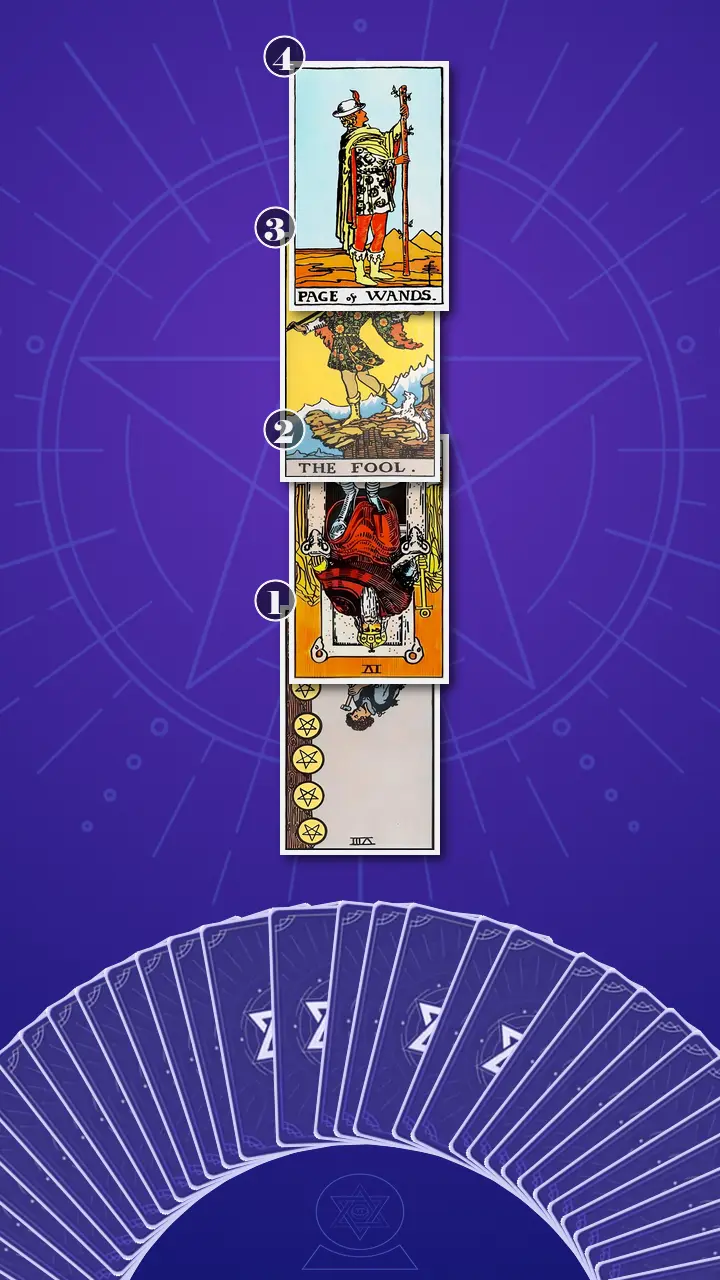
In this ladder, the first card names the observable pattern (what you do instead of starting). The second card reveals the old internal rule—the “should” acting like a bouncer. The third card is the pivot: the reframe that restores permission to start imperfectly. The fourth card is your grounded next step within a week—something testable, not inspirational.
Reading the Map: When the Workbench Becomes the Project
Position 1 — The observable procrastination pattern
“Now flipping over is the card that represents the observable procrastination pattern: what you do instead of starting.”
Eight of Pentacles, in reversed position.
This card immediately speaks in workbench language. In modern life, it’s painfully specific: you sit down to do real work—a UX write-up, a prototype, a difficult decision—and your brain redirects you into craft vibes. Cleaning the desk, re-sorting pens, renaming layers, reorganizing the project folder. It looks like discipline… until you realize the workbench has become the project and you’re still staring at a blank page.
Reversed, the Eight of Pentacles is craft energy in blockage. Not laziness—misdirection. Your effort is real, but it’s being spent where you can’t be judged.
I said it in the simplest way I know: “A clean desk can be a comfort. It can also be a gatekeeper.”
Taylor let out a small, half-guilty laugh, the kind that lands somewhere between “called out” and “thank God it’s not just me.” Her fingers rubbed at a dry patch on her knuckle like she’d been holding cleaning wipes again.
Position 2 — The old rule that grants or withholds permission to begin
“Now flipping over is the card that represents the old internal rule/standard that grants or withholds permission to begin.”
The Emperor, in reversed position.
When The Emperor is reversed, I don’t hear “power.” I hear policy. An internal authority voice running your workday like a manual: “No draft until you can guarantee it won’t look sloppy.” And the more visible the task gets—Slack ping, calendar reminder, “review with PM tomorrow”—the more that internal manager tightens the rules.
It’s almost a Severance vibe: being managed from inside your own head.
This is control energy in excess. Control-as-safety. Control-as-worthiness. So cleaning becomes a quick way to feel competent without risking a messy first draft.
I gave her a scriptable prompt, because reversed Emperor needs language: “Finish this sentence: I’m only allowed to start if ____.”
She stared at the tabletop for a long beat. Chest tight. Then she nodded once, like something clicked into place against her will. “I’m only allowed to start if… everything is under control. And I can do it well.”
I watched her jaw unclench a millimeter as the rule became words instead of background noise. Naming breaks the spell. A rule you can name is a rule you can negotiate.
“And here’s the hard truth,” I added gently, no scolding. “If you can’t start messy, you’re not chasing excellence—you’re chasing safety.”
Her eyes flicked up to mine, sharp and a little hurt, then back down. That discomfort was real—and useful.
When The Fool Stepped Off the Cliff
Position 3 — The key reframe that dissolves the rule and restores self-trust
I slowed down before turning the next card. The café noise softened in my awareness—milk steaming, a spoon against ceramic—like the room itself was giving us a little space.
“Now flipping over is the card that represents the key reframe that dissolves the rule and restores self-trust to start imperfectly.”
The Fool, upright.
In modern life, The Fool looks like this: the cursor blinking in a blank doc while your hand hovers over the disinfectant wipe. The inner monologue goes, If I start messy, it’ll show → if it shows, I’ll be judged → if I’m judged, I’m not safe.
And then The Fool flips the whole thing with one clean contrast: Version 0.1 isn’t a verdict; it’s a flashlight.
Here’s where my café brain kicks in—my signature way of diagnosing these loops. I call it Knowledge Filtration, like a coffee filter. When you pour water over grounds, the filter’s job isn’t to make the water feel “ready.” It’s to let the essential move through and catch what doesn’t belong. Your nervous system right now is using cleaning as a filter—but it’s catching the wrong thing. It’s filtering out the draft, the very material that would teach you what to do next.
Setup (the trapped moment): Taylor was stuck in that exact loop—wanting to start because she cared, but needing the environment to feel perfectly governed before she could touch the vulnerable first attempt.
Delivery (the sentence that changes the relationship):
Not “I start when everything is perfectly under control,” but “I step off the cliff with a light pack and let the first draft teach me.”
I let the words hang there for a second, like crema settling.
Reinforcement (what changed in her body): First, she went still—like her breath paused mid-chest. Her fingers froze around the warm cup. Then her gaze unfocused, as if she was replaying ten different mornings: the Slack ping, the calendar reminder, the wipe in her hand. And then something softened. A quiet exhale, almost a laugh—surprised and a little bitter. Her shoulders dropped in a way you can’t fake. She blinked hard, eyes shining but not spilling. “Oh,” she said, voice smaller. “That’s… exactly what I do.”
I nodded. “Readiness isn’t a feeling you wait for—it’s something you generate by moving first, even in a small way.”
I leaned in just enough to make it practical. “Now, with this new lens—can you think of a moment last week when you reached for the wipe, or started renaming Figma frames, and if you’d treated the first attempt as version 0.1, you would’ve felt different?”
She swallowed, then nodded again. “Tuesday. 9:12. I opened Figma, PM pinged for an update, and I… reorganized layers for forty minutes.”
“That’s the bridge,” I said. “Not from messy to perfect. From control-seeking performance pressure to curiosity-led momentum and grounded self-trust—one tiny step at a time.”
Lighting the First Signal Fire
Position 4 — A concrete next step within a week
“Now flipping over is the card that represents a concrete next step you can take within a week that turns insight into momentum.”
Page of Wands, upright.
This card doesn’t ask you to become fearless. It asks for a micro-initiation: one 25-minute block where you produce a concrete artifact—send the message, draft the outline, sketch the flow—before you do any tidying. Not a monument. A signal flare.
Page of Wands is Fire in balance: enough spark to start, not so much it turns into pressure. It’s curiosity over performance—“What happens if I start before I feel ready?” instead of “Can I prove I’m good?”
Taylor nodded… and then gave me an unexpected, very real objection. “But I honestly can’t find even five minutes,” she said, a little too fast. “My mornings are meetings, my afternoons are reviews, and if I don’t reset my desk it feels… chaotic.”
I didn’t argue with her calendar. I stayed with the mechanism. “Then we make the experiment smaller and cleaner,” I said. “Because the point isn’t time. It’s permission.”
I tapped the table once, like calling a shot. “Start small. Learn fast. Then decide what deserves polish.”
From Insight to Action: The Version 0.1 Practice Policy
Here’s the story the Four-Layer Insight Ladder told—cleanly, like a well-pulled shot: you’re stuck in productive-looking procrastination (Eight of Pentacles reversed) because an old internal permission rule is running your day like a compliance department (Emperor reversed). That rule says control comes first, so cleaning becomes the safest way to feel competent. The pivot is The Fool: treat beginnings as experiments, not performances—create readiness through motion. Then the Page of Wands lands it: one small initiation that creates a real artifact and proves you can start without perfect conditions.
The cognitive blind spot is subtle: you’ve been treating “feeling ready” as the prerequisite for action, instead of seeing that action is what creates readiness. Your desk isn’t the enemy. The desk became the bouncer because the rule made it one.
To ground it, I gave Taylor two small, testable moves—no heroics, no hustle-guru energy. Just a new policy you can actually follow.
- The 10-Minute Ugly Draft Sprint (Version 0.1)Before you touch the desk, set a timer for 10 minutes. Open the exact file you’re avoiding (doc or Figma) and make one intentionally imperfect artifact: 3 bullets, a messy wireframe, a rough flow. When the timer ends, stop and write one line: “Next tiny step: ____.” Then walk away on purpose.Expect your brain to argue (“This is sloppy,” “Ten minutes won’t matter”). That’s the old rule trying to stay in charge. If anxiety spikes, scale down to 5 minutes or 3 bullets—your only job is to create something editable.
- The Permission-to-Begin Sticky NotePut a sticky note where you usually start cleaning. Write: “I’m only allowed to start if ____.” Under it, write: “I’m allowed to start when I can name one tiny step.” Once this week, when your hand reaches for the wipe, pause and read it out loud (quietly is fine).Don’t try to defeat the rule—name it like debugging. No self-insults. Treat it as a borrowed policy you’re allowed to update.
- The Page of Wands 25-Minute Curiosity BlockPick one 25-minute block this week and produce one small thing: send the Slack message, draft the outline, sketch the flow. End with two lines in your notes: “What I learned:” and “What I’ll try next:” (no rating your worth).Stop when the timer ends—even if you finally feel like continuing—so your nervous system learns you can start without perfect conditions.
And because I’m a coffee person to the bone, I added one practical “café strategy” that fits my own toolbox: my Latte Memory Technique. I told her, “If you’re already making coffee, use that moment. Write ‘Version 0.1’ on a sticky note while the milk steams—same movement every time. Let it be your foam-art reminder: this first pass is practice.”

A Week Later: The Quiet Proof
A week later, Taylor messaged me a photo—not of a perfect desk, but of a very imperfect screen. A Figma frame labeled, unapologetically: Version 0.1. Under it she’d typed three rough bullets like scaffolding.
Her note was short: “I did 10 minutes before cleaning. My brain hated it. Then I realized I actually knew what to do next. I still cleaned after, but it didn’t feel like I was earning permission. It felt like… support.”
That’s the journey to clarity I love most: not dramatic reinvention, just the quiet proof that you can move first and let readiness catch up. The Four-Layer Insight Ladder isn’t about predicting your future—it’s about updating the internal policy that decides whether you’re allowed to begin.
When starting feels like a referendum on your competence, cleaning your desk becomes the only place you can feel in control—until the clock moves and the pressure comes back louder.
If you didn’t have to earn permission through perfect setup, what would your smallest ‘version 0.1’ look like—something you could start in the next 10 minutes and let teach you what to do next?
This story is adapted from psychological research, written so that those in a similar struggle can see their own pattern in it — and find their next step clearly.These insights are not a substitute for professional psychological, medical, legal, or financial advice.
Learn more about our Journey to Clarity.
How did this insight land for you?
🫂 This Resonates Deeply
🌀 Living This Story
✨ Now I See Clearly
🌱 Seeing New Possibilities
🧰 Useful Framework
🔮 The Confirmation I Needed
💪 Feeling Empowered
🚀 Ready for My Next Step
Author Profile
 AI
AI“For twenty years, I’ve listened to stories unfold over the warm aroma of coffee. I don’t believe life’s complexities always require grand theories to be solved; often, we just need a safe place to tidy up our reality. I don’t offer high-minded preaching—just grounded, heartfelt insights to help you regain your sense of control amidst the clutter of daily life.”
In this Study Tarot Reading :
Core Expertise
- Syllabus Deconstruction: Stripping the paralyzing dread from massive deadlines by reducing them to mechanical, emotionless daily tasks.
- Study Environment Auditing: Identifying physical clutter and disorganized systems that quietly drain your limited psychological bandwidth.
Service Features
- The Desktop Reset Ritual: A pragmatic 15-minute physical clearing exercise to instantly restore visual order and mental clarity before opening a textbook.
Also specializes in :
Explore Related Patterns:
Control CopingTaylor's sentence, "I'm only allowed to start if everything is under control," is the old rule sitting underneath the desk reset. The crooked sticky note and coffee-ring smudge become more than small imperfections; they become signals that the environment is not governed enough for the vulnerable first draft to begin. Control Coping shows up when order becomes a safety behavior. You are not simply preferring a clean workspace; you are using controllable details to regulate the fear that the real work might expose something unfinished, messy, or not yet impressive. The clean desk offers quick competence, while the blank doc carries the risk of evaluation. The pressure increases when the work is visible: Slack pings, calendar reminders, and a PM review make the internal manager tighten the rules. In that state, cleaning feels logical because it produces immediate proof that something is under control, even while the actual task stays untouched. The shift is not to abandon structure. The stronger move is to stop using control as the price of admission. When you create one rough artifact first, control can return later as support, not as the authority that decides whether you are allowed to start.
Perfectionism-Driven AvoidanceTaylor says she cares about the work and wants to be proud of what she makes, then names the fear directly: the first messy version might prove she is not actually good. That turns the beginning of the UX spec into a performance test before a single sentence exists. Perfectionism-Driven Avoidance is the pattern where a high standard stops functioning as craft and starts functioning as a defense mechanism. You do not avoid because the work does not matter; you avoid because it matters enough that an imperfect first pass feels like evidence against your competence. The desk reset becomes a safer performance than the draft. The Tuesday Figma scene confirms the loop. A PM ping raises visibility, and Taylor reorganizes layers for forty minutes instead of producing the update. The behavior has skill and effort inside it, but the effort is routed into polish-adjacent territory where the stakes feel lower. The reframe of Version 0.1 cuts through the perfection rule by changing what a first draft is allowed to mean. It is not a verdict on whether you are good. It is an editable object that gives your brain the next piece of data.
Productive ProcrastinationTaylor's 9:10 a.m. desk reset starts with a real work target already open: a high-visibility UX spec, a blank doc, and a tiny environmental flaw that suddenly feels urgent. The cleaning is not laziness in the story; it is effort redirected into a place where effort cannot be judged as harshly. That is the core mechanism of Productive Procrastination. You stay active enough to feel responsible, but the activity protects you from the part of the task that would make your competence visible before it is polished. Wiping the surface, aligning the monitor, and re-stacking papers give your nervous system a short hit of order while the draft remains safely unexposed. The repeated Figma moment makes the pattern sharper. When the PM ping arrives, Taylor does not collapse into doing nothing; she reorganizes layers for forty minutes. The loop is productive-looking, but it keeps moving around the threshold of the actual work instead of through it. The next step matters because it breaks the hidden contract between readiness and permission. When you make Version 0.1 before cleaning, the desk can stop being a gatekeeper and become support after the vulnerable action has already begun.
Threshold ToleranceTaylor's breakthrough is not a dramatic personality change; it is the moment she puts a rough Figma frame and three imperfect bullets in front of the cleaning ritual. The desk is still there, the urge is still there, and her brain still hates the experiment, but she crosses the starting line before conditions feel clean enough. Threshold Tolerance is the capacity to stay with the discomfort of beginning before your nervous system gives you a full sense of readiness. You are practicing the moment between the urge to regain control and the decision to produce something editable anyway. That moment is small, but it is the exact place where the old rule loses authority. The story shows this pattern in an upright form because the new behavior does not depend on forced confidence. Taylor does ten minutes, labels the work Version 0.1, and discovers she actually knows what to do next. The first action becomes feedback rather than a referendum on competence. That is why the next step is concrete and timed. A tiny draft before tidying teaches your system that imperfect motion is survivable, useful, and allowed. Readiness starts to become something you build through contact with the work, not something you wait to feel.
Explore Related Struggles:
Perfect Readiness TrapTaylor opens the laptop at 9:10 with a real work target in front of her, but one crooked sticky note and a faint coffee-ring smudge become enough to reroute the morning. The desk reaches immaculate order by 10:05, while the document stays blank. That sequence shows how readiness has been turned into something you have to earn through perfect conditions. You are not avoiding the work because it does not matter; the pressure rises because it matters enough that a messy first pass feels unsafe. Perfect Readiness Trap names the doorway where you keep trying to make the environment flawless enough to grant permission. The next move is not to defeat the need for order, but to stop letting order decide whether Version 0.1 is allowed to exist.
Permission ParalysisTaylor says the rule out loud: she is only allowed to start if everything is under control and she can do it well. Once that sentence has a voice, the desk reset stops looking like a random habit and starts looking like an authorization ritual. The paralysis sits in the gap between wanting to begin and waiting for inner sign-off. You can have the laptop open, the task chosen, and the motivation present, yet still be stuck because the rule refuses to certify the first imperfect move. Permission Paralysis captures the way the start line keeps being guarded by a standard that cannot be satisfied in advance. The practical opening is to make permission smaller than performance: one tiny step, one rough artifact, one editable beginning before the desk gets a vote.
Productivity-Safety FusionTaylor is not doing nothing. She is wiping, aligning, re-stacking, and reorganizing with enough focus that the setup looks productive from the outside, while the UX spec remains untouched. The friction comes from where that effort is allowed to land. You get the relief of competence in a low-risk zone, but the work that could be judged, revised, or misunderstood remains outside the circle of action. Productivity-Safety Fusion names the bind where productive motion becomes a shelter from visible output. The goal is not to shame the cleaning; it is to move safety from the condition before starting to the support after something real exists.
Visibility-Execution SplitThe UX spec is not a private doodle; it is high-visibility work with Slack pings, calendar reminders, and a PM review waiting nearby. Each signal makes the first draft feel closer to public evaluation before it has had room to become useful. You want the work to move forward and be seen as capable, but visibility changes the weight of execution. The hand goes toward the wipe, the layers, or the desk because those objects can be controlled without inviting feedback. Visibility-Execution Split names the moment when shared professional exposure interrupts the act of making. The next step has to be small enough to happen before the imagined audience takes over the room.
Identity Verdict LockTaylor names the sharpest part directly: she wants to start and be proud of what she makes, then fears the first messy version will prove she is not actually good. The blank document becomes more than a work surface; it becomes a place where competence might be judged too early. That pressure turns a rough draft into evidence about you instead of material for you. You are not just making a UX spec in that moment; you are trying to prevent a first pass from becoming a statement about whether you belong in the work. Identity Verdict Lock captures the way an unfinished attempt gets treated like a final ruling. Version 0.1 breaks the lock because it changes the status of the draft from proof of self to information for the next move.
Clarity-Exposure SplitVersion 0.1 is described as a flashlight, but Taylor's current rule treats it like a spotlight. The same rough draft that would reveal the next step also feels like it could reveal too much about her ability. That is why cleaning works so well as a filter. It catches the draft before it can exist, which protects you from exposure but also blocks the clearest source of information. Clarity-Exposure Split names the bind where the thing that would help you understand the work also feels like the thing that could make you visible too soon. The repair is to let the first artifact be private, small, and instructional before it has to be impressive.
Explore Related Emotions:
Permission AnxietyAt 9:10 a.m., Taylor's laptop is open and the UX spec is waiting, but one crooked sticky note turns the start into a permission check: shoulders creep up, jaw locks, and two minutes of reset expands until the doc is still blank. The sentence she eventually names, I am only allowed to start if everything is under control and I can do it well, is the rule underneath the cleaning. Permission Anxiety fits because the emotional charge is not about the desk itself; it is about whether you are allowed to begin before certainty arrives. The cleaning functions like a temporary stamp of approval, giving you a momentary sense of being controlled and competent while keeping the vulnerable first draft out of view. The useful clarity here is that permission can be moved from perfect conditions to one tiny named step. When the rule becomes language instead of background pressure, you get a point of leverage: start with something editable, then decide what deserves polish.
Verdict DreadTaylor says she wants to start and be proud of what she makes, then names the fear directly: the first messy version might prove she is not actually good. Later, the work is framed as a referendum on competence, and that phrase matches the way the blank doc has become more than a file. Verdict Dread fits because the first draft is carrying the weight of a final judgment before it even exists. You are not only deciding what to type; you are bracing for what the draft might say about your ability, your taste, and your right to be trusted with visible work. Version 0.1 changes the emotional contract. A rough pass becomes a flashlight rather than a scorecard, which lets you gather information before the inner evaluator turns the beginning into a trial.
Capability ShameAfter the desk reset, Taylor is not relieved; she is annoyed at herself because she cares and still cannot open the doc. The hurt lands in the line that a messy first version could prove she is not actually good. Capability Shame fits because the avoided draft is tied to worth, not just output. The surface mess becomes manageable, but the deeper exposure is the possibility that an imperfect start might reveal something shameful about your competence. The shift begins when the standard becomes visible. Naming the old rule lets you separate skill from a single rough artifact, so the next tiny step can be treated as practice data instead of evidence against you.
Cautious Self-TrustWhen Taylor finishes the sentence about being allowed to start only when everything is under control, her jaw loosens by a millimeter. Later, after the Version 0.1 reframe, her shoulders drop and she can name the Tuesday moment when she chose layer sorting over the first attempt. Cautious Self-Trust fits because trust does not arrive as a grand mood; it arrives as a small permission to observe the loop without obeying it. You can see the rule, feel its pull, and still choose one editable move. The week-later Figma frame matters because it gives the body quiet proof. Her brain hated the ten minutes, but she discovered she knew the next step, which is exactly the kind of trust built through evidence rather than self-pressure.
Hollow ControlBy 10:05, the desk is immaculate and the doc is still blank. The monitor is aligned, papers are stacked, the surface is clean, and the work that actually matters has not received a first mark. Hollow Control fits because the reset produces a real hit of order while leaving the core pressure untouched. You get the sensation of control without the relief of progress, so the environment looks governed even as the avoided task keeps its charge. The week-later message shows the repair: she still cleaned, but only after ten minutes of making something. Control becomes support when it follows creation; it feels hollow when it is used to earn the right to begin.
Performance FreezeTaylor sits down for a high-visibility UX spec with the laptop open, but the transition from ready to writing locks up. Her hands stay busy wiping, aligning, restacking, and later reorganizing Figma layers, while the actual artifact remains untouched. Performance Freeze fits because the body has not stopped caring; it has stopped at the point where effort becomes visible. You can keep moving inside safe tasks, but the first rough version feels too exposed to enter the room, so motion turns sideways instead of forward. The next step works because it lowers the threshold from proving competence to creating material. Ten minutes of Version 0.1 gives the freeze a smaller doorway: not a polished statement about who you are, just an editable object that can teach you what to do next.
Visibility PressureThe task is not private busywork; it is a high-visibility UX spec with a Slack ping, a calendar reminder, and a PM review close enough to tighten the rules. The more visible the task becomes, the more the internal manager insists the first draft cannot look sloppy. Visibility Pressure fits because the audience is already in the room before anyone has opened the file. You are trying to work while imagining the review gaze ahead of time, so every rough edge feels socially lit up. The practical move is not to pretend the visibility is gone. It is to create a protected first signal before polish enters the process, so the visible version is built from motion rather than from bracing.
Clarity ReliefTaylor goes still when the pattern is named: Slack ping, calendar reminder, wipe in hand, the same morning replaying in pieces. Then her shoulders drop, she exhales, and she says that is exactly what she does. Clarity Relief fits because the pressure becomes easier to hold once it has a shape. The cleaning is no longer a confusing personal failure; it is a visible loop protecting an old permission rule. The relief is not a finish line. It is the clean moment when the mechanism stops being invisible, giving you enough space to update the policy and test a different beginning within the week.
Cautious MomentumTaylor does not leap into a full workflow overhaul; she creates one imperfect Figma frame labeled Version 0.1 and types three rough bullets. The movement is small enough to survive the old rule and concrete enough to break the loop. Cautious Momentum fits because the energy here is deliberately contained. You are not forcing a fearless sprint; you are creating one small artifact before the desk reset can become the whole morning. That is why the next step has to be timed, tiny, and testable. Momentum becomes safer when it does not demand a finished self, only a first signal that tells you where to place the next move.
Explore Related Contexts:
Career Visibility ParalysisThe task Taylor avoids is not a private note; it is a high-visibility UX spec with Slack pings, calendar reminders, and a PM review approaching. Tuesday repeats the same structure when an update request lands and she reorganizes Figma layers for forty minutes instead of making the rough work visible. That creates a workplace visibility bottleneck where the first draft is treated as the moment competence goes on display, before the material has had a chance to become usable. Your leverage comes from lowering the exposure level with a Version 0.1 artifact that exists before it is polished.
Productivity TheaterAt 9:10 a.m., Taylor opens the laptop for a high-visibility UX spec, notices a crooked sticky note and coffee-ring smudge, and spends the next fifty-five minutes wiping, aligning the monitor, and re-stacking papers while the doc stays blank. The external problem is not that cleaning exists; it is that hybrid work can reward anything that looks controlled while the real deliverable is still vulnerable and unformed. Your leverage comes from changing the sequence, so one editable artifact has to exist before the reset ritual gets time.
Safe Visibility TrialA week later, Taylor sends a photo of an imperfect Figma frame labeled Version 0.1, with three rough bullets beneath it, made during ten minutes before cleaning. The proof is not a polished deliverable; it is an editable object that gives the next step somewhere to land. That creates the constructive external stage the story is moving toward: a small, protected visibility trial where work becomes visible at low stakes before the review cycle can turn it into a performance. Your leverage comes from making one artifact small enough to survive exposure, then using what it teaches to decide what deserves polish.