From “No Worries” at 11:40 P.M. to One Boundary Sent While Steady

The 11:40 P.M. “No Worries”
If you are the dependable one in the group chat who confirms the reservation, checks that everyone got home, and says “all good” when your own time is treated as optional, I may know the kind of anger that brings you to a tarot reading. Jordan, a 29-year-old communications specialist in Toronto, brought that exact anger to my table.
Jordan described a Wednesday night at 11:40 p.m. in their condo bedroom. A friend had cancelled at the last minute for the third time. Jordan typed, “That hurt, especially because this keeps happening,” deleted it, and sent, “No worries!” Blue phone light stretched across the unmade bed. The radiator clicked. Their thumb kept scrolling upward through six months of messages while their jaw locked and a heavy knot formed below their ribs.
“I’m not trying to start a fight,” Jordan told me, both hands curved around the coffee I had placed between us. “I’m trying to become certain enough that nobody can tell me I’m overreacting. But then some tiny thing happens later and I snap. Why do I keep ignoring red flags until my anger spills over?”
I heard the contradiction beneath the question. Jordan wanted to preserve connection by staying easygoing, yet feared that naming what hurt would make the other person pull away. Their resentment had become like a pot kept on low heat with the lid clamped down: almost silent from across the room, painfully hot to anyone holding it.
“Anger is not your first boundary; it is often the one that survived being ignored,” I said. “That does not make every uncomfortable interaction a red flag, and it does not excuse a sharp message or raised voice. It tells us that a quieter signal may have arrived much earlier. I’d like us to find that signal and give it usable language before it has to shout.”
I told Jordan that our Journey to Clarity would not produce a verdict about whether their friend was good, bad, safe, or secretly uncaring. Tarot cannot read another person’s private motives. What it can do is place Jordan’s observations, interpretations, needs, and choices where we can examine them without the blue light and midnight adrenaline. Together, we would make a map of the fog and locate the next step Jordan actually controlled.

Choosing the Compass: A Relationship Spread
I invited Jordan to put their phone face down, set both feet on the floor, and take one unforced breath. I shuffled slowly while they held the question in mind. I use this pause as a transition for attention, not as a test of spiritual worthiness or a ritual that hands authority to the cards.
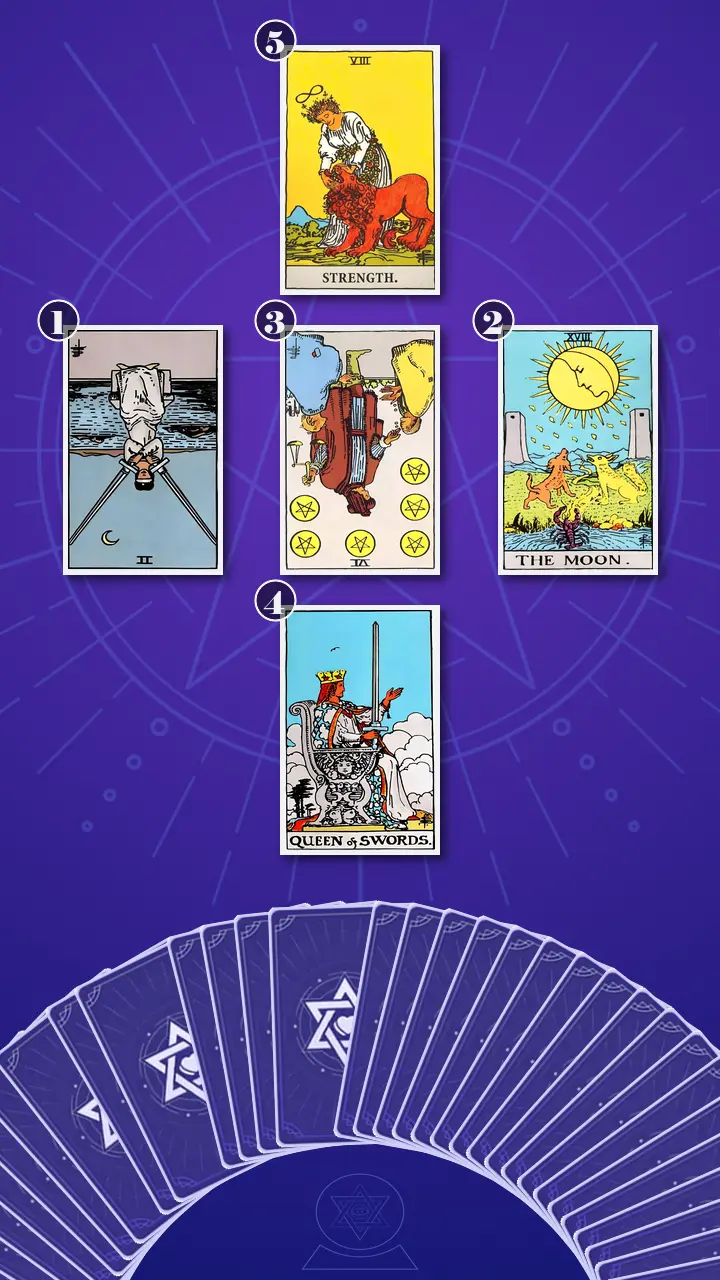
I chose a five-card classic Relationship Spread. When readers ask me how tarot works for mixed signals, boundaries, and communication, I explain that card meanings become useful only in context. This spread was well suited to Jordan because it could hold five distinct parts of the same pattern: the first internal reaction, the ambiguous relationship atmosphere, the need for belonging, the unspoken boundary, and a regulated way to respond.
I arranged the cards like a compass over a bridge. Jordan’s response would sit to the left, the relational atmosphere to the right, and the need for reciprocity in the centre. Beneath that centre, the fourth card would expose the friction Jordan had kept unspoken. Above it, the fifth would offer a practice for keeping anger informative rather than explosive.
The structure mattered. It kept me focused on what Jordan could observe and choose rather than encouraging speculation about someone else’s intent. The spread would move from symptom to context, from context to need, then down into the buried boundary before rising toward actionable guidance.
The Blindfold Made of Drafts
Position One: The Reply That Never Leaves the Chat
I began with the card representing Jordan’s first internal response when a behaviour feels off, including their habit of withholding a reaction until certainty seems available. I turned over the Two of Swords, reversed.
The blindfold and crossed blades did not suggest that Jordan was oblivious. They suggested that Jordan already felt the first impact and then tried to protect the connection by refusing to look directly at it. In modern life, this was the third last-minute cancellation: the chat opened, Jordan frozen between “They’re busy” and “They don’t respect my time,” a pleasant reply sent, and the rest of the night lost to rereading.
I described the reversed card as blocked Air. Thought, which could have helped Jordan form one clear question, had become trapped in internal debate. The immediate conflict disappeared from the chat, but it stayed active in the body. The neutral message said, “No worries.” The tight jaw, held breath, and scrolling thumb said otherwise.
“Maybe it was one thing. Maybe I need more proof. Maybe I can wait one more time,” I said, voicing the loop Jordan had described. “But what is one observable behaviour you already know is not working for you, even if you cannot yet decide what it means about the entire relationship?”
Jordan gave a short, bitter laugh. Their fingers stopped against the cup, tightened once, then released. “That’s so accurate it’s almost cruel. I keep saying I don’t know what it means, but I do know I lost three evenings.”
“Then we keep the three changed plans and set the character judgment aside,” I replied. “You do not need a verdict on their intent to name the impact on you. That distinction is not a technicality. It is the first opening in the stalemate.”
Position Two: The Moonlit Scroll on Line 1
I turned over the card representing the ambiguous relational atmosphere that Jordan had been using as a reason to suspend judgment, without pretending I could know the other person’s motives. It was The Moon, upright.
Jordan had already given me the Moon’s modern scene. At 8:47 p.m. on a rain-slick Line 1 train, they had watched a friend post cheerful rooftop Instagram Stories while their message remained unanswered. Fluorescent lights buzzed over wet boots, and the phone warmed their palm. Jordan’s shoulders crept toward their ears while their mind tried to decode the delay, the Story, the vague apology, and the plan that never became a date and time.
I drew an imaginary line on the table. “On this side, what you observed: your message was unanswered, the Story was posted, and the plan remained unconfirmed. On the other side, what your brain inferred: they were avoiding you, you mattered less, or asking for an answer would expose you as needy.”
The Moon’s uncertainty was operating in excess. Ambiguity had become an endless invitation to investigate, as if an Instagram Story, a typing indicator, and one “sorry, crazy week” text could reveal a whole relationship. It reminded me of driving through Toronto slush with high beams reflecting off the windshield. More staring can create more glare without creating more visibility. The winding path on the card offered a different instruction: Jordan did not need to see the entire future of the connection to ask the next clear question.
“It’s very Normal People,” Jordan said quietly, looking at the card. “Everyone says too little and then carries too much.”
I watched their shoulders lower by a fraction. The Moon had not proved that the friend meant harm. It had helped Jordan separate a real pattern from the story built around its gaps. That separation made room for curiosity without requiring self-erasure.
Position Three: The Scales Beneath the Group Chat
I turned over the card representing the need for belonging and reciprocity that made Jordan more likely to offer extra benefit of the doubt. At the centre of the spread lay the Six of Pentacles, reversed.
I asked Jordan to picture the actual exchange. They moved the plan, sent the check-in, arrived early, and saved the table in a crowded Kensington Market cafe. The other person cancelled casually and offered no new date. Jordan replied, “Totally, whenever works,” while their oat latte went cold and a knot settled below their ribs.
The reversed Earth energy showed a deficiency of visible reciprocity. Jordan’s generosity was real, but it had become partially blocked by fear. They were giving flexibility, reassurance, coordination, and emotional smoothing in the hope that asking for little would make their place in the relationship more secure. The problem was not generosity itself. The problem was that Jordan’s needs had been removed from the exchange.
“Am I being generous, or am I hoping generosity will make me harder to leave?” I asked.
Jordan’s breath paused. Their gaze moved away from the cards as though an old sequence of changed plans were replaying somewhere beyond my shoulder. Then they exhaled from deep in their chest and pressed one palm flat against the table.
“I hate how much that lands,” they said. “I’m always the one making things easy. Then I’m furious that nobody notices what it costs.”
“Reciprocity gets clearer when you stop making your needs invisible,” I said. “The scales do not ask you to become rigid or keep a secret score. They ask you to make one exchange measurable. Who confirms? Who adjusts? Who offers the next date? A proportionate request can tell you more than another month of over-functioning.”
When the Queen Raised One Sword and Opened One Hand
Position Four: The Boundary That Anger Had Been Carrying
The radiator clicked once, echoing the sound from Jordan’s bedroom story, and then the room became unusually still. I turned over the card representing the unspoken boundary whose repeated crossing had accumulated into resentment and later anger. The key card was the Queen of Swords, upright.
Clear Air returned in balance. The Queen held one sword upright while extending her other hand. I read the sword as a specific observation and the open hand as an invitation to accountable dialogue. Her message was not to prosecute the friend’s character. It was to say, “When plans change at the last minute repeatedly, I stop feeling considered. I need more notice, or a clear reschedule.”
This was where I used what I call Daily Friction Deconstruction. I removed the dramatic accusations from both sides: “They never cared” and “I’m too needy.” What remained was mundane and mechanical. Three plans changed late. Jordan had protected the time, managed the coordination, and absorbed the inconvenience. No replacement time had been offered. That was enough material for a conversation.
I paired that lens with Emotional Clutter Sorting. A delayed reply might come from fatigue, workload, forgetfulness, avoidance, or a genuine mismatch in how two people handle care. Jordan could not sort those possibilities by building a private case file. One clear, proportionate boundary would create better information: could the other person acknowledge the impact, make a concrete repair, and participate in a more sustainable pattern?
I thought of the many cups of coffee I had watched go cold over twenty years while someone searched for a morally perfect reason to say a simple no. Clarity rarely arrived as a grand theory. More often, it arrived as one ordinary sentence with nothing hidden inside it.
At 11:40 p.m., after another cancellation, the honest sentence had already been typed. The room was quiet except for the radiator, but Jordan’s mind was crowded with old screenshots, alternate explanations, and the fear that one request could make the whole connection disappear.
You do not need to wait until anger makes the case; let the Queen of Swords' raised blade and open hand pair a clear boundary with a measured invitation.
You do not need anger to make your boundary credible; a repeated impact is already enough to name.
I let the words rest without filling the silence.
Jordan’s breathing stopped first. Their eyes widened slightly, then lost focus as though they were watching every deleted draft return at once. Their fingers hovered above the table, curled inward, and slowly opened. A flush crossed their face. Then they pushed their chair back half an inch and said, more sharply than they had spoken all evening, “But doesn’t that mean I was wrong all those times? That I did this to myself by not speaking?” I heard anger in the question, but beneath it I heard grief and the new vulnerability of seeing an available choice. “No,” I said. “Other people remain responsible for how they treat you. Your silence was a protection strategy with a cost; it was not consent, and it was not proof that the behaviour was acceptable. I’m showing you where your agency can return, not assigning you blame.” Jordan’s jaw trembled once. Their shoulders dropped, but the release left them looking briefly unsteady, as if putting down a heavy bag had revealed how tired their arms were.
When their breathing settled, I asked, “Now, with this new perspective, think back: was there a moment last week when this insight could have made you feel different?”
Jordan remembered the joke at the Ossington bar, the one about them being “so intense.” Ice had clinked in a glass, bass had travelled through the floor, and Jordan had laughed half a beat late while their face burned. “I could have said, ‘That landed like a put-down. What did you mean?’” they told me. “I still would have felt exposed. But I wouldn’t have had to carry it home alone.”
That distinction marked the key emotional transformation in the reading. Jordan was moving from waiting for courtroom-level proof and swallowing discomfort toward trusting an early impact signal and expressing a calm, proportionate boundary. It was not certainty about the relationship. It was the beginning of steadier self-trust.
Position Five: Strength Without Silence
I turned over the final card, representing a grounded practice for expressing concern early enough that anger could remain information rather than become an explosion. It was Strength, upright.
The figure’s gentle hands at the lion’s mouth showed regulated Fire in balance. I did not interpret that as taming anger into politeness. I saw a person staying close enough to protective energy to guide it. In Jordan’s life, this looked like noticing a warm face, quick pulse, and clenched jaw; placing both feet on the floor; taking one longer exhale; and saying the prepared sentence without swallowing it or unloading the entire archive.
“The middle path is not pretending you are fine, and it is not sending six months of screenshots at midnight,” I said. “It is a 90-second pause with one inner line: ‘I can feel this fully without making it say everything at once.’”
Jordan practised the Queen’s sentence aloud. Their voice caught on “I stop feeling considered.” They looked at me, took another breath, and tried again. The second version was still quiet, but it no longer disappeared at the end.
“Calm is not silence. Calm is staying with what you meant,” I told them. “Strength does not guarantee that the other person will respond well. It helps you remain connected to your values while you learn what their response actually tells you.”
The Private Case File Reset
I drew the cards together into one story. The reversed Two of Swords showed thought trapped in an unsent reply. The Moon showed why partial signals kept that reply suspended. The reversed Six of Pentacles revealed the practical cost: Jordan kept giving time and care while making their own needs difficult to see. The Queen of Swords restored clear language, and Strength carried that language through a body that might still feel frightened.
The cognitive blind spot was not simply “I miss red flags.” It was the belief that a boundary becomes legitimate only after Jordan can prove another person’s intent beyond dispute. That belief turned discomfort into a courtroom case and anger into the only witness Jordan trusted. The transformation direction was smaller and more useful: name one observable pattern and one concrete impact the first time the behaviour repeats, then treat the response as information.
I offered three experiments. None required Jordan to decide the future of the friendship that night.
- Write This Moment, Not the Whole Archive Within ten minutes of one repeated behaviour, open Notes and write three lines: “What happened,” “How it affected me,” and “What I need next time.” Use only the current pattern, not the entire relationship history. Set a ten-minute timer. If your body feels flooded, write the first line only and return when you have more space.
- Use the 24-Hour Micro-Boundary Reset Choose one non-negotiable time boundary in the calendar space you share. For example: “I won’t keep Friday evening open after 3 p.m. without a confirmed plan.” If a plan changes, respond within 24 hours: “I can reschedule once. Can you send two times you can genuinely hold?” Start with one low-stakes plan. The goal is to reduce daily friction and make follow-through visible, not to force a promise about the whole relationship.
- Take the 90-Second Strength Pause Before a difficult text or conversation, place both feet on the floor, unclench your jaw, breathe out longer than you breathe in, and say your observation-impact-request sentence aloud once. After sending it, wait 20 minutes before adding reassurance. Practise in a private voice note first. Regulation supports speech; it does not require you to continue a conversation that becomes disrespectful.
I reminded Jordan that these were experiments, not obedience tests. They could revise a message, postpone it until they had capacity, choose a different channel, or end an exchange that stopped feeling respectful. The purpose of actionable tarot advice is not to replace judgment. It is to return enough structure to the moment that judgment becomes available again.

Six Days Later: The Quiet Proof
Six days later, Jordan messaged me. At 6:20 p.m., feet on the kitchen floor, they sent the boundary. The reply was slow and slightly defensive. Jordan slept anyway, woke thinking, “What if I was wrong?”, and made coffee before choosing their next step.
The message Jordan had sent was brief: “When plans change at the last minute repeatedly, I stop feeling considered. I need more notice, or a clear reschedule.” They had not attached screenshots. They had not added “sorry” or followed immediately with reassurance. They had also not declared the friendship over.
“I didn’t feel fearless,” Jordan wrote. “I felt exposed. But I didn’t feel like I had abandoned myself.”
I did not read that as a perfect ending. The friend’s response still needed to be observed over time, and Jordan might still freeze, over-explain, or wake with doubt. The micro-boundary had not solved their life. It had produced one piece of honest evidence: Jordan could speak while their voice was steady, tolerate an imperfect response, and decide what came next without turning their discomfort into a private trial.
That was the quiet proof of this Journey to Clarity. The cards had not predicted the fate of the relationship or granted Jordan permission to have needs. They had made an existing pattern visible. Jordan created the change by choosing one sentence, one breath, and one boundary they could sustain.
When you have held your breath through every “it’s fine” so nobody can call you difficult, the anger that finally spills out can feel like both the only proof you have and the thing you are most ashamed of. I hope Jordan’s reading offers a gentler possibility: the quieter voice was never invalid; it was waiting for you to stay beside it.
The next time your thumb hovers over “No worries,” what two-sentence boundary could pair the Queen’s clear sword with her open hand and feel most like staying on your own side?