From Public Proof to Private Repair After Fights, Letting the Feed

The Quiet Feed After the Fight
You are a Toronto freelance social media manager who can schedule a client's entire week of content, yet after one fight you cannot stop checking whether your partner has viewed the couple story. I heard that sentence from Riley (name changed for privacy) as we sat in my small Toronto studio, where coffee warmed the room and the late-evening rain made the window shine like a dark screen.
At 8:47 PM on the TTC Line 1, Riley had held a warm phone in one hand while the fluorescent lights buzzed overhead. Their thumb moved through the camera roll: a summer photo, a soft-launch-era selfie, an inside joke that looked effortless. Their chest tightened as they weighed wanting privacy against the fear that a quiet feed would expose the fight. In the hours after an argument, the phone became an emergency repair kit: post something affectionate, watch the hearts arrive, feel the warning light go dim, then check again because the private engine was still making a noise.
Riley had put the conflict plainly: why did every post have to prove that the relationship was okay after a fight? They wanted secure connection with their partner, but feared that not posting would announce rejection, abandonment, or a loss of belonging before either of them knew what the silence meant. Their anxiety was not a vague cloud; it was tight chest, restless hands reaching for the phone, a quick surge of relief when a heart appeared, and renewed tension when the person they most wanted to reach stayed quiet.
They looked down at their hands. If we stop posting, everyone will know something is wrong.
I did not hear vanity in that sentence. I heard a person trying to make uncertainty smaller with the tool that was already closest. I said, "That makes sense as a nervous-system move, even if the post cannot finish the conversation. We do not have to shame the urge or obey it automatically. Today, let us draw a map of the difference between public reassurance and private repair. That is our journey to clarity."
Choosing a Compass for Public Proof and Private Repair
I invited Riley to put both feet on the floor, take one unforced breath, and hold the question without trying to make the answer appear immediately. I shuffled slowly, treating the process as a way to focus attention and create a clean pause between the argument and the next reaction, not as a supernatural verdict.
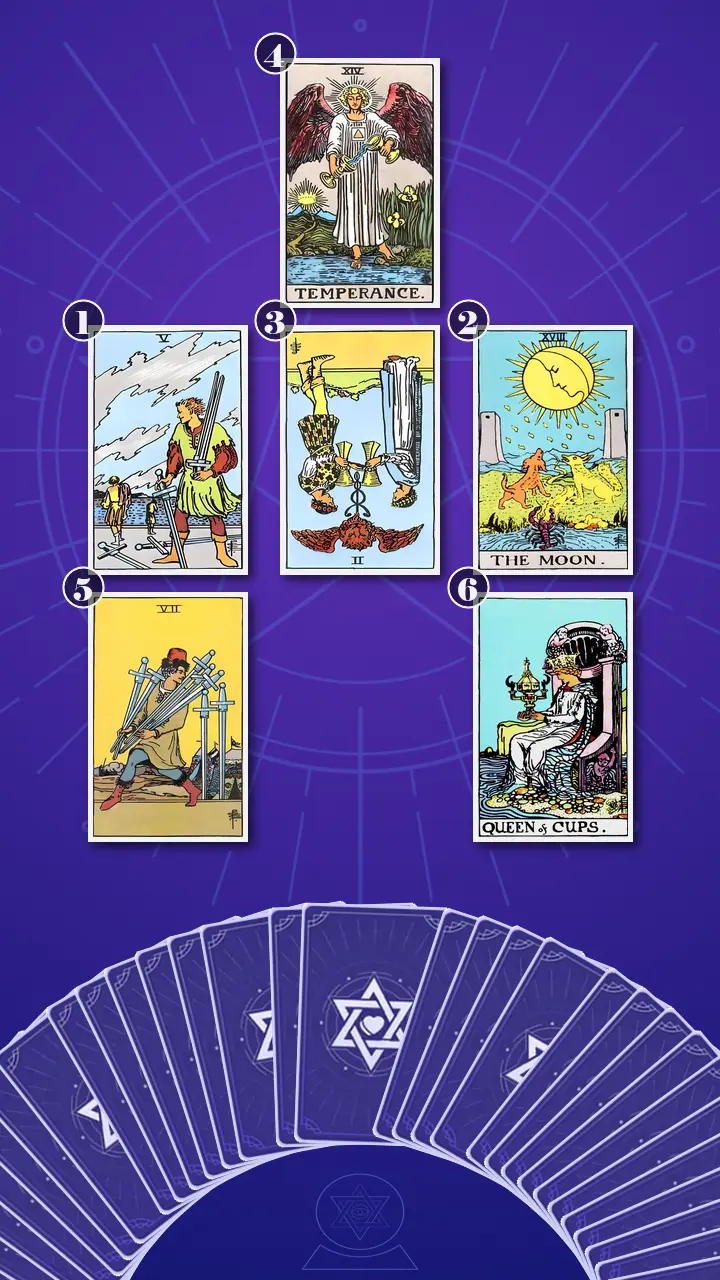
"I am using the Relationship Spread - Context Edition," I told Riley, and then I explained the method for the reader as well. This six-card contextualized Relationship Tarot Spread is useful when the question is about a repeating interaction rather than a simple yes-or-no decision. It separates what Riley does after conflict from the meaning they assign to the partner's online stance, then places the present dynamic, a repair resource, the maintenance pattern, and a chosen next step in view.
The cross gives us a horizontal tension between the visible post-fight response and the story built around silence. At the center, we will look at where affection and mutual repair have become blocked. Above that center is the quality that can restore balance; below it is the habit that keeps the conflict saturated; and the final card points toward a practice Riley can choose, not a future I can predict. Tarot here is a reflective tool for noticing card meanings in context. It does not give me access to the partner's private mind, and it does not take the steering wheel from Riley.
The Screenshots We Mistake for Answers
Position 1: The Visible Stance - Five of Swords, Upright
"Now I am turning over the card that represents the querent's visible stance after conflict: the concrete behavior, emotional posture, and public move that express the need for every post to prove the relationship is okay."
The card was the Five of Swords, upright. I pointed to the central figure gathering the swords while two figures walked away beneath a gray sky. "At 10:05 PM after an argument, you post a smiling couple photo before either of you has discussed what happened, then watch the comments to see whether the relationship appears restored. The post briefly gives you the feeling of winning back stability, but the two people in the room can still feel separate."
In everyday language, this is the familiar social-media move of turning a private rupture into an affectionate announcement. The image can look decisive, like the relationship has survived and the brand is back online, while the actual exchange has not yet happened. The upright energy is not a moral failure; it is an excess of outward control and a deficiency of inward pause. You are trying to manage what is visible before you have had a chance to ask what hurt, what you need, and whether both people are ready to meet.
I asked, "When the feed goes quiet after a fight, does the thought arrive as, If I post this, people will see we are still close; if I do not, they will assume we are falling apart?" Riley gave a small, bitter laugh instead of nodding. "That is almost too accurate," they said. "It makes me sound like I am campaigning for my own relationship."
"I would call it reassurance-seeking through impression management," I said. "The point is not to label you. The point is to notice the job you are asking the post to do. It can express affection. It cannot make the private separation disappear."
Riley's fingers stopped above their phone, then rubbed the edge of the case. The first recognition landed as discomfort, not agreement: a bright image could be genuine and still be recruited to lower an alarm. That distinction gave the urge a shape I could work with.
Position 2: The Story Assigned to Silence - The Moon, Upright
"Now I am turning over the card that represents your interpretation of your partner's stance, especially the story assigned to delayed reactions, distance, or the absence of couple content."
The Moon, upright showed its large uncertain light above a winding path, with a dog and a wolf facing it and a crayfish rising from the pool. I was careful here: this card does not tell me what Riley's partner secretly feels. It shows how an incomplete online signal can become emotionally loaded inside Riley's interpretation.
Riley sees that their partner viewed an Instagram Story but did not reply. That is the observable fact. Then the mind, working like an algorithm that fills missing data with the most emotionally charged recommendation, supplies a whole forecast: they are leaving, friends will notice, the couple brand is embarrassing, the relationship is becoming publicly unbelievable. The phone provides just enough information to keep the fear moving. The upright energy is a blockage in meaning-making: uncertainty is being treated as a verdict before a private question has been asked.
I slid a blank card beside The Moon and wrote three lines. "What I know is __. What I am imagining is __. What I still need to ask privately is __." I said, "A quiet feed is not a verdict about the relationship. It is incomplete information for tonight. Your interpretation may be important, but it is not proof of another person's inner state."
Riley stared at the viewed-story detail on their screen. Their breathing paused; their eyes lost focus as if the same delayed reaction were replaying in several versions; then they let out a low breath and their shoulders moved a fraction lower. The fear had not vanished, but the online fact and the frightening story were no longer fused.
Position 3: The Public Homepage, the Unanswered Message - Two of Cups, Reversed
"Now I am turning over the card that represents the present relational dynamic between conflict, reassurance, public image, and mutual repair."
The card was the Two of Cups, reversed. I looked at the two figures offering cups and then turned the image toward the modern scene: two phones displaying the same affectionate couple story while the private chat about the argument remains unanswered.
"This is blocked reciprocity," I said. "The desire to meet each other is still present, but the exchange is interrupted. You can look synchronized to everyone else while neither of you has said what actually hurt or acknowledged how the other person was affected. The reversed orientation shows an imbalance: public connection is being displayed, while private listening and responding are postponed."
The energy here is not a prediction that the relationship will fail. It is a clear description of the current loop. Public proof lowers the alarm without repairing the rupture. A heart emoji may bring a moment of warmth, but if the person who needs to hear the truth has not heard it, the body remains lonely inside the affectionate image.
I asked, "Can the relationship be real and worthy of care while the feed is still unfinished?" Riley pressed their palm against their sternum. "We look close enough for everyone else," they said quietly, "but can we tell each other the truth?" Their chest stayed tight even after the phone filled with remembered heart reactions. The reaction chain was visible: a physical freeze, the recognition of the unanswered private exchange, and then a long exhale that did not solve the disagreement but made room to name it.
When Temperance Stopped the Caption
Position 4: The Bridge - Temperance, Upright
The room grew quiet as I turned to the card placed above the central blockage. The rain tapped the glass in an even rhythm, and the light from the phone seemed suddenly too sharp.
"Now I am turning over the card that represents the quality or practice that can support repair and move the relationship from reactive public proof toward balanced, private contact."
It was Temperance, upright: an angel pouring between two cups, one foot in water and one on land, with a steady path rising toward a distant crown between mountains. The card did not ask Riley to choose between love and hurt. It asked for a pace that could hold both truths long enough for an honest response to become possible.
In Riley's life, this looks like placing the phone face down instead of uploading a new couple post at the first surge of fear. It looks like writing, "I felt dismissed when we stopped talking. I still care about us, and I would like ten minutes to explain what I need." It is a staged update in the best practical sense: make one careful private change before changing the public-facing version of the relationship.
At this point I used the diagnostic lens I have developed over twenty years of listening over coffee: Daily Friction Deconstruction. I strip away the dramatic accusation that the relationship is either perfectly secure or secretly ending, then locate the mundane mechanical breakdown. In this case, the breakdown is a sequence: an argument, a quiet apartment, a hand reaching for Instagram, an audience check, a brief drop in alarm, and no private repair. The question becomes more workable when we ask which link in that sequence can be slowed.
The Sentence That Can Hold Two Cups
Temperance's basic message reached Riley first as a challenge. It is 8:47 PM on the TTC Line 1, the phone warm in their hand, while a quiet couple feed makes them reread the fight. They choose a smiling photo, not because the hurt is gone, but because silence feels like public evidence. The familiar solution is to make the image brighter before making the conversation safer.
You do not need the feed to erase conflict in order to feel connected, so practice Temperance's middle path by naming both the hurt and the care in one private, paced exchange.
I let the sentence sit between us. For several seconds Riley did not blink. Their fingers tightened around the phone; their jaw set as if the insight had accused them of getting the whole relationship wrong. "But then I have been doing it backwards," they said. "I thought proving we were okay was how I got us back to okay."
I did not rush to turn that pain into a neat breakthrough. "You were trying to protect connection with the fastest tool you had," I said. "Now we are separating two jobs. A post can share affection. A private exchange does the listening. You can care about the relationship without pretending the conversation is finished."
Riley's eyes moved from the card to the draft caption. First came the bodily freeze: the thumb hovered, breath held, shoulders lifted toward the ears. Then the idea entered slowly, replaying the last argument not as evidence of impending abandonment but as an interaction with a missing repair step. Their eyes reddened at the edges. Their fist loosened around the phone, and a tremor passed through their exhale. For one brief moment their shoulders dropped so quickly it looked like weight had slipped from them. Then came a quieter vulnerability: the small dizziness of having a clear path and realizing that clarity did not control the partner's response. Riley looked at the blank note, not relieved exactly, but less trapped.
I asked, "Now, using this new perspective, can you remember a moment last week when this distinction might have changed what you did next?" Riley thought of an old date-night clip they had posted after the last argument. "I could have left it in drafts long enough to find the actual sentence," they said. That was the first crossing from anxiety-driven public reassurance toward grounded self-awareness. Not a guarantee, not a command, just a usable piece of trust in their own perception.
Position 5: The Route Around the Hard Sentence - Seven of Swords, Upright
"Now I am turning over the card that represents the behavior or communication loop that keeps conflict saturated."
The Seven of Swords, upright showed a figure looking back while carrying five swords away, leaving two behind. I connected it to Riley editing every trace of tension out of a couple story, choosing an old date-night clip, and rereading the argument while monitoring reactions. The figure is moving, but the backward glance says the conflict is still being carried.
"This is strategic withdrawal and selective disclosure," I said. "It is an active protective strategy, not a character flaw. You move around the difficult sentence by making the public story look continuous. The two swords left behind are the need and the fact that have not entered the direct conversation."
In the language Riley knew from creator work, it was like editing a brand campaign until the difficult customer-support issue disappeared from the public dashboard while the underlying ticket stayed open. I asked them to complete the thought: "I am moving on publicly, but I am still carrying __ privately." Riley wrote, the fear that being upset makes me harder to choose, and the request that they tell me when they can talk.
They glanced at the two swords still on the table, then turned their phone face down for the first time. Their mouth tightened with resentment before softening. "I hate that the post makes me look calm when I am still waiting," they said. "It gives everyone else the version of us I wish I could feel." I told them that naming the mismatch was already more direct than polishing it away.
Position 6: The Private Inbox - Queen of Cups, Upright
"Now I am turning over the card that represents your chosen next step for honest participation, without predicting or controlling your partner's response."
The Queen of Cups, upright sat beside the water, holding an ornate closed cup. I read the cup as a private inbox for feeling: receptive, deliberate, and not automatically forwarded to the entire audience. The water held emotional depth; the throne held enough steadiness to witness that depth without making every feeling public.
"The next practice is not suppression," I said. "It is emotional stewardship. Notice the attachment surge, validate the hurt, and choose a message that reflects the actual state rather than recruiting followers to certify the bond. You can write, I feel __ because __. I want to ask for __. I do not need the audience to answer this for me."
Riley imagined opening Notes before Instagram. Their shoulders were still not fully relaxed, and that mattered. The Queen of Cups was not promising a permanently calm nervous system. She was offering a repeatable way to participate: feel, name, ask, and leave the public outcome outside the part Riley could control.
The Ten-Minute Draft Hold
When I gathered the six cards into one story, the pattern was direct. The Five of Swords showed Riley trying to control the visible aftermath of conflict. The Moon showed how silence and delayed reactions became a foggy path filled with projected rejection. The reversed Two of Cups named the center: a public display of unity standing in for the private act of listening, responding, and repairing. Temperance offered the bridge, Seven of Swords revealed the indirect route that kept the issue active, and the Queen of Cups returned the work to Riley's own emotional clarity.
The blind spot was not simply "I need too much reassurance." It was the assumption that public visibility and private security are the same kind of evidence. They are not. The feed can show affection; it cannot do the listening for you. The transformation is from anxiety-driven public reassurance and compulsive audience checking toward grounded self-awareness, private repair, and comfort with imperfect visibility. The relationship does not have to look perfectly fine in order to remain worthy of care, and a quiet Instagram feed is not a verdict about the relationship.
I framed the next steps through my 24-Hour Micro-Boundary Reset. The boundary was not a permanent rule about posting, nor a test of loyalty. For the next twenty-four hours, Riley could establish one small, non-negotiable pause in the shared digital space: after conflict, no couple post would be published during the first ten minutes of the urge. The post could remain a draft. Riley could still choose to share it later, and they could stop the exercise if writing or contact felt unsafe or unwanted.
- The feeling-and-need noteAfter a fight this week, Riley will open a private note before opening Instagram and write one line beginning, "I feel..." and one line beginning, "I need..." The smallest version takes two minutes.Use a ten-minute timer if the phone offers faster relief than reflection. One honest sentence is enough, and the note does not have to be sent.
- The draft holdBefore uploading an affectionate couple photo or caption, Riley will leave it in drafts for ten minutes and ask whether it expresses genuine affection or is mainly asking the audience to certify that everything is okay.Keep the choice open: keep it private, share it later because it feels true, or send a private message asking whether a conversation is possible. This is an experiment, not a permanent ban.
- The paced repair requestIf Riley wants contact, they can send, "I care about us and I am still processing last night. Would a ten-minute conversation later feel possible?" The request names a need without demanding a public post or an immediate emotional response.Read the message once and remove any sentence that asks the partner, followers, or comments to prove the relationship is secure. Consent and timing remain part of repair.
- The fact-versus-story pauseDuring one short uncertainty window, Riley will write down the actual online facts, such as "they viewed my story" or "their reply is delayed," beside the meaning being assigned to them.Mute notifications for twenty minutes, take a shower, make tea, or walk one Toronto block. Record one body cue and one emotional word without turning either into a verdict.
These are small next steps because the aim is not to solve a relationship in one sitting or force a public outcome. It is to create enough room for a real choice. If the partner is willing and the context feels safe, private repair can begin. If not, Riley still has the right to pause, keep a feeling private, seek support, or decide what kind of communication works for them. Tarot can clarify a pattern; Riley remains the person who chooses the boundary.

A Week Later, the Feed Was Still Imperfect
Four days later, Riley messaged me from a Queen West cafe. They had left a couple story in drafts after a disagreement, opened Notes, and written, "I felt dismissed when we stopped talking. I still care about us, and I would like ten minutes to explain what I need." They asked their partner whether a conversation was possible instead of asking Instagram to certify that the relationship was safe.
The message did not end with a cinematic reconciliation. Riley told me they sat alone with an espresso while the grinder shrieked, and for three minutes the feed stayed quiet. Their first thought was still, What if I am wrong? This time, they noticed the tightness in their chest, named it as fear, and did not turn it into evidence. Then they sent the short request. The change was only a draft left unsent and a private sentence finally made speakable, but it was real movement.
I think of that as the first proof of clarity: not a perfect couple post, not a guaranteed answer, and not the disappearance of uncertainty. It was Riley learning that care and conflict could occupy the same evening without one needing to be erased for the other to count. Our Journey to Clarity moved from reactive urgency to a steadier practice of self-awareness, direct expression, and honest consistency.
When the apartment goes quiet after a fight, your chest may tighten and your thumb may reach for a couple photo because being visibly imperfect can feel less frightening than wondering whether you still belong. That reaction deserves understanding, not shame. A quiet feed is not a verdict about the relationship, and you can love someone and still leave the draft unsent.
If you let the feed stay quiet for one evening, what feeling, need, or small private sentence might you notice before deciding what anyone else needs to see?