The Venmo Request That Hit Before the Door Even Closed
“It’s not the money—it’s the vibe of being invoiced.”
Alex said it like she’d been holding the sentence behind her teeth for weeks. Twenty-nine, mid-level marketing in New York, stable job, not-stable cost of living—yet somehow early dating still had her doing post-date math like it was part of the romance. She wanted to feel chosen and cared for, but she was scared that naming a money boundary would make her look petty. Hard to love. “Dramatic.”
She described Thursday night like a clip she couldn’t stop replaying: 9:42 p.m., walking up the narrow stairs to her Chelsea walk-up, mezcal and lime still clinging to the back of her throat. Keys clattered into the bowl by the door. The kitchen was dark except for the blue glow of her screen when she flipped her phone back over—because of course she did.
The Venmo notification popped up like an emotional jump-scare. And her body answered before her brain could. Jaw tight. Chest tight. Thumb already moving. She hit Pay the way you hit “Agree” on a Terms of Service you didn’t read because you just want the app to open.
“I pay immediately to keep it… smooth,” she said, eyes on her hands. “And then I lie in bed and spiral, like—did I even like him? Or am I just annoyed? Am I overreacting? Why does it feel like I’m being audited after every date?”
I nodded, not in a “here’s the mystical answer” way, but in the way you nod when someone finally says the quiet part out loud. “Let’s make this less about decoding what their Venmo request means and more about finding clarity around what you will and won’t do. We’re not here to win a vibe war. We’re here to stop paying for peace.”

Choosing the Compass: The Relationship Spread · Context Edition
I had Alex take one slow breath with me—nothing ceremonial, just a nervous-system handoff from the group-chat spiral to something we could actually use. I shuffled until the cards felt steady in my palms, like a deck becoming a map.
“For this,” I told her, “I’m using the Relationship Spread · Context Edition.”
And for anyone reading who’s ever googled ‘Venmo request after a date boundary’ at 1 a.m.: I chose this spread because the issue isn’t just money. It’s the pattern—how a repeated ‘after-the-date invoice’ vibe changes closeness, respect, and attraction. This layout keeps the classic you/them/dynamic structure, then pivots into what matters most here: boundary definition, clear communication, and sustainable follow-through. Not prediction—practice.
“The first card shows your automatic response,” I said. “The second reflects their money operating system—without us turning into mind-readers. The center shows the loop you two are creating together. Then we go to your boundary blueprint, your wording style, and finally the system that keeps you out of resentment.”
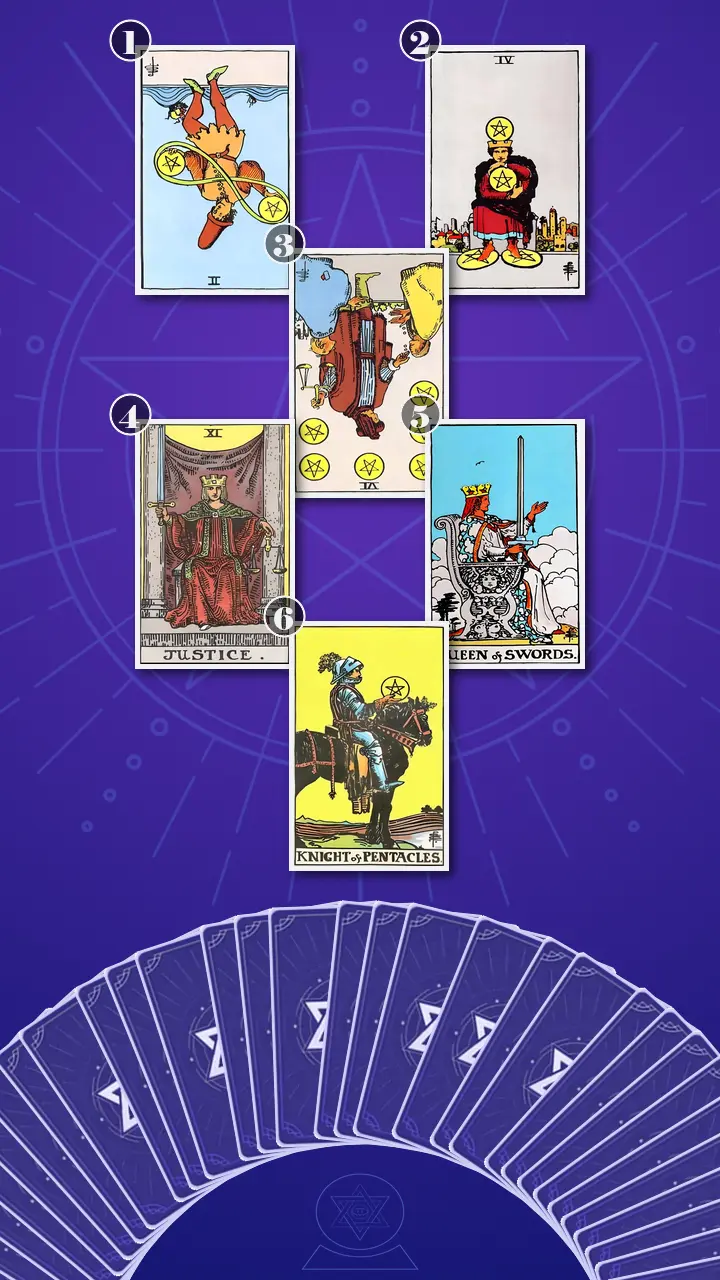
Reading the Map: Coins, Control, and the Loop That Keeps Repeating
Position 1: Your current pattern around paying and reacting
“Now flipped over is the card representing your current pattern around paying and reacting.”
Two of Pentacles, reversed.
In modern life, this is the moment Alex already described perfectly: the split-second after you get home in NYC and your brain tries to juggle romance, budget, and self-image at once. Venmo request appears. You want to stay the ‘easygoing’ version of yourself, so you pay instantly—then you re-run the night like a spreadsheet, trying to prove you’re not “too much” for caring.
Reversed, the energy is a blockage: too many tabs open, the laptop overheating. The juggler isn’t playful anymore—she’s wobbling. The fun-date energy tips into budgeting and self-protection, like spinning plates you can’t let crash.
Alex gave a small laugh that wasn’t funny. It came out sharp, then died off. “That’s… brutal,” she said. “Because I literally do that. I pay in under a minute. And then I’m in Notes like it’s my unofficial therapist substitute.”
I kept my voice warm, but clear. “That reflex—pay fast—makes sense as protection. It prevents awkwardness in the moment. But it also buys you a different cost: resentment, self-doubt, and the private accounting afterward.”
Position 2: Their likely money mindset/approach
“Now flipped over is the card representing their likely money mindset that’s shaping this pattern.”
Four of Pentacles, upright.
This is someone who treats spending like risk exposure. Clean accounting helps them feel safe and in control. That doesn’t automatically make them selfish or a villain in a Cut essay; it’s simply a tight-grip style.
Upright, the energy is a balance that can lean into excess: security is prioritized over warmth. The coin on the chest in the classic image is almost too perfect—resources held close, emotions held close. The question isn’t “Are they bad?” The question is: does their version of “fair” leave room for generosity and attunement, or do you always end up feeling managed?
Alex’s shoulders crept up, then she forced them down. “It’s like… he’s not mean. It’s just so… itemized.”
Position 3: The shared money dynamic you two create together
“Now flipped over is the card representing the shared dynamic—what these repeated Venmo requests create between you two.”
Six of Pentacles, reversed.
I watched Alex’s breathing change as soon as she saw it—quick, shallow, like her chest was trying to protect its own ledger.
Here’s the scene this card describes: even if you split down the middle, the energy can still feel off—like you’re being graded for how quickly you comply. The repeated requests create a quiet hierarchy: one person sets the system, the other adapts. That’s why the resentment isn’t irrational. It’s information.
And this is the line I want anyone stuck in “is it normal to request money after every date?” discourse to hear: Equality on paper isn’t the same as care in real time.
Alex’s face did a three-part shift—first a tiny freeze (breath held, fingers hovering as if she still had her phone in her hand), then an unfocused stare like she was replaying a specific Venmo notification, then a soft exhale that sank her shoulders.
“It’s like a post-date Jira ticket,” she said quietly. “Technically organized. Emotionally… dead.”
“Exactly,” I said. “That’s reversed Six energy. Transactional, measured, worth-math. And it traps you in the internal ledger voice: ‘If I pay fast, I’m chill. If I say something, I’m dramatic.’”
When Justice Spoke: Scales, Sword, and the Bridge Between You
Position 4 (Key): Your healthy money boundary—what ‘fair’ means for you
“Now flipped over is the card representing your healthy money boundary—what ‘fair and respectful’ means for you in practice.”
The room got unusually quiet, the way it does on a ship at night when the corridor noise drops and you can suddenly hear the ocean doing its slow, massive breathing. I’ve guided people through hard conversations on transoceanic voyages—people who could discuss mergers calmly but couldn’t say, ‘I need this to feel mutual.’ The silence before the truth always sounds the same.
Justice, upright.
Setup. Alex was stuck in the most exhausting kind of decision fatigue: trying to decode what a Venmo request “says” about her desirability and his character, while her body kept flashing the same alarm—tight jaw, tight chest, a restless urge to fix it with the quickest payment possible. She wanted to be courted, but she feared that naming the boundary would collapse the whole vibe.
Delivery.
Not ‘keep the peace by paying silently’—choose a clear standard, hold it like Justice’s scales, and speak it with the clean edge of the sword.
I let that land. No extra words. Just air.
Reinforcement. Alex blinked hard once. Her mouth opened like she had an argument ready—then closed. Her eyebrows pulled together, not in confusion, but in that flash of resistance that’s really grief: grief for how long she’d been trying to be “low maintenance” while privately tallying costs like a performance review she never agreed to be in. Her breath caught (freeze), her gaze went slightly distant (the memory replay), then she exhaled in a shaky release that softened her shoulders.
“But if I do that,” she said, voice tighter at first, then steadier, “doesn’t it mean I’ve been… training this? Like I did it to myself?”
“It means you were protecting yourself the only way you knew,” I replied. “Justice isn’t about blame. It’s about structure. The boundary isn’t punishment; it’s a policy you can repeat.”
Then I brought in my own lens—my Bridge-Corridor Theory, born from Venice and refined in every awkward human passageway I’ve ever watched. “In Venice,” I told her, “a relationship isn’t one straight road. It’s corridors and bridges. Money moments are bridges: short crossings where you either connect cleanly—or you hesitate, wobble, and drop the weight into the water. Paying instantly is you sprinting over the bridge so no one sees you hesitate. Justice asks you to pause at the bridge entrance and put up a simple sign: ‘This is how I cross.’ If someone wants closeness, they’ll cross with you.”
I looked at her. “Now, with this new perspective, think back to last week. Was there a moment—maybe right when you saw the request—where this insight could’ve made you feel different?”
She swallowed. “Yeah,” she said. “I would’ve realized it wasn’t a personality test. It was… data. And my boundary is the thing I actually control.”
“That’s the pivot,” I said, and I meant it as a clinical observation and a kindness. “From tense resentment and self-doubt fueled by silent scorekeeping to calm self-respect through explicit, repeatable money agreements. Stop decoding the request. State the agreement.”
The Queen’s Clean Line: Clarity That Doesn’t Apologize
Position 5: How to communicate the boundary clearly
“Now flipped over is the card representing how to communicate the boundary—tone, wording style, emotional posture.”
Queen of Swords, upright.
This card is your nervous system learning it doesn’t have to write a dissertation to deserve respect. In real life: instead of a 12-message draft to your friends and silence toward your date, you send one short text that’s calm and adult. A reusable template—copy/paste, not reinvent-your-personality.
I said it plainly, the way I’d coach someone on a cruise ship to speak to their partner over the hum of engines: “Clarity isn’t harsh. It’s kind—because it’s usable.”
I offered Alex a two-line script and watched her thumbs hover in the air as if she could feel the keyboard already.
“Hey—quick note on dates. I’m happy to split, but I don’t do Venmo requests after. I prefer splitting at the table or alternating. What works for you?”
Her stomach visibly flipped—then she exhaled. “It’s… so short,” she said, half amazed. “I always start with ‘I don’t want this to be weird…’”
“That’s the essay trying to pre-empt judgment,” I said. “Queen of Swords doesn’t negotiate your right to have a preference. She just states it.”
The Slow, Boring System That Stops the Spiral
Position 6: A sustainable next step you can actually maintain
“Now flipped over is the card representing your sustainable next step—the system that keeps you out of resentment.”
Knight of Pentacles, upright.
This is where we trade vibes for a plan you can maintain when you’re tired. Not a dramatic confrontation. A steady rhythm: budget-friendly first dates, splitting at the table, alternating—whatever feels aligned—repeated until your nervous system stops bracing for the Venmo buzz.
It’s the “boring” montage that’s actually soothing: choosing a low-stakes spot where the check is easy, bringing it up before phones come out, repeating the same line next week. Consistency over intensity. A boundary you can repeat beats a rule you can only follow on a good day.
From Decoding to Agreement-Making: Actionable Advice for the Next Two Dates
I leaned back and stitched the story together for her—past to present to next step.
“Here’s what the spread shows,” I said. “You’re in a loop of reactive juggling (Two of Pentacles reversed): you pay fast to keep things smooth, then privately spiral. They may be running a tight-control money system (Four of Pentacles): clean accounting equals safety. Together, that creates a transactional dynamic (Six of Pentacles reversed) where you feel measured instead of met. The solution isn’t more analysis—it’s Justice: define fairness as a repeatable agreement, communicate it with Queen of Swords clarity, and follow through with Knight of Pentacles consistency.”
The cognitive blind spot was clean: Alex kept treating money as a secret test of desirability. “If I can just interpret this correctly, I’ll know if I’m worth choosing.” But the transformation direction was even cleaner: shift from silent scorekeeping to stating a simple, repeatable money agreement—and letting their response inform attraction or exit.
Then I offered her a small set of next steps, designed to be doable in NYC life, not fantasy-life:
- The 10-Minute “Justice Script” DrillOpen Notes and write one sentence you can repeat: “I’m happy to split, but I don’t do after-the-date Venmo invoices—let’s split at the table or alternate.” Then write the paragraph you want to add and label it “Anxiety DLC.” Choose one follow-through for the next date: ask before the check comes, pick a venue where splitting is clean, or pause before paying any request.If your chest tightens, stop early. The goal is a usable line, not forced confidence.
- The Two-Sentence Boundary Text (Queen of Swords)Before the next date—or at least before the next check—send: “Quick note on dates: I’m happy to split, but I prefer handling it at the table or alternating rather than Venmo requests after. What works for you?”Use my Burano-inspired Lace Communication Method: one clean edge, no extra frills. If you start justifying, delete the second paragraph.
- The 10-Minute Venmo Pause RuleIf a post-date request arrives anyway, don’t pay immediately. Set a 10-minute timer. Then respond once: “Hey—I prefer handling it at the table. Let’s do that going forward.”Think of it as the Gondola Balance Technique: you’re redistributing emotional load so you’re not carrying ‘keeping it smooth’ alone.

A Week Later: The Quiet Proof of Finding Clarity
A week later, Alex messaged me a screenshot—cropped tight, no drama. Two sentences. No emojis trying to soften the impact. She’d sent the Queen of Swords text before date four.
His reply was simple: “Totally fair. Let’s just split at the table.”
She wrote, “I slept through the night. Woke up and my first thought was still ‘What if I sounded intense?’—but then I laughed. Quietly. Alone in a coffee shop. It felt… lighter.”
I thought about how often people mistake clarity for conflict. This was the opposite. This was a small, grounded shift from paying-for-peace to self-respect—money as shared logistics, not a secret referendum on worth.
And if tonight you’re trying to be the “chill” version of yourself while your body is keeping a full spreadsheet in your chest, remember: it’s not romance that’s failing—you’re just tired of paying for peace.
If you didn’t have to prove you’re easygoing, what simple money agreement would let you stay present on the date—and what would it be like to let their response give you clean information?
This story is adapted from psychological research, written so that those in a similar struggle can see their own pattern in it — and find their next step clearly.These insights are not a substitute for professional psychological, medical, legal, or financial advice.
Learn more about our Journey to Clarity.
How did this insight land for you?
🫂 This Resonates Deeply
🌀 Living This Story
✨ Now I See Clearly
🌱 Seeing New Possibilities
🧰 Useful Framework
🔮 The Confirmation I Needed
💪 Feeling Empowered
🚀 Ready for My Next Step
Author Profile
 AI
AI“Having traveled across cultures... I've learned that what we often lack isn't a simple answer, but a moment of being truly understood. I use a Jungian psychological lens to help you deconstruct your subconscious patterns—not to prove anything, but to be the gentle companion who helps you unravel your knots, free of judgment, so you can reconnect with your inner wisdom.”
In this Love Tarot Reading :
Core Expertise
- Attachment Loop Diagnosis: Logically decoding whether your relationship friction is driven by an anxious-avoidant trap or deep-seated insecurity.
- Shadow Projection Analysis: Identifying the unacknowledged fears or unmet childhood needs you are unconsciously projecting onto your partner.
Service Features
- The Projection Detachment Exercise: A structured psychological journaling prompt to separate your partner's actual behavior from your triggered internal narrative.
Also specializes in :
Explore Related Patterns:
Conflict AvoidanceAlex does not lack a preference; she lacks a low-threat way to say it while the connection still feels fragile. Each after-date Venmo request gives her a clear moment to speak, but she chooses the fastest route out of tension by paying first and thinking later. The defensive mechanism is avoidance through smoothness. You remove the immediate discomfort, but the unspoken issue stays active in the relationship field, turning a simple payment preference into resentment, self-doubt, and private analysis. Conflict Avoidance is the pattern because the feared conflict becomes more powerful than the actual conversation. The clean money boundary interrupts that loop by making the disagreement usable instead of letting it become a silent test of whether You are allowed to have needs.
People-PleasingAlex's thumb moves to Pay before she has even had time to think, because the immediate goal is to keep the date energy smooth and avoid becoming the person who makes things awkward. The money is concrete, but the deeper pressure is social: if she names the discomfort, she fears she will look petty, dramatic, or hard to love. That reflex turns payment into a compliance ritual. You give the other person's system the final say, then process the emotional cost alone afterward. The pattern is not about generosity; it is about using instant agreeability to manage the risk of rejection. People-Pleasing shows up here as the attempt to purchase peace with self-erasure. The boundary work begins when You stop treating ease as proof of lovability and start treating your preference as legitimate information.
Transactional IntimacyAlex describes the Venmo request as feeling less like shared logistics and more like being invoiced, audited, or managed after a date. Even when the split is technically fair, the repeated after-the-fact request changes the emotional meaning of the interaction. The cognitive shift happens when money stops being money and becomes a hidden desirability test. You start asking whether the request means You are not being chosen, whether asking for warmth would make You too much, and whether fairness on paper is replacing care in real time. Transactional Intimacy is the pattern because closeness is being filtered through accounting logic. The boundary restores emotional clarity by moving money out of the secret-worth-test zone and into an explicit agreement both people can understand.
Assertive CommunicationAlex's two-line boundary text changes the whole shape of the problem: she is still willing to split, but she no longer agrees to after-date Venmo invoices as the default. The message is short because the point is clarity, not persuasion. Assertive Communication works here by separating preference from apology. You do not need a long preface to prove You are reasonable; You need a usable sentence that states what works for You and invites a direct response. The pattern is upright because the defense system becomes organized instead of reactive. Clear wording lets You stay respectful without abandoning your own standard, and the other person's reply becomes clean data rather than something to decode in bed later.
Boundary DiscernmentAlex's boundary does not require her to decide that the other person is wrong for wanting clean accounting. It requires her to notice that their system creates a feeling of being managed after the date, then separate that discomfort from the pressure to be agreeable. Boundary Discernment is the ability to identify the line without turning the line into a moral trial. You can be fair, generous, and open to splitting while still saying that after-date Venmo requests do not work for You. That distinction is what gives the next move its clarity. The boundary is not a punishment or a test; it is a clean definition of how You cross the money bridge in dating.
Energy ScorekeepingAlex's private ledger is not only about who paid for what. It includes the tight jaw, the fast payment, the Notes app processing, and the resentment that builds when she keeps acting easygoing while feeling measured. Energy Scorekeeping appears when the emotional labor becomes silently itemized. You may look cooperative on the outside, but internally You are tracking every cost of staying agreeable, every moment of self-suppression, and every sign that the dynamic is not mutual. The pattern matters because hidden accounting eventually distorts attraction. A clear money agreement gives the emotional ledger somewhere to go before it turns into resentment.
Values-Based Decision MakingAlex's pivot happens when she stops treating the Venmo request as a personality test and starts treating it as data. The key question becomes less about whether she is chill enough and more about what kind of money agreement lets dating feel fair, respectful, and emotionally present. Values-Based Decision Making appears when the boundary is tied to a standard she can repeat: split at the table, alternate, or discuss it before phones come out. You are no longer reacting to each notification; You are choosing from a defined sense of what respectful dating requires. This pattern gives the money boundary durability. It does not depend on a perfect mood or a perfectly worded confrontation; it depends on knowing the value underneath the request and letting your next action match it.
RuminationAlex lies in bed replaying the date, the request, and her own reaction as if one more pass through the evidence will finally tell her whether she is annoyed, unfair, attracted, or overreacting. The loop feels like problem-solving, but it keeps her attention trapped inside interpretation. This is rumination because the thinking does not move toward a decision point. You keep auditing the vibe after the fact instead of converting the discomfort into a clear standard for next time. The pattern becomes especially costly because the analysis is trying to do the job of a boundary. The way out is not a better theory of what the request means; it is a repeatable agreement that makes the next payment moment less psychologically loaded.
Urgency BiasAlex's body responds to the Venmo notification before her thinking catches up: jaw tight, chest tight, thumb already moving. Paying instantly makes the uncomfortable signal disappear, which gives the action a false sense of necessity. Urgency Bias is the cognitive pressure to treat immediate relief as the correct choice. You move fast because the discomfort feels like a problem that must be solved right now, even though the real issue requires a slower boundary decision. The pause matters because it separates nervous-system urgency from actual consent. Ten minutes is not about playing games; it is a small behavioral interrupt that lets You choose from your standard instead of from panic-smoothness.
Explore Related Struggles:
Approval-Safety FusionAlex is scared that a simple money preference will be read as a character flaw: petty, dramatic, hard to love. That fear turns the Venmo request into more than a payment request. It becomes a moment where approval feels tied to whether she can stay agreeable under pressure. Approval-Safety Fusion names the lock that forms when being liked starts to feel like the only way to stay safe in a connection. You may know the boundary is reasonable, but your body treats the act of saying it as a risk to belonging. So the safer move becomes paying quickly, softening your language, or drafting a long explanation before you have even stated the actual need. The story's shift is not toward becoming colder or more demanding. It is toward separating respect from performance. When approval is no longer the safety system, a boundary can become a clean piece of information: this is how you handle money, this is what keeps dating comfortable, and the other person's response tells you whether the connection has room for your preference.
Boundary Ambiguity LockAlex keeps trying to read the Venmo request like a hidden message: whether it means he is inconsiderate, whether she is overreacting, whether splitting after the fact is normal, whether caring about the timing makes her petty. The problem keeps moving because the standard has never been placed outside the spiral where she can actually use it. Boundary Ambiguity Lock fits because the money issue is not simply about who pays. It is about the absence of a clear, repeatable agreement that protects your presence on the date before resentment starts doing the organizing for you. When the boundary is undefined, every notification becomes a referendum, every payment becomes a performance, and every silence becomes more evidence to re-audit. The way out is not a perfect interpretation of their Venmo habit. The structural pivot is a usable standard: split at the table, alternate, choose lower-stakes venues, or state that after-the-date invoices do not work for you. Once the boundary has language, you can stop treating discomfort as a flaw in your personality and start treating it as information about what agreement you need.
Fairness-Agency SplitAlex is not rejecting fairness. She is reacting to a version of fairness that arrives as an after-the-date invoice, after one person has already chosen the system and the other is expected to comply. The bill may be mathematically equal, but the relational load is not equally shared when she has to absorb the awkwardness, pay fast, and process the emotional fallout alone. Fairness-Agency Split names the tension between paper equality and lived consent. You can believe in splitting costs and still need the method to feel mutual, timely, and respectful. The stuck point appears when fairness is defined so narrowly that your agency disappears inside someone else's logistics. The boundary becomes clearer when fairness is no longer treated as silent endurance. A fair agreement is one you can say before the check, repeat without apologizing, and evaluate by how the other person responds. That gives you back the part of the date that the Venmo loop had taken over: the ability to stay present instead of privately calculating whether respect was included.
Performative HarmonyAlex hits Pay before her body has even finished reacting. The smooth version of the date is preserved on the outside, while the real conversation gets postponed into tight jaws, late-night Notes, and the private question of whether she is allowed to want something different. Performative Harmony fits because peace is being maintained through self-silencing. You are not choosing ease from a grounded place; you are performing ease so the connection does not have to encounter your boundary. The cost is that the relationship looks frictionless while your inner world becomes crowded with resentment and second-guessing. This struggle is especially sticky in early dating because being low maintenance can feel like social currency. The story shows the exact moment that currency turns expensive: the payment clears quickly, but the emotional invoice stays open. A real boundary interrupts that performance and lets harmony become something mutual, not something you fund alone.
Chosen-Worth BindAlex says she wants to feel chosen and cared for, but the money moment keeps turning into a test she never agreed to take. The Venmo request does not stay in the category of shared logistics. It slides into the deeper question of whether she is wanted enough to be treated with warmth. Chosen-Worth Bind fits because the payment dynamic becomes fused with self-value. You are not just deciding whether after-date requests work for you; you are trying to decode whether your preference makes you less desirable. That bind makes every small financial interaction feel emotionally oversized, because the real fear is not the dollar amount. It is the possibility that needing care will cost you being chosen. The cleaner frame is to separate worth from response. A money boundary does not have to prove that you are lovable, and someone else's accounting style does not get to become the final verdict on your desirability. It can simply show whether their way of dating has enough room for the kind of care and clarity you need.
Reciprocity DeficitAlex can accept splitting, but she cannot ignore how the repeated requests make the connection feel itemized. The money is handled, yet the care does not land. One person creates the rhythm, sends the request, and defines the terms; the other person adapts quickly enough to keep the surface calm. Reciprocity Deficit names the gap between equal payment and mutual relational care. The story is not asking for one person to carry all costs. It is showing what happens when logistics are technically clean while attunement is missing, leaving you to provide smoothness, speed, and emotional cleanup without receiving the same consideration back. A healthy money boundary tests whether reciprocity can become real time instead of theoretical. Splitting at the table, alternating, or agreeing ahead of time are not just payment methods. They are ways of seeing whether both people can share the relational labor of making dating feel respectful, not merely balanced on a spreadsheet.
Explore Related Emotions:
Boundary GuiltWhen the boundary finally becomes clear, Alex's first reaction is not simple confidence; it is the question of whether she somehow trained the pattern or did it to herself. The moment she gets close to naming what she wants, responsibility starts sliding inward and turning into self-blame. Boundary Guilt shows up when a preference feels like a moral charge against everyone involved, including you. Instead of letting the boundary be information, you start treating it like proof that you are difficult, late, or at fault. In this story, the clean move is to separate accountability from punishment: you can update the agreement without making yourself the villain of the old one.
Grounded AgencyAlex's pivot arrives when she says the request was not a personality test; it was data, and her boundary is the thing she actually controls. That shift takes her out of decoding mode and puts the focus back on a repeatable agreement: split at the table, alternate, or name it before phones come out. Grounded Agency is not a dramatic power move. It is the steadier feeling of knowing which part of the dynamic belongs to you. You do not have to solve their entire money style or prove you are easygoing; you can state the crossing terms clearly and let their response give you usable information.
Low-Maintenance ShameAlex says she wants to feel chosen and cared for, but the thought of naming a money boundary immediately becomes loaded with words like petty, hard to love, and dramatic. So she pays in under a minute, stays outwardly easygoing, and saves the real reaction for bed, Notes, and the private replay. The shame here is not about the dollar amount; it is about the performance of being chill. You start treating your own preference as something that has to be made smaller before it can be spoken. Low-Maintenance Shame captures the pressure to prove you are effortless, even when the effort of seeming effortless is costing you your own sense of ease.
Self-Audit AnxietyThe Venmo notification lands in the blue glow of Alex's dark kitchen, and her body answers before her brain can catch up. She pays fast, then lies in bed replaying the night like a spreadsheet, trying to decide whether she liked him, whether she is annoyed, and whether caring about the request makes her overreactive. That sequence turns a simple payment moment into a private performance review. You are not only deciding how to split drinks; you are checking whether your reaction is acceptable, whether your desirability survived the invoice, and whether your own discomfort can be trusted. Self-Audit Anxiety names the inner weather of being watched by your own internal reviewer after every money moment.
Suppressed ResentmentAlex pays immediately because it keeps the moment smooth, but the smoothness does not stay clean inside her. It turns into post-date math, a late-night spiral, and the quiet sense that she is absorbing the awkwardness so no one else has to feel it. Suppressed Resentment forms in exactly that gap between the action you take and the preference you do not let yourself name. You are not exploding; you are complying quickly, then carrying the emotional residue privately. The boundary matters because the resentment is already giving you information: the current system asks you to pay with more than money.
Transactional UneaseAlex's first sentence cuts straight to the texture of the problem: it is not the money, it is the vibe of being invoiced. The request arrives before the door has even closed, turning the after-date atmosphere into something itemized, managed, and strangely cold. That is why the unease persists even when the split is technically equal. You can accept fairness on paper and still feel the relational warmth drain out of the room. Transactional Unease names the discomfort of being handled like a line item when what you wanted was mutuality, care, and a payment rhythm that still feels human.
Mutuality HungerAlex does not object to splitting; she objects to the feeling of being settled up with after a moment that was supposed to build closeness. The story keeps returning to the same distinction: equality on paper is not the same as care in real time. Mutuality Hunger is the ache underneath the boundary question. You want the logistics to carry some sign of consideration, not because someone has to perform generosity, but because dating is not just a receipt exchange. The hunger is for a rhythm where fairness and warmth can exist in the same room.
Clarity ReliefA week later, Alex sends the two-sentence boundary text and gets a simple reply: totally fair, split at the table. She still has the old reflexive thought, wondering whether she sounded intense, but this time it does not take over the whole night. She sleeps, wakes up, laughs quietly in a coffee shop, and feels lighter. Clarity Relief comes from the mind no longer having to build an entire courtroom around one notification. You have a line, a response, and a next step. The relief is practical and embodied: the issue stops expanding into a referendum on your worth and becomes a shared logistics question you can actually answer.
Explore Related Contexts:
Financial Boundary NegotiationAlex's key move is the two-line money standard: she is happy to split, but she does not do after-date Venmo requests and prefers splitting at the table or alternating. When she sends the boundary before date four, the reply accepts it and moves the payment method into the date itself. You now have a money boundary that is specific enough to repeat and flexible enough to stay collaborative. It defines timing, method, and acceptable options without turning the date into a character trial, which is exactly why it can replace silent resentment with usable agreement-making.
Peer Reimbursement LimboThe Venmo notification lands after Alex is already back in her Chelsea walk-up, before the date has fully closed socially. Because the request keeps arriving after dates rather than being handled at the table, the payment moment becomes a delayed social test instead of shared logistics. You are not just looking at a dollar transfer; you are looking at a reimbursement system with no agreed timing, tone, or protocol. The boundary question becomes practical: move money decisions into the date itself, where both people can name the split, alternate, or choose a lower-cost plan before the post-date invoice loop takes over.
Relationship Power PlayThe shared dynamic is named clearly in the story: one person sets the payment system, and Alex adapts. Even when the split is numerically equal, the timing and delivery of the Venmo request give one person procedural control over what happens after the date. You need a boundary because the issue is not only fairness in dollars; it is who gets to define the rules of the exchange. Stating that you split at the table or alternate relocates you from reactive compliance into co-authorship, and their response gives clean information about whether the connection can handle mutual terms.
Scorekeeping RelationshipAlex pays in under a minute, then lies in bed replaying whether she liked him, whether she is annoyed, and whether caring about the request makes her too much. The story keeps returning to ledgers, audits, performance reviews, and post-date Jira tickets because the dating exchange has started to feel measured. You are being shown a relationship structure where care is filtered through accounting and speed of compliance. A clean money boundary interrupts the private ledger: instead of proving you are easygoing by paying fast, you set the terms that let attraction be measured by mutual responsiveness, not silent scorekeeping.