Steady Dating Felt Flat, Then She Paused and Kept the Saturday Date

Why Steady Dating Felt Flat When Uncertainty Sounded Like Chemistry
“You want consistency until someone gives it to you,” I said to Maya, “and then the certainty seems to drain the colour out of the connection.”
She gave me the kind of half-smile that appears when recognition lands before comfort does. We were meeting over video on a rainy Toronto evening. Her camera showed one corner of her bedroom, a grey duvet, and the amber glow of a lamp; every few minutes, her radiator clicked behind her while wet tyres hissed on the street below.
At 11:40 p.m. the previous night, she had sat on the edge of that same bed rereading a warm message: “Saturday at 7 still good?” The phone had grown hot against her palm. The person who sent it had already chosen a place, remembered her schedule, and made their interest clear. Maya had not replied. Instead, she had opened Hinge and revisited the profile of a match who had disappeared two weeks earlier.
“When they’re unclear, I can think about them all day,” she told me. “When they become dependable, I start noticing everything that’s missing. Then I’m Googling ‘why do I lose interest when someone likes me back?’ at midnight.”
I heard the contradiction plainly. When someone remained ambiguous, Maya checked messages, replayed voice notes, and built possible futures from a few charged exchanges. When someone became reliable, she delayed replying, inspected ordinary texts for signs of dullness, and searched for a fresher emotional spike. Then she called the difference chemistry.
Her longing did not sound soft or wistful. It sounded like a bass note turned up until it vibrated through the chest: compelling enough to demand attention, but so loud that quieter parts of the song became difficult to hear. Underneath it, I could hear a second fear. If calm did not feel intoxicating, how could she trust herself to know what she wanted?
“I’m not here to persuade you to like someone,” I told her. “And the cards won’t decide whether you should continue dating them. I want to help you separate what you feel, what the other person actually does, and what uncertainty may be adding to the volume. Let’s make a map of the pattern before you make another verdict about yourself.”
Choosing a Ladder Out of the Notification Loop
I invited Maya to place both feet on the floor and take one unforced breath. I shuffled slowly beneath the overhead camera while she held the question in mind. The brief ritual was not about summoning an answer from outside her; it was a transition from compulsive analysis into focused observation.
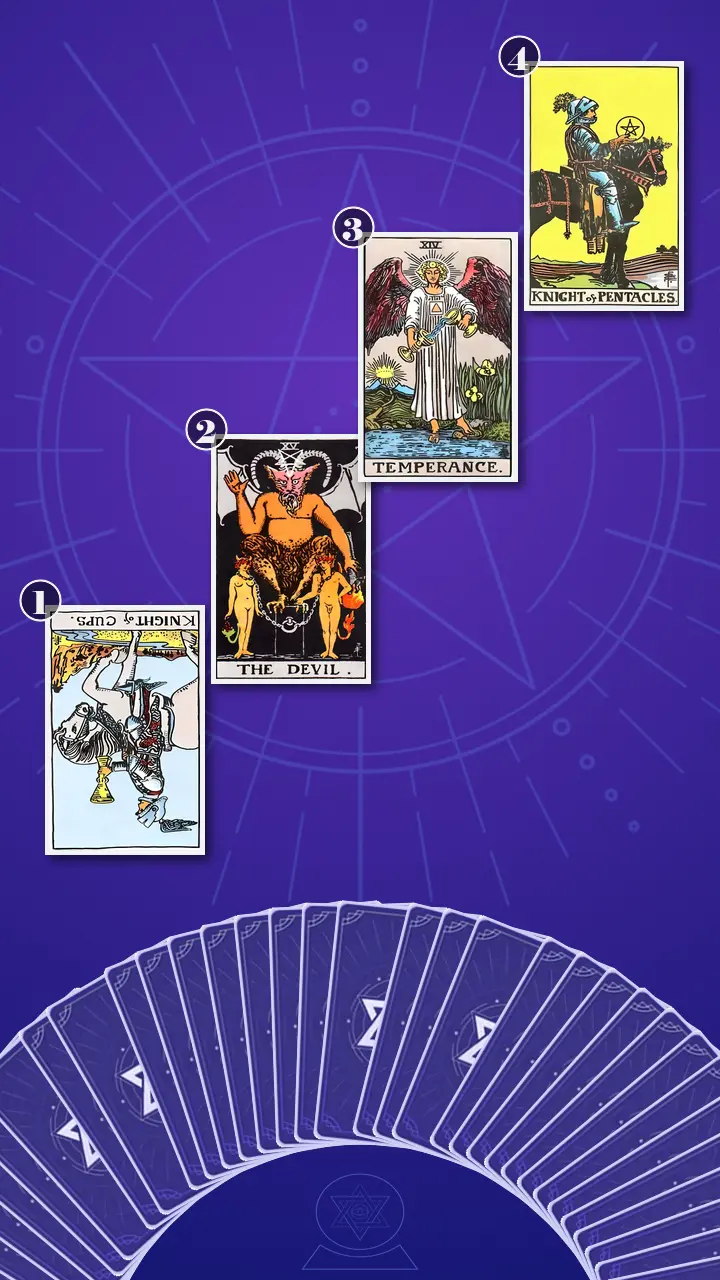
I chose the Four-Layer Insight Ladder · Context Edition, a four-card tarot spread designed to move through present pattern, reinforcing root, transformation, and action. I arranged the cards like a staircase rising from the lower left of my table. The layout suited Maya’s question because the problem was not simply whether one date was compatible with her. It was a repeatable sequence: uncertainty created activation, activation was named chemistry, consistency reduced uncertainty, and withdrawal restored the conditions for another intense pursuit.
This is how tarot works in my practice. It does not turn a card into a verdict. It gives different parts of a tangled experience their own visual positions, so behaviour, interpretation, and choice can be examined separately. Card meanings matter in context, and this compact spread offered enough structure without pretending to reveal details that neither Maya nor I could know.
The first position would show the observable dating pattern: intense pursuit during ambiguity, followed by delayed replies or withdrawal when communication became dependable. The second would reveal the mechanism beneath it, the loop in which uncertainty produced activation and activation was interpreted as chemistry. The third would introduce the bridge, holding chemistry and consistency as separate but compatible signals. The final position would turn that bridge into one bounded consistency test based on lived experience.
“So we’re not asking whether stable dating is secretly right for you,” I said. “We’re asking what changes inside the sequence when someone becomes available, and where you still have room to choose.”
The Romantic Story Reality Could Not Match
Position One: The Knight of Cups Reversed
The first card I turned over represented Maya’s observable pattern: intense pursuit while a connection remained ambiguous, followed by delayed replies or withdrawal when communication became dependable. It was the Knight of Cups, reversed.
Upright, the Knight carries an invitation through an open landscape. Reversed, I read that romantic Water as both excessive and blocked. Imagination was overflowing into the missing information, while the slower flow of mutual discovery could not get through. The cup was still emotionally compelling, but it had become a projection screen.
I brought Maya back to 11:40 p.m. A warm message and a clear Saturday invitation were waiting. Because there was little left to decode, she reread the ordinary wording for signs of flatness, left it unanswered, and opened the profile of someone who had vanished. The unavailable match supplied blank space, and blank space gave fantasy room to look more vivid than the dependable person in front of her.
“An unavailable person can stay perfect because reality never gets enough screen time,” I said. “It’s a little like building a polished Figma prototype from three vague user comments, then rejecting the real product because it can’t match every imagined feature. The prototype was designed inside your head. The person has to exist in ordinary life.”
I watched Maya’s fingers stop rubbing the edge of her phone case. Her mouth tightened, and then she let out a brief, bitter laugh.
“That is so accurate it feels a little brutal,” she said. “I say I want clarity, but when clarity arrives, I start auditing the connection for what’s missing.”
“I can see why it stings,” I replied. “But the card isn’t accusing you of being shallow, and it isn’t saying the dependable person must be right for you. It’s showing that the actual person and the story made possible by incomplete information have not been competing on equal terms.”
I asked her to recall the last dependable invitation that suddenly felt flat. “Before deciding what the feeling meant, what did you do next?”
“Delayed. Checked their Instagram. Opened Hinge. Sent a voice note to the group chat asking if the date sounded exciting enough.”
I nodded. That was the visible pattern. The next card would show why those small actions had so much power.
Position Two: The Loose Chain in The Devil
The card I turned over next represented the reinforcing mechanism beneath Maya’s pattern: uncertainty created activation, activation was interpreted as chemistry, and withdrawal recreated the uncertainty. It was The Devil, upright.
I made one boundary clear immediately. In this reading, The Devil did not mean an evil person, a doomed relationship, or a permanent flaw in Maya. It represented concentrated energy caught in a compelling loop. The excess lay in fixation and repeated checking; the blockage lay in how little space remained between feeling the pull and obeying it.
I pointed to the chains around the two figures. They looked restrictive, but they were visibly loose. That detail mattered more than the frightening face above them. It suggested a small point of agency inside a pattern that felt automatic.
I asked Maya to picture the Line 1 ride home after a recent date. A reliable Sunday confirmation appeared on her screen. Her shoulders dropped for one second, then heaviness arrived. She opened a dating app, found a vague new match, and felt the buzz return as the brakes screamed into Bloor-Yonge. Browse, activate, compare, withdraw. The renewed charge then seemed to prove that the less available person had more chemistry.
“It works like a dating-app algorithm trained on intermittent rewards,” I said. “No reply creates checking. Checking creates activation. Activation gets renamed chemistry. The feed mistakes engagement for preference, and your attention can make the same mistake.”
I adapted one of my sound-based tools, Reactive De-escalation Mapping. I normally use it to locate the high note in an argument, the exact instant defensive anger overtakes emotional safety. No one was arguing here, but there was still a defensive high note: the second reassurance landed and Maya’s hand moved toward an app to restore suspense.
“The useful question isn’t ‘Why am I like this?’” I told her. “It’s ‘What happens in the five seconds between receiving reassurance and reaching for more uncertainty?’ That is where the chain loosens.”
Her breathing paused. Her eyes shifted away from the cards as if she were replaying several train rides at once. Then she pressed her palm lightly against her sternum.
“I know opening the app will make me spiral,” she said quietly. “But in that moment, one look feels like it might make me feel something.”
“The rush is real; its meaning is still open,” I said. “I’m not asking you to deny the sensation. I’m asking you not to promote it automatically from sensation to compatibility.”
She frowned. “So were all my intense connections fake?”
“No. Intensity can contain real attraction. It can also contain anticipation, fear, projection, novelty, or uncertainty. The card gives you no reason to erase your past feelings. It gives you a reason to become more precise about what those feelings can and cannot prove.”
When Temperance Lowered the Volume Without Muting Desire
Position Three: Two Cups, Three Signals
The card I turned over now represented the key shift: holding chemistry and consistency as separate but compatible signals long enough to evaluate both. The room seemed to settle before I named it. Rain moved down Maya’s window in a steady line, and a pipe released a soft hiss behind her, as if the environment had found a quieter tempo.
The key card was Temperance, upright.
I showed her the liquid passing continuously between two cups, the angel keeping one foot in water and one on land. I read this as balanced energy, not the suppression of desire. Feeling remained present in the water; observable reality remained present on land. Neither had to overpower the other, and neither had to deliver an instant answer.
In Maya’s life, Temperance looked like the morning after a calm date. Instead of typing “no spark” and closing the case, she could record one moment of physical or conversational pull, one example of the person’s actual follow-through, and one cue from her body. Steadiness would not decide the connection for her. It would remove enough noise for attraction, reliability, and ease to become separately legible.
My mind flashed to the waveforms I had studied during years of sound-energy research. Two tracks can occupy the same mix while moving at different tempos. A track does not disappear merely because the distortion has been removed; sometimes that is the first moment its actual shape can be heard.
I told Maya I wanted to run a Communication Dissonance Audit. I usually use this framework to examine conflict beneath the spoken words, listening for a mismatch in emotional tempo and frequency. Here, the mismatch was between the message and the pace at which her nervous attention expected romance to arrive. The message said, “Saturday at 7.” Her internal rhythm answered, “Where is the crescendo?” When none came, she concluded there was no song.
We separated the mix into three tracks. Chemistry meant specific moments of pull, desire, playfulness, or curiosity. Consistency meant whether words and behaviour matched over time. Bodily Ease meant concrete cues such as a relaxed jaw, held breath, leaning closer, softening shoulders, or wanting more space. None of the tracks could dictate a verdict alone.
At 11:40 p.m., one connection offered Maya information through a warm message and a confirmed Saturday plan. The other offered enough uncertainty to keep her imagination buzzing. She had been caught in the belief that she must feel completely captivated before another ordinary interaction could be worth having.
I said, “Steadiness does not erase chemistry. It removes the uncertainty that was amplifying it, giving you a chance to see what attraction is actually there.”
Chemistry is not proven by emotional whiplash; let desire become legible through steady pacing, as Temperance pours between two cups without spilling either.
The silence lasted. Maya’s inhale stopped halfway, and her thumb froze above the dark screen of her phone. Her pupils widened slightly before her gaze slipped past me, unfocused, as though she were replaying the Queen West brunch she had dismissed as merely “fine.” Her jaw tightened first. Then a flash of anger sharpened her voice. “But doesn’t that mean I’ve been wrong this whole time?” I kept my tone low. “It means you were using the loudest signal available. That is not the same as being foolish, and adding better signals does not invalidate everything you felt.” Her fingers curled once around the phone and slowly released. A long breath left her chest; her shoulders dropped with it. Relief arrived, but not cleanly. I could see the slight disorientation that follows when an old rule stops carrying full authority. Clarity had returned responsibility to her, and for a moment that freedom looked almost as vulnerable as the uncertainty she knew.
I asked, “Now, with this new perspective, think back to last week. Was there a moment when this insight could have made the experience feel different?”
“The brunch,” she said after a pause. “I laughed a lot. They remembered something I’d told them. I didn’t have to monitor whether they liked me. I called it boring before I asked whether I was curious.”
“And were you curious?”
“A little,” she said. “Not obsessed. But yes.”
I saw the breakthrough in that distinction. Maya did not have to choose between feeling and evidence; she could let each tell her something different. “Maybe calm is not an answer yet,” she said. “Maybe it’s a different kind of data.”
I named the shift carefully. This was one small movement from restless infatuation sustained by ambiguity toward grounded interest that could tolerate steadiness. It was not a promise that attraction would grow, and it was not an instruction to settle. It was permission to gather information before turning a change in emotional volume into a final meaning.
Position Four: The Knight Who Did Not Need to Charge
The final card represented the concrete consistency test: follow through on one chosen plan and assess attraction through repeated lived experience rather than one emotional spike. It was the Knight of Pentacles, upright.
The horse stood still. The knight held a pentacle at eye level instead of racing toward the horizon. I read the energy as balanced Earth: patient, deliberate, and attentive. Its lack of dramatic motion was not deficiency. It was the capacity to examine what was actually present.
For Maya, this looked like keeping one clearly chosen coffee date near a subway stop, giving it a 75-minute container, and leaving the apps closed until the next morning. During the date, she could notice where curiosity appeared, whether her body softened or withdrew, and whether the other person’s behaviour matched their words. She would be evaluating the meal she actually ate, not the adrenaline of trying to secure an impossible reservation.
“One more date is data, not a contract,” I said. “You are not promising a future. You are agreeing to observe one real evening.”
I also protected the limits of the experiment. Another date was never required after disrespect, ignored consent, a boundary violation, or a clear lack of interest. Consistency alone was not compatibility. The Knight offered pacing, not obligation.
Maya looked at the still horse for several seconds. Then she opened her calendar and found the Saturday plan she had left in limbo.
“I’ve been treating a second date like I’m signing away the next six months,” she said.
“What would change if it were simply a 75-minute usability test with your own transport home?”
Her smile came more easily this time. “I could probably go without predicting the entire relationship first.”
The Three-Signal Dating Check
I traced the spread from the first card to the last. The Knight of Cups reversed showed the recent history carried into the present: incomplete information had become a polished romantic story. The Devil showed why the pattern repeated: uncertainty produced activation, and small digital behaviours restored that activation whenever reassurance made the connection feel quiet. Temperance separated feeling from evidence without forcing them apart. The Knight of Pentacles made that discernment observable through a limited, repeatable experience.
The objects in the cards told the same story. One idealised cup became a chain; the chain gave way to two cups in active balance; the balanced liquid became a solid pentacle that could be examined. The reading did not move from romance to dullness. It moved from projection to calibration, then from calibration to grounded evaluation.
I also noted what was absent. No Swords appeared, so clear naming had to be added deliberately. No Wands appeared, so the most intense sensation could not automatically be treated as sustainable Fire. Maya’s blind spot was not that she wanted chemistry. It was that she had collapsed chemistry, consistency, and bodily ease into one dashboard number called “spark,” then allowed any drop in activation to set the whole score to zero.
The transformation direction was precise: move from treating intensity as proof of compatibility to recording three separate signals before making a decision. That left Maya free to continue, pause, or end a connection based on accumulated experience rather than one notification-driven spike.
I turned the reading into two actionable next steps.
- The Seven-Minute Three-Signal Check After the next promising date, wait until the following day before making a final spark judgment, unless a safety issue or clear boundary violation requires an immediate decision. Set a seven-minute timer in the Notes app and create three headings: Chemistry, Consistency, and Bodily Ease. Under each heading, record one observable detail. For chemistry, name a specific moment of pull or curiosity. For consistency, record one example of follow-through. For bodily ease, note a physical cue such as relaxed shoulders, held breath, leaning closer, or wanting more space. Do not turn the note into another scoring system. Stop after one observation per heading. The minimum version is three words: pull, follow-through, ease. A blank or negative observation is valid and never obligates another date.
- The One-Date Evidence Experiment Keep one already-chosen 60- to 90-minute plan this week rather than cancelling solely because the anticipation feels calm. Choose a contained setting near transit, keep your own route home, and close the dating apps from one hour before the date until the next morning. If your hand reaches for an app after reassurance, use my Syncopation Pause: stop for three seconds, listen for the nearest sound, and name the trigger before acting, such as “They confirmed Saturday, and I’m looking for activation.” Then decide deliberately whether to set a ten-minute timer or open the app. During the date, notice one moment of genuine curiosity and ask the follow-up question. The experiment is information, not a promise. Skip it entirely when your boundaries, interest, consent, or safety already give you a clear answer.
I told Maya that the Syncopation Pause was not a ban. In music, a pause does not end the piece; it changes the relationship between one beat and the next. Three seconds could lower the emotional BPM just enough for an automatic move to become a visible choice.

A Week Later, the Quiet Proof
Six days later, Maya sent me a message. She had replied, “Saturday at 7 works,” before opening Hinge. She kept the coffee date, left after 80 minutes, and wrote her three observations the following morning: “Wanted to hear the end of their story. They followed through. My shoulders were down.”
“It wasn’t cinematic,” she wrote. “I also didn’t spend the whole date checking whether I was excited enough. I was just there. I still don’t know where it’s going, but I agreed to see them once more because I’m curious, not because I’m forcing it.”
She slept through the night. In the morning, her first thought was still, “What if calm means nothing?” She told me she smiled, reopened the three-column note instead of Hinge, and let the question remain a question.
I did not read that as a solved dating life. I read it as evidence of choice returning at the exact place where the old rhythm had once taken over. The Four-Layer Insight Ladder had not selected a partner or manufactured desire. It had helped Maya hear the difference between attraction, reliable behaviour, bodily ease, and the amplifier of uncertainty.
The cards offered the visual language, but Maya created the change. She paused. She replied. She attended one real date. She allowed her own experience to become more authoritative than the loudest emotional spike. That was her Journey to Clarity: not certainty about another person, but a more trustworthy way of listening to herself.
If someone finally becomes dependable and your chest goes strangely quiet, I hope you remember that noticing the urge to search for an exit already places a small pause inside the old loop. Calm does not have to become a forced yes, and it does not have to become an immediate no.
If calm were allowed to remain undecided for one more beat, which track in your own Temperance mix, chemistry, consistency, or bodily ease, would you become curious enough to hear before reaching for the volume knob?