Chasing the Spark After Love Bombing Fades at 11:48 p.m.
I often meet early-career city professionals who can manage ten Slack threads but feel completely unmoored by one delayed iMessage. Casey, a 27-year-old marketing coordinator in Queens, joined my video call with the latest Instagram Story still glowing on the phone in her hand and her afternoon text still marked Delivered.
It was 11:48 on a Wednesday night. The radiator hissed behind her, a siren thinned into the distance, and blue light sharpened the tired set of her jaw. She had a carefully casual follow-up open in Notes. Beneath it, the first-week message thread waited like an emergency exit she had used too many times.
"I know checking makes it worse," she said, rubbing her thumb along the warm edge of the phone. "But the first few weeks felt real. I keep thinking there has to be a sentence that brings them back."
I heard the real question underneath her words: Why do I keep chasing the spark after love bombing fades? I use the phrase love bombing drop-off to describe the observable shift from intense attention to inconsistent contact, not to diagnose another person's motives from a distance. Casey was not only waiting for a reply. She was waiting for proof that the beginning had been a promise, because accepting the current pattern felt dangerously close to confirming that she was not worth sustained love.
Her longing looked less like a soft ache and more like a magnet lodged behind her sternum, pulling her hand toward every notification before her mind could catch up.
"I am not going to tell you what this person secretly feels, or predict whether the intensity will return," I told her. "I want us to see the pattern clearly enough that your next move belongs to you. Let us make a map of the fog, then find the part of the road you can actually choose."

Choosing the Ladder Through the Fog
I asked Casey to place both feet on the floor, take one unforced breath, and hold one question in mind: "What happens inside me when their attention drops?" I shuffled slowly, using the motion as a transition from reacting to observing. There was nothing supernatural to perform. The point was focus.
I chose the Four-Layer Insight Ladder, Context Edition, an original four-card tarot spread for relationship-pattern reflection. I laid the cards in a rising diagonal from lower left to upper right, leaving a small gap before the third card. That space mattered. It represented the moment in which an automatic loop might become a choice.
I chose this spread because Casey was not deciding between two partners, and a larger predictive spread would have encouraged speculation about the other person's motives. The Ladder is designed for systemic deconstruction: it follows a self-reinforcing pattern from the visible chase, into its repetition root, across a compulsion interrupt, and finally toward reality-based integration. This is how tarot works best in a situation like this. The cards do not issue a verdict. Their meanings become useful in context, as structured prompts for behavior, memory, emotional regulation, and boundaries.
I explained that the first position would show what the chase looked like on her phone and in her body. The second would reveal why the beginning carried so much authority. The third would identify the inner quality capable of interrupting the pursuit. The fourth would turn that capacity into one clear communication and an observable next step.
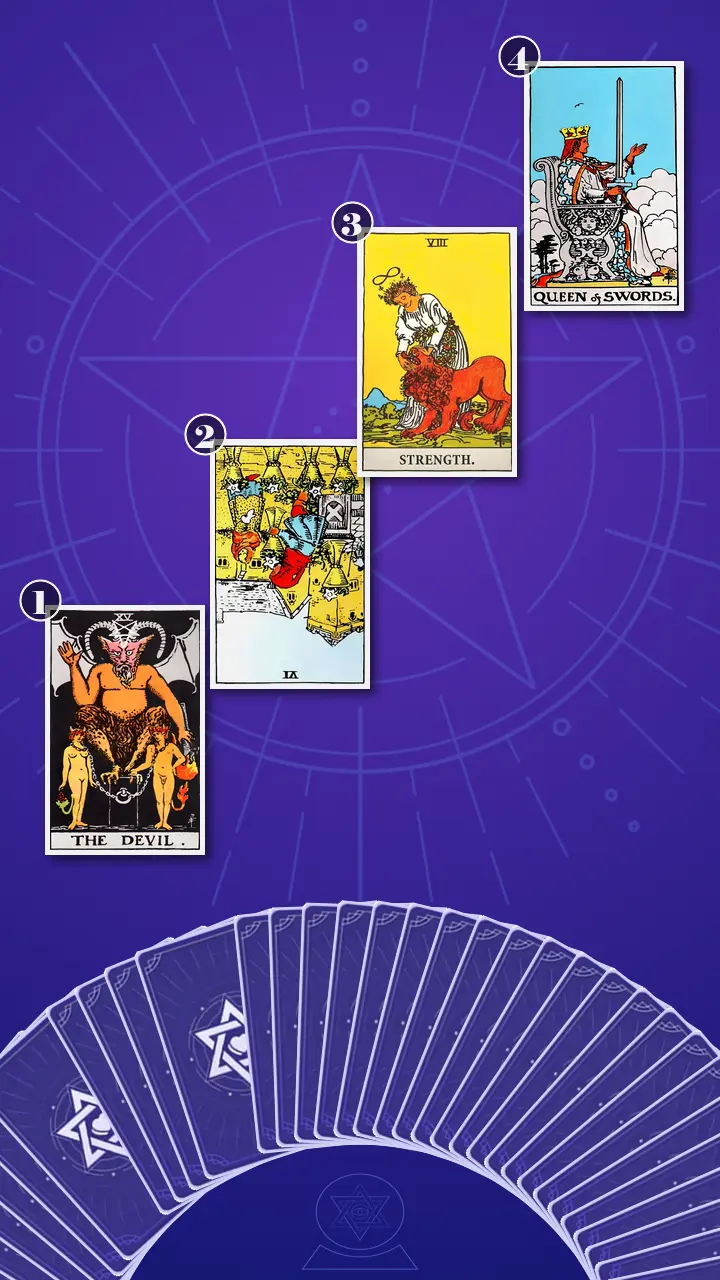
The Loose Chain Behind the Refresh
Position One: The Visible Chase and The Devil
I turned over the card representing the visible chase: the concrete behavior and emotional pull that appeared after the drop-off. It was The Devil, upright.
I pointed to the tethered figures and, more importantly, the loose chains around their necks. I did not read the card as proof that Casey was trapped in a doomed or inherently evil relationship. I read it as attachment energy in excess: fixation had become so loud that the available moments of choice were difficult to feel.
The card mirrored the scene already open on Casey's phone. At 11:48 p.m. in Queens, she had the first-week thread on screen, the person's latest Story visible, and a third follow-up waiting in Notes. Her chest was tight. The possibility of one affectionate reply felt more compelling than the present pattern of vague availability. Each check promised control, and every small sign of warmth trained her to check again.
"It works like a variable-reward notification system," I said. "Most refreshes give you nothing, but one warm message makes the next ten checks feel justified. That is relief, but it is not freedom."
Casey gave one short laugh, sharp around the edges. "That is so accurate it is almost cruel." Her eyes stayed on the loose chains while her fingers stopped moving over the phone.
I let the laugh land without correcting it. "I can see why this is hard. The chain is loose, but that does not mean taking it off feels emotionally simple. Stopping the chase can feel like grieving the beginning, not merely exercising willpower."
I asked what she had done the last time a reply slowed down. She listed the sequence without looking up: checked Instagram, reopened the old thread, drafted a meme, deleted it, wrote a more casual version, then kept the evening open in case a last-minute plan appeared. Naming the sequence made The Devil specific. It was not an identity. It was a loop with recognizable cues.
Position Two: The Preserved Beginning and the Six of Cups
I turned over the card representing the repetition root: the memory, expectation, or fear that made the current drop-off feel like a problem she had to reverse. The Six of Cups appeared in reversed position.
I saw its water energy as blocked and flowing backward into memory. Upright, the card can honor tenderness and emotional history. Reversed here, the preserved past had begun overruling the present. A meaningful memory was carrying more decision-making authority than current behavior.
I asked Casey to remember the E train at 6:32 p.m., when she had reread a week-two declaration between Midtown and Queens. The brakes had shrieked; damp coats had filled the carriage with the smell of wool and rain. She had compared "I have never felt this way before" with that day's vague "busy this week" and decided the current inconsistency must be a temporary error she could correct.
As a marketing coordinator, Casey knew how seductive launch-week numbers could be. I told her she was treating the opening intensity like a perfect campaign launch that every quieter week had to reproduce. The relationship's current conditions kept disappearing beneath its opening analytics.
"The beginning is data, not a contract," I said. "It may have been tender. It may have mattered. Honoring that does not require treating it as a live guarantee about today."
Casey's breath paused. Her gaze shifted past the screen as if she were replaying a specific train ride, and then her shoulders dropped with a long, unwilling exhale. "It happened once, so I keep thinking the right sentence can make it happen again," she said. The admission carried recognition and grief in equal measure.
I placed The Devil and the reversed Six of Cups closer together. They formed a split-screen: first-week declarations on one side, delayed and vague contact on the other. The present hurt, so Casey returned to the beginning. The beginning revived hope, so she pursued the present harder.
She told me about a 1:16 a.m. "miss you" after four quiet days. Her jaw had unclenched before she replied. By breakfast, there was still no plan, and relief had already become renewed monitoring.
"A warm reply can be real and still not make the pattern reciprocal," I said. "Consistency cannot be reconstructed from screenshots."
When Strength Put a Hand on the Send Button
Position Three: The Compulsion Interrupt
The radiator on Casey's side of the call clicked off. For the first time that night, the room behind her was quiet. I reached across the deliberate gap in the spread and turned over the card representing the compulsion interrupt: the inner quality capable of holding longing without obeying it. Strength appeared upright.
I centered the image of the woman's calm hands resting at the lion's mouth. I read the card as balanced fire: neither a deficiency that denied desire nor an excess that let desire command the phone. Casey's lion was the tight chest, the restless fingers, and the thought, "If I wait, I will lose them." The woman's hands were the pause that neither attacked the feeling nor broadcast it immediately.
"Strength is a notification cooldown, not deleting the app and pretending the alert means nothing," I said. "The feeling can be here without becoming your next instruction. Longing is a feeling, not a send button."
I used a method from my practice that I call Toxic Script Identification. The name does not label either person as toxic. It identifies the repetitive script that keeps assigning the same roles. In Casey's script, one side became the Spark Restorer, responsible for producing the right message, while the other side's availability became the Holder of Relief. Every delayed reply cued the direction: perform harder, sound more effortless, recover the opening scene.
As I looked at Strength, I had the artist's flash I often get in an editing room: repetition can make a scene feel inevitable when it is only the same take replayed. A new act begins when someone receives a different direction. Strength did not ask Casey to stop caring. It handed the Spark Restorer a new line: "I can feel this without auditioning for reassurance."
I asked her to picture the familiar setup: she was on the E train, her thumb hovering over a follow-up draft, with first-week messages bookmarked above it. Yesterday's warm reply had loosened her chest. Today's silence had already turned that relief back into a search.
Stop treating the faded spark as a test you must pass; let the woman who calmly holds the lion show you that desire can be felt without being obeyed.
I stopped speaking and let the sentence remain between us.
Casey's breath froze first. Her thumb hovered over the side button of her phone, and her pupils widened as though the card had lit a scene she had been avoiding. Then her brow tightened. "But does that mean I was wrong the whole time?" she asked, with a flash of anger that sounded almost protective of the woman she had been two weeks earlier.
"No," I said. "It means you reached for the form of relief you knew. The insight does not put your past self on trial. It gives your present self another option."
Her eyes grew wet before she looked down. Her shoulders, held close to her ears all evening, lowered by degrees. The hand gripping the phone loosened until it rested open on her knee. A small breath left her with a tremor, followed by a strange, blank stillness. I recognized the vulnerability inside that release: once the chase was no longer compulsory, she would have to decide what current contact actually offered. Clarity had created room, but it had also returned responsibility to her.
"Now, with this new perspective, can you remember a moment last week when this insight might have made you feel different?" I asked.
Casey returned to the E train. She did not claim that Strength would have erased the ache. She said it might have let her notice the urge before turning it into a third message.
I guided her through a seven-minute Present Reciprocity Check. She placed the phone face down and wrote three current behaviors she could already observe, one feeling in her body, and one limit on what she was willing to keep participating in. I reminded her that the exercise was not a forced relationship decision, a texting rule, or strategic silence. She could stop if body awareness became overwhelming, and the minimum version was one observed behavior with one slow exhale.
This was the central crossing in the reading: from compulsive pursuit of vanished intensity and anxious digital vigilance toward self-respecting observation of present reciprocity. It was not certainty. It was the first believable space between a feeling and an action.
The Queen Who Removed the Sales Pitch
Position Four: Reality-Based Integration
I turned over the card representing reality-based integration: clear communication, a personal boundary, and an action that would not try to control the other person's response. It was the Queen of Swords, upright.
I read her air energy as balanced discernment. Her vertical sword suggested precise language; her open left hand suggested willingness to receive whatever the present revealed. She was not cold, punitive, or interested in winning. She simply refused to let emotional intensity replace evidence.
I invited Casey to imagine herself at the kitchen table, writing the consistency she could genuinely participate in: reasonably steady contact and plans that were not repeatedly left vague. She could state that once, then observe what happened instead of optimizing another persuasive follow-up.
I also used Dialogue Loop Auditing to identify the phrase that repeatedly started Casey's dead-end sequence. The trigger was "busy this week." Her automatic response was to erase her need, write "no worries," add a charming meme, and offer several easier alternatives. The exchange looked casual on screen, but underneath it Casey was pitching for reassurance.
"You write persuasive copy for work," I told her. "This message does not need conversion strategy. The Queen's sword is the edit that removes the sales pitch and leaves one accurate sentence: 'I like you, and I am looking for more consistent contact than this. Is that something you want and can participate in?'"
I emphasized that she did not have to send it. A private participation limit was still a boundary. If she chose to communicate it, she could send it once and observe whether the person answered directly, made and kept a plan, remained vague, or did not respond.
"A boundary describes your participation; it does not control their response," I said. "You are not forcing an outcome. You are deciding what kind of contact receives your continued investment."
Casey nodded once, opened Notes, and typed without deleting. Her face held relief, but not triumph. "I can state what works for me once," she said. "I do not have to pitch, test, or bargain."
Letting the Present Testify
I gathered the four cards into one continuous story. The Devil had shown the visible fixation: checking, drafting, and pursuing for immediate relief. The reversed Six of Cups had shown the root: an opening scene preserved so carefully that it kept overruling the film currently in production. Strength had introduced the missing resource, compassionate self-command. The Queen of Swords had given that resource language, a boundary, and a way to evaluate observable reciprocity.
I named Casey's cognitive blind spot plainly. She had assumed her problem was a failure to find the right message. The deeper problem was that she had granted archived intensity more authority than current behavior and interpreted changing attention as a live verdict on her worth. That belief kept the personal algorithm running: uncertainty prompted pursuit, intermittent warmth rewarded pursuit, and the next silence felt even more significant.
The transformation was not from caring to indifference. It was from pursuing the original spark to tracking present reciprocity and naming one clear boundary before reassurance-seeking took over. Early chemistry could remain meaningful without becoming a promise. Grief could be present without being converted into surveillance. The other person retained full autonomy, and Casey reclaimed the same for herself.
The Two Small Rewrites for the Next Seven Days
I offered two pieces of actionable advice. Both were experiments, not tests of whether Casey was disciplined enough or whether the relationship deserved to continue.
- The Pattern Interruption ScriptOnce this week, when a visible Story, delayed reply, or vague message triggers the urge to follow up, place both feet on the floor, turn the phone face down, and set a ten-minute timer. In Notes, role-play two lines: "Old direction: If I wait, I lose them, so I send." Then write: "New direction: I feel longing in my chest, and I will choose after the timer." Draft without entering the recipient's name. When the timer ends, freely send, revise, save, or delete it.If ten minutes feels impossible, start with ninety seconds. This is not strategic silence. The only goal is to create a gap between the feeling and the send button.
- The One-Sentence Participation BoundaryOn one evening this week, write: "I am looking for contact that is reasonably consistent and plans that are not repeatedly left vague." Casey could keep it private or communicate it once in direct language. For the following seven days, she would record only behavior she already encountered: a direct answer, a kept plan, continued vagueness, or no response.Use neutral verbs and do not monitor for extra evidence. If sending the boundary feels unsafe or simply is not what you want, keep it private and let it guide your own participation.
I told Casey that neither action guaranteed closure, a renewed relationship, or instant confidence. Their purpose was smaller and more useful: to help her distinguish present reciprocity from the emotional afterimage of the beginning.

A Week Later, the Quiet Proof
A week later, I received Casey's message: "I sent the one sentence. They answered vaguely. I did not send a second pitch." She slept through the night, then woke thinking, "What if I was too much?" She smiled, she wrote, and put the phone face down.
I did not see tarot rescue Casey or decide the relationship for her. I saw it give objective shape to a pattern she had already felt but could not yet name. She created the change by pausing, observing, and choosing what she would participate in. Her journey to clarity moved from compulsive pursuit toward cautious, boundary-based self-trust, one unsent sales pitch at a time.
I keep returning to this: when a quiet screen tightens the chest, gripping the first weeks like proof can feel safer than facing the fear that being less pursued means being less worthy. But the moment the old script becomes visible, the pen is already back in reach.
If your next step did not have to win back the spark, what small sign of present reciprocity, or its absence, might you finally let into the frame?
This story is adapted from psychological research, written so that those in a similar struggle can see their own pattern in it — and find their next step clearly.These insights are not a substitute for professional psychological, medical, legal, or financial advice.
Learn more about our Journey to Clarity.
How did this insight land for you?
🫂 This Resonates Deeply
🌀 Living This Story
✨ Now I See Clearly
🌱 Seeing New Possibilities
🧰 Useful Framework
🔮 The Confirmation I Needed
💪 Feeling Empowered
🚀 Ready for My Next Step
Author Profile
 AI
AI“I’ve always felt our lives are films currently in production. As an artist, I know that when you feel stuck, it’s often because you’ve bravely stayed in a painful scene for just a little too long. I’m not here to coldly analyze you. I want to sit closely with you, look at those difficult moments with profound empathy, and gently hand you the pen so you have the courage to write your next beautiful act.”
In this Love Tarot Reading :
Core Expertise
- Toxic Script Identification: Recognizing the repetitive, destructive roles you both automatically play (e.g., the Savior and the Victim) during conflicts.
- Dialogue Loop Auditing: Analyzing the specific triggering phrases that consistently escalate your arguments into dead ends.
Service Features
- The Pattern Interruption Script: A creative role-play directive to consciously change your default response to a known trigger, forcing the relationship dynamic to shift.
Also specializes in :
Explore Related Patterns:
Chemistry ChasingAt 11:48 p.m., Casey has the first-week thread open, the latest Instagram Story visible, and another carefully casual follow-up waiting in Notes. Her attention is organized around recovering the intensity that existed before the delayed replies and vague availability became the current pattern. The chase continues because the early spark has become both a benchmark and an unfinished promise. When present contact falls below that benchmark, pursuit can feel like an attempt to restore something real rather than a decision to keep investing in inconsistency. You may recognize this pattern when the question "How do I get the spark back?" becomes more compelling than "What is this connection consistently offering now?" Naming that shift does not invalidate the beginning; it returns decision-making authority to present reciprocity.
Illusion of ControlCasey keeps a carefully casual follow-up open in Notes because she believes there must be a sentence that can bring the earlier version of the connection back. She repeatedly revises her wording, offers alternatives, and treats the present inconsistency as something she might correct. Message optimization creates a temporary sense of control over a situation governed partly by another person's independent capacity and choice. The more uncertainty is framed as a problem of wording, the easier it becomes to overlook the fact that sustained reciprocity cannot be produced through perfect communication alone. You may recognize this pattern when the search for the right text replaces observation of what has already been shown. Reclaiming agency means directing it toward your own message, boundary, and investment rather than assigning yourself responsibility for engineering somebody else's consistency.
Intermittent ReinforcementThe 1:16 a.m. "miss you" arrives after four quiet days, and Casey's jaw unclenches before she replies. By breakfast there is still no plan, but the brief warmth has already made renewed monitoring feel worthwhile. Unpredictable rewards can train pursuit more powerfully than reliable contact because every warm exception appears to justify the previous checks and the next attempt. Relief becomes attached to the possibility of a message, while the absence of consistency keeps the reward uncertain enough to hold attention. You may experience this as a loop in which one affectionate reply outweighs several periods of vagueness. The useful audit is not whether the warm moment was real, but whether the broader pattern provides reciprocity without requiring repeated pursuit to access it.
Nostalgia LoopOn the E train, Casey rereads "I have never felt this way before" and compares it with that day's vague "busy this week." Instead of letting the contrast update her understanding, she treats the current inconsistency as an error that the earlier declaration can still overrule. Returning to the preserved beginning reduces the pain of the present for a moment, but it also restores the hope that another message can reactivate the old intensity. Memory then becomes a decision-making loop rather than one valid part of the relationship's history. You may recognize this when screenshots and early declarations carry more authority than repeated present behavior. The beginning can remain meaningful without functioning as a live contract, and letting current evidence testify is not the same as declaring the past fake.
Reality TestingCasey places the week-two declaration beside the delayed replies, vague plans, and the warm message that produced no follow-through by breakfast. Instead of deciding which moment reveals the other person's hidden truth, she begins tracking what the current pattern repeatedly shows. Reality testing allows both kinds of evidence to exist without giving the emotionally intense beginning automatic authority. A warm reply can be sincere and still fail to create reciprocity; a meaningful start can remain meaningful without guaranteeing present availability. You may recognize this capacity when you can let observable behavior update your understanding even when the update is disappointing. The aim is not cynical interpretation but accurate weighting, so screenshots, hopes, and isolated moments no longer outvote consistent present evidence.
Reassurance SeekingAfter a reply slows down, Casey checks Instagram, reopens the old thread, drafts a meme, deletes it, and writes a more casual version. The sequence is directed toward finding immediate evidence that the connection has not disappeared and that she has not become "too much." These messages function as reassurance attempts because their psychological job extends beyond communication. Each one tries to reduce uncertainty, restore the other person's attention, and settle the question of Casey's relational worth, but any relief remains dependent on the next response. You may recognize this pattern when sending feels less like expressing what you mean and more like escaping the distress of not knowing. A pause makes it possible to ask whether the message communicates a real preference or is being recruited to obtain another short-lived dose of certainty.
Relationship PerformanceThe phrase "busy this week" leads Casey to write "no worries," add a charming meme, offer several easier alternatives, and keep her evening available. Although the exchange looks casual, she is working hard to make her need for consistency invisible while maximizing the chance of renewed attention. Treating connection like persuasive copy creates a performance role in which the right tone, timing, or degree of effort is supposed to restore momentum. That role protects against direct rejection in the short term, but it also prevents the current relationship from being tested against Casey's unedited preferences. You may recognize this pattern when you are constantly optimizing how easygoing, attractive, or low-maintenance you appear. Removing the sales pitch allows a more useful question to emerge: can the connection respond to an accurate version of what you want?
Conditional Self-WorthCasey says that accepting the current pattern feels dangerously close to confirming that she is not worth sustained love. Even after she sends one reasonable sentence and receives a vague answer, she wakes wondering whether she was "too much." The other person's level of attention has become a proxy measurement for personal worth. Under that condition, letting go of the chase does not merely mean accepting inconsistent contact; it can feel like accepting a negative judgment about the self, which gives pursuit much more psychological weight. You may recognize this pattern when another person's inconsistency quickly becomes evidence that you are difficult, excessive, or unworthy. Separating your value from their present capacity does not require denying disappointment; it prevents their availability from functioning as your self-worth score.
Boundary DiscernmentAt the kitchen table, Casey writes that she is looking for reasonably consistent contact and plans that are not repeatedly left vague. She can communicate that once or keep it private, then observe whether the response is direct, actionable, vague, or absent. The boundary does not attempt to force attention back to its original intensity. It distinguishes Casey's preference and participation from the other person's autonomous response, replacing bargaining with a clearer allocation of responsibility. You may recognize boundary discernment when the central question changes from "How do I make them respond differently?" to "What kind of contact will receive my continued investment?" This preserves openness without requiring you to abandon your own criteria for reciprocity.
Reflective DistanceCasey places the phone face down, notices the tightness in her chest, and gives herself a timed interval before deciding whether to send. A week later, she notices the thought "What if I was too much?" without turning it into a second pitch. The pause creates distance without demanding emotional detachment. Longing, fear, and the urge to act remain visible, but they no longer collapse into one automatic instruction, allowing observation to enter before another round of pursuit begins. You may recognize reflective distance when you can say, "I am having the urge to restore contact," rather than immediately treating the urge as proof that contact must be restored. That small shift preserves choice while remaining honest about the feeling.
Explore Related Struggles:
Accelerated Intimacy TrapCasey keeps a week-two declaration beside today's vague "busy this week," allowing the opening intensity to establish the standard for everything that follows. The beginning may have been sincere and meaningful, but it created expectations of closeness before the connection had demonstrated that it could sustain steady contact or concrete plans. You can become trapped when emotional acceleration feels like evidence of established intimacy. Once that pace drops, the change can seem like a problem you must reverse rather than information about the connection's actual capacity. The struggle is not that you cared too quickly; it is that the emotional authority of the launch now outweighs the slower evidence needed to judge whether the relationship can support what the spark appeared to promise.
Affection-Workability SplitThe 1:16 a.m. "miss you" loosens Casey's jaw after four quiet days, yet there is still no plan by breakfast. The message can carry real affection while leaving the practical conditions of the connection unchanged: contact remains inconsistent, plans remain vague, and Casey remains responsible for restarting momentum. You do not need to declare every warm moment fake in order to ask whether the relationship works in its present form. The struggle emerges when emotional truth and relational viability are treated as the same test. Affection answers whether a moment contains warmth; workability asks whether both people can participate with enough steadiness and clarity. Holding those questions separately lets you value what was felt without requiring isolated tenderness to prove that the current arrangement can meet your needs.
Availability-Worth FusionA delayed iMessage does more than leave Casey without an answer; it pushes her toward the fear that the beginning was not a promise because she was not worth sustained love. The other person's changing availability therefore becomes evidence in two separate questions at once: what they are currently offering and what Casey is worth. You can see how this fusion makes every notification disproportionately powerful. A warm reply temporarily restores both connection and self-evaluation, while silence appears to withdraw both, even though another person's contact pattern cannot establish your value. The struggle is not resolved by pretending the reply does not matter. It begins to loosen when availability is allowed to describe the other person's present participation, leaving your worth outside the unstable rhythm of their attention.
Desire-Agency SplitAt 11:48 p.m., Casey's thumb moves toward the phone while she is already saying that checking makes things worse. The delayed reply activates a visible pull toward the Story, the archived thread, and a third follow-up, so longing reaches the send button before reflective choice has time to enter the sequence. You do not have to eliminate desire to recover agency. The friction lies in allowing the feeling to remain present without granting it automatic control over your next action. Casey's pause matters because it makes both forces visible at once: the wish to reconnect and the capacity to decide whether another message serves her. That space does not guarantee comfort or a particular relationship outcome, but it returns authorship of the next move to the person holding the phone.
Earned Love BindAfter receiving "busy this week," Casey writes "no worries," adds a charming meme, and offers several easier alternatives instead of naming the consistency she wants. Her skill at persuasive copy turns the exchange into a quiet pitch: perhaps the right amount of ease, wit, and flexibility will make the other person choose the connection again. You can become trapped when love feels available through successful performance but not through direct participation as yourself. Each attempt asks you to earn reassurance by making your needs smaller and your offer more appealing, while the other person's capacity to reciprocate remains untested. The deeper bind is not simply sending too many messages. It is carrying responsibility for producing affection that must, by definition, be freely and mutually sustained. Naming what works for you once removes the audition and lets reciprocity reveal itself.
Relational Resurrection TrapCasey reopens the first-week thread, watches the latest Story, and keeps a third follow-up waiting in Notes because she believes there may be a sentence that brings the opening back. Each return to the archive makes the earlier connection feel actionable again, even though checking, rewriting, and leaving her evening open have not produced steadier contact. You can become locked into restoring a relationship phase rather than evaluating the relationship that currently exists. The beginning matters, but its emotional afterimage keeps recruiting new effort from the present, making another attempt feel more urgent than the evidence already available. The struggle persists because stepping out of the restoration project can feel like abandoning something real. In practice, it means allowing the past to remain meaningful without assigning yourself responsibility for recreating it alone.
Monitoring-Safety FusionCasey checks Instagram, reopens the old thread, drafts a meme, deletes it, rewrites it, and keeps the evening available for a possible plan. Most of these actions produce no useful information, but one affectionate reply brings enough bodily relief to make the next round of checking feel justified. You can be seeking safety through monitoring even when monitoring repeatedly intensifies uncertainty. The phone offers continuous access to signals but no authority over whether contact becomes consistent, direct, or reciprocal. As that distinction collapses, checking starts to feel like the only responsible way to stay oriented, while attention to your own time and limits contracts around the screen. Recognizing the structure allows a pause to become more than a texting tactic: it separates access to information from the deeper security that only observable reciprocity can support.
Explore Related Emotions:
Cautious Self-RespectAt the kitchen table, Casey writes that she wants reasonably steady contact and plans that are not repeatedly left vague. She types the sentence without deleting it, then later allows a vague answer to remain visible without sending another persuasive pitch. Cautious Self-Respect is the emerging feeling that your preference deserves accurate language even when another person may not meet it. It does not harden into punishment or demand control over the response. Instead, it lets you decide what kind of contact can receive your continued participation, one observable choice at a time.
Mutuality HungerCasey keeps offering casual follow-ups, memes, easier alternatives, and an open evening while the other person's contact remains delayed or vague. Her effort is directed toward recovering a form of closeness that once arrived freely but now requires repeated prompting. Under the pursuit sits Mutuality Hunger, the felt absence of contact that is warm, consistent, and carried by both people. You may appear to be chasing intensity, while the deeper wish is to stop having to manufacture reciprocity alone. Naming that hunger clarifies that wanting sustained participation is different from trying to persuade a particular person to provide it.
Need Exposure DreadWhen 'busy this week' appears, Casey automatically writes 'no worries,' adds a charming meme, and offers several easier alternatives. After she finally states her preference for consistent contact in one sentence, the old concern returns the next morning as 'What if I was too much?' Need Exposure Dread names the vulnerability of allowing your actual relational preference to remain visible without softening it into effortless availability. The polished follow-up offers short-term cover because it keeps the need from being directly evaluated, but it also leaves you pitching for what you have not plainly named. Treating the need as information about your participation restores the freedom to express it without making another person's answer a judgment on its legitimacy.
Nostalgia Loop AnxietyOn the E train at 6:32 p.m., Casey rereads a week-two declaration and compares it with that day's vague 'busy this week.' Instead of allowing those two pieces of information to remain different, she treats the current distance as a temporary error that the right message might correct. The archived beginning becomes both shelter and benchmark, keeping you emotionally oriented toward what contact used to feel like while present behavior becomes harder to accept. Nostalgia Loop Anxiety captures the uneasy repetition of returning to old warmth for certainty, only to feel the current discrepancy again. Recognizing the loop does not invalidate the beginning; it restores present evidence to the decision-making frame.
Not-Enough PanicA quiet screen tightens Casey's chest, and the possibility of one affectionate reply becomes more compelling than the established pattern of vague availability. The speed of that bodily reaction shows how quickly delayed contact becomes personal evidence rather than neutral information. Not-Enough Panic appears when changing attention is translated into an urgent judgment about your adequacy: perhaps you were not interesting enough, effortless enough, or lovable enough to sustain the beginning. The chase then feels like an attempt to repair your value through another person's response. Identifying that translation creates room to assess contact without using it as a measurement of worth.
Retroactive Rejection DreadCasey is not only waiting for a reply; she is waiting for proof that the beginning was a promise. Accepting the current inconsistency feels dangerously close to admitting that the early declarations no longer protect her from the question of whether she was worth continuing to choose. The present drop-off therefore threatens to rewrite the emotional meaning of the past. Retroactive Rejection Dread captures the fear that today's distance proves the beginning was never real enough and that your own value must be revised downward with it. Separating another person's current participation from your worth lets the past remain meaningful without allowing it to issue a verdict on you.
Cautious Self-TrustA week later, Casey reports that she sent the one sentence, received a vague answer, and did not send a second pitch. She still wakes with the thought 'What if I was too much?', but she notices it, writes it down, and puts the phone face down. Cautious Self-Trust does not require the old doubt to disappear before you rely on your own observation. It grows through the smaller experience of keeping one limit while uncertainty remains active. Casey's restraint is not strategic silence; it is emerging confidence that she can tolerate an unanswered question without negotiating away what she knows she needs.
Grounded AgencyCasey puts both feet on the floor, turns the phone face down, and records three current behaviors, one body sensation, and one participation limit. These concrete movements create the first believable interval between the tightness in her chest and the follow-up waiting to be sent. Grounded Agency is the felt steadiness of knowing that an urge may remain intense without becoming an instruction. You do not need certainty about the other person in order to choose what receives your continued investment. The pause returns authorship to your side of the interaction while leaving the other person's autonomy intact.
Hypervigilant AnxietyAt 11:48 p.m., Casey is holding several possible signals at once: the glowing Instagram Story, the Delivered text, the archived thread, and a follow-up waiting in Notes. Her tight chest and restless thumb show that the silence is being experienced as something that must be watched closely rather than as ordinary space between messages. Repeated scanning turns relational uncertainty into a full-body state of alert. Hypervigilant Anxiety names the feeling that the next notification could either restore safety or deepen the threat, making disengagement feel difficult even when you know checking will not produce reliable clarity. Naming that state helps separate the alarm created by uncertainty from the actual evidence available in the present.
Reassurance CrashAfter four quiet days, a 1:16 a.m. 'miss you' makes Casey's jaw unclench before she has even replied. By breakfast there is still no plan, and the bodily relief has already become another round of monitoring. When reassurance arrives intermittently, its comfort can be real without becoming durable. Reassurance Crash names the drop that follows when one warm message settles you briefly but cannot support the security you hoped it represented. Seeing that sequence clearly allows the momentary relief and the broader pattern of follow-through to be evaluated separately.
Bittersweet ReleaseCasey's eyes grow wet as her shoulders lower and the hand gripping her phone opens on her knee. The physical release arrives alongside the recognition that stopping the chase may require grieving the beginning rather than dismissing it as meaningless. Bittersweet Release allows you to preserve the tenderness of what happened without preserving it as a live guarantee. The opening spark can have mattered, and its afterimage can still be relinquished as a basis for present decisions. That combination carries pain and relief together because letting go of the promise also frees you to see what is actually being offered now.
Clarity AmbivalenceWhen the pursuit loop is named, Casey's breath freezes before her shoulders begin to lower. She responds first with anger about whether she had been wrong, then with wet eyes, an open hand, and a blank stillness as the phone comes to rest on her knee. Clarity Ambivalence captures the mixed internal weather of finally seeing what has been happening. Recognition gives you room to choose, yet it also removes the fantasy that one perfect message can settle the uncertainty for you. The discomfort belongs to regained responsibility as much as to loss, which makes the clarity difficult but usable.
Explore Related Contexts:
Chemistry to Consistency TestCasey compares "I have never felt this way before" with "busy this week" and treats the quieter phase as an error her next sentence can correct. The relationship is being measured across two different conditions, with launch-week chemistry on one side and present-day follow-through on the other. You can keep the beginning meaningful without letting it outrank current behavior. A consistency check moves the focus from recovering a feeling to observing whether contact is reasonably steady and whether plans stop being left vague.