Moving PTO to Next Month, Then Writing the Three-Line Handoff
The PTO That Kept Moving to Next Month
I met Alex (name changed for privacy), a 29-year-old project coordinator in Toronto, after they had asked me a question that sounded practical but carried the dull weight of a much longer week: "Why do I keep postponing my PTO when I clearly need a break?"
I recognized the Monday-morning pattern immediately. Alex opened their Workday balance before stand-up, saw unused vacation days accumulating, checked a Google Calendar packed with colored project blocks, and moved a tentative half-day to next month. Again. Their coffee had gone bitter beside the laptop. The air conditioner clicked above the glass-walled meeting room near King Station, and their jaw had locked hard enough to make their temples ache.
When Alex described the ride home that evening, I could picture it clearly: 8:47 p.m. on TTC Line 1, fluorescent carriage lights buzzing, coworkers' rooftop-bar Stories sliding past on a warm phone screen. They wanted time away, but whenever an unfinished task appeared, they refreshed the calendar, postponed the request, and called it bad timing. Their shoulders stayed raised as though someone had tied a drawstring through the base of their neck; the idea of rest made their chest feel hollow instead of open.
"I keep saying next month will be calmer," Alex told me. "But I think I have been saying that for months."
I told them what I tell people when PTO guilt has begun to disguise itself as responsible planning: "You are not failing to want rest; you are waiting for work to give you permission it was never designed to give." I did not see a lazy person or a broken calendar. I saw an intelligent person caught in a loop: review created delay, delay brought a few minutes of relief, and the resulting depletion made stopping feel even less possible.
"We are not here to make the cards decide whether you deserve a break," I said. "We are here to draw a map of the rule that makes the request feel dangerous, then find one choice that belongs to you. That is our Journey to Clarity."

Choosing a Map for PTO Guilt
I invited Alex to put both feet on the floor, take one unforced breath, and hold the question in plain language: why does available leave remain only a number until it expires? I shuffled slowly, not to manufacture mystery, but to create a clean transition from the open browser tabs and looping self-talk into a focused conversation.
I chose my Six-Position Four-Layer Insight Ladder, Context Edition. I use this tarot spread when someone is feeling stuck in a pattern rather than weighing two genuinely separate options. Here, PTO was available. The issue was the stagnation lock between seeing it and scheduling it.
For anyone wondering how tarot works in a situation like this, I use card meanings in context as a structured mirror, not a forecast. This six-position spread separates the visible habit from the belief that maintains it, then identifies the hidden cost, the interruption, the practical action, and the longer-term rhythm. It lets me distinguish a real coverage problem from a story about worth that has borrowed the calendar's voice.
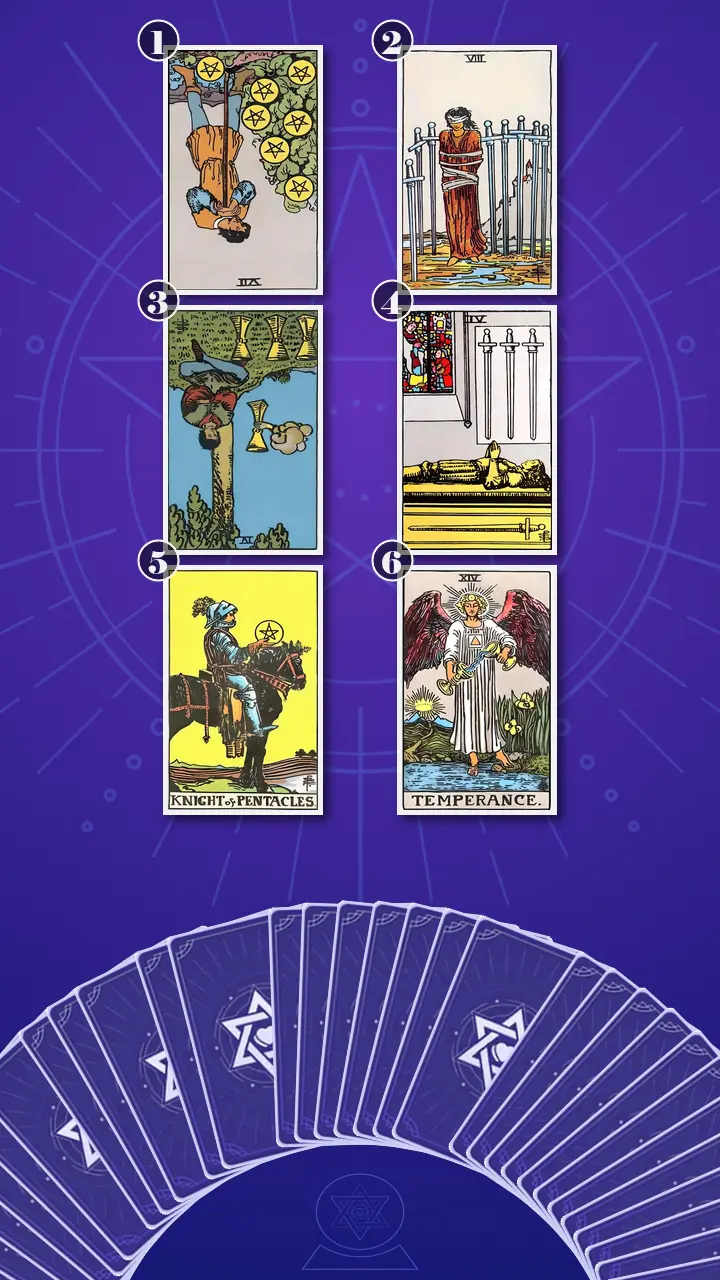
I laid the cards in three rows like a short staircase. The upper left would show Alex's surface lock: what happened when PTO stayed in draft. The upper right would name the maintenance mechanism underneath it. The middle pair would reveal the cost of the pattern and its pivot toward change. The lower pair would give us a testable scheduling practice and a more sustainable relationship with rest.
Reading the Calendar Stairway
Position 1: The Harvest Held in Review
I turned over the card for the surface lock: Seven of Pentacles, reversed.
I pointed to the worker leaning on a hoe, studying a harvest instead of gathering it. "This is the PTO portal and the project tracker open side by side," I said. "The work is real. But the assessment has stopped serving the decision. You keep measuring whether the calendar is clear enough, and because the measure has no finish line, the break stays in a permanent waiting room."
In its reversed position, I read this as stalled earth energy: effort becomes over-assessment. Alex had been treating another twenty minutes of task review as proof of care, when it was also a way to avoid choosing a stopping point. Each new checkbox felt productive, but it made every available gap look less legitimate.
I asked, "When you open the PTO portal, what happens first: do you check a deadline, add a task, ask no one, or simply close the tab?"
Alex's fingers paused on the rim of their mug. A short laugh escaped them, dry and a little bitter. "That is so accurate it is almost rude," they said. "I make the list longer so I can say the list is why I cannot take time off."
I nodded. "That is not a character flaw. It is a visible loop. The first useful question is not whether you have earned rest. It is what undefined standard keeps the request from becoming a date."
Position 2: The Calendar's Ring of Swords
I turned over the card for the maintenance mechanism: Eight of Swords, upright.
The blindfolded figure stood within a ring of swords, and I could see why this was the spread's major blockage. "This is you looking at the team calendar and seeing only two choices," I said. "Work continuously, or become unreliable. A handoff, a manager question, a return note, and a bounded absence sit outside the frame because fear has narrowed what counts as permissible."
Its upright air energy had become constricted: a thought had hardened into a rule. Alex's inner script was familiar: If I stop, then they will think I cannot be counted on. I asked them to set that prediction beside one practical question: "What evidence do you actually have?"
I had known that mental enclosure on a Wall Street trading desk. In high-stakes environments, speed can make constant responsiveness look like the only form of competence. My professional instinct now is to separate the contract from the panic: a genuine deadline, policy, or coverage risk deserves concrete planning; a fear of being judged deserves examination. They are not the same thing.
"Unfinished work is a condition of the job, not a verdict on your reliability," I told Alex. "No tarot card can tell us whether your team has enough coverage. But we can ask the real coverage question instead of treating every unfinished task as evidence that you are forbidden to stop."
Alex's shoulders tightened before they eased by a fraction. Their eyes went briefly unfocused, as if they were replaying a recent stand-up where they had volunteered for one more task rather than ask who could cover it. "My manager has said coverage is manageable," they admitted. "I just hear it like a test."
Position 3: The Cup That Looked Too Small
I turned over the card for the blind spot: Four of Cups, reversed.
I described the offered cup entering from outside the seated figure's attention. "This is the free Thursday afternoon you dismiss because it is not a full holiday," I said. "It is the half-day already sitting in Workday that you call too small to matter, then lose when the next week fills up."
Reversed, the card carried the energy of attention returning to an overlooked offer. The issue was not that Alex had no recovery available. The hidden cost was that they had learned to reject imperfect recovery so quickly that every small opening disappeared. Crossed arms could look like careful timing, but they could also look like task reorganizing, Slack checking, and refusing to receive what was already there.
"A small break does not have to solve your depletion to be worth receiving," I said. "You do not need to optimize a half-day into a perfect getaway before it counts."
Alex looked down at the card, then at the rain-softened Toronto light on the window. "I have a Friday afternoon open this week," they said. "I wrote it off because I thought, what is four hours going to fix?"
"It does not have to fix your whole life," I replied. "It only has to let you gather evidence about what happens when you accept an available pause."
When the Four of Swords Made a Room
Position 4: The Transformation Card
The room seemed to become quieter as I turned over the center pivot, the card I had been waiting for: Four of Swords, upright. Outside, the streetcar vibration faded under the steady hush of the building. I saw the recumbent figure, the three swords displayed above, and the one sword resting out of reach below.
"This is deliberate rest," I said. "Not escape. Not disappearing from responsibility. The swords have not vanished; they have been placed outside immediate action. In modern terms, it is a defined PTO block, a concise handoff for genuinely urgent work, Slack silenced, and the remaining task list left outside the room."
Alex was still back on that 8:47 p.m. Line 1 ride, mentally comparing their unfinished tasks with other people's vacation Stories. They wanted a break, yet the possibility of choosing a date before everything was handled made their body brace as if they were preparing to defend their reliability. The open laptop and the unfinished list had become the same command: I should keep going until this is handled.
I used the diagnostic lens I call Time-Asset Valuation. I asked Alex to audit the actual return on their routine: twenty minutes refreshing the calendar, another ten expanding a Notion board, a nominal day off spent checking Slack. The short-term return was relief from making a vulnerable request. The hidden cost was far larger: PTO disappeared, attention never fully recovered, and the next request felt even heavier. The routine was not free simply because it was familiar.
Stop treating unfinished work as proof that you must keep going; choose a protected pause as a responsible act, like the Four of Swords creating a room where the mind can finally put its weapons down.
I let the sentence settle before I added, "The break does not become legitimate because the workload finally disappears. It becomes legitimate when you give it a clear boundary, make the necessary handoff, and stop asking unfinished work to certify your worth."
For several seconds, Alex did not move. First, their breathing stopped high in their chest and their thumb hovered above the lip of the mug. Then their gaze drifted past me, toward the rain-striped window, as if they were replaying every time they had put the laptop beside dinner in the hope that one more answer would buy future rest. Their pupils widened; the set of their jaw loosened; their eyes shone without quite spilling over. When they finally exhaled, it came out shaky and low.
"But if that is true," they said, with a flicker of anger beneath the relief, "does that mean I have been doing this wrong the whole time?"
"No," I said. "It means you learned a rule that made sense as protection, and it has started charging more than it returns. You do not need to punish yourself for following it. You can test a better structure." I waited until their shoulders lowered, even though their hands still rested uncertainly in their lap. Then I asked, "Now, with this new frame, think back over last week. Was there a moment when this insight could have helped you feel differently?"
Alex named the free Friday afternoon. They did not suddenly look fearless. They looked briefly unmoored by the fact that a clear path would require their own decision. But that was the hinge: a move from resigned depletion, PTO guilt, and fear-driven availability toward the first thread of self-trust around protected rest before work was finished.
The Handoff That Lets Rest Hold
Position 5: One Dependable Commitment
I turned over the action rung: Knight of Pentacles, upright.
I saw the still horse, the grounded rider, and one pentacle held with steady focus. "This card does not ask for a dramatic escape," I said. "It asks for one ordinary operational commitment: choose a realistic half-day or day, name the coverage owner, write the next return task, and protect the absence without adding ten new conditions."
The Knight's earth energy was balanced and practical. Where the reversed Seven of Pentacles had measured endlessly, this card made one commitment that could actually be honored. I told Alex, "A clear handoff is part of responsible work; so is being unavailable after you send it."
Alex's hands flattened on the table. "A three-line note feels less impossible than a whole vacation plan," they said.
"That is the point," I replied. "You are not trying to prove that every loose end can vanish. You are practicing dependable pacing. One date and one proportionate handoff can do more than an ideal holiday that never leaves draft mode."
Position 6: Two Cups in the Same Working Week
I turned over the final card for integration: Temperance, upright.
I traced the image of the angel carefully blending two cups, one foot on land and one in water. "This is the relationship with PTO we are building," I said. "Work and recovery do not have to eliminate each other before the other can begin. You can prepare coverage in proportion to the actual risk, take time away, and return without treating the break as a debt you must repay."
Temperance brought the whole staircase into focus. The crowded upper row had been blocked earth and constricted air: measuring, then mentally enclosing. The Four of Swords made a maintenance window in the middle. The Knight gave that pause a calendar date, and Temperance offered a repeatable rhythm rather than a single rescue mission.
"Reliability can look like knowing when to stop, not only knowing how to keep going," I said. Alex gave a small nod, not as a promise that the discomfort had disappeared, but as recognition that responsibility and recovery could share the same calendar.
Turning Insight Into a Protected Pause
I gathered the reading into one clear story. Alex had been standing beside a harvest and waiting for a completion percentage that no real coordination job could provide. The more they reviewed, the more the Eight of Swords turned unfinished work into a verdict on their worth. Then the Four of Cups showed the quiet cost: small openings for recovery had been present, but were dismissed because they were not perfect enough. The Four of Swords changed the rule. The Knight of Pentacles and Temperance showed how a bounded pause could become responsible work maintenance rather than an earned exception.
The blind spot was not that Alex had ignored every real deadline. It was that they had allowed the feeling of being judged to masquerade as calendar data. I encouraged them to assess actual policies, manager expectations, and coverage needs honestly. Where a real constraint existed, they could ask one concrete question. Where the barrier was an old worth rule, they could stop negotiating with it through endless delay.
"Here is the practical experiment I would use," I said. "Make it small enough to happen, specific enough to observe, and gentle enough that you remain in charge of the pace."
- Book the bounded pause. By Wednesday at 4:00 p.m., I asked Alex to open Workday, choose the smallest responsible option available this week, and place a half-day or one full day on the calendar. In the event note, Alex would list only three genuine handoff items, one owner for each, and write: "Everything else can wait until I return." Set a ten-minute timer. If an actual deadline creates a real coverage risk, ask one named teammate or manager one specific coverage question instead of silently moving the date again.
- Run an Energy Portfolio Restructuring. For the next 48 hours, I asked Alex to subtract one high-friction habit: the after-hours Slack and calendar refresh that restarts the workday from the couch. The first 30 recovered minutes would go only into a phone-free recovery block, with the work phone in a drawer or another room and one pre-decided check window only if their role truly required it. Before leaving the desk, write one return-task note with the task and return date. The goal is not to force relaxation; it is to stop carrying the entire backlog in working memory.
- Create a PTO maintenance rhythm. At the start of the next workweek, I asked Alex to add a recurring 15-minute "PTO maintenance" block every two weeks. During it, they would review leave balance, select one future date before the next review, and record only the date, handoff owner, and return task in a simple note. If fortnightly feels like another task to fail, begin monthly with one half-day target. A genuine deadline can move the block once to a named date; it does not need to delete the practice.
I did not frame these as rules Alex had to obey. I framed them as evidence-gathering. The cards had not taken responsibility away from Alex; they had returned the decision to them in a smaller, more workable form. A protected break could be tested, adjusted, or paused according to their real workplace conditions. That choice belonged to Alex.

A Week Later, the First Quiet Proof
Six days later, I received a message from Alex. They had booked Friday afternoon, sent a three-line coverage note, and left one return task for Monday. "I almost reopened the handoff four times," they wrote. "But I kept it to the three items. I put Slack in a drawer and went for a long walk without turning it into errands."
Alex later told me they sat alone by a cafe window afterward, not celebrating, just noticing that the afternoon had been theirs. The next morning, the old thought arrived: What if I made the wrong call? They smiled at it, then got out of bed without opening Slack.
I took that as the right scale of proof. The backlog had not vanished. Alex had not become permanently unbothered by the idea of stopping. But they had created one room in the week where unfinished work did not get to define them. That was movement from depletion toward steadier self-trust, and it came from their own clear action, not from the cards' authority.
When the calendar stays crowded and your body goes heavy at the thought of stopping, you can want a real break and still fear that taking it will expose you as less dependable than the work you keep carrying. Naming that private tug-of-war is already a way of loosening the brace.
If you let one bounded pause count before the workload feels perfectly finished, what small kind of rest would you be curious to place in the Four of Swords room on your calendar?