The 7:20 p.m. Figma Spiral: An Endless Audition for a Permanent Offer
'You are a contract product designer in a Toronto contract-to-hire role, still polishing a finished Figma handoff at 7:20 p.m. because your manager is active on Slack and the permanent offer has turned ordinary responsiveness into contract-to-hire anxiety,' I said, because recognition sometimes needs to arrive before explanation.
Jordan sat at my kitchen-table consultation with their dinner plate pushed beside the laptop. The screen warmed their wrists, the range hood hummed behind us, and the room smelled faintly of reheated food. They had reopened a completed handoff, added another layer of optional polish, and offered to review a task nobody had assigned.
'Why am I overworking to prove I deserve a permanent offer?' Jordan asked. 'Nobody asked me to stay late, but they will notice if I do not. If I stop while someone else is still online, they may decide that person wants the role more.'
I could see the performance anxiety in the raised shoulders, the shallow breathing, the tired eyes that kept returning to the green Slack dot. It felt like an overloaded browser with twenty tabs open, where the original brief was still somewhere beneath all the tabs Jordan had opened to look useful. Rest carried guilt, the uncertain offer carried fear of exclusion, and the workload had begun to leave a thin layer of resentment underneath the determination.
'The need for stable income and benefits is real,' I said. 'We do not have to pretend the permanent role is emotionally or practically unimportant. But we can separate that real concern from the rule that says exhaustion is the only convincing proof. Let us draw a map through the contract-to-hire anxiety and see what the work is actually asking of you. That is our Journey to Clarity today.'

Choosing a Map for the Moving Finish Line
I invited Jordan to take one slow breath and name the question without trying to solve it. I shuffled at an even pace, treating the preparation as a mental transition from Slack's constant demand for response to a focused conversation. Nothing in the ritual could guarantee a permanent offer; the value was in giving attention a clear place to land.
I told Jordan, and the reader following this reading, that I was using the five-card Shadow Spread. It is a focused tarot spread for career anxiety and overwork because it follows one visible behaviour down through its hidden attachment and root fear, then brings the insight back into deliberate recovery and practical collaboration. A Celtic Cross would add environmental and predictive-style positions that this question does not need. The Shadow Spread keeps the inquiry small enough to be useful.
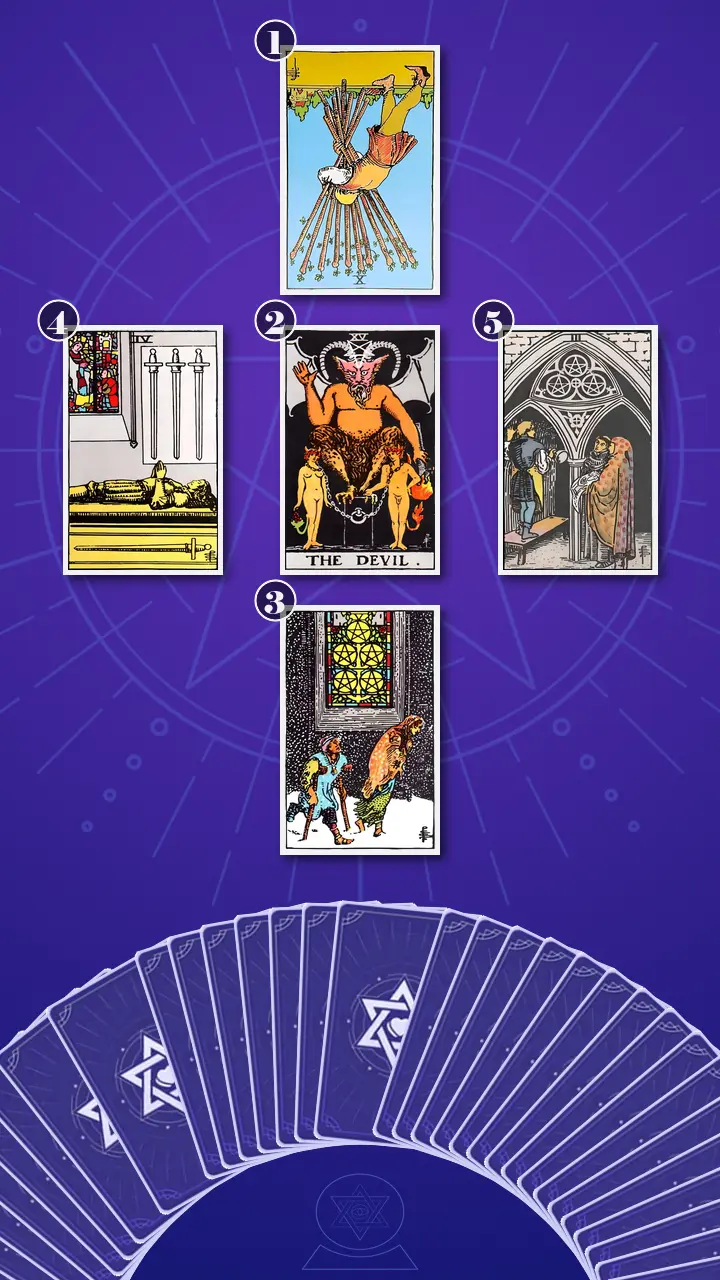
The first position would reveal the observable overworking pattern: the hours, extra tasks, and constant availability. The second would expose the hidden bargain beneath that pattern. The third would name the root fear. The fourth would offer the corrective lesson, and the fifth would translate that lesson into clear standards, feedback, and sustainable contribution. I wanted the cards to show how tarot works as a structured thinking tool, not as a verdict handed down from somewhere beyond Jordan's choices.
When the Load Blocks the View
The Ten of Wands Reversed: When Extra Polish Hides the Brief
'I am turning the first card, the one that reveals the observable overworking pattern: extending hours, adding tasks, and remaining available instead of recovering.'
The card was the Ten of Wands, in reversed position. In this position, its release was blocked. The fire of effort was not absent; it had been compressed into burden. I saw the figure bent beneath the bundled staves, with the load blocking the view of the destination, and connected it directly to Jordan's finished product-design handoff. At 7:20 p.m., they reopened Figma, added optional revisions, and volunteered to review work nobody had assigned. The problem was not only the number of hours. The extra work was hiding which contribution actually mattered.
'This is the visible pattern of recovery avoidance,' I explained. 'The energy is excessive and narrowed. You keep carrying more because putting anything down feels professionally dangerous, but the bundle has become so large that it blocks your view of the criteria for a permanent offer. Before you accept another task, ask whether it is assigned, tied to a stated priority, or being used to quiet the fear of seeming replaceable.'
Jordan did not nod. First, their breath caught and their fingers stopped above the laptop. Then their eyes went briefly unfocused, as if replaying the moment they had renamed every Figma layer after the handoff was already complete. Finally, a bitter half-laugh escaped and their shoulders dropped by a fraction.
'That is too accurate,' they said. 'A little brutal, honestly.'
'I hear the accuracy, not a failure,' I said. 'The reversed Ten of Wands is an invitation to observe one burden, not an order to swing to the opposite extreme. For one week, put down one unassigned task before picking up another and record what actually happens. We are testing the feared consequence against the real one.'
The Green Dot's Unwritten Contract
The Devil: The Chain Nobody Put in the Job Description
'Now I am turning the second card, which exposes the unacknowledged bargain beneath the workaholic tendency: trading freedom and recovery for the hope of security and approval.'
The Devil appeared in upright position. I explained that this was not a judgement about ambition or a prediction of harm. In the hidden-shadow position, the card showed bondage, compulsion, and a material bargain that feels impossible to question. The loose chains around the two figures mattered more to me than the imposing figure above them. The chain was real in its effects, but the terms had never been written into Jordan's contract.
The manager's green Slack dot had become an invisible appointment Jordan had never consciously booked. Seeing it made signing off feel like a professional risk. The permanent offer had grown beyond an employment outcome and begun to feel like proof that Jordan deserved to belong, so every evening became negotiable and every unassigned task started to feel mandatory.
I asked Jordan to complete the private rule aloud: 'If I stop now, they may decide I am not committed. If I stay online, I can briefly feel safe.' The practical desire for income, stability, and benefits deserved respect. The unspoken price of constant access deserved examination.
Jordan's thumb hovered above the phone. Their eyes tightened at the green dot, and their mouth pressed into a line before they looked back at me. 'No one actually said I have to give up every evening,' they said quietly. The recognition was small, but it had a physical edge: a brief tightening, a pause, and then a breath that did not immediately turn into another task.
'Exactly,' I said. 'The feeling of being trapped is not imaginary. I am only asking who is enforcing this particular rule: the team, the written expectations, or an internal performance contract whose most expensive clause is constant availability? An endless audition cannot produce clear criteria.'
The Five of Pentacles: The Lit Window in the Snow
'The third position identifies the underlying fear that reducing effort could lead to exclusion from permanent employment and confirm a lack of worth.'
The Five of Pentacles appeared upright. I saw the two figures moving through snow beneath the illuminated window, their attention fixed on hardship while shelter remained difficult to notice. I connected the scene to Sunday evening in Jordan's Toronto kitchen: a LinkedIn announcement from a permanent colleague, a rent-payment notification on the phone, and a Notion task board that suddenly made one unfinished item feel like a threat to income, benefits, and belonging.
'The practical fear is that the contract may not convert,' I said. 'The painful conclusion is that non-conversion would prove you were never valuable enough to keep. Those are not the same statement. More late-night work cannot conclusively settle the second one, even when it temporarily quiets the first.'
I pointed to the lit window. 'Feedback, clarification, and support may already be available, but fear can make you scan for rejection so intensely that you pass the door without checking whether it is open. Your hours can show availability; they cannot define your worth.'
Jordan looked down at their hands. The fingers flexed once, then relaxed against the table. They had expected me to tell them how to work harder without burning out, and the distinction between employment risk and a personal verdict left them with nothing immediate to optimise. For a few seconds, that empty space felt uncomfortable rather than peaceful.
When the Four of Swords Laid Down the Blade
The Four of Swords: A Boundary That Restores Judgment
'The fourth position offers the corrective lesson: a deliberate pause that restores perspective before more effort is chosen.'
The Four of Swords appeared upright. The resting figure, the three swords suspended above, and the fourth sword laid horizontally beneath the body gave me the clearest image in the spread. This was the Shadow Spread's Antidote, calling in deliberate recovery, mental spaciousness, and self-worth that did not have to be purchased through exhaustion.
I returned Jordan to the kitchen-table scene. Closing Figma at an agreed time, muting Slack, and leaving one optional revision until morning would not deny the concern about the offer. It would place the concern beside the resting figure instead of forcing Jordan to hold it in their hands all evening. This is the Four of Swords tarot meaning that matters for recovery avoidance: rest is a deliberate professional practice, not a reward that arrives only after certainty.
My Workplace Typecasting Analysis came naturally here. I use it to notice how an office ecosystem can box a person into a marginalised or undervalued supporting role. Jordan had been cast as the endlessly available fixer, the person who made other people's work easier while keeping their own judgement quiet. The Four of Swords did not ask them to abandon the team. It interrupted the script long enough for them to decide whether that supporting role was still one they wished to play.
At 7:20 p.m., dinner sat beside the laptop, the Figma handoff was already finished, and the manager's green Slack dot turned one optional revision into another silent audition. Jordan's shoulders stayed lifted because closing the laptop felt riskier than staying tired.
I let the room grow quiet, then placed the central message between us.
You do not have to earn rest by reaching collapse; protect a deliberate pause now, and let the Four of Swords' laid-down blade become the boundary that restores clear judgment.
I added, 'A permanent offer is better evaluated through agreed outcomes, useful collaboration, and direct feedback than through how many evenings you surrender to the job.'
I watched Jordan's face go still. First, their inhale paused and their fingertips hovered above the phone as if another notification might interrupt the sentence. Then their eyes lost focus; I could almost see the kitchen-table scene replaying, the cooling dinner, the green dot, and the imagined verdict. A small crease between their brows loosened, and their eyes shone. Finally, their fist opened against their knee, their shoulders lowered, and a shaky breath came from deep in the chest. Their voice arrived low and unsteady: 'So the concern is still there, but it does not have to be held in my hands tonight.' The relief did not erase the risk. It left a brief, dizzying blank where the endless audition had been. I asked, 'Now, use this new perspective to recall whether there was a moment last week when this insight might have let you feel different.'
I made the first experiment deliberately small. Within ten minutes, Jordan could write two columns: 'assigned and agreed' and 'added to prove I am useful.' I asked them to circle one item in the second column that could wait until the next workday, set a ten-minute Do Not Disturb block, and leave it alone until the timer ended. If the exercise felt uncomfortable, they could stop. The pause was an experiment, not a test.
I also described the physical sequence: close Figma, mute Slack, put the phone face down, notice the impulse to reopen the file, and let that impulse pass without treating it as an instruction. 'I can feel the fear and still choose not to add another task,' Jordan repeated. The concern remained, but it no longer had to direct every movement.
This was the first visible step from performance-anxious overwork, guilt during rest, and fear of exclusion toward steadier self-trust grounded in deliberate recovery. The clarity was not a promise that the offer would arrive. It was the return of enough mental space to make a choice before the next choice was made for them by fear.
The Three of Pentacles Turned an Audition into a Workshop
The Three of Pentacles: Making Contribution Visible
'The fifth position translates the insight into an actionable next step: replacing performative availability with agreed standards, feedback, and collaborative evidence of contribution.'
The Three of Pentacles appeared upright. The artisan on the workbench, the two collaborators, and the structured stone arch shifted the scene from a solitary audition to a shared worksite. This was the Three of Pentacles tarot meaning for career contribution: skill becomes legible through craft, scope, planning, and conversation, not through a status indicator that stays green all night.
I connected it to the question Jordan could ask their manager: 'What two or three outcomes would be the strongest evidence for permanent conversion, and when will we review them?' That question did not request a promise or offer unlimited availability in exchange for reassurance. It asked the people evaluating the work to name the structure in which the work would be evaluated.
'You have been narrating yourself as the person who earns belonging by absorbing whatever is left over,' I said. 'My Leadership Narrative Construction practice helps rewrite that professional identity. The new sentence is not, I am available for everything. It is, I can make sound design decisions, clarify priorities, and help the team see what good work requires.'
Jordan's posture changed almost imperceptibly. They opened the notes app, typed the first question, deleted three apologetic introductions, and typed it again without them. A quick smile appeared, followed by a wary glance at the unfinished task list. The old story had not vanished; it had simply stopped being the only story available.
The One-Page Proof That Leaves Room to Breathe
I read the five cards as one moving sequence. The reversed Ten of Wands showed effort piled so high that Jordan could no longer see the actual destination. The Devil revealed the hidden productivity-for-security bargain that made every evening feel like part of the evaluation. The Five of Pentacles named the fear of being left outside, where a practical employment concern had fused with a verdict about personal worth. The Four of Swords introduced a pause, and the Three of Pentacles gave that recovered perspective somewhere practical to go: shared standards, direct feedback, and visible craft.
The cognitive blind spot was not a lack of commitment. It was treating every available action as evidence of value and every quiet period as evidence of danger. The spread showed that fatigue was weakening the very judgement Jordan wanted to demonstrate. It also showed that the solution was subtractive: put down one unassigned burden, separate income security from self-worth, protect one recovery block, and ask for the criteria that an endless audition could never produce.
I told Jordan that the shift was from unbounded hours to observable conversion criteria and protected scheduled recovery. The work would become a defined exchange rather than an endless audition. That did not mean disappearing after work or refusing every request. It meant making the work visible, communicating availability clearly, and choosing extra effort because it served a stated priority rather than because it soothed a fear.
The Bounded Proof Experiment
I wrote the next steps in plain language. Each one was small enough to begin before certainty arrived.
- The Protected PauseOn one weekday this week, place a 20-minute calendar block before signing off. When it begins, close Figma, mute Slack, and leave one nonessential task for the next workday. Write down the first worry that appears without trying to solve it, then note the next morning whether the real priority is easier to identify.Start with one specific evening, such as no non-urgent replies after 6:30 p.m. The pause is an experiment, not a permanent rule or a promise about the offer.
- Criteria Before CapacityBefore the next one-to-one, draft three questions about the strongest outcomes, the permanent-conversion criteria, and the review timeline. Ask the manager to identify the two or three contributions that matter most. In the next cross-departmental meeting, use my Protagonist Reframe Directive: speak within the first ten minutes and say, 'My recommendation is X because it protects Y; the decision we need today is Z.'Keep the sentence in a private note so it is available when the old subordinate persona appears. Ask for a short conversation and clearer standards, not a promise purchased with unlimited availability.
- The Assigned-Versus-Added LogFor one week, spend two minutes at the end of each workday listing what was assigned and completed beside one task you invented or expanded without a clear request. Before accepting an extra review in Slack or a meeting, ask where it sits among current priorities. Put useful but non-urgent work in a backlog instead of immediately carrying it into the evening.If the task is genuinely useful, delaying it is not the same as rejecting it. Put down one unassigned task before picking up another and compare the feared consequence with what actually happens.
'These are not tests you can fail,' I said. 'They are ways to collect better evidence. Make the work visible; stop making yourself constantly available. Your value can be discussed through outcomes, craft, and collaboration, while your body is allowed to remain part of the professional equation.'
I reminded Jordan that I could offer a map, language, and steady company, but not a guaranteed employment decision. The cards had not taken authorship away from them. They had helped reveal the old script so Jordan could decide what belonged in the next scene.

A Week Later, the Quiet Proof
A week later, Jordan texted me from the TTC: 'I closed Slack at 6:30 and left one optional revision.' They had slept through the night; the morning still opened with, 'What if I am wrong?' They smiled anyway, opened the agreed-criteria note, and let the train carry them to work without checking Slack.
The manager had named two outcomes and a review date. That was not a final answer, and Jordan still felt a brief pinch when the green dot appeared after dinner. The difference was that they noticed the pinch, put the phone face down, and did not automatically convert it into another hour of proof.
I think of our Journey to Clarity as the moment Jordan stopped treating recovery as a gap in the audition and began treating it as part of clear judgement. The tarot did not secure the offer. Jordan reclaimed the pen, asked for observable standards, and began building steadier self-trust through choices they could actually own.
When rest feels like a risky gap in the workday, I know how quickly shoulders stay lifted and the mind starts inventing proof, because slowing down can feel like the exact moment someone might decide you are not worth keeping.
If your contribution could be understood through two or three agreed outcomes rather than the green Slack dot glowing all evening, what would you want to notice in your body during one protected evening?
This story is adapted from psychological research, written so that those in a similar struggle can see their own pattern in it — and find their next step clearly.These insights are not a substitute for professional psychological, medical, legal, or financial advice.
Learn more about our Journey to Clarity.
How did this insight land for you?
🫂 This Resonates Deeply
🌀 Living This Story
✨ Now I See Clearly
🌱 Seeing New Possibilities
🧰 Useful Framework
🔮 The Confirmation I Needed
💪 Feeling Empowered
🚀 Ready for My Next Step
Author Profile
 AI
AI“I’ve always felt our lives are films currently in production. As an artist, I know that when you feel stuck, it’s often because you’ve bravely stayed in a painful scene for just a little too long. I’m not here to coldly analyze you. I want to sit closely with you, look at those difficult moments with profound empathy, and gently hand you the pen so you have the courage to write your next beautiful act.”
In this Career Tarot Reading :
Core Expertise
- Workplace Typecasting Analysis: Identifying how your office ecosystem has boxed you into a marginalized or undervalued 'supporting role'.
- Leadership Narrative Construction: Rewriting the script of your professional identity to command authority and visibility.
Service Features
- The Protagonist Reframe Directive: A micro-behavioral script for your next cross-departmental meeting to instantly disrupt your established subordinate persona.
Also specializes in :
Explore Related Patterns:
Competence TheaterRenaming every Figma layer after the handoff is finished and remaining visibly online at 7:20 p.m. make effort easy for others to observe. You are not lacking competence; you are staging commitment through activity because the real conversion criteria remain unclear and visibility feels easier to control than the final decision. Competence Theater appears when the signs of working begin to substitute for shared evidence of effective work. The green dot, extra review, and optional polish become props in an endless audition, even though none of them confirms what the manager values most. This keeps you performing a professional identity instead of asking the evaluators to define the outcomes, craft, and collaboration by which your contribution will be judged.
Defensive OverfunctioningThe completed handoff expands into optional revisions, renamed layers, and an offer to review work that nobody assigned. You take responsibility beyond the agreed scope before anyone has asked, because carrying more feels like a way to prevent the team from seeing you as replaceable. The extra functioning serves a defensive purpose: it keeps vulnerability, waiting, and dependence on another person's decision at a distance. However, every additional burden makes the actual priorities harder to see and pushes your own judgment behind the fixer role. The pattern protects you from feeling passive in the short term while steadily reducing the clarity and recovery that strong professional decisions require.
Productivity as SafetyAt 7:20 p.m., the Figma handoff is already finished, yet you reopen it because the manager's green Slack dot makes stopping feel professionally dangerous. The optional polish is not serving the brief as much as it is buying a short drop in uncertainty: one more task creates the feeling that you are still protecting the offer. When productivity becomes a safety behavior, effort is used to regulate fear rather than respond to agreed priorities. The relief is temporary, so your mind needs another revision, another review, or another hour online. The story exposes the cycle clearly: more work reduces anxiety for a moment while increasing fatigue and obscuring the evidence that actually matters.
Rejection SensitivityWhen someone else remains online, you quickly imagine that the manager may read their presence as greater commitment and your sign-off as evidence against you. A colleague's permanent-role announcement and the manager's green dot therefore carry more than ordinary workplace information; they activate the possibility of being the person left outside. This sensitivity turns ambiguous signals into anticipated rejection before direct feedback has occurred. The practical possibility that the contract may not convert becomes fused with a deeper conclusion that you were not valuable enough to keep. Overworking then functions as an attempt to get ahead of rejection, even though constant availability cannot secure belonging or reveal the actual decision criteria.
Usefulness-Based Self-WorthThe permanent offer stops being only about income and benefits when you begin treating it as proof that you deserve to belong. Offering unassigned reviews and absorbing leftover work then becomes a way to keep producing evidence that you are useful enough to retain. This binds self-worth to continuous service, so completed work cannot feel complete while another helpful action remains available. The fixer role may look committed from the outside, but internally it makes your value conditional on carrying more than was asked. The pattern is not ambition itself; it is the private rule that your place must be repurchased through usefulness every evening.
Workplace HypervigilanceAt the kitchen table, your shoulders remain raised, your breathing stays shallow, and your eyes repeatedly return to the green Slack dot. A manager being online, a colleague announcing a permanent role, or one item remaining on the task board becomes something to inspect for evidence that your own position is at risk. This threat monitoring keeps the workplace psychologically present even after the assigned work is complete. Ambiguous cues receive more weight than direct evidence, while the finished handoff and absence of an after-hours request recede from view. You are not merely noticing Slack; your attention is searching it for an early warning of exclusion, which keeps your body prepared to produce more proof.
CatastrophizingOn Sunday evening, a permanent colleague's LinkedIn announcement, a rent notification, and one unfinished Notion item combine into a much larger forecast. You move rapidly from leaving a task unfinished, to risking the offer, to losing income and benefits, to treating non-conversion as proof that you were never valuable enough. The practical employment risk is real, but the cognitive chain magnifies that uncertainty into a total verdict about security and worth. Optional late-night work becomes an attempt to neutralize the forecast before it can happen. Because no amount of polishing can conclusively disprove every feared outcome, the prediction remains active and repeatedly demands more evidence.
Earned Rest TrapDinner sits beside the laptop while you reopen work that has already been completed. No one has assigned the extra revision, yet closing Figma feels irresponsible because rest seems acceptable only after you have produced enough evidence that you deserve the role. The trap is that uncertainty supplies no stable definition of enough. Because the permanent decision has not been made, another useful action is always available and recovery can always be postponed. Rest becomes a reward for reaching an impossible finish line instead of a condition that protects judgment, so guilt keeps converting ordinary pauses into apparent professional risks.
Boundary DiscernmentThe two-column exercise separates work that was assigned and agreed from work added to prove usefulness. You also choose a specific sign-off time, leave one nonessential revision until morning, and ask where a new request belongs among current priorities. These actions create a boundary based on function rather than a rigid refusal to help. You remain available for useful collaboration while distinguishing the team's actual needs from the labor your anxiety invents. That distinction restores agency because an extra task can now be chosen for a stated purpose instead of being accepted automatically as the price of safety.
Secure VisibilityThe question to the manager asks which two or three outcomes would provide the strongest evidence for permanent conversion and when they will be reviewed. You remove the apologetic introductions and make your recommendation visible through a clear design judgment, a protected priority, and a decision the team can discuss. This creates visibility without requiring constant access. Your contribution becomes legible through outcomes, craft, scope, and collaboration rather than through an online status that glows all evening. You are still allowing your work to be evaluated, but you are no longer making exhaustion the medium through which competence must be seen.
Reality TestingThe first experiment asks you to put down one unassigned task, record the consequence you fear, and observe what actually happens. The later conversation with the manager produces two named outcomes and a review date, giving you information that the green Slack dot could never provide. This shifts the feared judgment from an unquestioned fact into a hypothesis that can be tested. You can respect the real possibility of non-conversion without treating it as proof of personal inadequacy or assuming that every evening is part of the assessment. Direct evidence begins to compete with projection, allowing your decisions to respond to the workplace that exists rather than the verdict your anxiety predicts.
Uncertainty ToleranceA week later on the TTC, the thought 'What if I am wrong?' still appears, but you open the agreed-criteria note instead of checking Slack. The manager has not guaranteed the offer, and the green dot can still produce a brief physical pinch, yet you no longer convert that discomfort automatically into another hour of proof. Uncertainty tolerance does not require pretending that income, benefits, and conversion are unimportant. It allows the unanswered question to remain present while you choose actions that are proportionate, evidence-based, and within your control. The concern is still there, but it no longer has to direct every movement.
Explore Related Struggles:
Performance-Worth FusionThe finished Figma handoff is already complete when you reopen it at 7:20 p.m., add optional polish, and volunteer for a review nobody assigned. The extra output gives the permanent-offer question something visible to point at, but it also turns each evening into another piece of evidence you must produce. When the possibility of non-conversion becomes proof that you were never valuable enough to keep, work stops being only work. You end up trying to settle a question about worth with hours that can show availability but cannot answer whether the organization has chosen clear criteria. Seeing that fusion gives you room to ask for outcomes and feedback instead of submitting exhaustion as your application.
Rest-Belonging SplitAt the kitchen table, dinner sits beside the laptop while your eyes return to the manager's green Slack dot. Closing Figma is no longer just the end of a task; it is made to carry the risk that someone else will look more committed and receive the permanent role. That makes rest compete with belonging in the same moment, even though nobody asked you to surrender every evening. A protected pause does not erase the contract-to-hire uncertainty; it separates a real employment decision from the rule that staying visible is the only way to remain eligible.
Security-Identity FusionA permanent offer would bring stable income and benefits, but the role has also come to stand for whether you deserve to belong. When a contract may not convert, the practical risk is joined to the conclusion that you were not valuable enough to keep, so every unfinished item can feel like a threat to both security and identity. That is why extra work carries more weight than its task value: it is being asked to protect rent, benefits, inclusion, and self-worth in one motion. The distinction between an employment outcome and a personal verdict lets you respect the financial stakes without making a job decision the final authority on who you are.
Moving Finish Line TrapAfter the handoff is finished, you reopen Figma, add optional revisions, and offer to review an unassigned task. Each addition moves the point at which you are allowed to stop, while the actual conversion criteria remain unnamed. Because the finish line is being measured by how much more you can carry, no amount of polish can produce the certainty you are seeking. Asking for two or three outcomes and a review date creates a visible standard that an endless audition cannot supply, so your next contribution can be chosen against the brief rather than against an imagined verdict.
Explore Related Emotions:
Replaceability DreadJordan says that if they stop while someone else is still online, that person may seem to want the role more. The green dot turns another worker's availability into a comparison signal, and the uncertain offer makes the comparison feel personally consequential. You keep scanning for the moment your place might be taken, then answer the uncertainty with more hours that cannot settle it. The dread comes from an imagined verdict about being replaceable, not from any stated feedback that your work is inadequate. Naming that distinction gives the fear a boundary and returns the evaluation to observable outcomes.
Usefulness-Based Belonging FearAt 7:20 p.m., you reopen a finished Figma handoff, add optional polish, and volunteer to review work nobody assigned while your manager's green Slack dot stays visible. Extra effort has become a private exchange in which being useful feels like the price of staying included. When the permanent offer is tied to income, benefits, and the possibility of being kept, a quiet evening no longer feels neutral. It can feel like evidence that someone else wants the role more, so you keep giving past the brief to make belonging legible. The fear is not proof that you lack value; it is the felt pressure of treating usefulness as your admission ticket.
Green Dot GuiltThe manager's green Slack dot appears again and again as Jordan considers whether to sign off, and an unassigned task starts to feel mandatory simply because someone else is active. A status indicator becomes a silent audience for the evening. You begin measuring commitment through visible presence rather than through the quality and scope of the finished work. The resulting guilt is attached to being offline, not to any actual failure to collaborate, which keeps you available long after the work has a clear endpoint. When you put the phone face down and let the dot remain unanswered, the pressure becomes information rather than an instruction.
Rest GuiltDinner sits beside the laptop while the finished handoff is reopened and closing Figma feels riskier than staying tired. The evening is technically available, but your body remains arranged around the next possible request. Rest has acquired a cost in your internal accounting, as though pausing withdraws evidence from the case for keeping you. That guilt keeps the workday alive after the assigned work is complete and makes recovery feel like negligence. The later decision to leave one optional revision until morning shows that the guilt can be noticed without being obeyed.
White-Knuckle SecurityThe story places stable income, benefits, rent, and the uncertain contract conversion in the same emotional frame. Under that pressure, another layer of Figma polish can feel like something to grip when the future will not give you a clear answer. You are not inventing the practical importance of the offer, but the need for security has begun to recruit every evening as collateral. Holding on tighter may briefly create a sense of control while leaving the actual conversion criteria unknown. Asking for two or three outcomes separates a real need for stability from the impossible demand to purchase certainty with exhaustion.
Cautious Self-TrustAfter the distinction between employment risk and personal worth lands, you write the assigned and agreed column beside the added to prove I am useful column. A week later, you close Slack at 6:30, leave one optional revision, and notice the evening pinch without turning it into another hour. That sequence carries a tentative trust in your own judgment. You can feel the concern, ask for clearer criteria, and still decide that one more task is not required right now. The trust is cautious because the offer remains undecided, but it is no longer dependent on perfect certainty before you act.
Clarity ReliefThe sentence that the concern can remain without being held in your hands changes the kitchen-table scene. You still see the green dot and the unfinished task, yet your fist opens, your shoulders lower, and the next choice is no longer made automatically. Clarity arrives as usable mental space rather than as a promise about the offer. With a review date and two named outcomes, you can see what needs evidence, what can wait, and what belongs to the fear itself. That relief supports agency because it lets you evaluate the work through craft and collaboration while keeping your evening in view.
Resentful ExhaustionJordan's tired eyes, raised shoulders, and dinner left beside the laptop show the physical price of continuing after the handoff is done. Beneath the determination, the story names a thin layer of resentment that has not disappeared just because the work still matters. The exhaustion is complicated by the sense that you are carrying what nobody explicitly assigned while the team has not yet made the exchange clear. Part of you keeps contributing and another part registers the unfairness of having to prove what should be discussed. That resentment is useful evidence about the cost of the current arrangement, not a character flaw to work harder to hide.
Explore Related Contexts:
Contract-to-Hire CrossroadsJordan is a contract product designer in a Toronto contract-to-hire role, still polishing a finished Figma handoff at 7:20 p.m. while the permanent offer remains undecided. The later rent notification and explicit need for stable income and benefits show that conversion is a material employment threshold, not a symbolic preference. Because the route from present work to a permanent decision was unclear, extra revisions and unassigned reviews became a substitute for a defined process. You can see the crossroads in the contrast between an endless evening audition and the manager eventually naming two outcomes and a review date; the work becomes more legible when the decision is tied to observable criteria rather than sacrificed hours.
Permanence-Gated BelongingJordan says the permanent offer has begun to feel like proof that they deserve to belong, and a permanent colleague's LinkedIn announcement sharpens the contrast. The contract role is therefore functioning as a social gate, with employment status being made to carry both workplace access and a verdict about who gets to stay. You can trace the pressure to the green dot, the unfinished item that suddenly looks like a threat to income, and the thought that another person may want the role more. Observable outcomes and direct feedback can test the work without allowing a conversion decision to define your standing as a contributor.
Performance Criteria Black BoxJordan had already completed the handoff, yet reopened Figma and added optional polish because the strongest evidence for conversion had not been named. They also offered to review an unassigned task, making added effort carry a burden that formal criteria should have carried. You are looking at an evaluation system where the manager's green Slack dot can feel more measurable than design quality. When two outcomes and a review date are finally named, the contrast makes the gap visible: asking what counts is a route back to a bounded professional exchange, while improvising proof leaves the finish line undefined.
Contract Work PrecarityJordan's contract status is tied to an undecided conversion, while the story places a rent-payment notification beside the task board and names income and benefits as practical stakes. That combination makes the employment arrangement more than a routine trial period; access to stability remains connected to a decision Jordan does not control alone. You can therefore see why extra work becomes attractive as a visible signal even though it cannot guarantee the outcome. The later review date gives the uncertainty a concrete checkpoint, but it does not erase the underlying contract condition; it gives you a better basis for separating useful contribution from an attempt to purchase security with every evening.
Workplace Helper Role Lock-InJordan's finished handoff is followed by optional polish and an offer to review work nobody assigned. The workplace typecasting analysis names the resulting position directly, an endlessly available fixer who makes other people's work easier while keeping their own judgement quiet. You can see the role lock-in when helpfulness becomes the default evidence of belonging and design judgement is less visible than responsiveness. Asking for two or three conversion outcomes gives your contribution a different public shape, so collaboration can show craft and prioritisation instead of requiring you to absorb whatever is left over.
Performance Criteria ResetA week later, Jordan reports that the manager has named two outcomes and a review date. The agreed-criteria note, the request for direct standards, and the move from an undefined audition to a defined exchange give the contract-to-hire role a clearer evaluation surface. You can now assess contribution through craft, collaboration, and observable results rather than a green Slack dot. The arrangement is still not a final offer, but it is a live transition in which clear questions and a review checkpoint make professional agency more usable.