When Full-Time Work Is Compressed Into Four Days
If you are a Toronto product or operations manager whose four-day week still contains every recurring meeting, Monday can look less like flexibility and more like work compression with better calendar colours.
At 6:20 p.m. on her scheduled day off, Maya joined my video call from the kitchen counter of her Toronto condo. Her laptop was open to a private Notion list where she had just moved three unfinished tasks. I could hear the refrigerator humming through the call, and she shifted her palms away from the laptop's heat while Slack glowed at the edge of the screen.
She had reduced her hours because she wanted time to draw, see friends, and discover who she was when productivity was not setting the agenda. The hours had changed, but the work had kept its old shape. Instead of letting something drop, she had made herself smaller and faster around it.
“I technically work four days, but the work still thinks it has five,” she said. “It feels easier to work faster than to explain what will not get done.”
I watched her shoulders remain lifted even after she closed Slack. The exhaustion seemed to sit on her like a soaked winter coat: heavy at the collar, cold at the wrists, and somehow still being worn indoors. A four-day calendar cannot hold a five-day agreement without borrowing from the body.
“I am not going to ask the cards whether you are capable enough,” I told her. “Your capability is not the question. I want us to examine why speed has become safer than scope, then find one place where you can recover choice. Let us draw a map through the fog rather than force an answer.”

Choosing the Five-Card Cross as a Pressure Valve
I invited Maya to take one slower breath and hold a single question in mind: “What keeps me carrying full-time scope, and what could change the pattern?” I shuffled while she settled her feet on the floor. The pause was a way to shift attention, not a performance of mystery.
I chose a Five-Card Cross. For readers wondering how tarot works in a conversation about work burnout, I use the cards as an objective reflection tool: each position isolates a different part of the system so that a tangled experience can be examined without treating any image as fate.
This spread suited Maya's question because it could trace one repeating loop with precision. The centre would show her visible work-compression behaviour. The left-hand card would uncover the attachment beneath it, while the upper card would identify the practical pressure keeping the loop active. The lower card would offer a grounding intervention, and the final card would show what sustainable integration might look like.
I placed the cards in a cross that resembled a pressure valve. The reading would move from symptom to root, then from blockage to resource and possible integration. It was enough structure to examine the reduced-hours scope mismatch without adding layers that Maya did not need.
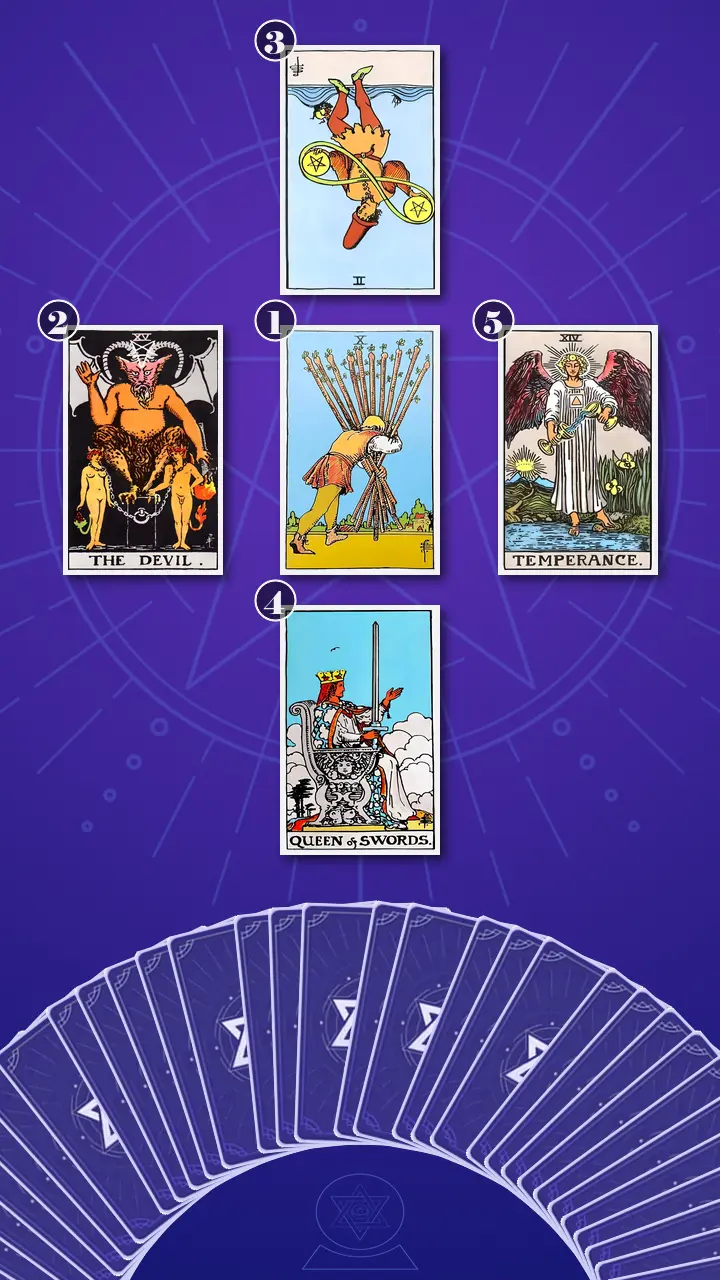
Reading the Loop Behind the Crowded Calendar
Position One: The Bundle That Blocks the View
I began with the card representing Maya's visible work-compression behaviour: preserving full-time responsibilities by increasing the intensity of her reduced hours. I turned over the Ten of Wands, upright.
The figure was bent beneath ten staffs gathered into one obstructive bundle. I asked Maya to picture her Google Calendar at 8:04 on Monday morning: four columns packed with five days of recurring meetings, reports, and follow-ups. Lunch and focus blocks disappeared first. Her attention dropped toward one goal, reaching Friday, while the creative and social life she had wanted vanished beyond the bundle.
“The thought underneath this card is, ‘If I can just get the whole bundle to Friday, then I can finally use the arrangement properly,'” I said. “But each successful delivery preserves the same load for the next week.”
The Wands energy was in excess. Maya had plenty of drive, competence, and follow-through, but obligation had consumed the Fire that might otherwise have supported curiosity or creative work. Her effort was not failing. It was succeeding at the wrong task: proving that an unchanged workload could still be delivered.
I asked, “Which responsibility did you protect most recently by shortening lunch, focus time, or your evening?”
She gave a small laugh with a bitter edge and rubbed the side of her jaw. “That's too accurate. It feels almost cruel. I cancelled a Friday dinner so I could finish a report nobody had actually confirmed was still urgent.”
“The card is not accusing you of carrying it,” I replied. “It is helping us see the bundle as a bundle. Until then, every individual stick can look non-negotiable.”
Position Two: The Loose Chain of Constant Usefulness
I moved to the card representing the workaholic attachment between usefulness and self-worth, the part of the pattern that made reducing responsibilities feel personally threatening. I revealed The Devil, upright.
I drew Maya's attention to the loose chains around the figures. The card did not deny the reality of rent, job security, deadlines, or uneven workplace power. It asked where those real pressures ended and an untested private rule began.
In Maya's life, the chain looked like a late “quick ask” arriving on Slack. Before anyone called it urgent, she treated it as a test of her professional value. She replied within minutes, kept the green status dot alive, and covered the work beside her dinner plate because asking what should move felt more dangerous than giving away the evening.
The energy here was blocked through attachment. Reliability had stopped meaning follow-through on agreed priorities and started meaning that nobody could ever encounter her limits. Like training a recommendation algorithm through repeated clicks, every instant reply taught the surrounding system to recommend more urgency. Urgency kept receiving engagement, so urgency kept returning.
“No one explicitly asked me to prove this,” Maya said slowly, “but if I stop, I imagine someone noticing that I am not as useful as before.”
Her fingers tightened around her mug, then released. I asked her to notice the wording: not “the work will fail,” but “they will notice me.” That distinction did not erase organizational responsibility. It showed us why private overwork felt emotionally safer than a shared planning conversation.
Position Three: The Calendar That Keeps Changing
I turned to the card representing the reduced-hours scope mismatch and the repeated calendar juggling that maintained Maya's stuck position. The card was the Two of Pentacles, reversed.
Its infinity-shaped band became the task arrows on her screen: Tuesday to Thursday, Thursday to Sunday, Sunday into a private list. The same unfinished report moved again. Lunch became another fifteen-minute block. A new request entered, but no existing commitment left.
“Maybe the next calendar version will make this fit,” I said, giving voice to the promise beneath the reshuffling. “But continuous rescheduling is not evidence that the arrangement works when the total commitment never falls.”
The card showed adaptability pushed into excess until it produced instability. Maya did not have a deficiency of planning skill. She had been using a strong planning skill to conceal an impossible equation. The calendar keeps changing because the agreement has not.
Her breath left in one sharp stream. Her eyes moved away from the cards as if she were watching several previous Sundays replay on the condo wall. Then her shoulders dropped by a fraction.
“I have a report that has moved six times,” she said. “I thought that meant I needed a better system.”
“It may mean the system needs a confirmed pause,” I said. “Working faster hides the evidence that the scope does not fit.”
When the Queen of Swords Drew One Clean Line
Position Four: The Boundary That Becomes Planning Information
The room seemed to quiet when I reached the lower card, the position representing the boundary and communication resource that could turn private overextension into explicit priority trade-offs. I revealed the Queen of Swords, upright.
Her sword stood vertical and precise, while her other hand remained open. I read that combination as balanced Air energy: a clear limit paired with an invitation to collaborate. This was not a dramatic refusal or a demand that Maya risk her livelihood. It was factual language about capacity, sequence, and consequence.
I returned us to 6:20 p.m.: three tasks moved into a private list while Slack said everything was on track. The time Maya had protected was already being spent proving she deserved it. She was trying to make the right calendar solve an agreement no calendar could hold.
I told her I wanted to run what I call an Imposter Syndrome Audit. I separated the evidence of professional competence from the fear of exposure. On the evidence side, Maya had an approved schedule, trusted ownership, and a record of delivering complex work. On the fear side sat a forecast: if one task paused, someone might decide she could not handle her role. The forecast felt vivid, but it was not the same kind of information as the evidence.
“Your competence is established through what you can verify,” I said. “The fear is asking you to buy extra protection with evenings. The Queen asks whether that protection is still serving you.”
Working faster is not proof of commitment; naming what will pause is the Queen of Swords' clear cut that turns reduced hours into real capacity.
I let the sentence rest between us. Outside Maya's window, the last grey cloud shifted beyond the neighbouring tower, leaving a narrow strip of clear evening sky.
Reduced hours become real only when something is allowed to wait; working faster merely hides the fact that the scope no longer fits.
Maya's breath stopped first. Her fingers hovered above the mug, perfectly still. Then her gaze lost focus, as though she were replaying every “no problem, I can fit it in” message she had sent from a day off. Her eyebrows drew together, and recognition arrived with heat rather than relief.
“But doesn't that mean I have been doing this wrong the whole time?” she asked. Her voice came out sharper than before. “I fought for the schedule, and then I made it meaningless.”
“No,” I said. “It means speed was a strategy that protected your stability and reputation when a scope conversation felt risky. We can respect why you used it without requiring you to keep paying for it. Clarity gives you responsibility for the next choice, not blame for every previous one.”
Her jaw loosened. The hand around her mug opened, and she placed both palms on the counter as if testing whether it would hold her. A long breath moved through her chest. Relief appeared, but so did the slight blankness that can follow when a familiar burden is set down and choice becomes real.
I asked, “Now, with this new perspective, think back to last week. Was there a moment when this insight could have made you feel different?”
“The director's quick ask,” she said after a pause. “I could have said, ‘I can add it, but the dashboard review would move.' I would still have felt nervous. But I would not have had to pretend there was no cost.”
I wrote her sentence beside the Queen. A boundary here was planning information, not a confession of weakness. This was the first crossing from compressed exhaustion and worth-based overwork toward clear boundaries, proportionate responsibility, and sustainable self-trust.
Temperance and the Life Left After Work
Position Five: A Week Measured by More Than Output
I turned over the final card, representing the possible integration in which work scope became proportionate to time and fulfillment became a legitimate measure of the arrangement. It was Temperance, upright.
I pointed to the measured flow between two cups and the figure standing with one foot on land and one in water. The image did not promise a perfect work-life balance. It showed an ongoing exchange between practical commitments and felt capacity, adjusted before the room became unbearable.
In context, Temperance looked like Maya reviewing actual hours before overload developed, allowing one lower-priority item to wait with her manager's awareness, and reaching her non-work day with enough energy for a quiet drawing session. The test was no longer whether she could reproduce five-day output perfectly. It was whether the arrangement left usable energy for recovery, relationships, and creativity.
The energy here was balanced, but dynamic. Available hours, agreed priorities, bodily recovery, and creative time all had to influence one another. If work expanded, something would move visibly. If Maya reached Friday able only to recover, that result would become data for the next calibration rather than evidence that she should try harder.
“At the end of a workable week,” I asked, “what would you still have enough energy to do besides prepare for work again?”
Maya looked toward a closed sketchbook on the counter. Her posture softened, although her expression held a little grief for the Fridays already lost.
“Twenty minutes with that would be enough to know the day was mine,” she said.
“Then twenty minutes is information,” I replied. “Temperance is not asking you to create a second performance target. It is asking whether the cups are still exchanging anything, or whether work has taken the whole measure.”
Scope Before Speed: Making the New Agreement Visible
I gathered the Five-Card Cross into one story. The Ten of Wands showed Maya carrying every responsibility until the bundle blocked her view. The Devil revealed why she kept holding it: uninterrupted usefulness had become a private insurance policy against feeling less valuable. The reversed Two of Pentacles exposed the operational consequence, a reduced-hours scope mismatch disguised as a calendar problem. The Queen of Swords offered the leverage point, and Temperance showed how one clear trade-off could become an ongoing, sustainable rhythm.
The pattern was like forcing the contents of a five-day suitcase into a four-day case, sitting on the lid, and calling the problem solved. Maya's cognitive blind spot was not that she misunderstood her exhaustion. It was that she treated her efficiency as proof the workload fit, when that efficiency was hiding the strongest evidence that it did not.
The direction of change was specific: stop privately compressing every task and begin agreeing on a ranked reduced-hours scope with explicit priorities, exclusions, and shared trade-offs. I framed the next actions as small tests. None required a dramatic confrontation, and each could be stopped or shortened if it felt too activating.
- Run the ten-minute Scope-Before-Speed Reset. On Monday, open a plain note and sort five active commitments into must do, negotiable, and pause. Highlight one plausible pause candidate and ask your manager whether it waits, changes owner, or replaces another priority this week. Tip: Rank by deadlines, named stakeholders, and consequences rather than by which item creates the most guilt. Request a decision on only one task.
- Anchor competence before naming capacity. For eight minutes before the next one-to-one, use my Competence Anchoring Exercise: list three verifiable outcomes you have delivered, then write the feared verdict you imagine a limit would trigger. Draft: “With four days available, I can complete A and B. If C becomes the priority, which existing item should move?” Tip: Keep the message factual and character-free. The minimum version is one sentence about one conflicting task, drafted without sending.
- Use a Temperance Energy Review. On the final workday, spend five minutes comparing contracted hours with actual hours, skipped breaks, and after-hours messages. Then reserve one thirty-minute block on the next non-work day for drawing at home, the library, or a cafe, with no requirement to finish or share anything. Tip: If this starts feeling like another productivity project, reduce it to a two-minute hours check and ten minutes of creativity. Stopping on time is part of the exercise.

A Friday That Did Not Have to Prove Anything
A week later, I received a short message from Maya. She had taken one pause candidate into her one-to-one and used the Queen's capacity sentence. Her manager chose the launch analysis as the priority and agreed that the dashboard cleanup could wait until the following week.
No career-ending verdict arrived. More importantly, Maya did not hide the displaced work in a Sunday list. She left it visible on the shared board, closed her laptop, and spent eighteen minutes drawing at the kitchen counter where I had first seen Slack glowing beside her.
She told me she slept through the night, though her first thought in the morning was still, “What if I misjudged this?” This time, she smiled before getting up.
I did not read that message as proof that one boundary had fixed her workplace. I read it as quiet evidence that Maya had begun replacing private overextension with shared prioritization. The cards had not granted her permission; they had helped her recognize the authority she already had to name reality.
That was her Journey to Clarity: not certainty, and not a perfectly balanced life, but one lower-priority task allowed to wait without her worth waiting beside it.
If your shoulders stay lifted after you have logged off because slowing down feels like risking your value, a day off can become one more place to prove you can carry everything. Noticing that pattern is already a small loosening of the chain.
So I will leave you with the question I left beside Maya's cards: if your available time were allowed to set the size of the suitcase this week, which one lower-priority commitment are you curious enough to let wait?
This story is adapted from psychological research, written so that those in a similar struggle can see their own pattern in it — and find their next step clearly.These insights are not a substitute for professional psychological, medical, legal, or financial advice.
Learn more about our Journey to Clarity.
How did this insight land for you?
🫂 This Resonates Deeply
🌀 Living This Story
✨ Now I See Clearly
🌱 Seeing New Possibilities
🧰 Useful Framework
🔮 The Confirmation I Needed
💪 Feeling Empowered
🚀 Ready for My Next Step
Author Profile
 AI
AI“Having traveled across cultures... I've learned that what we often lack isn't a simple answer, but a moment of being truly understood. I use a Jungian psychological lens to help you deconstruct your subconscious patterns—not to prove anything, but to be the gentle companion who helps you unravel your knots, free of judgment, so you can reconnect with your inner wisdom.”
In this Career Tarot Reading :
Core Expertise
- Imposter Syndrome Auditing: Separating your objective professional competence from deep-seated subconscious fears of exposure.
- Authority Archetype Integration: Diagnosing the psychological friction hindering your transition from individual contributor to leadership.
Service Features
- The Competence Anchoring Exercise: A structural journaling prompt to logically anchor your self-worth to verifiable achievements rather than external validation.
Also specializes in :
Explore Related Patterns:
Defensive OverfunctioningMaya answers late Slack requests within minutes, keeps her status active, works beside dinner, and shifts unfinished tasks into her day off instead of asking which priority should move. Those actions convert the uncertainty of a capacity conversation into a controllable burst of extra effort, so overwork functions as a defense against possible judgment. When you repeatedly become the person who privately closes every gap, competence can hide the scope mismatch from both you and the workplace. Defensive Overfunctioning names that loop: the strategy succeeds in the short term, but each success trains the system to expect the same invisible rescue again.
Imposter SyndromeMaya has an approved schedule, trusted ownership, and a record of delivering complex work, yet she predicts that pausing one task may expose her as unable to handle the role. She then buys protection from that imagined verdict with immediate replies, skipped breaks, and invisible work outside her agreed hours. When you treat a normal capacity limit as evidence that others may discover you are less capable than they believe, verified competence loses ground to a vivid forecast. Imposter Syndrome names this evidence imbalance. The manager's acceptance of a visible trade-off does not instantly erase the old prediction, but it gives you reality-based data with which to test it.
Productivity as SafetyMaya explicitly says that working faster feels easier than explaining what will not get done. By accelerating, staying visibly available, and moving unfinished work into a private list, she exchanges an exposed negotiation for an activity she knows how to control. When you experience output as protection, productivity stops being only a practical tool and starts regulating perceived safety. Productivity as Safety captures why speed can remain compelling after it has stopped serving your actual goals: it lowers the immediate fear of judgment while keeping the capacity problem, and the need for more protection, alive.
Usefulness-Based Self-WorthMaya says that her deepest fear is not simply that the work will fail, but that someone will notice she is not as useful as before. A late quick ask therefore becomes a referendum on her professional value, and an ordinary limit feels more personal than the request itself. When you use uninterrupted usefulness as proof that you deserve your place, every boundary can feel like a withdrawal of evidence. Usefulness-Based Self-Worth explains why Maya keeps paying for reassurance with evenings: the extra work is not only completing a task, but trying to stabilize a sense of value that the task was never qualified to determine.
Workplace Self-SilencingAt 6:20 p.m. on her day off, Maya moves three unfinished tasks into a private Notion list while Slack still suggests that everything is on track. The calendar conflict is real, but the information needed to resolve it remains hidden because revealing the cost feels more dangerous than absorbing it. When you withhold accurate information about capacity, other people can only plan around the version of reality they can see. Workplace Self-Silencing describes how fear turns a legitimate constraint into a private burden: the unspoken limit protects you from immediate exposure, but it also removes your chance to receive a real priority decision.
Illusion of ControlMaya moves the same report six times and assumes the repeated failure to place it means she needs a better system. Each calendar revision changes the location of the work but leaves every commitment intact, creating visible activity without changing the equation. When you keep reorganizing an unworkable scope, planning can produce a temporary feeling of control while delaying the evidence that something must be removed. The Illusion of Control explains why Maya stays busy but stuck: the calendar appears to offer another solution, even though the missing capacity can only be addressed through a real priority trade-off.
Cognitive DissonanceMaya reduced her hours so she could draw, see friends, and discover who she was when productivity was not setting the agenda, but she continued delivering work as though the missing day still existed. Her stated goal and her weekly behavior therefore support incompatible versions of the arrangement. When you hold both versions at once, working faster can temporarily reduce the discomfort without resolving the contradiction. Cognitive Dissonance explains the stuckness: speed allows you to believe you have protected the new life and the old workload simultaneously, even as your day off shows that one is consuming the other.
Earned Rest TrapMaya keeps looking toward Friday with the promise that once the whole bundle is delivered, she can finally draw, see friends, and use the arrangement properly. Yet she cancels a dinner and opens her laptop on the day that was supposed to contain that life, because completion remains the entry price for permission to stop. When you make rest conditional on finishing a workload that continually renews itself, the condition can never stay satisfied. The Earned Rest Trap turns recovery into a reward for limitless output, so each successful week delays the life it was meant to protect and makes the next round of overextension appear necessary.
Self-SabotageMaya cancels a Friday dinner for a report that nobody has confirmed is still urgent, then moves unfinished work into a private list on her day off. These choices protect immediate delivery while directly removing the creative and social time that motivated her reduced schedule. When you repeatedly preserve the short-term strategy at the expense of the goal it was meant to support, effort starts working against your own interests. Self-Sabotage here is not a lack of discipline; it is a defense that has become self-cancelling. By making the impossible workload appear deliverable, you unintentionally preserve the condition that keeps taking your time.
Explore Related Struggles:
Performance-Worth FusionNo one explicitly asks Maya to prove herself through the late request, yet she experiences it as a test of whether she remains useful. Her approved schedule, trusted ownership, and record of complex delivery are concrete, but one visible limit still seems capable of rewriting what those achievements say about her. Performance-Worth Fusion locks the question of workload to the question of personal value. You are left proving worth through fresh output because previous competence never feels sufficient to protect the next boundary, and an ordinary trade-off begins to carry the weight of an identity verdict.
Productivity-Safety FusionA late Slack request reaches Maya, and she replies within minutes before anyone has established that it is urgent. Keeping the green dot active and absorbing the request beside dinner gives her an immediate form of professional protection, even as it teaches the workplace that more capacity is always available. You can feel Productivity-Safety Fusion when output carries more than a practical purpose and starts functioning as insurance against exposure or loss of standing. Speed then becomes difficult to release because slowing down appears to risk the very security that constant performance has been trying to preserve.
Voice-Safety FusionMaya repeatedly chooses extra speed because explaining what will not get done feels more dangerous than surrendering another evening. The scope mismatch remains private, while the shared plan continues without the capacity information needed to change it. Voice-Safety Fusion appears when stating a verifiable limit seems capable of threatening your professional position. You may know exactly what cannot fit, yet speaking that reality carries such exposure that silence and overextension become linked to staying secure, trapping both you and the work inside an agreement no one has fully examined.
False Recovery LoopAt 6:20 p.m. on her scheduled day off, Maya is still moving unfinished tasks while Slack glows beside her. The calendar contains a recovery day, but the work reaches it through private lists, skipped breaks, and responsibilities displaced from the visible schedule. A False Recovery Loop forms when time away from work is repeatedly used to make the working arrangement appear sustainable. You may keep arriving at the next nominal break, yet each hidden extension funds another unchanged week, turning recovery into maintenance for the very load that keeps consuming it.
Boundary CollapseWork crosses Maya's scheduled limits through shortened lunches, a cancelled dinner, a Sunday task list, and Slack glowing on her day off. The boundary remains printed on the calendar, while the spaces meant to enforce it repeatedly absorb whatever the workweek cannot hold. Boundary Collapse becomes visible when a limit no longer changes what can enter your time, body, or home. You keep carrying the overflow because every personal space remains available as a backup container, leaving the formal boundary intact in appearance but unable to protect the life behind it.
Rest-Permission SplitMaya fought for reduced hours so she could draw, see friends, and meet the part of herself that was not organized around productivity. At 6:20 p.m. on that scheduled day off, the laptop is still open, Slack is glowing, and the sketchbook remains closed on the same counter. You meet the Rest-Permission Split when protected time exists formally but still has to be earned through complete output. Because the full workload never reaches a natural endpoint, rest and creativity remain waiting behind one more report, leaving your time technically available but not fully yours to inhabit.
Explore Related Emotions:
Cautious Self-TrustMaya takes one pause candidate into her one-to-one, states what four days can hold, and asks which existing item should move if the new priority enters. After her manager defers the dashboard cleanup, she leaves it visible on the shared board instead of rescuing it in a private Sunday list. The next morning still brings the thought that she may have misjudged the decision, but she does not treat that thought as an instruction to reopen the laptop. Cautious Self-Trust describes this evidence-based willingness to stand beside a limit before complete confidence arrives, letting you build trust through one observable choice rather than demanding certainty in advance.
Imposter Exposure FearBefore anyone calls the director's quick ask urgent, Maya treats it as a test of her professional value and replies within minutes. Her feared outcome is not simply that a task might move; it is that someone might notice her limit and decide she cannot handle the role as well as they believed. When you experience capacity as something that must remain invisible, speed can feel like protection from being exposed as inadequate. Imposter Exposure Fear names the subjective threat beneath Maya's overwork while leaving room to audit it against evidence: her approved schedule, trusted ownership, and record of complex delivery already exist independently of one task being allowed to wait.
Rest GuiltAt 6:20 p.m. on her scheduled day off, Maya is moving unfinished tasks in Notion while Slack glows beside her, and she has already cancelled a Friday dinner for an unconfirmed report. The time she negotiated for drawing, friends, and recovery is being used to prove that granting her that time did not reduce her usefulness. When you feel compelled to earn a day off by reproducing the output of the day it replaced, rest can carry a quiet accusation instead of offering release. Rest Guilt captures the sense that stopping requires justification, making it easier to surrender personal time than to let visible capacity determine what work can realistically contain.
Cautious ReliefMaya's manager chooses the launch analysis and agrees that the dashboard cleanup can wait, and no career-ending verdict follows the capacity conversation. She closes the laptop, draws for eighteen minutes, and sleeps through the night, while the next morning still opens with a question about whether she misjudged the situation. Relief does not need to erase watchfulness in order to be real. Cautious Relief names the measured easing that follows when a feared judgment fails to arrive and one boundary holds, giving you enough space to register new evidence without pretending that a long-practised alarm will disappear after a single conversation.
Chronic OverwhelmMaya keeps every recurring meeting, report, and follow-up while lunch, evenings, and her scheduled day off become overflow space. Her shoulders remain lifted after Slack closes because the working week has technically ended without the demand on her attention or body ending with it. When you repeatedly preserve every commitment by compressing yourself around it, pressure stops belonging to any single deadline and becomes the atmosphere of the whole week. Chronic Overwhelm names that sustained internal crowding while keeping the central fact visible: your capability is not failing, but it is being asked to conceal an amount of work that does not fit.
Clarity ShockWhen Maya hears that reduced hours become real only when something is allowed to wait, her breath stops and she mentally replays every no-problem message sent from a day off. The insight reaches beyond calendar technique and reveals that her efficiency has been preserving the very mismatch she wanted the new schedule to change. When you suddenly see a successful coping strategy as part of the loop keeping you stuck, recognition can arrive with heat before it offers orientation. Clarity Shock captures that destabilizing instant without converting it into blame: you can acknowledge what speed protected while using the new distinction between competence and capacity to make a different next choice.
Directionless UrgencyA late quick ask receives Maya's reply within minutes even though nobody has called it urgent, and every new request enters without an existing commitment leaving. The calendar keeps moving, but the only stable direction is toward Friday, followed by the same unfinished work returning on Sunday. When you respond to everything at the speed of an emergency without an agreed ranking of what matters, motion can feel intense while progress remains strangely unavailable. Directionless Urgency names this combination of acceleration and disorientation, helping you separate genuine priority from the internal pressure to prove readiness through immediate response.
Optimization FatigueMaya moves the same report six times and keeps rebuilding the calendar while the underlying five-day scope remains untouched. Tuesday becomes Thursday, Thursday becomes Sunday, and the private Notion list absorbs what the shared plan cannot honestly contain. When you repeatedly optimize the arrangement without being able to change its total demand, planning itself becomes draining. Optimization Fatigue describes the worn-down feeling of applying more skill to the same impossible equation, and it redirects attention from finding a smarter calendar toward asking which commitment is actually allowed to move.
Bittersweet ReleaseMaya's jaw loosens, both palms settle on the counter, and a long breath moves through her after speed is reframed as a protective strategy rather than a personal failure. When she later looks toward the closed sketchbook, her posture softens while the Fridays already lost remain visible to her. Setting down an old burden can make more than lightness available; it can also expose the cost that carrying it kept out of view. Bittersweet Release holds both parts of Maya's experience, the physical opening created by a real choice and the sorrow attached to time she cannot recover, without requiring either feeling to cancel the other.
Self-Betrayal AcheMaya reduced her hours to draw, see friends, and discover who she was when productivity was not setting the agenda, yet the sketchbook stays closed and a Friday dinner disappears beneath another report. She protects the arrangement on paper while repeatedly giving away the life it was designed to make possible. When your own competence is used to erase a choice you worked to create, the loss can feel more intimate than ordinary exhaustion. Self-Betrayal Ache names the pain of watching your stated values vanish through protective decisions you understand, allowing you to respect why speed once felt safer while still recognizing what it now costs.
Survival Mode FatigueMaya's shoulders stay lifted after Slack closes, her jaw remains tight, and the laptop is still open on her day off. The story's soaked winter coat image makes the physical cost unmistakable: work has ended on the screen, but her body is still carrying its weight indoors. When you maintain delivery by drawing energy from meals, evenings, friendships, and recovery, staying functional can begin to feel more urgent than feeling restored. Survival Mode Fatigue captures the depleted inner weather created by remaining operational for too long, even when the original goal of the reduced schedule was to make a fuller life physically available.