At 10:47 p.m., One Wedding Duty Led to a More Honest Boundary

The 10:47 p.m. Yes: When Wedding Duties Keep Expanding
Jordan was a 29-year-old hybrid marketing project coordinator who managed scope creep all day, then accepted another "quick wedding favour" before checking their own calendar.
At 10:47 p.m. on a Tuesday, midway through our video consultation, a notification pinged over the low hum of the dishwasher in their Toronto apartment. Blue light sharpened the tired lines around their eyes. They picked up the phone, remarked that it felt strangely warm, and opened a Google Calendar already striped with work deadlines and wedding tasks.
The new message asked whether someone could collect signage on Saturday. I watched Jordan's shoulders rise. Their thumb hovered for half a second, then typed: "Happy to!"
Anticipatory guilt moved through them like a drawstring pulled tight around the throat, making a two-word refusal feel heavier than an entire lost weekend.
"I keep saying yes before I have worked out whether I can actually do it," Jordan said. "I want to be part of the celebration, not its unpaid operations team."
I let the contradiction sit between us without turning it into an accusation. Jordan genuinely loved their friend. They also genuinely wanted to step back from the expanding wedding role. The problem was not a lack of care. It was that their private limit and public response kept reporting two different realities.
"I am already resentful," they admitted, lowering the phone, "and nobody knows because I keep sounding enthusiastic."
"Then we will not use that resentment as evidence that you are a bad friend," I said. "We will treat it as information. Your calendar is capacity data, not an obstacle to overcome. Let us make a map of what happens between the request and the reply, so your real answer has a chance to arrive before the cheerful one does."

Choosing the Relationship Map
I asked Jordan to place the phone face down, put both feet on the kitchen floor, and take one slow breath. I shuffled while they held the question in practical terms: "Why do I accept more wedding duties when I want to step back?" The pause was not a mystical performance. It was a deliberate transition from reacting to observing.
I chose a five-card Relationship Spread. This is how tarot works in my practice: the cards do not predict whether a friendship will survive a boundary, expose anyone's secret motives, or issue commands. They create a structured way to examine observable behaviour, emotional pressure, resource exchange, and possible choices.
The Relationship Spread was the right tool because Jordan's problem existed in a relational loop. An inner-only reading would have ignored the real requests, costs, and deadlines. A larger Celtic Cross would have added unnecessary forecasting. Five positions were enough to separate Jordan's automatic response from the visible wedding context, measure the exchange between them, uncover the fear beneath it, and identify a healthier communication posture.
I placed the third card at the centre. The first and second cards sat to its left and right, showing Jordan's stance and the accumulating wedding context. The fourth card rested below the centre as the emotional root. The fifth sat above it as the constructive direction. On my table, the cross looked like a balance scale intersected by a clean vertical line: capacity measured horizontally, boundary spoken vertically.
"We will begin with what happens inside you," I explained. "Then we will count what is actually being carried. The centre will show how the exchange is being measured. The card underneath will reveal why saying no feels socially dangerous, and the final card will show how to communicate without becoming cold or disappearing."
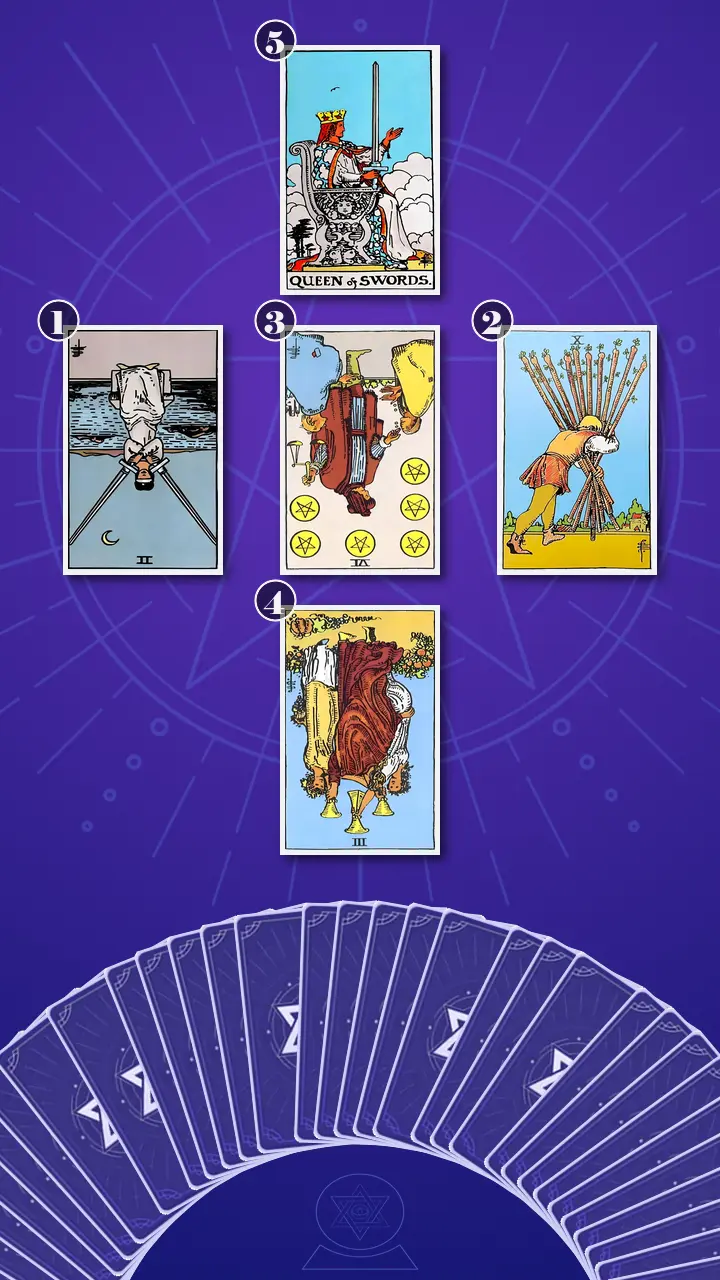
The Cards That Counted the Hidden Cost
Position 1: The Private No Behind the Public Yes
Now I turned over the card representing Jordan's current stance: the automatic acceptance behaviour and the gap between wanting to step back and publicly saying yes. It was the Two of Swords, reversed.
The blindfolded figure held two blades across the chest as if protecting against a conflict that had not yet occurred. Reversed, that defensive pose no longer looked stable. I read it as blocked Air: thought was present, but it could not move into honest language. Jordan already knew they did not want the new task. The overload came from rehearsing every possible interpretation of a refusal until the known answer was pushed aside.
"This is your 10:47 p.m. moment," I said. "You can see the overloaded calendar. Your throat has already tightened. But you hold the phone between the request and the evidence, and the wording of the reply suddenly feels more urgent than deciding whether you consent."
I gave voice to the loop I could see: "I already know I do not want to, but if I pause they might think I am difficult. If I say no, they might decide I was never committed. Other people are replying with hearts, so perhaps I should just handle it."
Jordan gave one short laugh, but there was no amusement in it. "That is so accurate it feels a little brutal."
"Accurate does not have to mean condemning," I replied. "The card is identifying the mechanism, not sentencing you for having one. Answering quickly gives you a few minutes of social safety. It also prevents accurate self-expression, so the future correction becomes larger."
I asked what they would have answered about the signage pickup if no explanation or group reaction had been required. Their fingers stopped rubbing the edge of the phone.
"No," they said. Then, more quietly, "I would have said no immediately."
That answer mattered. The reversed Two of Swords was not asking Jordan to reject every remaining duty in one frustrated message. It was showing that automatic agreement was not neutral. The private decision was already becoming clear; the missing step was a pause long enough to let that decision reach the chat.
Position 2: The Second Project Nobody Scoped
Now I turned over the card representing the observable wedding-party context: the accumulating requests, expanding role, and practical expectations that could be seen without guessing anyone's motives. It was the Ten of Wands, upright.
The figure bent beneath ten bundled staffs, carrying so much that the destination was barely visible. I read this as Fire in excess. Jordan's willingness to act had been used so repeatedly that action itself had become an obstructive load.
I asked Jordan to name only what had been added since they first agreed to join the wedding party. They counted vendor follow-ups, signage collection, group reminders, two purchases, a spreadsheet, transit across the city, and a Saturday supply pickup. They had also been answering wedding messages over lunch and after paid work.
No single duty sounded impossible. Together, they functioned as a second project layered on top of Jordan's actual job. It had the multiplying-task logic of The Sorcerer's Apprentice: each small job appeared manageable, but the system kept producing work because nothing interrupted it.
"The useful question is not whether you could technically squeeze in one more task," I said. "It is what the total load is already costing. What disappears when this gets added?"
Jordan looked away from the camera and named the displaced pieces one by one: brunch, a workout, an afternoon with another friend, part of their discretionary budget, and the quiet Saturday morning they had expected to spend alone.
Their posture changed as they spoke. The bundle became visible in their body: chin slightly forward, shoulders still raised, breathing contained high in the chest. What had been described in the group chat as a collection of quick favours was being carried as wedding-party burnout.
"I keep telling myself it is faster to handle it than explain why I cannot," they said.
"Faster for the next ten minutes," I answered. "More expensive for the next ten days."
Position 3: The Capacity Dashboard With Missing Data
Now I returned to the centre and turned over the card representing the current exchange: how Jordan's immediate agreements and the continuing requests combined to distribute time, money, labour, and responsibility. It was the Six of Pentacles, reversed.
On the card, one figure held scales while coins fell from the other hand. Reversed, I read its Earth energy as imbalanced measurement. The card did not tell me that anyone was deliberately exploiting Jordan. It asked a simpler, more useful question: what information was the current exchange using to decide who had capacity?
Jordan completed tasks efficiently and answered requests with visible ease. The group could see the check marks, receipts, reminders, and upbeat messages. It could not see skipped lunches, transit time, cancelled plans, reduced spending money, or the recovery needed after another week of deadlines.
"Every completed task is being mistaken for available capacity," I said. "This exchange is like a project dashboard that marks every deliverable green while hiding the overtime, the cancelled Saturday, and the team member who has not eaten lunch."
Jordan's eyes moved from the card to the banking app on their phone. They opened it, then switched to the calendar. I watched the project coordinator in them begin to recognise the missing metrics.
"They can only measure what I show them," they said. "And I keep showing them that this is fine."
"Exactly. That does not make the other people villains, and it does not make your generosity fake. It means the available data is inaccurate."
I asked Jordan to estimate the time and cost of the next seven days of wedding tasks. Their first total was low. They had forgotten travel time, a purchase they had not been reimbursed for, and the work break they would lose to a vendor call. When those went into the calculation, they became still.
The point was not to turn friendship into a debt ledger or demand exact repayment for every favour. The scales offered a first point of movement: make the practical distribution visible enough to renegotiate. One reliable duty could remain Jordan's. Another could be clarified or reassigned. Measurement was not pettiness; it was the ground on which freely chosen generosity could stand.
Position 4: The Toast That Felt Like an Entrance Exam
Now I turned over the card representing the primary challenge: the fear that setting a limit could threaten belonging or make Jordan appear insufficiently caring. It was the Three of Cups, reversed.
The familiar image showed three figures raising cups inside a close celebratory circle. Reversed, I read the Water energy as contracted around belonging. Friendship and celebration were still real, but Jordan had begun experiencing visible group enthusiasm as a standard they had to match.
I asked them to imagine another request arriving beneath a wedding photo, a string of heart reactions, and messages full of exclamation marks. I saw recognition before they spoke: their breath paused, their thumb pressed into the side of the phone, and their gaze slipped toward the dark kitchen window as if replaying an earlier exchange.
"If everyone else sounds excited and I hesitate, maybe I am the problem," they said. "I do not actually think they would kick me out of the wedding. I think I am afraid I would become the difficult one. The person people discuss in another chat."
There it was. The errand was practical, but the force behind the yes was relational. Jordan was not only avoiding a task refusal. They were trying to avoid the imagined experience of standing outside the toast.
"This card does not predict that anyone will reject you," I said. "It shows that you have been organising your behaviour around that possibility as though it were confirmed. Genuine belonging and belonging performed through constant availability are not the same thing."
Jordan's hand loosened around the phone. Their expression held recognition and grief at once. The pattern had protected them from short moments of social exposure, but it had also made the celebration feel less like friendship and more like an ongoing test.
"Resentment often grows where the public yes keeps concealing the private limit," I said. "It is difficult to feel warmly included while privately carrying work that nobody knows you want to reduce."
Jordan nodded once. "I have been trying to prove I belong in the wedding instead of letting myself belong as a person with limits."
When the Queen Raised One Sword
Position 5: Warmth in One Hand, a Limit in the Other
The dishwasher stopped. Its mechanical hum had filled Jordan's kitchen for most of the reading, and the sudden quiet made the room seem larger. My coffee had gone cool beside the spread as I turned over the card representing the constructive direction: a communication posture that could align Jordan's commitments with actual capacity while preserving warmth.
It was the Queen of Swords, upright.
She held one sword vertically, not two crossed defensively over her body. Her gaze was unobstructed. Her other hand remained open. I read this as restored, balanced Air: a single decision made communicable without punishment, withdrawal, or an argument designed to force agreement.
Seeing her, I thought of the cleanest project scopes I had encountered over twenty years of listening to people describe the clutter of their lives. A good scope does not insult the person making the request. It says what is included, what is not included, and what can be delivered reliably. Fairness is easier to feel when it has a structure.
I used my Analysis Paralysis Deconstruction here. I asked Jordan to strip away every abstract "what if" and work only with grounded reality: the request, the hours available, the likely cost, the personal plan that would move, and the contribution they still wanted to make. "They might think I am selfish" was a fear worth acknowledging, but it was not verified capacity data.
Then I applied Complexity Reduction. Beneath all the imagined reactions, the practical choice was clean: "I can reliably own this" or "I do not have capacity for this." Jordan did not need to decide whether they were a good friend in the same message. They only needed to answer one request accurately.
I asked Jordan to return to the exact scene at 10:47 p.m.: the phone lighting up, the throat tightening, the crowded calendar already open, and the cheerful yes somehow reaching the group before their actual limit had been allowed to speak.
You do not have to keep proving care through overcommitment; name the help you can genuinely give, with the Queen's open hand and upright sword holding warmth and limit together.
I let the sentence settle, then gave Jordan its plainest form: A boundary does not reduce your care; it stops your yes from overstating your capacity.
Jordan's breathing stopped first. Their fingers remained suspended above the phone, no longer scrolling, while their eyes lost focus as if several weeks of group-chat messages were replaying behind them. Then their mouth tightened. "But does that mean I have been doing this wrong the whole time?" they asked, with a sudden flash of anger that sounded partly directed at themselves.
"No," I said. "It means the immediate yes was a strategy. It bought relief when hesitation felt dangerous. We are not rewriting your past help as a mistake. We are noticing that the strategy now costs more than it protects."
The anger softened before the tension fully left. Jordan blinked several times; their eyes shone, and one shoulder lowered before the other. Their fist opened against the counter. A breath came out with a small, unsteady laugh, followed by the faintly dizzy silence that can arrive when a burden is set down and the person realises they must now choose what to do with their free hands.
"Now, using this new perspective, can you think of a moment last week when this insight might have made you feel different?" I asked.
Jordan returned to Thursday's office kitchenette. They had been updating a wedding purchase spreadsheet while lunch cooled beside the laptop and fluorescent lights buzzed overhead. They had told themselves it was easier to do the work than explain why they could not.
"I could have said I was already at capacity," they told me. "Not because I was angry. Just because it was true."
"That is the crossing this card offers," I said. "Not from caring to refusing, and not from fear to perfect certainty. It is a first step from anticipatory guilt and automatic overcommitment toward bounded, compassionate confidence. A warm no is not a withdrawal of care."
I angled the Queen toward the camera again. Her sword supplied precision; her open hand kept the relationship in the frame. Tarot had not decided what Jordan must do. It had made the decision mechanics visible enough for Jordan to author their next response.
The Coffee Bean Filter for a Wedding Scope Reset
I drew the five cards into one practical story. Blocked Air in the reversed Two of Swords had made Jordan act before deciding. Excess Fire in the Ten of Wands had converted that automatic agreement into an accumulating workload. Imbalanced Earth in the reversed Six of Pentacles showed that the exchange was being measured with missing data. Contracted Water in the reversed Three of Cups revealed why Jordan kept consenting: a limit felt like a risk to belonging. The Queen restored Air by turning a private limit into precise, compassionate language.
The temporary favour had become an unwritten job description because Jordan had left the edit button untouched. The central blind spot was not simply "I have too much to do." It was giving imagined reactions more authority than the calendar, budget, body, and plans already providing hard evidence. Jordan had been treating every hypothetical disappointment as fixed while treating every personal commitment as movable.
The shift was therefore specific: no more immediate decisions inside the emotional weather of the group chat. Jordan would pause, check capacity, and choose one defined yes or one clear no. Care could be reliable without being unlimited.
For the next request, I adapted my Coffee Bean Filter Protocol into two small actions. The name comes from the simple work of filtering: keeping what belongs in the decision while allowing emotional static to be noticed without letting it determine the answer.
- Run the 24-Hour Coffee Bean FilterWhen the next wedding request arrives, send only: "Let me check my calendar and budget, and I will get back to you tomorrow." During the next 24 hours, write the decision variables on separate notes and physically sort them into two cups or piles. "Absolute Must-Haves" includes available hours, likely cost, paid-work deadlines, rest, existing plans, and duties you have already chosen. "Emotional Noise" includes unverified predictions such as "They will think I do not care" or "Everyone else can handle this easily." Finish by checking three facts: time, cost, and the personal plan that would be displaced.Emotional Noise does not mean the feelings are unimportant. It means they are not confirmed facts. If 24 hours feels too exposing, start with a 20-minute timer and keep the final answer in drafts.
- Send the Queen's Care-Capacity-Decision MessageChoose one real duty this week and take no more than 10 minutes to draft three lines: "I care about being part of this. I can reliably own X. I cannot take on Y, so it will need another plan." Read the message aloud once and remove repeated apologies, long defences, or replacement offers that quietly reopen the declined task. Send it privately to a trusted person if the group chat feels too exposing.After sending, mute the wedding chat for one hour and return to a personal plan already on the calendar. The recipient may have feelings; Jordan does not have to manage every reaction by abandoning the stated limit.
Neither action required Jordan to resign from the wedding party, confront the group dramatically, or decide the entire friendship at once. The aim was smaller and more honest: introduce accurate information into one exchange. One pause. One scope check. One contribution freely kept. One added duty clearly declined.

A Week Later: The Quiet Proof of One Honest Answer
A week later, Jordan sent me a screenshot. Another request had arrived for a last-minute pickup. This time, their first message was not "Happy to!" It was the saved holding reply: "Let me check my calendar and budget, and I will confirm tomorrow."
They used two coffee mugs for the filter. In one, they placed notes for the work deadline, transit time, cost, Saturday brunch, and the wedding duty they had already agreed to keep. In the other went the imagined second group chat, the fear of looking uncommitted, and the belief that a good friend should never be inconvenient.
The following morning, Jordan sent three sentences. They named the wedding task they could continue owning and declined the pickup. The reply came back: "No worries, we will reassign it. Thanks for letting us know."
Jordan kept the brunch reservation. They slept through the night, although their first waking thought was still, "What if they are annoyed?" This time, they smiled at the thought, checked no messages, and made coffee.
I did not read that ordinary response as proof that every boundary would always be received easily. I read Jordan's action as the real evidence. They had allowed discomfort to exist without converting it into another commitment. Their confidence remained cautious, but their participation was finally becoming warmer because it no longer had to conceal the same amount of resentment.
That was the quiet result of our Journey to Clarity. The cards did not give Jordan control over other people's interpretations. They helped Jordan stop surrendering control over the information they contributed to the relationship. The Queen offered an image; Jordan supplied the pause, the words, and the decision.
When your throat tightens over another request but your reply still says "happy to," you may be carrying both the fear of losing your place and the weight of a role nobody knows you want to reduce. Merely noticing that split means your honest answer is no longer completely hidden.
If your care did not need to be proved through unlimited availability, what answer might you let through the Coffee Bean Filter next time, with the Queen's open hand preserving the warmth and her upright sword preserving the limit?