One Full Bin, One Unsent Rota, and a Two-Week Household Trial

The 10:45 p.m. Bin and the Unsent Rota
You ask everyone separately what would feel fair, collect four different answers, and quietly shelve the group conversation when they do not align. I have come to recognize that pattern as decision fatigue disguised as preparation.
Jordan, a 29-year-old non-binary customer support coordinator, described the moment with painful precision. At 10:45 p.m. on a Tuesday, they were standing in the kitchen of the rented Toronto home they shared with their mother, grandmother, and younger sibling. The fluorescent light buzzed above a full bin. Their phone felt warm in their hand, the sink smelled faintly of detergent, and a colour-coded chore rota filled the screen.
They changed two assignments after imagining how each person might object. Then they closed the document, carried the bin outside alone, and felt their shoulders drop for about a minute.
“I keep thinking one more revision will make the conversation easier,” Jordan told me across my table. Coffee steamed between us while rain tracked down the window. “It feels faster to do the chore myself, but I am tired of being the default. We keep discussing the mess without deciding what happens next.”
Their problem was not a lack of effort. They wanted a household routine three generations could live with, one that respected different work hours, study blocks, rest, mobility, and standards. Yet every attempt to protect those differences became another reason to delay the conversation. They wanted shared responsibility, but they were trying to secure conflict-free approval before allowing anyone to see the plan.
The feeling in their body was apprehension made physical: as if they were carrying a full bin by one thin plastic tie while balancing four open calendars across their shoulders. Speaking might split the bag. Postponing let them put it down, briefly, but only after they had carried it alone again.
“I do not think you are failing at basic chores,” I said. “I think you have been asking private planning to perform a group decision. We are not going to use tarot to predict whether everyone will agree. We are going to use it as an objective mirror, so we can tidy up the pattern, find the part that belongs to you, and identify one next step you remain free to take, change, or decline.”

Choosing a Ladder, Not a Verdict
I invited Jordan to take one slow breath and hold one question in mind: “Why do I keep delaying a household routine everyone can live with?” I shuffled while they focused. The brief pause was not a mystical performance; it was a transition from the noisy details of the kitchen into a more structured view of the problem.
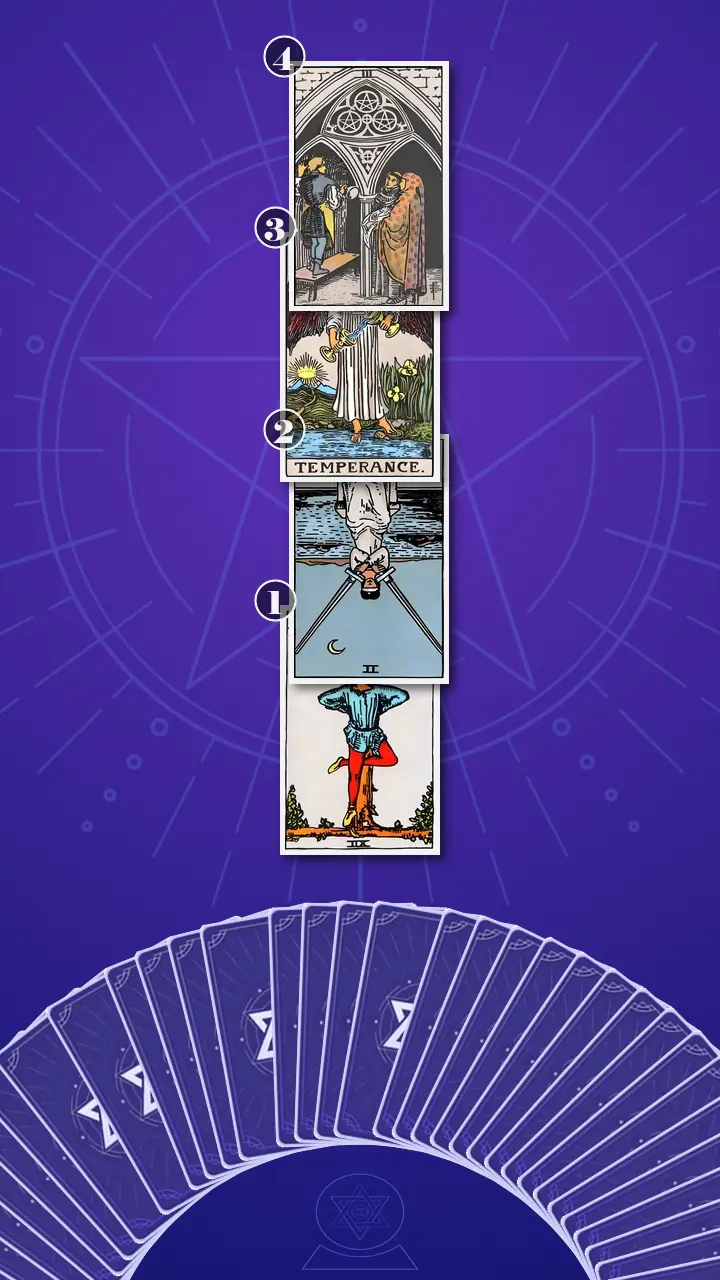
I chose the Four-Layer Insight Ladder · Context Edition, arranging four cards in a vertical column and reading upward. This spread suited the question because Jordan was not choosing between two clearly defined rotas, asking me to decide who was right, or seeking a prediction. They were caught inside a self-reinforcing system: anticipated disagreement led to private redesign, redesign postponed feedback, and the absence of feedback made the routine seem even harder to propose.
This is how tarot works in my practice. Each position gives one part of a complicated experience an external image, allowing us to examine card meanings in context without treating them as fate. The bottom card would show Jordan's observable behaviour. The second would reveal the psychological mechanism maintaining it. The third would identify the leverage point, and the fourth would ground that shift in a practical, collaborative action.
I told Jordan to picture the layout as a short staircase. We did not need to solve the whole household from the bottom step. We only needed enough footing to see what the next step actually was.
Reading the Permanent Draft
Position One: The Pause That Stopped Helping
I turned over the card representing the diagnosis-level behaviour: repeatedly revising the household routine, postponing the conversation, and handling chores reactively. It was The Hanged Man, reversed.
In the Rider-Waite-Smith image, the figure's head is illuminated while the body remains suspended. Jordan already understood the household problem. They had compared schedules, gathered preferences, and produced several thoughtful drafts. The missing ingredient was not one more insight. It was a date on which anyone else could respond.
In Jordan's life, The Hanged Man reversed was the 10:45 p.m. scene almost frame for frame: opening the same colour-coded rota, adjusting assignments around objections nobody had made in the room, closing the file, and taking out the bin alone. The card's reflective energy had become blocked. Awareness was abundant, but movement was deficient. Sacrifice had also tipped into excess, because Jordan kept compensating for the stalled process by doing more of the physical work.
I reached for a diagnostic lens I call Daily Clutter Deconstruction. I never use physical disorder as evidence of a person's character. I read it as a map of unresolved signals. The full bin represented the urgent task. The warm phone represented invisible coordination. The buzzing light represented the sensory cost of making decisions when Jordan was already tired. The missing calendar invitation represented ownership that had never become explicit.
“The clutter is not telling me you need to try harder,” I said. “It is showing me that one household problem has split into two jobs: doing the chore and privately carrying the decision about how everyone should do it. Tonight's solo fix is not the same thing as a shared routine.”
Jordan let out a short, bitter laugh. “That is so accurate it feels a little cruel.”
I kept my voice level. “Then let us be precise about what feels cruel. The card is not accusing you. It is showing that a strategy which once protected you from an uncomfortable conversation is now charging more energy than it returns. When did the pause last produce genuinely new information?”
Their thumb rubbed the rim of the mug, stopped, and pressed flat against the ceramic. “Honestly? Weeks ago. I am mostly changing things because I can imagine someone hating them.”
Position Two: Every Calendar Tab Open at Once
I turned over the card for the root mechanism beneath the delay: Jordan's attempt to prevent disagreement by resolving every household preference before discussion. It was the Two of Swords, reversed.
The blindfolded figure and evenly crossed swords offered a visual model of Jordan's private calculation. They asked each household member separately what would feel fair, stored each answer as a possible veto, and tried to hold every schedule at equal weight. Meanwhile, the household group chat accumulated thumbs-up reactions to missed bins and dishes but no meeting time, named owner, or review date.
The card's air energy was in excess. Thought had become over-pressurized, like keeping every Google Calendar layer and every browser tab open until the device froze. Decision energy was blocked because choosing one testable proposal felt, to Jordan, like betraying every alternative they had not chosen.
I gave the underlying monologue words: I am not waiting for more information; I am trying to prevent anyone from being disappointed.
Jordan's jaw tightened. Their eyes moved away from the card and settled on the rain-dark window. I watched the idea travel through three small reactions: their breath paused, their gaze lost focus as if replaying old kitchen conversations, and then their grip on the mug loosened by a fraction.
“If someone says the plan is unfair,” they said, “I immediately hear, 'You handled this badly.' I know those are not technically the same sentence. They just feel like the same sentence at home.”
“That distinction matters,” I said. “A draft is not a verdict on belonging. Another person can reject a timing, a task, or a definition of 'done' without rejecting your place in the home. I cannot promise that disagreement will feel easy or that every dynamic will cooperate. I can say that privately predicting disagreement has not protected you from its emotional cost. It has simply made you carry that cost before anyone else enters the conversation.”
For a moment, I remembered a cafe where I used to read on Thursday evenings. Four friends could agree that a table needed clearing and still leave the cups behind because nobody had named who would carry what. The problem was not a lack of care; it was undefined ownership. Looking at the crossed swords, I thought the same thing now: goodwill cannot complete a task that remains structurally invisible.
I drew a small line on Jordan's notepad. On one side, I wrote three examples of fixed constraints: work or study windows, mobility limits, and a task tied to a specific day. On the other, I wrote adjustable after evidence.
“Are you waiting for agreement,” I asked, “or waiting to avoid the first visible disagreement?”
Jordan exhaled through their nose. “The second one. I do not need everyone to love the routine, but I act as if I do.”
I nodded. “Then fair enough to test beats perfect enough to postpone. Do not make private rehearsal carry a group decision.”
When Temperance Turned the Rota into a Beta Test
Position Three: Different Needs Moving Between Two Cups
A streetcar bell sounded once beyond the wet window and then the room settled. I turned over the card representing the key shift from advance consensus on a permanent system to a bounded, revisable trial. It was Temperance, upright, the bridge card of the reading.
The figure pours water between two cups, with one foot on land and one in water. I translated those cups into Jordan's real household: separate calendars, energy levels, mobility needs, and definitions of fair contribution. Temperance does not force different contents to become identical. Its energy is balanced and available because information is allowed to circulate until a workable proportion emerges.
In ordinary life, this card looked like Jordan bringing three fixed constraints and one imperfect draft to a 20-minute kitchen-table conversation. Everything else could be labelled adjustable. The proposal would cover two weeks, not forever, and it would include a review date so that direct feedback could shape the next version.
I paused over the card and ran what I call an Energy Extraction Audit. Three micro-habits were repeatedly over-extracting Jordan's baseline energy: reopening the rota after each imagined objection, gathering preferences through separate side conversations, and completing the urgent chore alone. Each habit delivered immediate relief, but the return was delayed anxiety. The same problem came back the following week with less energy available to address it.
“That is why you can feel exhausted even though the household meeting has not happened,” I said. “You have already rehearsed several versions of it and then paid for tonight's workaround. Temperance is not asking for another burst of motivation. In fact, there is no Wands card in this spread. The missing resource is not more fire or willpower. It is circulation, followed by structure.”
Jordan was still treating the 10:45 p.m. moment as a demand for a correct final answer: phone warm, fluorescent light buzzing, rota revised twice, shoulders dropping only after the solo bin run. Their mind kept calling postponement relief, even though the same bill came due each week.
The answer is not a flawless rota everyone approves in advance; it is a workable trial that lets different needs move between Temperance's two cups.
I let the sentence remain between us without immediately explaining it away.
For one beat, Jordan stopped breathing. Their fingers stayed curved around the mug, but the grip went still. Their eyes widened, then slipped past the card toward the rain on the window as if the Sunday group chat were replaying there: the reminder about the bins, the reaction emojis, the half-written message, the quick decision to do it alone. Colour rose along their cheeks. “But does that mean I have been doing all of this wrong?” they asked, sharper than before. “All those drafts, all that work?” I heard anger first, then hurt beneath it. “No,” I said. “It means the work was protective, and it has reached its limit. You were trying to secure belonging before exposing a need. That was understandable. It is also no longer giving you the control it promised.” Their fist loosened, one finger at a time. Their shoulders dropped, but the release left a brief, unsteady blankness on their face, the look that comes when clarity returns responsibility to the person who can act. Their next breath came out with a slight tremor.
“Now, with this new perspective, think back to last week,” I said. “Was there a moment when this insight could have changed how the situation felt?”
“Sunday,” Jordan said quietly. “When everyone reacted to the message and nobody proposed a time. I thought I needed a better rota before replying. I could have asked for a conversation instead. I would not have needed to solve it in the chat.”
I asked them to picture a more modest scene, not as a prediction but as a possible design. One household member points to an assignment on a printed draft. Another names a schedule constraint. Nobody is defending an imagined version because everyone is finally reacting to the same object. The inner sentence changes from I must get this right before they see it to We are finally giving the same draft real information.
That was the emotional crossing in the reading: from apprehensive stagnation and private over-planning toward cautious relief and practical trust. The relief was not certainty that nobody would object. It was the recognition that an objection could become information about timing, scope, capacity, or standards instead of automatic proof that Jordan had failed.
Position Four: The Plan Becomes a Household Object
I turned over the final card, representing the concrete next step: a short household meeting, one visible two-week rota, distributed responsibilities, and an agreed review date. It was the Three of Pentacles, upright.
Three people stand beneath an arch, looking at the same architectural plan. In Jordan's life, this was not another polished Notion template or private Google Sheet. It was one shared object on the kitchen table, with the people carrying the routine able to inspect and edit it together.
The card's earth energy was balanced and available. Temperance had allowed needs to circulate; the Three of Pentacles gave that exchange a material form. The household could name who was taking each task, when it would happen, what “finished” meant, and what alternative applied if that person could not do it. A review date would keep the plan adjustable without returning it to endless draft mode.
I compared it to a very small collaborative project: one shared brief, clear owners, a humane definition of done, and a scheduled review. I was careful not to turn a home into a workplace. The point was not performance monitoring. It was shared visibility, consent, and distributed authorship. Jordan could initiate the process, but they did not have to become its permanent administrator.
“The plan gets fairer when it becomes reviewable,” I said. “Fairness is not you correctly predicting every person's needs in private. It is each person having a chance to name real constraints and help shape what happens next.”
Jordan leaned forward for the first time that afternoon and turned their phone face up beside the cards. Their eyebrows lifted with a small, uncertain smile. “That sounds less like me pitching a system and more like us editing one.”
“Exactly,” I said. “You are offering a starting point, not issuing a permanent rule. You control the clarity of your invitation. You do not control whether everyone accepts it, and the cards do not pretend otherwise.”
From Private Rehearsal to a Shared First Draft
I looked at the four cards as one continuous account. Repeated solo fixes had taught Jordan's body that postponement bought immediate calm. The Hanged Man reversed showed that this useful pause had become suspension. The Two of Swords reversed revealed why: Jordan was keeping every household calendar tab open in their head, treating preferences as vetoes and disagreement as a threat to competence or belonging. Temperance redirected that congested thought into an exchange of actual constraints. The Three of Pentacles grounded the exchange in one visible plan that could be used, reviewed, and changed.
Jordan's cognitive blind spot was the belief that fairness had to exist before participation. In reality, their private draft could only model fairness according to imagined responses. The plan would become fairer through transparent participation, consent, direct evidence, and revision.
The transformation was therefore specific: move from waiting for advance approval of a permanent household routine to offering a 20-minute conversation about a two-week trial. This did not guarantee agreement. It did return the right-sized part of the problem to Jordan's control: what they proposed, how clearly they framed it, how small they kept it, and whether the setting felt safe enough to proceed.
The Three-Constraint Chore Reset
I gave Jordan three possible actions and asked them to choose the smallest one that felt honest. The actions were not tests of courage. They were ways to gather better information without asking another private draft to carry the entire household.
- Create a 15-minute physical anchor.Within the next 48 hours, reorganize one small surface Jordan could change without touching anyone else's belongings, such as a corner of their desk or an agreed strip of the fridge. They would place one card there reading: “Three fixed constraints; everything else adjustable.” The physical boundary would give the decision a visible edge and reclaim a little mental bandwidth.Set a timer and stop at 15 minutes. The goal is not to clean the kitchen or build a new productivity system; it is to create one calm, finite place from which to make the next decision.
- Write three constraints and one scheduling message.At that surface, Jordan would open a blank note titled “Two-Week Household Trial,” spend no more than 10 minutes naming three fixed constraints, and label every other detail adjustable. They could then draft: “Could we take 20 minutes this week to test one household routine for two weeks? I can do Wednesday at 7:00 or Saturday at 11:00. If neither works, please send one time that does.”When another exception appears, place it under “adjustable” instead of rebuilding the rota. If sending feels too exposed, Jordan can save the message, edit it later, choose a smaller step, or pause. A proposal is not a demand.
- Build one visible two-week trial together.If the household agrees to meet and the conversation feels safe, Jordan would bring one draft to a 20-minute discussion. The first trial would cover only repeated pressure points, such as bins and dishes. For each task, the group could record an owner, timing, what “done” means, and an agreed alternative if capacity changes, then place the result in one accessible format and schedule a review two weeks later.Keep the group chat focused on booking the conversation. If neither proposed time works, request one alternative. During the meeting, let feedback change the trial instead of interpreting a requested change as proof that the process failed.
Jordan chose the 15-minute physical anchor and the unsent-message draft. They did not promise me they would hold the meeting, and I did not ask for that promise. Their agency mattered more than a tidy ending. The meaningful change was that they could now distinguish a protective pause from permanent postponement and a shared invitation from an imposed rule.

Six Days Later: A Review Date Instead of a Verdict
Six days later, Jordan wrote: “Message sent. Saturday at eleven. Bins and dishes only. I slept through the night, but my first thought was still, What if this goes badly? I smiled, opened one draft instead of four, and let the review date hold the unknown.”
I read that as a first piece of evidence, not a solved life. The kitchen had not transformed into a finished system, and the household had not become perfectly harmonious. Jordan had simply stopped requiring certainty before allowing shared information to enter the room.
That was the quiet proof of our Journey to Clarity. The cards did not clean the kitchen, secure the meeting, or make the decision for Jordan. They separated the observable habit from the fear beneath it, revealed an unused form of flexibility, and helped Jordan choose a proportionate action. Tarot supplied the map; Jordan remained the person deciding whether, when, and how to climb.
If your kitchen is quiet tonight only because you carried the bin out again, I hope you notice both truths in the drop of your shoulders: the relief is real, and so is the fear that asking for shared structure could unsettle your place at home. Seeing both means you are no longer standing at the bottom of the ladder.
If one imperfect household plan could sit between Temperance's two cups for only two weeks, without becoming a verdict on anyone's belonging, what is the smallest shared task you feel curious enough to place on the table?