Why Days Off Become Recovery: From Shutdown Toward Cautious Aliveness

The Saturday That Was Already Monday
If you are a late-twenties hybrid worker who logs off on Friday already calculating how little energy you can afford to spend before Monday, you may recognize the Saturday I saw with Maya. I recognized the pattern before she finished explaining it: the weekend recovery loop, where time off becomes a repair bay instead of a place to feel alive.
Maya sat across from me in my Toronto studio at 11:40 on a Saturday morning, still carrying the shape of her condo sofa in her shoulders. She had three unanswered messages about afternoon plans, a delivery app open on her phone, and Monday's client calendar waiting behind another tab. Pale winter light slipped around the blinds; the radiator clicked in the quiet; her phone felt warm in her palm. She had slept late, yet her eyes stung whenever she considered getting up.
“Why do I spend my days off recovering instead of living?” she asked. “I want plans until the plan actually arrives. Then I cancel brunch, stay on the couch, and scroll for the same amount of time anyway. My weekend has turned into maintenance.”
I heard the contradiction clearly: she wanted her days off to feel like a life, but she also needed those same hours to recover enough to remain functional at work the following week. Her exhaustion had the texture of wet sand packed into her limbs, while guilt kept tapping at the glass whenever she saw friends' Instagram Stories from markets, hikes, or rooftop drinks. I told her, “I am not here to convince you that genuine rest is a failure. Let us look at what kind of rest is actually reaching you, and draw a map through the fog together.”

Choosing a Compass for a Closed Circuit
I invited Maya to put both feet on the floor, take one unhurried breath, and name the question again without trying to solve it. Then I shuffled slowly. The small pause was not a supernatural test; it was a way to move attention from the open calendar and the imagined Monday into the room we were sharing.
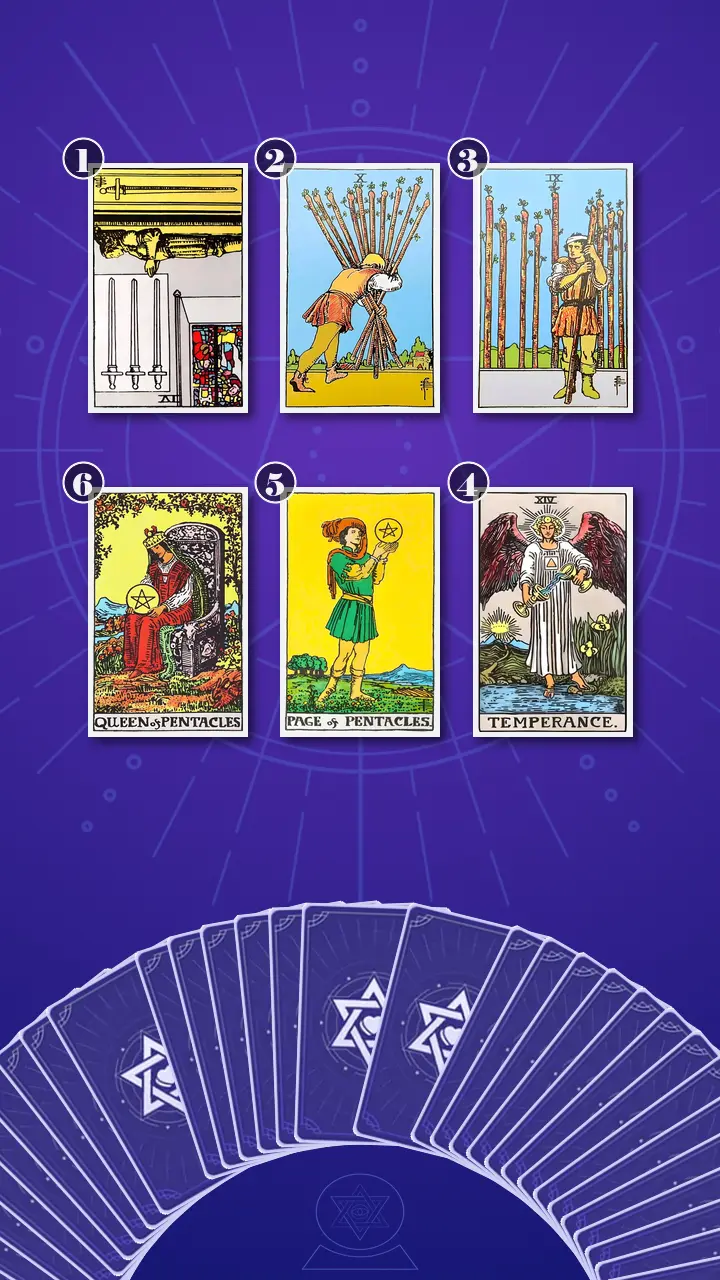
For anyone wondering how tarot works in a situation like this, I chose the Transformation Path Grid: Context Edition, a six-card tarot spread for a feedback loop rather than a prediction. Maya was not facing one isolated decision. Work depletion led to shutdown, shutdown brought immediate relief, the empty hours brought frustration and comparison, and Sunday night restarted the same pressure. A Past-Present-Future spread would make that system too linear, while a Celtic Cross would give us more information than this question needed. The six-card grid let me separate the visible symptom, structural blockage, protective root, catalyst, experiment, and sustainable integration.
I explained the switchback path before laying down the cards. The upper row would show the observable shutdown, the accumulated burden, and the survival stance beneath it. I would then drop to the lower-right card for the leverage point, move through a small practical experiment, and finish with the integrated pattern Maya could build over time. The cards could give us a clear cognitive tool and a language for reflection, but Maya would decide what fit her actual capacity. The reading would never outrank her body, her finances, her work circumstances, or her own judgment.
The Body Logged Off, the Mind Stayed at Work
The Four of Swords Reversed: The Phone-Warm Pause
I began with the card whose role was to surface the observable form of Maya's Stagnation Lock: sleeping late, scrolling, cancelling plans, and remaining inactive without feeling restored. Now I turned over the Four of Swords, in reversed position.
In the traditional image, a recumbent figure lies beneath three suspended swords. I saw the same distinction in Maya's 11:40 Saturday: her body was horizontal beneath the duvet, but her attention moved between short-form videos, the delivery app, unanswered invitations, and Monday's Outlook calendar. The reversed Air was not a lack of rest in the simple sense. It was blocked disengagement. Her body had stopped moving while her mind remained in a low-level meeting, like the uneasy Severance feeling of leaving the workplace physically while the inner control room keeps running.
I said, “Your body logged off; your attention did not.” The inactivity gave her an hour of relief from demands, but passive stimulation and repeated capacity calculations did not let her nervous system settle into a clean pause. More hours in bed could therefore reproduce the symptom without creating genuine restoration. I asked what work tab, notification, or Monday thought usually stayed open behind the day she called rest.
Maya gave a short, bitter laugh. “That is too accurate. Almost rude.” Her fingers tightened around the phone, then loosened as she looked down at the card. I told her I was not using the image to shame her scrolling. I was separating physical shutdown from psychological recovery so she could stop treating a failed method as a personal failure. She rubbed the rim of her mug and nodded, though the nod carried recognition more than agreement.
The Ten of Wands: Friday's Bundle Arrives Home
I moved to position two, whose role was to identify the immediate structural blockage: accumulated work demands and depleted PTO that made every day off function as emergency recovery. I turned over the Ten of Wands, in upright position.
The figure in the card bends beneath a bundle so large that the road ahead is almost invisible. I translated those wands into the late client messages, shifting deadlines, emotional labour, postponed groceries, laundry, meal preparation, friendship guilt, Monday preparation, and the nearly empty leave balance Maya carried off the Line 1 train on Friday evening. By the time the train brakes shrieked into the station, Saturday had already been assigned the job of unloading everything.
“The weekend problem starts before the weekend,” I said. “You are not choosing between rest and fun with a full tank. You are choosing what gets the last ten percent of you.” The load was both practical and financial. Toronto living costs made unpaid time off unrealistic, and isolated PTO days had been spent after difficult stretches simply to become employable again by Monday. I wanted the reading to validate that reality before asking Maya to change anything about her personal time.
Her shoulders rose as though she had just lifted the bundle from the card into her own arms. Then she exhaled through her nose and said, “I keep assuming the weekend is where I am supposed to catch up, but there is never enough of me left to do that.” I asked her to distinguish what was genuinely fixed from what she had continued carrying by habit. Her gaze moved toward the window, and the tightness around her mouth softened when the burden was named as accumulated structure instead of lack of imagination.
The Nine of Wands: An Empty Calendar Can Still Be a Guard Post
For position three, I needed to reveal the psychological root of Survival Mode: the guarded belief that energy must be conserved because another demand was always approaching. I turned over the Nine of Wands, in upright position.
The bandaged figure in the card is not resting after the struggle. The figure is watching, braced behind a wall of wands, ready for the next impact. I connected it to the Saturday after Maya cancelled brunch. Relief loosened her jaw when she sent the message, but she still checked the group chat to see whether anyone was annoyed. She kept Teams notifications within reach and monitored Monday as though it were already approaching through the condo door.
“An empty calendar can still be a guard post,” I said. “The same rule that protects you from another demand may also keep gentle pleasure outside the perimeter.” I asked, “If you spend energy on something you want, what exactly do you fear will happen when work asks for energy you no longer have?”
Maya went still first. Her breath paused, and her thumb hovered above the phone. Then her eyes lost focus as if she were replaying several cancelled Saturdays at once: the invitation, the quick relief, the hours of scrolling, and the Sunday-night heaviness. Finally, a small catch moved through her chest and left as a long exhale. “I think I am protecting myself from Monday,” she said, “but I am also protecting myself from having to find out whether anything still feels good.”
I did not call the rule irrational. It had probably helped her survive intense work stretches. I named its current cost instead: safety had become indistinguishable from zero demands, and freedom had started to look like a threat to capacity. The weekend was not empty because Maya had no desires. It was guarded because her internal forecast treated every desire as a possible future liability.
When Temperance Opened the Second Cup
I paused before reaching for the lower-right card. Outside, a thin branch moved across the pale light, and the radiator stopped clicking for a moment. The room seemed to make space around the next image.
Temperance: The Leverage Point Between Collapse and Performance
I told Maya that position four would locate the leverage point capable of interrupting the recovery-only loop by integrating rest with one manageable form of living. I turned over Temperance, in upright position.
In the card, water moves steadily between two cups, while one foot stands on land and the other rests in water. I translated that into a quiet morning for sleep, food, and a shower, followed by one nearby, time-limited experience before returning home. The balance was not a packed itinerary disguised as self-care, and it was not a demand to become energetic on command. It was responsive pacing: actual capacity deciding the proportion.
I brought in my signature lens, Micro-Cycle Energy Mapping. I do not ask someone to estimate one fixed battery percentage for an entire weekend. I help them observe the natural peaks and troughs across a day and a week, then place different kinds of effort where there is the least friction. I asked Maya to track whether her first hour after waking, late morning, or afternoon offered even a small opening for interest, without forcing an opening that was not there. The map was a way to notice her orbit, not a new performance dashboard.
I also named Rest Phase Legitimacy, another part of my practice. An unproductive recovery phase can be completely legitimate. A quiet morning does not need to produce a better version of Maya in order to deserve space. The useful question was whether the pause actually restored or merely kept her horizontal while work and stimulation continued to drain the background battery.
The Rule Beneath the Duvet
At 11:40 on Saturday, Maya was still under the duvet, her phone warm from scrolling, Monday's calendar open behind three unanswered invitations. She kept waiting for enough energy to begin living, while treating every possible experience as a withdrawal from the energy she might need later.
Your days off are not failed workdays or emergency recovery wards; choose a measured blend of rest and aliveness, like Temperance pouring steadily between two cups.
I let the sentence remain in the room. Then I gave her the shorter version I wanted her to carry into the next Saturday.
You do not have to finish recovering before you are allowed to live. A day off can hold one measured act of aliveness and still leave room for real rest.
The words did not soothe her immediately. Her fingers froze around the mug, her breath caught, and her pupils seemed to widen as the familiar rule met a different possibility. Her gaze drifted past me toward the window; I could almost see her replaying the Sunday evenings when she had guarded every scrap of energy and still felt neither restored nor free. Her jaw set. “But does that mean I have been doing it wrong?” she asked, with a flash of anger that sounded close to grief.
I did not rush to make the anger positive. I said, “It means the strategy made sense under pressure, and it may no longer be giving you what it promised. You are allowed to test that without putting your job, your money, or your recovery at risk.” Her shoulders lowered by a fraction. The hand gripping the mug opened one finger at a time. Her eyes grew bright, and her next breath arrived shaky but deeper, followed by a quiet, almost disbelieving laugh. The relief carried a brief dizziness too, the blankness that can follow a rule losing its authority. She was not suddenly certain. She was facing the responsibility of choosing a proportion for herself, and that was both lighter and more vulnerable.
I asked, “Now, use this new perspective to remember last week. Was there one moment when a small act of aliveness could have existed beside rest, instead of waiting for a full recovery that never arrived?”
I named the shift carefully: this was the first movement from numb, guilt-heavy weekend shutdown toward cautious aliveness and grounded ownership of personal time. It was not a promise that a café walk would erase workload or cure exhaustion. It was a change in the decision rule, from predicted collapse to measured self-trust.
The Page-Sized Exit Route
The Page of Pentacles: One Data Point, Not a Perfect Weekend
Position five would translate Temperance into one low-demand, observable experiment that Maya could attempt without turning leisure into another performance task. I turned over the Page of Pentacles, in upright position.
The Page studies one pentacle closely while an open field and distant mountain remain available in the background. I connected the image to a 20-minute coffee on a park bench, one library browse, or one aisle of a neighbourhood market. The single object mattered. Maya did not need a full reset-weekend list containing errands, exercise, meal prep, social plans, and an aspirational Sunday routine. She needed one small experience that could be started and exited easily.
“Collect one data point, not a perfect weekend,” I told her. “Notice what happens before, during, and after. Interest, strain, neutrality, or uncertainty are all information. None of them is a grade.” I watched her take out her phone and open Notes rather than Instagram. Her shoulders stayed cautious, but her thumb began making a short list: coffee downstairs, library, voice note to a friend. For the first time that morning, the screen seemed to hold a choice instead of a demand.
The Queen of Pentacles: A Life That Can Hold the Change
Position six would describe the integration potential: stewarding workload, PTO, home routines, rest, and pleasure as connected finite resources. I turned over the Queen of Pentacles, in upright position.
I read her as grounded care rather than indulgence. The Queen holds the pentacle securely inside a flourishing garden, suggesting that resources are protected within a living environment instead of being hoarded exclusively for emergency work recovery. For Maya, integration could look like muting a nonessential notification during one protected hour where her role allowed it, reviewing annual leave before a crisis stretch, simplifying one Sunday chore, and keeping one low-energy source of ordinary pleasure available.
I emphasized that this was not a demand to optimize her whole life. A repeatable structure might be as modest as a recurring grocery pickup, a two-load laundry limit, one prepared meal, or a flexible invitation with an easy exit. I asked her which small condition would make both rest and connection easier to access next month. She looked at the Queen's garden, then at the three options in her Notes app, and said, “Maybe I need to stop making work the automatic first claimant on every usable hour.”
A Day Off That Can Hold Two Truths
I drew the six cards into one story for Maya. The reversed Four of Swords showed the symptom: her body paused while her attention stayed clocked in. The Ten of Wands showed why the weekend arrived already spent, carrying client demands, chores, emotional labour, money limits, and depleted PTO. The Nine of Wands showed how that external burden had become an internal guard post, where cancellation brought immediate relief but kept pleasure outside. Temperance opened the hinge, and the Page and Queen of Pentacles gave the hinge a practical future. The charging station had never filled the battery because it was still running work apps in the background while calling itself rest.
The blind spot I named was the belief that inactivity automatically equals recovery and that safety requires giving every remaining unit of capacity to Monday. That belief made pleasure look like an energy expense and made an empty calendar look neutral when it was actually defensive. The transformation direction was simpler and more humane: protect genuine rest, choose one small act of aliveness early enough to be felt, and use what happens as information rather than proof of worth.
I told Maya that this was the point where the cards had to become her decisions. The six-card grid could reveal the system, but it could not choose her Saturday. For the next week, I offered my Lunar Routine Sync, a one-week experiment that adjusted daily output expectations according to her observed energy tide. Its purpose was to remove guilt from low-energy days, not to turn her weekend into another productivity project.
The Lunar Routine Sync: Practical Next Steps
I wrote the following actionable advice beside the cards. Each step was deliberately small, time-limited, and easy to stop.
- Protect Rest and AlivenessFor one week, on Friday evening, place two blocks on one day off: a protected rest window and a 10- to 20-minute Aliveness Anchor. Within ten minutes of waking on Saturday or Sunday, write one present need and one mildly appealing option before opening Outlook, Teams, or Monday's calendar.Keep the experiment responsive. If naming an option creates strain, noticing that capacity is enough. Give the anchor a clear exit time, and let rest remain protected afterward.
- Run a Page-Size Weekend ExperimentCreate a three-option low-energy menu in Notes: one at-home option, one outside option within a ten-minute walk, and one brief connection option. On one day off, choose only one, set a 10- to 30-minute timer, and record three words under Before, During, and After.You are collecting one data point, not proving that you know how to have a perfect weekend. Put on your shoes, step outside, and turn back whenever you need to. Stopping is information, not failure.
- Make One Grounded Stewardship ChangeAt 5:50 p.m. on the final workday, where role expectations allow, set a clear Teams or Slack status and write Monday's first task on paper. Spend ten minutes reviewing the next eight weeks of PTO without submitting anything, then choose one Sunday friction reducer such as a grocery pickup, a two-load laundry limit, or one prepared meal.Separate what you control from what requires workplace negotiation, and make only one change. The goal is to protect finite time, money, energy, and home capacity, not to build a complete life-optimization system.
Maya read the list twice. “The plan is almost annoyingly small,” she said. I told her that small was the point. A tarot reading should return choice to the person asking, not replace one demanding authority with another. She could adjust the ratio, skip the experiment, or choose a different low-cost activity. The clarity was not in obeying Temperance. It was in seeing that she had options.

A Week Later, the Quiet Proof
A week later, Maya texted me from a café near her building: she had stayed for twenty minutes, come home before it became a demand, and slept well. On Monday, she still thought, “What if I got it wrong?” She smiled, because the question no longer made the choice for her.
Her Before-During-After note read: Before: heavy and braced. During: neutral, then curious. After: still tired, but more present. Nothing about the workload had magically disappeared. Her PTO balance had not changed, and she still had laundry waiting in the bedroom. But the day off had contained recovery and one manageable expression of personal choice, which gave her actual evidence to use the following weekend.
I saw the beginning of grounded ownership there. The cards had not predicted a better life or granted Maya a new supply of energy. They had helped her distinguish a real low tide from a rule that kept the tide permanently in charge. She was still moving through a cycle, but she was no longer treating every cycle as a verdict or every pause as a failure.
When Sunday evening arrives and your shoulders tighten over undone laundry and Monday's calendar, the hardest part may not be that you rested. It may be realizing that you guarded every scrap of energy for work and still never felt safely off. If your next day off did not require full recovery first, what tiny, time-limited thing might you choose before returning to rest, perhaps in the second cup of your own Temperance blend?