Delaying the Main Task, Working Late: One Start and a Protected Break
The 9:40 p.m. Procrastination-to-Overwork Loop
At 9:40 p.m. on a Tuesday, I watched Alex drag the same deliverable between “Urgent,” “This Week,” and “Blocked” on the project board glowing behind our video call. They had already answered two low-stakes Teams messages, reformatted a status tracker, and searched “why do I procrastinate when I feel overwhelmed” while the file due the next morning remained untouched in another tab.
The kitchen table in their rented London flat had disappeared beneath chargers, sticky notes, cold tea, and three open work files. I could hear the laptop fan humming and the kettle clicking off. Alex still held their phone; its screen had been on long enough to warm their palm. Their shoulders sat close to their ears, and their jaw tightened each time a notification flashed.
“I keep planning the work instead of touching the work,” they said. “Then I realise how late it is, delete the break from my calendar, and work until I feel sick of the whole thing. A break feels irresponsible when the list is still growing.”
I told them what I could already see: “You are not doing nothing; you are doing everything around the one task that would actually change the pressure.”
The urgency in the room felt like an accelerator held to the floor while the fuel light glowed red. Underneath it, I heard guilt, frustration, and the resentment of someone who kept losing their evenings to work they had spent all day trying to approach.
“I’m not going to use tarot to tell you whether you are disciplined enough or predict whether every deadline will be met,” I said. “I want us to separate the real workload from the rules that have formed around it. Let’s make a map of this deadline fog and find the smallest place where you still have room to choose.”
Choosing the Switchback Through Deadline Anxiety
I asked Alex to put their phone face down and take one ordinary breath before naming the question again. I shuffled slowly, not to make the moment mystical, but to give their attention a clean transition away from Teams, task columns, and tomorrow morning.
I chose a six-card Transformation Path Grid · Context Edition. This is how tarot works in my practice: the cards provide an external structure for examining a pattern that feels too crowded when it stays inside the mind. They do not issue a verdict. They help me place behaviours, beliefs, constraints, and available choices where both of us can inspect them.
I selected this spread because Alex was not dealing with one isolated obstacle. They were caught in a self-reinforcing procrastination-to-overwork cycle. A difficult start led to task switching; task switching increased deadline pressure; deadline pressure removed recovery; depleted attention made the next difficult start even harder. A simple past-present-future line would have flattened that system, while a Celtic Cross would have introduced more context than this focused question needed.
I laid the cards in a two-row switchback. The first three would show the visible behaviour, the blocked recovery, and the restrictive belief underneath both. The fourth would mark the leverage point. The final two would translate that insight into a practical next action and a sustainable form of integration. The layout would take us to the edge of the current pattern, turn at the catalyst, and return by a more workable route.
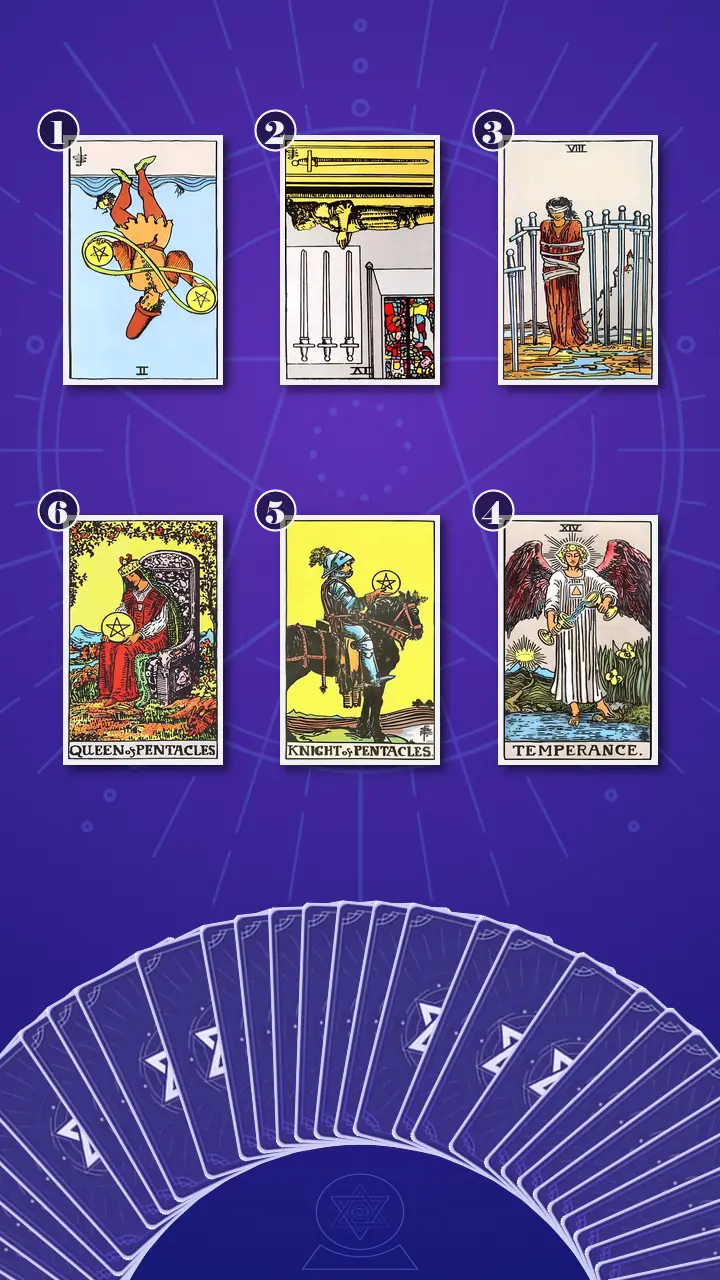
Reading the Crowded Side of the Map
Position One: Motion Without a Decision
“The card now turning over represents the observable current-state behaviour: switching among tasks and losing a stable priority while deadlines accumulate,” I said.
I revealed the Two of Pentacles, reversed.
In the Rider-Waite-Smith image, two pentacles are held inside an infinity-shaped loop while ships rise and fall behind an already unsteady figure. Reversed, the adaptive energy of the card has tipped into excess. Too many demands are being kept in motion, while the capacity to choose one next action has become deficient.
I pointed towards Alex’s open project board. At 9:40 p.m., two work files and that board were still active while the same deliverable travelled between three priority columns. The system was moving, but no decision had landed. It had become less like a map and more like an infinite scroll: every drag promised a cleaner answer, and every drag postponed contact with the file carrying the real consequence.
“When you see several deadlines competing for the same evening, what do you touch first?” I asked. “The important task, the easy task, or the newest notification?”
Alex gave a short laugh, but there was no amusement in it. “That is uncomfortably specific. I call it prioritising, but mostly I am moving the panic into different boxes.”
I let the honesty sit without turning it into an accusation. “The card is not calling you lazy. It is showing displacement: small, finishable actions temporarily reduce the discomfort of the larger start. The useful question is no longer, ‘How do I keep everything airborne?’ It is, ‘Which one responsibility needs a place to land?’”
Position Two: The Break That Keeps Receiving Messages
“The card now turning over represents recovery avoidance as the immediate blockage,” I said. “It shows what keeps deadline pressure active even after you physically step away from work.”
I revealed the Four of Swords, reversed.
The resting figure could not remain symbolically at rest. Reversed, the card’s recuperative energy was blocked: the body might leave the desk, but attention stayed on call. The three swords suspended above the figure resembled the unfinished tasks Alex kept mentally hanging over every attempted pause.
I brought the image back to their kitchen. At 9:55 p.m., Alex might close the laptop and step away, yet leave Teams notifications active. A buzz would arrive before their breathing had settled. They would return to check whether it affected tomorrow’s deadline, and a calendar break would end without creating any real separation from the queue.
“The inner sentence sounds something like this,” I said. “I am technically taking a break, but I am still on call to every unfinished task.”
Alex’s breath caught first. Their thumb hovered over the phone as if an alert had appeared, although the screen was dark. Then their gaze slipped past me towards the closed kitchen door, replaying a familiar interruption. Finally, they put the phone on the table and slowly released their jaw.
“I check every break,” they said. “Even in the shower, I’m thinking about what might have come in.”
“A break feels irresponsible when the queue has become your proof of control,” I replied. “But I want to distinguish expectation from evidence. Does a protected pause actually cause the delay, or does the fear of delay prevent the pause before you can observe what it does to your attention?”
I was careful not to pretend that workplace pressure was imaginary. Alex had real deadlines, colleagues with dependencies, and practical reasons to care about performance. The card was not asking them to ignore those conditions. It was showing how continuous availability could keep the air element overactive, so neither work nor rest received a clear channel.
Position Three: The Rule Hidden Inside the Deadline
“The card now turning over represents the belief underneath the cycle,” I said. “It asks which limit is externally required and which limit is being maintained by the current rule about unfinished work.”
I revealed the Eight of Swords, upright.
The figure wore a blindfold and loose bindings, surrounded by swords that created real discomfort but not a complete wall. I focused on the visible gap. The card’s mental energy had narrowed into blockage: Alex could see only two options, clear the entire backlog tonight or lose control, while the smaller route between those extremes remained difficult to recognise.
In modern terms, the task-management app seemed to offer only two buttons: finish everything or fail. Faced with three deliverables across two days, Alex scanned every consequence, reopened messages, and tried to select the perfect starting point. The deadline facts were real swords. The binding was the conclusion that no rest could be legitimate until all of them disappeared.
“But some of those deadlines genuinely cannot move,” Alex said, their fingers tightening around the edge of the table.
“Yes,” I said. “Clarity should not erase material reality. The opening in this card is not ‘stop caring’ or ‘assume everything will be fine.’ It is the option to complete one limited step, take one bounded pause, and then reassess with more information. The blind spot is treating the rule ‘I cannot rest until the queue is clear’ as if it were written into every deadline itself.”
Their fingers loosened, then tightened once more. I could see the idea reaching them before it felt comfortable. Naming an internal rule can create room, but it can also expose how long that rule has been quietly organising a life.
When Temperance Changed the Terms
Position Four: Two Cups, One Deadline Plan
The radiator clicked once and settled. The room became quiet enough for me to hear the kettle’s last thread of steam. I turned the card at the point where the switchback changed direction.
“The card now turning over represents the leverage point that can interrupt procrastination and skipped rest by integrating bounded work with bounded recovery,” I said.
I revealed Temperance, upright, the key card of the reading.
Water moved continuously between two cups. One foot rested on land and the other in water. Nothing in the image suggested passivity; its power came from measured exchange. Here the energy was balanced: focused effort and restoration remained distinct, but neither had to defeat the other before movement could begin.
I slowed the reading down. At 9:40 p.m., with three files open and the calendar break disappearing, the unfinished queue had become louder than Alex’s tired body. One more message felt safer than choosing a difficult first step, and any pause looked like evidence that control had already been lost.
I used a lens I call Syllabus Deconstruction. I take a deadline that has swollen into a judgement about someone’s competence and strip it down until only mechanical, emotionally neutral actions remain. “Finish the presentation” became “open the deck, draft the opening slide, and check three source links.” Temperance then added the part most productivity systems omit: the next unit of work would be paired with a defined recovery interval rather than used to bargain recovery away.
As I watched the water pass between the cups, my mind flashed to the coffee shops where I had spent years listening to people untangle their lives. I had watched busy counters reset between orders. The pause was part of preparing the next cup; it was not evidence that service had failed.
You do not have to empty the entire queue before you are allowed to pause; pair one focused work block with one protected recovery block, like Temperance moving water between two cups.
For a moment, Alex did not move. Their breath stopped midway in, and their eyes widened slightly before dropping to the card. Then their gaze lost focus. I could see them replaying late nights when they had deleted dinner, a walk, or sleep from the plan and still spent the first hour reorganising tasks. Their eyebrows drew together as the recognition sharpened into resistance. “But doesn’t that mean I’ve been doing it wrong this whole time?” they asked, their voice suddenly louder. The anger arrived before relief, protecting the part of them that had survived by making urgency useful. Then their voice thinned. “I’ve lost so many evenings to catching up.” Their shoulders lowered by a fraction. Their hands, clenched beneath the table, opened against their knees. A long breath left their chest, but the release carried a slight tremor, as if the new room around the problem also contained the responsibility to choose differently.
“No,” I said. “It means urgency became a strategy when you needed one. It has sometimes helped you deliver, which is why the pattern survived. We are looking honestly at its current cost, not rewriting your past as a failure.”
I leaned closer to the camera. “Now, using this new perspective, think back to last week. Was there a moment when this insight might have made you feel different?”
Alex looked towards the cold tea. “Thursday. I had forty minutes before a call. I decided forty minutes was useless because I couldn’t finish the deck, so I answered messages instead. If I’d drafted one slide and taken five minutes away from the screen, I think I would’ve entered the call feeling less trapped.”
“That is the crossing,” I said. “Not from a full queue to an empty one, and not from procrastination to perfect discipline. It is one step from compressed deadline urgency, guilt, and reactive task switching towards a sustainable rhythm that integrates focused effort with protected recovery.”
I asked Alex to picture a small Wednesday experiment: write “draft the opening slide” on paper, close unrelated tabs, work for fifteen minutes, put the phone face down, and take a notification-free five-minute pause. The deliverable would not magically be complete. The purpose was to observe a new rhythm, not prove that a timer could solve an entire workload.
“Rest is not the reward for an empty queue,” I said. “It is part of the plan that lets you meet a non-empty one.”
Giving One Task a Place to Land
Position Five: The Steady Builder
“The card now turning over represents the practical response to the deadline pile-up: define one small next action, work steadily, and stop at a planned boundary,” I said.
I revealed the Knight of Pentacles, upright.
The horse stood still. The Knight held one pentacle carefully at eye level rather than charging across the cultivated fields. The card’s Earth energy was balanced and available: patient attention could now replace the emergency flare Alex had been using as a substitute for initiation.
I translated the image into a normal work evening. Before opening the task board again, Alex would choose the deck due tomorrow, write “check three source links” as the next physical action, and set a realistic stopping point. They would work on that action for the agreed interval without reopening the entire priority system. Progress would be measured by a repeatable start, not by how late they could remain online.
“The goal is not to keep every task airborne,” I said. “It is to give one task a place to land.”
Alex nodded once, then frowned. “Fifteen minutes still sounds almost offensively small when I’m behind.”
“That reaction makes sense,” I said. “Urgency wants a rescue plan big enough to erase the whole problem. The Knight offers a well-scoped project ticket instead: one acceptance criterion, one interval, one planned stop. If fifteen minutes feels too exposed, use five. Small is not a claim that the workload is small; it is a way to make the entrance visible.”
Position Six: The Environment That Stops Spending You
“The card now turning over represents the integrated learning available through continued practice,” I said. “It shows deadlines, attention, workspace, and recovery being managed as interconnected practical resources.”
I revealed the Queen of Pentacles, upright.
The Queen cradled one pentacle inside a cultivated garden. I placed her image beside the reversed juggler from the first position. Both cards concerned material responsibilities, but the relationship had changed. The first kept every demand airborne through continuous effort. The Queen held one responsibility with support around it.
I used my second diagnostic lens, Study Environment Auditing, even though Alex’s work happened inside decks and project boards rather than textbooks. I asked what the kitchen table communicated before they touched the main task. The answer was immediate: chargers from different devices, old notes, an empty mug, an always-visible phone, open Teams, and a task board full of red labels. Each object was small, but together they quietly spent psychological bandwidth before the real work began.
The Queen’s modern-life scenario was not an immaculate home office or a permanently empty inbox. I pictured Alex planning deadlines beside meals, short breaks, and an end-of-work boundary, then giving one responsibility full attention. The kitchen table could still become a desk, and the queue could remain open, but their energy would no longer be treated as an unlimited emergency fund.
This upright Earth energy represented practical stewardship, not a guaranteed outcome. “You can be responsible for the work without making your attention expendable,” I said. “That is a capacity you cultivate through structure. It is not a personality trait the cards either grant or withhold.”
Alex looked at the six-card path and touched the edge of Temperance. “So the answer isn’t that I need more motivation.”
“That is what I notice too,” I said. “There are no Wands in this spread. I do not read that as a defect or a prediction. I read it as a useful correction: the problem is not an absence of ambition. The missing piece is a container that can settle mental pressure, include recovery, and turn intention into one manageable material action.”
The One-Task Landing Method
I gathered the spread into one clear account. Repeated late-night catch-up sessions had taught Alex that frightening urgency was the engine that finally produced action. In the present, the Two of Pentacles reversed showed that the task system was creating motion without commitment. The Four of Swords reversed showed the immediate blockage: no pause lasted long enough to restore attention. The Eight of Swords revealed the internal conflict beneath both, where real deadlines became fused with the rule that rest was unsafe until the whole queue disappeared.
Temperance offered the potential resource: coordination instead of competition. The Knight translated that principle into a defined task unit and stopping point. The Queen expanded it into an environment where time, food, attention, sleep, and recovery counted as real resources. Alex had been pressing the accelerator while refusing to refuel, then interpreting the slowing engine as proof that more pressure was needed.
I named the cognitive blind spot directly. Alex had been equating constant motion, instant availability, and cancelled breaks with control. Yet those behaviours were making it harder to choose. The transformation direction was not towards a flawless routine or heroic catch-up marathon. It was towards one clearly defined fifteen-minute task start followed by a protected, time-bounded break, repeated often enough to build evidence that work and recovery could belong to the same deadline plan.
“But I can absolutely turn cleaning the table into another form of avoidance,” Alex said when I introduced the next steps.
“Then the boundary matters more than the tidiness,” I replied. “The reset stays physical, limited, and slightly imperfect. No redesigning Notion, no colour-coding the project board, and no attempt to create the ideal workspace. The ritual serves the first action; it does not replace it.”
- Run the Desktop Reset and land one task. At the kitchen table before opening Slack or Teams, set a maximum fifteen-minute timer for the Desktop Reset Ritual. Clear dishes and unrelated notes, close nonessential tabs, put the phone face down, and leave one sheet of paper beside the laptop. In the final two minutes, choose the deliverable with the nearest meaningful consequence and use Syllabus Deconstruction to write one observable action, such as “draft the opening slide” or “check three source links.” When the reset timer ends, begin that action for fifteen minutes without reopening the full task system. Tip: If fifteen minutes of clearing could become avoidance, use a three-minute version. Visual order only needs to be sufficient, not impressive.
- Protect the second Temperance cup. When the focus timer ends, take a five-minute recovery break away from the kitchen table with work notifications off. Make tea, stand by the window, or walk to the end of the street. Return only when the break timer finishes, then consciously choose whether to start another work interval. Once during the workweek, test a twenty-minute version in Google Calendar and record one neutral observation afterwards, such as “the deadline stayed the same, but I returned with less screen noise.” Tip: If five notification-free minutes feel unsafe, begin with two. Make exceptions only for a genuinely agreed urgent channel, not every unread message.
I reminded Alex that these were experiments, not moral tests. A timer ending did not mean they had to feel restored, and a difficult start did not invalidate the structure. The purpose was to collect usable evidence: whether narrowing the task reduced paralysis, whether protected recovery changed the next focus interval, and whether a planned stopping point reduced the need for a panic-fuelled marathon.

A Week Later, the Queue Was Still There
Six days later, I received a message from Alex just after lunch. They had used the three-minute Desktop Reset before opening Teams, written “check the three source links” on paper, and worked on only that for fifteen minutes. When the timer rang, they made tea with their phone left in the bedroom.
“The deck was still unfinished after the break,” they wrote. “But I went back without spending twenty minutes rearranging the board. I finished the next section before dinner instead of waiting until I was frightened enough to start.”
They slept through the night. Their first thought in the morning was still, “What if I fall behind?” Then, they told me, they smiled at how familiar the sentence sounded and left Thursday’s recovery block on the calendar.
I did not call that a solved life or proof that every future deadline would become easy. I called it the first observable evidence of a different relationship with pressure: discomfort while choosing one limited task, relief after a defined interval and bounded break, and the beginning of trust in a pace that did not require exhaustion.
The cards had not completed the deck, silenced Teams, or handed Alex control from somewhere outside them. They had helped us make the loop visible. Alex created the change by choosing one action, protecting one pause, and treating the results as information rather than a verdict.
Ownership, Not an Empty Queue
When the kitchen table is covered in open files and your jaw is locked, stopping can feel like surrendering control, even though trying to keep everything airborne is what leaves you least able to choose. If you recognise that silent pull between the task carrying the real consequence and all the safer work around it, noticing the loop already gives you a place to interrupt it.
If one focused block and one protected Temperance cup could belong to the same deadline plan, what would you quietly want that first small interval to feel like?