Reopening the Laptop at 5:30—Then Taking the Walk Before Another Tab

When 5:30 Becomes a Waiting Room
"You close one browser tab, notice another unfinished deliverable, and bargain with yourself about the perfect evening that will finally arrive after the next deadline," I said. "That is career burnout anxiety meeting an all-or-nothing plan in real time."
Jordan, a 28-year-old content strategist in Toronto, had joined my video call from their apartment kitchen at 7:15 on a Wednesday. A productivity podcast sat paused beside a saved book and an unanswered message. The kettle clicked off, cold screen light pooled across the counter, and their phone vibrated against the wood.
"I keep telling myself I can do something for me after I get through today," Jordan said. "But work never feels finished. Why do I keep saving my real life for after work?"
They showed me the Notes page where that real life had been stored: a writing class, two books, a walk by the lake, a museum visit, and the names of three friends they meant to text. Almost every entry had been moved to the weekend at least once. When the weekend arrived, errands and accumulated exhaustion took over.
What I heard was not laziness or a lack of interests. It was resignation with the weight of a rain-soaked winter coat: heavy limbs, shoulders still lifted after clocking out, and a jaw quietly holding every unfinished task. Guilt said pleasure had to be earned. Longing watched other people's dinners and gallery trips through Instagram Stories. Resentment whispered that everybody else had somehow received instructions for having a life alongside a demanding job.
"You want your real life to begin," I said, "but you have also learned to treat work as the gatekeeper that decides when it is allowed to begin. We are not going to use tarot to predict whether you will escape that pattern. We are going to use it as a clear reflection tool and map the rule keeping the pattern in place."
I asked the question that would guide our journey to clarity: "What if the waiting is not a scheduling problem, but a rule about when your life is allowed to count?"

Choosing Four Rungs Out of the Office
I invited Jordan to put both feet on the floor, take one slow breath, and notice where the unfinished day was still sitting in their body. I shuffled while they held the question in mind. The pause was a focusing cue, not a mystical test they had to pass.
I chose the Four-Layer Insight Ladder · Context Edition, a custom four-card tarot spread for work-life boundaries and deferred living. For anyone wondering how tarot works in a consultation like this, I use the spread as a structured sequence of questions. Card meanings in context help us separate what is happening, why it keeps happening, what perspective could interrupt it, and which next step is small enough to test in ordinary life.
A broader Celtic Cross could have generated more information, but Jordan did not need ten competing themes. Their question contained one repeating loop. The first position would show the visible after-work routine collapse. The second would reveal the delayed-gratification rule beneath it. The third would offer the transformative perspective, and the fourth would turn that perspective into a bounded experiment.
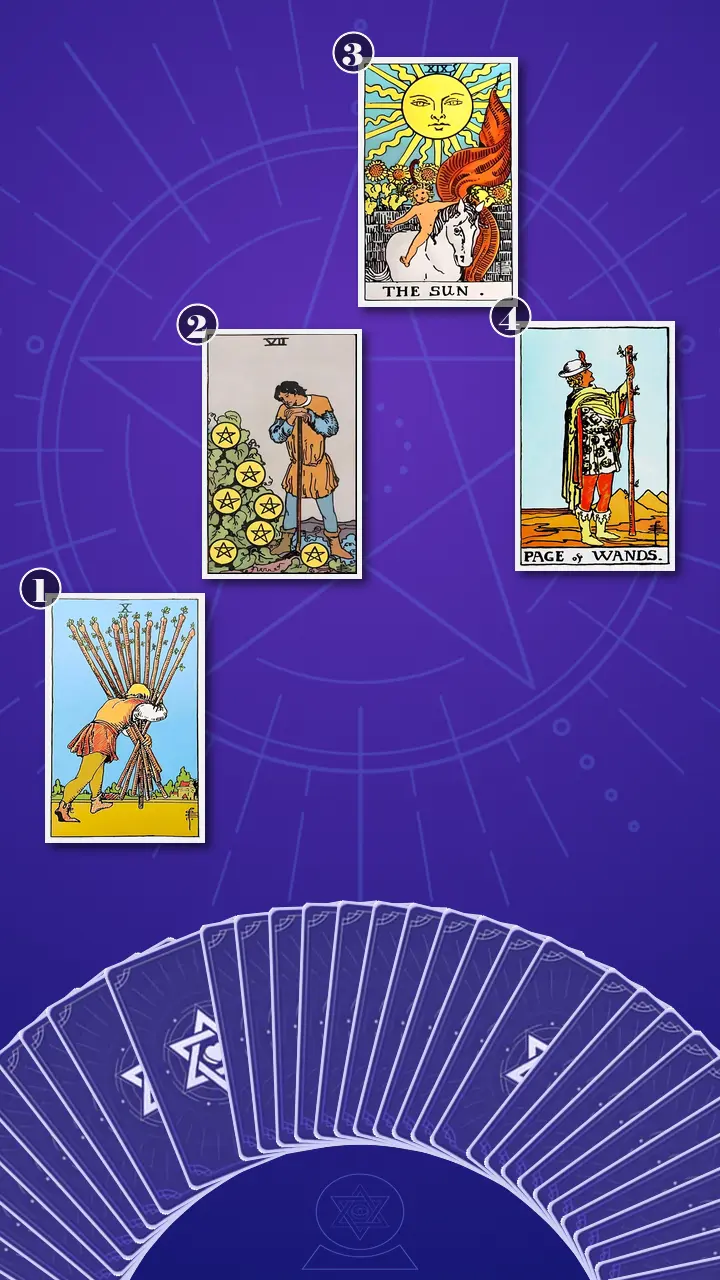
I arranged the cards like a staircase rising from the lower left. The first two occupied the dimmer, diagnostic side of the table. The third stood at the highest point, with the final card just beyond it, bringing the insight back down into daily life.
The Bundle Blocking the Road Home
Position 1: Every Open Tab Carried Into Dinner
"The card opening now represents the presenting condition," I said, "the observable after-work routine collapse: unfinished work entering the evening, personal plans being postponed, and the remaining time dissolving into passive screen use."
I turned over the Ten of Wands, upright.
The figure is bowed beneath ten staffs, and the bundle blocks most of the road toward the distant town. I pointed out that the town matters. The figure is carrying the load toward a destination, but the burden has become so large that it obscures the life the effort was supposed to support.
For Jordan, the card was 5:30 p.m. at the home-office desk. One work tab closed, another unfinished deliverable appeared, and the laptop reopened while the after-work Notes list waited. Every Slack thread, draft, and mental reminder joined the bundle. Dinner, a walk, a friend, or a creative idea became the distant town.
Upright Wands usually carry purpose and movement, but here that fire was in excess. Responsibility had expanded beyond the work boundary until it occupied the whole road. This did not mean work was bad or that Jordan needed to become careless. It meant the amount being carried at once was preventing responsibility from having a clear stopping point.
"Which one task could be deliberately left for tomorrow," I asked, "without treating that decision as proof that you are losing control?"
Jordan gave a short, bitter laugh. Their fingers tightened around the mug before loosening again. "That is so accurate it is almost rude. I always think one open task means I have not really finished anything."
I did not rush to turn that recognition into a positive lesson. "It makes sense that stopping feels unsafe when open work has become your measure of control," I said. "We are not asking you to drop the whole bundle. We are finding out whether every piece has to travel into every remaining hour."
I placed the card at the bottom of the staircase. "You can leave one task open without leaving your whole life outside."
Position 2: The Future Harvest in a Notes App
"The next card represents the underlying mechanism," I said. "It asks how delayed gratification makes work feel like a prerequisite before pleasure, friendship, rest, or creativity is allowed to matter."
I turned over the Seven of Pentacles, upright.
The figure leans on a hoe and studies pentacles growing on a cultivated vine. There is patience in the image, but there is also suspension. All attention is directed toward the future harvest. Nothing in the scene is being enjoyed now.
For Jordan, the vine was the Notes page labelled after work. The writing class, book, walk, museum, and unanswered messages were being stored like a future crop: after this launch, after the next deadline, after the evening is less demanding, after work is finally under control.
The Seven of Pentacles is not inherently negative. Patient investment can be balanced and wise. In this position, however, its energy had hardened into a blockage. Waiting had stopped serving the future and started suspending the present. The after-work list had become a waiting room for the life Jordan kept postponing.
I spoke the inner bargain aloud: "I am investing now, so I will be allowed to live later."
Jordan's breath paused. Their gaze moved away from my camera and settled on the dark laptop beside the kettle, as though they were replaying a long sequence of evenings. Then one shoulder dropped by a fraction.
"The campaign launch," they said. "I keep thinking things will calm down after that. Before the launch, it was the quarterly review. Before that, it was getting through winter."
"And what are you hoping will finally become safe once the harvest arrives?" I asked.
"Stopping," Jordan said after a moment. "Enjoying something without checking whether I should be doing something more useful."
That answer showed me the split at the centre of the reading. Work had become concrete, measurable, and legitimate. Everything that made life feel inhabited had been classified as an optional reward. Jordan was not rejecting their personal life; they were continuously rescheduling its permission.
When The Sun Opened the Curtains Before Inbox Zero
Position 3: The Moment Life Stops Asking to Be Earned
The room seemed to quiet as I reached for the card at the highest point of the spread. Even the laptop fan on Jordan's counter went still.
"This position represents the transformative perspective," I said. "It shows the shift that can return real life to the present instead of reserving it for the imaginary perfect evening after work."
I turned over The Sun, upright.
The RWS image shows a child sitting openly on a white horse beneath a clear sun, holding a red banner in full view. Nothing is hidden, deferred, or being evaluated for productivity. The child participates in the moment before proving mastery over it.
At 5:30 p.m., Jordan closes one work tab, notices another unfinished task, and reopens the laptop while the after-work list sits untouched in Notes. The room is quiet, the screen is bright, and the evening already feels spent. This was the loop I asked them to watch again.
The Sun carried balanced vitality, but that energy had been chronically underused in Jordan's schedule. Their interests were not absent. Access to them was being deferred until the lowest-energy phase of the day, then judged for failing to arrive with enough force.
I used the diagnostic lens I call Macro-Cycle Phase Identification. I mapped Jordan's ordinary weekday as a cycle rather than a moral scorecard: sustained output through meetings and deliverables, a transition at clock-off, an energy low tide, and eventual recovery. A phase is not destiny. It is practical information. Jordan had been assigning every meaningful personal activity to the low tide, then blaming themselves when the tide did not behave like noon.
I followed it with a Systemic Friction Audit. The problem was not simply insufficient hustle. Jordan was asking a depleted nervous system to produce a complete, meaningful evening only after an effectively endless queue of digital work had granted permission. No productivity podcast could remove the structural friction in that equation. The Sun suggested moving one act of life before the next work tab, while energy and choice were still visible.
"If I do not finish everything first, what exactly am I afraid this moment will prove about me?" I asked.
Jordan looked down. "That I do not have control. That maybe I am not as responsible as everyone thinks."
I placed one finger beside the child on the card and gave them the clearest version of the message.
Your life does not become real when the unread messages reach zero. One present-tense act of connection, pleasure, or curiosity can count while work is still unfinished.
Then I let the image carry the insight one step further.
You do not have to earn your life by completing every work task; choose one small act of present-tense aliveness now, like the child standing openly beneath The Sun instead of waiting for permission from the unfinished list.
Jordan's breath stopped first. Their fingertips remained suspended over the rim of the mug, completely still. Then their eyes lost focus, not with confusion but with the unmistakable distance of someone replaying old evidence: declined invitations, five-minute Slack checks that became an hour, walks abandoned because they were too short to count. Their eyebrows drew together.
"But doesn't that mean I have been doing it wrong for years?" they asked. The anger in their voice was brief but real. Beneath it, I heard grief for time they could not retrieve.
"No," I said. "It means a strategy that once gave you a feeling of control now has a cost you can see. Recognition is not a verdict on your past. It gives you more choice in the next repetition."
Their hand lowered. Their jaw shifted as if releasing something held between the teeth. Their shoulders dropped, followed by a long exhale that trembled at the end. Relief arrived, but it was accompanied by a moment of blankness. I could see the new responsibility inside the clarity: if the unfinished list was not the gatekeeper, Jordan would have to decide what mattered without waiting for external permission.
"Now, using this new perspective, can you think of a moment last week when this insight might have made you feel different?" I asked.
Jordan remembered a friend texting at 5:22 on Thursday to ask about a short walk. Jordan had planned to reply after fixing one paragraph, worked until nearly seven, and then decided it was too late. "I could have said I had twenty minutes," they said. "I thought that would not count as a real plan."
As they spoke, they moved their phone farther from their face. Late Toronto daylight reached the counter where blue screen light had been. Nothing was solved yet, but that moment was no longer invisible.
I named the emotional shift carefully. This was not a leap from burnout to a perfectly balanced life. It was one step from resignation, guilt, and future-based waiting toward present-moment vitality and self-permission. Work could remain unfinished without becoming the authority that decided whether the day had contained anything real.
Before moving to the final card, I asked Jordan to pencil in three possible twenty-minute blocks on weekdays, each placed before reopening a work tab. I made the consent boundary explicit: a two-minute version would still count; they could stop, change the activity, or skip it. The experiment was meant to create choice, not become another productivity test.
The Page's Twenty-Minute Beta Test
Position 4: Curiosity Gets a Start and Stop Time
"The final position represents the embodied next step," I said. "It translates the shift into one small, bounded experiment that can interrupt the after-work routine collapse without creating another standard to perform against."
I turned over the Page of Wands, upright.
The Page studies a sprouting wand in an open landscape. I read that attentive gaze as curiosity before certainty. The Page has not mastered a craft, built a new identity, or committed to a flawless routine. The Page has simply made contact with something alive enough to explore.
For Jordan, this was a twenty-minute beta test: writing three lines, walking one nearby block, searching for one class and taking a single registration step, reading five pages, or sending a friend a specific short invitation. The sprouting wand was the first contact with an activity, not proof that Jordan had become a new and improved person.
The Page's upright fire appeared as a balanced, deliberately small response to the excess fire of the Ten of Wands. The first card carried everything. The Page carried one possibility. That difference was the practical wisdom of the spread.
"But some days I genuinely do not have twenty minutes," Jordan said. "If I commute home on Line 1 and the train is delayed, I am done."
"Then the TTC version might be two pages on Libby, one voice note to a friend, or two minutes noticing what you actually need before opening Slack," I said. "Access needs, weather, money, transit, and energy are real conditions. The scale adjusts to your life. The point is not to win at twenty minutes."
I tapped the Page lightly. "Start for curiosity, not proof. A changed mind is information. Stopping on time is part of the experiment. A twenty-minute life claim is still a claim on the day, and a two-minute claim is still real."
Drawing a New Orbit Around the Workday
I drew the four cards together into one coherent story. The repeated influence from previous deadlines had trained Jordan to carry work beyond its boundary, which the Ten of Wands made visible. The Seven of Pentacles explained why that burden had felt respectable: effort now promised permission later. The central conflict was not work versus irresponsibility. It was the desire to live a meaningful present-tense life versus the rule that life must wait until every important task is finished.
The Sun revealed Jordan's underused resource: the ability to participate directly in one ordinary moment without turning it into a reward or an achievement. The Page of Wands reduced that insight to a testable beginning. The spread moved like four steps out of a dim office: burden, justification, illumination, and first experiment.
I identified the cognitive blind spot plainly. Jordan had been treating completion as control. Yet knowledge work continually generates another draft, message, or deliverable, so completion could never reliably provide the permission being asked of it. Their concert ticket stayed in a drawer until the venue was empty.
The transformation direction was equally plain: protect one small present-tense activity before opening another work tab, let it count while work remains unfinished, and collect evidence about the experience without demanding that it solve the whole work-life pattern.
The Orbital Sync Protocol: Seventy-Two Hours Without Forcing a New Life
I translated the reading into my Orbital Sync Protocol, a seventy-two-hour exercise for aligning expectations with Jordan's actual energy cycle. I did not ask them to redesign every evening. For three days, the task was to pause forced action, observe the clock-off low tide, and make one bounded choice before the old work orbit automatically reclaimed the hour.
- Run the 72-Hour Orbital Sync. For the next seventy-two hours, do not build a new routine or force a full evening plan. At the first urge to reopen work after clock-off, write one unfinished task and its exact next action on paper beside the laptop, close the tab, and mute Slack for one bounded block. Start with five minutes if a longer boundary feels unsafe. The pause can end by choice; its purpose is to make the automatic loop visible.
- Make three 20-Minute Life Claims. On three weekdays, before opening another work tab, choose one item already saved in Notes and give it a visible start and stop time in Google Calendar. Walk one nearby block, read five pages, write three lines, or text one friend: "I have twenty minutes Thursday; want to walk or call? Easy no if not." Afterward, record what you did, what your body noticed, and whether it felt different from waiting. A two-minute curiosity start still counts. Keep the end time visible, stop when it arrives, and do not track a streak.
"After the block, you can deliberately return to work, continue the personal activity, or rest," I said. "Name the choice. Do not let a notification make it for you."
The cards had not issued an instruction about quitting, working less, becoming more productive, or choosing a particular lifestyle. They had made a hidden rule visible. Jordan remained the person who could accept, adapt, or reject every next step.

Four Days Later, Before the Next Tab
Four days later, I received a message from Jordan. On Thursday, they had written "revise intro, 9:15 tomorrow" on a piece of paper, closed the laptop, muted Slack, and walked one block while there was still a pale strip of daylight between the Toronto buildings.
The walk lasted seventeen minutes, not twenty. They bought nothing, tracked nothing, and did not turn it into a fitness goal. On the way home, they sent their friend a voice note suggesting a short call the following week. "The draft was still unfinished," Jordan wrote, "but the day did not feel completely gone."
They slept through that night, then woke with the thought, What if I fall behind? This time they noticed it, smiled once, and left the laptop closed until breakfast.
I took that as the quiet proof of our journey to clarity. Jordan had not solved their entire relationship with work. They had interrupted one orbit and discovered that an unfinished task could coexist with a real moment. The spread supplied the map; Jordan supplied the choice.
When the laptop is finally closed but your jaw is still holding the unfinished list, you can want your own life and still fear that choosing it before every task is done will mean losing control. Clarity may not be inbox zero. It may be the moment you notice that old orbit, move one ordinary act into the light, and remember that your life is allowed to be present rather than complete.
If one small present-tense choice could count without proving anything about your productivity, what might you feel curious enough to notice before the next work tab opens?