The 2:18 P.M. Intercom Jolt
I have learned, after years reading cards for high-functioning people with beautifully managed calendars and completely fried nervous systems, that if you’re a late-20s hybrid worker in a small city rental who can present a polished strategy deck at 2 p.m. and then panic at 2:07 because the condo hallway goes quiet outside your door, you already know messy apartment shame.
That was exactly how Maya (name changed for privacy) began with me. She didn’t ask, “How do I get more organized?” She asked, “Why does my messy apartment make me feel so exposed when people are outside?” Then she described a Tuesday in Toronto, 2:18 p.m., work-from-home light still flat and bright across the sink, Slack open, laptop warm under her wrists, nowhere in the apartment for unfinished life to really disappear. The intercom buzzed. Her chair legs scraped the floor. She grabbed the sweater off the clothes chair, shoved a delivery box behind the bedroom door, half-closed the blinds, and kept her breath so high in her throat it was like she was trying not to exist audibly.
She looked at me and said, “I know it’s just clutter, but it feels weirdly personal. It shouldn’t take this much energy to answer the door.”
I knew the feeling she meant. Not abstract embarrassment. Shame with a body. Shame that lands like a courtroom light clicking on behind the sternum. One ordinary room detail, and suddenly home stops feeling like refuge and starts feeling like evidence. It becomes a domestic shame spiral: the dishes are not just dishes, the laundry chair is not just laundry, the Zoom background is not just background clutter anxiety. Everything starts looking like it might testify against you.
I told her gently, “That makes sense. When privacy and shame get tangled together, even a hallway sound can feel like exposure. Let’s make a map for the fog instead of trying to fight it blind.”

Choosing the Compass: A Five-Card Cross for Messy Apartment Shame
I asked Maya to put both feet on the floor and say the question once more while I shuffled. Not for theatre—for focus. I learned long ago, first on ships and later in my consulting room, that the body needs a threshold moment before insight can land. A breath, a pause, a hand on the table: that is often where clarity begins.
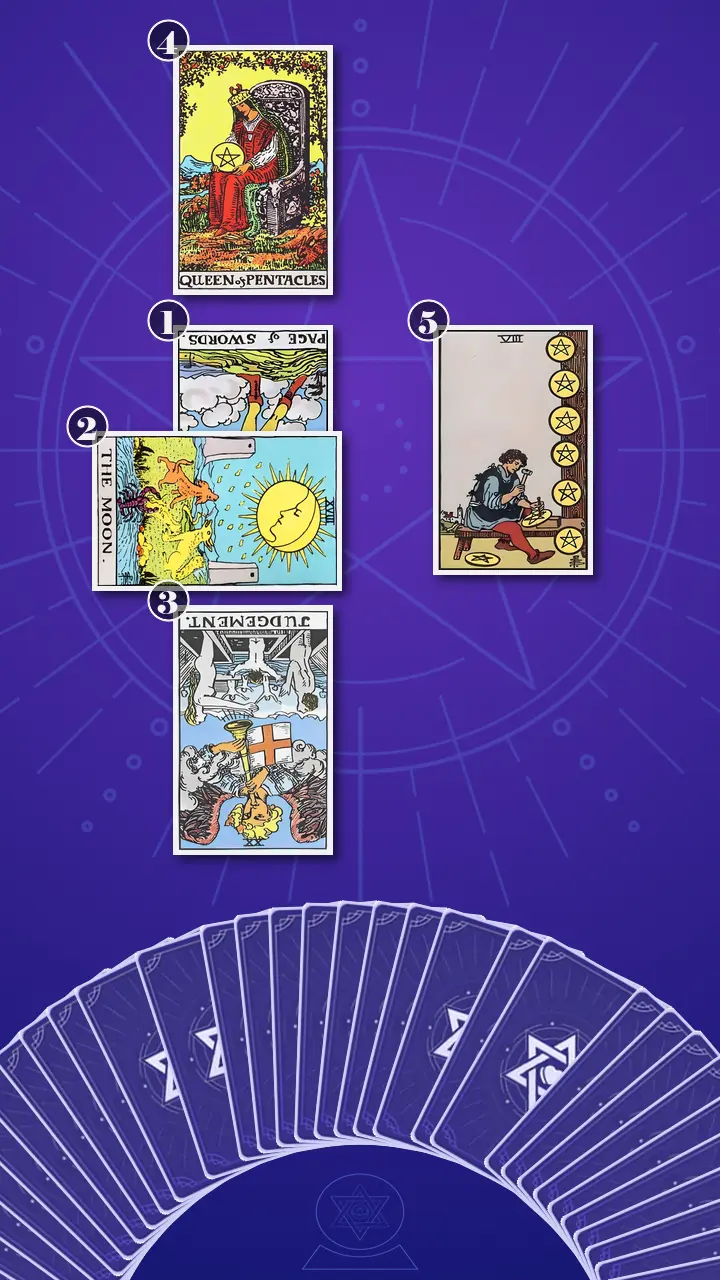
For her, I chose the Five-Card Cross · Context Edition. If you’ve ever wondered how tarot works for something as modern and specific as feeling exposed by clutter, this is one of my favorite structures. It keeps the classic Cross logic—center, challenge, foundation, guidance, direction—but it sharpens the card meanings in context. Here, the issue was not prediction. It was understanding why an apartment could feel emotionally dangerous the second it became visible from the hallway, the window, or the camera frame.
The structure fit her situation exactly. The center card would show the immediate symptom: how everyday clutter turns into a felt loss of privacy and a spike of exposure. The crossing card would reveal what amplifies that reaction when other people are physically near or might be able to see in. The foundation card would uncover the deeper fear underneath the whole thing. Above that, the key card would offer the reframe. And the final card, to the right, would translate insight into grounded next steps rather than some fantasy of instant transformation.
It is a small spread, but a strong one: symptom, amplifier, root fear, antidote, integration. A little window turning into a compass.
Reading the Window Like a Warning
Position 1: The Room Under Imagined Surveillance
The first card sat at the center, the position showing the immediate symptom: how everyday clutter turns into a felt loss of privacy and a spike of exposure. It was the Page of Swords, reversed.
I told Maya that this card is what happens when sharp perception stops gathering information and starts policing the self. In modern life, it looks exactly like her Tuesday scene: working from home, mostly fine, until the intercom buzzes or footsteps slow outside the door. Suddenly she is scanning the room through imagined outsider eyes, moving random visible items out of sight, narrowing the door opening, abandoning the actual task she was doing to manage what the apartment might reveal. It is like having a home-security feed turned inward.
The energy here is excess Air gone defensive—mental activity moving too fast, too sharp, with nowhere kind to land. Instead of perception serving her, it surveils her. I asked what changed first in the first ten seconds: chest, jaw, shoulders, breath? She answered before I finished the sentence. “Chest and shoulders. Always.”
I could see it even as she said it. Her shoulders had climbed toward her ears, her jaw had set, and her eyes kept flicking once toward the door behind me. One of the mind-body patterns I track in my Energy Flow Diagnosis is this exact shoulder-and-neck bracing. The body narrows the passage before the mind has facts, as if it must defend the perimeter from an imagined review panel. That is why the panic can arrive faster than thought.
She gave a half-winced laugh. “That is so rude,” she said. “The way I literally do the tiny narrow-door opening thing.” Her fingers worried the sleeve of her cardigan, but the laugh helped. Recognition had arrived.
Position 2: Moonlight Makes Everything Louder
The second card crossed the first. This position reveals what amplifies the exposure response when other people are physically near, visible, or potentially able to see in. The card was The Moon, upright.
I always slow down with The Moon, because it is not lying exactly—it is enlarging. This is the card of half-light, hallway shadows, dusk on a window, a laptop camera preview, a silhouette outside the glass. In that ambiguity, clutter stops feeling neutral and starts feeling revealing, as if one quick glance could somehow read your whole emotional state. I told her it works like rereading a dry text with no punctuation and deciding it must be bad news before the evidence is complete.
The energy here is emotional amplification: Water swelling around uncertainty. What looked manageable five minutes ago suddenly looks humiliating now. Not because the room changed, but because ambiguity gave projection somewhere to bloom. The path between wanting privacy and fearing exposure becomes charged, and the mind rushes in to fill the dark with judgment.
Her face softened into that unhappy kind of recognition that has no performance in it. She pressed her thumbnail into the mug handle and said, very quietly, “Dusk is the worst. And camera previews. It’s like the room gets louder.”
“Exactly,” I said. “The Moon doesn’t create the fear from nothing. It makes the uncertain parts feel more meaningful than they are.” Outside my window, the late light had already thinned to a cooler grey. The room itself seemed to demonstrate the card: edges softer, shadows longer, everything a little easier to misread.
Position 3: The Apartment as Courtroom
The third card lay below the center. This is the underlying foundation, the deeper fear beneath the conscious complaint. It was Judgement, reversed.
This is where the reading stopped being about housekeeping and became about self-condemnation. I told Maya that Judgement reversed turns a neutral task into a moral verdict. A sink of dishes becomes, “I’m not coping.” A chair full of clothes becomes, “I’m failing adulthood.” One unfinished room becomes the whole story. It is like the apartment has opened a comment section on your competence, and the loudest commenter is you.
I said it plainly: “A cluttered room is not a character reference.” Then I gave her the sharper truth behind the card. “The mess feels loud because your inner judge is already in the room.”
The angel’s trumpet on this card always gives me a flash of my years working on transoceanic ships. One announcement over the speaker—half information, half tone—and a whole deck of passengers could start hearing disaster before any real danger had appeared. Shame uses the same trick. It takes a small cue and broadcasts a total verdict. Here, the blockage was not the apartment itself. It was Judgement reversed: awakening turned inward as accusation.
Maya drew in a sharp breath. Her eyes watered before she blinked it away. “I honestly thought this was just me being ridiculous,” she said. “But yes. The second I see the sink, I hear something like, ‘Normal adults wouldn’t need a warning.’”
I nodded. “That is the root. You want privacy, which is human. But shame makes you hide like you’re destroying evidence. Privacy is not the same thing as hiding evidence.”
When the Queen of Pentacles Warmed the Room
Position 4: The Reframe That Restores Privacy
When I turned the fourth card, the whole reading changed temperature. The cool silver language of scanning, projection, and verdict gave way to Earth. This position names the key reframe that separates care for the home from moral judgment of the self. The card was Queen of Pentacles, upright—the key card, the antidote.
The Queen of Pentacles does not perform. She holds what is in her lap. She makes space usable. She is the difference between a showroom and a soft landing page. In real life, her energy looks like clearing enough space to eat, charge your phone, breathe, rest your eyes, or sit down without moving ten things first. Not asking the apartment to prove you are a competent adult. Letting it support your actual body and your actual week.
I asked Maya to picture that Tuesday moment again: the buzz downstairs, the warm laptop, the clothes chair in her peripheral vision, and her body already halfway into defense mode before she had even decided whether she was opening the door.
Your apartment is not evidence against you; hold it like the Queen of Pentacles holds her coin—with steady care, warm boundaries, and no need to perform for the people outside.
I let the sentence sit in the room.
First, she went completely still. Her hand froze halfway to her tea, breath paused, shoulders held in that familiar almost-invisible brace. Then her gaze lost focus—not blank exactly, but replaying: blinds half-shut, the narrow crack of the door, the 90-second stash run before a grocery delivery, the strange humiliation of seeing the laundry chair in a video call preview. Then came the unexpected part. Her mouth tightened and she said, with a flash of anger that was really grief wearing sharper shoes, “But that means I’ve been treating my own apartment like a witness stand.”
“Not because you were foolish,” I told her. “Because you were braced. Your system found a way to solve for safety using self-surveillance. It worked just enough to become a habit.” I could see the shift in her body more clearly than in her words. In my Energy Flow Diagnosis, shame often clogs at the base of the neck and across the shoulders—the body’s way of lifting the drawbridge. And then I thought, as I often do, of Venice. When water backs up in a narrow canal, nobody stands over it shouting moral advice. You clear a passage so the flow can move again. That is my Venetian Aqua Wisdom in one sentence. That is Queen of Pentacles energy. Not accusation. Circulation.
Her shoulders dropped a full inch. It was subtle, but undeniable. The release brought its own little wobble—the way clarity sometimes does when you realize how much effort it has taken to stay defended. She exhaled, then laughed once through her nose, softer now. “So the pile isn’t the confession,” she said.
“Exactly,” I replied. “Mess is a backlog, not a confession. Your apartment needs stewardship, not self-punishment.”
Then I asked her, “Now, with this new perspective, think back to last week. Was there a moment when this would have changed how your body felt in the room?”
She nodded almost immediately. “The DoorDash alert,” she said. “If I’d thought, ‘What does this space need next?’ instead of, ‘What does this say about me?’ I probably would have moved one mug and then answered like a normal person.”
That was the crossing we needed. Not perfection. Not a new identity. Just one step from exposure-driven self-surveillance toward grounded privacy and self-trust.
Position 5: The Practice That Rebuilds Trust
The fifth card sat to the right. This position translates the insight into a grounded, repeatable next step that restores agency inside the apartment. It was Eight of Pentacles, upright.
This is the craftsperson card. Not the dramatic Sunday reset. Not the CleanTok fantasy where one candle and a matching storage bin redeem the whole week. The modern-life version is much plainer and much kinder: choose one zone—the sink, the laundry chair, the entryway, the coffee table—and work it in the same order for a few minutes each day until your nervous system stops treating every pile like breaking news.
The energy here is balanced Earth. Repetition instead of panic. Skill instead of moral emergency. I told her it was like a Duolingo streak for one corner of the apartment, or like clearing browser tabs one by one instead of rage-quitting the whole laptop. The point is not drama. The point is trust.
She smiled for real this time. “So I’m not waiting for the mythical perfect-reset evening?”
“No,” I said. “Because that fantasy is one of the reasons the room stays charged. The Eight of Pentacles says trust is rebuilt by reps. One zone. Same order. Short timer. Stop before resentment takes the wheel.”
By then the room around us had changed with the reading. The outside light had thinned; the lamp beside us made the tabletop look warmer, more like wood than surface. That mattered. The spread itself had moved from cold watching to warm tending. From suspect to steward.
From Verdict to Task: Finding Clarity in Small Steps
When I laid the whole story back to Maya, it was clean and almost painfully simple. The Page of Swords reversed showed the live symptom: the room turns into a stage the moment someone might see it. The Moon showed the amplifier: uncertainty, half-light, hallway sounds, camera previews, all the places where the mind can fill in judgment before any real judgment arrives. Judgement reversed showed the root: a private room becoming an internal courtroom. Then the Queen of Pentacles and Eight of Pentacles offered the antidote and the method—home stewardship, practical care, and one repeatable task.
The blind spot was this: she had fused privacy with hiding evidence. She thought the goal was to remove all possibility of judgment before she could relax. But privacy is a boundary; shame is a prosecution strategy. The whole reading turned on a verdict-to-task reframe: not “What does this say about me?” but “What does this space need next?” Once those two questions are separated, the direction of change becomes obvious. She does not need to become a flawless housekeeper. She needs to become the keeper of her space again.
I told her, “Stewardship beats self-punishment.” Then I gave her three small next steps—not a full reset, not a new personality, just actionable advice her actual week could hold. I framed them through my Venetian Aqua Wisdom: don’t try to drain the whole city in one night. Open one channel, let the flow move, and stop while the movement still feels kind.
- Three Facts, One Story at the DoorThe next time the intercom buzzes, hallway footsteps pause, or a surprise video call catches the room in frame, keep both feet on the floor before touching anything. List three facts you know for sure and one story you are imagining. Wait 30 seconds, then move one visible item only—one mug to the sink, one hoodie to the hamper, or one box to recycle.Put the phrase somewhere you can grab fast—phone shortcut, sticky note by the door, desktop note. If 30 seconds feels impossible, do one slow exhale and name one fact. That still counts.
- Lamp-Lit Corner ResetTonight, clear one surface no bigger than a placemat where your body actually lands—part of the table, one bedside patch, or one section of the counter. Add exactly three supportive things there: one drink, one light source, and one item you reach for often, like your charger, lip balm, or notebook. Then stand or sit there for two full minutes without expanding the job.If opening the blinds feels too activating, use a warmer lamp instead. You do not need a full reset to make a room kinder to your body.
- One-Zone Stewardship for Seven DaysChoose one repeatable reset zone for this week only—the sink, the laundry chair, the coffee table, or the entryway. Set a 10-minute timer at roughly the same time each day, especially after work or before winding down. Work the zone in the same order every time: obvious trash first, dishes second, laundry third, objects that belong elsewhere last.Do not rotate zones, and do not keep going just because momentum appears. If 10 minutes feels impossible, make it 4 minutes or 8 objects. A missed day is not failure; it is just the next rep waiting.

A Week Later: The Quiet Proof
A week later, she sent me a message at 7:12 p.m. “I answered the buzzer without doing the full stash run,” it read. “I did the Three Facts, One Story pause, moved one mug, and then later did ten minutes on the laundry chair. Also… I opened the blinds halfway.”
A second message arrived right after: “The place was still messy. I just didn’t feel accused by it.”
That is the kind of finding clarity I trust most. Not the cinematic overhaul. The small proof. The body unbracing. The room becoming a lived-in place again. A Five-Card Cross tarot spread for messy apartment shame, privacy anxiety, and self-judgment can do exactly that when it is read honestly: it separates the door buzz from the verdict, the clutter from the character, the backlog from the confession.
I still remember the image I held after we closed the session: Maya alone at her small table, lamp on, one cleared patch of wood beside a mug of tea, the rest of the apartment still imperfect around her. Clear, but still a little tender. She had not solved her life. She had simply stopped prosecuting it.
When the hallway goes quiet and you hold your breath because one chair of clothes suddenly feels like it could expose your whole life, it makes sense that hiding starts to feel safer than being at home.
If tonight the mess stopped being evidence for one small moment, what would you want your next lamp-lit corner to help your body do instead?

Every reading at AceTarot is a journey to connect with inner wisdom and empower the path ahead. This reading shared here is a psychological mirror, not a private record—crafted to reflect universal emotional loops and help restore personal clarity. Please note that these insights do not replace professional psychological, medical, legal, or financial advice, and should not serve as the sole basis for major life decisions.
Learn more about our Journey to Clarity.
How did this insight land for you?
🫂 This Resonates Deeply
🌀 Living This Story
✨ Now I See Clearly
🌱 Seeing New Possibilities
🧰 Useful Framework
🔮 The Confirmation I Needed
💪 Feeling Empowered
🚀 Ready for My Next Step
Author Profile
AI Giulia Canale
956 readings | 527 reviews
“Having traveled across cultures... I've learned that what we often lack isn't a simple answer, but a moment of being truly understood. I use a Jungian psychological lens to help you deconstruct your subconscious patterns—not to prove anything, but to be the gentle companion who helps you unravel your knots, free of judgment, so you can reconnect with your inner wisdom.”
In this Introspection Tarot Reading :
Core Expertise
- Shadow Integration Audit: Objectively mapping suppressed emotions (anger, shame, grief) that are covertly draining your psychological bandwidth.
- Inner-Critic Neutralization: Deconstructing the harsh, subconscious self-judgment loop that masquerades as 'self-discipline'.
Service Features
- The Active Imagination Protocol: A structured psychological journaling technique to safely dialogue with your 'Shadow', turning internal friction into deep self-compassion.
Also specializes in :
Explore Related Patterns:
Boundary DiscernmentMaya's turning point is the line that privacy is not the same thing as hiding evidence. The hallway, the window, and the camera frame had been treated as if they could overrule her own sense of home, so she kept trying to manage the apartment for the people outside instead of letting it support the person inside. Boundary Discernment separates two things that shame had fused together. Privacy is a valid limit; concealment is a fear-driven strategy. When You can tell the difference, a messy apartment does not have to become public proof of private failure. It can stay a lived-in space with areas that need care. Opening the blinds halfway while the place is still imperfect is the clearest behavioral evidence of the shift. Maya is not forcing total exposure, and she is not hiding as if the room is guilty. She is allowing a boundary to exist without letting shame define what that boundary means.
Spotlight EffectHallway quiet, dusk on the window, a laptop camera preview, and a buzzer downstairs all make Maya scan the apartment through imagined outsider eyes. A chair of clothes becomes louder because it feels like someone else might see it, interpret it, and somehow know too much about her life. The Spotlight Effect shows up when the mind overestimates how visible and meaningful its own details are to other people. In Maya's case, that distortion is not abstract; it changes her body and behavior. She narrows the door, hides objects, and abandons the task she was doing because the possible gaze outside feels larger than the facts support. For You, the useful audit is not whether the apartment is perfectly neutral. It is whether the imagined audience has become too powerful. Once the presumed gaze is identified as a cognitive distortion rather than a confirmed verdict, the room can become a room again instead of a stage.
Visibility Shame LoopAt 2:18 p.m., the intercom buzzes and Maya instantly grabs the sweater, hides the delivery box, half-closes the blinds, and holds her breath as if the apartment has become visible evidence. The room itself has not changed, but the possibility of someone outside seeing in turns ordinary backlog into personal exposure. The mechanism is a shame loop built around visibility. A cue from outside activates self-surveillance, self-surveillance turns clutter into a character statement, and shame demands urgent concealment before she can answer the door. You are not just reacting to mess; You are reacting to the meaning your nervous system has learned to attach to being seen with unfinished life around you. The pattern becomes clearer when privacy gets fused with hiding evidence. Home stops acting like a boundary and starts acting like a courtroom, so even one mug or one clothes chair can feel like testimony. Naming the loop separates the buzzer from the verdict, which makes it possible to choose care instead of prosecution.
Self-Judgment LoopThe sink does not stay a sink for Maya; it becomes the sentence I am not coping. The clothes chair does not stay a clothes chair; it becomes I am failing adulthood. By the time the intercom buzzes, the harshest judgment is already inside the apartment. Self-Judgment Loop names the way a neutral cue gets converted into a global verdict, then used as proof the next time the cue appears. The mess starts as a task, becomes a character reference, and then feeds the next round of scanning and hiding. You can see the loop in the phrase normal adults would not need a warning, because it turns a practical backlog into a moral test. The shift happens when the verdict is translated back into a task. Mess is a backlog, not a confession, gives the mind a different pathway: one mug, one surface, one next action. The point is not to excuse the room or attack the self; it is to stop using the room as evidence in a private trial.
Reality TestingThe Three Facts, One Story practice appears exactly at the door, where Maya normally starts hiding things before she has checked what is actually happening. Instead of letting the buzzer become a verdict, she is asked to name what she knows for sure and what story her mind is adding. Reality Testing works here because the panic is being fed by projection, not by confirmed evidence. The facts are concrete: there is a buzzer, there is a mug, there is a room with clutter. The story is interpretive: someone outside will see this and know I am failing. You regain agency when those two layers stop blending into one threat. The later message proves the pattern in practical terms. Maya answers the buzzer without the full stash run, moves one mug, and later does ten minutes on the laundry chair. The apartment is still messy, but it no longer feels accusing, because her attention has shifted from imagined prosecution to observable reality.
Explore Related Struggles:
Identity Verdict LockAt 2:18 p.m., the intercom buzzes and the room stops being a room. The sink, the clothes chair, and the delivery box start reading like proof, so Maya rushes to hide objects before anyone can connect the mess to her competence. You are not watching a housekeeping problem expand. You are watching a private backlog get converted into a character reference. The lock forms when one visible detail is allowed to speak for the whole self. A dish becomes not coping, a laundry chair becomes failing adulthood, and a camera preview becomes a miniature trial. That is why the exposure feels so disproportionate. The mess is not only seen as clutter. It is treated as testimony. The way out begins when the apartment is allowed to become information again rather than evidence. You still get to care for the space, but care no longer has to be a defense against a verdict.
Monitoring-Safety FusionMaya scans the room through imagined outsider eyes before any outsider has judged it. She half-closes the blinds, narrows the door opening, moves visible objects, and holds her breath high in her throat as if silence itself could reduce exposure. You can see how safety has become attached to monitoring every sightline. The fusion is not simple tidiness. It is a body-level equation where checking, hiding, and preemptive correction become the quickest route to feeling less exposed. Because the scan works just enough to lower the spike for a moment, the apartment keeps training her to watch herself harder. When the reading shifts toward one factual pause and one small moved mug, the safety system gets a new option. You do not have to earn privacy by running surveillance on your own home.
Visibility-Safety SplitHallway quiet, a buzzer, dusk at the window, and a laptop camera preview all turn the apartment into a place that might be seen. Maya is still alone, yet her body reacts as though the room has been opened to a review panel. You can feel the split in the first ten seconds, when answering the door and protecting the self seem to demand opposite movements. The room becomes unsafe not because someone has already entered, but because visibility feels capable of collapsing the boundary. A lived-in chair of clothes suddenly carries the threat of being read, judged, and reduced. That is why the outside presence matters so much. It turns ordinary visibility into a safety question. The work is not to erase every visible sign of life. It is to rebuild the difference between being seen and being exposed, so the apartment can stay yours even when another person is near the threshold.
Environment-Agency SplitThe apartment is supposed to hold Maya's actual week, with the laptop, the mug, the sink, the clothes chair, and the patch of space where her body lands. Instead, the intercom makes the room feel like it is acting against her, pulling her out of work and into a defensive sweep. You can see agency leaving the body and moving into the room's visible surfaces. This split appears when a home stops functioning as support and starts functioning as a manager of self-image. Energy that could go toward eating, resting, or answering the door gets diverted into proving the space is acceptable. The environment becomes louder than the person living in it. The Queen of Pentacles reframe matters because it gives the apartment a different job. One cleared corner, one usable surface, and one repeatable zone teach the body that the room can serve life again instead of prosecuting it.
Explore Related Emotions:
Exposure DreadThe intercom buzzes at 2:18, and Maya immediately scrapes back her chair, grabs the sweater from the clothes chair, shoves a box behind the bedroom door, half-closes the blinds, and holds her breath high in her throat. The physical sequence matters because the threat is not actual entry; it is the sudden feeling that the apartment can be seen before she has chosen how much of herself to show. Exposure Dread names that threshold-weather: one hallway sound turns ordinary clutter into a possible disclosure. You are not reacting to dishes as objects; you are reacting to the sense that a stranger's glance, a camera preview, or a narrow door opening could make unfinished private life visible all at once.
Privacy AnxietyBefore anyone enters, the hallway is already in the room: the quiet outside the door, the intercom, the blinds, and the camera frame all press against Maya's private space. She wants a boundary, but the story shows how quickly that boundary turns into a hiding operation. Privacy Anxiety fits because the charge gathers around who gets access to the apartment and what that access might imply. You are trying to protect the difference between a lived-in home and a public exhibit, and that effort becomes exhausting when privacy starts to feel like evidence management.
Self-Audit AnxietyAt the first hallway cue, Maya starts scanning the apartment through imagined outsider eyes, moving visible items out of sight and narrowing the door before she has any real information. The home-security feed has turned inward, and her attention becomes an inspection tool aimed at her own space. Self-Audit Anxiety captures the mental loop where perception stops helping and starts policing. You are trying to pre-review every surface before anyone else can, which creates a tense inner audit even when no one has actually judged the room.
Shame SpiralThe dishes stop being dishes, the laundry chair stops being laundry, and the Zoom background stops being background. Maya's room gathers meanings faster than she can sort them, until one unfinished corner seems to speak for her entire adulthood. Shame Spiral names the way a small visible cue starts recruiting every other unfinished thing into the same internal case. You move from one object to a total self-reading, and the more you try to hide the room, the more personal the room feels.
Verdict DreadThe apartment becomes a courtroom in the story: dishes testify, the chair of clothes becomes a character reference, and Maya hears the line that 'Normal adults wouldn't need a warning.' The painful center is not the mess itself; it is the verdict that seems to arrive through the mess. Verdict Dread fits because the room is treated as if it can issue a final statement about competence. You are not only worried that someone will see clutter; you are bracing for the private conclusion that the clutter proves something about you.
Home Safety LongingThe reading keeps returning to what the apartment could be: a soft landing, a lamp-lit corner, a patch of cleared wood beside tea, enough space to eat, breathe, charge a phone, or sit down without moving ten things first. Those details matter because the home is being asked to hold a body, not prove a character. Home Safety Longing names the ache underneath the exposure reaction. You want the room to feel like a private base again, a place where unfinished life can exist without turning into a public statement.
Shame ReliefWhen Maya says the pile is not the confession, her shoulders drop, and later she writes that the place was still messy but she did not feel accused by it. The room has not been transformed into a showroom; the accusation has loosened. Shame Relief fits because the emotional weight moves without requiring a perfect apartment. You can let clutter return to being backlog, not a statement of failure, and that separation gives the body a little more room to stay.
Cautious Self-TrustA week later, Maya answers the buzzer while the place is still messy, moves one mug, works the laundry chair later, and opens the blinds halfway. The proof is small, but it is precise: she can stay in the room without turning every visible object into a warning sign. Cautious Self-Trust names the tender confidence that appears before everything is fixed. You begin trusting yourself to meet the threshold moment without disappearing into a full concealment ritual.
Grounded AgencyMaya's shift begins with tiny controllable actions: one mug moved, one zone worked in the same order, one timer, one buzzer answered without the full stash run. The apartment does not become perfect; her relationship to action becomes more stable. Grounded Agency fits the moment the question changes from what does this say about me to what does this space need next. You get a usable grip on the room without making your worth depend on a total reset, and that makes action feel possible rather than punitive.
Hypervigilant AnxietyMaya's shoulders climb toward her ears, her jaw sets, and her eyes flick toward the door while the apartment itself has not changed. The body narrows the passage before the mind has facts, as if the quiet hallway has already crossed the threshold. Hypervigilant Anxiety is the felt weather of that early bracing. You are responding to possible visibility before there is a real encounter, and the body spends energy defending the perimeter of the room as if every sound outside requires immediate readiness.
Explore Related Contexts:
Adulting Performance PressureThe sink, the laundry chair, and the delivery box do not stay neutral in Maya's account. They become quick evidence in an imagined competence review, especially when she says the room seems to say that normal adults would not need a warning. The pressure here comes from a social script that treats domestic order as proof of adulthood. You can be delivering a polished strategy deck at work and still have an apartment backlog, but the outside gaze makes those two realities look incompatible. This context explains why answering the door takes more energy than the task itself. The apartment is being forced to certify your adulthood before you feel allowed to be seen, so the practical move is to separate care for the space from the demand to look flawlessly grown.
Small-Space Domestic ExposureMaya is in a small Toronto rental with Slack open, the sink in flat work-from-home light, a laundry chair in sight, and the intercom buzzing while the condo hallway goes quiet. The room has almost no backstage; the same square footage has to hold work, rest, deliveries, camera previews, and unfinished chores. That spatial compression turns outside proximity into a real privacy problem. You are not dealing with clutter as a neutral housekeeping category; you are dealing with a home boundary that gets thin whenever the door, window, hallway, or camera frame can carry the room outward. The label fits because the exposure is built into the setting. Agency starts with rebuilding the perimeter in small, chosen ways: one visible zone, one door decision, one blind position, one part of the apartment that no longer has to perform for whoever might be outside.
Safe Visibility TrialA week later, Maya answers the buzzer without the full stash run, moves one mug, completes ten minutes on the laundry chair, and opens the blinds halfway. The apartment is still messy, but the door and the window are no longer governed by emergency concealment. That is a visibility trial, not a performance of total openness. You are testing whether a small amount of being seen can coexist with privacy, chosen boundaries, and an imperfect room. The context fits because the proof is behavioral and environmental at once. A half-open blind, a normal buzzer response, and one visible mug moved into place create a new external condition: the home can stay lived-in while you remain in charge of how much of it enters view.
Work Life Boundary CreepSlack is open, the laptop is warm under Maya's wrists, and the same room that holds a strategy deck also holds dishes, laundry, and a delivery box. Her apartment is not only a private room; it is also an office, a meeting backdrop, and a logistics point for the workday. Hybrid work makes the boundary problem structural. You are expected to be professionally legible from inside a space that was never designed to hide every unfinished domestic detail, so the camera frame and hallway start acting like extensions of the workplace. The label fits because the workday has crept into the home's visual field. Regaining agency means deciding which parts of the apartment belong to work, which parts belong to living, and which parts are allowed to remain offstage.