The 8:12 a.m. Bathroom-Light Interrogation: An Appearance-Based Self-Worth Spiral
If you’re 29, live in a big city, and one gray hair sent you into a full bathroom-light interrogation like it’s an emergency—welcome to the “first gray hair panic” club.
Maya said it with a laugh that didn’t quite land. “It’s one gray hair and somehow it feels like a full personality flaw.”
As she spoke, I could almost see the moment: 8:12 AM on a Wednesday in a tiny NYC bathroom, leaning into the harsh overhead vanity light. Damp fingers parting hair three different ways. The tile cold under bare feet. The fan buzzing like a small accusation. And then the same silver strand again—bright as a thread pulled from the wrong sweater.
Her body remembered it before her mind could dress it up: a stomach-drop like missing a stair, and a chest-tightening that made every breath feel smaller than it should be.
“A gray hair isn’t a problem. It’s a trigger that your brain knows how to weaponize,” I said gently, watching her shoulders tense as if she were bracing for a verdict.
She nodded, then looked away—toward the window, toward anywhere but the mirror memory. “I don’t want to be shallow,” she said. “But I also don’t want to be invisible.”
Underneath the strand was the true contradiction: wanting to feel confident and self-accepting as she ages, versus the fear that visible aging means she’s losing value—at work, in dating, in the invisible competition of a city where everyone looks like they have a routine and a ring light.
I let the silence settle for a beat, like dust finding the floor after a door closes. “We can work with this,” I told her. “Not by pretending it doesn’t matter, and not by letting it run your life. Let’s draw a map through the fog—this is a Journey to Clarity, not a trial.”
Choosing the Compass: The Horseshoe Spread · Context Edition
I asked Maya to take one slow breath and place both feet on the ground—not as mysticism, but as a practical way to shift her attention from the mirror in her head to the room we were actually in. While she did, I shuffled the deck in an unhurried rhythm, the way I once brushed soil from pottery fragments: patient, methodical, respectful of what’s underneath.
“Today, we’ll use something called the Horseshoe Spread · Context Edition,” I said. “It’s a seven-card tarot spread for aging anxiety and appearance-based self-worth—small enough to stay clear, but complete enough to show the whole loop: what shaped this, what triggers it now, what’s feeding it, what fear keeps it sticky, and what to do next.”
For you, the reader: this is how tarot works when it’s useful. Not fortune-telling. Pattern-mapping. The Horseshoe Spread’s arc moves from past conditioning into present behavior, then pauses at the core obstacle—like reaching the doorway in an excavation trench where you suddenly understand why the whole structure was built that way.
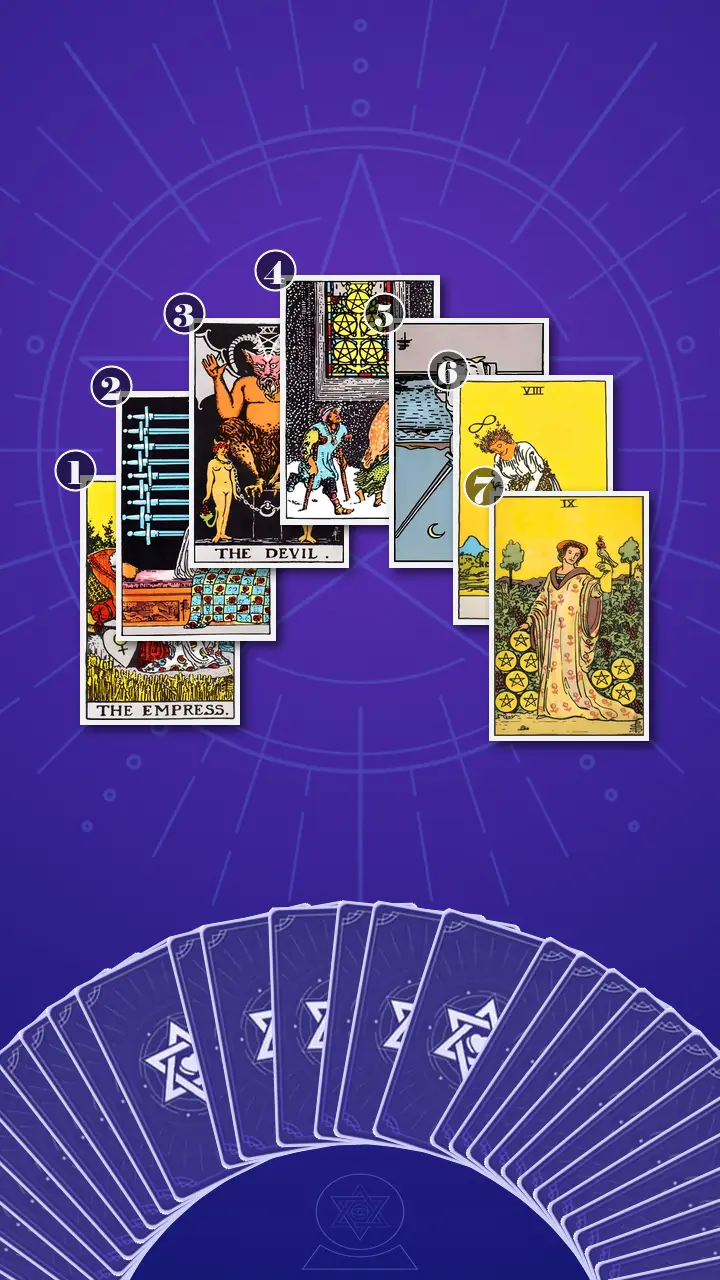
In this reading, position 1 traces where the “beauty = safety” template formed. Position 4 sits at the crown as the core fear. And position 6 is the key shift—the most supportive inner move that interrupts mirror checking and comparison loops.
“We’ll read left to right,” I told Maya, laying the cards in their horseshoe arc. “And when we reach the top card, we’ll stop and tell the truth about what this is really about.”
Reading the Map: The First Five Cards of Getting Older Insecurity
Position 1: Past conditioning — The Empress (upright)
“Now turning over,” I said, “is the card that represents Past conditioning: where your ideas about beauty, desirability, and ‘being valued’ first got reinforced.”
The Empress, upright.
The image is lush—wheat, abundance, the promise that the body is a home and a gift. In modern life terms, it’s the day you get ready for work and notice how differently you treat yourself on ‘polished’ days: hair behaving, skin cooperating, outfit hitting. Your brain quietly files it as proof you’re doing life right—more confident emails, more eye contact, more ease taking up space. The Empress is that original blueprint: beauty as abundance, beauty as safety, beauty as social protection in a city where being put-together can feel like part of being employable and dateable.
Energetically, this isn’t “bad” at all—it’s excess only when it becomes your only definition of safety. A single strand can’t just be a strand if the nervous system learned long ago that looking radiant keeps you inside the warm room.
Maya made a small, bitter sound—half laugh, half wince. “It’s brutal,” she said. “Like… I know I’m nicer to myself when my hair looks good. It’s embarrassing to hear it said out loud.”
“Archaeology taught me something about this,” I admitted. “In a dig, the top layer always looks like the whole story—until you realize it’s just what survived on the surface. We’re going to look underneath the ‘polished day’ layer without shaming you for having it.”
Position 2: Present symptom — Nine of Swords (upright)
“Now turning over,” I continued, “is the card that represents Present symptom: what the gray-hair moment is triggering in your day-to-day behavior and self-talk right now.”
Nine of Swords, upright.
This card is the night mind: worry that multiplies in the dark. And the modern life scenario is painfully specific—late, in bed, one gray hair becomes nine mental tabs: What if there are more?What if I look older in photos?What if I’m not the one people notice? You scroll product reviews like they’re going to soothe your nervous system, but your eyes feel dry, your jaw is tight, and your chest won’t unclench. You’re not solving hair—you’re trying to solve the fear of being downgraded.
The energy here is overactive Air—an excess of thinking used as an emergency response. It’s decision fatigue disguised as “research.” It’s reassurance checking disguised as “being responsible.”
Maya stared at the card like it had been reading her Notes app. “That’s my exact 11 PM brain,” she said, and her fingers pressed into her palm as if she could physically hold her thoughts in place.
“This is where I want to name something cleanly,” I told her. “If you’re checking again, you’re not looking for hair—you’re looking for reassurance.”
She blinked fast, then nodded once—tight, quiet recognition.
Position 3: Hidden influence — The Devil (upright)
“Now turning over,” I said, “is the card that represents Hidden influence: the less obvious force feeding the self-worth spiral.”
The Devil, upright.
In my mind, the Devil is never just “temptation.” It’s a contract you didn’t realize you signed. And Maya’s modern life translation matches it perfectly: you know filters aren’t real—you can say it out loud—and still your body reacts when you compare your unedited reflection to someone’s curated ‘effortless’ Story. The Devil is the invisible contract: Stay youthful to stay valuable. It shows up as compulsive checking, fix-it urgency, and the feeling that you’re not allowed to relax until you’ve neutralized the evidence of time.
This is blockage energy—attachment that behaves like a chain. It’s like being on a subscription you didn’t knowingly sign up for: the “youth = winning” plan keeps auto-renewing. TikTok #grwm, “clean girl aesthetic,” the Sephora app wishlist, the accidental front-camera check—none of it is evil, but the algorithm can be relentless in what it suggests your face is “for.”
“This isn’t vanity,” I said, carefully. “It’s a safety strategy that got stuck on ‘appearance.’”
Her shoulders lowered a millimeter. “That makes it feel… less like I’m broken,” she admitted. “More like I’m caught.”
Position 4: Core obstacle — Five of Pentacles (upright)
“Now turning over,” I told her, “is the card that represents Core obstacle: the belief or fear that keeps you stuck in checking, comparing, or fixing mode.”
Five of Pentacles, upright.
Snow. A stained-glass window. Two figures limping past warmth they can’t quite enter. The Five of Pentacles meaning, in this context, is not about money—it’s about belonging. It’s the gut-level fear of being excluded or not chosen once time shows up on you.
And the modern life scene is a winter-in-the-city contrast: you imagine other people warm inside the “chosen” category while you’re outside in the cold, watching through the glass. The real terror isn’t gray. It’s the flash image of walking into a bar, a meeting, or a wedding and being read as “tired”—like you’ve moved from “in demand” to “background.”
In her head, the monologue escalates in that exact structure:
If they see it, then… they’ll think I’m letting myself go.
And if that’s true, then… I won’t be chosen.
And if I’m not chosen, then… I’m not safe.
The energy here is deficiency—a felt lack of belonging that makes the mind treat a strand of hair like a social emergency.
Maya didn’t cry. Instead, she gave me the smallest nod I’ve ever seen someone give, like she was trying not to disturb the truth by moving too much.
“Yeah,” she said quietly. “It’s the fear of being overlooked, not the hair.”
Position 5: Your stance and protection strategy — Two of Swords (reversed)
“Now turning over,” I said, “is the card that represents Your stance and protection strategy: how you’re trying to manage the discomfort, and why it doesn’t fully work.”
Two of Swords, reversed.
This is the swing—the dam that holds all day and breaks at night. The modern life scenario is exactly that: all day you tell yourself, “It’s not a big deal.” You keep moving, keep working, keep performing competence. Then you catch your reflection again and the dam breaks: mirror-scanning, tweezing, opening Google, checking old selfies.
Energetically, it’s blockage turning into overflow. The more you blindfold the feeling, the more pressure builds behind it.
I mirrored the split-screen out loud, because it’s often the first moment the pattern becomes changeable:
What you say out loud: “I’m above this. It’s silly. I don’t care.”
What your body does: shoulders creep up, jaw tightens, thumb opens the front camera “just to check,” and suddenly you’re auditing your face like it’s a quarterly report.
Maya exhaled—small, involuntary. “Okay,” she said. “I do bounce between pretending and panicking.”
“That’s not a character flaw,” I replied. “It’s a coping strategy that gives short relief and long-term stress.”
When Strength Spoke: From Appearance Scorecard to Care-and-Choice
Position 6: Key shift — Strength (upright)
When I reached for the sixth card, the air in my office felt unusually still. Even the street noise outside—sirens and delivery trucks—seemed to lower its volume, as if the city itself was briefly listening.
“Now turning over,” I said, “is the card that represents Key shift: the most supportive inner move that interrupts the spiral and restores self-trust.”
Strength, upright.
The modern life version of Strength isn’t a motivational poster. It’s a behavior: instead of yanking yourself into “fix it now,” you practice a steadier kind of control. You pause, soften your shoulders, and decide from care—not fear. Maybe you still color your hair. Maybe you don’t. Strength isn’t about letting everything go; it’s about guiding your reaction like a powerful animal—firm, gentle, and self-respecting.
The energy here is balance: courage without aggression, control without punishment.
This is where my own “professor brain” always reaches for a myth—not to romanticize pain, but to make a growth metaphor you can actually hold. In ancient reliefs, the lion isn’t conquered by panic. The hero who survives isn’t the one who flails hardest; it’s the one who steadies his hands and breath and learns the animal’s weight. That’s Strength. Not domination—relationship.
“Stop treating your body like a problem to control and start relating to it like a powerful animal you can guide with calm hands—Strength over panic.”
The Aha Moment (Setup → Delivery → Reinforcement)
Setup: I watched Maya’s eyes flicker, as if she could see herself at 11:27 PM again—phone warm in her hand, deep in root touch-up reviews while her chest felt tight, like she had to solve her worth before she could sleep.
Your worth doesn’t need to be defended by perfection; it can be protected by tenderness and self-respect.
Reinforcement: The reaction came in layers—three quick beats I’ve seen in a hundred different crises, whether in a student’s face after a hard exam grade or in a client’s hands when a truth finally lands. First, a tiny freeze: her breath held mid-inhale, fingers hovering near her hairline without touching it. Second, a cognitive shift: her gaze unfocused, like she was replaying every time she’d turned a mirror into a courtroom. Third, the release—an exhale that softened her jaw and lowered her shoulders, followed immediately by something more complicated: a flash of irritation.
“But if that’s true,” she said, voice sharp for a moment, “then what does it say about me that I’ve been doing all this? Like… was I just wrong? Was I just being vain?”
I shook my head. “No. It says you learned a rule that looked like protection, and it worked—until it didn’t. Strength is not you scolding yourself into being ‘evolved.’ It’s you becoming reliable to yourself in the moment your nervous system asks for reassurance.”
I leaned forward slightly. “Now, use this new perspective and remember last week: was there a moment—the bathroom light, the Zoom self-view spiral, the L train front-camera check—where this insight could have made you feel different?”
She swallowed, eyes glassy but steady. “On Zoom,” she said. “I kept checking my hairline while my boss was talking. I wasn’t even listening. I was… trying to earn my spot in the meeting with my face.”
“That,” I said softly, “is the shift right there—moving from shame-driven reassurance checking to self-respecting, self-defined confidence. Not overnight. But in a real, repeatable way.”
Position 7: Integration direction — Nine of Pentacles (upright)
“Now turning over,” I said, “is the card that represents Integration direction: how self-worth can feel when you practice the shift.”
Nine of Pentacles, upright.
This is the quiet outcome: confidence that doesn’t depend on looking untouched by time. The modern life scenario is simple and radical: a few weeks from now, the goal isn’t “never caring.” It’s caring without desperation. You choose clothes, hair, and routines that feel like you—less like you’re auditioning for approval. You stop avoiding photos and start picking ones you genuinely like.
Energetically, it’s grounded Earth—self-contained confidence. You’re inside your own life, not outside begging the mirror to let you belong.
Maya looked at the garden on the card and let out a breath that felt like stepping into a warmer room.
The Pattern, Named: Why One Gray Hair Feels Like a Social Emergency
I gathered the arc of the horseshoe with my fingertip, card to card, like tracing a river back to its source. “Here’s the story the spread tells,” I said.
“The Empress shows an early template where looking radiant equaled safety and value. Then Nine of Swords shows what happens now: the night mind goes into emergency mode—mirror checking, Googling, comparing, rehearsing worst-case judgments. The Devil shows the hidden system feeding it: an external validation loop, a contract you keep paying into through algorithms and polish culture. At the crown, Five of Pentacles names the real engine—belonging-worth anxiety, the fear of being outside looking in, not being chosen. Two of Swords reversed shows your coping stance: denying the feeling until it floods. And then Strength interrupts the whole chain by offering a different kind of control—tenderness with authority. Nine of Pentacles is where that lands: cultivated, self-defined confidence.”
“The cognitive blind spot,” I added, “is thinking you’re solving hair when you’re actually trying to solve safety. Your brain treats visible aging like a threat because it’s trying to prevent exclusion. But the more you use appearance as a scorecard, the more the scorecard owns you.”
“So the transformation direction is clear,” I said. “Shift from ‘I must stay visually untouched by time to be worthy’ to ‘I can respond with care and choice without using appearance as a scorecard.’ That’s finding clarity—not in the mirror, but in the relationship you have with yourself when the mirror tries to start the trial.”
Before I gave her next steps, I offered the method plainly, the way a good syllabus tells you what you’re actually doing:
- Position 1: Past conditioning (where “pretty = safe” got reinforced)
- Position 2: Present symptom (what the trigger makes you do now)
- Position 3: Hidden influence (the system feeding the loop)
- Position 4: Core obstacle (the fear that makes it an emergency)
- Position 5: Coping stance (the strategy that gives short relief)
- Position 6: Key shift (the interrupt—Strength)
- Position 7: Integration direction (how self-worth stabilizes)
That’s the Horseshoe Spread tarot positions meaning, in context—less mystical, more practical: a structure to sort the spiral without moralizing.
Actionable Advice: The “Strength Over Panic” Experiments
Maya’s eyes narrowed a little—not in skepticism, but in the way high-achievers do when they’re bracing for homework. “I want something I can actually do,” she said. “But also… I don’t have time for a whole self-love ritual at 8 AM.”
“Good,” I replied. “We’re not building a personality overhaul. We’re building a pause.”
I reached for one of my own tools—what I call an Inscription Affirmation. Archaeologists know this: the sentences that survive on stone are short because the medium demands truth without fluff. “Pick a line that’s carved, not performed,” I told her. “Something you can repeat when your brain starts negotiating.”
- The 5-Minute Strength Container (once this week)The first time you notice the gray hair, set a 5-minute timer. Write (1) what you fear it means, and (2) what you actually need (comfort, rest, reassurance, choice). Then do one grounding action for 2 minutes (make tea, step outside, take a shower) before you decide anything cosmetic.If 5 minutes feels impossible, do the “2-minute version.” The goal is choice, not endurance.
- The Reassurance Check (7-day experiment)Before you Google a fix or open your front camera, ask out loud: “Am I seeking information—or reassurance?” If it’s reassurance, choose one non-appearance reassurance first (text a friend, drink water, step outside for one block).Your brain will call this “unproductive.” Treat it as nervous-system first aid, not laziness.
- One No Self-View Work Block (one meeting)Hide Zoom self-view for one meeting. In the first 60 seconds, notice what your body does (jaw, shoulders, breath). Then bring your attention back to the actual agenda—what you want to contribute.If anxiety spikes, you can unhide it. This is calibration, not punishment.
“And your inscription,” I added, “can be this—short enough to be carved, strong enough to hold you: ‘Care, not verdict.’ Put it on a sticky note by your bathroom mirror, or as your phone lock screen. Not because it’s cute—because it’s a boundary.”
A Week Later: The Quiet Proof (Not Perfection)
A week later, I received a message from Maya while I was grading a stack of essays—students arguing about identity as if it were purely an idea, not something you feel in your ribcage at 11:27 PM.
“I hid self-view for one Zoom,” she wrote. “My chest got tight for like 30 seconds. Then it eased. I actually listened. Also—did the timer thing once. I still want to tweak stuff, but it felt less like an emergency.”
I imagined her on a Friday night, getting ready for a birthday in the East Village: blow dryer humming, heat prickling her scalp, the silver strand still there. She doesn’t “win” some flawless enlightenment. She just pauses, reads her own note—Care, not verdict—and steps out the door anyway, a little steadier, a little braver, still human.
That’s what clarity looks like most of the time: not certainty, but orientation. A shift from being ruled by a scorecard to making one small, self-respecting choice.
When one gray hair makes your stomach drop, it’s rarely about the strand—it’s about the fear that being visibly human will make you less chosen, less safe, and less worth staying for.
If you didn’t have to use your appearance as a scorecard today, what’s one small, caring choice you’d actually want to make for your body—just because you live in it?
This story is adapted from psychological research, written so that those in a similar struggle can see their own pattern in it — and find their next step clearly.These insights are not a substitute for professional psychological, medical, legal, or financial advice.
Learn more about our Journey to Clarity.
How did this insight land for you?
🫂 This Resonates Deeply
🌀 Living This Story
✨ Now I See Clearly
🌱 Seeing New Possibilities
🧰 Useful Framework
🔮 The Confirmation I Needed
💪 Feeling Empowered
🚀 Ready for My Next Step
Author Profile
 AI
AI“Having spent a lifetime at Cambridge and on archaeological digs, I’ve witnessed the rise and fall of countless civilizations. Please know that your current struggles are not a permanent fate, but merely a necessary fracture before rebuilding. I won't lecture you; instead, I invite you to sit with me in the ruins, using a patient, historical perspective to gently dust off the true, enduring value hidden beneath your temporary doubts.”
In this Personal Growth Tarot Reading :
Core Expertise
- Cognitive Paradigm Excavation: Treating your current growth bottleneck as the necessary collapse of an obsolete intellectual era.
- Core Philosophy Stratigraphy: Identifying which foundational beliefs must be carried forward to your next life stage and which must be left in the past.
Service Features
- The Paradigm Shift Manifesto: A rigorous intellectual exercise to definitively articulate the new governing laws and core values of your next life chapter.
Also specializes in :
Explore Related Patterns:
Aesthetic Identity FusionMaya describing one gray hair as a full personality flaw shows the identity-level merge at the center of the spiral. The strand is not treated as neutral physical information; it becomes evidence about whether she is still valuable, dateable, employable, and visible in a city that rewards looking effortlessly polished. The defense makes sense as an old safety strategy. If looking radiant once created more ease, eye contact, and social protection, the mind learns to use appearance as a security system. The cost is that a normal sign of time starts auditing the whole self, so you are no longer asking what to do with hair; you are asking whether the visible body still gives you permission to belong. That is why aging lands so hard here: the threat is not gray hair, but the collapse of self-worth into an appearance scorecard. Naming the fusion gives you a way to separate care from verdict, so a cosmetic choice can become a choice again instead of a referendum on who you are.
Appearance PerfectionismAt 11 PM, the gray hair becomes a problem to solve before sleep: product reviews, Google, old selfies, and the pressure to neutralize visible time. The standard underneath is not simply wanting to look good; it is the demand to remain visually untouched enough to feel safe. This turns appearance care into a perfectionistic defense. The mind treats any deviation from polish as evidence that control is slipping, then reaches for fixing rituals to restore the old rule: if the surface is managed, the self is protected. For you, the trap is that care stops feeling optional and starts feeling mandatory. Appearance Perfectionism names the moment when grooming, style, or anti-aging choices are no longer expressions of taste, but attempts to prevent rejection, invisibility, or shame.
CatastrophizingThe story spells out the escalation in a chain: if they see the gray hair, they will think she is letting herself go; if they think that, she will not be chosen; if she is not chosen, she is not safe. A single strand becomes a forecast about social exclusion. That is catastrophizing, not because the feeling is fake, but because the mind jumps from one visible detail to a total future verdict. The defense is trying to protect you by rehearsing the worst case early, but it ends up making the body respond as if the feared rejection has already happened. The gray hair triggers a self-worth spiral because the brain treats aging as the first domino in a much larger loss story. Naming the distortion lets you slow the sequence down and ask which part is evidence, which part is prediction, and which part is an old safety rule speaking too loudly.
Reassurance SeekingMaya is told cleanly that if she is checking again, she is not looking for hair, she is looking for reassurance. The bathroom light, front camera, product reviews, and Zoom self-view all become tiny reassurance machines that promise certainty but only reset the countdown. The behavior gives short relief because it converts an emotional threat into a visible task: inspect, compare, search, fix. The problem is that each check teaches the nervous system that the fear needed checking in the first place, so the loop becomes stickier rather than calmer. For you, this pattern can feel rational because it arrives dressed as research or responsibility. Reassurance Seeking names the hidden function underneath the search: trying to get the mirror, the algorithm, or the camera to say you are still safe.
Self-Judgment LoopThe first gray hair becomes a courtroom scene: personality flaw, verdict, audit, and the sharp question of whether she was just vain or wrong. The mirror stops reflecting a body and starts cross-examining character. The loop is cognitive as much as emotional. A normal reaction to social pressure gets converted into evidence of personal failure, so shame attaches not only to aging but also to caring that aging is happening. For you, Self-Judgment Loop names that second layer of pain: judging the fear, then judging yourself for having the fear. Once that layer is visible, you can interrupt the trial and return to asking what kind of care would help without turning your body into a verdict.
Comparison TrapMaya can say filters are not real and still feel her body react when her unedited reflection is measured against an effortless Story. The city, the front camera, clean girl aesthetics, and product feeds become a comparison field where her face is evaluated before she has even chosen to participate. The trap works by making the curated image feel like the baseline and the lived body feel like the exception. Once that baseline is installed, a gray hair is no longer a neutral detail; it becomes proof that she is falling behind a standard nobody is actually living in real time. For you, Comparison Trap names the way external images become internal evidence. The work is not to pretend culture has no impact, but to see when the algorithmic mirror has quietly taken over your self-assessment.
Explore Related Struggles:
Aesthetic Self-Management TrapMaya keeps reaching for practical appearance fixes, but the story makes clear that the tools are being asked to solve the wrong problem. Googling products, checking old selfies, scanning her hairline, and opening the front camera all look like normal beauty maintenance on the surface, yet each action is carrying a much heavier question: am I still valuable enough to be seen, chosen, and taken seriously? You are not looking at a simple grooming concern here. The friction comes from using aesthetic management as a control panel for belonging. Hair, photos, Zoom self-view, and curated feeds become places where she tries to regulate her worth through visible proof. Aesthetic Self-Management Trap fits because the story shows appearance work becoming a self-worth system. The more Maya uses the mirror to secure her place, the more the mirror gains authority over how safe she feels in her own life.
Approval-Safety FusionMaya already knows that one gray hair should not determine her value, yet her body reacts as if something protective has been breached. The story traces that reaction back to a learned template where looking radiant, polished, and put-together has been filed as evidence that she is doing life correctly. You can feel the bind most clearly when she compares her real reflection to curated images she intellectually understands are edited or staged. Knowing better does not automatically free her, because approval has been wired into the feeling of safety rather than kept as a casual social preference. Approval-Safety Fusion fits because the story does not present approval as a nice extra. It shows approval functioning like shelter. When the gray hair appears, Maya is not only asking whether she looks older; she is asking whether the social warmth she associates with being attractive, employable, and dateable is still available to her.
Chosen-Worth BindMaya’s fear escalates in a very specific chain: if people see the sign of aging, they may read her as letting herself go; if they read her that way, she may not be chosen; if she is not chosen, she may not feel safe. The gray hair becomes the first domino in a much larger worth equation. You can see why the reaction lands so hard. The issue is not simply wanting to look good. It is the fear of being moved from foreground to background, from in demand to overlooked, from socially protected to quietly excluded. Chosen-Worth Bind fits because Maya’s value is being measured through imagined selection. The story keeps returning to bars, meetings, weddings, photos, dating, and work because those are the rooms where she fears her worth will be silently ranked and revoked.
Visibility-Safety SplitMaya looks at one gray hair and immediately finds herself negotiating two incompatible demands: she wants to age with self-respect, and she also fears that visible aging will make her less noticed, less desired, or less protected in the social field around her. The strand is small, but the reaction is not small because it touches work, dating, photos, meetings, and the city’s constant visual ranking system. You can see the struggle in the sentence she gives before any analysis: she does not want to be shallow, but she also does not want to be invisible. That is not vanity as a personality flaw. It is a split between wanting freedom from appearance rules and still needing visibility to feel socially safe. Visibility-Safety Split fits because the story keeps showing appearance as more than aesthetics. A gray hair becomes a signal that her place in the room might be less secure, so the mirror stops being a mirror and becomes a test of whether she still counts.
Inner Tribunal LockMaya’s bathroom mirror does not stay neutral. The story turns it into a courtroom: harsh overhead light, the same silver strand, shoulders bracing for a verdict, and the sense that her face is being evaluated before she has even started the day. You can see the same internal court reappear in other formats. Old selfies, Zoom self-view, the front camera, and product reviews all become evidence files. Instead of living inside her body, she starts presenting her body for review. Inner Tribunal Lock fits because the judgment system has moved inside. No one in the scene has to explicitly reject her for the trial to begin; the mirror is enough to activate the scoring, the defense, and the urgent need to prove that she still belongs.
Monitoring-Safety FusionMaya’s attention keeps returning to monitoring as if safety depends on catching every visible change in real time. The clearest scene is the Zoom meeting: her boss is speaking, but she is checking her hairline, trying to earn her spot in the meeting with her face instead of listening to the actual conversation. You can see how the system locks itself. Monitoring promises control, but it pulls attention away from the life it is supposed to protect. The more she checks, the less present she becomes, and the less present she feels, the more tempting another check becomes. Monitoring-Safety Fusion fits because watching herself starts to feel like staying safe. The cost is that self-trust gets outsourced to constant visual surveillance, even in moments where her contribution, voice, and competence are the real point.
Reassurance LoopMaya tries to push the gray hair out of importance during the day, but the story shows the pressure returning through the next reflective surface. She tells herself it is not a big deal, keeps performing competence, and then the dam breaks into scanning, tweezing, Googling, comparing, and checking old photos. You can track the loop by its temporary relief. Each check promises to settle the fear, but it mostly trains the fear to ask for another check later. The product reviews do not soothe the underlying question, and the front camera does not provide a stable answer. Reassurance Loop fits because the actions keep circling the same unmet need. Maya is not gathering information in a neutral way; she is trying to borrow certainty from the mirror, and the certainty expires almost as soon as she gets it.
Curated Belonging TrapMaya knows the images are curated, but the knowledge does not stop her body from responding to them. The story places her real reflection beside filtered Stories, TikTok routines, beauty apps, clean-girl aesthetics, and a city where everyone seems to have a ring light and a plan. You can see the trap in the mismatch between intellect and environment. She can reject the standard in theory while still moving through rooms where youth, polish, and effortlessness feel like unspoken entry requirements. Curated Belonging Trap fits because belonging is being filtered through a visual culture that keeps moving the target. Maya is not only comparing looks; she is trying to meet the aesthetic terms of being included, and ordinary aging starts to feel like falling out of frame.
Explore Related Emotions:
Conditional Belonging FearMaya names the contradiction directly: she wants to feel confident and self-accepting as she ages, but visible aging feels like losing value at work, in dating, and in the city's invisible competition. The story frames beauty as a warm room she learned to stay inside, and the gray hair as a sign that she might be pushed toward the glass. Conditional Belonging Fear is the emotional logic underneath that image. You are not fearing age in the abstract; you are fearing a version of belonging that only holds while you remain polished, youthful, desirable, and easy to choose. This label fits because the core wound is relational. The gray strand becomes a test of whether belonging is stable or conditional, whether you are still allowed inside the social warmth when your body shows evidence of time.
Not-Enough PanicThe first body signal is immediate: a stomach drop, a tightened chest, breath getting smaller than it should be. Then the mind translates one gray hair into something much larger, as if the strand is not a strand but proof of a full personality flaw. Not-Enough Panic fits the speed and scale of that escalation. You are not calmly evaluating aging; you are feeling a sudden collapse in the sense of being acceptable as you are. The fear jumps from visible change to social meaning, then from social meaning to whether you will still be wanted, noticed, and safe. This is why the spiral feels so disproportionate from the outside but so convincing from the inside. The trigger is tiny, but the meaning attached to it is huge: if they see this, they may see me as less enough.
Self-Audit AnxietyMaya leans into the bathroom light, parts her hair three different ways, then later finds herself checking old selfies, product reviews, and Zoom self-view as if each surface might deliver a cleaner answer. The gray hair becomes less important than the inspection habit it wakes up: the need to gather evidence about whether her appearance still protects her place in the room. That is the core of Self-Audit Anxiety. You are not simply noticing a change in your body; you are being pulled into a private review process where your face, hair, and visible age are treated like performance data. The more you check, the more the mind behaves as if worth can be verified through another look. This label fits because the story repeatedly shows appearance becoming an internal audit system. The bathroom mirror, the front camera, the Zoom tile, and the old photos all become checkpoints, and the emotional pressure comes from feeling that you have to pass before you can relax into your own life.
Social Exclusion DreadMaya says it plainly when the reading reaches the coldest part of the pattern: it is the fear of being overlooked, not the hair. She imagines entering a bar, meeting, or wedding and being read as tired, as if visible age could move her from in demand to background. Social Exclusion Dread names that flash of being outside the chosen category. You are not only afraid of a changed reflection; you are afraid of losing access to warmth, attention, desirability, and professional presence because other people might read your body differently. The Zoom moment makes the dread concrete. While her boss is speaking, Maya checks her hairline instead of listening, because part of her feels she has to earn her place in the meeting with her face. That is social exclusion dread turning visibility into survival math.
Verdict DreadHer shoulders tense as if she is bracing for a verdict, and the bathroom scene has the architecture of a trial: harsh light, cold tile, a buzzing fan, and one silver strand held up as evidence. The mirror is not acting like a neutral surface in this moment. It is acting like a place where a decision about her value might be handed down. Verdict Dread names the fear that a small visible change will be interpreted as a final judgment. You are not only seeing gray hair; you are feeling the threat of being classified, downgraded, or quietly moved out of the category of people who are still chosen. The story keeps returning to trial language because that is the pressure Maya is living under. She wants clarity, but her nervous system keeps staging a courtroom where her body is the defendant and every reflection can become another piece of evidence.
Visibility PressureMaya's sentence holds the whole tension: she does not want to be shallow, but she also does not want to be invisible. The fear spreads across work, dating, photos, meetings, and the city backdrop where everyone seems optimized under a ring light. Visibility Pressure captures the burden of having to remain visually legible as valuable. You are not just wanting to look good; you are feeling watched by a system that treats polish, youth, and effortlessness as proof that you still deserve attention. That pressure becomes especially clear on Zoom, where she keeps checking her hairline while her boss is talking. Her attention is not with her ideas because her body is busy trying to secure her visibility through her face.
Cautious Self-TrustMaya places both feet on the ground and shifts attention from the mirror in her head to the room she is actually in. Later, she hides self-view for one Zoom, feels her chest tighten for about 30 seconds, then notices it ease enough for her to actually listen. Cautious Self-Trust is the small but meaningful confidence that grows when you can stay with the trigger without immediately handing control to the mirror. You are not pretending the gray hair does not matter. You are proving that your reaction can be guided with care, timing, and choice. This label belongs to the integration side of the story because the change is repeatable rather than dramatic. Maya still wants to tweak things, but it feels less like an emergency, which means trust is beginning to move from the reflection back into her own hands.
Quiet Self-RespectThe line Maya is given is short enough to hold under pressure: Care, not verdict. It sits by the bathroom mirror or on the phone lock screen as a boundary against turning every reflection into a courtroom. Quiet Self-Respect names the steadier posture that starts to replace punishment. You can still make choices about hair, clothes, photos, and routines, but those choices no longer have to serve as emergency proof that you are acceptable. The quiet part matters. This is not a loud reinvention or a demand to never care about appearance again. It is a more private dignity: treating your body as something you guide with calm hands, not something you prosecute into worthiness.
Shame SpiralMaya does not only judge the gray hair. She judges herself for caring about it. She says she does not want to be shallow, then later asks whether all the checking means she was wrong or vain. Shame Spiral fits because the distress folds back on itself. You feel exposed by the visible change, then exposed again by your own reaction to it, as if needing reassurance makes you less evolved or less worthy of compassion. The story breaks that spiral by naming the strategy without moralizing it. Maya learned a rule that once looked like protection, and the work is not to shame her out of caring; it is to separate care from self-punishment.
Comparison FatigueThe late-night loop is crowded with other people's images: curated stories, filters, TikTok aesthetics, product reviews, old selfies, and the accidental front-camera check. None of these surfaces directly solve the gray hair, but they keep expanding the field of comparison around it. Comparison Fatigue is the drained feeling that comes from measuring an unedited body against a constantly refreshed standard. You are not failing to be rational; you are trying to recover steadiness inside a visual environment that keeps suggesting there is always one more flaw to correct. This emotion matters because Maya's spiral is not happening in isolation. The city, the apps, the beauty routines, and the polished feeds all make the mirror feel louder, until checking becomes exhausting even when it promises relief.
Explore Related Contexts:
Algorithmic Comparison LoopMaya knows filters are not real, but her body still reacts when her unedited reflection is measured against curated Stories, TikTok GRWM clips, clean girl aesthetics, and beauty product wishlists. The loop is visible in the late-night scrolling, the product research, the old selfie checks, and the accidental front-camera audits. The external structure here is an attention economy that keeps offering comparison as if it were information. Each platform cue turns one gray hair into a larger market of fixes, routines, and visual standards, so the next click feels like it might restore control even when it mostly keeps the evaluation cycle alive. This is why the aging trigger intensifies so quickly. You are not simply looking at hair; you are being pulled into a digital comparison environment where youth, polish, and effortlessness are repeatedly packaged as the conditions for staying visible and desirable.
Conditional Belonging PressureMaya says the core fear plainly: she does not want to be invisible. The gray hair becomes charged because it seems to threaten her place in rooms where people are noticed, chosen, desired, promoted, included, or quietly moved into the background. The story does not keep this fear inside the bathroom. It places it in bars, meetings, weddings, dating, photos, and the invisible competition of city life, where the social category of being in demand can feel fragile. Visible aging is treated as a sign that access to warmth, attention, and selection might become conditional. This context answers the question at the root of the spiral. The self-worth drop is not caused by the strand itself; it comes from a social field where belonging appears to depend on staying polished, youthful, and easy to choose. Seeing that structure gives you a cleaner place to intervene than blaming yourself for caring.
External Scorecard PressureMaya finds one gray hair in a tiny NYC bathroom and the scene immediately expands into questions about being valued at work, in dating, and in a city where everyone seems polished under a ring light. The strand becomes a scorecard because her environment has taught her that looking put-together can function like social proof. You are not dealing with a private mirror moment only. The story keeps moving between the bathroom, Zoom, bars, meetings, weddings, selfies, product reviews, and curated social feeds, which shows how appearance gets converted into a public evaluation system. The pressure is external because the rules are supplied by workplace visibility, dating markets, algorithmic beauty culture, and urban comparison norms. This context fits because the gray hair is treated less like a grooming issue and more like evidence in a social trial. The useful shift is not to pretend appearance has no social weight, but to notice when the scorecard has taken over your agency and turned care into constant self-auditing.
Zoom Self-View PressureMaya names the Zoom moment clearly: while her boss was talking, she kept checking her hairline and was not really listening. The work meeting became split between the actual agenda and the small live image asking her to monitor whether her face still looked acceptable. This pressure comes from a very modern workplace interface. Video calls put professional contribution and self-image in the same frame, so competence can start to feel weirdly tangled with lighting, hairline, camera angle, and facial presence. For Maya, that interface turns aging visibility into a live performance problem. The label fits because the story shows appearance pressure interrupting participation in real time. You can see the external stage clearly: a professional meeting where self-view becomes a mirror, and the mirror starts competing with the work you came there to do.