Finding Clarity in the 8:41 p.m. Rejection Tab
If you have ever opened a vague rejection after days of silence and immediately started doing the job-search version of doomscrolling, rereading, over-editing, and hunting for hidden meaning, you already know this feeling.
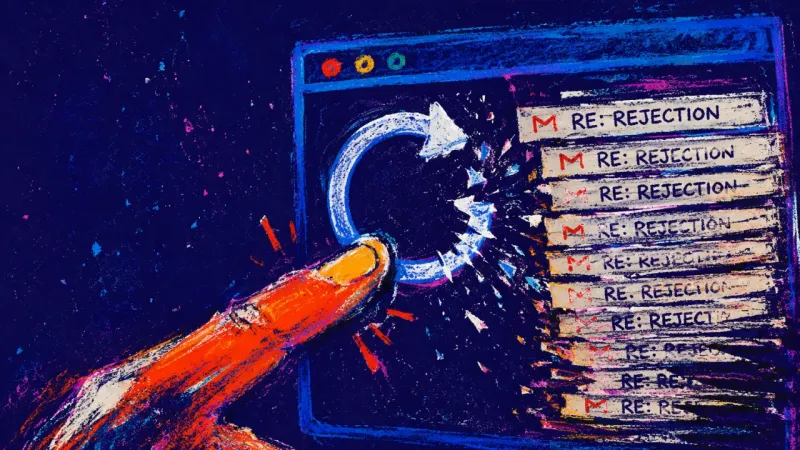
Jordan sat cross-legged on her Toronto couch like she’d been pinned there by her own laptop heat. It was 8:41 p.m. on a Tuesday—the radiator clicked under the window in stubborn little pops, the fluorescent kitchen light hummed like it had an opinion, and her phone kept lighting up with a LinkedIn offer post she hadn’t meant to open. The rejection email stayed open in one tab, refreshed so many times the thread looked worn.
“I know it’s only one email,” she said, staring at the screen like it might confess, “but it still lands like a judgment.”
I heard the core contradiction immediately: the desire to be chosen and move forward, versus the fear that one rejection proves she doesn’t really belong in UX. In her body it showed up as a tight chest, a heavy stomach, and a jaw she was holding like a locked door.
Shame can feel like trying to breathe through a scarf you didn’t choose—everything technically still works, but the air comes in smaller than it should.
“Okay,” I told her, keeping my voice gentle and very normal on purpose. “Let’s not make you argue with that sting. Let’s just map it. Our whole goal tonight is finding clarity—so this email stops being a verdict and starts being data.”

Choosing the Compass: The Four-Layer Insight Ladder Spread
I’m Alison Melody—radio host by day, tarot reader by night, and the person in my friend group who notices when the room is loud but the real noise is inside your head. I don’t treat tarot like a magic eight ball. I use it the way I use sound in music therapy: as a structured mirror. Not “what will happen,” but “what’s happening in you, and what’s the next workable move.”
I asked Jordan to take one slow breath with me—not as a ritual for the universe, just a nervous-system handrail. While she exhaled, I shuffled until the cards felt settled, the way a playlist finally clicks into the right order.
“Today, we’re using a spread called the Four-Layer Insight Ladder · Context Edition,” I said.
For a question like After a job rejection email, what old story is shaping my career? a bigger spread can turn into more tabs in your brain. This ladder is clean on purpose: it moves from (1) your visible reaction, to (2) the hidden story underneath, to (3) the turning point that restores self-trust, and finally to (4) a grounded next step you can actually do tonight. It mirrors how a rejection spiral works in real life—and how to stop rereading rejection emails without pretending you don’t care.
“We’ll start with what your body did first,” I added. “Then we’ll name the script your mind wrote underneath the email. Then we’ll find the interrupt—what helps you keep your dignity intact. And we’ll end with one practical action to rebuild momentum.”

Reading the Map: Five of Cups and The Moon in a Job Search Spiral
Position 1 — Visible reaction and immediate emotional response: Five of Cups (upright)
“Now flipped over is the card representing your visible reaction and immediate emotional response.”
Five of Cups, upright.
This is classic disappointment—the part of you that can only see what spilled. And in modern life it looks like this: opening a rejection email at 8:15 a.m., then spending the next hour staring at the same inbox thread, convinced the whole search just collapsed even though your portfolio, references, and earlier wins are still sitting there untouched.
“This card isn’t saying you’re dramatic,” I told her. “It’s saying your attention got hijacked. It’s grief with selective vision.”
Energy-wise, Five of Cups is excess water: the emotional tide rises fast, and it narrows the frame until three spilled cups become the whole story. That’s why the email starts to feel personal—like it’s deciding your worth—because the card’s pull is to treat one loss as the headline.
Jordan let out a little laugh that wasn’t amused—more like a cough of recognition. “That’s… kind of cruelly accurate.”
I watched her micro-reaction unfold in three beats: her breath caught for half a second, her gaze went unfocused like she’d replayed the morning the email arrived, and then her shoulders dropped a millimeter—just enough to say, okay, you see me.
“Five of Cups always has two upright cups behind the figure,” I said. “In career terms, those are the skills and proof that didn’t disappear. You just can’t turn around yet when your chest is tight.”
Position 2 — Hidden story and unconscious meaning-making: The Moon (upright)
“Now flipped over is the card representing your hidden story and unconscious meaning-making.”
The Moon, upright.
Immediately, I could feel the temperature of the reading change—like the room got quieter, but the silence got louder. The Moon is uncertainty, projection, and that specific career anxiety where ambiguity becomes evidence.
In modern life it’s reading a vague rejection and instantly building a private theory out of the silence: maybe the bar was higher, maybe I missed something obvious, maybe this means the field has already decided I’m not one of the people who get in. It’s a foggy ATS screen in your head, where the blanks get filled with your worst guesses.
“This is the ‘Severance hallway’ card,” I said, and Jordan’s eyes flicked up at that. “Half-lit corridors. No signage. And your brain goes, ‘If I can’t see the answer, the answer must be bad.’”
I kept my words clipped, almost bullet-pointed, because The Moon feeds on long, persuasive narratives.
It’s just one email.
But what if it means I’m behind?
What if everyone else has some secret, cleaner version of competence?
What if I only get chosen when I’m flawless?
That’s The Moon’s energy as a blockage: not intuition, but projection dressed up as “realism.” And it keeps the loop running—reread the email, over-edit the portfolio, check LinkedIn, feel behind—because it offers a short-term hit of control while quietly stealing momentum.
Jordan pressed her tongue against the inside of her cheek, like she was trying not to admit something. “I keep reopening it,” she said. “Like I’m going to find the one sentence that explains me.”
“Yeah,” I said softly. “That’s the old story hunting for proof.”
Position 4 — Grounded next step and embodied action (preview): Page of Pentacles (upright)
I like to show the landing spot before we hit the turning point, so your nervous system knows this isn’t endless fog.
“And at the base of the ladder,” I said, “the card representing your grounded next step and embodied action.”
Page of Pentacles, upright.
This is the apprentice—the person who learns by doing one real thing, not by achieving emotional perfection first. In modern life it’s: stop trying to solve your whole career in one sitting and treat the next move like a prototype. One revised bullet. One cleaner case-study intro. One application sent before the night is over.
Page of Pentacles is balanced earth. It doesn’t argue with the Moon. It just plants something small and trackable. It’s the exact opposite of “polishing instead of sending.”
Jordan nodded, practical even through the sting. “That… feels possible,” she admitted, and then immediately added, “but only if I can stop spiraling first.”
“Perfect,” I said. “That’s what our next card is for.”
When Strength Spoke: Dignity Over Flawlessness
Position 3 — Turning point that restores self-trust: Strength (upright)
“Now we flip the card representing the turning point that restores self-trust.”
The room felt suddenly still—the kind of stillness you hear in a studio right before the red light turns on.
Strength, upright.
Strength isn’t hype. It’s regulated courage. It’s the difference between forcing yourself through pain and staying with the sting without turning it into shame.
Jordan’s first response wasn’t relief. It was resistance.
She inhaled and held it, her fingers freezing around her phone like she might throw it into the couch cushions. Then her brows pulled together, and the words came out sharper than she meant: “But if I’m supposed to be ‘gentle’ about it… doesn’t that mean I was just being ridiculous? Like I made it a bigger deal than it was?”
I didn’t correct her fast. I let the moment breathe.
“No,” I said, calm and direct. “Strength doesn’t call you ridiculous. Strength calls you human. It’s saying you can feel the hit without using it as a reason to punish yourself.”
Setup
Right then, I could see the exact bind she lived in: the anxiety that says, Pick the correct interpretation of this email or you’ll lose your future, and the shame that says, If you were better, you wouldn’t be affected. She was trying to earn belonging through perfection, because the alternative felt like free-falling.
Delivery
Not 'I must be flawless to belong,' but 'I can stay with the sting, keep my dignity, and keep moving' - like Strength's gentle hand on the lion.
I paused and let it hang in the air, the way a single sustained note changes a whole chord.
Reinforcement
Jordan’s face shifted in layers. First: a tiny widening of the eyes, like she’d just realized how mean her inner voice had been without noticing. Second: her jaw worked—clench, release, clench—until she finally let it drop open a fraction. Third: the exhale arrived, long and shaky, as if it had been trapped behind her ribs all week.
Her shoulders didn’t collapse; they softened. It wasn’t triumph. It was the first 10% of release. The kind that feels almost dizzy because you’ve been bracing for so long you forgot what “not bracing” is.
“I… don’t have to hit myself to keep going,” she said quietly, surprised by her own sentence.
“Exactly,” I said. “And I want to make it even more practical.”
This is where my work with sound always comes in. I call it Music Pulse Diagnosis: I look at what you’ve been listening to lately the way I’d look at your sleep data—not to judge your taste, but to spot the stress pattern.
“After that email,” I asked, “what did you put on? Like, what was on your Spotify On Repeat?”
Jordan blinked. “Honestly? Sad girl stuff. And then lo-fi, but like… the kind that makes time disappear. And I replayed the same track on the TTC because it felt safer than thinking.”
I nodded. “That’s Strength’s lion, right there. Your nervous system chose repetition because repetition feels controllable. The issue isn’t the music—it’s that your brain used it to stay in the loop, not to move through the feeling.”
I slid into my second tool, the one that turns insight into something you can do in your body: Breath Soundtrack.
“Let’s give your inner voice a different tempo,” I said. “Both feet on the floor. Unclench your jaw like you’re letting go of a word you don’t need to say. And breathe to this rhythm: inhale for four beats, hold for two, exhale for six. Three rounds.”
As she did it, the apartment noise—the radiator, the kitchen hum—stopped sounding like an accusation and started sounding like weather. Still there, but not personal.
“Now,” I said, “use this new lens and think back: in the last week, was there a moment—on the TTC, in the inbox refresh, mid-LinkedIn scroll—when this could’ve changed how you spoke to yourself?”
Jordan swallowed. “Friday. I saw my reflection in the dark window on Line 1 and I looked… so tense. I remember thinking, ‘You’re embarrassing. You’re behind.’ If I’d had this… I could’ve just said, ‘Ouch. Okay. Next.’”
“That’s the shift,” I told her. “From shame-driven overthinking to calm self-respect. Not because the job search is easy, but because you refuse to turn pain into proof.”
Build Evidence, Not a Trial
I looked back down at the ladder—water, fog, fire, earth. Five of Cups showed the immediate slump. The Moon showed the old career script: ambiguity means I don’t belong. Strength offered the antidote: self-command without self-punishment. And Page of Pentacles promised something simple and true: confidence comes back through repeatable action, not through a perfect mood.
“Your cognitive blind spot,” I said, “is that you’ve been treating a hiring decision like a courtroom. Every bullet point becomes cross-examination. Every silence becomes a verdict.”
Jordan gave me a look that was half offended, half relieved. “Yeah,” she said. “I’m building evidence, but it’s like… evidence against me.”
“Right. The transformation direction is small but powerful,” I said. “Stop asking the rejection to define you. Start asking what story you attached to it—and what one next action looks like if this email is only data.”
I tapped the table lightly. “The email is factual; the story is optional. One rejection is a data point, not a verdict.”
- The 3-Minute Story vs Data CheckWith the email closed, open Notes and write two lines: “What happened” and “What story I attached to it.” Then underline only the factual words you can prove.If your chest tightens, ask a friend to sit with you while you do it—or do it from memory for now. Stop at 3 minutes. Clarity, not force.
- Strength Before You Edit (Jaw-Unclench Cue)Before touching Figma or your resume, do three rounds of 4–2–6 breathing. Then say out loud: “One no is not my whole career.” Only after that, make one small edit—one bullet, one intro sentence, one portfolio caption.If LinkedIn is your reflex, set a 20-minute timer for a “mute window.” Don’t negotiate with it.
- The Gentle Next-Send (5-Minute Sprint)Choose one application you can submit tonight. Set a 5-minute timer. Make it “good enough,” hit send, and log it in your Notion tracker as a completed experiment—green card, done.If perfection shows up, downshift: title the file “v1,” save, and stop. The win is momentum, not suffering.
Before she left, I added my BGM Prescription—not as spirituality, but as an environment hack for a Toronto apartment where the city’s hum keeps your nervous system half-on.
“Pick one for the next week,” I said. “Use it only during the reset and the send—so your brain learns a new association.”
Track 1: low, steady brown noise for 15 minutes (good for “my brain won’t stop scanning”).
Track 2: slow instrumental around 60–70 BPM (good for “I’m about to open the email again”).
Track 3: a simple piano or ambient tone bed—no lyrics (good for “I’m editing like it’s life or death”).
“You’re basically giving Strength a soundtrack,” I said. “So your body can remember the turning point without having to re-earn it every time.”

A Week Later: The Quiet Proof
A week later, Jordan texted me a screenshot: her Notion board with one more green card than red. Under it, a message: “Did the two-line facts vs story thing. Didn’t open LinkedIn. Sent one application in five minutes. Still felt tender, but I didn’t spiral.”
Her update wasn’t fireworks. It was something better: proof that the career is wider than one inbox thread.
In my head, I heard it like a clean mix—less distortion, more signal. That’s the real Journey to Clarity: not certainty, but ownership. Not “I’m flawless,” but “I can keep my dignity and keep moving.”
When a rejection email hits, it can make your chest go tight, your jaw lock, and the whole job search feel like it is deciding whether you belong at all.
If you let this email stay data instead of a verdict, what small next step would feel the least heavy today?
This story is adapted from psychological research, written so that those in a similar struggle can see their own pattern in it — and find their next step clearly.These insights are not a substitute for professional psychological, medical, legal, or financial advice.
Learn more about our Journey to Clarity.
How did this insight land for you?
🫂 This Resonates Deeply
🌀 Living This Story
✨ Now I See Clearly
🌱 Seeing New Possibilities
🧰 Useful Framework
🔮 The Confirmation I Needed
💪 Feeling Empowered
🚀 Ready for My Next Step
Author Profile
 AI
AI“Through ten years of sound energy research, I’ve found that when we struggle, it's usually just our internal rhythm falling out of sync under pressure. I know firsthand the frustrating helplessness of wanting to move forward but feeling paralyzed. Without overwhelming theories, I want to be the soothing background track that helps you recalibrate, turning your heavy burdens back into a light, effortless, and harmonious melody.”
In this Introspection Tarot Reading :
Core Expertise
- Mental Noise Cancellation: Diagnosing severe internal friction not as a moral failing, but as a chaotic overlapping of incompatible psychological frequencies.
- Resonance Healing Calibration: Identifying the 'dissonant baseline' of your chronic anxiety and calculating the specific acoustic or rhythmic input needed to soothe it.
Service Features
- The Frequency Reset Pause: A customized rhythmic breathing or acoustic grounding technique to forcefully lower your brainwave state from a frantic beta frequency to a restorative alpha state.
Also specializes in :
Explore Related Patterns:
Certainty SeekingJordan keeps reopening the same vague email, not because the text is changing, but because the uncertainty feels unbearable. The silence leaves a blank space, and her mind rushes to fill it with theories about the bar being higher, something obvious being missed, or the field quietly deciding she does not belong. Certainty Seeking fits because the loop promises relief through more information, even when no new information is available. You reread, refresh, edit, and check because those actions create a short-term feeling of control. The cost is that the search for the perfect explanation starts replacing the next workable move.
PerfectionismJordan's spiral keeps returning to polishing, editing, and trying to locate the flaw that would explain the rejection. Underneath that behavior is the line that names the old story directly: the belief that being chosen requires being flawless, and that anything less than flawless risks exclusion. Perfectionism fits because the standard is not simply high effort. It becomes a safety strategy. You try to make the work so clean that rejection cannot touch you, but the strategy backfires when one no becomes proof that the whole self still needs more correction before it is safe to be seen.
Rejection SensitivityJordan keeps the rejection email open as if it might confess, while also saying she knows it is only one email. That split is the core mechanism: the event is small on paper, but the nervous system treats it like a status verdict, and the mind starts scanning for proof that the hit means something larger about belonging. Rejection Sensitivity fits because the pain does not stop at disappointment. You see the email turn into evidence about worth, competence, and whether there is a place for you in the field. The pattern is not that you care too much; it is that a single external no gets fast-tracked into an identity-level conclusion before the facts have been separated from the story.
Imposter SyndromeJordan does not only ask why this company said no. She starts wondering whether everyone else has a cleaner, more legitimate version of competence, and whether UX has already decided she is not one of the people who get in. That is a shift from evaluating one application to questioning her right to belong in the room. Imposter Syndrome fits because ambiguity becomes identity evidence. You are not just interpreting a rejection; you are trying to answer whether your competence is real enough to count. The pattern makes ordinary career opacity feel like exposure, as if one vague email could reveal that you were never as qualified as you hoped.
Explore Related Struggles:
Chosen-Worth BindJordan names the ache plainly when one rejection lands like a judgment and the fear underneath says she may not belong in UX. The desire to be chosen is not shallow here. It is attached to whether the field will recognize her as someone who gets to enter. Chosen-Worth Bind captures the visible pull between moving toward the career and waiting for external selection to confirm her value. You can see it in the way a hiring decision starts carrying more weight than the role itself, as if being picked would settle the deeper question of whether she is allowed to trust her place. The old story is organized around conditional belonging. When the mind asks whether she only gets chosen when she is flawless, career progress stops being a path of attempts and feedback, and becomes a test of whether she is worthy enough to be let in.
Identity Verdict LockJordan keeps the rejection email open until it stops behaving like an email and starts functioning like a judgment. The tab gets refreshed, LinkedIn gets checked, and the UX field becomes a room she is afraid has already voted her out. Identity Verdict Lock fits because one piece of career data is pulled into the center of self-definition. You are not just watching someone react to a missed role. You are watching a normal hiring outcome harden into a ruling on who she is allowed to become. The struggle lives in that conversion point, where silence becomes testimony and every portfolio bullet starts to feel like evidence. The old story shaping the career is not that rejection hurts. It is that rejection gets treated as an identity sentence instead of a limited event.
Certainty-Safety FusionThe rejection email gives Jordan almost no real information, so her mind starts filling the blank space with theories. Maybe the bar was higher, maybe she missed something obvious, maybe the field has already decided she is not one of the people who get in. Certainty-Safety Fusion shows up when not knowing starts to feel more dangerous than the rejection itself. You can see the loop forming through the open tab, the LinkedIn post, the over-editing, and the search for one sentence that will explain everything. The trap is that checking briefly feels like control, but it keeps the body and attention locked inside the same unresolved signal. Until ambiguity is allowed to remain data rather than danger, the next move keeps getting postponed in favor of one more scan.
Inner Tribunal LockJordan eventually names the courtroom quality of the spiral. Every bullet point becomes cross-examination, every silence becomes a verdict, and even the act of gathering evidence starts turning against her. Inner Tribunal Lock fits because the job search is no longer only a search. It becomes an internal trial where preparation, editing, and interpretation are all recruited into the task of prosecution. You can feel the cost in the way effort stops building momentum and starts building a case. The old story says that if she can interrogate herself hard enough, she can prevent future rejection, but the trial consumes the very agency it claims to protect.
Performance-Worth FusionWhen Jordan asks whether being gentle with herself means she was ridiculous, the pressure underneath becomes visible. The rejection does not only question the application. It makes her wonder whether a better version of herself would have been untouched by it. Performance-Worth Fusion appears in the demand to be flawless before she is allowed to feel safe moving forward. Over-editing the portfolio and polishing instead of sending are not just productivity choices here. They become attempts to make performance so clean that rejection can no longer reach her. The struggle is that ordinary iteration starts to feel morally loaded. A case-study intro, a resume bullet, or a five-minute send carries the weight of proving whether she deserves her place, and that weight makes every next step heavier than it needs to be.
Explore Related Emotions:
Conditional Belonging FearThe old script becomes explicit when Jordan asks, What if I only get chosen when I am flawless? A single rejection has reached backward into a deeper rule: your place in the field feels conditional on perfect performance, perfect interpretation, and perfect resilience. Conditional Belonging Fear names the pressure beneath the portfolio edits and the LinkedIn scan. The fear is not only that one company said no; it is that being affected by the no might prove you were never legitimate enough to be here. That is why Strength lands as dignity rather than hype. The real shift is from trying to earn belonging through self-punishment to staying with the sting while refusing to make flawlessness the price of entry.
Verdict DreadJordan keeps the rejection tab open at 8:41 p.m., refreshed so often the thread looks worn, while saying it is only one email but it lands like a judgment. The hiring outcome has become more than information; it is being staged inside you as a courtroom, where silence cross-examines your competence and the missing explanation starts to feel like proof. Verdict Dread fits because the old story is not simply that rejection hurts. It is that a single no has been granted the authority to define whether you belong in UX at all. The dread comes from watching one data point swell into a final ruling, even while your portfolio, references, and earlier wins are still present outside the frame. Naming this emotion gives you a cleaner separation: the email can stay factual, and the verdict can be seen as the story your mind attached to it. That distinction returns agency without pretending the sting is nothing.
Ambiguity DreadJordan reads a vague rejection after days of silence and immediately starts searching the blanks: maybe the bar was higher, maybe she missed something obvious, maybe the field has already decided she is not one of the people who get in. The missing details become a foggy screen where your mind fills every empty space with the worst available explanation. Ambiguity Dread is the feeling of being trapped with insufficient information while your inner narrator treats uncertainty as evidence. It is not the rejection alone that tightens the loop; it is the lack of a clear reason, which makes rereading and over-editing feel like the only way to regain control. The old story shaping the career here is that unclear feedback must conceal a negative truth about you. Once that story is named, the silence can stop posing as certainty.
Clarity ReliefJordan separates the email into two lines: what happened and what story she attached to it. That small split changes the atmosphere of the room, because the rejection no longer has to carry both the fact of a hiring decision and the full weight of her identity. Clarity Relief is not a bright, instant confidence. It is the quieter release that arrives when your mind stops treating interpretation as evidence and starts seeing the difference between data, projection, and self-punishment. For the career question, this relief is crucial because the old story becomes visible without taking over the whole night. You can still feel tender and make one next move from a cleaner place.
Shame SpiralJordan's chest tightens, her stomach turns heavy, and her jaw locks as the email stays open on the screen. Later, the inner sentence gets crueler: you are embarrassing, you are behind, and if you were better you would not be affected this much. Shame Spiral fits because the pain does not stop at disappointment. It starts recruiting your body, your portfolio edits, your LinkedIn checking, and your self-talk into a tightening loop where every attempt to understand the rejection becomes another way to accuse yourself. The spiral has a recognizable logic: punish yourself first so the outside world cannot catch you unprepared. Seeing that logic clearly makes it possible to keep the sting without turning it into a private trial.
Cautious Self-TrustJordan's jaw goes clench, release, clench before the long shaky exhale arrives, and then she says she does not have to hit herself to keep going. The body does not leap into confidence; it tests a little less force, a little less punishment, and finds that movement is still possible. Cautious Self-Trust names that early return of inner authority. You are not asked to be untouched by rejection, and you are not asked to manufacture certainty. The trust comes from staying with the sting without handing it the steering wheel. A week later, the proof is modest and concrete: one application sent, LinkedIn left unopened, still tender, but no spiral. That is self-trust in its most useful form - not a performance of fearlessness, but a repeatable refusal to abandon yourself.
Doomscrolling AnxietyThe rejection tab stays open while the phone keeps lighting up with a LinkedIn offer post Jordan did not mean to open. The screen becomes a closed circuit: reread the email, over-edit the portfolio, check LinkedIn, feel behind, then return to the email for another pass. Doomscrolling Anxiety fits because the scrolling and rereading offer a quick sensation of control while keeping your body inside the threat signal. Each refresh promises an answer, but the loop mainly supplies more comparison, more hidden-meaning hunting, and less forward motion. The emotion matters because it shows how the old story keeps itself alive. If the mind believes one rejection might explain your whole career, it will keep scanning for proof, even when the scan is the thing draining momentum.
Explore Related Contexts:
Conditional Belonging PressureJordan names the private rule underneath the email when the question becomes whether one rejection proves she does not belong in UX. The story tightens further around the line that she only gets chosen when she is flawless, turning a normal hiring decision into a condition for being allowed into the field. That pressure is social before it is personal: competitive career spaces often make belonging look like a secret standard everyone else already knows. You regain agency by seeing the rule as a pressure system, not as a truth. A rejection can show that one application did not land without proving that your place in UX has to be earned through self-punishment.
Job Search LimboJordan is on the couch with the rejection tab, LinkedIn lighting up, and an unfinished next application still possible. The career path has not closed, but the next step is temporarily suspended between rereading the no and sending the next attempt. That is the logic of a job search limbo: progress exists, but the visible marker is a red card, a silent inbox, or a vague email. You are not outside the field, yet the process can make you feel paused at the door. The counterweight in the story is small measurable movement, because one green card in the tracker gives the search a shape wider than the inbox thread.
Performance Criteria Black BoxThe email gives Jordan a result without a map: no clear bar, no specific portfolio note, no visible reason why the application stopped. That missing criteria turns UX hiring into a black box where every bullet point and every silence can be treated like evidence in a trial. Under that structure, you can start over-editing because the real standard is hidden. The pressure is not laziness or lack of care; it is the strain of trying to satisfy an evaluator whose rules have not been shown. Naming the black box puts the authority back in the process, not in a private verdict about your competence.