Before the Coffees Land
If you work a fast, client-facing city job and can sound socially effortless all week, but still make yourself the punchline within the first three minutes of brunch, I usually know I am not looking at “just being funny.” I am looking at social armor.
When Maya sat across from me, she did not begin with a dramatic backstory. She began with a Saturday morning on Ossington: 11:18 a.m., a packed brunch spot, coats still half on the backs of chairs, menus damp at the corners from melted water glasses. Her phone was still warm from Instagram Stories full of engagement photos and soft-launch couple content. Before the coffees even landed, she had joked that she was a “walking HR violation” of her own dating life. The hiss of the espresso machine blurred into cutlery clinking against plates, and her smile had arrived half a beat too fast, like her face was trying to outrun the drop in her stomach.
“And then I do the face scan,” she told me. “I clock who laughed, who looked down, whether it sounded warm or pitying. I leave brunch replaying social interactions like security footage.” Her thumb kept rubbing the edge of her sleeve. “I want it to feel easy. I want real connection. But if I don’t make the joke first, I feel weirdly exposed.”
I nodded, because the contradiction was already sitting in the room with us: she wanted easy belonging and real closeness, but she feared that being seen without a joke would invite rejection. Shame had trained her into speed. In her body it was not abstract at all. It felt like trying to swim through cold syrup while everyone else seemed to know exactly where the floor was.
“That makes sense,” I said. “The joke lands fast because the fear landed first. So I’m not here to shame the bit. I’m here to understand what it protects. Let’s make a map of this fog and see what finding clarity looks like when you no longer have to pre-reject yourself just to stay included.”

Choosing the Ladder: How Tarot Works Here
I asked Maya to wrap both hands around her tea, take one slow breath, and hold the exact moment in mind: the menus landing, the almost-automatic self-roast, the quick social scan across the table. Then I shuffled. For me, that moment is not performance or mysticism for its own sake. It is a psychological threshold. It helps the nervous system stop free-falling long enough to let a pattern become visible.
For this session, I chose the Four-Layer Insight Ladder · Context Edition. When people ask me how tarot works in readings about self-deprecating humor with friends, fear of exclusion, or why they replay everyone’s reaction after a joke, this is one of the clearest tools I use. This was not a prediction question. It was a deep-inner-pattern question.
The reason this spread fits so well is that it holds exactly the sequence this kind of struggle requires: visible defense, older wound, healing pivot, and practical re-patterning. A larger spread like the Celtic Cross would have given us more scenery but less precision. Here, I wanted a tight vertical map from symptom to source to repair.
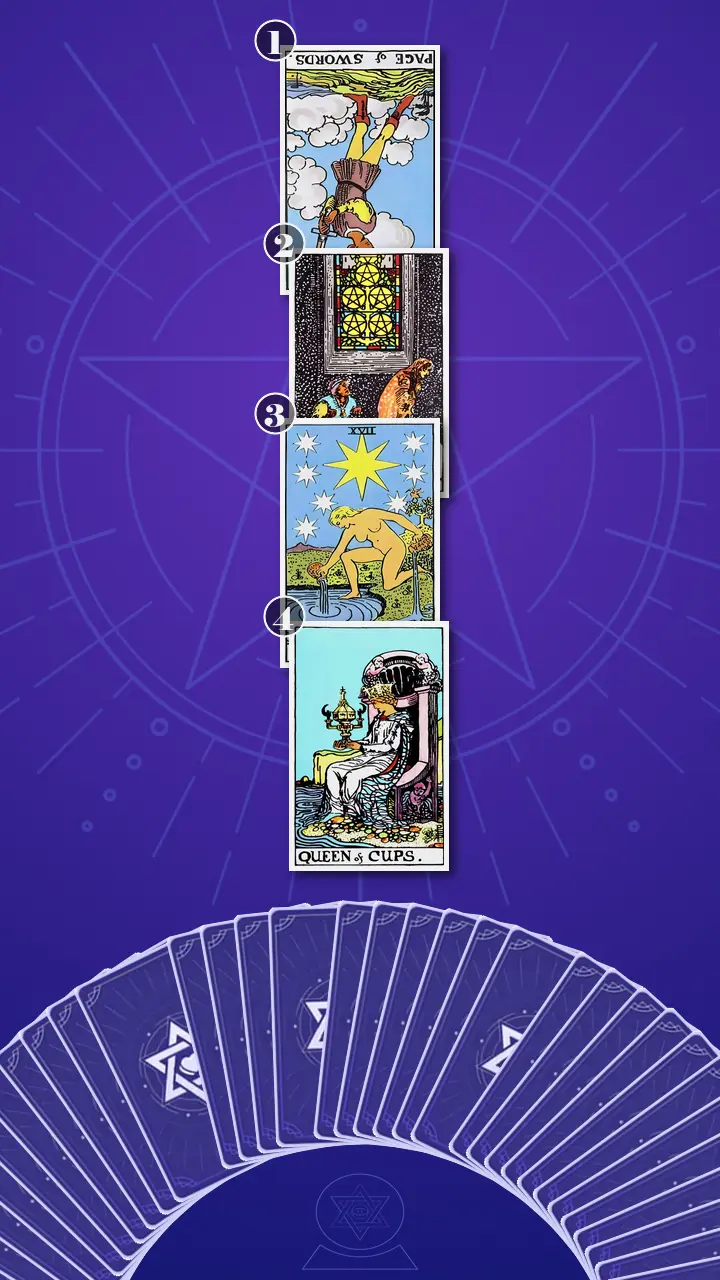
I showed her the four positions as I laid them in a straight line. “The first card shows the surface defense,” I said. “The second reveals the old rejection script underneath it. The third is the key insight—the healing truth that can interrupt the pattern. And the fourth shows the next social practice you can actually try at brunch, dinner, or the next catch-up.”
Reading the Reflex Beneath the Banter
The cards landed in a clean ladder, just as I had hoped. I love this structure because the eye moves downward like a staircase into the basement of the pattern, then back up with the lights on. This is exactly why I use the Four-Layer Insight Ladder tarot spread for self-deprecating humor, fear of exclusion, and belonging wounds in friendships: it keeps the symptom attached to the wound, and the wound attached to a next step.
Position 1: The Joke Before the Menu Opens
“Now we’re looking at the card that shows the surface defense named in your question,” I said, turning the first card. “Page of Swords, reversed.”
In this position, the reversed Page of Swords is nervous speech, defensive wit, and mental over-scanning. I told her what I saw immediately: Maya sitting down at brunch already in live-edit mode, making a joke about dating, her body, or being “behind,” then keeping her words moving just fast enough that nobody can linger near the tender thing underneath. It had a little Fleabag-style aside energy, except the joke was aimed inward before anyone else got a turn.
“This is excess Air with a blockage in it,” I said. “Too much mental weather, not enough landing. Your mind is trying to control the emotional temperature of the room by naming your own flaw first. That’s why your self-roast arrives before the coffee. It isn’t random. It’s tactical.”
I slowed the inner monologue down for her, because that is often where recognition begins. Say it first. Keep it moving. Don’t let the silence mean anything. Wanted ease on one side. Felt vigilance on the other. Like jumping into a Slack thread to roast your own draft before feedback even arrives.
She gave a sharp nod, then let out a small laugh with a bitter edge to it. “That is way too accurate,” she said. “Like, borderline rude. I do this exact thing.”
“Good,” I told her gently. “Because that means we’re not talking about a vague personality trait. We’re looking at a reflex. And reflexes can be understood.”
Position 2: Outside the Warm Window
I turned the second card. “Now we’re in the position that reveals the old rejection script and belonging wound your humor is trying to dodge. Five of Pentacles, upright.”
Whenever this card appears in a social reading, I feel the temperature drop. The image is simple and brutal: cold ground, two figures outside, a lit window nearby. In real life, it is that exact feeling of being physically included yet emotionally bracing as if you are still one step away from exclusion. Maya could be at a full table with people who genuinely liked her and still feel like she was standing just outside the warm room. A pause. A side glance. Someone else’s easy confidence. And suddenly her whole system would read it as proof that belonging was conditional.
Rain clicked softly against my window as I said it, and I had one of those quick inner flashes from my cruise years: a packed gala deck, bright music, a hundred conversations, and one guest smiling too fast because her body had already decided she was not really with the group. Different sea, different city, same nervous system. My old Cross-cultural Decoding lens has taught me this much: the social code changes from Venice to Toronto, from shipboard dinners to agency brunches, but the fear of quiet exclusion translates perfectly.
“This is deprived Earth,” I said. “Not drama. Not chaos. Just a cold, old script: if you don’t manage the vibe fast enough, you could be the one left outside it. So the Page steps in and says, ‘Fine. I’ll define me first.’”
She went very still. First her breath paused. Then her eyes unfocused for a second, as if a dozen tiny memories had started replaying at once—birthday dinners, compliments at work, TTC rides home where she kept grading the laugh. Then the exhale came, long and low.
“Not laughed at,” she said quietly. “Left out. Quietly. That’s the one.”
“Yes,” I said. “And that matters. Because then the self-roast is not just humor. It is a protective move built on a belonging wound.”
When The Star Refused the Bit
Position 3: The Honest Sentence Under Open Sky
When I reached for the third card, the room changed. Not in some theatrical way—more in the way a room changes when somebody finally says the true thing and stops decorating it. I turned the card, and a stripe of pale winter light slid across the table, catching the image before it caught her face.
“This is the transformation layer,” I said. “The core healing truth that interrupts self-rejection and restores self-trust. The Star, upright.”
The Star is one of those cards people mistake for vague hope. It is not vague at all. It is precise. The naked figure under open sky is safe visibility without costume. One foot in water and one on land means feeling something real while staying grounded enough to remain present. In Maya’s actual life, it looked almost absurdly simple: instead of making herself the joke, she says, “Honestly, I’m a bit tired today,” or, “That topic actually hits a nerve for me.” Nothing flashy. Nothing clever. Just true enough.
This is where I brought in one of my own working lenses, something I call Social Role Switching. Years ago, when I was training intuition on transoceanic cruises, I watched people switch personas by setting: polished at captain’s dinner, confessional on the night deck, flirtatious at the bar, silent at breakfast. Same person. Different survival mode. “At brunch,” I told Maya, “your system keeps switching into what I would call Alert Comic mode—bright, fast, already scanning. The Star isn’t asking for oversharing, and it isn’t asking for rehearsed silence. It is asking for one deliberate switch into Visible Human mode. One sentence. One breath. No costume.”
I leaned back and gave her the setup as plainly as I could. “You know that split second at brunch when the menus land, everyone is settling in, and your mouth starts reaching for the usual self-drag before you’ve even decided whether you actually want to say it?”
You are not safer because you dim yourself first; offer one honest sentence and let The Star show that visibility is not the same as danger.
Then I let the deeper truth land underneath it. “Belonging cannot be honestly tested when you perform your own rejection before anyone else has even spoken.”
She blinked hard. For a second she did not look relieved. She looked irritated. “But if that’s true,” she said, “then I’ve been helping the exact thing I hate.”
“Only because it once worked well enough to get you through,” I said. “That is not the same as having done something wrong.”
Then I watched the reaction move through her in three clean stages. First came the freeze: her fingers stopped at the rim of her cup, her jaw held, even her blinking slowed. Then came the cognitive drop-in; her gaze slid sideways, not toward me but somewhere inward, as if she were replaying the exact two seconds before one of her usual brunch jokes. Finally the release arrived—not dramatic, just unmistakable. Her shoulders lowered. Her mouth softened. She took the kind of breath people take when something heavy has been unclipped from the back of the neck, and with it came a flicker of fresh vulnerability, almost dizziness. Clarity can feel like that. When the old script loosens, the body notices the missing railing.
“Okay,” she said, quieter now. “So if I don’t roast myself, maybe I’m not exposed. Maybe I’m just finally getting real data.”
“Exactly,” I said. “This is the move from preemptive self-rejection and hyper-vigilant social scanning to gentle visibility and steadier belonging. Not perfect confidence. Just a truer test of whether connection is actually available.”
I asked her the question I ask when a key card opens a real door. “Now, with this new lens, think about last week. Was there a moment when one honest sentence would have changed the feeling in your body?”
She nodded almost immediately. “At dinner. Someone asked about dating. I could have just said, ‘It’s actually been draining lately.’ That was the sentence. I felt it. And then I bulldozed over it with a joke.”
“Good,” I said. “That means the sentence already exists. We do not have to invent a new self. We only have to interrupt the old cue.”
Position 4: The Lidded Cup at the Edge of the Table
I turned the final card. “This position turns the insight into a concrete social practice. Queen of Cups, upright.”
I love this card for people who secretly think there are only two options in social settings: perform or overshare. The Queen of Cups sits by the water holding a lidded cup. That symbol matters. Feelings are present, but they are held with care. In Maya’s life, this is the moment somebody asks about dating, work, or how she is doing, and she notices the urge to self-drag, pauses, and gives one brief sincere answer instead. She shares enough to be real without turning herself into content for the table.
“This is balanced Water,” I told her. “Not spilled emotion, not blocked emotion—contained feeling. You can protect your privacy without attacking yourself first.”
She looked at the Queen for a long second, then laughed again, but this time there was no blade in it. “So the alternative to the bit isn’t a TED Talk about my attachment style?”
“Exactly,” I said. “Irony can protect you from embarrassment and from closeness. The Queen gives you a middle path: warmth without the bit.”
I translated that into practical language using my Ready-to-use Scripts, the same tool I use when colleagues overstep or friends need care. “If someone asks about dating, you can say, ‘It’s been a bit tender lately, honestly,’ and stop. If someone asks about work, you can say, ‘It’s been full-on this week.’ Then take a sip of water. Let the sentence stay in the room for one breath. That is enough.”
Her eyes went back to the card, steadier now. “I can do one breath,” she said.
Warmth Without the Bit: Actionable Advice for the Next Hangout
Once all four cards were on the table, the story was clean. The Page of Swords reversed showed the defense: quick wit, defensive timing, a joke used like a shield. The Five of Pentacles showed why that shield felt necessary: an older fear of quiet exclusion, the feeling of standing outside the warm window even when you are already at the table. The Star changed the meaning of exposure itself, showing that being visible is not the same as being in danger. And the Queen of Cups grounded that healing into behavior—warmth with containment, honesty with boundaries.
I named Maya’s blind spot carefully. “You keep treating the first pause in the room like a verdict,” I said. “But a pause is often just a pause. The deeper issue isn’t that you use humor. It’s that you’ve been using self-attack as proof of self-awareness, and speed as proof of safety.”
The direction of change was just as clear: not from funny to serious, not from guarded to oversharing, but from trying to control other people’s judgment toward tolerating brief vulnerability and letting the first response be honest rather than preemptive.
Then I gave her the practical framework I wanted her to use. I borrowed from what I still call my Maritime Social Protocol: on a crowded ship, the goal was never to throw yourself overboard to make the table comfortable. Enter steadily, share deliberately, keep your own balance. For Maya, that became three small, realistic next steps.
- The 90-Second No-Roast WindowAt one brunch, birthday dinner, or drinks plan this week, wait the first 90 seconds after you sit down before making any self-deprecating joke. If someone speaks to you first, answer with one neutral fact such as, “The TTC was chaos today,” “I barely slept,” or “Work has been full-on this week.”If 90 seconds feels too exposed, make it 30. The goal is to delay the reflex, not to become a different personality overnight.
- One Honest Sentence PracticeBefore you leave home, open your Notes app and make a two-line cheat sheet for your next social plan: line one is a neutral opener you can actually say out loud, and line two is one real sentence you usually hide behind a joke, like “Dating has actually been draining lately” or “I’m figuring it out.” Use it once this week and let it stay in the room for one breath.If your body tightens, stop after the sentence. No rescuing, no explaining, no second joke. Small still counts.
- Soft Containment ResponseBefore your next brunch or dinner, choose one topic you are willing to answer sincerely for one sentence and one topic you want to keep private. If somebody asks about the tender topic, use a brief warm reply—“It’s been a bit tender lately, honestly”—then hold your cup, touch a ring, or feel your feet on the floor while the moment settles.Privacy is part of the practice. You are not failing if you stay brief; you are learning to protect yourself without making yourself smaller first.
She hesitated there and gave me the most practical objection of the whole reading. “But the joke happens so fast,” she said. “Sometimes I don’t even think first.”
“I know,” I said. “So don’t aim to prevent the impulse. Aim to spot it. Silently label it: There it is—the safety joke. Recognition is the interruption. Interruption is the beginning of choice.”

A Week Later, the Table Stayed Standing
Four days later, a message from Maya lit up my phone. “I did the Notes app thing,” she wrote. “When someone asked about dating, I said, ‘Honestly, it’s been a bit draining lately,’ and then I just took a sip of coffee. Nobody freaked. One friend said, ‘Yeah, same.’ I still had the stomach drop. I still wondered for half a second if I’d been weird. But I didn’t spend the streetcar ride home replaying everyone’s face.”
I sat with that message for a moment and smiled. This is what a real Journey to Clarity looks like most of the time: not a brand-new personality, not some final cure for social anxiety, but one small live experiment where the room does not collapse and the self does not need cutting down to stay inside it. An honest sentence can be more connecting than a perfect bit.
A lot of us know the feeling of smiling too fast at a full table, stomach dropping for one quiet second, and trying to earn belonging by making ourselves smaller before anyone else gets the chance. If that feeling lives in you too, then simply noticing the pattern means you are no longer only trapped inside it.
So the next time the old reflex reaches for the punchline before the coffees land, what one plain sentence might you let stay in the room instead?
This story is adapted from psychological research, written so that those in a similar struggle can see their own pattern in it — and find their next step clearly.These insights are not a substitute for professional psychological, medical, legal, or financial advice.
Learn more about our Journey to Clarity.
How did this insight land for you?
🫂 This Resonates Deeply
🌀 Living This Story
✨ Now I See Clearly
🌱 Seeing New Possibilities
🧰 Useful Framework
🔮 The Confirmation I Needed
💪 Feeling Empowered
🚀 Ready for My Next Step
Author Profile
 AI
AI“Having traveled across cultures... I've learned that what we often lack isn't a simple answer, but a moment of being truly understood. I use a Jungian psychological lens to help you deconstruct your subconscious patterns—not to prove anything, but to be the gentle companion who helps you unravel your knots, free of judgment, so you can reconnect with your inner wisdom.”
In this Friendship Tarot Reading :
Core Expertise
- Guilt-Trip Deconstruction: Uncovering the subconscious codependency that forces you to act as an unpaid 'emotional dumping ground' for friends.
- Savior Complex Auditing: Identifying whether your inability to set boundaries stems from a deeply ingrained psychological need to 'fix' others.
Service Features
- The Compassionate Detachment Protocol: A psychological boundary script to validate a friend's emotions while firmly refusing to absorb their psychological toxic waste.
Also specializes in :
Explore Related Patterns:
Rejection SensitivityMaya's self-roast arrives before the coffees land, and the timing matters: the joke is not only humor, it is a defensive move that tries to define the wound before anyone else can touch it. When she immediately scans who laughed, who looked down, and whether the reaction felt warm or pitying, her nervous system is treating ordinary brunch signals as possible evidence of quiet exclusion. That is the core mechanism of Rejection Sensitivity in this story. You are not just noticing other people's reactions; you are tracking them as if belonging could be withdrawn at any second. A pause, a glance, or a slightly uneven laugh becomes loaded with meaning because an older exclusion script is already bracing for proof. The self-roast gives temporary control because it lets you pre-reject yourself before the room can reject you. But it also keeps you stuck testing connection through fear rather than through real contact, which is why one honest sentence becomes such a powerful interruption: it gives you actual social data instead of another round of defensive scanning.
Secure VulnerabilityMaya's repair begins when the usual self-drag is replaced by one plain sentence: dating has been draining, work has been full-on, or the topic hits a nerve. She is not asked to overshare or become perfectly confident; she is asked to let one accurate piece of herself stay in the room for one breath. That is Secure Vulnerability in action. The pattern is not about removing all fear from social contact, but about staying present while visibility happens. You protect your privacy through containment rather than through self-attack, and you let other people respond to something real. This matters because the old defense could never give clean evidence of belonging. Once you stop performing your own rejection first, the room can finally provide real data: whether warmth is available, whether a friend can meet you, and whether closeness can exist without the bit.
Self-SabotageMaya wants easy belonging and real closeness, but the moment the table settles, she reaches for a joke that makes herself the target. The protective logic is clear: if she names the flaw first, nobody else gets the power to name it later, and the room's judgment feels temporarily managed. That is why Self-Sabotage fits the story. The behavior is meant to protect connection, but it quietly interferes with the very connection she wants. By turning herself into the punchline, she prevents the group from responding to her real state, which means she cannot fully learn whether she is accepted without the performance. The pattern is not a moral failure; it is a defensive loop with a cost. You are using self-attack as a form of control, but the control blocks intimacy because the table keeps meeting the bit instead of meeting you.
Shame BindingMaya's smile arrives half a beat too fast, and her self-roast lands before the room has had a chance to respond to her as she is. The story names the mechanism directly: shame has trained her into speed, so the joke becomes a way to move faster than the stomach drop. Shame Binding is the pattern because the vulnerable part of her is not simply hidden; it is tied to self-criticism as a survival strategy. The self-attack works like a preemptive strike: if you expose the embarrassing thing first, the feared judgment feels less able to surprise you. The cost is that shame stays in charge of the social script. You may look socially effortless on the surface, but internally the room is being managed through self-reduction, which keeps belonging linked to making yourself smaller before anyone else gets the chance.
Boundary DiscernmentMaya's practical shift is not from guarded to fully exposed. She chooses what she is willing to answer sincerely and what she wants to keep private, then gives a brief warm reply instead of converting discomfort into a self-roast. Boundary Discernment fits because the healing move is a more precise boundary, not the absence of one. You can be honest without turning your inner life into content for the table, and you can stay private without using self-criticism as the lock on the door. This pattern gives the brunch moment a workable middle path. Instead of performing, oversharing, or disappearing behind the bit, you let a contained truth enter the room and then stop, which teaches your system that connection and self-protection can happen at the same time.
Explore Related Struggles:
Belonging-Authenticity SplitMaya is already at the table, already among people who may genuinely like her, yet her body reads the setting as if she is still standing outside the warm window. The self-roast becomes the price of entry: funny enough to stay included, reduced enough not to ask for too much room. You can hear the contradiction in her own words. She wants it to feel easy and wants real connection, but the version of herself she sends into the room first is edited, sharpened, and aimed inward before anyone else can respond. Belonging-Authenticity Split names the cost of that move. The table may offer social contact, but the contact cannot fully answer the deeper question if the self being offered has already been cut down for safety. The old rejection she is dodging is the fear of being included only conditionally, only when she is the easiest version of herself to keep around.
Connection-Defense FusionMaya's humor is not random decoration around the conversation. It arrives early, moves fast, and keeps attention circulating around the bit instead of settling on the tender sentence underneath, like the dating answer she later realizes she could have said plainly. You can see the defense doing two jobs at once. It helps her enter the social rhythm and gives the table something easy to laugh with, but it also keeps closeness at arm's length by making sure nobody has to meet the more vulnerable truth directly. Connection-Defense Fusion names that locked double function. The joke is her bridge into the room and her barricade against being known inside it, which means the same move that protects her from embarrassment also blocks the kind of belonging she is trying to find.
Monitoring-Safety FusionAfter Maya makes the joke, she does not simply move on with brunch. She scans faces, measures laughter, tracks who looked down, and later replays the interaction like security footage, as if the table has become a set of tiny signals she must decode to know whether she is still okay. You can feel how much work her system is doing before anyone has actually rejected her. A pause becomes data, a side glance becomes evidence, and someone else's ease can tilt the whole room into a test of whether belonging is still available. Monitoring-Safety Fusion captures the way safety has become tied to constant social tracking. The old rejection being dodged is quiet exclusion, and the scan is an attempt to catch it early enough to survive it, even though the monitoring itself keeps her from resting inside the connection she came for.
Visibility-Safety SplitMaya's self-roast lands before the coffees because ordinary visibility already feels too exposed. The brunch table is not hostile in any clear way, yet the moment before anyone reacts becomes charged enough that she tries to cover herself with a joke before the room can look too closely. You can see the split in the way she wants real connection while also treating a plain honest sentence as risky. The joke gives her a sense of control over how she is seen, but it also prevents her from finding out whether she can be received without performing her own flaw first. Visibility-Safety Split names that exact pressure point: being seen and being safe have stopped feeling compatible. The old rejection she is dodging is not loud humiliation; it is the quieter fear that if she does not manage the room first, she could be left outside the warmth even while sitting at the table.
Dignity-Belonging SplitMaya's self-roast does more than make brunch lighter. It asks her to pay for inclusion with a small act of self-reduction, turning her dating life, her body, or her sense of being behind into material before anyone else has decided what to do with it. You can see why that would once have felt useful. If she lowers herself first, the room has less power to do it for her. But the cost is that belonging starts to require a quiet surrender of dignity, as if staying inside the group depends on making herself less threatening, less needy, or less fully present. Dignity-Belonging Split captures that bargain. The old rejection she is dodging is quiet exclusion, but the protective move recreates a smaller version of the wound by asking her to abandon herself first so the table might keep her.
Explore Related Emotions:
Cautious VulnerabilityWhen someone asks about dating, the new move is small enough to be real: you say it has been draining lately, then take a sip of coffee. No rescue joke, no full emotional TED Talk, no collapse into overexposure. That one sentence creates a different container. You let a true feeling enter the room, but you keep the lid in your own hands, which means honesty does not have to become performance and privacy does not have to become self-attack. Cautious Vulnerability names the strength of that middle path. You are not proving that exposure feels easy; you are proving that you can stay with one honest breath long enough to gather real data about connection.
Conditional Belonging FearBefore the coffees land, you make yourself the punchline because the table already feels like a place where membership could be quietly revoked. The joke gives everyone a ready-made flaw to laugh with, so nobody has to find the tender one by accident. Under that speed is a rule your body seems to have learned early: belonging is safer when you manage the room before the room can evaluate you. A pause, a side glance, or someone else's effortless confidence starts to feel like evidence that warmth is conditional. Conditional Belonging Fear names the inner weather of trying to stay included by pre-editing yourself in real time. It is not about being bad at friendship; it is about how much energy you spend making sure the door does not close while you are already inside the room.
Micro-Performance ShameWithin the first three minutes of brunch, you offer the table a polished flaw: dating chaos, being behind, being the punchline before anyone else can improvise. It is a tiny performance, but it costs more than it looks like it costs. The performance works by turning tenderness into content. If you can make the room laugh at the edited version of your vulnerability, then nobody gets close enough to touch the unedited version. Micro-Performance Shame names the sting underneath that social skill. It is the private contraction that comes from packaging yourself for approval while knowing, somewhere in the body, that the real sentence never got to arrive.
Rejection ChillThe old wound sharpens when you describe the difference between being laughed at and being left out quietly. That distinction matters because the brunch table is not just a social setting; it becomes a warm window you can see from the outside, even while your body is sitting in the chair. Rejection Chill is the drop in temperature that moves through the scene whenever inclusion feels provisional. The half-beat-too-fast smile, the stomach drop, and the cold-window image all point to a body preparing for emotional distance before anyone has actually stepped away. This feeling explains why the joke has to arrive so early. If exclusion is expected to come quietly, then self-roasting first can feel like a way to make the silence less powerful, even when it also keeps you from receiving the warmth that might already be there.
Social Exposure DreadBefore the coffees land, your mouth reaches for the self-roast faster than the room can reach for you. The packed table, the clinking plates, and the damp menus create a scene where a single quiet second feels too open to tolerate. The joke works because it covers the part of you that might otherwise arrive unguarded. You are not only trying to be funny; you are trying to avoid the rawness of being visible without a costume. Social Exposure Dread is the tightness that says, if I do not define myself first, someone else might define me in a way I cannot survive socially. The emotional work is not to erase humor, but to notice when the joke is protecting you from being plainly seen.
Truth ReliefWhen you say, 'Not laughed at. Left out. Quietly,' the target finally sharpens. The pain underneath the joke is not about being seen as ridiculous; it is about being near the group and still not feeling fully inside it. That truth changes the map. If the old wound is quiet exclusion, then the self-roast is not a personality quirk; it is a strategy that tries to control the terms of belonging before the room can withhold it. Truth Relief is the bodily softening that comes when the right sentence lands. Your shoulders lower because the fog has a shape now, and once the shape is visible, you get a little more choice about what happens next.
Hypervigilant AnxietyAfter the joke lands, your attention keeps moving across the table: who laughed, who looked down, whether the reaction sounded warm or pitying. Brunch does not end when you leave the restaurant, because the replay follows you like security footage. That scanning turns other people's faces into a risk dashboard. Instead of letting the conversation breathe, your mind keeps auditing micro-signals for proof that you either passed or failed the moment. Hypervigilant Anxiety captures that high-alert inner weather. It is the feeling of being socially present while also running an invisible surveillance system, trying to detect rejection before it becomes undeniable.
Verdict DreadA pause at the table does not stay neutral for you; it starts acting like a ruling. Someone looks down, someone laughs half a beat differently, and the room suddenly feels as if it has issued a decision about your place in it. That is why the replay becomes so intense afterward. You are not simply remembering brunch; you are reviewing the evidence, trying to locate the exact reaction that proves whether you were accepted, pitied, or quietly marked as too much. Verdict Dread captures the pressure of living inside that imagined judgment. The self-roast becomes a way to soften the sentence before it is spoken, but it also keeps you trapped in the courtroom of other people's faces.
Visibility ReliefThe turning point comes when you test one plain sentence and the room stays standing. You still feel the stomach drop, and you still wonder for half a second if you have been weird, but nobody freaks out and the moment keeps breathing. That experience loosens the old equation between being seen and being unsafe. Visibility becomes something you can measure in real time, not something your body has to preemptively defend against. Visibility Relief is the exhale that follows when you realize you do not have to dim yourself first to remain included. The self can stay intact at the table, and the table can still respond with warmth.
Grounded BelongingFour days later, you try the honest sentence and a friend simply says, 'Yeah, same.' The response is ordinary, but that is exactly why it matters: nothing has to become dramatic for connection to be real. The streetcar ride home changes too. Instead of replaying every face, your body has one clean piece of evidence that a sincere sentence can land without you having to turn yourself into the joke. Grounded Belonging is the steadier feeling that grows from contact with reality rather than prediction. You are not earning your seat by shrinking first; you are learning that your unperformed self can still be met.
Explore Related Contexts:
Conditional Belonging PressureMaya makes herself the punchline before the coffees land, then immediately checks who laughed, who looked down, and whether the reaction sounded warm or pitying. The timing matters: the joke arrives before anyone else has named her dating life, her body, or her place in the group. That sequence turns belonging into a conditional contract. To stay safely included, she has to be fast, funny, self-aware, and low-maintenance enough to remove the group's possible discomfort before it appears. You can see the pressure in the way she treats a pause as a verdict rather than a pause. The old rejection being dodged is not public humiliation. It is the quieter social threat of being physically present but emotionally outside the room, where inclusion seems available only if she manages the vibe before anyone else has a chance to define her.
Social Performance LoopMaya describes the sequence with almost procedural clarity: self-roast first, scan the table, register who laughed, then replay the whole interaction like security footage afterward. A casual brunch becomes a feedback system she has to operate in real time. The external structure is not only the joke; it is the room turning into a stage where every micro-reaction seems to carry data about her social standing. Her fast, client-facing city job has trained social fluency, but the friend table uses that fluency as a pressure chamber: keep the bit moving, keep the temperature controlled, do not let silence gather meaning. You are seeing a loop where connection is constantly converted into performance review. The self-roast buys a few seconds of control, but it also keeps Maya from receiving clean social evidence about whether the room can meet her without the shield.
Soft ExclusionWhen Maya finally names the rejection underneath the joke, she does not say she is trying to avoid being laughed at. She says, quietly, that the fear is being left out. That distinction gives the whole brunch scene its real structure. She can be at a full table with people who genuinely like her and still behave as if she is standing just outside the warm room. A side glance, a pause, or someone else's easy confidence becomes enough to reactivate the old social map: close to the group, but not fully inside it. You are looking at exclusion in its softest and most confusing form. There is no dramatic conflict to point to, which is exactly why the self-roast becomes so useful; it creates a role she can control before the group has a chance to quietly withhold one.