Defending a Meaningful Career Decision—And Testing What Comes Next

The TTC Ride Home: Defending a Meaningful Decision Instead of Moving Forward
I met Jordan, a 29-year-old non-binary product operations coordinator, after a long Toronto workday. I began with the pattern I could already see: "You keep a decision document open beside Slack during your Toronto workday, adding another reason the choice is sound whenever someone asks for a next step. That is decision paralysis wearing the clothes of preparation."
Jordan had told me about the 8:47 p.m. TTC Line 1 ride north from downtown. They scrolled through polished LinkedIn career updates instead of replying to a message they had drafted. Their phone felt warm in their palm, the fluorescent carriage lights buzzed overhead, their jaw tightened, and their shoulders lifted as the unsent message sat there like a door they could not quite touch.
When I asked what had brought them in, Jordan said, "What am I missing when I defend this decision instead of moving ahead? I know why it makes sense, so why am I still not moving?" They were considering a meaningful professional direction, but whenever someone asked, "What happens next?" they offered context, dependencies, and carefully reasoned caveats instead of naming one action.
I could see the pressure in their restless hands and shallow breathing. Their ambivalence was not a vague mood; it was the feeling of guarding a bridge blueprint while refusing to step onto the first plank. A polished rationale is not the same as new evidence. I told Jordan, "I am not here to decide for you or make uncertainty sound dangerous. Let us draw a map of the loop, find the place where it tightens, and see whether one small step can let reality speak. That is our Journey to Clarity."
Choosing a Map for a Foggy Career Crossroads
Before I shuffled, I asked Jordan to put the phone face down, take one slow breath, and name the question without trying to make it sound impressive. I shuffled slowly while they listened to the paper move through my hands. I use that pause as a practical transition: it gathers attention, separates the pressure of the workday from the consultation, and gives the mind one clear object to examine.
For this reading, I chose the Transformation Path Grid (6) - Context Edition. It is a six-position, two-by-three grid designed for reflective decision analysis rather than prediction. I explained how tarot works in this setting: the images give us a structured language for patterns, assumptions, body signals, and possible experiments. They do not remove Jordan's agency or announce a fixed outcome.
This spread fits because Jordan was not comparing two explicit options. They were caught in a self-reinforcing loop: defending the decision briefly restored control, but avoiding movement prevented new evidence from arriving, which made the decision feel even more fragile. A Celtic Cross would distribute attention across too many broad areas, and a decision spread would imply a choice between options that Jordan had not actually presented. This grid lets me trace the visible pattern, the blocking process, the hidden fear, the catalyst, the practical action, and the integration of vision with evidence.
I told Jordan that the upper row would show the diagnostic structure: the surface behavior, the process blockage, and the underlying blind spot. The lower row would answer it with movement: the key trigger, the repeatable action, and the self-directed integration in which a method can change without becoming a judgment on the self.
Reading the Workbench of a Decision
The Shield Made of Explanations
Now I turned over the card for the surface pattern: what is being defended and where movement stops, specifically showing the observable behavior of repeatedly explaining the decision instead of taking its next step. Its standard Rider-Waite-Smith meaning is the present situation or visible condition.
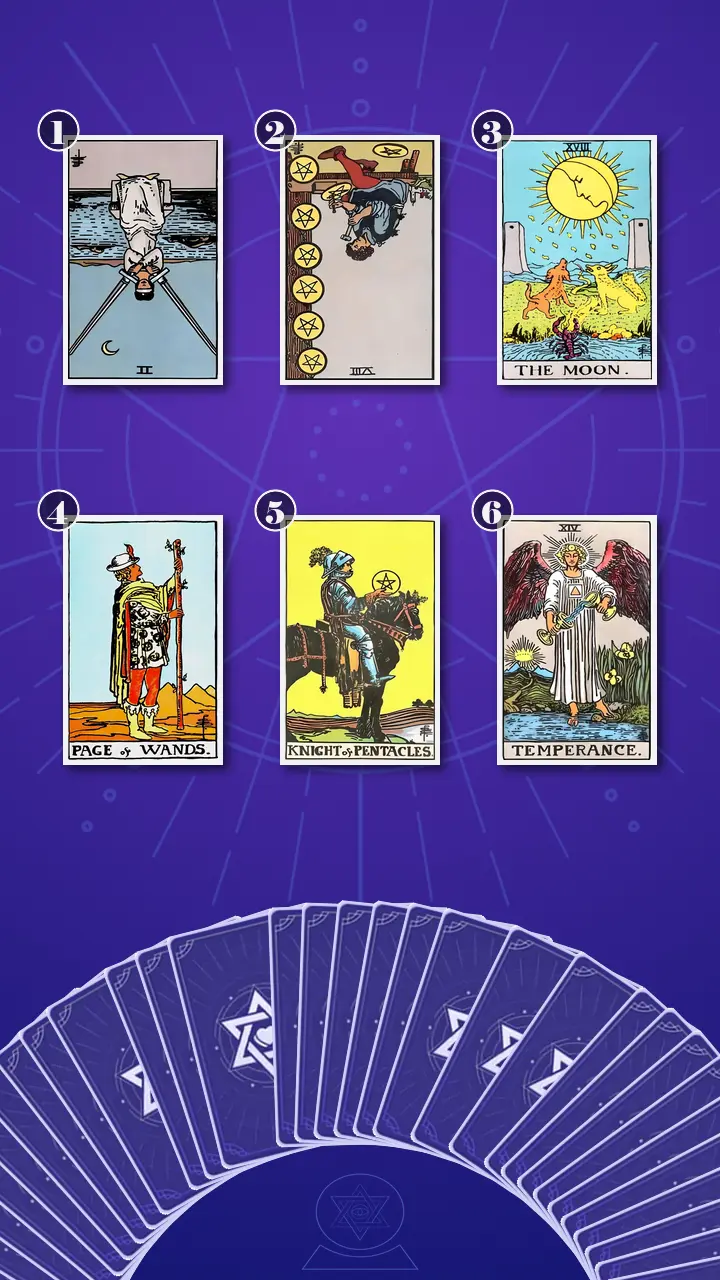
The card was the Two of Swords, in reversed position. The gray blindfold and crossed swords held across the chest looked to me like a carefully worded paragraph of reasons held as a shield: articulate, protective, and blocking contact with the next piece of information. In Jordan's modern life, this was the Slack message asking for a timeline. They typed a detailed explanation, reopened their decision notes, added another caveat, and never sent the short message that could have booked a low-risk conversation.
The energy was contracted Air. The mind had enough force to argue for the decision but not enough openness to let fresh evidence alter the next step. The reversed position showed a blocked equilibrium becoming visible. It did not mean Jordan had made the wrong choice; it showed that explanation had begun to replace movement. The useful question was simple: which single next action could provide information that another round of argument could not?
I also noticed the social character Jordan was trying to maintain: the person who always has the complete rationale, the answer ready before anyone can question the process. I call this Persona Fatigue Diagnosis, a way of noticing the psychological toll of performing an artificial character that conflicts with the ordinary, unfinished reality of learning. I was not diagnosing Jordan. I was naming the weight of having to sound certain before they were allowed to experiment.
Jordan's thumb stopped over the invisible Send button and their breath caught. Their eyes went distant as if the Slack thread were replaying itself. Then they gave a small, bitter laugh and said, "That is almost rude. I can explain the whole decision, but I go blank when someone asks what I am actually doing next."
I did not ask them to agree with the card or treat recognition as a verdict. I asked, "What would your body be protecting you from if the next step gave you information instead of approval?" Their jaw worked once, then loosened slightly. The first gate in the reading was not a lack of intelligence or commitment. It was the moment a defended conclusion needed contact with real conditions.
When Craft Became Proof
Now I turned over the card for the blocking mechanism: how the Process-Vision Split turns effort into stalled execution, specifically revealing the repetitive preparation that keeps the decision untested. Its standard meaning is the obstacle or challenge, the practical mechanism interrupting progress.
The card was the Eight of Pentacles, in reversed position. The seated craftsperson bent over the workbench and the row of repeated pentacles mirrored Jordan's duplicated Notion pages, revised spreadsheets, and polished slide decks. At 10:30 p.m., they could make a fourth pass through a decision framework, rename its sections, compare one more scenario, and perfect the wording of a process map. The same thirty minutes could have produced a fifteen-minute conversation or a rough work sample.
The reversed Earth was not a shortage of effort. It was effort being used to make the decision defensible instead of testable. Preparation had become a ritual of proof-seeking repetition. The central question arrived in the inner monologue I heard beneath Jordan's explanation: "I am doing work, so why does nothing new exist afterward?" The row of pentacles had become activity without a new data point.
I told Jordan that this card did not ask them to abandon process or leap blindly toward the vision. It asked them to end one preparation cycle by producing evidence. A message sent, a question answered, or a tiny sample made would be more informative than another persuasive paragraph.
Jordan's fingers moved toward their phone as though they might open the familiar notes app, then stopped. Their stomach dropped before they smiled at the accuracy of the reflex. I watched the recognition settle into the room, not as shame but as a precise image of the loop they had been calling responsible preparation.
The Moonlit Meaning of Being Wrong
Now I turned over the card for the underlying blind spot: the unexamined fear or assumption beneath the Inner Conflict, especially the belief that revising the process would prove poor judgment or loss of control. Its standard meaning is the root cause or subconscious influence, the hidden fear beneath the visible pattern.
The card was The Moon, in upright position. The winding path between the two towers, the dog and wolf facing the moon, and the crayfish emerging from the pool all showed partial visibility. Jordan had no failed test yet. They had an untested process, but their mind was leaping from one imperfect result to the imagined conclusion, "I judged badly and everyone will see it." Uncertainty had started to look like a warning.
I used one of my signature tools, Internal Monologue Auditing, and asked what genre Jordan's subconscious narration had been writing. It was not a neutral documentary. It had the lighting and music of a courtroom thriller: one flawed result becoming evidence, evidence becoming a sentence, and the sentence becoming a statement about their competence. I asked them to separate two lines: "What happened: the process has not been tested." Then: "What I am afraid it will mean: I judged badly and lost control."
The distinction mattered. I was not asking Jordan to replace fear with forced confidence, and I was not treating the Moon as a diagnosis. I was showing the gap between an observed fact and a projected consequence. The card's indirect light could not provide the certainty Jordan wanted, but it could make the mental jump visible enough to question.
Jordan's hands went still. Their gaze moved from the card to the imaginary two columns on the table, then unfocused as though an old conversation were being replayed. After a long breath, they said, "I keep asking for evidence, but I have already decided that any imperfect evidence will mean I was wrong." I let the silence hold that sentence without rushing to make it brighter.
When the Page of Wands Turned Defense into a Question
The room grew quiet when I reached beneath the upper-left card. I had the sense that we were no longer only describing the loop; we were approaching the hinge where its meaning could change.
The Living Spark Beneath the Verdict
Now I turned over the card for the key trigger: the smallest shift that reconnects the vision with process, translating the Decision Blind Spot into a curious, bounded experiment. Its standard meaning is a turning point, guidance, or catalytic influence.
The card was the Page of Wands, in upright position. The Page's focused gaze rested on a sprouting wand, as if possibility were not a finished announcement but a living thing worth investigating. In Jordan's life, this looked like sending one exploratory message to a former colleague, asking for fifteen minutes and one specific answer. No career pivot announcement. No full decision document. No promise that the vision was permanently settled.
The Page introduced Fire as curious initiative and beginner's openness. This was not confidence performed for an audience. It was the willingness to approach reality with one useful question. The Page became a bridge between the Moon's incomplete visibility and the Knight of Pentacles' grounded follow-through. I said, "Your decision does not need a courtroom; it needs a small test. Let the next step be a question, not a verdict."
At 8:47 p.m. on the TTC Line 1, Jordan had scrolled past another polished career update, reopened the decision document, and added one more reason the choice made sense. Their phone was warm, the carriage lights buzzed, and the message that could create real information remained unsent.
You do not need to keep defending the decision until uncertainty disappears; let the Page of Wands carry the vision into one curious, bounded experiment, so the Process-Vision Split becomes information instead of a verdict.
I let the sentence sit between us. Then I gave Jordan the shorter version that brought the whole reading into focus.
You are not missing a stronger defense of the decision. You are missing a small experiment that lets the vision teach the process. A result can revise the method without becoming a verdict on your judgment.
Jordan's thumb froze above the table, and their breath stopped halfway in. For a beat, their face held the stunned blankness of someone whose defense had lost its script; their pupils seemed to widen, and the blue window light caught at the waterline of their eyes. Then their gaze slipped past the Page, replaying the Slack question, the unsent message, and the fourth revision. Their fingers tightened against the chair, released, and rested open on the cloth. Their shoulders dropped as if a heavy backpack had been unbuckled. A small, uneven exhale left their chest. When they spoke, their voice was low and rough: "So the experiment is not asking me to prove I was right." Relief arrived with a brief, dizzying blankness. Without a courtroom to maintain, they had to choose a living question.
I asked, "Now, use this new perspective to remember last week. Was there a moment when this insight might have made you feel different?" Jordan remembered a manager asking for a next step and saw that the question had not been an attack. It had been an invitation to make the process observable.
This was the first movement from defensive overanalysis and fear of flawed judgment toward curious experimentation, grounded self-trust, and adaptable progress. It was not certainty. It was the moment a meaningful decision became a working hypothesis rather than a verdict on personal worth.
The Calendar Block with a Finish Line
Now I turned over the card for the action path: a specific, repeatable behavior that generates evidence without requiring a final verdict or surrendering personal agency. Its standard meaning is practical advice or the next step, the grounded action that gives the situation something real to respond to.
The card was the Knight of Pentacles, in upright position. The stationary dark horse and the pentacle held carefully in front of the Knight looked like a calendar block that was deliberately small, dated, and repeatable. In Jordan's life, it was one weekly thirty-minute block to conduct a conversation, make a small work sample, or review what the previous test taught them. The task needed a finish line and a review date, not a dramatic leap.
This was steady Earth, useful precisely because it did not demand a performance of bravery. I asked, "What can you complete and review, even if it tells you to adjust the route?" I watched Jordan open Google Calendar and move their attention from broad promises to a date, a duration, and a deliverable. The practical process was beginning to carry the vision in a modest way.
Two Cups, One Evolving Route
Now I turned over the card for integration: the self-directed state in which vision and process inform each other, allowing the person to revise methods without treating revision as personal failure. Its standard meaning is outcome, synthesis, or lesson, used here for reflective integration rather than prediction.
The card was Temperance, in upright position. The angel blending liquid between two cups, with one foot on land and one in water, made the final image about cooperation between practical evidence and personal meaning. Jordan could keep the core direction while changing its timeline, scale, audience, or method. A first trial with two people instead of ten would not erase the vision. It would give the vision a more workable shape.
I explained the contrast plainly: revision of the process was not rejection of the self. Temperance did not ask Jordan to choose between protecting the vision and respecting evidence. It offered a rhythm in which movement and revision could coexist. Jordan's relief was measured rather than dramatic. They looked at the two cups, then at their calendar, and said, "I can adjust one variable without rewriting what matters to me."
The Decision Becomes a Working Hypothesis
When I set the six cards beside one another, the story was coherent. The reversed Two of Swords showed the visible defense: explanation had stopped where action needed to begin. The reversed Eight of Pentacles showed why the stalemate persisted: repeated preparation produced a stronger rationale but no new evidence. The Moon revealed the fear underneath it, the leap from an imperfect result to a verdict about judgment and control. Then the Page of Wands brought curiosity, the Knight of Pentacles gave curiosity a date and a finish line, and Temperance showed how the method could evolve without abandoning the destination.
Jordan had been guarding a bridge blueprint instead of walking onto the bridge. The cognitive blind spot was not simply "I need more information." It was the belief that the decision had to be fully defensible before the process was allowed to teach it anything. I named the transformation direction clearly: replace repeated justification with one small, time-bounded, reversible experiment that generates process evidence while leaving the final verdict in Jordan's hands.
I returned to The Director's Cut of Self-Compassion, my mental editing technique for pausing a spiral of self-hatred and changing the internal narrative from a punitive judge to an objective, supportive observer. I asked Jordan to notice the first script: "If this test is imperfect, I was wrong." Then I offered the director's cut: "This is one bounded test. The result can teach me what to adjust, and I can decide what happens next." The new line did not flatter them or promise success. It gave them a fairer scene in which learning was possible.
I kept the next steps deliberately small. I wanted action to create contact with reality, not another standard Jordan could fail to meet.
From Insight to Action: Let Reality Answer One Question
- Ask one useful questionWithin the next week, choose one low-risk former colleague or trusted peer and send a three-sentence message asking for a fifteen-minute conversation about the professional direction Jordan is exploring. Name one specific question, leave out the full decision document, and record one observed fact, one surprise, and one process adjustment after the conversation.Use: "I am exploring X and would value fifteen minutes to understand Y. I am not asking you to validate the whole plan." If the person feels too high-stakes, use a trusted peer, an anonymous community question, or a two-minute voice note to yourself. Send only if the choice remains freely yours.
- Book the evidence blockPut one thirty-minute block in Google Calendar this week with the title "Run the test, do not defend the decision." During that block, produce one visible artifact: a draft outreach message, a five-question interview guide, or a rough sample of the process. End by writing what the artifact taught you.Use the Director's Cut before opening Notion, Slack, or another research tab. If resistance is high, use a five-minute version or the first two-minute action, then stop without turning the smaller version into a new obligation.
- Review one variableAt the end of the week, compare the experiment with the original process in three lines: what happened, what it suggests, and what to adjust. Choose only one variable for the next attempt, such as scope, timeline, audience, or format, and set a review date instead of demanding a final conclusion.Keep the core value or vision steady while changing one proportion at a time. Process can change its route without invalidating the destination, and a private review with a trusted person is enough.
A Week Later, the Quiet Proof
Six days later, I received a message from Jordan while I was making tea. They had sent the three-sentence note to a former colleague and completed the fifteen-minute conversation. The answer did not settle the entire career direction. It showed that the first trial was too broad, so Jordan narrowed it from ten potential participants to two and kept the central vision intact.
Jordan told me that they slept through the night afterward, then woke with the familiar thought, "What if I am wrong?" The thought was still there, but this time they smiled, opened the calendar, and kept the thirty-minute evidence block. The uncertainty had not vanished; it had stopped being the only voice in the room.
I had not made the decision for Jordan, and the cards had not made it for them. I had helped them see the decision blind spot, separate facts from imagined consequences, and hand the pen back to the person living the next scene. That is the movement from career pivot anxiety and analysis paralysis toward grounded self-trust: not a perfect answer, but a real experiment and the freedom to learn from it.
I still describe this as the work of a Six-position Transformation Path Grid tarot spread for reflective decision analysis: a self-exploration map that turns a defended choice into a question reality can answer. The Journey to Clarity is not about surrendering authority to tarot. It is about using a clear structure to reconnect intuition, evidence, and the part of you that can choose again.
When the conversation shifts from "why this decision makes sense" to "what happens next," your jaw may tighten because one imperfect test feels dangerously close to proof that you judged badly and lost control. I hope you can meet that tightening with the same fairness Jordan practiced, allowing the sprouting wand to remain a possibility rather than a demand.
If the next step were only a private, fifteen-minute experiment for learning rather than a public verdict, what small question might you feel curious enough to let reality answer?