After a Tender Text: From Urgent Job Tabs to One Honest Sentence

The 6:42 a.m. Life Pivot After Closeness
Jordan was a 29-year-old Toronto product designer who had left a tender conversation, opened LinkedIn, Realtor.ca, and three course pages, and called the sudden urge to reinvent their life a career pivot before asking what had felt threatening.
At 6:42 a.m., they joined my video call from their rented Toronto apartment. I heard the radiator clicking behind them and the wet hiss of a delivery truck outside. An untouched mug sat beside the laptop. Jordan held up a warm phone showing a half-written reply to their partner, then turned it face down and rubbed both palms against their sweatpants.
“The minute closeness becomes real, I start planning a different life,” they said. “Last night they asked if we could make more consistent plans. Nothing dramatic. But this morning I’m comparing jobs in Vancouver and rent in Montreal. Part of me wants to be known, and another part wants to become impossible to depend on.”
I asked what happened in their body before the first listing appeared.
“My chest locked. My hands got fast. Then the new plan felt amazing, like I’d got my edge back.”
I heard the central contradiction clearly: Jordan wanted closeness, but feared that intimacy would make them less capable. The fear moved through them like a fire alarm wired to the refresh key. Every new tab looked productive, yet none answered the feeling that had started the search.
“I’m not here to tell you whether to stay, move, quit, or commit,” I said. “I want us to work out whether this pivot belongs to your values or to the urgent need for distance. Let’s draw a map through the fog before speed draws one for you.”

Choosing the Four-Layer Insight Ladder
I asked Jordan to place both feet on the floor, take one ordinary breath, and hold the question in mind without trying to solve it. I shuffled slowly. For me, that small pause is not a mystical performance; it is a deliberate transition from reacting to observing.
I chose the Four-Layer Insight Ladder, a four-position tarot spread for relationship patterns. The question was not asking me to predict a partner’s behaviour or declare the future of the relationship. It was asking why a visible life pivot appeared after closeness, what belief powered it, which capacity could interrupt it, and how that capacity could become an everyday practice.
This is how tarot works in my consultations: I use the images as an external thinking surface. Card meanings in context help me separate behaviour, assumption, resource, and next step so that a complicated emotional loop can be examined without treating it as fate.
I arranged the cards as a 2x2 stepped ladder. The first position would reveal the observable pivot. The second would expose the story linking intimacy with reduced competence. The third, our bridge, would identify the agency Jordan could use without leaving the conversation. The fourth would turn insight into a grounded experiment. It was the smallest spread that could trace the full sequence without burying Jordan beneath ten different answers.
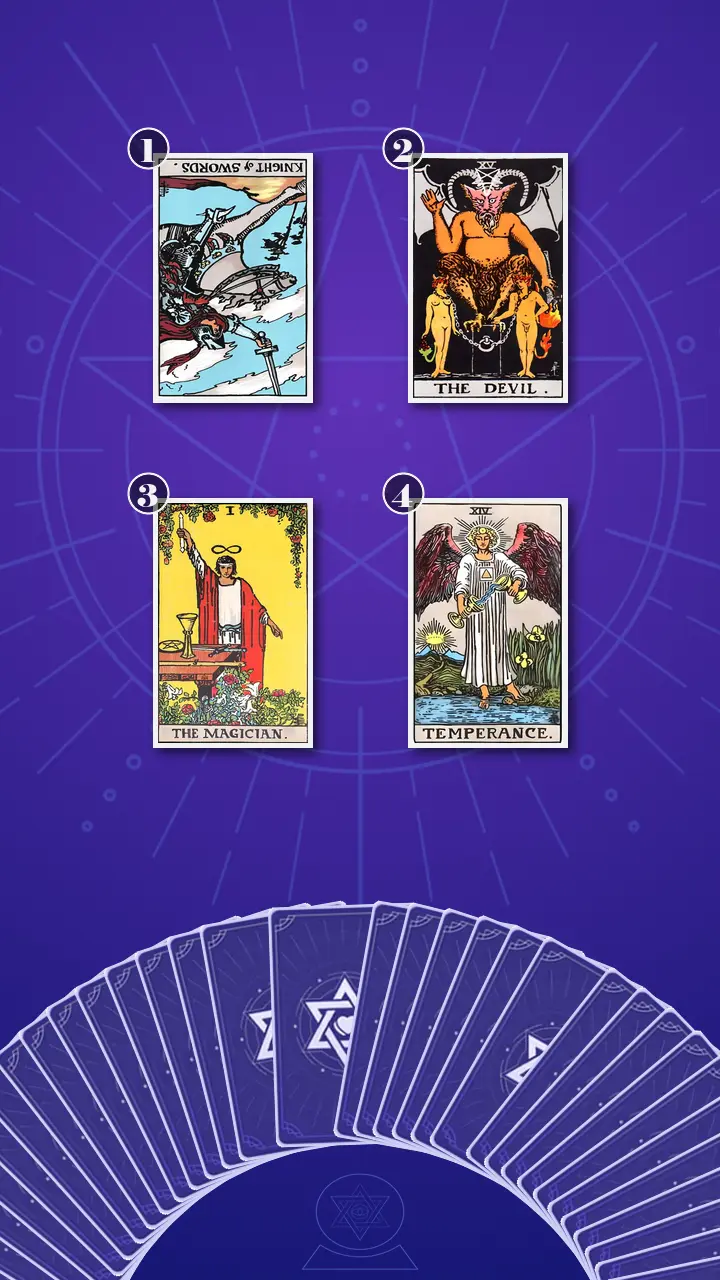
The Tabs That Looked Like Clarity
Position 1: The Knight Charging Without a Destination
I began with the card representing Jordan’s present pattern: the observable, impulsive life pivot that appeared when emotional or practical closeness made competence feel threatened.
I turned over the Knight of Swords, reversed.
I pointed to the charging white horse, the raised sword, and the windblown landscape. Upright, the Knight can carry conviction and decisive mental energy. Reversed here, that Air energy was in excess: thought had accelerated past feeling, dialogue, and destination. Movement was being mistaken for clarity.
In Jordan’s modern life, the card looked almost literal. They left a close conversation and immediately opened LinkedIn, Realtor.ca, and course pages. The raised sword became the thought, I need a new plan now, before they see me uncertain. The storm around the horse became a browser full of jobs, cities, rent calculators, and Google Maps commutes, all moving forward without answering where Jordan actually wanted to go.
“What would remain true if you waited one hour before opening the first listing?” I asked.
Jordan gave a short laugh that carried no amusement. “That’s so accurate it’s almost cruel.” Their breath stopped first. Their index finger hovered above the trackpad as if it had forgotten its next command. Then their gaze slipped past the screen, replaying something I could not see, before one shoulder lowered with a thin exhale. “I call it ambition because I don’t have words for what happens underneath it.”
“I don’t hear this card saying your ambition is fake,” I replied. “A move or career change may still be right. I hear it asking whether speed has become a way of leaving the conversation. The reversed Knight’s corrective is simple: let the plan exist for 72 hours without allowing its first surge of energy to make an irreversible decision.”
Position 2: The Chain That Felt Like a Contract
I moved to the card representing the underlying root: the hidden story that receiving love, help, or influence would reduce Jordan’s self-worth, privacy, or power to choose.
I turned over The Devil, upright.
I named the card carefully. I do not treat The Devil as a threat, a bad omen, or proof that a person or relationship is dangerous. In this position, it illuminated an active attachment story: the belief that closeness and captivity were the same thing.
I drew Jordan’s attention to the chains linking the figures to the pedestal. In daily life, those chains appeared when their partner offered help with a stressful task and Jordan immediately began calculating how to remove every practical reason they might need that person. The private line was blunt: If I need them, what does that say about me?
The Devil’s energy was a blockage, not an external sentence. The desire for connection had become fused with a fear of lower status and weaker agency. Receiving care felt like accepting a contract whose hidden terms included obligation, exposure, and surrender, even when no actual choice had been removed.
For a moment, I remembered the contracts I used to read on Wall Street. A genuine restriction had clauses, dates, counterparties, and consequences. Fear could feel equally binding while providing none of that evidence. I looked again at the loose chains in the card and asked, “Which choice did your partner actually take away last night?”
Jordan pressed their thumb into the edge of the phone. “None,” they said. “They asked about next month. I turned it into the rest of my life.”
“That distinction matters,” I said. “A request can still be unwelcome. A boundary may still be needed. But needing support is not the same as surrendering the controls. The card asks you to separate the observable request from the story that accepting any care will make you less impressive, less safe, or less yourself.”
When the Magician Put Capability Back on the Table
Position 3: One Skill, One Boundary, One Honest Feeling
The light outside Jordan’s window had shifted from steel grey to a thin winter gold. As I reached for the third card, the room seemed to become quieter around the clicking radiator. I turned to the position representing the transformative resource: the inner capacity that could let Jordan stay close while retaining agency.
I revealed The Magician, upright.
I asked Jordan to return mentally to 6:42 a.m.: the glowing partner text, the tightening chest, the multiplying tabs, and the sudden belief that a fresh city proved they still belonged to themselves. Their usual choice had been framed as escape or collapse, with nothing credible between them.
The Magician offered the missing middle. Its energy was in balance: conscious agency supported by tools already present. Jordan did not need to acquire a new role, postcode, qualification, or identity before becoming capable enough for one difficult conversation.
I mapped the four tools on the Magician’s table to a clear design desk. The cup held the feeling: I want this closeness, and it scares me. The sword supplied the exact sentence. The pentacle protected a practical limit, such as time, money, privacy, or the right to think. The wand held the initiative to remain present and choose the next small action. Relational competence was not a lesser form of competence. It was the ability to use feeling, language, judgment, and choice in the same room.
I applied what I call Strategic Path Valuation. I was not valuing Jordan’s relationship like an asset. I was comparing the long-term viability of two operating paths. Path A, proving independence through repeated reinvention, delivered fast relief and a convincing burst of control, but its costs recurred across rent, work, routines, relationships, and self-trust. Path B, holding one boundary and staying for one honest exchange, offered less adrenaline but far better information, stronger optionality, and a skill that could scale across cities, jobs, and relationships.
Then I gave Jordan the sentence at the centre of the reading.
You do not have to pivot away from closeness to remain capable; bring one skill, one boundary, and one honest feeling into the same conversation, as the Magician places all four tools within reach.
I let the silence stand. First, Jordan froze with their lips slightly parted and their breath held high in the chest. Their pupils widened; their hands, clenched beneath the sleeves of their sweatshirt, slowly emerged and opened on the table. Then their eyes lost focus as if a private reel of previous moves, applications, and abrupt endings had begun playing behind them. Their eyes reddened before their shoulders finally dropped.
“But doesn’t that mean all those pivots were wrong?” they asked. The words came out low and sharp, with anger protecting something more fragile. A second later, the anger loosened into a shaky breath. Relief crossed their face, followed by a brief, almost dizzy blankness: the new clarity returned responsibility to them.
“No,” I said. “Some may have been right, some protective, and some both. This is not a retroactive verdict. It is a new way to gather evidence before the next one.”
I waited, then asked, “Now, using this new perspective, think back to last week. Was there a moment when this insight might have made you feel different?”
Jordan told me about their partner offering to review a portfolio case study. Jordan had declined, cancelled their weekend plan, and started a relocation budget. “I could have said I wanted help, but I didn’t want feedback on the unfinished part,” they said. “That would have been the feeling, the boundary, and the request. I had all three. I just used my skills to leave instead.”
I set a ten-minute timer and invited them to write three private lines: the pivot I want; the feeling that appeared just before it; one need I could name without giving up my choice. I made it clear that they did not have to send the note or make a decision. If the exercise became too intense, they could stop, make coffee, wash a dish, or return to another ordinary grounding task before choosing whether to revisit it.
This was the breakthrough: not a promise to stay, but a move from proving competence through urgent distance and reinvention to practising self-directed closeness with deliberate choice. Jordan’s agency had not vanished inside intimacy. The Magician showed where it could be used.
Position 4: Temperance and the Week That Holds Both
I turned to the final card, representing grounded integration: the small relational practice that could separate intimacy from competence and interrupt the next impulsive pivot.
I revealed Temperance, upright.
I centred the two cups, the measured exchange between them, and the angel standing with one foot on land and one in water. Temperance carried balanced energy: emotional participation without abandoning practical autonomy, patience without passivity, and connection without total access.
I asked Jordan to picture an ordinary shared kitchen or a Google Calendar rather than a dramatic breakthrough. Two calendars could share one event without merging every appointment. Jordan could keep their Wednesday design meetup or Sunday solo coffee, make one time-limited plan with their partner, and name one honest need. One foot could remain in a self-directed routine while the other entered emotional contact.
“The experiment is not ‘Choose the relationship instead of the move,’” I said. “It is ‘Do not make either one the verdict tonight.’ If the urge to relocate or quit appears, you can record it without obeying it. You can keep one part of your life yours while letting one honest sentence enter the room.”
Jordan traced the rim of Temperance’s first cup with their gaze. Their mouth tightened, then softened into a wary half-smile. “That sounds almost too ordinary,” they said.
“It may feel flat at first,” I replied. “A reset gives you adrenaline. Proportion usually does not. But ordinary repetition is how you collect proof that closeness and capability can occupy the same week. You do not have to choose all closeness or all distance tonight.”
The 72-Hour Gate Between Urgency and Clarity
I drew the four cards into one line of cause and choice. Repeated resets had taught Jordan that movement could restore control quickly. The reversed Knight showed the current expression: fast thinking and logistical action before the feeling could be named. The Devil revealed why that speed felt necessary: intimacy had become fused with reduced competence, so ordinary support registered as a threat to agency. The Magician restored the overlooked resource, the ability to communicate, set limits, feel, and initiate without disappearing. Temperance slowed that agency into a repeatable practice.
The whole reading reminded me of switching TTC lines every time someone sits beside you. Changing trains creates immediate space, but it also prevents you from learning whether the original seat was unsafe, merely uncomfortable, or exactly where you wanted to remain. Jordan’s central blind spot was not ambition. It was treating immediate relief as reliable evidence, then mistaking the energy of escape for the clarity of a considered choice.
I also used Sunk Cost Decoupling to protect Jordan’s freedom in both directions. Their previous years in a role, city, or relationship did not obligate them to stay merely to justify the investment. Equally, their identity as an adaptable person did not obligate them to pivot whenever staying became emotionally exposing. Past investment was information, not a command.
I translated the reading into two actionable next steps. Neither required Jordan to disclose more than they wanted, accept unwanted help, or remain in a relationship or city that no longer fit. The goal was to create enough clean information for a deliberate Hold or Pivot decision.
- The 72-Hour Pivot Pause and 5-Year Horizon Stress Test When a tender conversation triggers a job, rental, course, resignation, deposit, or move, copy the link into a private note instead of applying, paying, announcing, or cancelling anything. Add a reminder for exactly 72 hours later titled “Check the feeling, not just the plan.” At the reminder, ask: Would I want this if last night’s conversation had not happened? Does this path improve the next five years of my values, finances, work, and daily life? Does it scale, or does it mainly buy immediate distance? Then make one micro-decision: Hold, or Pivot to one reversible research step. Define “major” before the next trigger and turn off listing alerts for the evening. Hold does not mean stay forever; Pivot can mean one interview, budget check, or informational call rather than an irreversible leap.
- The Four-Tool, Two-Cups Week During the next week, protect one existing independent routine and make one low-stakes shared plan with a clear start and end time. In text, a voice note, or conversation, use: “I want to stay connected, I need ___, and I am not deciding ___ tonight.” Ask for one precise form of support, such as ten minutes of listening or help with one practical task. Afterwards, write down what was actually requested of you and what you feared would be requested. Keep the experiment ordinary enough that it cannot become another performance. A short coffee, walk, or defined call is sufficient, and a boundary may include privacy, a time limit, or the right to answer later.
“These cards are not voting on your future,” I told Jordan. “They have separated the reflex from the decision. You still own the decision.”

Six Days Later: A Smaller Kind of Proof
Six days later, Jordan messaged me. They had saved a Vancouver role without applying, kept their Wednesday design meetup, and sent the one honest sentence. They slept through the night. Their first thought at dawn was, “What if I’m wrong?” They smiled, made coffee, and waited.
I read that message as evidence, not a grand transformation. Jordan had not solved their career, city, or relationship. They had experienced fear without immediately converting it into an instruction, and had kept both autonomy and contact intact long enough to make a more deliberate choice.
I do not think the Four-Layer Insight Ladder gave Jordan an answer. It gave them a sequence they could see: rush, binding story, available skill, measured integration. That was their Journey to Clarity, from disappearing to feel capable toward using capability inside connection. Tarot supplied the map; Jordan supplied the pause, the sentence, and the choice.
If someone you want beside you gets close enough to notice your uncertainty, and your chest locks while your hands begin building an exit route, I hope you remember this: noticing the first new-city tab before it becomes a verdict means you are already somewhere different from the starting point.
So, when the browser begins filling with a new life after one vulnerable text, which appointment will you keep as your own, and what one Magician truth will you let enter the room before deciding what your whole life needs to become?