From Protecting a Learning Streak to Building Evidence of Skill

The 10:47 p.m. Learning Streak That Kept Growth Waiting
At 10:47 p.m. on a Tuesday, I watched Jordan, a 27-year-old junior UX designer in Toronto, finish a five-minute technical lesson because the streak warning felt more urgent than the half-built feature glowing on their laptop. The fluorescent kitchen light made everything look slightly overexposed. A fridge hummed behind them, the laptop fan pushed out a dry mechanical whisper, and they shifted the phone between their palms as if it had grown too warm.
The completion animation flashed. Jordan's shoulders dropped for one breath. Then their fingers resumed tapping against the table, and their eyes moved back to the unfinished prototype.
“I am learning every day,” they said, “so why do I still feel like I am at the starting line?”
I knew the routine they were describing. After a full workday, the shortest familiar module offered a clean ending: tap, answer, celebrate, preserve the number. The prototype asked for something messier. It required decisions without prompts, mistakes without a reassuring animation, and perhaps another person's eyes on work that was not ready to impress anyone.
“If the number resets, what was the point?” Jordan asked. Their jaw tightened before they added, more quietly, “I can finish another lesson. I just don't want to show anyone what I can actually make.”
The pressure in their body looked like a TTC train stalled between stations: shoulders locked, fingers restless, one brief lurch of relief when the counter moved, then the same fluorescent nowhere. The feeling was not simply frustration. Shame sat beneath the relief, boredom had settled into the repeated beginner exercises, and apprehension waited inside the open project tab.
I said, “You keep doing the countable task because the measurable signal feels safer, while the applied task waits beside it and asks what you can actually do. I am not going to tell you that consistency is bad, or that you need to delete the app and reinvent your life tonight. Let's find out what the streak is doing for you, what it is protecting, and how it might serve your learning without judging your worth. We are going to draw a map through this fog.”
Choosing a Map Shaped Like a Workshop
I asked Jordan to place the phone face down, take one unforced breath, and hold the question in plain language: “Why am I protecting my learning streak instead of actually growing?” I shuffled slowly. The pause was not a mystical test. It was a psychological threshold between reacting to the notification and examining the pattern.
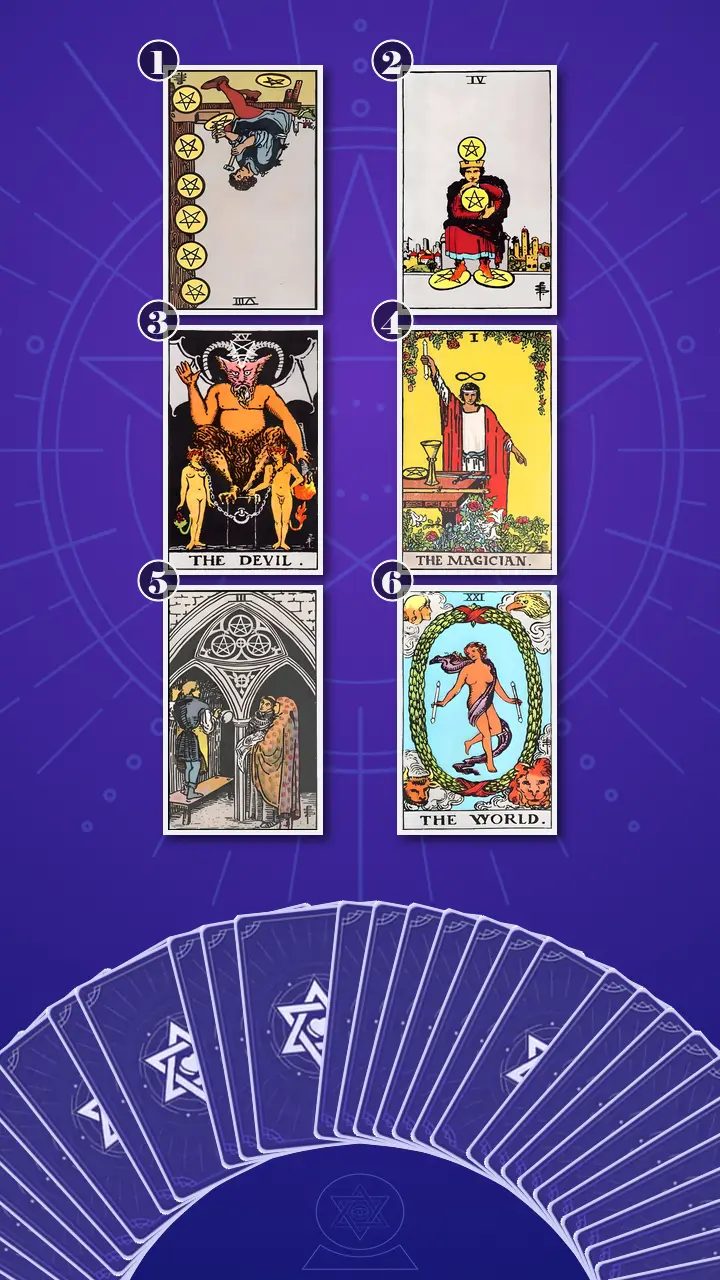
I chose the Rider-Waite-Smith Transformation Path Grid (6) · Context Edition. For anyone wondering how tarot works in my practice, I use a spread like a structured cognitive map. The cards do not announce an unavoidable future. Their positions separate a tangled experience into parts that can be observed, questioned, and changed.
This question was not really a choice between two courses or two career paths. It was a self-reinforcing system: the streak warning triggered protective behavior, the preserved number created immediate relief, and that relief made the same low-risk behavior more likely tomorrow. A broad Celtic Cross would have introduced more context than we needed. This six-card spread was precise enough to track the loop from symptom to defense, from defense to root, and from root to a practical intervention.
I laid the cards in a two-column, three-row grid and read them in a serpentine path. The first position would show the visible learning behavior. The second would reveal the protective grip behind it. The third would identify the bargain beneath that grip. The fourth, our key trigger, would locate the smallest useful shift. The final pair would turn that shift into feedback-based action and a wider definition of progress.
On the table, the layout resembled a workshop floor plan: a closed bench at the top, a central hinge in the middle, and an open practice space below. That structure mattered. Jordan did not need another lecture about discipline. They needed to see where choice had disappeared from their routine and where it could be restored.
The Closed Loop Behind the Progress Bar
Position One: The Work That Looks Finished
The card I turned over represented the present state: the observable learning-streak behavior and the stagnant emotional energy shaping Jordan's question. It was the Eight of Pentacles, reversed.
In the Rider-Waite-Smith image, a craftsperson works on one pentacle while a row of completed pentacles hangs nearby. Upright, the card often speaks to deliberate practice and refinement. Reversed, its energy can enter Blockage: effort continues, but attention shifts from improving the craft to producing repeatable evidence that work occurred.
I pointed to the pentacle under the worker's hands, then to the finished row. “This one is the skill being shaped. The row is the dashboard full of completed units. The question is not whether the row is fake. The question is which one is receiving your hands.”
The modern scene was already open around us. At 10:47 p.m., Jordan had tapped through another familiar five-minute lesson while a half-built UX feature waited on the laptop. The animation had added one visible unit, but the project requiring independent decisions, failure, and revision had remained untouched. The distant town in the card looked like the real-world practice they kept seeing without entering.
I said, “A progress bar is like a delivery receipt. It can confirm that something arrived, but it cannot tell you whether you can use what was delivered. Right now, your routine is heavy on counted exposure and light on transfer.”
Jordan's breath caught. Their gaze left the card and landed on the prototype tab behind our call. Then a short laugh came out, dry and slightly embarrassed.
“That is so accurate it feels kind of brutal,” they said. “I am doing the work, so why does the work still feel like evidence that I haven't begun?”
I answered, “The accuracy is not an indictment. This card is not calling you lazy. It is showing that a system can reward a behavior long after that behavior stops producing the outcome you wanted. You have been returning consistently. Now we need to ask what returning is changing.”
Position Two: The Number Held Against the Chest
The next card represented the blockage: the protective grip that made preserving the streak feel safer than confronting the uncertainty of actual growth. It was the Four of Pentacles, upright.
The figure clutches one pentacle against the chest, stands on two more, and holds another above the head. Security energy is useful when it creates a stable base. Here it had moved into Excess. The measure was under Jordan's feet, in their hands, and above their thoughts. A tool for tracking consistency had become an enclosure for self-evaluation.
I translated the image into a moment Jordan knew well: finishing a lesson on the TTC, holding the phone close, checking that the streak was intact, and only then looking at the unfinished prototype. The number produced a quick drop in tension. That bodily reward made the slower task, with no instant proof, feel more threatening than it objectively was.
“If I hid the counter for one week,” I asked, “what would remain valuable about your learning practice?”
Jordan's fingers closed around the edge of the phone even though it was still face down. Their eyes narrowed, not in disagreement but in concentration.
“My first answer is that I would still have the lessons,” they said. “But my honest answer is that I wouldn't know whether I was still a consistent person.”
For a moment, I remembered the performance screens from my Wall Street years. I had watched intelligent people confuse a moving indicator with the health of the underlying position. A dashboard can inform a decision. Trouble begins when the dashboard is allowed to make the decision and define the person reading it.
“That is the blockage,” I said. “The streak is carrying more than attendance. It is carrying identity, control, and reassurance. We do not need to shame that protective grip. We need to understand why loosening it feels like losing part of yourself.”
Position Three: The Bargain Renewed in Five-Minute Payments
The third card represented the root: the underlying bargain that sustained learning stagnation and turned a gamified metric into evidence of self-worth. It was The Devil, upright.
I never treat The Devil as a threat, curse, or prediction. In this position, it described an attachment loop. Its energy was caught in Blockage: a reinforcing bargain felt compulsory because it repeatedly converted discomfort into relief.
The chained figures on the card mattered, but so did the looseness of their chains. The horned figure stood above them like an authority. In Jordan's routine, a late-night reminder had begun to sound like a manager's instruction: complete anything now or lose the identity of being disciplined. Jordan chose a low-risk lesson, received the reward animation, and renewed the bargain for another day.
“The app's algorithm keeps recommending the easiest form of success because every easy completion trains both the platform and your nervous system to request more of the same,” I said. “The streak becomes a subscription you renew with five-minute payments, while the real project requires a larger and less predictable investment.”
Jordan rubbed one thumb across the other. Their mouth tightened before they asked, “So am I just being manipulated by the app?”
“The design is doing its job,” I said, “but that does not remove your agency or make this your fault. The important question is where you have granted the counter authority over what counts as a good learning day. The chains are loose because the relationship can be renegotiated.”
I let the next sentence arrive without softening it into vagueness: “You are not protecting learning; you are protecting what the number lets you believe about you.”
Jordan's jaw set. Their eyes dropped to the card, unfocused for a few seconds as though they were replaying every late-night reminder. Then they released a long breath and turned the phone farther away.
When The Magician Turned Attendance Into Use
Position Four: The Tool Already Within Reach
The fridge motor clicked off just as I reached the center-right position, and the sudden quiet made the room feel larger. The card I turned over represented the key trigger: the smallest shift capable of loosening the inner conflict and moving Jordan from protecting the streak toward actually growing. It was The Magician, upright.
This was the bridge card. The Magician's energy was in Balance: conscious will joined with available resources. One hand raised the wand; the other pointed toward the ground. On the table sat a wand, cup, sword, and pentacle. I read them as initiative, reflection, clear explanation, and tangible construction. Possibility was not being admired from a distance. It was being routed into use.
I described a different ending to Jordan's five-minute lesson. The course app could remain open, but instead of starting another module, Jordan could switch to a blank Figma frame, a code sandbox, a notes page, or a voice memo. They could make or explain one small feature from memory before asking the dashboard to certify anything.
This was where I used my Potential Actionability Assessment. I translated the inspiration into one disciplined milestone: within ten minutes, could Jordan produce a visible attempt, expose one uncertainty, or revise one detail without step-by-step prompts? The milestone did not need to be polished, public, or career-changing. It needed to create evidence that information had crossed into action.
I also applied a lens I call Pseudo-Growth Eradication. The name is intentionally blunt, but its target is never the learner. I use it to strip self-help language away from a routine and audit four things: input consumed, action attempted, feedback gained, and revision made. Another badge might score well on input and near zero everywhere else. One awkward Figma frame could score low on polish but high on execution and learning value.
I asked Jordan to return mentally to 10:47 p.m.: the warm phone, the humming laptop, the shoulders dropping when the counter updated, and the project quietly asking for the riskier kind of practice. I could see the old binary still operating in their face: preserve the perfect record or risk discovering a gap.
A streak can prove that you returned; it cannot prove that the skill moved. Growth starts when one lesson becomes something you attempt, inspect, and revise.
Instead of letting Inner Conflict keep Healing Stagnation alive through another badge, let The Magician's table of four tools turn one lesson into an applied experiment that makes growth visible through use.
I stopped speaking. Jordan's breathing paused first, and their fingertips remained suspended a few millimetres above the table. Their pupils widened as their gaze moved from the Magician's tools to the unfinished file on the laptop. Then their expression hardened.
“But doesn't that mean I've been doing it wrong this whole time?” they asked. The first words came out sharp; the last were thinner. “I've protected that streak for more than a year.”
I watched the anger reach its real destination. Their eyes became wet without spilling over. Both shoulders descended, but the release did not look purely comforting. It carried the slight dizziness of setting down a weight and realizing that free hands now have to choose what to pick up. Jordan opened one fist, pressed the palm flat against the table, and gave a quiet, uneven exhale.
“No,” I said. “The streak helped you return during a demanding year. That value is real. You are not being asked to put your past on trial. You are noticing that the tool completed one job and is now being asked to do a different job it cannot perform. We are changing its assignment.”
I leaned closer to the camera. “Now, using this new perspective, think back to last week. Was there a moment when this insight could have made you feel differently?”
Jordan looked toward the laptop and answered slowly. “Thursday. I finished a lesson about error states, and I almost tried one in the prototype. Then I thought it would take too long, so I did another quiz instead. If the goal had been one experiment, not proving I was on track, I probably would have opened the file.”
That was the first movement in the deeper emotional transformation: not instant confidence, but a shift from metric-protective anxiety toward curiosity. Jordan had identified one moment when agency was available and one tool already within reach. Grounded self-trust could now be built from evidence of changed skill rather than borrowed from an uninterrupted number.
The Work Became Visible to Another Pair of Eyes
Position Five: Feedback Without a Verdict
The fifth card represented the action plan: a concrete, low-risk learning experiment involving practice, feedback, and revision rather than another badge. It was the Three of Pentacles, upright.
The card's collaborative energy was in Balance. A craftsperson stood at the work while two people consulted the plan. No one in the image was being judged as a complete human being. A specific piece of work was being examined against shared standards so it could become clearer.
I connected that scene to Jordan's real options. They could post one rough interaction, small code sample, or plain-language explanation to a trusted colleague through Slack, Discord, email, or a course forum. They could ask one contained question: “What is one place where this idea could be clearer or more useful?” Then they could revise one detail and record what changed.
“Feedback is not a verdict,” I said. “It is a second set of eyes on one version of the work. Think of it as a small pull request, not a public referendum on whether you belong in tech.”
Jordan's thumb resumed tracing the phone's edge, but their shoulders stayed lower. “I don't want to post the whole thing publicly,” they said.
“Then don't,” I replied. “Public exposure is not the assignment. You choose the person, the fragment, the question, and the boundary. A screenshot and one asynchronous response can be enough. Being seen should serve the learning, not override your wellbeing.”
Jordan nodded once, glanced at a colleague's name in Slack, and then looked back at the card. The hesitation remained, but it had changed shape. It was attached to a specific next move rather than spread across their entire identity.
Position Six: The Wreath Was a Cycle, Not a Locked Circle
The final card represented integration: a broader definition of progress that allowed Jordan to recognize changed skill without making an uninterrupted streak the final authority. It was The World, upright.
The World's energy was also in Balance. The wreath enclosed a dancing figure, but it did not look like the static enclosure of the Four of Pentacles. The four figures in the corners widened the perspective. I read the image as an integrated learning cycle: input, attempt, feedback, revision, and transfer into a new context.
I asked Jordan to imagine reviewing a finished mini-project at the end of the week. They would name what one lesson had changed, carry that concept into a new UX decision, and note what still required practice. The original streak might remain intact or it might reset. Either way, it would no longer be the only record of movement.
“The World is not promising a perfect portfolio or guaranteed career result,” I said. “It offers a wider frame. A working demo, a clearer explanation, one useful critique, and a revision are all forms of evidence. The wreath is a complete learning cycle, not a locked circle you must defend.”
Jordan sat back from the table for the first time in the session. Their hand moved toward the phone, paused, and redirected toward the trackpad.
“So the streak can stay,” they said, “but it doesn't get to decide whether the day counted.”
“Exactly,” I said. “Let the streak be a cue, not the authority.”
The Evolution KPI Framework: Thirty Days of Real Evidence
I gathered the six cards into one coherent story. The Eight of Pentacles reversed showed repeated effort losing contact with craft. The Four of Pentacles revealed why the visible record was held so tightly. The Devil named the bargain beneath that grip: preserve the number, receive relief, and postpone the work that might expose a gap. The Magician restored deliberate use. The Three of Pentacles made growth observable through one bounded feedback exchange. The World widened progress into a complete cycle that could survive a changed metric.
The core metaphor was simple: Jordan had been polishing the progress bar while leaving the workshop door unopened. The app was not the enemy, and consistency was not the problem. The cognitive blind spot was the belief that protecting evidence of attendance also protected growth. In practice, it protected Jordan from discovering their current skill level, but it also denied them the experiments through which that level could change.
The transformation direction was equally precise: replace the goal of preserving every day with one weekly applied task that could be attempted, reviewed, and revised. Jordan did not need to feel confident before beginning. Curiosity was enough to open the workshop.
I built the next month around my Evolution KPI Framework, a 30-day execution challenge designed to force a philosophical insight into measurable behavior. I made one distinction clear: the framework would be strict about what counted as evidence, but flexible about scale. Jordan would track attempts started, uncertainties exposed, feedback requested, and revisions made. A two-minute experiment could count. Another completed lesson would count only if it changed one of those four fields.
- Run One Score-Hidden Magician Experiment Each WeekAfter one short lesson at the laptop, set a 10-minute timer. Spend two minutes hiding or turning away from the course counter, six minutes making, testing, or explaining one idea from memory in Figma, a code sandbox, or a plain note, and two minutes recording one changed detail and one unresolved question.Expect the blank file to feel louder than the dashboard. If ten minutes feels too exposing after work, use a two-minute version and keep the result private. The KPI is contact with the skill, not polish.
- Make One Contained Feedback Request Before Day ThirtyBy the second Friday, send one screenshot, short code sample, or 60-second explanation to a trusted colleague or course peer. Ask exactly: What is one place where this idea could be clearer or more useful? After the response, revise one detail and note what the second set of eyes changed.Use Slack, Discord, email, or a course forum, and keep the boundary narrow: one artifact, one question, one response window. Pause before revising if needed. Feedback provides information about the work, not a verdict on you.
I told Jordan they could keep the app, change the notifications, restore them later, miss a day, or decide that a different learning rhythm served them better. The framework existed to return authority to their hands. It was not another system entitled to their obedience.

Six Days Later, the Counter Went Quiet
Six days after the reading, I received a message from Jordan. They had used the ten-minute experiment after a lesson on form validation. Instead of opening the next module, they built one deliberately rough error-state interaction in a code sandbox. They sent a screenshot to a trusted colleague, asked the single feedback question, and revised the label after the colleague pointed out that the recovery action was unclear.
The message ended with: “My streak reset on Thursday. My stomach dropped, and I stared at the zero for about three minutes. Then I opened the revised interaction. I still hated losing the number, but I didn't feel like I was back at the starting line.”
That night, Jordan slept through until morning. Their first thought was still, “What if I am behind?” They told me they smiled, opened the revised file, and kept going.
I did not read that as a total transformation. The discomfort had not vanished, and the project was not suddenly finished. I read it as quieter, more credible proof: metric-protective anxiety had loosened enough for deliberate practice to occur, and self-trust had gained one piece of evidence grounded in changed work.
The Transformation Path Grid did not create that evidence or determine Jordan's future. It made the loop visible, separated the useful cue from the damaging verdict, and identified a point where choice could re-enter. Jordan opened the file, made the attempt, asked the question, and revised the work. The agency was theirs.
If a missed day makes your shoulders lock and your hand reach for the easiest lesson, losing the streak can feel as though it will expose you as unworthy of growth. Noticing that bargain does not make you weak or erase the value of returning. It means you are no longer standing at the workshop door without seeing it.
If the number went quiet for one week, which tool on your own Magician's table would you reach for first, and what small, imperfect thing might you feel curious enough to make, show, or revise?