When Drafting Feels Watched

A grounded look at shared doc pressure, related tarot cards, and tarot reading insights from visible-work collaboration moments.

Shared Doc Visibility Pressure
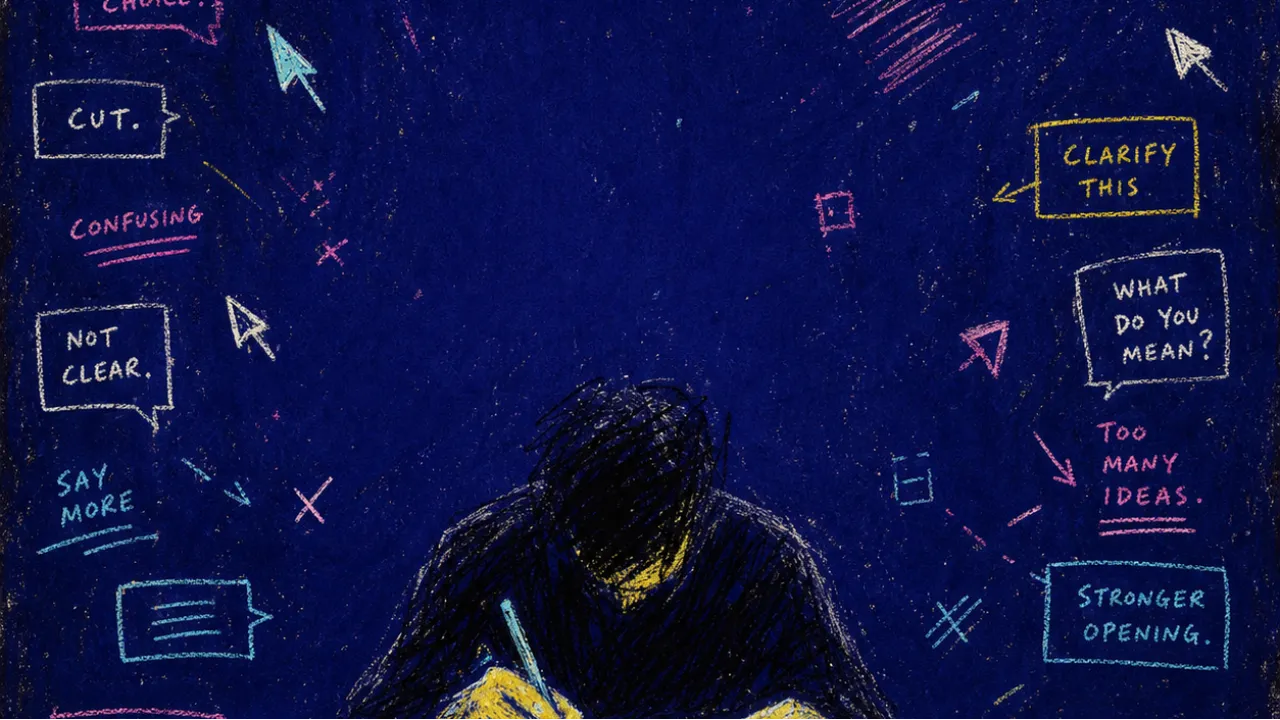
A hunched figure over a glowing page as cursors and comment boxes press inward, leaving marks across hands and shoulders

What is this situation?

Shared Doc Visibility Pressure — you open the Google Doc, Notion page, Sheet, Figma file, or shared deck and the first thing you notice is not the work itself, but who else is already there. Someone's cursor is blinking in the margin, a manager has left three comments before you've had coffee, a teammate's suggestion is sitting in your sentence, and the little profile icons at the top make the page feel less like a workspace and more like a room where everyone can watch you think. You start typing, delete half the line, rewrite it in safer wording, then pause because the revision history will still show what changed. A comment that could have been a quick clarification becomes a tiny public performance: how polished should your reply sound, who is copied in, will silence look careless, will answering too fast look defensive. The document never fully closes, because edits land after hours, mentions pull you back in, and your half-finished thoughts stay visible while the people with more authority can move faster, overwrite cleaner, or ask questions that make your work look less settled than it is. Over time, the task becomes two jobs at once: doing the work and managing how the work appears while it is still unfinished. Your body learns the platform's rhythms — the shoulder lift when a new comment appears, the jaw clench when someone enters the file, the careful hovering before you hit resolve — until the shared document feels like a stage you never agreed to stand on, much like the figure on the Seven of Wands, bracing on uneven ground while multiple staffs rise toward him before he can set his footing.

Why it's not you?

The problem is not that you are too slow, too exposed, or bad at collaborating — the setup makes unfinished work publicly trackable before it has had time to become solid. Live cursors, comment chains, revision history, permissions, and after-hours mentions create a pressure system around the task itself. This is the shape of a workspace that turns process into performance.

Shared Doc Visibility Pressure in Tarot Cards

Shared Doc Visibility Pressure turns ordinary collaboration into a live, visible performance where every cursor, comment, and edit can feel like it has an audience. The tight jaw, raised shoulders, and stalled hand over the keyboard are signals from an environmental, structural dynamic built into the tools and timelines around you. The cards below do not decide whether your draft is good enough; they reflect the pressure pattern underneath the surface. Here are the Tarot Cards that tend to mirror this kind of shared visibility strain.

Justice
Reversed
The seated authority holds scales in one hand and an upright sword in the other between two formal pillars. Reversed, those symbols of balanced evidence and consistent judgement no longer guarantee equal treatment, reflecting how revision histories and comment records can look objective while senior staff retain greater freedom to overwrite, reinterpret, or delay. You are working inside an audit trail, but visibility is not the same as procedural fairness. The blocked structure appears when your exploratory edits become evidence of uncertainty while a manager's interventions are treated as decisive refinement, allowing the same record to assign different reputational costs according to rank.
Three of Pentacles
Reversed
The working figure, the two observers, and the visible plan place craft, review, and coordination inside one public scene. Reversed, those roles fail to combine cleanly, matching a shared assignment where classmates or supervisors can alter a section without clear agreement about ownership, standards, or how individual learning will be assessed. You may be contributing real knowledge while the document's visible churn makes the work appear less coherent than it is. The reversal identifies a blocked learning resource: collaboration is present, but the structure does not provide enough role clarity or private drafting space for each person's expertise to develop before collective review.
Four of Swords
Reversed
The recumbent figure lies beneath three suspended swords while a fourth remains close to the body. In the reversed orientation, this protected chamber no longer delivers a complete pause: work signals remain psychologically overhead, much like a shared document that keeps collecting edits, comments, and mentions after the formal workday ends. You are not simply failing to switch off. The platform leaves the collaborative room structurally open, so rest competes with visible activity that can be interpreted as requiring a response. The reversal exposes a daily system in which recovery time exists on paper but is repeatedly interrupted by the possibility that unfinished work is still being watched.
Eight of Swords
Upright
The blindfolded figure stands loosely bound inside a ring of swords, with open ground visible beyond the enclosure. The image captures how revision history, active cursors, and anticipated judgement narrow your perceived range of expression, making safer wording feel like the only available movement even though the interface has not literally removed every option. You may delete exploratory sentences or freeze when someone enters the file because the audience has become part of the thinking process. The upright image keeps an important distinction visible: the pressure is real and externally produced, while the loose bindings show that its internal rules may be broader than the platform's actual requirements. That gap is where the hidden self-censorship mechanism becomes observable.
Page of Swords
Reversed
The Page holds a raised sword while looking back across a wind-bent landscape, as birds gather in the unsettled sky. Reversed, that alert relationship to information loses its stable purpose and becomes diffuse monitoring: presence icons, cursor movements, copied colleagues, and comment timing start carrying more social weight than the work itself. You may find yourself scanning the file for who is present and what their activity could imply, because the platform supplies constant audience cues without supplying reliable context. The reversal locates the blockage in an information environment that makes observation easy but interpretation uncertain, allowing routine collaboration to feel like mutual surveillance.
Five of Wands
Upright
Five figures raise their staffs into a crowded mesh, each active but none moving according to a shared pattern. The scene translates easily into a group project where comments, citations, formatting changes, and competing interpretations collide inside the same live document. You have access to other people's ideas, which preserves the upright card's possibility of productive exchange, but the document currently displays contribution as competition. The study pressure is structural: without agreed editing lanes or review stages, every learning difference becomes a visible contest over whose wording will survive.
Seven of Wands
Upright
The figure stands alone above six approaching staffs, gripping his own while balancing on mismatched ground. In a study setting, the scene resembles a thesis chapter, group assignment, or research draft receiving simultaneous comments before the writer has finished testing the argument. You still have an argument to develop and a position from which to explain it, but the upright defence consumes attention that would otherwise support learning. The educational structure turns drafting into premature demonstration: classmates, supervisors, or reviewers can react to provisional thinking as though it were a settled claim.
Eight of Wands
Upright
Eight wands travel in parallel through an open sky, with no figure shown controlling their arrival or setting their pace. Their uninterrupted motion resembles a stream of edits, mentions, suggestions, and replies moving through a shared file faster than any one contributor can privately consolidate a response. You have access to a functioning communication channel, but its speed compresses the distinction between receiving information and being expected to act on it. The timing pressure comes from treating platform velocity as a social clock: silence can look inattentive, while an immediate reply can expose thoughts that have not had time to settle.
Nine of Wands
Upright
The injured figure watches from behind a line of upright wands, gripping the remaining wand before any new approach has reached him. The guarded posture reflects the psychological cache built by repeated comment alerts, visible rewrites, and manager entries: previous document encounters remain active inside the next one. You are not inventing the pattern, because the platform has repeatedly linked co-presence with evaluation and interruption. The upright card also keeps a usable resource in view: the figure can observe the boundary he is maintaining. That visibility makes it possible to separate present document activity from the accumulated expectation that every cursor will require another defence.

Shared Doc Visibility Pressure in Tarot Card Reading Insights

Shared Doc Visibility Pressure often follows people into readings when a draft, comment thread, or revision history starts feeling bigger than the task itself. Others have brought this same always-visible work dynamic into sessions, looking at what surfaced around timing, exposure, and response. Tarot Reading Insights from sessions where shared workspaces became the pressure point.

A Slack Offer at 9:18 P.M.—Then a Bounded Yes, Still in Control

A Slack Offer at 9:18 P.M.—Then a Bounded Yes, Still in Control

Topic:Introspection Tarot Reading

Struggle:Support Access Split

Context:Safe Visibility Trial
Changing “I led” to “we helped”—Then Leaving Both Roles Named

Changing “I led” to “we helped”—Then Leaving Both Roles Named

Topic:Career Tarot Reading

Struggle:Mutual Deprivation Loop

Context:Unspoken Expectations Gap

Three Rough Sentences Turned Group-Chat Waiting Into Feedback

Three Rough Sentences Turned Group-Chat Waiting Into Feedback

Topic:Study Tarot Reading

Struggle:Ambiguity Dependence

Context:Undefined Role Scope

How a Blank Google Doc Became One Bounded Draft Open to Feedback

How a Blank Google Doc Became One Bounded Draft Open to Feedback

Topic:Study Tarot Reading

Struggle:Binary Choice Lock

Context:Undefined Role Scope

Three Tabs and an Unwritten Section: Testing Scope with the Group

Three Tabs and an Unwritten Section: Testing Scope with the Group

Topic:Study Tarot Reading

Struggle:Feedback Disconnection

Context:Responsibility Without Authority

The Draft That Felt Pointless: One Question Before the Next Pass

The Draft That Felt Pointless: One Question Before the Next Pass

Topic:Study Tarot Reading

Struggle:Craft Ceiling Lock

Context:Safe Visibility Trial

Closing the Database: Twelve Minutes Became a 143-Word Thesis Draft

Closing the Database: Twelve Minutes Became a 143-Word Thesis Draft

Topic:Study Tarot Reading

Struggle:Performance-Worth Fusion

Context:Academic Collaboration Trial

When a Slack Ping Feels Like a Grade, Learning to Read the Ask

When a Slack Ping Feels Like a Grade, Learning to Read the Ask

Topic:Career Tarot Reading

Struggle:Feedback Disconnection

Context:Routine Reset Trial

At 11:47 p.m., a Shared Deck Spiral Turned Into One Clear Ask

At 11:47 p.m., a Shared Deck Spiral Turned Into One Clear Ask

Topic:Personal Growth Tarot Reading

Struggle:Unspoken Expectation Load

Context:Unspoken Expectations Gap
When

When "Upset" Became "Off": Letting the First Feeling Reach the Page

Topic:Personal Growth Tarot Reading

Struggle:Internal Authority Collapse

Context:Reflection Structure Trial

Calendar reminder, stomach drop—then the 3-sentence update sent early

Calendar reminder, stomach drop—then the 3-sentence update sent early

Topic:Study Tarot Reading

Struggle:Visibility-Isolation Split

Context:Safe Visibility Trial

Psychological Contexts Related to Shared Doc Visibility Pressure