When Performative Composure Burnout Reaches 5:40 p.m.
Jordan (name changed for privacy), a 27-year-old customer success manager in Toronto, had become the dependable person who could keep a tense client call civil. Their whole pattern could be heard in one sentence: when a colleague added one more urgent task at 5:40 p.m., Jordan said, “That should be fine,” before checking whether it was true.
As Jordan took me through the moment, I could almost see their apartment kitchen: the blue camera light reflected on the warm laptop, the refrigerator hum merged with compressed call audio, and a phone vibrated against the table beside an unread stack of Slack messages. Jordan kept nodding while their jaw locked and their shoulders crept toward their ears. Then the call ended, the camera went dark, and they closed the laptop without answering anyone.
“I am fine until I suddenly am not,” Jordan told me. “I don't want to make my feelings everyone else's problem. But if I say what I actually think, I'm scared I'll sound way harsher than I mean.”
I heard the contradiction clearly. Jordan wanted to remain calm, trusted, and considerate, yet every slip in that public mask seemed to expose something they feared would cost them respect. Their contained frustration had the physical quality of steam trapped behind a glass screen: invisible enough to ignore, but hot enough that every new notification made the surface tremble.
“You aren't confused about what happened,” I said. “You're waiting until you can explain your reaction perfectly, and by then you've already gone quiet. I don't want to tell you what the cards say your fate is. I want us to use them as a structured mirror, so we can identify what the mask is doing, what it is hiding, and where you still have a choice. Let's make a map of the fog.”

Choosing the Cross-Section: The Five-Card Shadow Spread
I asked Jordan to place both feet on the floor, take one ordinary breath, and hold one question in mind: “What is my slipping calm trying to show me?” I shuffled slowly. I treat that small pause as a change of cognitive pace, not a supernatural performance; it gives the mind time to stop rehearsing and start observing.
I chose The Shadow Spread. More precisely, I used a five-card Shadow Spread tarot reading for examining the public persona, hidden conflict, overload triggers, buried boundary skills, and emotional integration. It was the smallest spread that could answer Jordan's question without burying it beneath unnecessary detail.
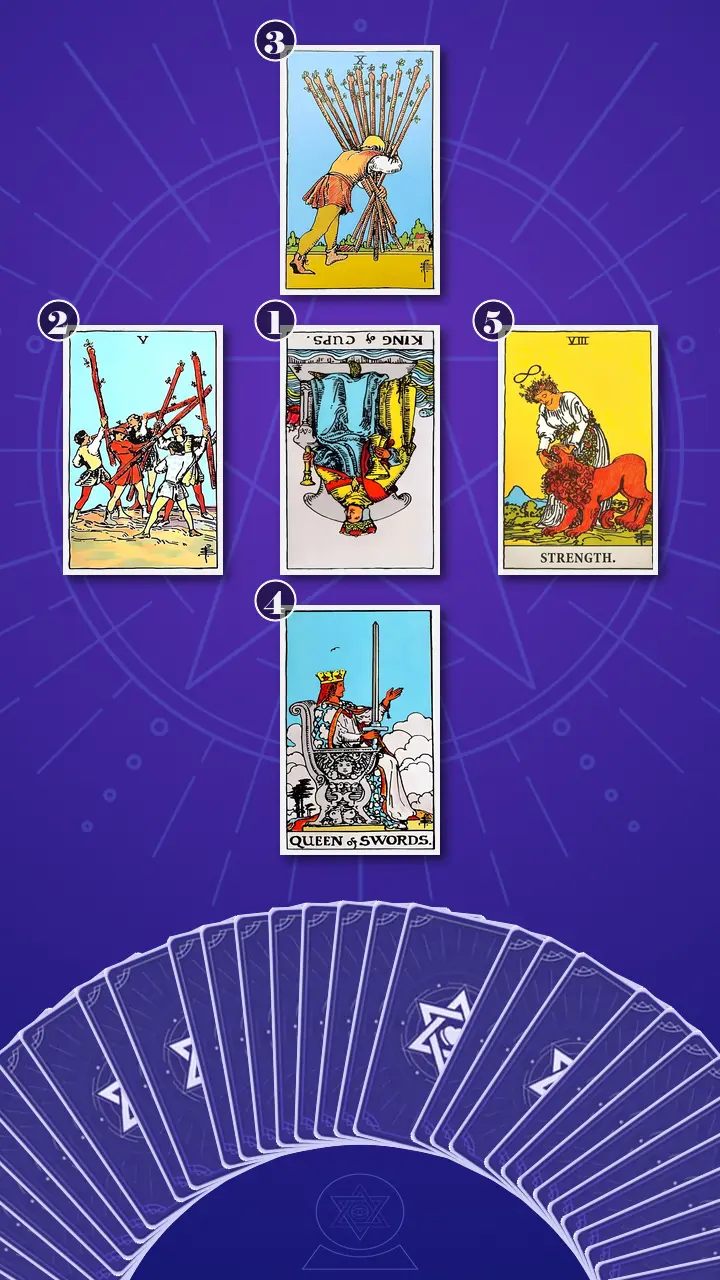
I arranged the cards as a compact cross. The centre would show the public persona and the current symptom. The card to its left would reveal the disowned conflict waiting offstage. Above, I would look for the pressure that made the mask slip; below, for the constructive capacity hidden inside that unwanted reaction. The final card on the right would show a practice of integration rather than a fixed prediction.
The shape reminded me of an archaeological cross-section: a visible surface, older layers beneath it, pressure from above, and a foundation that may be stronger than the standing structure suggests. This is how tarot works in my practice. The cards do not uncover an objective secret that only I can access. They give me distinct symbolic positions from which to test a pattern against a person's actual life.
The Stone Throne and the Water That Kept Moving
Position One: The King of Cups Reversed Behind the Green Dot
The first card I turned over represented Jordan's current public persona: the specific way they performed calm, edited reactions, and gradually lost access to useful emotional information. It was the King of Cups, in reversed position.
I pointed to the rigid stone throne surrounded by restless water. In Jordan's workday, that throne was the polished video-call face: measured voice, attentive nod, Slack status still green. The water was everything their body was already reporting while a colleague added another task to a full day. The later clipped reply or camera-off disappearance was not random. It was an emotional backlog finding the only available exit.
Energetically, I read the reversed King as Blockage. Emotional steadiness had hardened into emotional overcontrol at work. Jordan was not lacking feeling or maturity; the problem was that irritation, fatigue, and need could not circulate as information. Because the public interface had to appear stable, the internal system kept running hotter.
“The rule sounds something like this,” I said. “If I keep my voice even, nobody can question me. If I show irritation, they may decide I am difficult. So you preserve immediate smoothness, then pay for it alone after the camera goes off.”
Jordan let out a short laugh, but there was no amusement in it. Their fingers tightened around the sleeve of their mug, their gaze shifted away from the card, and then their shoulders dropped by less than an inch. “That's so accurate it feels a little brutal,” they said. “People trust me because I keep it together. I don't know who I am at work if I stop being that person.”
“I don't think this card asks you to stop being composed,” I replied. “It asks which emotion has to be edited out before your calm feels acceptable.”
Jordan looked at the moving water around the throne. “Irritation,” they said. After a pause, they added, “And the fact that sometimes I just don't want to help.”
I nodded. “A slipping mask is not a character verdict; it may be a late boundary.”
Position Two: Five Voices in One Draft Window
I next turned over the card representing what the slipping mask might be exposing: the competing needs, frustration, and wish to occupy more interpersonal space that Jordan had kept outside their trusted public identity. It was the Five of Wands, upright.
The five figures crossed their staves without a shared direction. I read them as Jordan's simultaneous impulses during a meeting: help the colleague, object to the request, preserve goodwill, protect the evening, and end the conversation. Only the helpful response was permitted to reach the microphone. The rest continued arguing after the call.
Energetically, this was an Excess of uncoordinated fire, but I was careful about what that meant. I did not see secret hostility or evidence that Jordan was secretly difficult. I saw legitimate internal positions with no process for negotiation. The card felt like five browser tabs playing different audio at once while Jordan kept presenting one clean Zoom background.
“A trustworthy person can have conflict,” I said. “The blind spot is expecting trustworthiness to mean that no conflict should exist inside you at all. Which voice becomes loudest only after you've agreed?”
Jordan's thumb stopped rubbing the mug sleeve. Their eyes unfocused for a moment, as if replaying several conversations in quick succession. “The one saying, ‘I wanted to leave an hour ago,’” they said. “Or, ‘Why is this automatically mine?’” The words came out quietly, followed by a longer breath.
I let that breath finish. The Five of Wands did not ask Jordan to obey every impulse. It asked them to stop excluding four voices and then blaming the fifth for shouting.
Position Three: The Last Request Was Carrying the Others
The third card I turned over represented the trigger: the cumulative responsibility and final extra demand that pushed Jordan's unspoken limit into view. It was the Ten of Wands, upright.
The figure on the card carried ten staves so tightly bundled that they blocked the nearby town from sight. I connected that image to Jordan's colour-coded calendar, where every block looked urgent and one more call appeared small only because the existing workload had disappeared from the conversation. Jordan agreed to the new task as though it were an isolated favour, even though several previous agreements were already pressing against the same evening.
Energetically, the Ten showed an Excess of burdened fire. The scattered friction of the Five had consolidated into one load Jordan felt personally responsible for carrying. By then, patience was no longer being tested by one request. Their whole system was trying to move while a bundle of unspoken commitments obstructed capacity, choice, hunger, fatigue, and perspective.
“A sharp tone can look disproportionate when everyone sees only the final request,” I said. “But your body is responding to the total. Being trusted does not require being endlessly available.”
Jordan's mouth tightened, then softened. “No one has actually told me I have to say yes to everything,” they said. “The staffing is lean, rent is ridiculous, and I don't want to be labelled difficult. But no one literally asked me to keep pretending my calendar has room.”
I noticed the distinction land. Their apprehension had not vanished; realistic economic pressure was still part of the picture. But fear was no longer masquerading as a direct instruction. That difference mattered because it returned some room for judgment.
The Sword That Left the Door Open
Position Four: The Queen of Swords and the Sentence Jordan Had Been Deleting
The fourth card I turned over represented the buried resource inside Jordan's unwanted reaction: the ability to use discernment, direct language, and boundaries before frustration had to communicate indirectly. It was the Queen of Swords, upright.
I centred the upright sword and the Queen's extended hand. In Jordan's work life, the image became a clean message: “I can take this tomorrow, but I cannot complete it responsibly today.” The sword separated capacity from obligation. The open hand kept collaboration visible.
Energetically, I read the Queen as Balance in the realm of air, arriving after a Deficiency of usable language. Jordan had plenty of thoughts, but most were being spent explaining other people's behaviour, rehearsing neutral wording, or deleting the actual limit. The Queen did not offer a colder mask. She offered exactness.
“I can care about the outcome and still say what I cannot take on today,” I said. “That isn't ‘nice versus cold.’ It's softness versus automatic agreement. The boundary is not the opposite of care; it is what lets care stay honest.”
Jordan's shoulders lowered enough that the change was visible on my screen. Their palm opened on the table, and they read the sentence again. “That doesn't sound rude,” they said, sounding almost suspicious of the discovery. “It just sounds like scheduling.”
“Exactly,” I replied. “Directness does not guarantee that everyone will like the answer, and a card cannot promise that every workplace will respond well. But precision gives you a better chance of protecting both the relationship and the truth. You can name what is possible without prosecuting anyone, including yourself.”
When Strength Heard the Lion
Position Five: Calm as Contact, Not Conquest
The final card represented integration: the conscious practice through which Jordan could let composure and strong feeling work together. The radiator clicked and fell silent as I turned it over, leaving the room unusually still. The card was Strength, upright.
I showed Jordan the woman's unforced contact with the lion. Her hands were close to its mouth, but the image did not depict punishment, fear, or brute domination. In Jordan's next meeting, this looked like noticing heat behind the face, asking what it was protecting, and stating a proportionate limit without smiling the feeling away or releasing it as a clipped remark.
Energetically, Strength showed Balance: instinct remained alive, but awareness could guide its expression. The lion was not a defect to eliminate. It might be guarding rest, fairness, dignity, time, or the right to have a preference. Sustainable self-command came from approaching that force closely enough to understand it.
Here I used what I call Cognitive Stratigraphy. I treated the visible slip as a surface artifact rather than the foundation of Jordan's character. Beneath the sharp tone lay accumulated workload. Beneath the workload lay competing needs. Beneath those needs sat an older governing belief: respect depends on uninterrupted calm. I did not assume a hidden trauma or invent an origin the cards could not prove. I simply asked whether that belief still deserved authority in the present.
At 5:40 p.m., Jordan had nodded through one more urgent request and said, “That should be fine,” while unread messages stacked up. The camera had gone dark, the laptop had closed, and the reaction edited all day had finally become silence.
Calm is not forcing the lion silent; real Strength hears its message, names a boundary, and keeps a gentle hand on the response.
For one beat, Jordan did not breathe. Their fingers froze halfway toward the mug, and their eyes remained fixed on the woman's hands. Then their focus drifted beyond my screen, as if they were watching the previous week replay with a different soundtrack. The line between their brows deepened; their pupils widened; moisture gathered at the lower rim of their eyes without falling. Their shoulders loosened, but the release seemed to leave them briefly unsteady, as though they had set down a familiar weight and had not yet worked out where to place their hands. A breath finally left their chest in a low, uneven rush. Then resistance arrived. “But doesn't that mean I've been doing calm wrong this whole time?” they asked. The question carried a flash of anger, followed almost immediately by embarrassment at having shown it.
“No,” I said. “It means a strategy that helped you preserve connection became too rigid for the conditions you're living in now. I don't prosecute an old structure for having kept something standing. On archaeological digs, I learned that a retaining wall can be both ingenious for its era and inadequate for the next one. We understand it, keep what still bears weight, and rebuild what no longer does.”
I leaned slightly closer to the screen. “Now, using this new perspective, can you think of a moment last week when this insight might have changed how the situation felt?”
Jordan's gaze dropped to the Strength card. “Thursday,” they said. “I thought I was furious because my coworker was being inconsiderate. But I hadn't eaten, I had two deadlines, and I had already moved my evening plans once. The anger was protecting the fact that there was genuinely no room left.”
“That is the excavation,” I replied. “Not ‘anger means attack,’ and not ‘anger must disappear.’ The surface heat was pointing to a capacity fact. You could keep care in your voice without removing the truth from the sentence.”
I suggested a deliberately ordinary reinforcement: ten minutes before the next demanding conversation, Jordan could write three short notes, naming the feeling, the limit beneath it, and one possible sentence. They would not be required to send it, disclose the feeling, or complete the exercise if it became uncomfortable. They could stop, look around the room, and return to an ordinary task.
I watched Jordan read the sentence once more. This was not a transformation from “emotional” to “controlled.” It was a first movement from hyper-vigilant self-editing, accumulated frustration, and delayed withdrawal to emotionally honest boundaries and flexible, authentic calm. The cards had not made that movement happen. They had helped Jordan see where their own choice could enter the sequence earlier.
Restoring the Structure Before the Next Collapse
When I read the spread as one cross-section, the story was coherent. Jordan had learned that being even-tempered brought trust, praise, and short-term safety. The reversed King showed that useful composure becoming a sealed public role. The Five revealed several legitimate needs arguing beneath it. The Ten showed those unvoiced conflicts accumulating into overload. Then the Queen introduced distinctions: feeling was not behaviour, care was not agreement, and capacity was not a moral failure. Strength brought those distinctions back into the body, where frustration could be heard without being given total control.
The central cognitive blind spot was not simply “I have trouble setting boundaries.” It was the belief that a trustworthy person should not experience internal conflict, combined with the habit of evaluating each new request separately from the total load. That made every boundary feel like an overreaction and every shutdown feel inexplicable.
I framed the transformation through Ruins Restoration Thinking. A crack in a public identity does not automatically mean the whole self is failing. Sometimes a structure has reached the end of what it can carry. The task is not to rebuild the same polished mask with thicker walls. It is to preserve Jordan's genuine diplomacy while adding doors, windows, and load limits.
I also pointed out that the spread contained no Pentacles. Insight needed an earth-based container: a timer, a calendar check, a pause between calls, or a prepared sentence. Otherwise, Jordan could turn emotional honesty into one more idea they felt obliged to perform perfectly.
Jordan raised an immediate obstacle. “I like the ten-minute exercise,” they said, “but some days I literally don't have ten minutes between calls. Then I'll fail at the boundary practice too.”
“Then ten minutes is the wrong dose,” I replied. “We use two minutes, one word, and one fact. The practice has to fit your actual life or it becomes another Ten of Wands.”
Three Small Forms of Actionable Advice
- The Two-Minute Trigger ExcavationBefore one public-facing call this week, set a two-minute timer and write one honest feeling plus one capacity fact, such as “irritated” and “two deadlines remain.” If your jaw locks later, add the old rule that surfaced: “If I show this, I will lose respect.” Then note one present-day fact that tests that rule.Tip: One word is enough. The note stays private and creates no obligation to disclose, justify, or uncover your whole history.
- The Queen of Swords Boundary SentenceChoose one low-stakes work request that arrives after your capacity is full. Say or send, “I can take this tomorrow, but I cannot complete it responsibly today,” adapting the timing honestly and naming the next available option.Tip: Keep the sentence factual and leave out the long apology. Use a written message if speaking live feels too exposed, and pause the exchange if someone pushes past the limit.
- Interrupt the Earliest WandOpen your calendar and task list for the next 48 hours. Circle the earliest commitment that could be moved, shortened, delegated, or clarified. Send one two-line message asking which priority should move before accepting another task.Tip: Renegotiate one item only. This is a capacity check, not a productivity overhaul or a demand to solve your entire workload.
“The goal isn't to express every feeling in public,” I told Jordan. “Privacy remains yours. The goal is to notice one honest reaction, check the capacity beneath it, and choose one proportionate boundary before composure breaks. Calm can be a container, not a sealed lid.”

A Week Later: The Quiet Proof
A week later, I received a message from Jordan: “I used the tomorrow sentence. Nothing exploded. I slept through the night, then woke up thinking, What if I sounded difficult? This time I laughed, ate breakfast, and left Slack closed until nine.”
I did not read that as a life solved or a fear permanently removed. I read it as a small piece of evidence. Jordan had noticed the lion before it needed to roar through a sharp reply or disappear behind a dark screen. They had kept care in the exchange without deleting themselves from the sentence.
That was the real Journey to Clarity for me: not certainty, and certainly not obedience to a card, but enough inner room to choose differently. The Shadow Spread offered a map. Jordan supplied the courage, the wording, and the boundary.
When I think of anyone spending an entire call keeping their voice even while their jaw locks around a real need, I understand why the eventual slip can feel like proof that respect requires concealment. I would offer the gentler possibility the cards offered Jordan: the lion does not need to disappear for your hands to become steady.
Before your next call, if your irritation were the lion guarding a real limit rather than evidence against your character, what one boundary sentence could let it be heard while your hand stays steady?
Every reading at AceTarot is a journey to connect with inner wisdom and empower the path ahead. This reading shared here is a psychological mirror, not a private record—crafted to reflect universal emotional loops and help restore personal clarity. Please note that these insights do not replace professional psychological, medical, legal, or financial advice, and should not serve as the sole basis for major life decisions.
Learn more about our Journey to Clarity.
How did this insight land for you?
🫂 This Resonates Deeply
🌀 Living This Story
✨ Now I See Clearly
🌱 Seeing New Possibilities
🧰 Useful Framework
🔮 The Confirmation I Needed
💪 Feeling Empowered
🚀 Ready for My Next Step
Author Profile
 AI
AI Hilary Cromwell
911 readings | 529 reviews
“Having spent a lifetime at Cambridge and on archaeological digs, I’ve witnessed the rise and fall of countless civilizations. Please know that your current struggles are not a permanent fate, but merely a necessary fracture before rebuilding. I won't lecture you; instead, I invite you to sit with me in the ruins, using a patient, historical perspective to gently dust off the true, enduring value hidden beneath your temporary doubts.”
In this Introspection Tarot Reading :
Core Expertise
- Cognitive Stratigraphy: Treating sudden emotional triggers as 'surface artifacts', systematically digging down to locate their foundational trauma or obsolete belief system.
- Ruins Restoration Thinking: Reframing fragmented identities and chronic mental exhaustion as a necessary phase of profound internal transition.
Service Features
- The Trigger Excavation Exercise: A logical framework to trace a current, disproportionate emotional reaction back to its original 'epoch', separating the past from the present.
Also specializes in :
Explore Related Patterns:
Approval-Driven Self-SilencingJordan says, “That should be fine,” before checking whether the added task can actually fit, while every internal position except the helpful one remains outside the conversation. The response secures immediate approval and prevents visible friction, but it does so by withholding the information most relevant to an honest decision. When you expect disagreement to make you sound difficult or cost you respect, self-silencing can feel safer than testing whether the relationship has room for a limit. Approval-Driven Self-Silencing names the mechanism by which anticipated judgment edits your answer before capacity has been consulted. What remains hidden is not hostility; it is the valid objection, preference, or no that was never permitted to enter the exchange.
Emotional OvercontrolJordan keeps nodding through tense calls while their jaw locks, then turns the camera off and withdraws once the interaction ends. The even voice preserves immediate smoothness, but it also prevents irritation, fatigue, and need from functioning as real-time information. When you treat composure as a fixed requirement rather than a flexible skill, emotion has to wait until the public role is no longer sustainable. Emotional Overcontrol names that regulatory strategy: the feeling is not absent, but edited until it can only emerge through sharpness or silence. What the slipping mask exposes is not defective self-control; it is a delayed capacity signal that needs an earlier, more proportionate route into the conversation.
People-Pleasing Resentment CycleAt 5:40 p.m., Jordan accepts another urgent task as though it were a separate favor, then closes the laptop and stops answering once the accumulated frustration breaks through. The visible reaction appears to belong to the final request, but it is carrying hunger, deadlines, moved plans, and several earlier agreements that were never renegotiated. When you use automatic agreement to preserve short-term peace, the unspoken no does not disappear; it returns later as resentment, sharpness, or withdrawal. The People-Pleasing Resentment Cycle describes this self-reinforcing sequence: compliance conceals the limit, delayed frustration makes the eventual response look excessive, and that response then seems to prove that earlier honesty would have been unsafe. Interrupting the cycle means letting capacity enter before resentment has to speak for it.
Boundary DiscernmentJordan's sentence, “I can take this tomorrow, but I cannot complete it responsibly today,” names a limit without turning the colleague into an opponent. When Jordan later uses it, the message protects present capacity while keeping a realistic route to collaboration open. When you distinguish care from compliance and capacity from moral worth, a boundary no longer has to function as rejection or attack. Boundary Discernment allows you to decide what belongs to you, what cannot be carried now, and what alternative can honestly be offered. This is the earlier route the hidden irritation was asking for: a clear separation before frustration has to create distance indirectly.
Emotional PerfectionismJordan waits to explain the reaction perfectly, yet the search for flawless wording lasts until silence has already replaced communication. Ordinary irritation is treated as acceptable only if it can be translated into a response so measured that no one could possibly read it as harsh. When you require emotional expression to be perfectly controlled before it is allowed to exist publicly, useful information becomes trapped behind an impossible standard. Emotional Perfectionism turns trustworthiness into a performance of having no messy or conflicting reaction at all. The mask slips because real feelings cannot consistently satisfy that standard, especially after workload and fatigue have accumulated.
Usefulness-Based Self-WorthJordan links being trusted with keeping everything together and then says they do not know who they are at work without that role. A request for extra labor therefore lands as more than a scheduling decision; refusing it appears to threaten the identity that has organized Jordan's value and credibility. When you rely on usefulness to establish your worth, reluctance can feel like a character failure and rest can feel difficult to justify. Usefulness-Based Self-Worth makes the dependable role emotionally expensive to question, even when your calendar and body are reporting that no capacity remains. The slipping mask exposes the part of you that wants value to survive a limit, a preference, or a moment of not being available.
Shadow IntegrationJordan first admits both irritation and the occasional wish not to help, then revisits Thursday and recognizes that the anger was protecting a concrete fact: there was genuinely no room left. The unwanted reaction becomes more intelligible once hunger, deadlines, and already-displaced personal time are allowed back into the account. When you can acknowledge a strong feeling without either obeying it or prosecuting yourself for having it, the excluded part of the experience becomes usable. Shadow Integration describes this movement from concealment to conscious relationship: irritation can reveal a boundary, while awareness still determines how that boundary is expressed. The calm that follows is more authentic because it includes the lion's message instead of depending on its disappearance.
Explore Related Struggles:
Capacity-Identity FusionJordan links being trusted with keeping everything together and cannot readily picture who they would be at work without that role. A full calendar, two deadlines, hunger, and a twice-negotiated evening still fail to authorize a limit before the next task is accepted. You are caught in Capacity-Identity Fusion when availability stops being a changing practical fact and becomes evidence of your professional character. Saying there is no room then seems to announce that you are no longer dependable, considerate, or competent. The mask conceals finite capacity because acknowledging it threatens the identity that has been carrying recognition, leaving you able to see the limit while still feeling unable to let it define the answer.
Capacity-Obligation FusionAt 5:40 p.m., Jordan says, "That should be fine," before checking a calendar already crowded by previous agreements. The request is handled as an isolated obligation even though their locked jaw, unfinished work, hunger, and disrupted evening all report that the total load has reached its limit. You can become stuck here when being considerate and being available start functioning as the same requirement. A factual lack of room then feels less like information you are allowed to use and more like a failure to meet an obligation, leaving the body or a later withdrawal to enforce the limit that could not enter the original decision.
Harmony-Safety FusionJordan follows a rule that an even voice prevents questions and visible irritation risks being labelled difficult. Each smooth call appears to preserve trust, even when the agreement made inside that call is not supported by the calendar or by what their body is reporting. You become locked in Harmony-Safety Fusion when the absence of friction serves as your proof that respect and connection are intact. Disagreement can no longer remain an ordinary part of collaboration; it carries the weight of possible exclusion or reputational loss. The calm mask hides conflict because your safety test allows connection to feel secure only while no disruptive need, preference, or limit is visible.
Masked Self-DivisionJordan's measured voice, attentive nod, and green Slack status present one coherent person to colleagues, while several other positions remain outside the frame: object to the request, protect the evening, end the conversation, or simply decline to help. Their statement, "I don't know who I am at work if I stop being that person," shows how completely the public role has claimed the right to represent them. You experience Masked Self-Division when only the agreeable part of you is authorized to participate in connection. Objection, preference, and depleted capacity do not disappear; they return through a rigid body, a clipped response, or a sudden retreat after contact ends. The mask is therefore hiding more than irritation. It is hiding the internal plurality that would let you remain considerate without reducing your whole workplace identity to uninterrupted helpfulness.
Tone-Truth FusionJordan is afraid that saying what they actually think will sound much harsher than they mean, so they wait for a perfectly controlled explanation. By the time the wording feels acceptable, the call is over, the laptop is closed, and the limit has been replaced by silence. You are caught in Tone-Truth Fusion when an honest statement and an aggressive delivery seem inseparable. Protecting your tone then requires removing the truth, while protecting the truth appears to risk the relationship. The struggle is not a lack of words; it is the narrowing of expression to two costly options, polished agreement or a delayed reaction carrying more force than the original boundary required.
Anger-Ownership SplitOnly Jordan's helpful response reaches the microphone, while the voices saying, "I wanted to leave an hour ago" and "Why is this automatically mine?" continue after the call. On Thursday, what first looked like a verdict against an inconsiderate coworker also pointed to concrete facts: no meal, two deadlines, and an evening plan already moved once. You face an Anger-Ownership Split when irritation contains usable information but allowing it into your identity feels equivalent to approving an attack. The reaction is pushed away as evidence against your character, even while it guards a legitimate claim to fairness, time, preference, or physical capacity. Owning that information does not require obeying every impulse; it restores your ability to separate the message from the force with which it may eventually emerge.
Self-Editing ExhaustionJordan keeps nodding beneath the blue camera light while their jaw locks, their shoulders rise, and unread Slack messages accumulate beside the laptop. The edited response keeps the live call civil, but once the camera goes dark there is no remaining capacity to answer anyone. You enter Self-Editing Exhaustion when every reaction must be reviewed, softened, or deleted before it can influence a decision. The editing does more than conceal a feeling; it blocks relevant information about workload, preference, and limits while consuming the energy needed to stay engaged. Silence and clipped replies become the remaining exits because the usable version of your voice was held back until the choice point had already passed.
Explore Related Emotions:
Anger ShameJordan asks whether they have been doing calm wrong, and a flash of anger enters the question. Embarrassment follows almost immediately, repeating the same fear they described earlier: an honest reaction might sound harsher than intended and alter how others see them. That immediate recoil turns the appearance of anger into a second emotional event. Anger Shame captures the exposed feeling that the reaction itself says something discrediting about you, which can drive you to edit the signal before you have identified the limit, unfairness, or depleted capacity it was registering.
Hard-Won ComposureJordan studies the image of a steady hand remaining close to the lion, then recognises that their internal heat can be heard before it becomes a clipped reply or a dark screen. The new response keeps care in the voice while placing the capacity fact directly into the sentence. Hard-Won Composure describes steadiness built through contact with strong feeling, precise language, and an honest limit. You remain present to what your body is reporting, give the signal a proportionate form, and carry calm as a flexible container with enough room for both the relationship and your own position.
Hidden ResentmentFive different responses are active during Jordan's meeting: help the colleague, object to the request, preserve goodwill, protect the evening, and end the conversation. Only the helpful response reaches the microphone, leaving "Why is this automatically mine?" to continue after the call. When your refusal, preference, and fairness concerns have no recognised place in the exchange, automatic agreement can accumulate a private protest. Hidden Resentment names the sense of being inwardly opposed to a demand you have already accepted outwardly, with the unsaid objection lingering after everyone else believes the matter is settled.
Perfect Composure AnxietyJordan says they are afraid their honest reaction will sound much harsher than they intend, then admits they do not know who they are at work without the dependable persona. The jaw-tightened nod and later disappearance show how carefully every visible signal is being managed. Your public response can become subject to constant reputational inspection when respect feels dependent on an uninterrupted even tone. Perfect Composure Anxiety captures the fear that one imperfect reaction could expose an unacceptable version of you and destabilise the identity that has made you trusted.
Performative CalmAt 5:40 p.m., Jordan says, "That should be fine" before checking their capacity. Their voice remains measured and their nod stays attentive while their jaw locks, their shoulders rise, and unread Slack messages continue stacking beside them. Composure has become a public performance organised around preserving trust and preventing scrutiny. When you maintain that surface while excluding every inconvenient reaction underneath it, calm can feel like a role you are continuously auditioning to keep. Performative Calm names the strain of appearing settled while your internal signals keep pressing against the script.
Polished AlienationThe video-call face stays attentive, the voice remains measured, and the Slack status is still green. Once the camera goes dark, Jordan closes the laptop without answering anyone and is left alone with every response that was removed from the public exchange. Maintaining a socially effective version of yourself while your private reactions remain unrepresented can create distance from your own presence. Polished Alienation describes the feeling of being recognisable and trusted to others through a persona that no longer gives you enough room to recognise yourself.
Protective AngerLooking back at Thursday, Jordan recognises that they had not eaten, had two deadlines, and had already moved their evening plans once. The heat they attributed to an inconsiderate coworker was also guarding the concrete fact that there was genuinely no room left. Protective Anger gives that heat a clear emotional function: it draws attention to capacity, fairness, rest, dignity, and the right to have a preference. When you can hear that message early, the feeling can move into a measured boundary sentence and support your judgment without taking over the entire response.
Usefulness-Based Belonging FearJordan says, "People trust me because I keep it together," and then asks who they would be at work without that role. Their reluctance to help, need to leave, and lack of capacity are all treated as information that could threaten the respect attached to being dependable. When your place in a relationship feels secured through continuous usefulness, an ordinary limit can carry the emotional weight of possible exclusion. Usefulness-Based Belonging Fear names the apprehension that being less available, less agreeable, or visibly conflicted could weaken the connection that your helpfulness has maintained.
Vulnerability HangoverA week after the reading, Jordan uses the clear "tomorrow" sentence and nothing explodes. The next morning, they still wake up wondering whether they sounded difficult, extending the emotional exposure beyond the conversation itself. When you have learned to protect connection through careful self-editing, even a proportionate limit can leave an afterimage of possible rejection. Vulnerability Hangover names the delayed second-guessing that follows visible honesty, when the interaction is over but your mind is still checking whether being real cost you safety or respect.
Contained OverwhelmUnread Slack messages, two deadlines, missed food, and an evening plan already moved once are all present when one more urgent request arrives. The colleague sees a single task while Jordan's body is responding to the entire bundle. When you assess each demand separately, the total load remains invisible inside the conversation and becomes difficult to defend in words. Contained Overwhelm is the crowded internal weather of carrying more than the visible moment reveals while still presenting yourself as available and composed.
Grounded AgencyJordan sends, "I can take this tomorrow, but I cannot complete it responsibly today," and the exchange remains intact. They then leave Slack closed until nine, preserving a concrete interval that had previously been absorbed by work. Linking one internal signal to one capacity fact and one usable sentence gives choice an earlier place in the sequence. Grounded Agency is the felt sense that you can influence what happens before accumulated pressure decides for you, using actions that fit the real calendar, relationship, and workload in front of you.
Explore Related Contexts:
Designated Peacekeeper BurdenJordan is the dependable customer success manager who can keep a tense client call civil, even when five competing responses are active beneath the measured delivery. Colleagues and clients encounter the stabilizing voice, while protecting the evening, questioning the assignment, and ending the conversation remain off-mic. Once you become the designated regulator of an interaction, other people can rely on the calm without seeing the work required to produce it. The burden is not simply having strong reactions; it is occupying a social role in which preserving everyone else's smooth exchange repeatedly takes priority over putting your own capacity into the room.
Public Mask MaintenanceJordan keeps their voice measured, nods through the call, leaves Slack green, and says the late request should be fine while their jaw locks and their calendar is already full. The visible composure is not merely a private preference; it has become the workplace interface through which Jordan receives trust and remains legible as the dependable person. When your acceptable public role allows helpfulness but excludes timely objection, maintaining the mask starts to conceal concrete information about workload, preference, and capacity. Its repeated slippage marks the point where the performance can no longer carry every demand without a more explicit boundary entering the exchange.
Understaffed Team PressureAt 5:40 p.m., another urgent task lands while Jordan already has two deadlines, unread messages, and an evening plan that has been moved once. Jordan also names the staffing as lean, making the final request part of an allocation problem rather than an isolated test of patience. When a team lacks spare capacity and no existing priority is visibly removed, each new assignment transfers the scheduling conflict to the individual receiving it. You can then appear to be reacting too strongly to one request even though the operative reality is a workload system with no room left and no clear mechanism for deciding what must give way.
Competence TaxJordan is known as dependable and capable of keeping difficult calls civil, and another urgent task still reaches them after the day is already full. The recognition is visible, but the existing deadlines, displaced evening plans, and effort required to maintain that standard do not produce an automatic capacity adjustment. A competence tax develops when proof that you can handle difficult work becomes a reason for more work to keep accumulating around you. The hidden cost is that reliability gets measured through continued absorption rather than accurate limits, leaving your actual workload invisible until a sharp reply or sudden shutdown makes it visible indirectly.