The 11:48 p.m. Spiral of Accelerated Intimacy
I met Jordan after they had done the thing that was meant to make a promising second hangout feel more real: they had sent the long voice note. I recognized the pattern before they named it. For a late-twenties Toronto hybrid worker building a social life through friendship apps, creative meetups, and coffees squeezed between busy calendars, one good conversation can start to feel like a narrow door that must not close.
Jordan described sitting on the edge of their bed at 11:48 p.m., close enough to a rattling streetcar line that the windows gave a tiny shiver now and then. The radiator clicked behind them. Their phone had gone warm in their palm as they recorded seven minutes about a difficult part of their life, deleted it, recorded a shorter version, then sent the original-length one anyway. The screen threw a pale blue rectangle across the duvet. Their throat loosened when they hit send; then their shoulders climbed back toward their ears as they reopened the chat again and again.
"I finally sent the thing that was supposed to make me feel known," Jordan told me, "and now the silence feels louder than the message. I do not know how to be honest in small doses."
I could hear the real contradiction underneath the voice note. Jordan wanted to be genuinely known, but the uncertainty required to build trust slowly felt almost physically intolerable. The longing sat in their body like trying to hold a full cup while riding a streetcar around a sharp turn: a brief release after sharing, then every muscle bracing for the spill. I told them, gently, that this was not a character flaw and not proof they were too much. "We are not here to decide whether you should become less open," I said. "We are here to draw a map of what your openness is trying to secure, and to find a way to protect it."

Choosing a Map for Friendship Anxiety
I invited Jordan to put both feet on the floor, take one unforced breath, and hold the question beneath the question: why did disclosure become urgent before trust had evidence behind it? I shuffled slowly, not as a performance of mystery, but as a pause that gave their nervous system somewhere other than the chat window to rest.
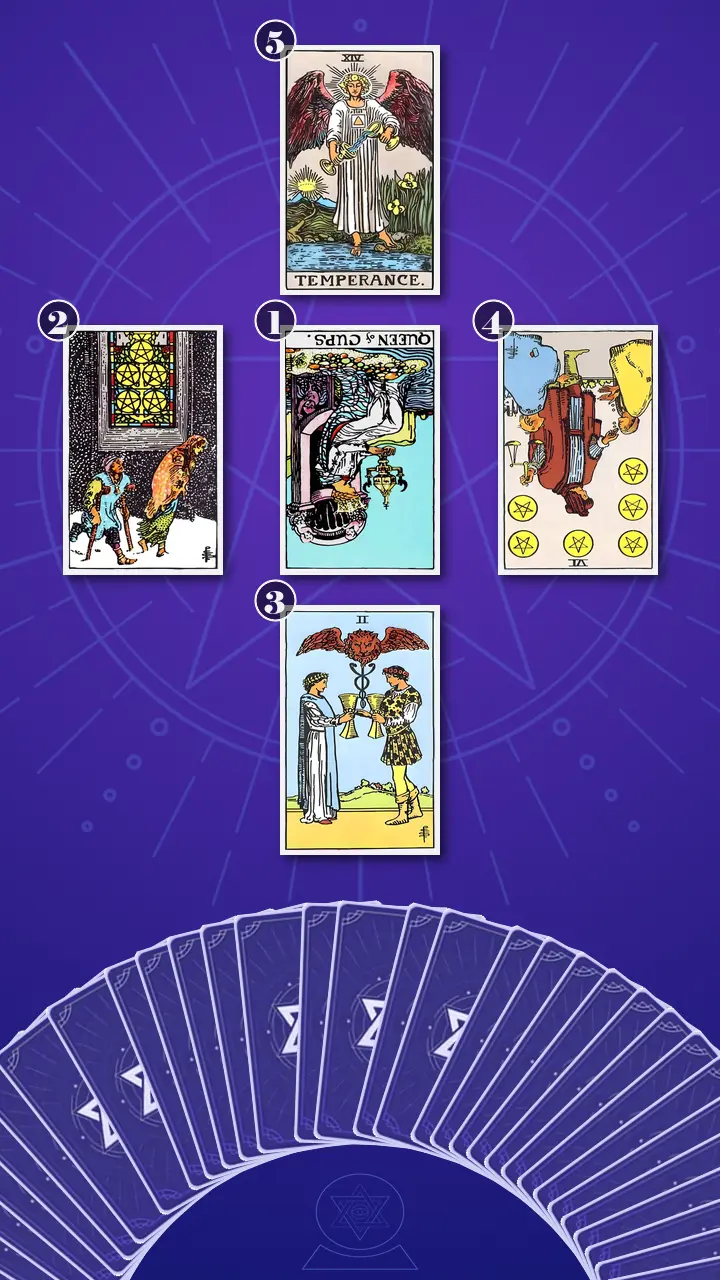
I chose The Shadow Spread, a five-card tarot spread for understanding recurring inner patterns such as oversharing with new friends. I use it when the question is not what another person will do, but why one familiar response keeps appearing. The spread does not predict whether a particular friend will stay. It traces a chain: the visible behaviour at the centre, what activates it, the valid need hiding beneath it, the distortion that keeps it running, and the practice that can integrate it.
I placed the first card in the middle for the observable habit. The card to its left would show the belonging fear that activated the urge. The lower card would reveal the deeper need for mutual recognition. The right-hand card would examine the cost of turning disclosure into a test, and the card above would offer an orientation for paced trust-building. I told Jordan that this layout was a compass, not a verdict. Cards can make a pattern visible; Jordan would remain the person choosing what happened next.
Reading the Map: Five Cards in Context
The Cup That Could Not Hold Everything
I turned over the card at the centre. "Now I am opening the card that represents the visible pattern: sharing multiple high-stakes experiences with a new friend before reliability and reciprocity have been established." It was the Queen of Cups, reversed.
I pointed to her elaborate lidded cup, held carefully at the edge of the water. Upright, this Queen understands feeling and responds with tenderness. Reversed, her emotional attunement has become overextended. This was not an excess of feeling in Jordan; it was a shortage of containment around feeling. The Queen's cup became the Notes draft on Jordan's phone: the whole story could be true, meaningful, and still deserve a private container before it was handed to someone new.
I described what I saw in their life: after a good second coffee, a casual topic becoming several painful histories, followed by a late-night voice note because the first version did not feel complete enough. It reminded me of opening every browser tab at once because choosing one feels like hiding the rest. I mentioned Fleabag, too, not to reduce Jordan to a reference, but because its fast confessions and humour capture how seductive instant emotional access can feel when safety is still unclear.
"Honesty is not a deadline," I said. "This card is asking you to notice the precise second when chosen vulnerability becomes an attempt to secure the relationship."
Jordan let out one short, dry laugh. Their fingers stopped moving against the cup in front of them, their mouth pulled briefly to one side, and then their eyes dropped to the Queen. "That is so accurate it feels a little rude," they said. I smiled, because a card does not need to flatter us to be kind. "It is not calling you dishonest," I said. "It is showing you that authenticity and immediate access are not the same thing."
The Warm Window Across the Snow
I turned left. "This card represents the trigger beneath the behaviour: the felt possibility of remaining unknown, unsupported, or outside the emerging friendship while trust develops gradually." The card was the Five of Pentacles, upright.
I showed Jordan the two figures moving through snow outside an illuminated window. In this reading, I did not treat that image as a prediction of rejection. I treated it as the internal picture that arrives when a new friend takes a day to reply, says they are booked for the next two weekends, or answers kindly but briefly. The card's Earth energy had become scarcity: a normal city schedule was being translated into a closed door before anyone had actually closed it.
Jordan immediately pictured a Thursday morning on the TTC platform, cold air lifting off the tracks and a damp coffee lid pressed against their thumb. A new friend's message had been unread for twelve hours. They scrolled past a crowded group-dinner photo on Instagram and felt the thought land: everyone else got a membership card; I should have said more while I had their attention.
"What evidence of exclusion existed at that moment?" I asked. Jordan took a breath through their nose, then shook their head. "None," they said. "Just the gap." That distinction mattered. The Five of Pentacles did not dismiss the ache of the gap. It separated the ache from the conclusion that Jordan had already been left outside.
Two Cups at Equal Height
I moved to the lower card. "This one represents the hidden need beneath accelerated disclosure: mutual recognition, reciprocal vulnerability, and evidence that emotional closeness can be shared rather than performed alone." It was the Two of Cups, upright.
The two figures faced one another, each holding a cup at equal height. I told Jordan that the card was not asking for matching trauma disclosures or a perfectly symmetrical text thread. Its balance was about equal agency. One person could share a medium-risk truth at a third coffee; the other could listen, ask a thoughtful follow-up, offer something at their own pace, and suggest another plan. Mutuality could arrive through curiosity, consent, and repeated contact, not through identical levels of access.
"Your wish is not the problem," I told Jordan. "You want a friendship where both people keep choosing the next layer. That is a healthy desire." Their jaw softened a little. I asked what mutual recognition would look like in observable terms. After a pause, Jordan named a remembered detail, a question asked without being prompted, and a concrete invitation to meet again. Those were much steadier signs than trying to interpret one delayed reply.
When the Phone Became a Scale
The Unspoken Reply Scorecard
I turned over the card on the right. "This card represents the blind spot and relational cost: personal disclosure can create an uneven exchange, where a new friend is quietly expected to prove closeness through their response." It was the Six of Pentacles, reversed.
The scales in one hand and the coins falling from the other gave the card its exactness. Reversed, its Earth energy was not stable structure but imbalance. I returned with Jordan to the evening after a promising coffee on College Street: their tote dropped beside the apartment door, takeout lingering in the room, and a typing indicator appearing and disappearing on the screen. They had shared a large piece of personal history. Then the phone became a scale, weighing the reply's warmth, length, timing, emojis, and whether the other person had disclosed enough in return.
"I did not mean to make this a test," Jordan said quietly, looking at the card, "but now every word feels like a score."
I named the distinction with care. A long message can be real and still be asking for a guarantee. In my Guilt-Trip Deconstruction, I look for the private contract that neither person has actually agreed to. This was not an accusation that Jordan was manipulative. It was a compassionate way to see that a new friend could be unintentionally drafted into becoming an unpaid emotional dumping ground, expected to regulate the panic that followed disclosure. The friend might be kind, interested, busy, uncertain, or simply a different kind of texter. None of those possibilities could be fairly measured by a single response.
Jordan's hand froze above their phone. Their eyes lost focus for a second as if replaying a dozen message threads at once. Then their breath left their chest in a long, almost embarrassed exhale. "I have gone quiet after a short reply," they said, "because I did not want them to know how much I was waiting for them to fix it." I told them, "A reply is not a loyalty test. It is one moment in a relationship that still needs time to show its shape."
When Temperance Poured Between Two Cups
The Practice of Measured Vulnerability
The room seemed to settle before I turned the final card. "This is the integrating perspective: sharing one appropriate layer, observing reciprocity, and allowing repeated interactions to build trust." I revealed Temperance, upright.
I showed Jordan the angel's measured stream moving between two cups, one foot on land and one in water, and the path rising toward distant light. The card did not ask them to become guarded, casual on command, or less emotionally intelligent. It offered balance: private feeling on one side, shared connection on the other, with a deliberate transfer between them. Its energy was not restraint as punishment. It was measured vulnerability, patience, relational discernment, and a pace that made reciprocal trust observable.
I asked Jordan to picture the familiar 11:48 p.m. scene again: the clicking radiator, the open chat, the seven-minute voice note, the thumb hovering over send. Their throat had loosened enough to want relief, but their stomach was already bracing for the read receipt. They had been trapped between two false options: give full access now, or hide who they were.
You do not have to pour out the whole cup to prove you are real; let trust move between two cups, one measured exchange at a time.
Jordan did not nod right away. Their breath paused. Their pupils widened slightly, and their fingers tightened once around the edge of their sleeve before slowly opening in their lap. I watched their gaze move past the cards, not away from them, but through the memory of every sent voice note and every late-night refresh. Their eyes shone, then their shoulders lowered in a way that looked like relief but also left them briefly unsteady, as though they had put down a heavy bag and forgotten what their hands were for. "But if I do not explain all of it," they said, their voice thin at first, "I am scared they will only know a version of me that does not count." I let the silence make room for that fear instead of rushing to cover it. Then I asked, "Now, with this new perspective, can you think of a moment last week when one true sentence might have felt different from sending the whole archive?"
Jordan remembered the coffee on College Street. They could have said, "This week has been a bit heavy, but I was glad to get out tonight," and then asked their new friend what had made their week easier or harder. That would not have been a performance. It would have been an opening with room for an answer.
This was the move from urgency-driven oversharing and reply monitoring toward authentic, reciprocal trust built in gradual and observable layers. I used my Savior Complex Auditing lens here, because Jordan had quietly appointed themself the rescuer of every promising connection. They were trying to save the friendship from uncertainty before two people had enough shared experience to choose it. Temperance released them from that job. They did not have to rescue closeness; they only had to participate in it. You can be authentic without giving a new person the keys to every room. Trust grows in layers, not one giant reveal.
From Insight to Action: A Two-Cup Pace
I gathered the whole reading into one story. The Queen of Cups reversed showed real emotional depth without a sturdy enough container. The Five of Pentacles revealed the cold rush of belonging fear, where ordinary distance began to feel like exclusion. The Two of Cups clarified that Jordan did not actually want to unload; they wanted mutual recognition. The Six of Pentacles reversed exposed the private scorecard that turned a heartfelt disclosure into an uneven emotional exchange. Temperance offered the missing structure: Water needed trustworthy Earth, meaning feeling needed time, boundaries, repeated plans, and visible care.
Jordan's blind spot was not that they cared too deeply. It was the assumption that a new friendship had to prove its future through the intensity of one conversation. The direction forward was not toward emotional shutdown. It was from sharing enough to secure closeness toward sharing one appropriately sized truth and waiting for reciprocal evidence before offering the next layer.
I gave Jordan three small practices. I framed them as experiments, not rules. Their purpose was to make room for choice in the small gap between longing and sending.
- The One-Layer Check Before the next first, second, or third hangout, or before sending a vulnerable voice note, Jordan will write the full story privately in Notes. They will circle one present-focused sentence they could share without a long explanation, then decide whether that one sentence fits the relationship today. The complete version remains real in the private note. If ten minutes feels like too much, set a two-minute timer and choose one sentence.
- The Reply-Delay Reset After Jordan shares something personal with a new friend, they will place the phone face down for twenty minutes, make tea, shower, or walk around the block before rereading the chat or adding context. I offered this as part of my Compassionate Detachment Protocol: "I appreciated sharing that. No pressure to reply in depth." It respects the other person's capacity while refusing to make their reply responsible for Jordan's immediate relief.
- The Reciprocity Evidence Log After one new-friend interaction this week, Jordan will list only observable facts: who initiated, whether the person asked a follow-up, remembered something, or suggested a low-pressure repeat plan such as a thirty-minute coffee, a walk after a meetup, or a market visit. This is not a scorecard for judging someone. It is a way to distinguish visible reciprocity from guesses based on wording, timing, or read receipts. One warm follow-up or one concrete plan is enough to record.
I reminded Jordan that no practice could guarantee closeness or make every friendship compatible. That was not its job. The point was to stop demanding certainty from a single message and let a connection reveal its capacity through ordinary, repeated choices.

A Week Later: The Quiet Proof
Five days later, I received a message from Jordan. They had met someone from a creative meetup for coffee after work. In Notes, they had written the entire difficult story first. Then, in person, they shared one sentence: "I have been trying to build more steady friendships lately, and I am glad we did this." They asked an open question instead of filling the quiet. The other person told them about a stressful week, remembered a detail from the meetup, and suggested another coffee the following Thursday.
Jordan put their phone face down when the follow-up came later that night. The next morning, they still woke with the first thought, what if I get this wrong? Then they made coffee, smiled a little at the thought, and went to work. The uncertainty had not vanished. It had simply stopped being the person in charge.
I thought about the measured stream in Temperance's cups. This Journey to Clarity had not turned Jordan into someone who never longed to be known. It had helped them recognise that the longing could be honoured without asking a new friendship to carry the weight of a close one before its structure existed.
When the chat goes quiet after you finally tell someone the hard part, that suspended breath between wanting to be fully known and fearing that giving less than everything will leave you outside the connection deserves kindness. If one honest sentence were enough for today, what small reciprocal sign would you be curious to notice before offering the next layer?
This story is adapted from psychological research, written so that those in a similar struggle can see their own pattern in it — and find their next step clearly.These insights are not a substitute for professional psychological, medical, legal, or financial advice.
Learn more about our Journey to Clarity.
How did this insight land for you?
🫂 This Resonates Deeply
🌀 Living This Story
✨ Now I See Clearly
🌱 Seeing New Possibilities
🧰 Useful Framework
🔮 The Confirmation I Needed
💪 Feeling Empowered
🚀 Ready for My Next Step
Author Profile
 AI
AI“Having traveled across cultures... I've learned that what we often lack isn't a simple answer, but a moment of being truly understood. I use a Jungian psychological lens to help you deconstruct your subconscious patterns—not to prove anything, but to be the gentle companion who helps you unravel your knots, free of judgment, so you can reconnect with your inner wisdom.”
In this Friendship Tarot Reading :
Core Expertise
- Guilt-Trip Deconstruction: Uncovering the subconscious codependency that forces you to act as an unpaid 'emotional dumping ground' for friends.
- Savior Complex Auditing: Identifying whether your inability to set boundaries stems from a deeply ingrained psychological need to 'fix' others.
Service Features
- The Compassionate Detachment Protocol: A psychological boundary script to validate a friend's emotions while firmly refusing to absorb their psychological toxic waste.
Also specializes in :
Explore Related Patterns:
Certainty SeekingJordan describes the uncertainty required for slow trust-building as almost physically intolerable, and hitting send produces a brief release. When uncertainty feels like a problem that must be solved immediately, you may turn disclosure into a way of forcing an emerging connection to reveal what it means before enough relational evidence exists. Reopening the chat and analyzing the reply continue the same attempt after the message has been sent. The deeper mechanism is not simply wanting closeness; it is trying to obtain a guarantee from one exchange so you no longer have to occupy the unresolved space where a friendship is still becoming.
Outsourced Self-SoothingJordan's throat loosens immediately after the long message is sent, but their body tightens again as they repeatedly reopen the chat. This sequence shows that disclosure is being used for short-term regulation, while lasting relief is then placed in the hands of the person receiving it. When you need the reply to settle what the disclosure activated, a new friend is unintentionally assigned responsibility for an emotional state they did not create and may not know how to address. Their response becomes less about mutual conversation and more about whether they can restore your sense of safety quickly enough.
Premature VulnerabilityJordan's seven-minute voice note follows only a promising second hangout, and the story describes the same acceleration after other good early conversations. When this pattern takes over, you use high-intensity openness as a shortcut across the period when trust would normally be tested through time, consistency, and mutual choice. The immediate physical relief after sending shows the defensive function of the disclosure: it briefly resolves the strain of waiting to be known. The later bracing and repeated chat checking reveal the cost, because the vulnerability was used to secure safety before the relationship had supplied evidence that it could hold that level of access.
Defensive OverexplainingJordan records a shorter version of the voice note but sends the original-length account because the reduced explanation does not feel complete enough. When partial understanding feels unsafe, you may keep adding context in an effort to prevent the other person from forming an incomplete or inaccurate picture of you. The fear that a smaller truth would create a version of you that does not count gives the extra explanation its protective function. The result is a defensive loop in which more disclosure promises more accurate recognition, even though the volume of context can exceed what a new relationship has learned to hold.
Rejection SensitivityA new friend's twelve-hour delay, two booked weekends, or brief reply quickly becomes evidence that Jordan may already be outside the connection, even though Jordan acknowledges that no exclusion has actually occurred. When ambiguous social signals are filtered through anticipated rejection, you can feel pressure to disclose more before the feared door closes. The later withdrawal after a short response shows how the same sensitivity can produce both pursuit and retreat. You first try to prevent rejection through accelerated closeness, then conceal how much the response mattered when it does not deliver the reassurance you expected.
Scarcity MindsetOne promising conversation becomes a narrow door that Jordan believes must not be allowed to close, while an ordinary delay or busy calendar begins to look like lost access. When you experience another person's attention as scarce, sharing more can feel urgent because the present interaction seems like the only available chance to become important to them. The group-dinner photo intensifies this filter by making belonging appear already allocated to everyone else. That perceived shortage converts openness into a time-sensitive strategy: instead of letting continued contact demonstrate whether the friendship has room to grow, you feel pressure to establish your place while attention is still available.
Relational ScorekeepingAfter Jordan shares a large piece of personal history, the phone becomes a scale measuring reply length, warmth, timing, emojis, and whether the other person has disclosed enough in return. When vulnerability carries an unspoken expectation of repayment, you begin evaluating a new friend's response as a verdict on the relationship rather than one limited interaction. This scorekeeping turns emotional exchange into a private contract the other person never saw or accepted. A short reply can then feel like a deficit that justifies withdrawal, even though differences in schedule, texting style, or emotional capacity have not yet had time to become clear.
Black-and-White ThinkingJordan describes being trapped between giving full access and hiding who they are, then worries that a smaller explanation would produce a version of them that does not count. When those are treated as the only options, paced disclosure can feel dishonest even when every sentence shared is true. This cognitive distortion removes the workable middle ground where authenticity and privacy coexist. You may then send the whole archive because anything less feels false, overlooking the possibility that another person can know a real part of you today and earn access to other parts through future contact.
Emotional ReciprocityAt the later coffee, Jordan offers one honest sentence, asks an open question, and notices that the other person remembers a detail and proposes another meeting. When you orient toward reciprocity, closeness is evaluated through both people's ongoing participation rather than through the intensity of what one person reveals. Reciprocity does not require matched painful histories, identical messages, or immediate emotional symmetry. It becomes visible through equal agency: each person can choose what to share, respond at their own pace, show curiosity, and decide whether to take the next relational step.
Secure VulnerabilityFive days later, Jordan writes the entire difficult story in Notes but shares one present-focused sentence at coffee and leaves room for the other person to answer. When you practice vulnerability this way, openness remains genuine while access is paced according to the relationship's current capacity. The private version is not denied, minimized, or made less real; it is held until reciprocity becomes observable. This allows trust to grow through consent, curiosity, remembered details, and another chosen meeting rather than asking one large reveal to create closeness by itself.
Uncertainty ToleranceAfter the later coffee, Jordan puts the phone face down, and the next morning they can notice the thought that they might get the friendship wrong without acting on it. When you tolerate uncertainty, you do not need fear to disappear before choosing not to send more, overinterpret the gap, or withdraw. This is an active capacity to carry an unresolved question while the relationship gathers evidence over time. The uncertainty remains emotionally real, but it no longer has sole authority over how much you disclose or how quickly the other person must define the connection.
Explore Related Struggles:
Accelerated Intimacy TrapAfter a promising second coffee, a casual topic expands into several painful histories, and you send the seven-minute voice note after first trying to shorten it. Your throat loosens when the message leaves your hand, then your shoulders rise and the chat is reopened because the disclosure has moved faster than the evidence that this friendship can hold it. The strain is not that you want closeness. You are trying to prevent a promising connection from closing by making intimacy arrive before trust has had time to become observable. The more urgently the friendship must prove it will stay, the more one conversation is asked to carry the future of the relationship. Seeing that acceleration gives you a way to slow the pace without making yourself less real.
Vulnerability Without ContainmentAt 11:48 p.m., you record seven minutes, delete a shorter version, send the original, and keep reopening the chat. After a good second coffee, the first topic is not allowed to remain partial; it becomes several painful histories because honesty in small doses feels unavailable. Your story is real, yet the handoff has not been sized to the relationship. The complete archive is being used to secure recognition before a new friend has shown how they receive, respond, and reciprocate. You can keep the full account private and offer one true layer, allowing openness to remain yours rather than turning it into an immediate demand on the connection.
Belonging-Authenticity SplitOn the TTC platform, a twelve-hour unread gap and a crowded group-dinner photo become the thought that everyone else has a membership card and you should have said more while you had their attention. Later, the same split appears when you fear that not explaining everything will leave only a version of you that does not count. You are holding belonging and authenticity as if one must be purchased with the other: either give full access now so you can be known, or pace yourself and risk being left outside. That makes ordinary uncertainty feel like a test of whether your real self has a place. One measured sentence can preserve both parts, giving the other person room to meet you rather than requiring disclosure to prove that you belong.
Read Receipt Worth LockAfter sharing personal history, the typing indicator appears and disappears, and your phone starts weighing warmth, length, timing, emojis, and what the other person reveals. When the reply is short, you go quiet because you do not want them to see how much you were waiting for them to fix what the disclosure stirred up. The message has become more than an expression; it is carrying a request for proof that the friendship is secure. Each response is then forced to answer a question no single text can settle, so uncertainty returns as more monitoring and withdrawal. Treating a reply as one observable moment lets reciprocity emerge through remembered details, follow-up questions, and another plan instead of through a score.
Explore Related Emotions:
Certainty HungerJordan weighs the reply's warmth, length, timing, emojis, and level of reciprocal disclosure after sending a large piece of personal history. The response is being asked to establish more than whether the message was received kindly; it is being asked to settle what the friendship is and whether it will continue. Certainty Hunger names the craving for an answer that a new connection cannot yet provide. When you cannot comfortably remain inside the unfinished stage of knowing someone, disclosure can feel like a way to force the relationship into focus. Seeing that hunger clearly allows you to seek observable evidence over time without treating uncertainty as an immediate verdict.
Conditional Belonging FearOn the TTC platform, Jordan sees that a new friend's message has been unread for twelve hours, scrolls past a crowded group-dinner photo, and thinks that everyone else received a membership card. No one has excluded them, yet the ordinary gap already feels like a position outside the connection. Conditional Belonging Fear appears when your place seems dependent on saying enough while another person's attention is available. The long disclosure becomes an attempt to earn emotional membership before shared experience can establish it. Naming this fear preserves the importance of belonging while exposing the painful assumption that your presence alone may not be enough.
Mutuality HungerJordan identifies remembered details, thoughtful follow-up questions, and concrete invitations as the signs that would actually make a friendship feel shared. They do not ask for matching personal histories; they want evidence that another person is freely choosing the next layer too. The urge to unload is therefore carrying a valid relational wish beneath its intensity. Mutuality Hunger names the ache of wanting to be met rather than merely heard. You may be reaching for proof that attention, initiative, and recognition can move both ways, even when the method of seeking that proof places too much weight on one disclosure.
Relational UrgencyAt 11:48 p.m., Jordan records seven minutes, deletes it, attempts a shorter version, sends the original-length message anyway, and repeatedly reopens the chat. A promising second hangout has become a narrowing window in which the connection seems to need immediate emotional weight before it closes. Relational Urgency names that compressed inner timetable. You are not simply choosing openness; you are experiencing closeness as something that must be secured before ordinary time can test it. Recognising the urgency creates room to separate the valid wish to be known from the demand that one conversation establish the friendship's future.
Cautious VulnerabilityAt the later coffee, Jordan keeps the complete difficult story in Notes and shares one present-focused sentence instead. They remain honest, ask an open question, and leave enough quiet for the other person to answer from their own experience. Keeping part of the story private does not make the shared sentence less real. Cautious Vulnerability names the experience of opening deliberately while allowing access to grow alongside observable care. You can let someone meet a true part of you without making the whole archive available before the relationship has shown what it can hold.
Defensive LonelinessAfter receiving a short reply, Jordan goes quiet because they do not want the new friend to know how intensely they were waiting for that person to fix the feeling left by the disclosure. The retreat conceals the expectation, but it also removes the possibility of staying present for a slower, less dramatic exchange. Defensive Loneliness describes the isolation created when withdrawal protects your exposed investment. You can end up alone with the uncertainty that the long message was meant to resolve, while the other person never sees the need beneath the silence. Recognising the protective function of going quiet makes it possible to treat that withdrawal as information rather than proof that the connection has already failed.
Vulnerability HangoverJordan's throat loosens at the moment the voice note is sent, but their shoulders immediately climb back toward their ears as they reopen the chat. The disclosure provides a brief release, then leaves every minute of silence feeling louder than the message itself. Vulnerability Hangover captures the exposed aftermath of giving someone more access than the relationship can currently contextualise. You may have wanted the message to make you feel known, only to find yourself newly dependent on how it is received. The discomfort does not prove that openness was wrong; it shows that pacing and containment affect whether openness remains bearable after the send.
Grounded Self-TrustJordan lets the complete story remain in Notes, shares one sentence in person, and discovers that the unsent material still counts. The next morning, uncertainty appears again, but Jordan makes coffee and goes to work without letting it determine the next relational move. The shift is internal: another person's immediate access no longer has to certify the reality or importance of your experience. Grounded Self-Trust is the steadier feeling that you can hold your own story, choose its timing, and remain authentic while a new connection reveals its capacity.
Read Receipt AnxietyThe typing indicator appears and disappears while Jordan weighs response time, message length, warmth, and emojis. Their stomach is already bracing for the read receipt before the new friend has had a meaningful chance to respond. The phone becomes a measurement device for a relationship whose shape is still unknown. Read Receipt Anxiety names the suspended state in which small digital signals seem capable of confirming or undoing the closeness you hoped the disclosure would create. Separating those signals from actual patterns of reciprocity restores proportion to what one reply can tell you.
Reciprocal WarmthFive days later, Jordan shares one honest sentence over coffee. The other person responds with something about their own week, remembers a detail from the meetup, and suggests another coffee the following Thursday. No dramatic confession is required to make the exchange meaningful. Reciprocal Warmth emerges through small signs that attention and initiative are moving in both directions. You can feel connection taking shape through ordinary participation, with neither person required to prove closeness all at once.
Explore Related Contexts:
Accelerated Intimacy PressureAfter the promising second coffee, you send the seven-minute voice note, delete a shorter version, and send the original because the first version does not feel complete enough. The next twelve-hour gap, the booked weekends, and the brief reply then become the stage on which you try to secure a friendship that has not yet had time to establish reliability. That is the pressure of accelerated intimacy: a new friendship is asked to carry close-friend access before repeated contact can show whether the exchange is mutual. You do not have to become less honest; the useful boundary is between the relationship's actual pace and the demand for immediate certainty from one disclosure.
Friendship Disclosure Pace MismatchAt the second-coffee stage, you offer several painful histories while the other person may be booked for two weekends, answer briefly, or simply use a different texting pace. The relationship therefore has two different clocks: your access has moved toward close-friend territory while shared reliability is still being built. That mismatch creates the pressure around each new disclosure. You do not have to hide the difficult part of your life; you can let one proportionate truth meet the available pace, then use repeated contact and reciprocal action to decide whether the next layer belongs in the friendship.
Friendship Loyalty TestAfter the voice note, you reopen the chat and weigh warmth, length, timing, emojis, and reciprocal disclosure. The phone becomes a scale, and the new friend's single response is asked to answer a much larger question about whether the friendship can hold you. That is how a heartfelt disclosure turns into a loyalty test without being planned as one. You can replace the private contract with observable evidence such as a thoughtful follow-up, a remembered detail, or a concrete invitation, allowing one reply to remain one moment rather than a verdict on the relationship.