Finding Clarity in the Friday-Night Countdown
You’re a late-20s city professional who can ship polished work on a deadline, but 45 minutes before “just drinks,” you’re stuck in a mirror/closet loop and the Sunday Scaries energy shows up on a Friday.
Taylor said it like she was confessing something mildly embarrassing, but her body told the truer story: her jaw looked locked, like she’d been biting down on a thought all day and only now noticed her teeth hurt.
She was calling from New York, and I could picture it instantly because I’ve met this exact moment on a thousand thresholds—on cruise ships right before formal dinners, in airports before reunions, in tiny apartments before first dates. Her scene was Brooklyn, 6:24 p.m.: harsh bathroom lighting that makes every detail feel like a flaw, a tissue already stained pink from wiping lipstick off and reapplying, radiator clicks keeping time behind her. Mirror, phone, time, mirror again. Her stomach was tight in a way that didn’t feel like butterflies—more like a fist.
“I’ll be fine all day,” she told me. “Then the calendar reminder pops up—‘7:30 drinks’—and suddenly it’s like… I’m being graded. I start changing outfits, rewriting texts, checking the MTA even though I already checked it. And I like my friends. So why does my perfectionism spike before I see them? What am I scared of?”
I let the question hang for a beat, the way I do when someone finally says the honest thing out loud. “That dread you’re describing,” I said, “isn’t vague. It’s specific. It’s like you’re trying to leave your apartment, but your nervous system has started treating the hangout like a performance review.”
She gave a small, irritated breath—half laugh, half pain. “Exactly. And then I hate myself for it. Because it’s just friends.”
“We’re not here to shame the pattern,” I said. “We’re here to understand it. Let’s try to turn that spike—tight stomach, clenched jaw, shallow breathing—into something readable. Our whole journey today is about finding clarity: not ‘how do I become flawless,’ but ‘what is my mind protecting me from, and what would help me show up as myself anyway?’”
Choosing the Compass: The Four-Layer Insight Ladder for Pre-Hangout Perfectionism
I invited Taylor to take one slow breath with me—nothing mystical, just a clean transition from spiraling to observing. While she exhaled, I shuffled in a steady rhythm I learned long before tarot, back when my job was reading energy shifts on transoceanic voyages: the difference between panic and preparation is often just pacing.
“Today,” I said, “I want to use an original spread I call the Four-Layer Insight Ladder · Context Edition.”
For you reading this: this is a tarot spread for anxiety before seeing friends and perfectionism before social events. It’s designed for self-inquiry—not prediction. The structure is simple on purpose: it moves from the visible symptom (what happens before plans), to the coping behavior (what you do to feel safe), down to the underlying fear (the engine), and then back up through a resource, a turning-point reframe, and one practical integration step. It’s like walking down the stairs into the basement of the pattern and coming back up with a lantern.
“We’ll read it like a ladder,” I told Taylor. “The first card shows the observable moment when the spike hits. The second shows how perfectionism is being used as protection. The third names what you’re actually scared of underneath. Then we find what you need, what shifts, and what to practice next week.”
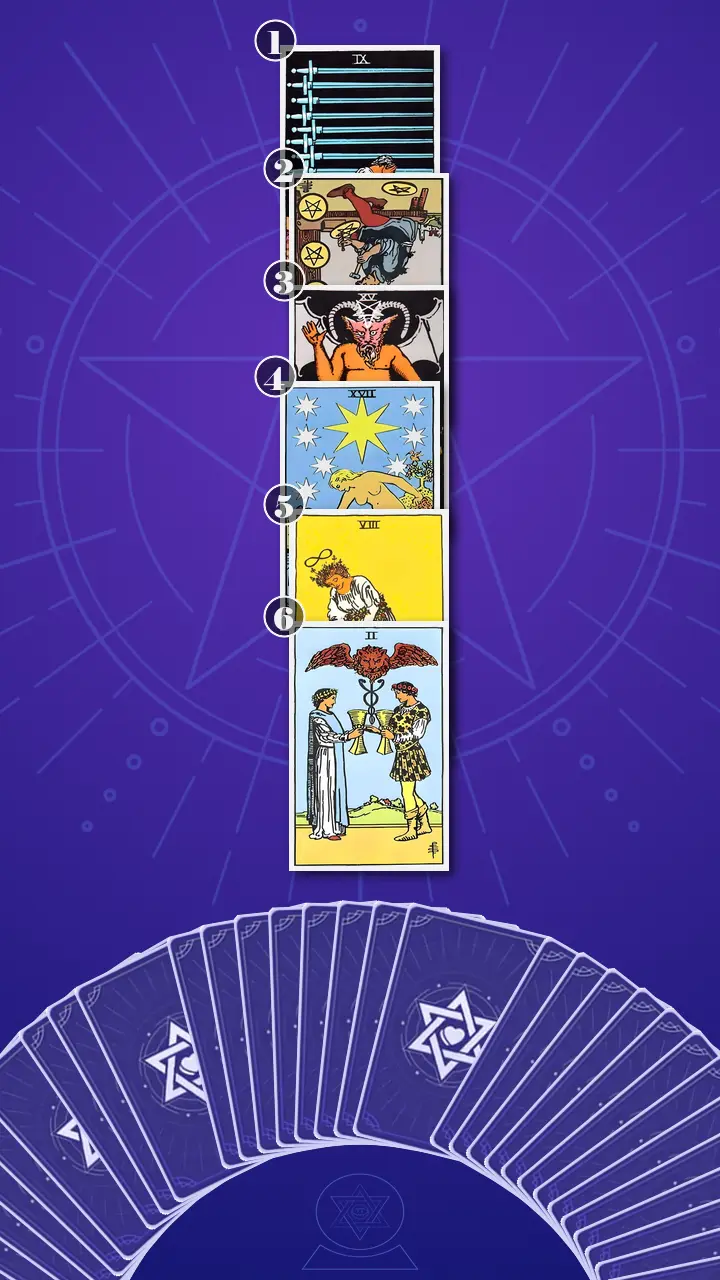
Reading the Map: Why ‘Just Drinks’ Starts Feeling Like an Audition
Position 1 — The Moment the Spike Hits
“Now flipped over,” I said, “is the card that represents: Show the observable moment when perfectionism spikes before meeting friends—what it looks like in thoughts and behavior.”
Nine of Swords, upright.
On the card, someone sits up in bed, hands to face, nine swords mounted on the wall like accusations that don’t sleep.
“This is the 2 a.m. open-tabs brain,” I told her. “And your version is painfully modern.” I anchored it in the exact scene the card keeps showing me for you: It’s 10:47 PM the night before you’re meeting friends. You’re in bed scrolling through old group photos and replaying last weekend’s conversation like a post-mortem. Your chest feels tight, and you’re mentally drafting ‘safe’ topics so you don’t get stuck in silence—because silence has started to feel like proof you’re not likable enough.
Energy-wise, this card is an excess of Air: too much thinking, too much prediction, too much inner commentary. Not insight—surveillance.
Taylor didn’t nod politely. She did something more honest: she let out a short laugh that landed bitter. “That’s… brutal,” she said. Then her mouth pressed flat, like she regretted laughing. “But yeah. That’s literally me.”
I watched the micro-sequence: her breath stopped for a second, her eyes unfocused like she was rewatching a memory, then her shoulders dropped a millimeter when she realized I wasn’t judging her for it. That’s the first pivot in any good reading—recognition without shame.
Position 2 — The Protective Strategy That Looks Like ‘Prepping’
“Now flipped over,” I said, “is the card that represents: Reveal how perfectionism is being used as a protective strategy—the specific prep behaviors meant to create safety.”
Eight of Pentacles, reversed.
In the Rider–Waite image, a craftsperson bends over repetitive work—one more pentacle, one more correction, one more pass at ‘good enough.’ Reversed, that effort doesn’t land as mastery. It lands as compulsion.
So I used the card’s modern translation exactly where Taylor lives: Forty minutes before you leave, you treat your whole self like a project deliverable: outfit change #4, hair reset #2, you open the group chat and rewrite “On my way” until it sounds effortless. The timer in your head screams ‘not ready,’ even though you’re already late—because the goal isn’t readiness, it’s control.
“You’re a UX designer,” I added, “so let me put it in your native language: it’s like iterating a design mock in Figma at 97% zoom—still hunting tiny alignment issues because you’re scared the whole thing will be rejected. ‘One more tweak, then I’ll be safe.’”
Energetically, this is a blockage in Earth: effort gets stuck in loops. Preparation stops being supportive and becomes self-editing. That’s why it doesn’t soothe you. It can’t. It’s not actually aiming at calm—it’s aiming at approval.
Taylor winced, then laughed again—this time with full recognition. “I do that exact thing,” she said. “I’m like, ‘just one more outfit’ and suddenly it’s 7:22 and I’m sweating.”
“And you’re not ‘high-maintenance,’” I said gently. “You’re high-alert.”
Position 3 — What You’re Actually Scared Of
“Now flipped over,” I said, “is the card that represents: Name what Taylor is actually scared of—the underlying fear about worth, belonging, or rejection that fuels the spike.”
The Devil, upright.
People get dramatic about this card, but I’ve always found it practical. The chains in the image aren’t welded. They’re loose. That’s the point. The pattern is powerful, but it’s also learned.
Here’s the exact real-life scene the card points to: You’re walking to the bar and your brain flips the hangout into a high-stakes audition. It feels like there’s a hidden scoreboard: every joke, every pause, every outfit choice gets counted. The real fear isn’t ‘being awkward’—it’s being quietly demoted in the group, like you’ll stop getting invited if you’re not the polished, easy version of yourself.
Energy-wise, The Devil is a blockage that masquerades as a rule: “If I’m not impressive/easy/put-together, I lose my place.” It turns belonging into a conditional contract you keep trying to renegotiate through performance.
Taylor’s reaction came in a three-beat chain: first, her chest visibly tightened and she swallowed hard; second, her gaze slid off-screen like she was seeing an old scene in her head; third, she exhaled through her nose, quiet and angry. “I hate that this feels true,” she said. “Like… I don’t even think my friends are mean. But I’m terrified of being phased out.”
“That’s the root,” I said. “Not ‘I need a better outfit.’ The fear is: quiet exclusion. And when your mind believes belonging is conditional, it will do anything to keep you from being ‘the person who made it weird.’”
My own inner flashback hit—one I don’t usually share, but it belonged here. On cruise ships, I watched guests perform at cocktail hour the same way: joking too quickly, scanning faces, trying to secure their place at a table. Different cultures, same nervous system. The ocean teaches you this: when people feel unmoored, they reach for anything that looks like control.
Position 4 — The Resource You Keep Skipping
“Now flipped over,” I said, “is the card that represents: Identify the deeper need beneath the perfectionism and the internal resource that can meet it without over-control.”
The Star, upright.
Visually, it’s a hard cut from the Nine of Swords’ enclosed room to an open sky. From surveillance to spaciousness. From “fix it” to “soothe it.”
I grounded it in the card’s modern scene: Right before you leave, you stop trying to perfect the vibe and do something almost boring: drink a glass of water, take a slow breath, step outside and feel the air on your face. You tell yourself one honest truth—“I’m nervous and I still want to go”—and the night suddenly feels a little less like a test and more like a human moment.
Energy-wise, The Star is balance. It doesn’t hype you up. It lowers the temperature. It’s like closing ten background apps so your phone stops overheating—your nervous system runs smoother when it’s not doing constant self-surveillance.
Taylor’s shoulders dropped in a way you could almost hear. “That,” she said quietly, “sounds like what I want. Space. Not more… effort.”
“Exactly,” I told her. “Your deeper need isn’t a perfect persona. It’s emotional safety. And The Star says you can give yourself a portion of that safety before you ask the room for it.”
When Strength Held the Lion: The Turning Point for Presence Over Performance
Position 5 — The Mindset Shift That Changes Everything
I slowed down before turning the next card. “We’re flipping the turning point,” I said. “This is the card that defines the most important shift—what directly challenges the fear and opens a new way to show up.”
Strength, upright.
The image is famous: a woman, not armoring up, not winning a fight—just gently holding a lion. Soft hands. Quiet authority. The infinity symbol above her head like a reminder that steadiness is renewable.
And the scene is unmistakable: You feel the urge to spiral—another outfit change, another text edit—then you pause with your hand on the closet door and choose steadiness instead of polish. Not fake confidence. Just: “Okay. I’m nervous. I can still go.” You leave the house ‘ready enough’ and let your presence—not your performance—do the work.
Strength is not an energy of excess or deficiency. It’s balance under pressure. It’s what I’d call, in Jungian terms, a new relationship to the fear: not exile, not obedience—companionship.
And this is where I brought in one of my signature tools, the one that’s saved more friendships than any pep talk: Social Role Switching. “Taylor,” I said, “right now your mind is putting you in Performer Mode. That mode is useful in a client presentation. It’s poison at a bar with friends. Strength is you choosing a different mode on purpose—Participant Mode. Or, if we name it more tenderly: Supportive Mode. You don’t have to dominate the room. You just have to be with people.”
Setup (I kept it close to her reality): “You’re in front of the mirror with three outfits on the bed, lipstick half-wiped on a tissue, phone warm in your hand—rewriting ‘On my way’ like it’s a cover letter. Your brain is trying to earn safety by getting everything ‘right’ before you’re allowed to be seen.”
Delivery (I let it stand alone, the way a true sentence deserves to):
Stop treating the hangout like a test you must ace; start treating it like a lion you can soothe—one gentle breath, one honest moment at a time.
Reinforcement (the room got quiet, even through the screen). Taylor’s face went still first—like she’d been caught mid-sprint and didn’t know what to do with the sudden stop. Then her eyes shone, not in a dramatic way, but in that glassy almost-tears way people get when a sentence names them too accurately. Her shoulders, which had been riding up near her ears for most of the call, lowered on a long exhale. The clenched jaw softened; she rubbed her thumb over her knuckle as if she’d been holding something tightly for a long time.
“But if I’m not trying,” she said, voice smaller, “won’t I just… show up wrong?”
“Strength isn’t ‘not trying,’” I said. “It’s trying differently.” I guided her through a micro-practice that matched the card’s gentleness and kept it safe and doable: “Set a 7-minute timer. Sit on the edge of your bed or by the window. One hand on your chest, one on your belly. Take 10 slow breaths and label what’s here in plain language: ‘I’m nervous,’ ‘I’m trying to control,’ ‘I want to be liked.’ Then pick exactly one presence intention for the hangout: ‘I will ask one real question,’ or ‘I will share one true sentence.’ If this makes you feel flooded or worse, stop immediately—switch to something neutral (drink water, feel your feet on the floor), and choose the smallest version: one breath, one text, or no action today.”
She nodded—small, almost reluctant, but real. “Okay,” she whispered. “That sounds… possible.”
“Now,” I asked her, “with this new lens—Strength as soothing, not forcing—can you think of a moment last week when this would’ve changed how you felt?”
Taylor went quiet again. I watched her eyes move as she searched her memory. “Yeah,” she said finally. “Wednesday. I rewrote a text to my friend like six times. If I’d just… soothed the lion and hit send once? I would’ve had my life back for ten minutes.”
That was the shift landing in real time: moving from anticipatory dread and shame-driven self-editing to self-compassionate presence. Not a personality transplant—an inner posture change.
Position 6 — The Practice: Turning Connection into an Exchange
“Now flipped over,” I said, “is the card that represents: Offer a concrete, doable one-week practice for showing up with friends with more presence and less performance.”
Two of Cups, upright.
This card is almost offensively simple: two people meeting as equals, each offering a cup. Not a monologue. Not an audition. An exchange.
I tied it directly to the lived scene: At the table, you stop scanning faces for approval and decide your only job is mutuality: ask one genuine question and share one real sentence. The pressure drops because you’re no longer trying to ‘win the room’—you’re meeting one friend at a time, as equals.
Energy-wise, this is balance in Water: reciprocity. And it’s a corrective to the Devil’s hidden-scoreboard thinking. You’re not trying to accumulate points. You’re participating in connection.
I borrowed from my cruise-training days here—my Maritime Social Protocol, adapted for NYC bars instead of ship lounges. “On a cruise,” I told her, “the guests who enjoyed themselves weren’t the loudest. They had a simple protocol: arrive with one offering—attention—and one anchor—honesty. That’s Two of Cups.”
Then I gave her a ready-to-use script in my most practical voice, because this is where tarot becomes actionable advice: “If you blank out in the moment, use this: one genuine question—‘How are you really doing?’—and one real sentence—‘I had a long week, I’m glad to be here.’ Not a joke. Not a performance. A human line.”
The Ready-Enough Boundary: Next Steps You Can Actually Try
I stitched the whole ladder together for her, like I was summarizing a story we’d just watched in fast-forward.
“Here’s the architecture,” I said. “Your mind starts in Nine of Swords mode—anticipatory dread, replay, mind-reading. Then Eight of Pentacles reversed kicks in: you try to regulate fear by polishing yourself like a deliverable. But the engine underneath is The Devil: a shame-based belief that belonging is conditional, that one ‘wrong’ night could quietly cost you your place. The system only reopens when you access The Star—self-soothing and spaciousness instead of more effort. Then Strength turns that softness into steady inner authority: you hold fear gently and still show up. And Two of Cups makes it real: connection is an exchange, not an audition.”
Her cognitive blind spot—what she hadn’t been naming—was clear: she kept treating social plans like a place to prove worth instead of a place to experience connection. “The transformation direction,” I told her, “is exactly what you came in asking for: shifting from earning belonging through polished performance to practicing presence.”
Then I gave her small experiments, not life advice. I kept them low-drama on purpose—because perfectionism loves grand plans it can later fail.
- The 20-Minute Prep CapBefore the next hangout, set a timer for 20 minutes. Choose an outfit, do one round of getting-ready, send one necessary message (if needed), and leave when the timer goes off—even if your brain says “not ready.”Expect the thought “this is silly” or “20 minutes isn’t enough.” That’s the pattern talking. If it’s too much, cap just one category (outfit or makeup or texting) and still leave at the next reasonable moment.
- Imperfect-on-Purpose TextThe next time you type “On my way” (or any simple update), hit send once—no rereading after you press send. Then physically put your phone face down for 60 seconds.If your urge spikes, name it: “I’m trying to control.” One breath counts. Ready enough is a boundary, not a failure.
- The Two of Cups Exchange RuleAt the hangout, bring one genuine question and one real sentence. If you catch yourself scanning faces for approval, switch into listening mode: repeat back one detail your friend just said.Keep it socially safe. If “real” feels like oversharing, use a low-stakes truth: “I’m a little tired, but I wanted to come.” Connection is an exchange, not an audition.

A Week Later: Ownership, Not Certainty
Six days later, Taylor messaged me a screenshot I didn’t ask for: her sent text bubble—“On my way”—no edits, no follow-up. Under it she wrote, “I did the one-send thing. I felt insane for 30 seconds. Then it passed.”
She told me she still had nerves, still had a moment in the hallway where she almost turned back. But she did the Star reset—water, feet on the floor, a wide gaze outside the building—and walked in anyway. She didn’t become a new person. She became a person who could arrive ready enough.
She described it in a way that made me smile because it was perfectly, imperfectly human: she slept through the night for the first time in weeks, then woke up and her first thought was still, “What if I was weird?”—but this time she exhaled and thought, “Okay. I can soothe the lion.”
That’s the real Journey to Clarity. Not certainty. Ownership. A steady inner authority that chooses presence over performance.
When you’re standing in the doorway with your stomach tight and your jaw clenched, it’s not that you don’t want your friends—it’s that you’re trying to prove you deserve them before you even arrive.
If you didn’t have to earn your spot tonight, what’s one small way you’d let yourself show up as a participant instead of a performance?
This story is adapted from psychological research, written so that those in a similar struggle can see their own pattern in it — and find their next step clearly.These insights are not a substitute for professional psychological, medical, legal, or financial advice.
Learn more about our Journey to Clarity.
How did this insight land for you?
🫂 This Resonates Deeply
🌀 Living This Story
✨ Now I See Clearly
🌱 Seeing New Possibilities
🧰 Useful Framework
🔮 The Confirmation I Needed
💪 Feeling Empowered
🚀 Ready for My Next Step
Author Profile
 AI
AI“Having traveled across cultures... I've learned that what we often lack isn't a simple answer, but a moment of being truly understood. I use a Jungian psychological lens to help you deconstruct your subconscious patterns—not to prove anything, but to be the gentle companion who helps you unravel your knots, free of judgment, so you can reconnect with your inner wisdom.”
In this Friendship Tarot Reading :
Core Expertise
- Guilt-Trip Deconstruction: Uncovering the subconscious codependency that forces you to act as an unpaid 'emotional dumping ground' for friends.
- Savior Complex Auditing: Identifying whether your inability to set boundaries stems from a deeply ingrained psychological need to 'fix' others.
Service Features
- The Compassionate Detachment Protocol: A psychological boundary script to validate a friend's emotions while firmly refusing to absorb their psychological toxic waste.
Also specializes in :
Explore Related Patterns:
Achievement FusionTaylor can ship polished work on a deadline, and the story shows that professional competence model leaking into friendship. A casual drink becomes something to optimize, edit, and deliver, as if social belonging depends on producing the correct version of herself. The underlying mechanism is a fusion between achievement and identity. The same standard that helps her polish a work product becomes misapplied to her body, her texts, her timing, and her conversational presence. It offers a familiar route to control, but it makes friendship feel like another arena where she has to prove value. Achievement Fusion fits because the question is not only 'Why am I anxious before seeing friends?' It is 'Why does my mind think performance is the price of staying included?' You can see the fear clearly: if the output is not polished, the self might be rejected with it.
External ValidationThe clearest rule in Taylor's story is brutally specific: if she is not impressive, easy, and put together, she might lose her place. That belief turns a friendly night out into a conditional contract where belonging must be re-earned through polish. The cognitive mechanism is externalizing the source of safety. Instead of locating her right to belong in mutual history, friendship, or ordinary humanness, the pattern asks the room to confirm that she is still acceptable. Every outfit choice, joke, and pause becomes a data point in the search for approval. External Validation fits because Taylor's worth gets outsourced to imagined group feedback before the group has even responded. You can see why perfectionism spikes: it is trying to manufacture evidence that she deserves to stay included.
Relationship Performance AnxietyThe calendar reminder for a casual 7:30 drinks plan does not land as a neutral schedule cue for Taylor; it flips her body into a graded state. The outfit changes, text rewrites, and repeated transit checks show a nervous system trying to turn social uncertainty into something measurable and controllable. The core mechanism is that friendship gets converted into evaluation. Silence becomes evidence, jokes feel scoreable, and the walk to the bar starts to resemble an audition rather than a meeting with people she already likes. You can see the cognitive distortion in how a normal hangout becomes a performance review before anyone in the room has actually judged her. Relationship Performance Anxiety fits because the fear is not simply looking imperfect. The fear is that a less polished version of You could lose status, warmth, or future invitations. The pattern tries to protect belonging through preparation, but it quietly makes connection feel unsafe before it even begins.
Perfectionism-Driven AvoidanceForty minutes before leaving, Taylor is not simply getting ready; she is revising herself. Outfit change #4, hair reset #2, and the repeated editing of a basic 'On my way' text show preparation turning into a control ritual, especially once the timer says she is already running late. The defensive logic is subtle: one more correction promises safety. If the look, the message, and the vibe can be perfected, then maybe the risk of being awkward, judged, or quietly excluded will shrink. But the loop does not create readiness because readiness is not the real target; emotional certainty is. Perfectionism-Driven Avoidance fits because the perfectionism delays exposure to the social moment it claims to prepare her for. You are watching a coping mechanism that looks productive from the outside while functioning internally as a way to postpone being seen before the self feels safe enough.
Authentic Self-ExpressionTaylor's later practice is concrete: leave the house ready enough, ask one genuine question, and share one real sentence. Those choices move her away from performing a flawless social version and toward participating as a real person in a reciprocal exchange. The psychological shift is not forced confidence. It is a different relationship with visibility: You can be nervous and still show up; You can be imperfect and still connect; You can offer one honest sentence instead of an optimized persona. That creates a small but meaningful break from approval-based self-editing. Authentic Self-Expression fits because the pattern is about letting the self become visible without first passing through a perfection filter. In this story, the healthier movement is not becoming more impressive; it is becoming more present.
Mind ReadingTaylor drafts safe topics before the hangout because silence has started to feel like proof that she is not likable enough. That is the key distortion: a normal social pause gets treated as if it contains other people's verdicts. The mechanism is a projection of feared rejection onto ambiguous cues. She explicitly says she does not think her friends are mean, yet her mind still fills in the missing information with a story of being phased out. The threat is not based on a confirmed conversation; it is generated by reading imagined evaluation into neutral space. Mind Reading fits because the pattern tries to prevent rejection by pre-answering what other people might think. You can see how it feeds the perfectionism: if every pause might mean disapproval, then every outfit, text, and joke starts feeling like evidence that must be managed.
Boundary DiscernmentThe 20-minute prep cap and the one-send text give Taylor a boundary around the part of preparation that never knows when to stop. 'Ready enough' becomes a line she can practice, especially when her mind argues that one more edit will finally make her safe. The mechanism is discernment between supportive preparation and anxiety-driven control. She is not rejecting care, effort, or social awareness; she is refusing to let the fear of being judged keep expanding the task. That boundary protects her access to the actual relationship. Boundary Discernment fits because Taylor learns to separate the self from the loop. You can see the relational impact when she stops trying to win the room and starts meeting one friend at a time, as equals.
Self-SoothingTaylor's turning point happens at the closet door, where the next outfit change or text edit is available but no longer automatic. Instead of escalating the control loop, she names what is happening in plain language and uses water, breath, and grounding to lower the internal temperature. The mechanism is emotional regulation replacing compulsive correction. Her body still carries the tightness and the urge to manage impressions, but she stops treating those sensations as commands. She gives the nervous system a safety signal before asking the room to provide one. Self-Soothing fits because the story shows Taylor building an internal resource in the exact place where perfectionism used to take over. You can see the change a week later: the fear still appears, but it passes through a steadier system instead of hijacking the whole evening.
Explore Related Struggles:
Approval-Safety FusionThe calendar reminder for drinks does not just tell Taylor when to leave; it flips the whole evening into a grading environment. She likes her friends, yet her body reacts as if approval is the entry fee, tightening around the idea that one awkward pause or imperfect outfit could quietly lower her standing. That is why the prep does not feel like normal getting ready. The outfit changes, rewritten texts, and repeated transit checks are all trying to purchase safety through acceptability. You can feel the trap in the line between wanting to be with people and believing you must first become the version of yourself least likely to be rejected. Approval-Safety Fusion names the moment where being liked stops feeling pleasant and starts feeling necessary for basic social security. The fear underneath is not simply looking bad; it is losing your place unless you can stay polished, easy, and low-risk enough to remain invited.
Belonging-Authenticity SplitTaylor keeps saying the most important contradiction out loud: she likes her friends, and still the plan feels like an audition. The desire to be with them is real, but so is the pressure to bring only the polished, easy version of herself into the room. That split turns connection into a performance problem. Instead of arriving as a participant, she starts managing the self that might be received, trimming away anything tired, nervous, awkward, or too human. The hangout becomes less about meeting friends and more about protecting her membership in the group. Belonging-Authenticity Split names the tension between being accepted and being real. You are scared that if you stop performing ease, the connection may not hold; the deeper work is learning that presence can be relationally safer than constant self-editing.
Social Self-Judgment LockThe phrase 'just drinks' never stays casual for Taylor. A calendar reminder becomes a grading notice, the walk to the bar becomes an audition, and silence starts to read as evidence that she is not likable enough. That internal scoreboard changes the social field before anyone else has done anything. Every pause has to be interpreted, every joke has to land, and every visible detail feels like it might count toward a verdict. The fear is not only rejection; it is being trapped inside a private evaluation system with no clear way to pass. Social Self-Judgment Lock names the way ordinary friendship gets pulled into a mental courtroom. You are not trying to be perfect because the night objectively demands it; you are trying to survive the feeling that your social worth is being decided in real time.
Perfect Readiness TrapForty-five minutes before drinks, Taylor is not calmly choosing an outfit; she is caught in a loop of mirror, closet, phone, time, and mirror again. Each correction promises that she will finally feel ready, but every pass creates another detail to inspect. The story makes the mechanism visible when she is already late and still chasing one more tweak. Readiness has stopped being a practical state and become a moving finish line, so the exit from the apartment depends on satisfying a standard that keeps shifting with the fear. Perfect Readiness Trap captures that locked structure. You are not preparing because the situation truly requires more preparation; you are trying to make uncertainty disappear before you allow yourself to be seen. The way out begins when ready enough becomes a boundary, not a failure.
Competence-Connection SplitTaylor can ship polished work on a deadline, and that competence follows her into the bathroom before drinks. The same system that helps her refine a deliverable starts treating her outfit, text tone, hair, and conversational vibe as if they have to pass review. The problem is not competence itself; it is context collapse. Performer Mode belongs in a client presentation, but at a bar with friends it starts replacing connection with optimization. The more she tries to make herself frictionless, the harder it becomes to arrive as someone who can actually be met. Competence-Connection Split points to the misapplied strength inside the struggle. You know how to improve things, but friendship is not asking you to become a better product. It is asking for an exchange, which means some of your unedited, present-tense self has to be allowed into the room.
Monitoring-Safety FusionThe night before the hangout, Taylor is in bed scrolling old group photos and replaying last weekend's conversation like evidence review. Before she even reaches the bar, her attention is already monitoring old facial expressions, future silences, safe topics, transit timing, and the possible meaning of every pause. The monitoring is trying to protect her, but it also turns friendship into surveillance. When every joke, outfit choice, and gap in conversation becomes data, there is no room for ordinary mutuality; the room is being scanned before it can be experienced. Monitoring-Safety Fusion names the structure where watching for danger starts to feel like the only way to stay socially safe. You are not overthinking because you lack intelligence; you are using intelligence as a security system in a situation that is asking for presence, reciprocity, and enough trust to stop checking the scoreboard.
Explore Related Emotions:
Approval AnxietyForty minutes before leaving, Taylor treats the hangout like a project deliverable: outfit change after outfit change, hair reset, another MTA check, another rewrite of a simple 'On my way.' The problem is not that she needs more information. The problem is that each tiny correction is carrying the weight of being approved. The body reads casual friendship as evaluation, so preparation stops functioning as care and becomes social risk management. She is trying to arrive already validated, already acceptable, already safe from the possibility of a bad read. Approval Anxiety fits because the fear is organized around how she will be received. You can feel it in the hidden scoreboard image: the room is imagined as a place where every micro-choice might confirm or threaten whether you are still wanted.
Conditional Belonging FearTaylor likes her friends, yet the walk to the bar turns into a high-stakes audition in her mind. Every joke, pause, outfit choice, and text starts to feel like evidence in a quiet social review, as if one slightly wrong version of herself could move her lower on the invite list. That is why the perfectionism spikes right before she leaves. The prep loop is trying to solve a belonging problem with presentation control: if she can become polished enough, easy enough, and socially frictionless enough, maybe she will not be phased out. Conditional Belonging Fear names the emotional engine underneath the mirror loop. You are not scared of drinks themselves; you are scared that your place with people is something you must keep re-earning before you are allowed to relax.
Shame SpiralAfter naming the spike, Taylor immediately turns it back on herself: 'I hate myself for it. Because it's just friends.' That moment matters because the fear is no longer only about the hangout; it has become a judgment of her own reaction. The shame makes the loop tighter. Harsh light turns details into flaws, the lipstick tissue records correction after correction, and the thought that she should be over this adds another layer of pressure to an already overloaded body. Shame Spiral fits because the self-attack becomes fuel for the perfectionism. You are not only trying to avoid being rejected by the group; you are trying to stop feeling embarrassed by your own need for reassurance.
Social Exposure DreadThe scene begins in the bathroom light: mirror, phone, time, mirror again, lipstick wiped off and reapplied while her jaw stays locked and her stomach tightens. Nothing dangerous is happening in the room, but being seen by friends has started to feel physically exposing. Social Exposure Dread captures the way ordinary visibility becomes loaded. Taylor is not simply nervous about going out; she feels as if the social room will inspect the parts of her she has not managed to perfect. The dread sharpens because the event is casual on the surface. When 'just drinks' starts feeling like a performance review, you are dealing with the fear of being perceived without enough control over the verdict.
Cautious Self-TrustSix days later, Taylor sends 'On my way' once, with no edits and no follow-up. She feels intense discomfort for 30 seconds, notices it pass, and later still has the old 'What if I was weird?' thought without letting it take over the whole night. Cautious Self-Trust names the modest but real shift in that sequence. She is not suddenly certain, socially fearless, or beyond the old loop; she has one piece of lived evidence that she can feel the spike and still choose a smaller, cleaner action. The trust is cautious because it is being rebuilt through tiny proof, not dramatic certainty. You begin to believe yourself when you can keep a boundary with the loop and still remain connected to the people you came to see.
Grounded PresenceTaylor's turning point is small and physical: a hand on the closet door, the urge to spiral still present, and a choice to leave ready enough. She does not erase the nerves; she changes her relationship to them. Grounded Presence is the feeling that appears when she stops making polish the price of entry. Water, breath, feet on the floor, one honest sentence, and one genuine question give her something steadier than the hidden scoreboard. This emotion belongs here because the story is not asking for flawless confidence. It is asking how you can stay connected to yourself while walking into connection with others, even while part of you still wants one more round of control.
Performance FreezeTaylor is not lying on the couch deciding she does not care. She is standing at the threshold with friends waiting, the clock moving, and her attention trapped between mirror, phone, time, and mirror again. Performance Freeze describes that stuckness at the exact point where private preparation has to become public presence. She wants to go, but each attempt to leave activates another demand to edit herself first. The freeze is not laziness or lack of desire. It is the body holding the door closed until the self feels polished enough to be seen, which means connection gets delayed by the fantasy of perfect readiness.
Self-Audit AnxietyThe night before seeing friends, Taylor lies in bed scrolling old group photos and replaying last weekend's conversation like a post-mortem. She mentally drafts safe topics before anyone has even said hello, because silence has started to feel like evidence against her. Self-Audit Anxiety names the internal review panel that wakes up before the social event. Her mind is not just preparing; it is reviewing, predicting, checking for weak points, and trying to remove anything that could make her look less likable. The emotional cost is constant self-surveillance. You do not get to simply anticipate connection; you feel pushed to inspect yourself in advance, as if every future pause must be controlled before you can walk into the room.
Mutuality HungerAt the table, the practice is almost disarmingly simple: ask one genuine question and share one real sentence. That simplicity reveals what the perfectionism has been covering over, which is Taylor's wish for the hangout to feel like an exchange rather than an audition. Mutuality Hunger points to the need beneath the fear. She does not want to dominate the room, win approval, or become a flawless social product; she wants to meet her friends as an equal participant. The longing matters because it reorients the whole pattern. You are not trying to earn a spot by performing connection from the outside; you are hungry for the kind of reciprocity where presence, attention, and ordinary honesty are enough to belong.
Explore Related Contexts:
Conditional Belonging PressureTaylor names the central social rule herself when she says the calendar reminder makes it feel like she is being graded. The room she is walking into is not described as openly cruel, but her preparation is organized around a harsher contract: every joke, pause, outfit choice, and text tone could affect whether she keeps her place. Conditional Belonging Pressure captures the external shape of that contract. Friendship becomes something that has to be renewed through being easy, polished, responsive, and never awkward. You are not only afraid of one bad moment; You are navigating the possibility that a subtle drop in social approval could lead to fewer invitations, quieter distance, or a lower rank inside the group. The story keeps returning to that structure through the hidden scoreboard, the fear of being phased out, and the effort to avoid becoming “the person who made it weird.” This label is the core answer to the question because the perfectionism spikes at the exact point where belonging starts to feel conditional rather than secure.
External Scorecard PressureTaylor replays last weekend’s conversation like a post-mortem, drafts safe topics before she even arrives, and checks the MTA again after already checking it. Those actions point to an environment with no visible scoring system, yet she behaves as if one exists and is already active. External Scorecard Pressure fits because the social standard is not stated, measurable, or negotiable. You cannot simply meet the requirement and move on, because the imagined criteria keep expanding: look right, text right, arrive right, joke right, avoid silence, stay easy, do not become awkward. The more unclear the standard is, the more ordinary details become possible evidence. This is a strong outer context because the pressure is not just an internal habit; it is attached to a real social setting where reputation, invitation, and group position matter. The story shows how a casual hangout can start functioning like a silent review cycle when the room is perceived as scoring You before You have even walked in.
Ready Enough BoundaryTaylor’s one-week practice gives the preparation loop a hard edge: a 20-minute prep cap, one necessary message, one sent text with no rereading, and leaving at the next reasonable moment. The point is not to become socially flawless; it is to stop letting the pre-hangout system demand unlimited revisions. Ready Enough Boundary fits the constructive side of the story because it turns an unclear social standard into a self-owned threshold. You no longer wait for perfect certainty before participating. You create a small external rule that says preparation is complete enough for movement. The week-later screenshot makes the boundary concrete. Taylor sends “On my way” once, lets the spike pass, does the reset, and walks in anyway. The outer context here is a new social staging ground where readiness is not proven through endless editing, but protected through a clear limit that lets You rejoin the room.
Social Performance LoopTaylor is forty minutes from a simple friend hangout, but the scene has the structure of a live evaluation: outfit change #4, hair reset #2, a warm phone in her hand, and “On my way” rewritten until it sounds effortless. The same skill that lets her ship polished work on a deadline gets pulled into the social room, turning her body, message, and entrance into outputs that must be cleaned up before she can leave. That is why the spike is not random. The external situation has become a performance environment, even though the official plan is just drinks. The mirror, the group chat, the calendar reminder, and the imagined arrival at the bar all function like review points, so You are not simply getting ready; You are trying to pass a social quality check with no clear rubric. Social Performance Loop fits because the pressure repeats across the story: replaying old group photos, drafting safe topics, changing outfits, editing texts, checking transit again, and scanning faces at the table. The loop keeps promising safety through one more adjustment, while the real cost is that connection gets delayed until You can appear polished enough to deserve it.
Soft ExclusionTaylor’s clearest fear is not that her friends will attack her or openly reject her. She says she is terrified of being phased out, and the reading names the risk as quiet exclusion: a slower social demotion where invitations thin out, warmth drops, and nobody has to say the rule out loud. That makes Soft Exclusion a precise outer context for the story. You are preparing against an invisible social consequence, not a single dramatic confrontation. The outfit changes, safe-topic drafting, and approval scanning all make sense inside a social field where losing position might happen gradually and ambiguously. The label also explains why “just friends” does not feel simple. When the feared outcome is subtle displacement, every small cue can start to matter too much. A pause, a delayed laugh, or a distracted look can feel like early evidence that Your place in the group is becoming less secure.