Turning Vulnerability Into Content With Friends: A Private-First Shift

When Turning Vulnerability Into Content Starts at 11:38 P.M.
Taylor placed their warm phone beside my coffee cup and said, “I tell the story clearly enough to sound self-aware, but the second the conversation ends, I open Notes to turn it into a Reel. I keep asking myself: am I sharing, or am I performing vulnerability?”
They asked me to picture the previous night in their small Toronto apartment. At 11:38 p.m., the radiator clicked against the wall and a streetcar hummed below the kitchen window. Their friends had gone home, but the room still smelled faintly of takeout and cold coffee. Taylor opened Notes, typed a polished hook, added a self-deprecating punchline, and reread it while their throat stayed tight.
“I was honest with them,” they said. “But somehow I was still performing. I want my friends to hold me, not just help me frame the moment.”
I could see the ambivalence in their body: one hand rested near the phone while the other curled around the coffee cup. It looked like a streetcar stalled on an icy track, the wish to move toward another person vibrating through one rail while the instinct to retreat behind glass hummed through the other.
“Nothing about this makes your vulnerability fake,” I said. “You have learned to make emotional exposure controllable and socially useful. Let us use the cards to separate what helps you create from what helps you feel held. We are not looking for a verdict. We are drawing a map through the clutter.”

Choosing the Map for an Audience-Aware Heart
I invited Taylor to place the phone face down and take one unforced breath. I shuffled slowly while they held one practical question in mind: “What happens between the raw feeling and the moment I turn it into content?” The pause was not a mystical performance. It was a way of letting their attention arrive before the analysis began.
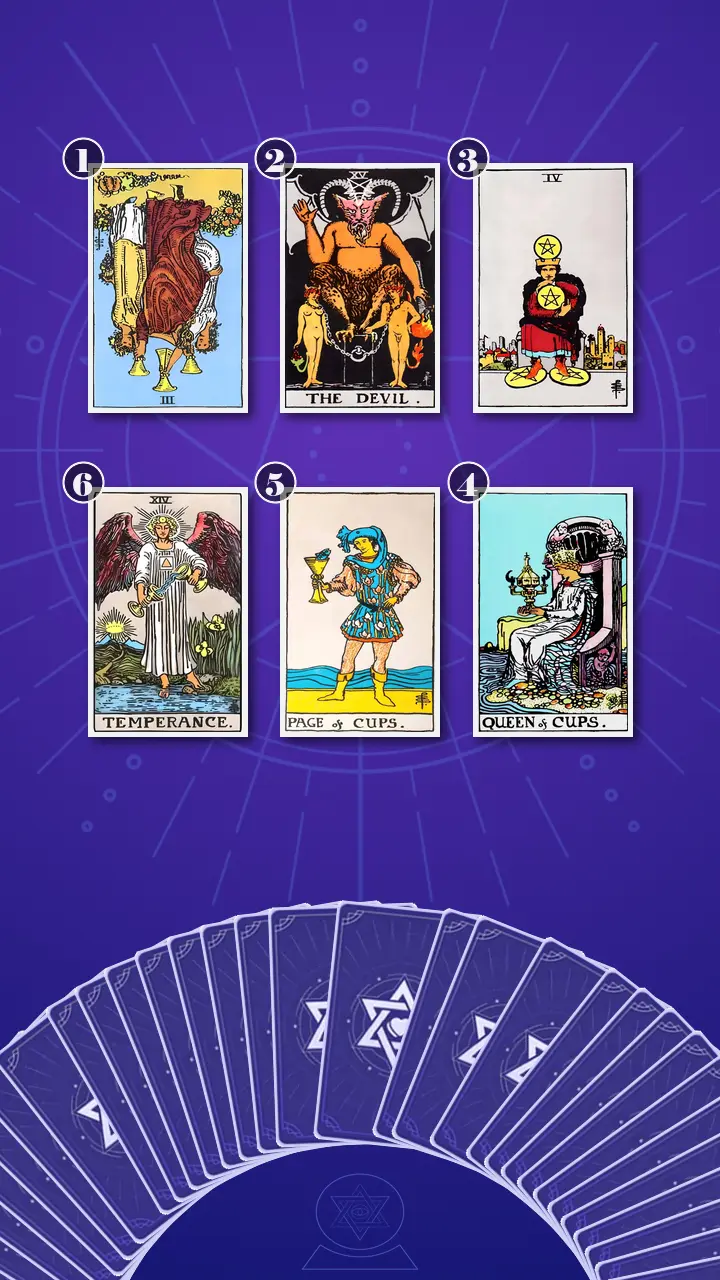
I chose the Transformation Path Grid (6) · Context Edition, a six-card Transformation Path Grid tarot spread for exploring performative vulnerability, emotional processing, friendship boundaries, and the relationship between private feeling and public content.
For anyone wondering how tarot works in a question like this, I treat the spread as a structured cognitive tool. A relationship spread could describe Taylor's friends, but it would not fully trace Taylor's internal cycle. A Celtic Cross would add more material than this focused question required. These six positions were the smallest useful map: visible behavior, reinforcing reward, protective root, catalyst, action, and integration. The card meanings in context would help us examine Taylor's choices; they would not predict what any friend would do.
I pointed to the upper row. “The first card shows the observable moment when connection becomes performance. The next identifies the payoff that keeps the pattern repeating. The third uncovers why controlling the frame feels protective.” Then I traced the return path across the lower row. “The fourth is the bridge. The fifth gives us a small experiment, and the sixth shows how private feeling and creative work can coexist.”
When the Friendship Circle Becomes a Stage
Position 1: Three Raised Cups and an Imagined Audience
“Now I am turning over the card representing your present state: the observable behavior in which vulnerability with friends rapidly becomes audience-aware content.” I revealed Three of Cups, in reversed position.
I showed Taylor the three figures raising their cups in a shared circle. Upright, that exchange can represent affection, celebration, and mutual emotional support. Reversed, its social Water was scattered outward in excess. Group warmth remained, but private attention had become deficient.
In Taylor's life, Three of Cups reversed looked like leaving a late-night Toronto hangout with two friends and remembering the funniest line more clearly than the support they needed. The affection was real, yet the disclosure had already been routed into a Reel idea, caption, or filming plan. A friend-to-friend check-in had quietly acquired an imagined audience.
“At what exact point,” I asked, “does the room stop being three people talking and start feeling like a set?”
Taylor gave one short laugh, but no smile followed it. Their fingers tapped the table twice before becoming still. “That is too accurate,” they said. “Almost cruel.”
“Then let us slow it down,” I replied. “This card is not calling you cruel, shallow, or dishonest. It is showing where the emotional route changes. The issue is not that you have creator friends. It is that nobody asks what the moment needs before deciding what it could become.”
Position 2: The Devil and the Reward Loop
“Now I am turning over the card representing the blocking pattern: the reward, attachment, and social reinforcement that keep performative vulnerability repeating.” The card was The Devil, upright.
I kept my attention on the loose chains around the two figures. I did not interpret The Devil as an outside force, a moral judgment, or a fixed fate. Here it described a blockage created by an overactive reward loop: emotional exposure produced laughter, creative momentum, reassurance, or the warm jolt of inclusion, and the nervous system learned to repeat whatever delivered that relief fastest.
In Taylor's modern life, the card appeared whenever a painful story earned the biggest laugh, the most enthusiastic content ideas, or the strongest sense of belonging among creator friends. The bargain was practical: vulnerability felt safer when it was useful, entertaining, and easy for everyone to understand.
I phrased the loop in the voice Taylor's body seemed to know already: “If they react well, I can relax. If I shape it first, nobody can misread me.” Creator notifications, comments, laughter, and group-chat momentum functioned like the card's loose chain. Taylor could remove it, but the immediate reward made staying inside the loop feel easier.
Their shoulders rose toward their ears. Their gaze moved from the card to the dark phone screen, as though they were replaying several conversations at once. “Being legible feels safer than being held,” they said quietly. “I know how to earn the first one.”
“And being articulate is not the same as being emotionally met,” I said. “The camera can document vulnerability; it cannot do the holding.”
Position 3: Four of Pentacles and the Locked Frame
“Now I am turning over the card representing the underlying root: the belief that edited vulnerability is safer than an unstructured emotional exchange.” I revealed Four of Pentacles, upright.
The figure gripped one pentacle against the chest, stood on two more, and carried another at the crown. Control surrounded the whole body. In energetic terms, security had moved into excess while flexibility, shared meaning, and tolerance for uncertainty had become deficient.
For Taylor, Four of Pentacles looked like sharing exactly enough of a personal story to appear open, editing the uncertain paragraph out, and choosing a carefully limited audience. The disclosure was genuine, but timing, wording, context, audience settings, and anticipated reactions were all locked down. Their phone could serve as a tool for connection and a physical shield at the same time.
“If you said only, ‘I felt scared,’ without a polished explanation or a joke,” I asked, “what are you afraid a friend might misunderstand?”
Taylor's thumb pressed into their palm, held there, and slowly released. “That I am needy. Or dramatic. Or that I do not actually understand myself as well as I sound online.”
I nodded. “The Devil and Four of Pentacles form the closed loop. Attention rewards the polished disclosure, and control protects you from the unfinished response. Neither card says the openness is false. Together they show why the openness can remain emotionally stagnant: the story is managed before the feeling has had room to change you.”
When the Queen of Cups Turned Attention Back Toward the Feeling
Position 4: The Private Cup at the Center of the Reading
The radiator in my consultation room stopped clicking. In the sudden quiet, the light from the window moved across the table and caught the blue water behind the figure on the next card. I could feel the reading reach its hinge.
“Now I am turning over the card representing the key catalyst: the emotional quality that can interrupt healing stagnation by letting you receive and name a feeling before making it useful.” I revealed Queen of Cups, upright.
I showed Taylor the Queen's sustained gaze toward her ornate, closed cup. Unlike the three raised cups in the opening card, this vessel was not being displayed to a circle. Its balanced Water energy offered receptive attention, compassionate boundaries, and a private container. In Taylor's life, it looked like putting the phone down, naming the feeling without making the language clever, and telling a friend what kind of listening they wanted before discussing content.
I brought Taylor back to 11:38 p.m.: the conversation over, the phone warm, Notes already asking for a hook. They could make the moment legible before discovering whether they wanted comfort, reassurance, silence, or simply a friend who would stay.
Stop using a polished story to prove that vulnerability counts; let the Queen of Cups hold the unedited feeling first, then choose what, if anything, becomes content.
I let the sentence remain between us without explaining it away.
Taylor's breath stopped first. Their fingers hovered above the face-down phone, frozen as if an invisible notification had appeared. Then their eyes lost focus. I watched recognition move across their face while they replayed the previous week: the ring light reflected in a coffee table, a friend reaching for a phone, Taylor laughing before anyone could ask what hurt. Their pupils widened; their jaw tightened; a faint flush rose beneath their eyes. Finally, their shoulders dropped and their hand opened against the table. The exhale came from deep in their chest, but the release carried a slight tremor, like stepping off a moving walkway and discovering the floor was solid but unfamiliar.
“But does that mean I have been doing vulnerability wrong this whole time?” Taylor asked. A sharp edge briefly entered their voice. “Because that feels awful.”
“No,” I said. “It means creativity has protected you effectively enough that it became automatic. We are not putting your past on trial. We are noticing that a strategy built for control is now being asked to provide closeness, and it cannot do both jobs alone.”
I leaned toward the Queen. “Now, with this new perspective, think back: was there a moment last week when this insight could have made you feel different?”
Taylor stared at the closed cup. After several seconds, they told me about a friend asking whether their relationship story could become a series. Taylor had agreed immediately, then felt hollow on the TTC ride home. “I could have said, ‘I need this to stay mine tonight,’” they murmured. Their eyes shone, and a relieved half-smile appeared, followed by a brief blankness. I recognized the new vulnerability in it: once the pattern was visible, Taylor could no longer outsource the next choice to habit.
“I know how to explain what happened,” Taylor said. “I am still learning how to stay with what it did to me.”
This was where I used a framework I call Social Clutter Sorting. I asked Taylor to look across their network and sort social spaces by function. A core nourishing connection was one in which a person could tolerate silence, ask consent before retelling, and respond to a need without immediately making it productive. An energy-draining connection was one in which Taylor consistently left more exposed, more performative, or responsible for keeping the exchange entertaining.
“This is not a good-friend versus bad-friend verdict,” I said. “The same person may be nourishing in a private walk and draining in a group creator session. We are sorting access and context, not assigning human worth. Before you share something raw, ask which room you are actually entering.”
I paired that with Obligation Decoupling. A friend's excitement about a story did not create an obligation to publish it, repeat it, or make it available for brainstorming. Declining the content conversation was not a rejection of the friendship. It was a consent decision about Taylor's own experience.
“Before I decide what this means to anyone else,” I offered, “I can notice what I need right now.”
Taylor repeated the sentence more slowly. I heard the shift in their voice: from making vulnerability immediately useful, polished, and audience-legible toward receptive self-trust, private emotional connection, and intentional creative expression. It was not complete confidence. It was the first permission to let a private feeling be valuable without proving its value through performance.
“A private feeling is not unfinished content,” I said.
Position 5: The Page of Cups Sends the Plain Message
“Now I am turning over the card representing the action plan: one small boundary or direct request you can try with a friend without publishing the experience.” I revealed Page of Cups, upright.
The fish emerging from the cup suggested an unexpected emotional truth arriving without a polished narrative arc. The Page's upright energy was available but underused: sincerity, curiosity, and direct communication without certainty about the response.
In Taylor's life, Page of Cups looked like sending one plain iMessage to a trusted friend: “Can you listen for ten minutes? I am not trying to turn this into content.” The message did not need to explain the complete emotional journey or guarantee a perfect reply. It gave an unfinished feeling a small route into friendship.
“I do not know exactly what I need yet,” I suggested, “but I can say what I do not want to happen to this moment.”
Taylor picked up their phone, unlocked it, and then paused. “My first instinct is to make that text sound less dramatic.”
“Then keep it ordinary rather than impressive,” I said. “You can ask for listening. Your friend can say no, and you can stop if the conversation feels too exposing. A boundary is not a test of courage or friendship.”
Position 6: Temperance and the Two-Stage Edit
“Now I am turning over the card representing integration: how friendship, emotional processing, and creative expression can coexist without requiring every vulnerable moment to become content.” The final card was Temperance, upright.
The angel poured between two cups with one foot on land and one in water. This was balanced energy in its clearest form: not total privacy, not automatic disclosure, but proportion, timing, and deliberate movement between inner experience and creative translation.
For Taylor, Temperance looked like having the private conversation first, waiting until the emotional charge had settled, and only then deciding whether a broader creative version would honor the experience or merely restore control. Friendship could hold the original exchange. Creativity could later translate part of it, with consent, without becoming the price of being heard.
After twenty years of listening to stories over coffee, I have learned that a cup matters because someone is willing to stay at the table with it. It does not become more meaningful when it is photographed, captioned, or displayed. Looking at Temperance, I thought of how often the most sustainable changes resemble a careful pour rather than a dramatic break.
“Content can translate connection without becoming the price of being heard,” I said. “The goal is not to stop creating from your life. The goal is to regain authorship over when the experience is ready to become art, if it ever is.”
The VIP Section for What Has Not Settled Yet
I gathered the six cards into one coherent sequence. Taylor's creator-friend circle offered real affection, but its familiar rhythm made a raw disclosure audience-aware almost immediately. The Devil showed the quick reward of laughter, approval, and creative momentum. Four of Pentacles showed the protective control underneath: if Taylor shaped the story first, nobody else could define it. The Queen of Cups restored private emotional attention; the Page turned that attention into one sincere request; Temperance separated support from later creative translation.
I described the pattern as a personal algorithm. Taylor's system had learned that polished pain received the strongest and fastest response, so it kept recommending the same behavior whenever emotional exposure appeared. The cognitive blind spot was not a lack of honesty. It was mistaking articulation, usefulness, and attention for the experience of being emotionally met.
The absence of Swords and Wands mattered as well. I did not see a need for more analysis, more output, or a forceful reinvention of Taylor's personality. The transformation direction was smaller and more relational: notice the urge to perform, allow one unedited conversation, choose what remains private, and decide later what may become creative work.
A One-Week Reservation-Only Rule
I adapted my VIP Section Strategy into a one-week experiment. Taylor's private emotional time would become reservation-only. Friends, group chats, deadlines, and potential posts would not receive automatic access to a feeling simply because it had been disclosed. Entry required a clear purpose: listening, brainstorming, or filming. Taylor could choose one, choose none, or change their mind.
- Reserve a phones-away check-in.At the next emotionally charged catch-up, Taylor will ask one trusted friend, “Do you want listening, brainstorming, or filming? I want listening.” They will set a ten-minute timer at a kitchen table, on a walk, or during a private call, keep devices face down, and agree that there will be no recording, screenshots, captions, or reuse.If ten minutes feels awkward or impossible, use the two-minute version with the phone in another room. Either person may pause or stop without explaining more.
- Send the plain request, then delay the story.This week, Taylor will text one core nourishing friend, “Can you listen for a few minutes? I am not looking for a caption, joke, or solution right now.” Afterward, they will write one private sentence: “What I needed from that conversation was...” Any public draft will receive a 24-hour calendar reminder before Taylor chooses to keep it private, share a limited version with consent, or revisit it later.The delay is an option, not a purity rule. The only test is whether sharing honors the experience and everyone involved, rather than merely calming the urge to control the reaction.

A Week Later, the Quiet Proof
A week later, I received a message from Taylor. They had sent the plain listening request to a trusted friend before a Sunday catch-up. Their friend agreed. Taylor left the phone in the bedroom, sat at the kitchen table, and spoke for eight minutes without adding the joke they had already composed in their head.
Afterward, Taylor wrote one sentence in Notes: “I wanted company while I felt embarrassed.” They did not expand it into a caption. They did not delete it either. The sentence remained private, useful only because it was true.
That night they slept through. In the morning, their first thought was, “What if I made it weird?” They laughed softly, left the note unpublished, and made coffee.
I did not read that message as proof that the pattern had disappeared. I read it as the first grounded evidence of movement: self-conscious packaging had been interrupted by one unedited conversation and one deliberate choice. The six-card Transformation Path Grid had made the loop visible, but the cards had not placed the phone in another room, spoken the boundary, or tolerated the silence. Taylor had done that.
That is the clarity I trust. It does not demand that creativity disappear or that every friendship become perfectly safe. It returns authorship to the person living the experience. Tarot can help tidy the table and identify what belongs where, but the querent decides which cup stays private, which conversation needs support, and which story may eventually become art.
When your throat tightens and your hand reaches for the Notes app, I know it can feel safer to offer friends a finished story than to let them meet the uncertain person underneath it. Noticing that reach already creates a small space between the feeling and the old algorithm.
If one feeling stayed off-camera in the Queen's closed cup for ten minutes this week, what plain sentence would you want a trusted friend to hear before the hook appeared?