When a Private Bond Became a Public Proof Test: Choosing Consistency

The 12:40 a.m. Split Screen
I often recognize this scene instantly: if you are a twenty-something hybrid creative worker who can polish product copy all day but spends Friday night comparing one vague introduction with six weeks of intimate DMs, you may know public-private friendship ambiguity by heart. I met Jordan, a 27-year-old junior UX writer in Toronto, inside that exact contradiction.
Jordan told me that at 12:40 a.m., they were sitting on the edge of their bed in a shared apartment, Friday-night clothes hanging from a chair, event photos open on their laptop and the friend's warm messages glowing on their phone. The radiator clicked behind them, bass from a roommate's speaker leaked through the wall, and the phone felt hot against their palm as they rewrote the same line: 'Maybe I misunderstood what we are to each other.'
When I asked what they wanted this tarot reading to clarify, Jordan looked down at the Notes app and said, 'What am I trying to prove when my friend hides our bond in public? If we are really close, why do I become nobody when other people are around?'
I heard the central contradiction immediately. Jordan wanted public acknowledgment to confirm that the friendship was real, yet feared that every omission proved the bond, and their place in it, were not secure. The feeling had a physical shape: a hot coin pressed beneath the breastbone, sending heat into the face whenever the friend became formal, then pulling Jordan back toward Instagram, photo tags, and message history like a magnet under a table.
I said, 'Your hurt is not silly, and it does not give us permission to invent the friend's motive. We can look at what happened, what your mind concluded, what you need, and what choice remains yours. Let us draw a map through this belonging proof test so you can move from post-hangout anxiety toward finding clarity.'
Choosing a Compass for a Hidden Friendship
I asked Jordan to place the phone face down, take one slow breath, and hold the question in a single sentence. I shuffled slowly, treating the ritual as a change of gear rather than a supernatural test: a few quiet minutes to let attention settle before we examined the pattern.
For this reading, I chose the Relationship Spread - Context Edition, a five-card tarot spread for friendship dynamics and boundaries. When people ask how tarot works in a situation like this, I explain that I use the cards as a structured cognitive tool. The images give us a neutral set of symbols, and the position meanings help us test card meanings in context instead of letting one anxious interpretation run the entire conversation.
This spread is deliberately small. It can hold the self, the friend's observable public conduct, the meaning the bond has taken on, the attachment pattern that keeps the question alive, and a self-directed path forward. It does not claim access to the friend's private thoughts, and it does not predict what they will choose.
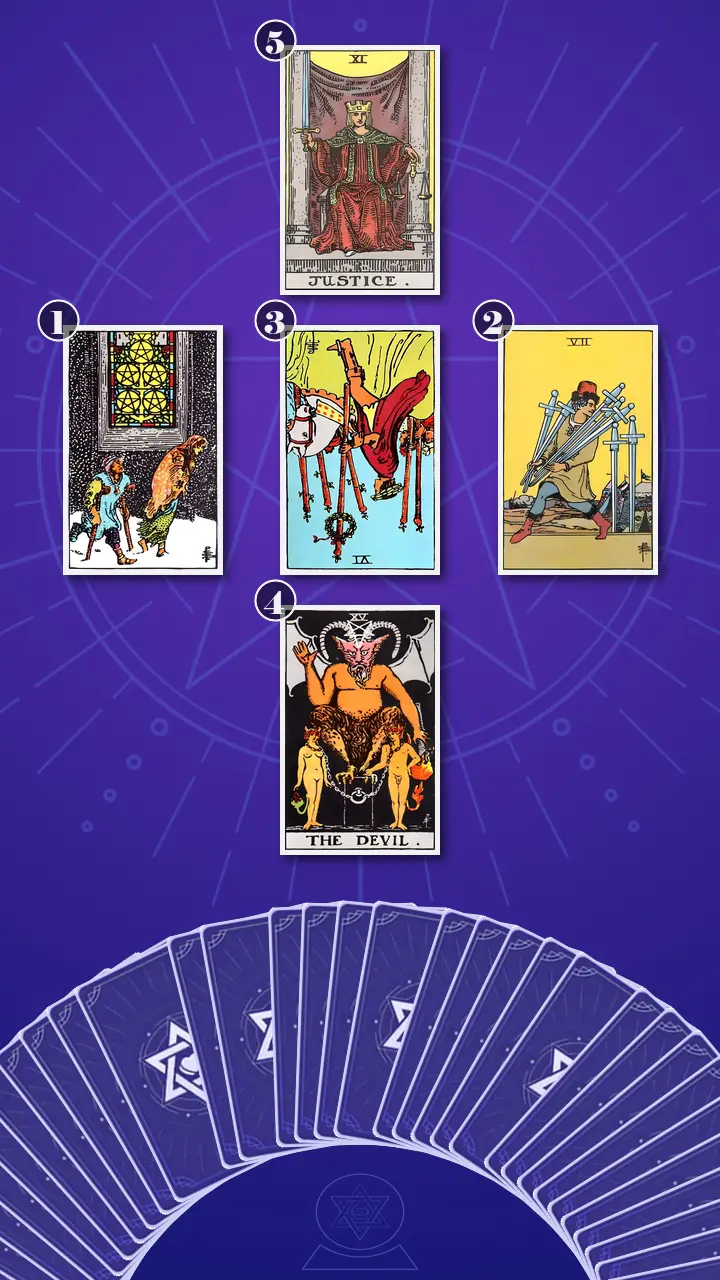
I explained the route across the cross. The first card would show the emotional and behavioral activation inside Jordan. The second would stay with conduct that a camera or transcript could confirm. The central third card would answer what public acknowledgment had come to symbolize. The card below it would show the proof-seeking blockage, and the card above it would offer an integration principle Jordan could apply regardless of the friend's eventual response.
'We are not asking the cards to announce whether this person is good or bad,' I said. 'We are asking a cleaner question: what is this dynamic asking you to notice, name, and decide?'
Reading the Map Beneath the Public Mask
I laid the cards in a cross and began where the spread asked me to begin: at the left side of the horizontal relationship axis, where lived impact comes before explanation. The room had quieted to the soft hum of my laptop and the faint traffic beyond the window.
Outside the Lit Window: Five of Pentacles Upright
I began with the position that shows the observable emotional and behavioral activation described in the diagnosis: the moment public exclusion sends Jordan scanning for evidence that the friendship is real. I turned over the Five of Pentacles, in upright position.
The RWS image showed two figures moving through snow beneath an illuminated window set with five pentacles. I did not read the scene as a prophecy that Jordan had been abandoned. I read it as the body-level experience of seeing warmth and legitimacy nearby while feeling kept outside the public version of a bond.
The modern translation was precise. Jordan leaves a crowded Queen West event after the friend introduces them as a casual work-adjacent contact. On the TTC home, Jordan watches the friend openly joke with and tag mutuals while weeks of intimate voice notes remain on their own phone. The event is observable. The larger conclusion, that being outside the public circle means Jordan never truly belonged, is the painful story forming around it.
The upright energy here was contracted earth: attention pulled downward into the chest, the jaw, the remembered wording, and the need to locate a secure place. I asked Jordan to hold two sentences beside each other: 'I can see the warmth, and I have private evidence that I belong there. So why am I still outside it?' Wanting ordinary inclusion is not the same as demanding a public performance, but the nervous system can experience the difference as a verdict before the mind has checked the facts.
Jordan did not nod. They let out a short laugh with a bitter edge. 'That is too accurate,' they said. 'Almost rude.'
I smiled gently and said, 'We do not have to make the feeling prettier than it was. The card is locating the bruise, not judging you for having one.' I watched their fingers tighten around the paper cup, then loosen as they looked back at the figures under the window. I wanted the humiliation to be acknowledged without allowing it to become evidence of the friend's motive or a ranking of Jordan's worth.
Two Incomplete Records: Seven of Swords Upright
I moved to the position narrowed to the friend's observable public conduct and its impact on Jordan, without claiming access to the friend's private intentions. The card was the Seven of Swords, in upright position.
The figure in the RWS image carries five swords while glancing backward, leaving two standing apart. I used that divided inventory as a picture of the friendship Jordan had been trying to reconcile: affectionate late-night voice notes on one side, vague introductions, omitted tags, and a cooler group tone on the other.
This card names selective visibility and partial disclosure. Its energy was blocked transparency, but blocked transparency is not the same as confirmed deception. Jordan could ask, 'What behavior have I directly observed, and what intention am I adding to it?' The friend could be protecting privacy, avoiding conflict, managing another relationship, feeling awkward in a work-adjacent social circle, or acting from a motive Jordan had not considered. I did not need to choose among those explanations before naming the impact.
I brought in one of my signature diagnostic lenses, which I call Clique Power Dynamics. I use it to examine subtle jealousy, micro-aggressions, and implicit hierarchies within tight-knit friend groups: who is made visible, who is treated as optional, who gets a clear label, and who is expected to smile through a downgrade. The lens is useful only when it stays anchored to repeated behavior. It is a way to inspect the social structure, not a license to prosecute someone from a single photo.
I said, 'Private warmth does not erase public diminishment. But public diminishment does not automatically tell us why it happened. We can be accurate about the effect while remaining honest about the unknown.'
Jordan nodded, then hesitated with their gaze fixed on the two swords left behind. 'I know what happened,' they said quietly. 'I do not know why it happened. I keep trying to solve the second part by collecting more of the first.'
I noticed the difference in their posture. The shoulders were still raised, but their eyes were no longer chasing an answer through the image. For a moment, the facts stood on their own without being forced to carry a complete explanation.
The Public Verdict That Could Never Hold
The Laurel Crown Turned Sideways: Six of Wands Reversed
I returned to the central position, the place that reveals what the bond has come to symbolize for Jordan and answers the question of what they are trying to prove. The card was the Six of Wands, in reversed position.
The upright rider with the laurel wreath and raised wand usually evokes victory, recognition, and the watching crowd. Reversed, the fire of recognition was blocked. It had become dependent on an external signal, so every imagined victory faded as soon as the next group interaction introduced a new uncertainty.
I asked Jordan to picture the perfect public moment. The friend posts the photo, uses an unmistakably close caption, introduces Jordan warmly, and everyone in the room understands. I let the fantasy sit there long enough to reveal its job. The imagined scene was not really about a caption. It was being asked to prove two deeper claims: that the friendship was legitimate and that Jordan was worthy of being openly chosen.
'If everyone can see that I am chosen,' Jordan said, 'maybe I can stop wondering whether I count.'
I pointed to the reversed wand. 'This is the blockage. Public recognition has been assigned more stabilizing power than it can hold. A post cannot carry the full weight of belonging. Even a perfect photo could offer relief, but if the next introduction turned vague again, the old question would reopen.'
Jordan's thumb moved toward their phone and stopped. Their breath caught, and their face went still as they seemed to replay the omitted carousel, the formal voice, and the imagined corrective scene. Then they said, 'So I am not asking for a performance, but I am asking a post to settle whether I am real to them.'
I said, 'That sentence is the opening. We can translate it into a need that a person could actually respond to. Maybe you want to be introduced as a friend around mutuals. Maybe you want the private and public tone to stop changing so sharply. The goal is not applause. The goal is ordinary consistency.'
The Loose Chain in the Refresh: The Devil Upright
I turned to the position that exposes how Possessive Attachment and the Betrayal-Closure Lock turn public ambiguity into monitoring, indirect reassurance tests, and a self-reinforcing need for proof. The Devil appeared in upright position.
I showed Jordan the loose chains around the two figures. I wanted that detail visible because The Devil is not a sentence, and it is not a declaration that the friend is dangerous or that Jordan is broken. The card describes a binding pattern: a legitimate wish for reciprocity becomes tied to controlling the evidence of reciprocity.
The modern scene was familiar. Jordan tells themself they will open Instagram for one quick check, compares likes, tags, comment warmth, timestamps, and photo order, then returns forty minutes later with more evidence and less clarity. A warm private reply briefly releases the pressure. The next public omission tightens it again. The energy here was excessive attachment and narrowed attention, not moral failure.
'The checking looks like clarity,' I said, 'but it keeps outsourcing the verdict. The next clue might settle it, so you cannot stop now. But the next clue has never been the last one.'
I then used my Sidekick Syndrome Diagnosis. I asked whether the friend group had quietly boxed Jordan into a restrictive character: the low-maintenance confidant, the private therapist, the person who carries emotional intimacy one-on-one while remaining socially easy to downgrade when the room fills. I made the question conditional. I was not declaring that the group had consciously assigned this role. I was checking whether the role existed in practice and whether Jordan had been helping maintain it by absorbing the hurt in silence.
Jordan put the phone face down. Their hand stayed on it for a second, as if the device might call them back. 'I hate that this works,' they said. 'I know the next check will not create trust, but stopping feels like giving up my only chance to find the explanation.'
'Stopping the check is not giving up on the truth,' I replied. 'It is refusing to make your nervous system earn the truth through another hour of surveillance. Your need for respectful consistency can remain. The loop does not have to remain with it.'
When Justice Replaced the Public Verdict
The Standard Jordan Could Control: Justice Upright
I let the room settle before lifting the fifth card, the position reframed from prediction into self-directed integration: the clear request, evidence standard, and boundary Jordan could choose regardless of the friend's response. The card was Justice, in upright position. It was the antidote in this spread.
The balanced scales and upright sword gave me two distinct tasks. First, weigh the full observable pattern without exaggeration. Second, communicate one precise need without building an endless prosecution case. Justice did not ask Jordan to ignore the hurt or accept any treatment in the name of being reasonable. It asked for proportion, emotional honesty, and a decision based on congruence.
I translated the card into a sentence Jordan could use: 'At the gallery, you introduced me as a distant work contact even though we relate as close friends in private. I felt diminished by that shift. Could we talk about what is happening and whether we can be more consistent in group settings?'
I ran the insight through my Clique Power Dynamics lens again. I looked for a recurring pattern in who was made legible around mutuals, whether Jordan was being kept in a sidekick position, and whether the group benefited from Jordan's closeness while avoiding the responsibility of acknowledging it. I did not use the lens to demand a public label, a post, or forced disclosure. I used it to clarify what conduct needed to change for the relationship to feel reciprocal.
Then I added the second question from my Sidekick Syndrome Diagnosis: 'What character have you been playing to keep the status quo comfortable?' Jordan did not need to become louder, colder, or more public than felt safe. They needed to stop accepting the assigned part of the person who smiles through the introduction, performs no need in the room, and then brings home a carefully organized case.
As an artist, I have always felt that our lives are films currently in production. In that moment, I did not imagine a dramatic final scene. I thought of an edit: the painful footage remains true, but it no longer gets to dictate the next shot. I was not there to coldly analyze Jordan. I was there to sit close to the difficult moment and gently hand them the pen.
At 12:40 a.m., the event carousel had been open beside weeks of warm DMs. Jordan kept switching screens because one version seemed to say close friend and the other barely known, while their chest waited for a final piece of evidence. I asked them to notice that this was the moment the spread had brought us back to, not as a trap, but as a place where a different response could begin.
You do not have to win a public verdict to validate your worth; define what reciprocal acknowledgment means, weigh the observable pattern, and let Justice's scales guide a proportionate boundary.
Jordan's breath stopped first. Their hand hovered above the phone, finger frozen over Instagram; then their pupils widened as they looked from the sword to the scales, replaying the gallery introduction and the photo dump as if the scene had been edited in front of them. Their jaw tightened. 'But does that mean I was wrong for wanting to be acknowledged?' they asked, and anger flashed before their eyes reddened. I told them no: the hurt was information too. Then their shoulders lowered by degrees, their fist opened against their knee, and a shaky breath left their chest. For a moment they stared at the blank space between the cards, relieved and slightly dizzy, as though clear air required a new balance. 'Their answer may hurt,' I said, 'but it can give you information; you do not need it to decide your worth.' Jordan nodded, not brightly, but steadily. Now, use this new perspective to remember whether there was a moment last week when this insight might have let you feel differently.
I gave Jordan an eight-minute exercise, with no requirement to send a message. In the Notes app, they could make two columns: 'What I observed' and 'What I concluded.' Under one recent incident, they could add a third line for feeling and need: 'When this happens, I feel this, and I need this.' One observed fact was enough. The purpose was not to build a stronger case. It was to let the evidence speak without asking it to certify personal worth.
I also named what the spread had not shown. No Cups appeared in the five cards. Earth registered exclusion, air investigated the discrepancy, and reversed fire sought recognition, while the emotional field remained largely blank. Jordan had been trying to process grief and longing through screenshots, timestamps, and rankings. A spreadsheet can store the data of a voice note, but it cannot hold the feeling carried inside it. Justice made room for both: observable conduct and the sentence, 'I wanted to be openly treated as your friend.'
From Receipts to a Relational Standard
I gathered the spread into one story for Jordan. The Five of Pentacles showed the embodied wound of standing outside a lit window. The Seven of Swords showed why the public and private records felt like two incomplete accounts without giving me permission to invent the missing motive. The reversed Six of Wands revealed the proof target: public recognition had been asked to certify both the bond and Jordan's worth. The Devil exposed the cost of pursuing that verdict through refreshing, comparison, and indirect reassurance. Justice offered another route: name the behavior, name the need, observe the response, and choose the level of closeness Jordan could live with.
I told Jordan, 'You have been trying to authenticate a private bond under public floodlights. The problem is not that you noticed the mismatch. The problem is that you have been treating the crowd's response as the only possible certificate. Your private warmth may be meaningful, and the public inconsistency may still be unacceptable. Both facts can exist while the motive remains unknown.'
The cognitive blind spot was not caring too much. It was confusing a legitimate desire for consistency with a demand that another person's public display regulate Jordan's self-worth. The key shift was from collecting public proof of the bond to stating one specific acknowledgment need and deciding a boundary from the friend's observable response. That is the movement from humiliation-driven proof seeking and possessive monitoring toward emotionally honest discernment about reciprocity.
I said, 'A clear request is not a courtroom. A boundary is not a punishment. It is a decision about what access, emotional labor, and closeness you will continue to offer when the pattern does not meet your standard.'
The Observed-versus-Concluded Split
- Separate the receipt from the verdictAfter the next urge to investigate, set an eight-minute timer in Notes. Record one camera-confirmable event from a group setting, then write the conclusion your mind added, followed by one feeling and one need: 'Observed: they introduced me as a design contact. Concluded: our private closeness was fake. I felt humiliated and confused. I need our basic level of closeness not to disappear around mutual friends.'Use the five-minute version if eight minutes feels too much. Stop at one observed fact, and do not send anything while your body is still braced.
- Use the Role Resignation ActChoose one calm twenty-minute window this week, away from the event and away from active social-media checking. Gracefully resign from the role of the composed extra, private therapist, or social detective by saying: 'I've noticed that we're very close one-on-one, but at group events you sometimes introduce me as a distant acquaintance. I feel diminished by that shift. Could we talk about what is happening and whether we can be more consistent?'Ask for consistency, not a performance. Rehearse the sentence aloud once, or send it by text if a live conversation feels too destabilizing. Privacy and safety still matter.
- Let the response become dataBefore the conversation, write one minimum standard and one boundary you control: 'I can stay emotionally close when our friendship is not actively minimised in shared social settings. If the split continues after we discuss it, I will share less intimate material and relate to this as a more limited friendship.' Review the pattern after two or three relevant interactions, not after every like or tag.A clear answer can still hurt. Choose a proportionate adjustment rather than an all-or-nothing penalty, and give yourself permission to revise the boundary as new behavior becomes observable.
I reminded Jordan that the friend retained the right to privacy, context, and their own relationship labels. Jordan retained the right to decide whether the level of private intimacy still felt healthy when basic public treatment remained incongruent. That was the practical heart of Justice tarot for friendship reciprocity and boundaries: not controlling another person's presentation, but setting an acceptance criterion for Jordan's own participation.

A Week Later, the Quiet Proof
Six days later, I received a message from a cafe near Ossington: 'I did the two columns, asked for consistency, and did not check the carousel afterward.' The friend offered context and agreed to say friend, but not a public performance. Relief arrived beside grief for the certainty Jordan had wanted.
I read the message twice. Nothing had been magically solved. Jordan had not obtained a perfect caption, a permanent guarantee, or access to the friend's private motives. They had created a small piece of observable evidence through a direct conversation, then allowed the response to inform a self-respecting choice instead of turning it into a public ranking.
That was the first quiet proof of change. The next time a group plan appeared, Jordan still felt the old pull toward the tags and photo order. They paused, noticed the heat in their face, and asked what they needed before opening the app. The feeling did not disappear, but it no longer held the only pen.
For me, the Journey to Clarity was never about getting the cards to certify the friendship. It was about using a five-card relationship tarot spread as a clear mirror, separating impact from motive, and returning authorship to the person living the scene. Jordan could value private closeness without using it as proof of personal worth, while still asking for reciprocity that survived daylight.
When someone is tender in your inbox and distant in the room, I know your chest can tighten as if everyone else has just learned that you were never as chosen as you thought. But noticing the split is already a movement toward clarity, and your worth does not need the crowd's caption to become real.
If the room no longer had to certify your worth, what is the smallest honest sentence you might want this friendship to hear?