The 10:18 p.m. Friendship Anxiety Spiral
I met Casey (name changed for privacy), a 28-year-old junior UX researcher in Toronto who spent their workdays separating observations from interpretations, then reread a friend’s delayed reply at night as evidence that they had been too much. When our video call opened at 10:18 p.m. on a Tuesday, they were lying against two flattened pillows with their phone held above their face. Blue screen light washed across their cheeks; the radiator clicked behind them, and the phone had grown warm in their restless hand.
Casey played me the end of a thoughtful voice-note exchange with a new friend. The conversation had felt unusually safe, so Casey had followed it with a long story about family conflict and the fear of never quite fitting into other people’s lives. The friend had answered warmly at first. Then the replies slowed. That evening, Casey had opened the chat six times, checked an Instagram Story from a rooftop bar, and drafted: Sorry, that was probably a lot.
“A slower reply shouldn’t mean anything,” Casey said, lowering the phone to their chest. “But somehow it becomes the only thing I can think about. I keep wondering whether I should explain more or disappear before they can decide I’m too much.”
I heard the central contradiction immediately: Casey wanted emotionally open, dependable friendships, yet every act of vulnerability seemed to place their sense of belonging on a trapdoor. Their longing had the physical pull of a subway leaving the platform while part of them was still caught between the doors: chest compressed, hands reaching, mind insisting that one more message might keep the connection from moving away.
“Nothing about wanting to be known is shameful,” I told them. “I don’t want these cards to decide whether this friend will stay, and I won’t pretend they can reveal someone else’s private motives. I want us to map what happens between the moment you feel understood and the moment uncertainty takes over. We’re looking for clarity you can use, not a verdict you have to obey.”

Choosing a Compass for an Uncertain Friendship
I invited Casey to put both feet on the floor, take one unforced breath, and hold the question in plain language: Why do I keep opening up in friendships that turn cold overnight? I shuffled slowly, using the familiar movement as a transition from replaying the chat to examining the pattern.
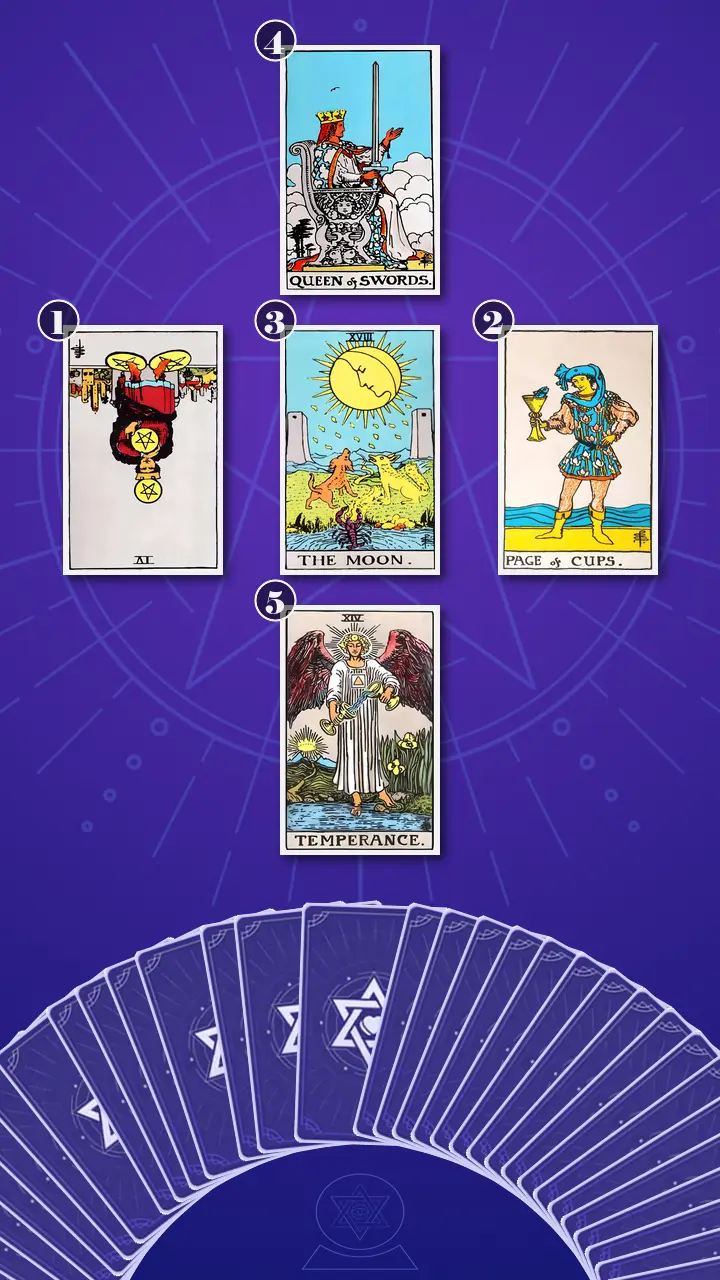
I chose the Relationship Spread · Context Edition, a five-card friendship tarot spread shaped like a small cross. I use this spread when the real question concerns a repeated relationship dynamic but the ethical focus needs to remain on the querent’s observable choices. It does not claim to expose what another person secretly thinks, and it does not predict whether a particular friendship will continue.
For anyone wondering how tarot works in this kind of consultation, I treat the spread as a structured cognitive map. Each position asks a different question, and the card meanings in context help me distinguish behavior, emotional motive, uncertainty, communication, and practical next steps. The value comes from making a tangled pattern visible enough to examine.
The first position would show Casey’s current stance: how they opened the door and what they did when the other person did not immediately move further inside. The center would reveal the interpretation gap between a cooler response and the meaning Casey feared it carried. The upper card would identify a communication lever, while the final lower card would offer a grounded practice Casey could choose for themselves. The layout was a compass, not a fixed destination.
The Coin That Slipped from the Grip
Position One: The Door Opened Before Trust Arrived
I turned over the card representing Casey’s current stance and observable behavior in the friendship: the Four of Pentacles, reversed.
In the Rider-Waite-Smith image, the upright figure presses one coin against the chest while keeping others beneath the feet and above the head. Reversed, that tightly controlled arrangement loosens. For Casey, it mirrored the swing from protecting private material to releasing it quickly once a conversation felt warm.
I connected the image to the scene Casey had described. After one late-night conversation, they sent a detailed voice note about family history, dating insecurity, and the fear of not fitting in. When the reply slowed, the disclosure began to feel less like a chosen act of intimacy and more like emotional currency they had spent without knowing whether the friendship could hold it. They edited follow-ups because they hoped another explanation might restore the earlier warmth.
In energy terms, I read this as excess release paired with deficient containment. The problem was not openness itself. The problem was that personal access had expanded before consistent curiosity, follow-through, and respect for boundaries had shown Casey what kind of container actually existed. The card asked a practical question: apart from one beautiful conversation, what had this person consistently demonstrated?
Casey gave a short, bitter laugh. “That is so accurate it feels a little brutal.” Their thumb rubbed the edge of the phone case, but they did not reopen the chat.
“Accuracy can sting when it names a strategy that once helped you feel safe,” I said. “I’m not reading this as a character flaw, and I’m not telling you to stop sharing. I’m asking whether the amount you reveal is being guided by your choice or by the urgent need to make uncertainty disappear.”
Position Two: The Tender Offer Beneath the Pattern
I turned over the card representing the relational invitation beneath Casey’s disclosure: the Page of Cups, upright.
The Page holds an open cup while a fish appears unexpectedly from it. I saw genuine emotional curiosity here, not manipulation and not carelessness. A new friend had asked Casey a thoughtful question after a casual coffee and Slack conversation, and Casey had felt unexpectedly understood. They sent the sincere voice note because they wanted a friendship with emotional life, not another polished city acquaintance who only knew their meeting-calendar version.
The Page’s receptive Water was essentially balanced, but Casey had given it an excessive assignment. One tender exchange was being asked to verify the entire future of the bond. I told them, “Your openness is real, and the warmth you felt may also have been real. Neither fact can guarantee what happens next. One warm conversation is an invitation, not a contract.”
Casey looked down at the small fish rising from the cup. Their jaw softened, though their eyes held a trace of grief. “Maybe I keep confusing being understood once with being known over time.”
“Yes,” I said. “And separating those two things does not erase the first moment. It simply stops that moment from having to carry the full weight of your belonging.”
The Moon Over Line 1
Position Three: Where the Facts End and Fear Continues
I turned over the card representing the central relationship dynamic and interpretation gap: The Moon, upright.
I was careful with this card. The Moon did not prove that Casey’s friend was deceptive, secretly angry, or preparing to leave. It showed a blockage created by partial visibility: instinct, memory, and fear were moving through the same dim landscape, making each one sound like reliable intuition.
The modern scene was painfully specific. Casey’s question remained unanswered while the friend posted an Instagram Story from dinner with other people. The observable information was narrow: no reply had arrived. The Moonlit conclusion was much larger: the friend had heard Casey’s vulnerable disclosure, decided they were too much, and begun quietly ending the friendship.
“This reminds me of standing on a TTC platform when the arrival display has stopped updating,” I said. “The board contains incomplete information, but your mind fills in every missing stop and decides the entire route has been cancelled. That story may express a real fear. It is still not the same as confirmed information.”
I gave Casey two sentence stems: The fact is ____.The story my fear adds is ____.
They inhaled and held the breath. Their fingers froze above the screen; then their gaze slipped out of focus as if the rooftop photos and unanswered messages were replaying behind the card. Finally, a low exhale left their chest.
“The fact is that they haven’t replied since yesterday afternoon,” Casey said. “The story my fear adds is that they regret hearing the real version of me and have energy for everyone except me.”
I nodded. “Both sentences deserve to be acknowledged, but only one describes what the screen actually shows. A delayed reply is data; it is not the whole story.”
The Sword That Cut a Clean Sentence
Position Four: Asking for Information Without Overexposing
I turned over the card representing the communication and boundary challenge that could interrupt Casey’s loop: the Queen of Swords, upright.
The Queen held her sword vertically while extending an open hand. I read that combination as precise but receptive: a boundary capable of hearing an answer. Her Air energy was not an invitation to become cold. It supplied a quality that had been underused in Casey’s friendships: the ability to separate an observation from an interpretation and ask directly for missing information.
Because Casey worked in UX research, I used their professional language. “In a research report, you wouldn’t write, The user paused for four seconds, therefore they hated the product and felt fundamentally unwelcome. You would record the pause as an observation, name your interpretation as a hypothesis, and gather more evidence. The Queen is asking you to offer your own relationships the same discipline.”
I suggested one realistic sentence: “I noticed our messages have become less frequent after that conversation, and I wanted to check whether you still have space for this friendship.”
The sentence contained no apology for existing, no second disclosure designed to earn reassurance, and no accusation about the friend’s social activity. It also left Casey free to evaluate the answer, including a vague answer or no answer at all. Directness could produce useful information without requiring Casey to empty another private room.
Casey exhaled and read the sentence again. Their shoulders stayed slightly raised, but their grip on the phone loosened. “I can imagine sending that,” they said. “The hard part would be not adding three paragraphs explaining why I’m asking.”
“Then the boundary belongs after the sentence as much as before it,” I replied. “You can protect your privacy without disappearing from the relationship. Clarity is one clean question followed by enough space for the response to stand on its own.”
When Temperance Made Room to Breathe
Position Five: Trust, One Reciprocal Pour at a Time
When I reached the final position, the room on Casey’s side of the call seemed to settle. The radiator released a soft hiss and went quiet. I turned over the card representing self-directed integration and the next sustainable step: Temperance, upright.
The angel poured water between two separate cups, with one foot on land and one in the pool. I read this as balanced energy: emotional openness remained in motion, but practical ground gave it pace and proportion. The card did not ask Casey to become guarded. It asked them to share one honest layer, then notice whether the other person asked a thoughtful question, returned to the subject later, and respected the limits around what Casey had chosen to reveal.
I thought of my fifteen years working with perfume. A fragrance cannot reveal its architecture if every concentrate is emptied into the air at once. Top, heart, and base notes need space, diffusion, and time. This is why I use what I call a Boundary Permeability Diagnosis. I was not diagnosing Casey’s friend or labelling anyone unsafe. I was examining the rate at which personal access crossed Casey’s threshold, and whether the friendship had demonstrated enough reciprocal structure to support that rate.
At that point, Casey was still caught inside the 10:18 p.m. equation: if one more disclosure restored the warmth, the bond was real; if it did not, the bond had failed. Their chest was asking one conversation to settle the entire question of belonging.
I brought their attention back to the two cups. Neither was being smashed, sealed, or emptied into the other. Each retained its shape while something moved between them. Closeness did not have to be secured by revealing everything at once; trust could become more reliable by accumulating through consistent, mutual exchanges. Like a two-way calendar invite, the friendship became meaningful through repeated attendance, not because one excellent meeting filled the whole month.
Stop treating one intense disclosure as proof of lasting closeness; let Temperance's two cups represent a measured exchange in which trust is built one reciprocal pour at a time.
I let the sentence remain in the quiet.
Casey’s breath stopped first. Their fingers hovered above the phone, then curled into their palm as if they had almost reached for the chat by reflex. Their pupils widened; their focus slipped past the card, and I could almost see earlier friendships replaying behind their eyes. A flush climbed into their cheeks. Then their shoulders lowered, not cleanly but in two uneven drops, and their fist opened against the duvet. Relief arrived with a wobble. Their eyes reddened, yet the first words came out sharper than I expected: “But doesn’t that mean I got all of this wrong? That I made people leave?” After the anger, their voice thinned. They drew a slow breath, looked back at the two cups, and said, “I don’t know what to do with the fact that I could have waited.” The clarity had created space, and that new space felt briefly dizzying: less blame, but more choice.
I did not rush to turn their resistance into a positive lesson. “No,” I said. “It means you used disclosure to solve uncertainty because uncertainty felt unbearable. That strategy makes emotional sense, even when it costs you. Other people remain responsible for their own communication, capacity, and consistency. Your responsibility is not to guarantee that everyone stays. It is to choose how access to your inner life develops.”
Then I asked, “With this new perspective, can you remember a moment last week when this insight might have changed how the silence felt?”
Casey looked toward the dark window. “When I saw the rooftop Story,” they said. “I could have told myself, This moment can matter without deciding everything. I might still have felt hurt, but I wouldn’t have sent the apology draft just to make the feeling stop.”
I named the shift plainly. This was not a leap from friendship anxiety to perfect certainty. It was the first movement from urgency-driven oversharing and hypervigilant text monitoring toward emotionally open, fact-aware trust built through clear boundaries and reciprocal pacing. Casey could remain tender while letting trust earn its next layer.
A Boundary That Lets the Air Move
I drew the five cards together into one coherent account. An older fear of not belonging had taught Casey to treat an open door as a trusted home. The reversed Four of Pentacles showed personal access moving faster than the friendship’s demonstrated capacity. The Page of Cups protected the sincere longing beneath that pattern. The Moon explained why a small communication gap became a verdict, while the Queen of Swords restored the distinction between evidence and mind-reading. Temperance turned that clarity into a repeatable rhythm.
The cognitive blind spot was not simply “oversharing.” Casey had been treating emotional intensity as evidence of reciprocity and assuming that their only alternatives were total openness or abrupt withdrawal. The spread revealed a third option: measured disclosure, direct clarification when useful, and observation over time. The transformation was not from vulnerable to guarded. It was from instant emotional proof to paced reciprocity.
The Space Calibration Ritual: Two Breathable Next Steps
I translated that direction into my Space Calibration Ritual. In perfumery, blank space allows individual notes to remain distinguishable. In friendship, deliberate digital and physical blank spaces allow Casey to feel what they feel without turning every pause into investigation. I offered two small experiments, not rules and not tests another person had to pass.
- Calibrate the First Pour In the next promising friendship conversation this week, share one meaningful but bounded detail, such as a recent work frustration or a personal preference, without adding the full backstory. Afterward, place the phone in another room for twenty minutes. Before sharing another layer, observe two reciprocal behaviors: thoughtful curiosity in the moment and follow-through later. Tip: Treat those behaviors as information, not a pass-fail test. If twenty minutes feels too activating, begin with five. You never owe a second layer because someone responded warmly once.
- Separate the Screen from the Story When a reply slows, open a note titled Fact / Story before sending anything. Spend no more than ten minutes writing one observable fact, such as They have not replied since yesterday afternoon, and one feared interpretation, such as They regret hearing my personal story. Then choose one action: wait, return to your evening, or send one clear check-in without a second explanatory paragraph. Tip: Keep both lines without arguing with either one. If the exercise feels too activating, stop after naming the fact. A vague or absent response is information about available reciprocity, not a verdict on your worth.
I reminded Casey that these were experiments under their control. Tarot had not ordered them to trust this friend, end the friendship, or disclose less forever. It had helped us identify what could be observed, what remained unknown, and which choices would protect openness without forcing it to prove anything overnight.

Six Days Later: The Quiet Proof
Six days later, Casey messaged me: they had shared one work frustration, left their phone in the kitchen for twenty minutes, and received a thoughtful check-in the next afternoon. They still woke thinking, “What if it goes cold?” This time, they smiled.
I did not read that message as a solved life or a guaranteed friendship. I read it as the first credible evidence of change: Casey had felt the old urgency without handing it the phone. The cards had supplied an objective map, but Casey had chosen the route. That is the purpose of my work and the heart of any honest Journey to Clarity: the querent remains the author of what happens next.
If a warm friendship goes quiet and your chest tightens while your hand reaches for the screen, I hope you remember why the reaching began: you wanted to be known, even as part of you braced for that openness to prove you were too much to keep. Noticing that struggle already creates a little air between the feeling and the next message.
If no single conversation had to prove that you belong, what one small layer of yourself might you pour into Temperance’s first cup, then allow to unfold at the pace of being met?
Every reading at AceTarot is a journey to connect with inner wisdom and empower the path ahead. This reading shared here is a psychological mirror, not a private record—crafted to reflect universal emotional loops and help restore personal clarity. Please note that these insights do not replace professional psychological, medical, legal, or financial advice, and should not serve as the sole basis for major life decisions.
Learn more about our Journey to Clarity.
How did this insight land for you?
🫂 This Resonates Deeply
🌀 Living This Story
✨ Now I See Clearly
🌱 Seeing New Possibilities
🧰 Useful Framework
🔮 The Confirmation I Needed
💪 Feeling Empowered
🚀 Ready for My Next Step
Author Profile
 AI
AI Luca Moreau
835 readings | 512 reviews
“As a perfumer for fifteen years, I’ve learned to perceive human boundaries through the delicate metaphor of scent. Relationships need the right amount of space to breathe, and I've seen too many kind souls exhaust themselves trying to please everyone. I’m here with warmth and understanding—not to teach you to be guarded, but to help you gently clear the air and rediscover the comforting, safe boundaries that are rightfully yours.”
In this Friendship Tarot Reading :
Core Expertise
- Boundary Permeability Diagnosis: Identifying friends whose lack of limits is metaphorically 'bleeding into your space' and causing emotional suffocation.
- Vibe Contamination Auditing: Recognizing when a highly sensitive or negative friend is unconsciously polluting your personal psychological atmosphere.
Service Features
- The Space Calibration Ritual: A behavioral directive to implement specific 'digital and physical blank spaces', preventing enmeshment and restoring breathable boundaries.
Also specializes in :
Explore Related Patterns:
Anxious AttachmentCasey wants emotionally open, dependable friendships, yet a slower reply after vulnerability activates repeated checking, an apology draft, further explanation, and the impulse to disappear first. The desired closeness and the anticipated rejection therefore arrive together, making each act of being known feel as though it has placed belonging on a trapdoor. When connection becomes uncertain, you may monitor, repair, or retreat in an effort to prevent the relationship from moving beyond your control. Anxious Attachment describes this recurring relational coping pattern without deciding what any particular friend thinks and without making your wish for closeness the problem. The useful audit is whether urgency has begun directing access to your inner life. You can remain tender and invested while letting consistency, mutual curiosity, and follow-through determine the pace, rather than requiring another disclosure to secure the bond immediately.
Black-and-White ThinkingCasey initially saw two available responses to the silence: explain more or disappear before rejection could happen. The same split appeared in the meaning assigned to the friendship, which felt real if another disclosure restored warmth and failed if it did not. When your mind compresses a developing relationship into opposing outcomes, temporary ambiguity becomes a total judgment. Black-and-White Thinking removes the middle ground where a warm conversation can matter without guaranteeing permanence, a delayed reply can hurt without proving rejection, and openness can remain genuine without becoming unlimited access. That middle ground is not passive indecision. It gives you a third option in which you can share selectively, ask one direct question when useful, and let repeated behavior reveal whether reciprocity is actually present.
Certainty SeekingWhen the replies slowed, Casey considered explaining more, apologizing, or disappearing before the friend could decide they were too much. These actions look different on the surface, but each promises to end the same uncomfortable information gap by producing reassurance, forcing clarity, or preventing Casey from having to wait for an answer. When uncertainty feels intolerable, you may try to solve it through disclosure, digital monitoring, or pre-emptive withdrawal. Certainty Seeking turns an unknown relational moment into an urgent problem that appears to require immediate action, even when time and consistent behavior are the only reliable sources of information. The trap is that each attempt to secure certainty can make your sense of belonging more dependent on the next message. Recognizing the mechanism creates room to let uncertainty remain unfinished without letting it determine how much of yourself you reveal or whether you abandon the relationship first.
Mind ReadingThe unanswered message and the rooftop Instagram Story offered Casey only a narrow set of observable facts. Casey's mind supplied a much larger explanation in which the friend regretted the disclosure, had energy for everyone else, and had begun quietly ending the friendship. When you infer another person's private judgment from incomplete digital cues, fear starts functioning like privileged information. Mind Reading can feel protective because it appears to prepare you for rejection, but it also closes the case before the other person has communicated their motives, capacity, or intentions. Separating the screen from the story does not require you to dismiss the hurt or assume that everything is fine. It lets you hold the feared interpretation as a hypothesis, leaving you free to request information, observe future consistency, and evaluate the friendship without turning ambiguity into a verdict on your worth.
Premature VulnerabilityThe warm voice-note exchange moved quickly into family conflict, dating insecurity, and Casey's fear of not fitting into other people's lives. That disclosure was sincere, but it gave the friendship extensive personal access before consistent curiosity, follow-through, or respect for limits had established what the relationship could hold. When you use emotional depth to accelerate a sense of security, openness can begin carrying a job it cannot complete. Premature Vulnerability does not mean that your honesty is wrong or excessive by definition; it means the pace of access is being set by the urgent need to feel securely known rather than by reciprocal evidence gathered over time. The pattern becomes costly when a delayed response makes the original disclosure feel like emotional currency spent without protection. Auditing the pace lets you remain open while choosing which layer comes next, instead of asking one intense exchange to prove that the entire friendship is safe.
Reality TestingDuring the call, Casey named the observable fact that no reply had arrived and then separately named the fear that the friend regretted hearing the real version of them. Later, Casey reconsidered the rooftop Story and recognized that the moment could matter without deciding the entire friendship. When you separate available data from the interpretation fear adds, you interrupt the automatic conversion of ambiguity into rejection. Reality Testing does not demand that you suppress intuition, excuse inconsistent communication, or pretend that silence cannot hurt; it asks you to identify which conclusion the evidence can currently support. That distinction restores behavioral choice. You can wait, return to your evening, or send one concise check-in while allowing a vague or absent response to become information about reciprocity rather than proof that your openness made you unworthy of connection.
Strategic VulnerabilitySix days later, Casey shared one bounded work frustration and left the phone in the kitchen for twenty minutes instead of adding the full backstory or monitoring the response. The thoughtful check-in that arrived the next afternoon was allowed to count as one piece of reciprocal evidence, not as proof that the friendship could never turn cold. When you disclose in layers, vulnerability remains authentic while privacy retains its structure. Strategic Vulnerability is not calculated performance or emotional withholding; it is the choice to let access develop alongside demonstrated curiosity, follow-through, and respect for what you have and have not offered. This pacing changes the function of openness. Sharing no longer has to eliminate uncertainty or secure belonging overnight, because each exchange can be meaningful while still leaving the next layer under your control.
Explore Related Struggles:
Access-Belonging FusionAfter the friend asked a thoughtful question, being understood once opened the door to a long account of family conflict and belonging fears. Later, you described the choice as explaining more or disappearing, and the old equation made one more disclosure seem capable of restoring warmth while a failed response would mean the bond had failed. You are not merely deciding how much to say. You are asking access to your inner life to settle whether you have a place in the other person's life. That fuses two events that can move at different speeds, so the sincerity of the first exchange and the durability of the friendship become difficult to hold as separate facts. The first moment of being met can remain meaningful without becoming a contract for continued closeness. You can let belonging emerge from repeated mutual contact, while your private history stays under your control and no single reply has to certify that you are welcome.
Read Receipt Worth LockYou can state the observable fact that the friend has not replied since yesterday afternoon, yet the rooftop Instagram Story expands that narrow data into a conclusion that they regret hearing the real version of you and have energy for everyone else. You opened the chat six times and drafted an apology while the screen still contained no answer to the underlying question. The phone becomes a measuring device for whether you are safe to keep in the relationship. A delayed response is no longer just information about timing; it is made to carry a verdict about how much of you the friendship can tolerate. That is why a small gap can pull your attention away from the rest of the evening and make another message feel urgent. You can preserve the fact and the interpretation as two separate lines. That separation lets a response, a vague response, or silence tell you something about available reciprocity without turning the timestamp into a measurement of your worth.
Relational Pacing CollapseAfter one late-night conversation and a thoughtful question, you treated the felt safety of that moment as if it could establish the future of the friendship. The later silence then seemed to reverse the whole bond at once, because the relationship had been asked to move from first contact to lasting proof without enough time between stages. You are left trying to decide whether to send another explanatory paragraph or vanish, rather than allowing trust to accumulate through repeated attendance. The friction is temporal as much as emotional. One excellent conversation is carrying work that belongs to many ordinary exchanges, and the next pause feels like a collapse of the whole timeline. A slower pace does not make the first connection less real. It gives you room to watch whether warmth returns through mutual effort, whether curiosity continues, and whether the friendship can survive an ordinary gap without requiring a fresh disclosure to restart it.
Vulnerability Without ContainmentWhen a thoughtful voice-note exchange felt unusually safe, you followed it with a detailed account of family conflict, dating insecurity, and the fear of not fitting in. When the reply slowed, you drafted an apology for having shared too much and considered adding more explanation or disappearing. Your access to private material had moved faster than the other person had shown consistent curiosity, follow-through, or respect for the limits of what you shared. The pressure is not created by openness itself. It appears when one early exchange is asked to function as a container before the friendship has demonstrated its capacity to receive what you are offering. A warm response can invite the next layer without proving that the relationship can hold the whole room. You can keep the wish to be known while letting personal access develop from observed reciprocity. Each thoughtful question, later check-in, and respectful response becomes information about capacity, so sharing remains a choice rather than a way to force uncertainty to settle.
Explore Related Emotions:
Certainty HungerAt 10:18 p.m., one conversation had become responsible for answering the entire question of whether you belonged with this person. Your chest reached for one more message because another explanation seemed capable of restoring the warmth before uncertainty could become a verdict. The hunger was for certainty, not merely a reply. You were asking a single exchange to prove that being understood once meant being known over time, and that the connection would remain available after you had revealed more of yourself. A friendship cannot provide that proof all at once. Measured disclosure lets information accumulate through repeated contact, so the next message can be a choice for connection rather than an emergency attempt to make uncertainty stop.
Conditional Belonging FearAfter one unusually safe conversation, you sent a long voice note about family conflict and not fitting into other people's lives. When the reply slowed, the silence placed your place in the friendship on a trapdoor, as though being seen once had made your welcome dependent on never becoming too much. The urge to send 'Sorry, that was probably a lot' or disappear was an attempt to get ahead of the verdict you feared. It turned one delayed reply into a test of whether you could remain wanted, which helps explain why the same opening-and-panic sequence can recur across friendships. Naming this fear separates your wish to be known from the demand that one warm exchange prove lasting acceptance. You can let another person's consistency provide information while keeping the decision about access to your inner life in your own hands.
Mutuality HungerAfter a thoughtful question following coffee and Slack conversation, you felt unexpectedly understood and sent the sincere voice note because you wanted more than a polished city acquaintance. You wanted a friendship with emotional life, where personal reality could move in both directions. That desire is not the part of the pattern that needs to be shamed or removed. It explains why warmth opens the door so quickly. The difficulty begins when one tender exchange is asked to demonstrate the full mutuality that only repeated curiosity, follow-through, and respect can establish. You can keep the wish for a reciprocal friendship while letting reciprocity become observable over time. Your openness can be an invitation to mutual connection without becoming a payment made to secure someone else's continued presence.
Relational FogYour workday is built around separating observations from interpretations, yet at night the screen showed one narrow fact, no reply since yesterday afternoon, while your mind supplied a much larger conclusion. The rooftop photos became part of a dim landscape in which the friend had heard the real version of you and decided to pull away. That fog is not evidence that your intuition has discovered the other person's private motive. It is what partial visibility feels like when the unanswered space gets filled by memory, fear, and the wish to know where you stand. Writing one factual line and one added story does not require you to dismiss either one. It lets you keep the uncertainty visible long enough to choose whether to wait, return to your evening, or ask one direct question.
Relational WhiplashThe friend answered warmly after your thoughtful voice note, and then the replies slowed while an Instagram Story showed them at a rooftop bar with other people. Your experience had to move quickly from being met to being left with no explanation, so the change in communication felt larger than the missing reply itself. Because the shift followed disclosure, it was easy to make your openness the suspected cause. The mind then replayed earlier friendships and treated a change in pace as confirmation that closeness can disappear overnight. The fact-and-story distinction gives the shift a more usable shape. You can acknowledge that the change hurt, ask for information when appropriate, and still refuse to make a moment of distance explain the entire relationship.
Vulnerability HangoverAfter the conversation felt safe, you disclosed family conflict, dating insecurity, and the fear of never fitting into other people's lives. When the replies slowed, the disclosure stayed active in your body, showing up as the warm phone in your hand, repeated rereading, and the draft apology you never sent. The exposure did not end when the voice note ended. It became an aftershock that made another explanation feel like repair and disappearance feel like protection, even though neither move could tell you what the other person actually had capacity for. Temperance gives that openness a slower pace. You do not have to close the door, but you also do not have to offer a second private layer before the first one has been met with curiosity and follow-through.
Cautious TrustSix days later, you shared one work frustration, put your phone in the kitchen for twenty minutes, and received a thoughtful check-in the next afternoon. The friendship did not have to produce a dramatic reassurance for the exchange to count as useful information. You still woke with the question of what would happen if it went cold, but the old urgency did not receive the phone automatically. Waiting became a way to notice whether the other person returned, asked, and followed through before you offered another layer. The two cups in Temperance describe a closeness that keeps its shape while something moves between them. You can stay emotionally available and let confidence grow through repeated attendance instead of requiring one excellent conversation to guarantee the whole bond.
Grounded Self-TrustWhen you said, 'The fact is that they haven't replied since yesterday afternoon,' and separated it from the story your fear added, you gave yourself a usable point of contact with reality. You did not need to deny the hurt in order to stop the interpretation from taking over the screen. The clean check-in also returned choice to you. It contained no apology for existing and no second disclosure designed to force reassurance, which meant the other person's answer, vagueness, or silence could be observed without requiring you to overexplain. Six days later, you noticed the old urgency and did not hand it the phone. That is not proof that every friendship will remain warm; it is evidence that your own next move can stay yours while the relationship reveals its actual capacity.
Explore Related Contexts:
Friendship Disclosure Pace MismatchAfter one late-night conversation felt safe, you sent a detailed voice note about family conflict, dating insecurity, and not fitting into other people's lives, even though the friendship had not yet shown consistent curiosity or follow-through. Personal access therefore moved faster than the relationship's demonstrated capacity, turning a sincere act of openness into a test of whether the connection could hold it. The slower reply then made the disclosure feel like unfinished social work, with another explanation appearing to offer a way back to the earlier warmth. You do not need to make the next layer prove that the first one was acceptable. The more useful evidence is whether curiosity, follow-through, and respect for your limits accumulate before access expands again.
Friendship WhiplashYour new friend responded warmly to a vulnerable voice note, and then the replies slowed while an Instagram Story showed them at a rooftop bar. The social signal changed faster than the available facts could explain, leaving a narrow communication gap to carry a much larger verdict about the friendship. When this movement echoes earlier friendships, warmth and withdrawal become a repeating external rhythm rather than a clear conversation about what changed. You can record the change without assigning private motives. A delayed reply is observable information, while the conclusion that the friend decided you were too much remains unconfirmed, and the other person's communication capacity remains theirs to account for.