Friendship Hypervigilance: From Checking DMs to Asking What Was Agreed
The 12:40 a.m. Friendship Hypervigilance Spiral
I met Maya, a 28-year-old hybrid UX designer in Toronto, after she learned through a group chat that a close friend had told two other people about a major personal decision first. She called it wanting context. I recognized friendship hypervigilance after finding out late: the first search is not for comfort, but for a timeline that might prove where you stand.
At the start of our video session, Maya showed me the scene from 12:40 that morning. She had been sitting cross-legged on her bed with a group chat, her friend’s Instagram profile, and three old DM threads open around an unsent confrontation. The phone had grown hot in her palm. Blue light sharpened the shadows under her eyes while the radiator clicked against the quiet Toronto night.
“If we’re really close, why am I the last to know?” she asked. “I can’t relax until the story makes sense. But if I ask for every detail, I’m going to sound like I’m trying to own the friendship.”
I reflected the sequence back to her. “You noticed that two people knew first. Then you checked the timestamps. Then your mind turned the missing detail into a membership test.” Her betrayal alarm seemed to sit behind her ribs like a metallic perfume sprayed into a room with sealed windows: sharp, invasive, impossible to breathe around. Her jaw stayed locked, and her fingers kept waking the phone each time the screen dimmed.
“I understand why your mind is reaching for evidence,” I said. “Finding out late can land as humiliation, jealousy, and hurt all at once. I’m not going to tell you that privacy is always harmless, and I’m not going to use tarot to guess what your friend secretly thinks. Before we build a case, we’re going to name the hurt and draw a map of what can actually be known. The goal is clarity about the friendship boundary, not a verdict delivered by the cards.”
Choosing the Bridge: A Six-Card Relationship Spread
I asked Maya to put both feet on the floor, take one unforced breath, and hold the question in plain language: “Was an agreement broken, or am I treating privacy as proof that I matter less?” I shuffled slowly. The pause was not a mystical performance; it gave her nervous system a transition between checking and observing.
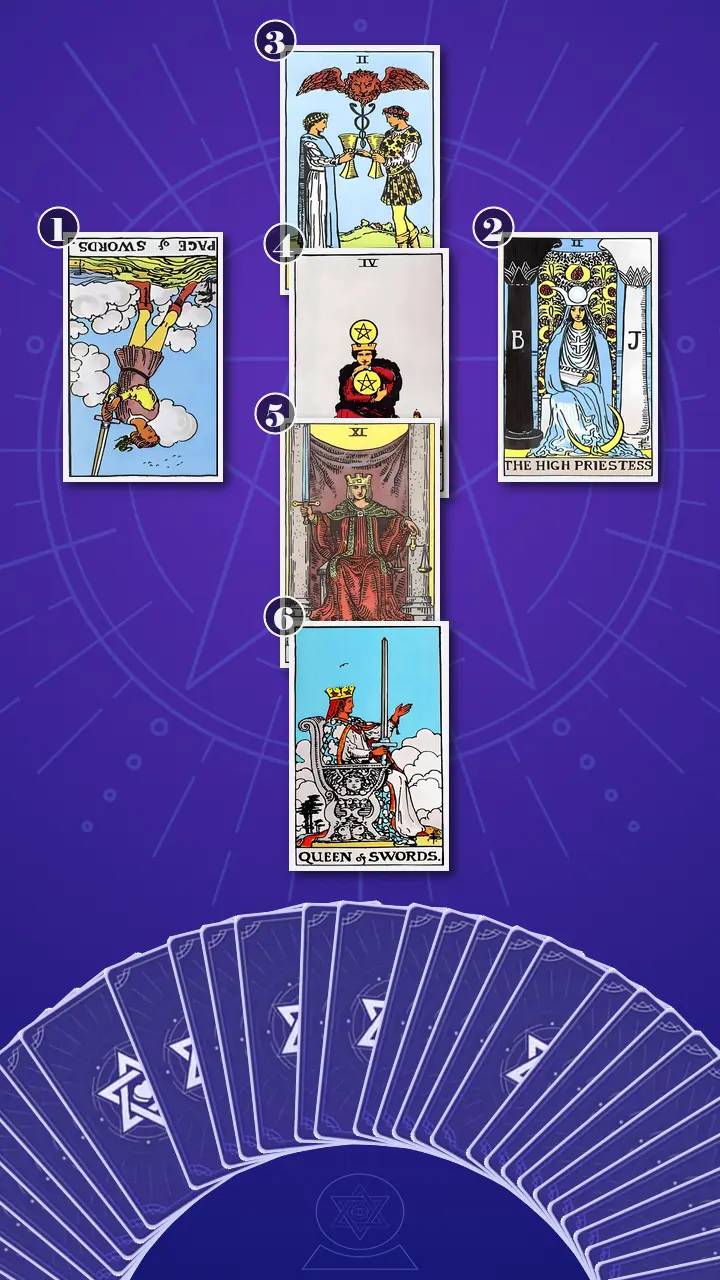
I chose the six-card Relationship Spread · Context Edition, a friendship-boundary tarot spread designed for privacy, reciprocal care, and unequal disclosure. I chose it because the issue involved two perspectives, a real bond, a repeating conflict, and a next action Maya could control. A larger spread might have produced more material, but more material was already part of her problem.
I want to be precise about how tarot works in a situation like this. I do not use cards to read an absent friend’s mind or predict whether a conversation will repair the relationship. I use card meanings in context as a structured reflection tool. The images make patterns visible, while the person receiving the reading decides which interpretation fits, what evidence matters, and what boundary to choose.
I arranged the cards as a bridge. The first position would show how Maya was turning the first sting into monitoring. The second would mark the limit between an observable privacy choice and an invented motive. Above the center, the third would show what genuinely connected the friends. The fourth would identify the grip holding the conflict in place. Beneath it, the fifth would offer the balancing principle, and the sixth would translate that principle into one boundary-respecting action.
Reading the Air Before It Turns Into Evidence
Position 1: The Sword Raised Over Three Open Chats
I turned over the card representing Maya’s current contribution to the dynamic, specifically the behavior through which she converted hurt into monitoring, evidence gathering, and a rehearsed confrontation. It was the Page of Swords, reversed.
The figure’s sword was raised before any clear target had been established, while the body looked ready to move and the head glanced backward. I saw the same divided attention Maya had described: three chat windows, an Instagram profile, an old DM thread, and a rebuttal drafted before she had asked what expectation existed.
The Page’s alert Air was not absent. It was in excess and partially blocked. Maya’s sensitivity to wording and interaction patterns was real; it was part of what made her effective in UX work. But under relational threat, that skill behaved like twelve browser tabs opened for one unanswered message. Every tab promised clarity, while the noise made the original fact harder to read.
“What did you directly observe?” I asked.
“I found out in the group chat on Tuesday,” she said.
“And what did the investigation add?”
She gave a short, bitter laugh. “That she trusts them more. That they got the real version and I got the press release.” She rubbed the side of her thumb against the phone case, then looked down. “That’s painfully accurate. Almost rude, honestly.”
I let the laugh settle. “The card is describing a process, not issuing a character judgment. Your attention is trying to prevent another surprise. The question is whether the investigation is producing reliable information or multiplying interpretations.”
Her shoulders shifted a fraction lower. The first opening in the reading was small but useful: she could keep her powers of observation without treating every inference as verified research.
Position 2: The Locked Page That Is Not a Rejection
I turned over the card representing the observable boundary on her friend’s side, with a deliberate limit against speculating about hidden motives. It was The High Priestess, upright.
The partly concealed scroll and the veil behind the seated figure showed information that existed without becoming available on demand. The High Priestess did not prove betrayal, innocence, affection, or rejection. Her balanced energy marked the edge of the evidence.
“In modern terms,” I said, “a locked Notion page is not automatically an insult to everyone who cannot open it. It can simply contain material that its owner is not ready to share. You know your friend did not tell you before the group chat. You do not yet know whether she was ranking the friendship, avoiding conflict, protecting something unfinished, or making a choice that had very little to do with you.”
Maya’s eyes narrowed at the card. “Privacy sounds reasonable until it happens to me.”
“That makes sense,” I said. “Because the undisclosed detail is touching belonging, not just curiosity. Respecting the threshold does not require you to pretend the impact was fine. It asks you to stop using unavailable information as permission to write the motive yourself.”
I asked her to complete two sentences aloud. “The fact is...”
“She didn’t tell me before other people knew.”
“The motive I’ve been filling in is...”
She paused long enough for the radiator to click again. “She wanted me to know I’m less important.”
I watched her fingers go still. The High Priestess had not answered the mystery. She had made the boundary around the mystery visible.
Position 3: Two Cups Offered, Not Extracted
I turned over the card representing the reciprocal value that genuinely connected the two friends beneath this possessive attachment response. It was the Two of Cups, upright.
The figures faced each other with cups offered at equal height. Nothing in the image was seized. The Water moved through voluntary exchange: chosen disclosures, mutual check-ins, time made for each other, and repair after strain.
I asked Maya for three recent pieces of relationship evidence that had nothing to do with who knew an update first. She remembered a voice note her friend answered during a brutal work morning, a long walk after a Figma review had gone sideways, and an apology they had managed after a tense dinner.
“That does not cancel what happened on Tuesday,” I said. “It widens the sample. The friendship is also built through the moments when both of you freely show up. Access is not the same thing as intimacy, and one disclosure order is not the entire dataset.”
Maya looked from the two cups to her phone. Her mouth tightened before softening. “I hate that both things can be true. She can care about me, and I can still feel shut out.”
“Yes,” I said. “Clarity is often the ability to hold two accurate things without forcing one to erase the other.”
The Access Pass Held Too Tight
Position 4: The Grip Beneath the Timeline
I turned over the card representing the central Betrayal-Closure Lock, the pattern through which informational access had become a way to secure belonging. It was the Four of Pentacles, upright.
The figure pinned one pentacle to the chest, balanced another above the head, and trapped two beneath the feet. The Earth energy was in excess and had become fixed. What was meant to provide security now prevented movement. I could see the same pattern in Maya saving screenshots, keeping the timeline open, and defending an unspoken rule that close friends should tell each other everything.
“Imagine this pentacle as an invisible inner-circle pass,” I said. “Being told first becomes proof that you still have your place. Finding out later feels like someone revoked the pass without warning.”
I offered the inner sentence I heard beneath the card: “If I know the whole story, I can keep my place. If I let this go, I might find out I never had it.”
Maya’s breath stopped. Her index finger hovered over the dark phone screen; her gaze lost focus as if she were replaying several old group-chat moments at once. Then her hand opened and the phone settled flat against her palm.
“That’s the part I didn’t want to say,” she replied. “I keep saying I want honesty, but I’m really asking for proof that I matter.”
I did not rush to turn that admission into a lesson. “Wanting proof of belonging is deeply human. The problem is not that you value the friendship. The problem is that collecting information gives you control for ten minutes and leaves the relationship frozen afterward.”
The image reminded me of a fragrance formula with no space between its materials. Even beautiful notes become suffocating when every molecule is forced to occupy the foreground. The Two of Cups had shown intimacy moving between two people; the Four of Pentacles showed fear trying to bottle that movement and keep it unchanged.
When Justice Put the Screenshots on the Scales
Position 5: Privacy Versus a Broken Agreement
I turned over the card representing what the relationship needed to distinguish privacy from a broken agreement and rebalance autonomy with accountability. It was Justice, upright, the key card of the reading.
As the card landed, the radiator on Maya’s side clicked once and went quiet. A pale line of afternoon light crossed the upright sword on my table. The room seemed to make space around the image: a direct gaze, a steady blade, and scales held level rather than yanked toward the loudest feeling.
Justice brought balanced Air to a situation crowded by theories. The card did not ask whether the undisclosed news hurt enough to count as betrayal. It asked what happened, what impact followed, and what standard had actually been shared. Maya’s feelings belonged on the scales, but urgency could not substitute for evidence.
Seeing those scales, my mind went first to the perfume lab rather than a courtroom. After fifteen years as a perfumer, I know that two scent strips touching in a drawer can create a false accord. Unless I separate them, I can no longer tell which material produced which note.
I call this Boundary Permeability Diagnosis. I used it here to separate three psychological spaces: Maya’s valid impact, her friend’s private interior, and the shared territory of any explicit agreement. Maya’s hurt had been bleeding into the unknown space and colouring it with motive. At the same time, her friend’s silence had filled Maya’s entire emotional atmosphere. Justice restored a breathable boundary without dismissing either person.
I placed a blank page beside the card and wrote three lines: “The fact is ____.” “The story I added is ____.” “The agreement, if there was one, was ____.” On one side of the scales sat the group-chat post, the timestamps, and the impact of finding out late. On the other sat the untested verdict that Maya had been deliberately downgraded.
Before I said more, I watched Maya look back at the screenshots as if precision could make the pain obey. She was still caught in “I must make the right accusation,” and every extra timestamp gave the fear one more place to hide.
You do not need total access to prove that you matter; choose one fair, direct question, and let Justice's scales separate observable facts from the story of betrayal.
For one beat, Maya did not move. Her inhale stopped halfway, and the hand around her phone tightened until the knuckles changed colour. Then her eyes shifted past the screen, unfocused, as though the sentence had begun replaying Tuesday night without the old soundtrack. Her jaw loosened first. Her shoulders followed, lowering by a few centimetres.
Then the release caught on anger. “But doesn’t that mean I was wrong this whole time?” she asked, her voice suddenly louder. “Like I made this into something it wasn’t?” Her eyes shone, but she blinked hard and held my gaze.
“It means your interpretation is not yet the same thing as a fact,” I said. “It does not mean your hurt was fake, and it does not mean your friend handled everything well. Justice is not asking you to acquit anyone. It is asking you not to sentence the relationship before you identify the agreement.”
Her fingers slowly uncurled. A long breath left her chest with a slight tremor, followed by a quieter, almost startled “Oh.” Relief appeared, but so did the light-headed blankness that comes when an exhausting job is returned to its proper owner. She no longer had to solve every motive, which also meant she had to decide what she would ask and what she would do with the answer.
“Now, using this new perspective, can you think of a moment last week when this insight might have made you feel different?” I asked.
Maya looked down. “On Tuesday, before I messaged our mutual friend. I could have written, ‘I learned this from the group chat, and I’m telling myself it means I matter less.’ I still would’ve been hurt, but maybe I wouldn’t have spent four hours trying to prove it.”
“That is the breakthrough,” I said. “Privacy is not a verdict. You are moving from treating every missing detail as proof of betrayal to distinguishing privacy from broken agreements and communicating with proportionate clarity. That is not passivity. It is a more accurate use of your power.”
The Clear Question With an Open Hand
Position 6: The Sword That No Longer Needs a Prosecution
I turned over the final card, representing Maya’s next boundary-respecting action: one direct statement, one clear question, and room for an answer. It was the Queen of Swords, upright.
The Queen held her sword vertically and steadily while extending an open hand. Her Air was balanced and mature. The sword supplied precision; the hand prevented precision from becoming interrogation. She was the developed counterpart to the reversed Page, transforming restless attention into concise, accountable speech.
“This is the before-and-after image of the entire reading,” I said. “The Page has ten screenshots and an argument under construction. The Queen closes the extra windows and asks one useful UX research question: ‘What expectation do we each have about sharing personal news?’”
I offered Maya a version in her own voice: “I felt hurt finding out through the group chat. How do we each understand sharing personal news in this friendship?” The sentence named impact without claiming ownership of the private decision. It also allowed her friend’s response to become information rather than an obstacle to overcome.
Maya read it twice. “It feels almost too short.”
“Short does not mean weak,” I said. “It means you are asking about the agreement, not the entire hidden story. Your boundary can be precise even if her answer is incomplete.”
I also pointed out that no Wands card had appeared. The spread contained no automatic burst of Fire. Movement would have to come from one deliberately chosen conversation, not from another wave of midnight urgency. The Queen did not promise reconciliation, disclosure, or a particular reply. She showed Maya how to speak clearly enough to decide her own next step.
Close the Extra Tabs, Keep the Clear Question
I read the bridge as one continuous story. Past experiences of finding out late had trained Maya’s sharp attention to brace for exclusion. In the present, the reversed Page scattered that attention across messages, profiles, and mutual friends. The High Priestess marked what could not responsibly be known, while the Two of Cups reminded her that real closeness already existed through voluntary care. The Four of Pentacles revealed the central grip: she was trying to turn informational priority into a possession that could guarantee belonging. Justice replaced that grip with a fair standard, and the Queen of Swords turned the standard into language.
The cognitive blind spot was not that Maya cared too much. It was that she had promoted an unspoken hope into a shared contract. Being told first mattered to her, but she and her friend had never agreed that disclosure order would define closeness. The transformation was not “stop caring” or “accept any treatment.” It was to identify the observable event, name its impact, ask whether an expectation was shared, and then choose a boundary based on the response and the broader pattern of reciprocity.
When I proposed the twenty-four-hour pause, Maya frowned. “But waiting feels like letting her get away with it. And if I don’t check, I’ll just think about checking.”
“Then we do not turn the pause into a test of your worth or self-control,” I said. “We calibrate the space. You can take ten minutes first, and you can stop if your body feels more activated rather than less.”
I introduced my Space Calibration Ritual, a practical way to create digital and physical blank spaces before a boundary conversation. In perfumery, I leave air between evaluations so one scent does not contaminate the next. In relationships, a blank space can be a muted chat, a phone placed outside arm’s reach, or a walk taken without asking a mutual friend for one more clue. The space is not punishment or avoidance. It prevents emotional enmeshment long enough for Maya’s own signal to become readable again.
- Create the fact-story blank space.For the next friendship trigger, Maya will open Notes before reopening Instagram or the group-chat history. In three minutes, she will write one sentence under “What I directly observed,” one under “What I inferred,” and one under “The agreement, if any.” She will then place the phone across the room, set a twenty-four-hour reminder, and avoid sending the confrontation during that interval.Tip: If twenty-four hours feels impossible, begin with ten phone-free minutes. Keep both fact and inference on the page so separating them does not become a way of minimizing the hurt.
- Use the one-question boundary check.After the pause, Maya will privately text her friend to request a short conversation or walk. She will use no more than two sentences: “I felt hurt learning about this through the group chat. How do we each understand sharing personal news in this friendship?” She will listen for the stated boundary before deciding whether to follow up, wait, or change her level of investment.Tip: Leave out the screenshot archive and third-party details unless one is essential. The goal is impact without interrogation, not a complete confession or guaranteed repair.
These were not instructions for preserving the friendship at any cost. Maya remained free to decide that the mismatch in expectations was workable, painful but repairable, or incompatible with the kind of closeness she wanted. The cards clarified the decision space; they did not take the decision away from her.
A Little More Air Three Days Later
Three days later, Maya messaged me: she had slept through the night after sending the two-sentence request for a walk. Her first thought at breakfast was, “What if I’m wrong?” She let it sit beside her coffee without reopening the group chat.
The conversation had not happened yet. Nothing had been magically solved. Still, I could see the first proof of change: Maya had named the impact, asked one clear question, and allowed the answer to arrive from the person involved rather than extracting fragments from everyone around her.
For me, that is how a six-card Relationship Spread · Context Edition can support finding clarity. Tarot did not expose her friend’s motive. It helped Maya move from digital surveillance to fair discernment, from trying to own certainty to choosing a boundary she could stand behind. The agency was hers before the cards appeared, and it remained hers after I gathered them from the table.
When a missing detail makes your chest tighten, it can feel safer to hold the whole friendship up to Justice’s light than to risk learning you were not included. Wanting proof that you belong and wanting the other person to remain fully their own person can hurt at the same time. Simply noticing those two needs gives the room a little more air.
If you left one extra tab closed tonight and let Justice’s scales hold one unanswered detail until morning, what small, honest question about the agreement might you choose to ask tomorrow, if any?