Friendship Scorekeeping: A Delivered Text Gives Way to a Direct Ask

The 11:43 p.m. Friendship Replacement Spiral
I met Jordan (name changed for privacy), a 27-year-old hybrid UX designer in Toronto, after she had spent another workday alone with Figma tabs, Slack notifications, and a half-cold coffee. She described the previous Tuesday at exactly 11:43 p.m.: her best friend’s Instagram Story showed clinking glasses at coworker drinks while Jordan’s own message still said Delivered. The radiator clicked beside her, a streetcar groaned over wet pavement outside, and the phone had gone warm in her palm from reopening the same thread. Before context could arrive, her body had already turned one ordinary social event into a verdict. Her stomach dropped as if a trapdoor had opened beneath her ribs, her chest tightened, and restless energy gathered in her fingers.
“I know friendship isn’t supposed to be a ranking,” she told me, “but I keep checking the scoreboard. I don’t want to control her. I just want proof that I can’t be replaced.”
I heard the contradiction clearly. Jordan wanted the friendship to remain secure and uniquely meaningful, yet every close relationship outside it seemed to subtract from the bond. The more she cared, the more she monitored reply times, reread affectionate messages, drafted loaded jokes, or went quiet to see whether her friend would notice. I told her, “There’s nothing shameful about wanting reassurance. We’re going to look at what happens between the first stomach drop and the message you choose to send. Tarot won’t rank your friend’s relationships or tell us what she secretly thinks. It can help us make the pattern visible, so you can decide what belongs in the next scene.”
As an artist, I often think of a stuck life as a film that has remained in one painful scene for too long. I did not want to drag Jordan out of hers or write the ending for her. I wanted to sit beside her in the editing room, separate the footage from the fearful voice-over, and return the pen to her hand. “Let’s draw a map through the fog,” I said, “and find out why her other friendships keep feeling like your loss.”

Choosing a Bridge Instead of a Verdict
I asked Jordan to place both feet on the floor and take one ordinary breath while holding the question in mind. I shuffled slowly, not as a performance of mystery, but as a practical transition from compulsive checking to focused attention.
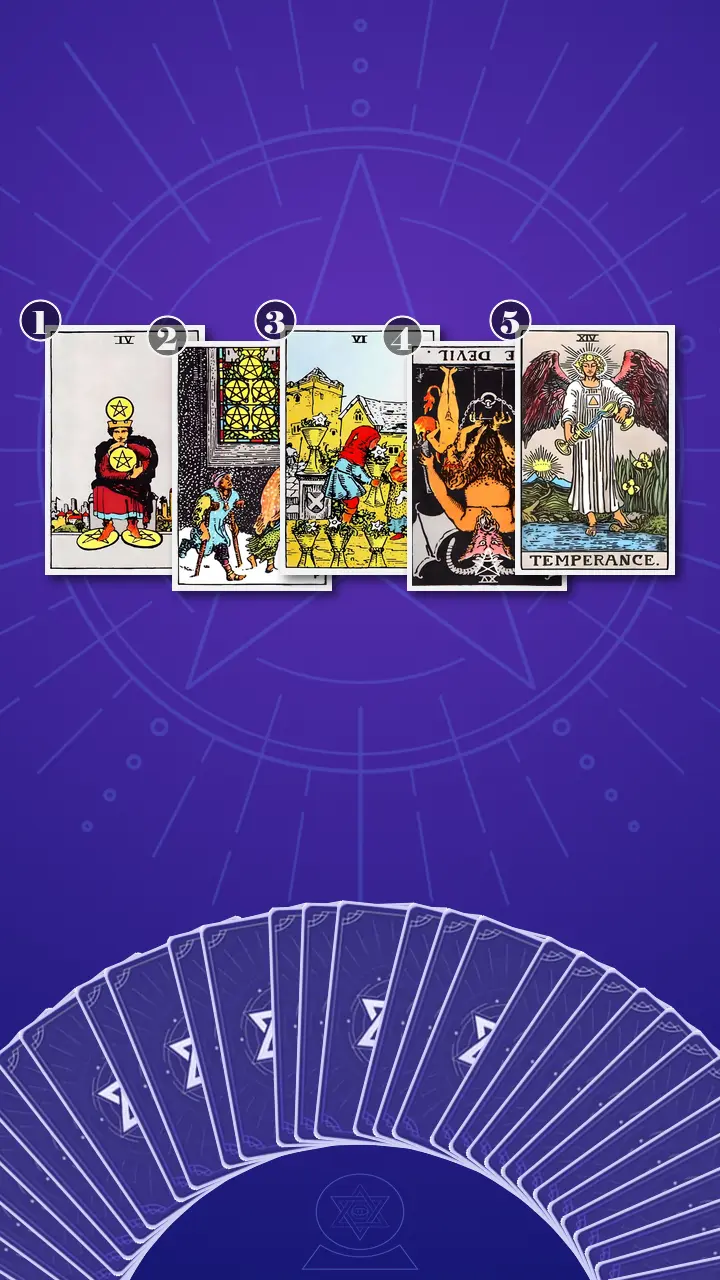
I chose the Relationship Spread · Context Edition, a five-card relationship tarot spread designed to examine Jordan’s stance, the meaning she projected onto her friend’s wider social life, the genuine foundation of the bond, the central challenge, and a constructive direction. A ten-card Celtic Cross could have generated more material, but more material was not what Jordan needed. Her phone already supplied an endless stream of ambiguous evidence. She needed the smallest structure capable of showing how a trigger became a replacement story and where choice could re-enter the sequence.
I arranged five cards in one horizontal line. The first position would show how Jordan currently tried to secure the friendship. The second would examine the exclusion story activated by her friend’s other relationships, without pretending to read the friend’s private mind. The middle card would identify what made this bond genuinely important. The fourth would reveal the repeating chain, and the fifth would offer an integrated next step. From left to right, the spread would form a bridge from guarding and scarcity toward connection between two separate lives.
Reading the Grip Before the Fear
Position One: The Coin Held Against the Chest
“Now I’m turning over the card that represents how you currently try to keep the friendship secure when access feels uncertain,” I said. The first card was the Four of Pentacles, upright.
I pointed to the figure pressing one pentacle against the chest while pinning two beneath the feet. “This is closeness handled like a finite asset,” I told her. “At 11:43, you had the unanswered thread open beneath the drinks Story. You checked the timestamp, revisited older affectionate messages, and inventoried who seemed to be receiving time, photos, and inside jokes. The friendship matters deeply, but the checking turns it into an analytics dashboard. Reply time becomes a performance metric, even though the dashboard cannot measure trust.”
The card showed contracted Earth energy in excess. Conservation had hardened into monitoring. The grip created a few seconds of control, much like refreshing an account balance after an unexpected charge, but it also made every ordinary schedule change look like depreciation. I asked Jordan which of her actions genuinely protected the relationship and which protected only her rank within it.
She did not nod. She gave one short, bitter laugh and looked away from the screen. “That’s so accurate it feels a little brutal,” she said.
I let the laugh settle before answering. “The card isn’t calling you a bad friend. It’s showing an understandable security strategy and its cost. You are trying to catch the loss before it happens. But scorekeeping can make closeness measurable; it cannot make closeness secure.”
Her fingers tightened once around her mug, then loosened. I watched recognition arrive without asking her to condemn the part of herself that had wanted safety.
Position Two: Outside the Glowing Window
“Now I’m turning over the card that represents what your friend’s separate social life comes to mean inside your threat system,” I said. “This position is about your interpretation, not a claim about her intention.” The card was the Five of Pentacles, upright.
Two figures moved through snow beneath an illuminated stained-glass window. I brought Jordan back to the Story glowing in her dark apartment. “You saw one photo of your friend at a gathering you didn’t know about. Before checking whether the warmth, plans, or care in your own friendship had changed, your mind placed you outside the bond. She is inside a warm room with them, so I must now be outside ours.”
The Five showed Earth energy blocked by scarcity. The feeling of exclusion was real, but the available evidence was narrow. An Instagram Story is a cropped screenshot, not the full project file. It can show warmth happening elsewhere; it cannot certify that Jordan’s own place has been cancelled. The card carried some of the emotional logic of Woody first seeing Buzz in Toy Story: another valued connection appears, and the nervous system immediately interprets arrival as replacement.
“The photo is a fact; the demotion is the story fear writes before context arrives,” I said. “What could a camera have verified that night?”
Jordan’s lips parted, but no answer came immediately. Her gaze went unfocused as if she were replaying the Story frame by frame. Then she exhaled through her nose. “A camera could verify that she went for drinks with coworkers. That’s it. It couldn’t verify that I’d become less important.”
I nodded. The distinction did not erase the ache in her chest. It simply stopped the ache from serving as evidence.
Position Three: The Voice Note That Still Knows You
“Now I’m turning over the card that represents the friendship’s genuine foundation and why this trigger carries more weight than one evening out,” I said. At the centre of the spread appeared the Six of Cups, upright.
I drew her attention to the flower-filled cup being freely offered inside a sheltered courtyard. Jordan told me about replaying an old university voice note after a difficult workday. Her friend’s familiar laugh filled the apartment, followed by a joke that only made sense because this person had known several versions of her. The warmth was not imagined. Years of remembered coffee orders, badly timed voice notes, shared deadlines, and ordinary acts of care had made the friendship a source of emotional continuity.
The Cups energy was balanced at its source: affection, memory, and generosity had genuinely flowed between them. The strain began when that history was asked to perform a job no history can perform. Jordan wanted the past to guarantee that her friend would never create equally specific rituals with someone else. A gift that had been meaningful because it was freely given was being pressed into service as a contract for future exclusivity.
“This card respects how much the friendship matters,” I said. “It doesn’t dismiss the jealousy as silly. It asks what you are really trying to recover when you replay that voice note. Is it rank, or is it the feeling of being known?”
Jordan’s shoulders lowered by a fraction. “Being known,” she said. “She’s one of the only people who connects who I was at nineteen with who I am now. I think I panic that if I’m not the only person who gets that version of her, then none of it was as special as I thought.”
“The history remains real even when it is not exclusive,” I said. “Wanting reassurance does not entitle you to exclusivity, and it does not make your need shameful.”
Position Four: The Message Not Yet Sent
“Now I’m turning over the card that represents the central challenge and the point where leverage becomes possible,” I said. The fourth card was The Devil, reversed.
I focused closely on the loose chains around the two figures’ necks. In this reversed position, the Devil did not announce danger or condemn attachment. It showed a blockage beginning to release. Jordan could feel the pull of the old rule, exclusivity equals safety, without granting it automatic authority.
I described the Wednesday evening she had already mentioned: rain tapping the window, the last Slack notification gone quiet, and looks like you had fun without me typed into the message box. The sarcasm was designed to force reassurance while keeping the actual need deniable. If her friend reacted warmly, Jordan would feel important for a moment. If the friend missed the hidden request, Jordan could withdraw and treat the missed test as further evidence.
“The urge is real, but it is not a command,” I told her. “You can want reassurance without making her prove your rank. Reversed, the loose chain says one interrupted repetition matters. You don’t have to abandon the friendship, act detached, or stop initiating for a week. Performing indifference would be the same scoreboard with the numbers reversed.”
Jordan’s thumb hovered over the edge of her phone, echoing the unsent-message scene. Her breath paused; her eyes moved across the chain as if searching for a catch; then her jaw softened. “So the first win isn’t that I stop feeling jealous,” she said. “It’s that I notice what the message is trying to make her do.”
“Exactly,” I said. “The feeling can give you information. It does not have to write the instruction.”
When Temperance Let the Water Move
Position Five: Separate Cups, Shared Water
The rain outside my window had thinned to a quiet line, and even Jordan’s radiator seemed to pause. The room on both sides of the call felt unusually still as I reached the card representing the friendship’s constructive direction: regulate the first reaction, preserve two distinct social lives, and make a direct request without demanding proof of priority.
I turned over Temperance, upright.
The figure moved water between two separate cups, with one foot grounded on land and the other resting in water. I explained that Temperance brought the spread’s first sustained image of balance. Jordan did not have to choose between caring deeply and respecting autonomy. She could allow the first stomach-drop reaction to settle, identify her actual wish, and send: “I’ve missed our proper catch-ups. Are you free Tuesday or Thursday for dinner?” Her friend’s coworker event could exist, and Jordan could still participate actively in their bond. A request for time was not a demand for rank.
At this point, I reached for a lens from my practice that I call Sidekick Syndrome Diagnosis. I usually use it to identify the fixed characters a close group quietly assigns: the clown who cannot be serious, the therapist who is never allowed to need support, or the low-maintenance friend who is expected to absorb every change without asking for anything. I saw no evidence that Jordan’s friend had maliciously cast her in a role. I did see Jordan protecting two restrictive characters at once: the irreplaceable historian who must always receive top billing, and the “chill home base” who cannot ask plainly for contact. That double casting made sarcasm safer than honesty. Temperance offered a different ensemble. Jordan could resign from fixed billing and become a full participant, significant without being exclusive and direct without becoming controlling.
I brought her back to the trigger. It was 11:43 p.m. Her friend’s drinks photo was still on-screen, her own message still said Delivered, and her stomach had already turned one incomplete snapshot into a verdict about where she stood.
“Other friendships feel like losses when exclusivity has become your receipt for safety,” I said. “The work is not to care less; it is to stop using rank as the only evidence that you still belong.”
Exclusivity is not proof of love; practice holding closeness and difference at the same time, as Temperance lets water move between two separate cups.
For one beat, I watched Jordan’s breathing stop. Her fingers remained suspended above her mug, and her eyes widened before shifting away from me, as though the sentence had started replaying several old group chats at once. Her eyebrows drew together. “But doesn’t that mean I’ve been wrong this whole time?” she asked, with more anger than relief in her voice. “Like I created half the thing I was afraid of?” I did not rush to brighten the moment. I told her that a protection strategy can make sense and still become expensive. Seeing its cost now did not make her past self foolish; it gave her present self more choice. Her grip released. First one finger, then the rest, opened against the ceramic. Her shoulders dropped on a long, uneven exhale, but the relief carried a slight dizziness. The path was clearer, which meant she could no longer pretend the next test was inevitable.
I asked, “Now, with this new perspective, can you think of a moment last week when this insight might have made you feel different?”
Jordan remembered Saturday morning, when she had delayed a warm reply for four hours and posted a cheerful brunch photo to see whether her friend would pursue her. “I could have said, ‘I missed you. Want to pick a night next week?’” she said quietly. “Her night out could have been true, and my wanting time with her could have been true too.”
I named the crossing I could see: from hypervigilant friendship scorekeeping and fear of replacement toward regulated, nonexclusive closeness and steadier trust. It was not certainty, and it did not require Jordan to suppress jealousy. It was the first credible gap between an ambiguous cue and an indirect reassurance test. Tarot had not removed uncertainty or predicted what her friend would do. It had made Jordan’s internal sequence visible enough for her to choose her response.
The Secure Room in a Larger House
Reading the cards from left to right, I could now tell Jordan one coherent story. The Six of Cups showed that the friendship’s history had given her real shelter during university and the more isolated years of hybrid work. Because the shelter mattered, the Four of Pentacles tried to preserve it by gripping access, measuring replies, and guarding familiar rituals. The Five of Pentacles then turned every glowing image of warmth elsewhere into a scene of personal exile. The reversed Devil exposed the chain beneath both reactions: if exclusivity proves safety, another close friendship must mean danger. Temperance supplied the resource already available to her, the ability to feel the need, remain grounded in observable reality, and let connection move between distinct lives.
The blind spot was not jealousy itself. It was treating felt exclusion as confirmed exclusion and assuming that more social data could produce security. Social media supplied visibility, not context. Checking harder could organize the fear, but it could not settle the underlying question of belonging.
The direction was clear: separate the observable fact from the replacement story, name the need underneath the trigger, and choose one response that did not control the friend’s other relationships. I offered Jordan the image of the friendship as one secure room in a larger house. Its value did not depend on being the only room either person could enter.
Two Small Edits for the Next Trigger
I kept the plan deliberately small. Jordan did not need to solve adult friendship, build a new social circle, or become perfectly unbothered before dinner. I wrote down two experiments she could begin during the next real trigger.
- The Fact-Story-Need Pause At the next Instagram Story, delayed reply, or friendship-scoreboard moment, open a blank note before sending anything. Write one short sentence under each heading: “Fact: what I can directly observe.” “Story: what I’m predicting this means about my place.” “Need: what kind of connection I actually want.” Set a timer for two to twenty minutes, move the app off-screen, and place both feet on the floor before choosing whether to message. Start with the minimum version: write only the fact, without adjectives. If tracking the trigger makes you more activated, shorten the pause or stop. The exercise is a choice, not a test you must pass to deserve secure friendship.
- The Role Resignation Act During the next group chat or hangout that activates the “chill home base” character, skip the loaded joke, cheerful performance, or silent withdrawal. Within twenty-four hours, use one private conversational pivot: “I’m skipping the joke because I actually miss you. Are you free Tuesday or Thursday for dinner or a call?” Keep it to one sentence and leave the other friendship out of the request. A plain request may feel more exposing than sarcasm. That is why it should stay brief and specific. Your friend remains free to decline, suggest another date, or reply later; a connection bid is an invitation, not an obligation.
“Direct connection asks for time; control asks for rank,” I told her. “You are allowed to ask for the first without disguising it as the second.”

A Week Later, One Honest Text
Six days later, Jordan sent me a message. After another coworker Story, she had opened Notes and written: “Fact: she went out and hasn’t replied yet. Story: I’m being replaced. Need: an actual catch-up.” She waited five minutes, then sent the dinner invitation. Her friend replied the next morning and chose Thursday.
“I still checked the chat once,” Jordan admitted. “And I still felt jealous. But I didn’t make her solve a test she didn’t know she was taking.”
She slept through the following night. Her first thought on waking was still, “What if I’m wrong?” She told me she smiled at the thought, made coffee, and left the chat closed.
I did not take that message as proof that every fear had disappeared or that the friendship’s future had been secured. I took it as quieter and more reliable evidence: Jordan had felt the old chain and chosen not to tighten it. The five-card Relationship Spread · Context Edition had moved from the Four of Pentacles, Five of Pentacles, and Six of Cups through the reversed Devil to Temperance. The cards provided images and distinctions; Jordan made the edit.
That was the real Journey to Clarity. Not a magical guarantee that no friendship would ever change, but a shift from trying to predict demotion toward asking honestly for connection. Separate cups could still share water, and Jordan remained the person deciding what she would pour into hers.
If one glowing photo makes your stomach drop and your hand reopen the same chat tonight, I hope you remember that the fear is rarely only that your friend had fun elsewhere. It is that your place in the warmth might never have been secure. Noticing that fear does not put you back at the beginning; it gives you a place to stand outside the scoreboard.
When the next cropped Story tries to become a verdict, what small form of connection could you pour into your side of Temperance’s separate cups: a dinner invitation, a call, or the simple truth, “I miss you”?