The Golden-Child Role at Family Gatherings, Before the Coat Comes Off
I have learned to recognise the moment when a Toronto product manager rehearses a polished life update on the TTC before a family dinner. Jordan, twenty-eight and non-binary, sat on the 6:18 p.m. Line 1 northbound, typing and deleting a two-sentence product-launch summary while the fluorescent carriage lights buzzed overhead.
Their phone was warm in their palm, the air smelled of somebody's garlic-heavy takeout, and their shoulders had climbed toward their ears. They were not just getting ready for dinner; they were preparing the version of themselves they thought the room would approve of, complete with a mental checklist for dessert, timing, and whatever might go wrong.
By the time Jordan reached the family condo near Yonge and Sheppard, they were checking the oven timer, fixing an uncle's phone, and confirming who was bringing dessert. A relative called them the organised one, and Jordan smiled while their chest tightened. At the table, they gave the polished work update and answered questions about dating and whether life was finally going well.
Jordan told me, 'Why do I keep performing the golden-child role at family gatherings?' They wanted to attend as an ordinary adult without performing competence, optimism, and emotional control, yet felt compelled to organise practical details, smooth tense moments, and say yes before checking whether they had the time or desire to help. Their anticipatory anxiety felt like a live approval dashboard under their ribs, with every pause or half-smile changing the score. I told Jordan we would not predict a family verdict. We would map the pattern, find the choice point, and begin a Journey to Clarity that returned authority to them.

The Four-Layer Insight Ladder · Context Edition
I asked Jordan to put both feet on the floor, take three unhurried breaths, and hold the question in plain language: what keeps happening at family gatherings, and what would participation look like without the performance? I shuffled slowly. The ritual was a psychological threshold, a way to move from the noise of the TTC and the family group chat into focused observation, not a supernatural test.
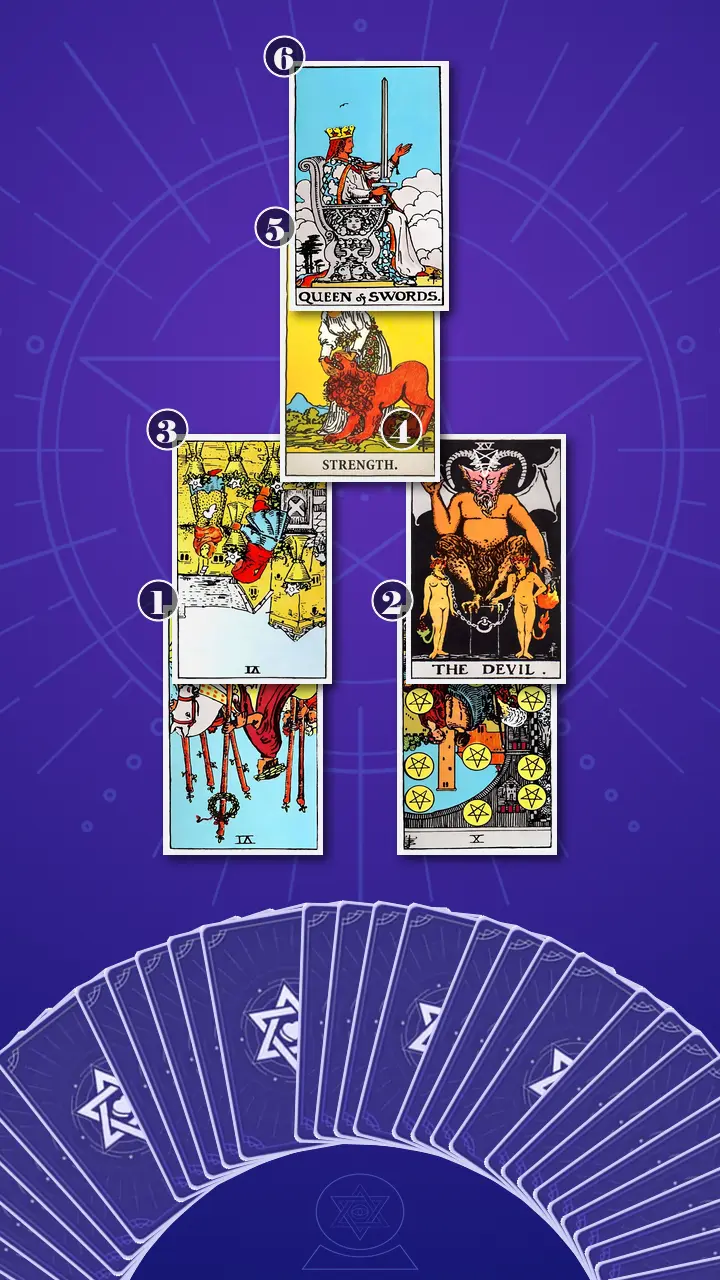
I chose the Four-Layer Insight Ladder · Context Edition, a six-card tarot spread, because this question is a repeating trigger-behaviour-reward-cost loop rather than one isolated disagreement. This is how tarot works in this reading: the cards give us an objective visual language for separating what is visible, what is inherited, what is emotionally younger, and what can be chosen now. They do not dictate a future or decide whether Jordan belongs.
A classic relationship spread could reduce this situation to Jordan and one other person. A shadow spread might reveal hidden material without showing the sequence that keeps the role active. This smaller, focused structure lets me trace the family trigger, the approval performance, the younger need, the reinforcing transaction, the internal transformation lever, and the boundary that can carry the insight into real life. It is the smallest sufficient map for this particular repeating pattern.
I told Jordan that the first card would show the observable golden-child performance, the second would reveal the family context that activates it, and the next two would descend toward the younger need and the repetition loop beneath the behaviour. The fifth card would offer the central transformation lever. The sixth would translate that inner shift into clear, repeatable language.
The Spotlight That Never Quite Settles
The Rider Who Keeps Checking the Crowd
This position depicts the observable golden-child performance identified in the diagnosis: polished achievement updates, automatic helpfulness, and close monitoring of approval. I turned over the card. It was the Six of Wands, in reversed position.
The rider lifted above the crowd and the laurel wreath usually speak of public recognition, victory, and praise. Reversed, that fire becomes unstable. It is not a lack of achievement; it is an excess of outward performance and a deficiency of inward permission. Jordan boards the TTC already preparing a successful product-launch summary, then watches relatives' faces while delivering it. If the response is brief, they add another credential, project detail, or reassuring joke, trying to keep the spotlight steady while privately wishing they could simply say, 'Work has been a lot lately.'
I said, 'A polished update can protect belonging and still leave you unseen.' Jordan did not nod. They gave a small, bitter laugh and rubbed one thumb along the edge of their phone. 'That is too accurate,' they said. 'It is almost rude.'
I let the reaction stand instead of asking for agreement. A performance can be effective and costly at the same time. Praise may be sincere, yet still become a moving target when Jordan uses it to measure whether they are allowed to take up space. I asked what the praise was being asked to prove. Their fixed smile softened, but their shoulders stayed raised.
The Family Resume Written Into the Walls
This position reveals how the Golden Child Spotlight is activated by family expectations, inherited definitions of success, and the gathering environment. The card was the Ten of Pentacles, in reversed position.
The RWS Ten of Pentacles shows continuity, legacy, established structures, and several generations gathered inside one social world. Reversed, the earth of that structure no longer fits cleanly. When Jordan enters the family home, the setting can feel like a shared Google Drive full of inherited templates for who is stable, successful, generous, and responsible. A vague WhatsApp message asking what everyone is doing for a birthday meal becomes a restaurant shortlist, a Google Calendar invite, and a reminder thread before Jordan has checked their own capacity.
In my archaeological work, I learned to look for layers before looking for a culprit. I call this diagnostic lens Inherited Belief Stratigraphy: separating Jordan's authentic values from obsolete, fear-based rules that may have travelled through family patterns. I was not trying to blame relatives or turn every tradition into evidence against them. I was asking which layer actually belonged to Jordan now. Showing up with warmth might be theirs. Proving stability to earn welcome might be an older layer.
Jordan's thumb stopped above an imaginary group-chat reply. They looked toward the family photograph on my shelf and said, 'It feels like I walk into a room where my family resume is already open.'
The Younger Self Still Knows the Shortcut
This position explores the younger emotional need held inside the Inner Child Fixation, especially the association between praise, usefulness, and belonging. I turned the next card. It was the Six of Cups, in reversed position.
The flower-filled cup and the guarded courtyard point toward childhood memory, familiar exchanges, and an identity shaped by an earlier emotional bargain. Reversed, the water flows backward into an old position. A childhood nickname or family story about Jordan always being the sensible one can act like a keyboard shortcut, sending their voice brighter and more agreeable before they consciously choose it. They clear plates, fix a relative's phone, suppress uncertainty, and offer practical help because those gestures once helped keep warmth available.
I told Jordan that the card did not require them to exile tender memories or dismiss every affectionate family story as manipulation. It invited a more precise question: what did the younger Jordan expect would happen if they were ordinary, uncertain, or disappointing? The answer could be met by the adult Jordan now, rather than automatically answered by the old family role.
Jordan's expression changed in three small movements. Their smile appeared, disappeared, and then returned without its usual brightness. Their hand moved toward the cup of tea but stopped halfway. Finally, they whispered, 'I do not know if I ever learned that being loved and being impressive were separate things.'
The Subscription That Renews at Dinner
This position exposes the Repetition Compulsion as a self-reinforcing transaction in which performance earns short-term approval while preserving long-term dependence on the role. The card was The Devil, in upright position.
The Devil is not a prediction and not a diagnosis. Here, it names the mechanism plainly: a family request arrives, the fear of disappointment rises, Jordan performs competence, praise and a calmer room arrive immediately, and the emotional charge is billed later on the ride home. It feels like a familiar subscription renewed at every gathering: short-term relief now, resentment and exhaustion charged afterward.
I zoomed in on the smallest transition. A relative says, 'Can you organise this?' Jordan's smile appears, their voice gets brighter, and their hand reaches for the shared planning document before they check the colour-coded Google Calendar. The inner exchange is almost contractual: 'I know this costs me. Why does it still feel mandatory?' Or, more sharply, 'I knew I would resent this, and I still said yes.'
The two figures in the RWS image wear chains that are loose enough to remove. That detail mattered. The pattern is powerful through repetition, but it is not an unchangeable fate. The first opening may be only a two-second delay before replying, long enough to notice whether the request is a genuine choice or an attempt to make the room safe before anyone can be disappointed.
I marked The Devil as the spread's catalyst and major blockage. Jordan's fingers tightened around the phone, then loosened. They looked at the planning document as though it had become visible for the first time. I said, 'The role is familiar; it is not a contract.' For a moment, they did not try to turn that sentence into a solution.
When Strength Put Down the Spotlight
The room grew quieter as I placed the fifth card at the centre of the narrow staircase. This position identifies the internal capacity that can soothe the younger fear and interrupt the automatic performance before Jordan decides how to respond. The card was Strength, in upright position.
The woman in the RWS image does not overpower the lion. Her hands are gentle, her breathing appears unhurried, and the infinity symbol above her head suggests patient integration rather than suppression. Strength brings balanced fire back into the reading: compassionate self-regulation, embodied courage, patience with discomfort, and internal permission. Jordan does not need to defeat the part that wants approval. They need to stay beside it long enough to choose.
At this point, I used my signature Generational Trauma Excavation. I did not ask which relative was responsible or demand that Jordan reconstruct every family history. I asked which old rule was being re-enacted across generations as though it still governed the adult in the room: usefulness buys welcome, impressive news keeps connection safe, and a calmer room proves that Jordan has done enough. Once the layer was visible, personal blame could be set down. A learned strategy can be understandable without remaining in charge.
I could see the old calculation trying to take over: if Jordan did not make dinner easy, keep the tone bright, and offer a convincing work update, disappointment might spread through the room; if someone was disappointed, they might read it as evidence that Jordan had failed. Every answer felt pre-decided.
You do not have to tame the room by being impressive; guide your own fear with the same steady hand Strength places beside the lion.
For one beat, Jordan's breath stopped and their hand hovered above the notes app. Their face went still; then their gaze lost focus, replaying the TTC carriage, the kitchen counter, and the planning document opened before the calendar had been checked. Their fingers, tight around the phone, loosened one at a time. The fixed social smile disappeared. A flush reached their cheeks, and their eyes shone, not with a dramatic revelation but with the grief of recognising how long the role had worked. Their shoulders lowered, then their jaw unclenched. When they spoke, the first words were barely audible: 'A part of me thinks I have to fix this now. The adult part of me can wait long enough to choose.' A breath trembled out of their chest. I could hear the relief, and also the small vertigo underneath it: without the performance, there was suddenly no script telling them what to do next. I said the pause did not need to feel peaceful to be real; it only needed to create room.
I asked, 'Now, use this new perspective to remember: was there a moment last week when this insight could have let you feel differently?'
Jordan looked down at their hands. The first answer was not a family memory but a recent WhatsApp request. They had felt the chest-tightening, opened Google Calendar, and volunteered before reading the rest of the message. This was the first crossing in the emotional transformation: from earning family belonging through competence, usefulness, and emotional control toward participating as an adult with compassionate self-trust, selective honesty, and clear boundaries. It was not certainty. It was a pause with a choice inside it.
The Upright Sentence With an Open Hand
This position translates the new internal stance into a clear, limited, and repeatable boundary practice for future family contact. I turned over the final card. It was the Queen of Swords, in upright position.
The Queen's upright sword and open hand hold two truths together. Jordan can be clear without becoming cold, and receptive without surrendering the boundary. The wind-swept sky brings the air of discernment: pause, assess capacity, and speak without building a courtroom case. When a relative asks Jordan to organise the whole birthday meal, the adult answer can be, 'I cannot organise that this time, but I can send one venue suggestion.' Then the sentence is allowed to remain complete.
I introduced an exercise from my communication toolkit called The Lineage Artifact Review. I asked Jordan to write three short lines: one family value to consciously preserve, one belief to revise, and one obsolete rule to permanently bury. Showing up with warmth could be preserved. Helping with a defined task could be revised from automatic duty into voluntary care. The belief that a clear no means rejection could be buried.
We were not burying people, affection, or every family tradition. We were deciding which inherited artifacts still carried living value and which ones had become heavy objects Jordan was carrying simply because they had been handed down. I told them, 'You can be warm without becoming the room's emergency system.' Jordan made a small mark beside that sentence, then let out a breath that sounded more practical than triumphant.
Finding Clarity in the Pause Before Proof
When I connected the six cards, the story became straightforward. The reversed Six of Wands showed Jordan entering the room with a public achievement update and using the audience's reaction as a measure of worth. The reversed Ten of Pentacles showed the inherited family resume and the expectations embedded in the setting. The reversed Six of Cups showed an earlier identity returning through nicknames, stories, and familiar tones. The Devil revealed why the pattern survived: praise and reduced tension worked quickly, while the cost appeared later. Strength offered the internal pause, and the Queen of Swords turned that pause into language.
The cognitive blind spot was not simply that Jordan helped too much. It was that they had been treating smoothness as proof of connection and a relative's disappointment as a referendum on belonging. They were also mistaking the absence of visible conflict for evidence that the performance was working. A polished update can protect belonging and still leave Jordan unseen.
The key shift was precise: pause at each family request, check actual capacity and preference, and choose one response that reflects the adult Jordan rather than the fastest way to make fear disappear. That is how the reading moves from feeling stuck and rehearsing decision after decision toward actionable advice and next steps. The family may still have mixed reactions. Jordan does not have to manage every one of them in order to remain caring.
I gave Jordan three small practices. Each one was designed to test a choice, not redesign the entire family system in a single conversation.
- Pause Before ProofWhen a family request arrives by WhatsApp or iMessage, wait ten minutes before replying. Put both feet on the floor, check the Google Calendar and your actual energy, then choose yes, no, or not now. At dinner, use the same pause before volunteering.Draft the reply in Apple Notes or say, 'Let me check and get back to you.' One breath is enough. You do not owe a paragraph-long explanation, and you can choose where this practice feels safe.
- The Two-Sentence TruthBefore the next family gathering, write one honest but selective answer to a career or life-progress question. At the table, give one real detail and one limit, such as, 'Work has been busy and I am still figuring out my next step. I do not want to get into the details tonight.' Stop there.Privacy is not dishonesty. If you notice yourself adding another credential, joke, or reassurance, pause before proof and let the two sentences stand.
- The Lineage Artifact Review and Limited YesSet a five-minute timer in Apple Notes. Write one inherited rule under Preserve, Revise, or Bury, then choose one bounded task for the next family plan, such as calling one restaurant or bringing one dish. Leave the rest of the organising available for other adults.If no feels too large, use not this time. A clear no is not a referendum on belonging, and a limited yes can express care without making you responsible for the whole room.
These next steps were not a demand to become emotionally flat or reject every family tradition. They were a way to practise capacity-based choice while the old approval dashboard was still running. The goal was not to eliminate discomfort before acting. It was to let discomfort exist without giving it the steering wheel.

A Five-Second Silence
Four days later, Jordan waited ten minutes before answering the family chat and offered one restaurant, not a full plan. The silence lasted five seconds. That night they slept; morning still brought, 'What if I was selfish?' but this time the question did not choose for them.
I did not read that small change as a miracle or a promise that every family gathering would suddenly feel easy. I read it as evidence of ownership. The cards had made the trigger, reward, and cost visible; Jordan had moved the authority from the room's applause to an adult hand on the wheel. That is finding clarity: not solving an entire family history, but making one response more honest than the automatic one.
When the family door opens and your shoulders rise before anyone asks anything, it can feel safer to hand over the polished, useful version of yourself than to risk discovering whether an ordinary, uncertain you would still be welcomed. But the Four-Layer Insight Ladder · Context Edition has shown me that clarity can begin before the answer, in the breath that makes room for your own voice.
So, when a familiar family role activates that old approval dashboard, if you let one breath come before the next yes, what answer might sound more like your actual capacity than the version of you everyone already knows?
This story is adapted from psychological research, written so that those in a similar struggle can see their own pattern in it — and find their next step clearly.These insights are not a substitute for professional psychological, medical, legal, or financial advice.
Learn more about our Journey to Clarity.
How did this insight land for you?
🫂 This Resonates Deeply
🌀 Living This Story
✨ Now I See Clearly
🌱 Seeing New Possibilities
🧰 Useful Framework
🔮 The Confirmation I Needed
💪 Feeling Empowered
🚀 Ready for My Next Step
Author Profile
 AI
AI“Having spent a lifetime at Cambridge and on archaeological digs, I’ve witnessed the rise and fall of countless civilizations. Please know that your current struggles are not a permanent fate, but merely a necessary fracture before rebuilding. I won't lecture you; instead, I invite you to sit with me in the ruins, using a patient, historical perspective to gently dust off the true, enduring value hidden beneath your temporary doubts.”
In this Family Tarot Reading :
Core Expertise
- Generational Trauma Excavation: Tracing the origins of toxic family behavioral loops across multiple generations to remove your personal blame.
- Inherited Belief Stratigraphy: Separating your authentic values from the obsolete, fear-based dogmas passed down by your ancestors.
Service Features
- The Lineage Artifact Review: An intellectual exercise to objectively decide which family traditions/beliefs to consciously preserve, and which to permanently bury.
Also specializes in :
Explore Related Patterns:
Approval SeekingYour approval dashboard comes online before anyone has delivered a verdict. On the ride to dinner you rehearse the version of your life the room might approve, and at the table a pause or half-smile changes the score enough to make you adjust the update. Monitoring the audience becomes a way to manage uncertainty when direct permission to be ordinary feels unavailable. When smoothness is treated as proof of connection and disappointment as a referendum on belonging, neutral reactions carry more authority than your own stated preference. The pattern persists because praise and a calmer room provide immediate relief, so checking and performing can feel necessary even when you know they leave you unseen.
Competence TheaterOn the TTC, you type and delete a polished product-launch summary before dinner, then arrive checking the oven timer, fixing an uncle's phone, confirming dessert, and delivering the update while watching relatives' faces. Those actions turn competence into a social performance that can organise the room and protect belonging, but they also make your usefulness visible before your actual capacity is consulted. When a brief response prompts another credential, project detail, or reassuring joke, the performance is doing more than sharing news. It is trying to stabilise the audience's reaction and prove that you are allowed to take up space. The cost is that an ordinary truth such as "Work has been a lot lately" is crowded out, leaving you effective and still unseen.
Emotional Hyper-ResponsibilityBefore dinner, you prepare not only your own update but the room's logistics and emotional temperature. You check the timer, fix a phone, confirm dessert, smooth tense moments, and feel pressure to keep the tone bright. This turns other people's possible disappointment into a problem you must preempt, so helpfulness becomes emotional regulation by proxy. When the room is calm, you receive quick confirmation that the effort worked; when someone might be disappointed, it can register as evidence that you failed. That is why the role continues even when it exhausts you. You can let other adults have their reactions while choosing one bounded act of care, returning responsibility for the atmosphere to the people who are actually in it.
Family Role RegressionWalking into the condo activates a familiar script before you consciously decide what to do. You check the oven, fix the phone, coordinate dessert, and hear yourself become the "organised one"; a childhood nickname or family story about being sensible works like a shortcut that makes your voice brighter and more agreeable. The old role is not simply a memory; it becomes the fastest route to warmth and order, while the adult question of whether you have time or want to help arrives later. That is why the family resume can feel already open when you enter. The work is to let the adult Jordan answer the younger expectation rather than letting the familiar role answer first.
Repetition CompulsionA relative asks you to organise something, your smile appears, your voice brightens, and your hand reaches for the shared planning document before you check the calendar. Praise and a calmer room arrive quickly, while resentment and exhaustion are billed later on the ride home. The sequence repeats at gatherings and in the recent WhatsApp request, so immediate relief trains the next automatic yes. The loop survives not because you lack insight, but because the reward comes before the cost. A two-second delay creates a choice point where you can ask whether the request is a genuine choice, a capacity-based yes, a no, or a not now. The role is familiar, but the response does not have to remain automatic.
Usefulness-Based Self-WorthBeing called the organised one, producing an impressive work update, and making dinner easier all place your value in visible usefulness. The inherited rule is stated plainly in the room's logic that usefulness buys welcome, impressive news keeps connection safe, and stability must be proved. Your behaviour then becomes evidence offered for belonging rather than care offered from choice. The strain appears when you recognise that warmth may be your authentic value but still feel that a clear no could mean rejection. Saying you never learned whether being loved and being impressive were separate captures the mechanism precisely. Separating contribution from worth lets you help with one defined task without making the whole gathering proof that you deserve a place in it.
Approval-Driven Self-SilencingYou privately want to say "Work has been a lot lately," yet you deliver a polished launch summary and answer questions about dating and whether life is going well. When the reaction is brief, you add a credential, project detail, or reassuring joke instead of letting your limited answer stand. Your voice is not absent; it is edited toward whatever seems least likely to disappoint the room. That editing protects short-term connection but suppresses the uncertainty you wanted to bring as an ordinary adult. The pause creates room for selective honesty without forcing full disclosure. A sentence such as "Work has been busy and I am still figuring out my next step. I do not want to get into the details tonight" lets you stay warm while keeping your inner life from being managed by the audience's score.
Explore Related Struggles:
Approval-Safety FusionOn the TTC and at the table, you track pauses, half-smiles, and the length of a response as though they were a live dashboard. When a relative asks you to organise something, your voice brightens and your hand reaches for the planning document before you check your calendar or desire, because a smooth room seems to confirm that connection is still secure. The same maneuver protects the evening in the short term but makes your right to relax depend on the room's reaction. You do not have to make every silence disappear to remain caring; a pause before answering lets safety become something you assess from your own capacity rather than something you earn through constant approval.
Competence-Connection FusionYour polished work update, practical organising, phone repair, and effort to keep the tone bright all do real work at dinner, yet they are also asked to carry the weight of connection. When the room is calm and praise arrives, the helpful version of you appears to have secured belonging, while your wish to say that work has been a lot or that you cannot help remains outside the exchange. That makes competence more than a skill; it becomes the bridge you keep rebuilding whenever closeness feels uncertain. A bounded contribution, such as one restaurant suggestion instead of the whole plan, lets care remain visible without requiring your performance to prove that you deserve a place in the family conversation.
Inherited Role LockBefore the family dinner, you rehearse a product-launch summary on the TTC, arrive with the oven timer and dessert logistics already in mind, fix a relative's phone, and answer to the identity of the organised one. The family resume is open before you choose how to enter the room, so an older definition of being stable, useful, and responsible starts directing your hands and voice. That role keeps returning because it offers a ready-made script at the exact moment the gathering asks who you are. You can preserve warmth and care while still noticing that the script turns participation into proof; the adult choice begins when you separate what you genuinely value from what was handed to you as the price of welcome.
Earned Love BindThe childhood nickname about being sensible, the familiar family stories, and the reflex to clear plates or fix a phone bring an earlier exchange into the adult room. You have learned to place usefulness, impressive news, and emotional control beside warmth, as if being ordinary or disappointing could remove the conditions that keep welcome available. That is why knowing the role costs you does not immediately dissolve it; the performance has been carrying a question about whether being loved and being impressive can be separate. You can answer that question in the present with selective honesty and a limited yes, without treating a relative's disappointment as proof that you no longer belong.
Boundary CollapseAt the condo, you check the oven, fix a phone, confirm dessert, and say yes to new requests before consulting your calendar or desire. Your time, energy, and preference are repeatedly moved behind the room's practical needs, so helping stops being one choice and becomes the condition for staying easy to be around. That is why a limited yes can feel disproportionately risky even when you know the task will cost you. The useful boundary is not a dramatic withdrawal; it is a clear unit of participation that leaves responsibility with other adults and lets your care remain voluntary.
Explore Related Emotions:
Approval AnxietyOn the 6:18 p.m. Line 1 ride, you type and delete a two-sentence product-launch update while your shoulders climb and your phone warms your palm. At dinner, a brief response makes you add another credential, project detail, or reassuring joke, so each face becomes part of the score under your ribs. Approval Anxiety names the pressure to secure visible permission before you can speak plainly about work, dating, or how much capacity you have. The role keeps returning because praise and a calmer room arrive immediately, while the cost of being unseen appears later. A pause before adding proof gives you a way to notice the score without letting it decide what you disclose.
Inner Child AcheA childhood nickname or family story about you being the sensible one can still act like a shortcut. You clear plates, fix a relative's phone, suppress uncertainty, and offer practical help before you have consciously decided what you want to give. Inner Child Ache names the younger need that learned praise and usefulness could keep warmth available. It explains why the adult pause can feel strangely disorienting even when the current request is ordinary. You do not have to reject affectionate memories to answer that earlier need with present-day choice.
Ordinariness ShameBefore the dinner, you rehearse a polished update; at the table, you answer questions about dating and whether life is finally going well while wishing you could say work has been a lot. Showing up as an ordinary, uncertain adult feels exposed because disappointment has been linked to personal failure. Ordinariness Shame captures the ache behind your line that you do not know whether being loved and being impressive were ever separate. The pressure is not just to share good news; it is to avoid the version of yourself that might need patience or have no polished answer. Letting one honest limit stand gives ordinary presence a place beside competence.
Usefulness-Based Belonging FearAt the family condo, you check the oven timer, fix your uncle's phone, confirm dessert, and smile when someone calls you the organised one. Your hand reaches for the shared planning document before you check the calendar or your desire, making usefulness the fastest route to a settled room. Usefulness-Based Belonging Fear describes the private possibility that welcome is safer when you are competent, generous, and easy to rely on. The old exchange is reinforced by sincere praise, so it can feel like care while still making ordinary participation risky. A defined offer lets you test whether connection can survive without turning you into the room's emergency system.
Boundary GuiltWhen a relative asks you to organise something, your smile appears, your voice brightens, and your hand reaches for the planning document before you check your own capacity. Four days later, after waiting ten minutes and offering one restaurant, the question What if I was selfish still rises. Boundary Guilt names the pull to treat a clear no or limited yes as evidence that you have harmed belonging. It keeps the golden-child role active by making other people's possible disappointment feel like a debt you must settle in advance. A complete sentence such as I cannot organise that this time, but I can send one suggestion gives your care a boundary without requiring a courtroom case.
Cautious Self-TrustAfter the central pause, you notice the adult part can wait while another part wants to fix everything immediately. Your breath trembles, your shoulders lower, and the next step still does not feel fully peaceful, yet you can check the calendar and choose. Cautious Self-Trust names a modest confidence built inside discomfort rather than after discomfort disappears. Four days later, the question What if I was selfish still arrives, but it no longer chooses for you. The feeling is credible because it leaves room for uncertainty, selective honesty, and a boundary that can be revised with new information.
Grounded AgencyFour days later, you wait ten minutes before answering the family chat and offer one restaurant rather than a full plan. The silence lasts five seconds, and the room's possible reaction is present without taking the choice away from you. Grounded Agency is the felt return of authority to an adult decision-maker who can care, assess capacity, and leave part of the plan with other people. It does not require family members to respond perfectly; it gives you a response that remains yours when they have mixed reactions. That small ownership is the usable counterpart to the old automatic yes.
Polished AlienationWhen your work update receives a brief response, you add a credential, project detail, or joke to keep the spotlight steady. The effort can protect belonging in the moment while leaving the person behind the update unrecognised. Polished Alienation captures the distance created when your most acceptable version is the one receiving attention. Sincere praise does not remove the gap if you are using it to measure whether you may take up space. A selective truth about work can let contact reach you without requiring a performance to carry the whole relationship.
Self-Betrayal AcheAt the planning document, you recognise the exchange clearly: you know the task will cost you, anticipate resentment, and still say yes before checking the calendar. Your action moves toward a smoother room while your stated capacity and desire remain outside the decision. Self-Betrayal Ache describes the hurt of watching your own response abandon information you already had. The immediate relief makes the choice feel necessary, but the later ride home shows what was traded away. Waiting before answering restores a small point of authorship where your actual preference can enter.
Resentful ExhaustionAt every gathering in the repeating loop, performance brings praise and a calmer room quickly, while the emotional charge is billed later on the ride home as resentment and exhaustion. The delayed cost is easier to overlook than the immediate relief of being seen as capable. Resentful Exhaustion captures the aftertaste of carrying practical details and emotional tone beyond your capacity. It matters to the question because the role survives through its short-term reward even while it drains the person performing it. Naming the later cost beside the immediate reward lets you compare the whole exchange rather than only the applause.
Explore Related Contexts:
Conditional Family BelongingYou prepare the version of your life that the room is most likely to approve of, answer progress questions with polished optimism, and volunteer before checking whether you have the capacity to help. The repeated rule underneath those actions is that successful, useful, and controlled participation receives the smoothest welcome. This does not require family affection to be false. It identifies the conditions that have become attached to uncomplicated access to that affection. When usefulness and impressive news function as entry requirements, ordinary uncertainty becomes harder to bring into the room. Recognising those conditions gives you a clearer basis for deciding which forms of participation reflect care and which are attempts to secure permission to belong.
Family Script PressureThe family room is described as holding templates for who should be stable, successful, generous, and responsible, while dinner questions check work, dating, and whether life is finally going well. Your update is therefore entering a setting where the criteria for acceptable adulthood have already been written. The pressure comes from the script's narrow range of approved answers, not from any single question in isolation. It rewards a coherent progress narrative and leaves less room for uncertainty, privacy, or an off-script stage of life. Distinguishing the inherited script from your own standards lets you choose which family values still fit and which expectations no longer have authority over your presentation.
Inherited Family Role Lock-InA relative calls you the organised one, older stories preserve you as the sensible one, and practical responsibilities begin before your coat is off. Those labels do more than describe past behaviour. They assign a familiar position that is already waiting when you enter the room. Your current adult life as a twenty-eight-year-old product manager does not automatically update the family hierarchy. The inherited role keeps recruiting you for competence, reassurance, and coordination before you have chosen how to participate. Seeing the assignment as a family structure allows you to evaluate each request in the present instead of treating an old description as a permanent job specification.
Praise as Performance ContractA request arrives, your hand moves toward the planning document, competence is delivered, and praise or a calmer room follows quickly. The cost is delayed until the ride home, which allows the exchange to look successful while the person supplying the work absorbs what the gathering does not see. That sequence turns praise into more than appreciation. It becomes the immediate payment in an unwritten contract linking performance to secure participation. Because the reward arrives before the cost, the arrangement can renew itself even when you already know you will regret the automatic yes. A pause before responding interrupts the transaction long enough for praise to stop functioning as advance authorisation for your labour.
Adulting Performance PressureOn the TTC, you edit a product-launch summary before anyone has asked about work. At the table, questions about dating and whether life is finally going well extend the review across career, relationships, and general life progress. This is more than ordinary catching up because adulthood is being presented as a product that should look coherent, successful, and under control. The pressure encourages credentials and reassurance while pushing unfinished realities out of view. Treating the conversation as optional disclosure rather than a progress report restores your ability to decide how much of your work or personal life belongs at the table.
Designated Organizer BurdenBefore your coat is off, you are checking the oven timer, fixing an uncle's phone, and confirming dessert. A vague message about a birthday meal can become a restaurant shortlist, calendar invitation, and reminder thread under your management before you have checked your own schedule. The external problem is not that you know how to organise. It is that demonstrated competence has become default ownership of family logistics. Repetition allows other adults to treat your coordination as part of the gathering's infrastructure rather than as a voluntary contribution. Identifying that allocation makes it possible to offer one bounded task without inheriting the entire planning system.
Designated Peacekeeper BurdenYou brighten your voice, smooth tense moments, add reassurance, and monitor whether the room remains calm. The gathering benefits immediately from that regulation, while the delayed cost travels home with the person who supplied it. This places responsibility for collective smoothness onto one family member. The absence of visible conflict then appears to confirm that the arrangement is working, even though it depends on your continued emotional control and rapid intervention. Once calm is recognised as a shared family responsibility, another person's pause or disappointment no longer has to become an emergency assignment for you.