Inside the Accountability Evasion Cycle: Return Before the Gap Grows

The 8:47 p.m. Accountability Evasion Cycle
If you want structure right up until structure can see you struggling, you may recognise the moment I saw on the northbound Line 1 TTC train. Alex (name changed for privacy), a 28-year-old product designer in Toronto, was heading home after a long day while a personal creative goal sat unfinished in a Figma tab.
At 8:47 p.m., Alex opened a recurring Google Calendar reminder beside a half-finished brief. The fluorescent lights buzzed above the carriage, the phone felt warm against their palm, and the train brakes gave a thin metallic squeal at the next station. Their thumb moved toward Instagram Stories before their mind had finished reading the check-in message.
Alex wanted accountability to keep the creative goal alive, but they also wanted to disappear until the week looked respectable. Their chest tightened as though someone had cinched a belt beneath their ribs. Their stomach dropped, their hands grew restless, and the thought arrived fully formed: 'If I answer now, I have to admit I did not do what I said I would do.'
I listened without turning the pattern into a character judgment. 'You are not dodging the goal; you are dodging the moment the goal might be used as evidence against you,' I said. 'That distinction gives us somewhere useful to begin. We can look at why the check-in feels like a verdict, what the silence protects for a few minutes, and what could help you return without performing success. Our Journey to Clarity is not about forcing a perfect answer. It is about drawing a map while the process is still real.'

Choosing a Map for the Unfinished Week
I asked Alex to place the phone face down, take three steady breaths, and name the question exactly as it was: Why do I dodge every check-in once my goals get uncomfortable? I shuffled slowly. The movement was not a supernatural test or a promise about the future. It gave the mind a small, deliberate transition from reacting to observing.
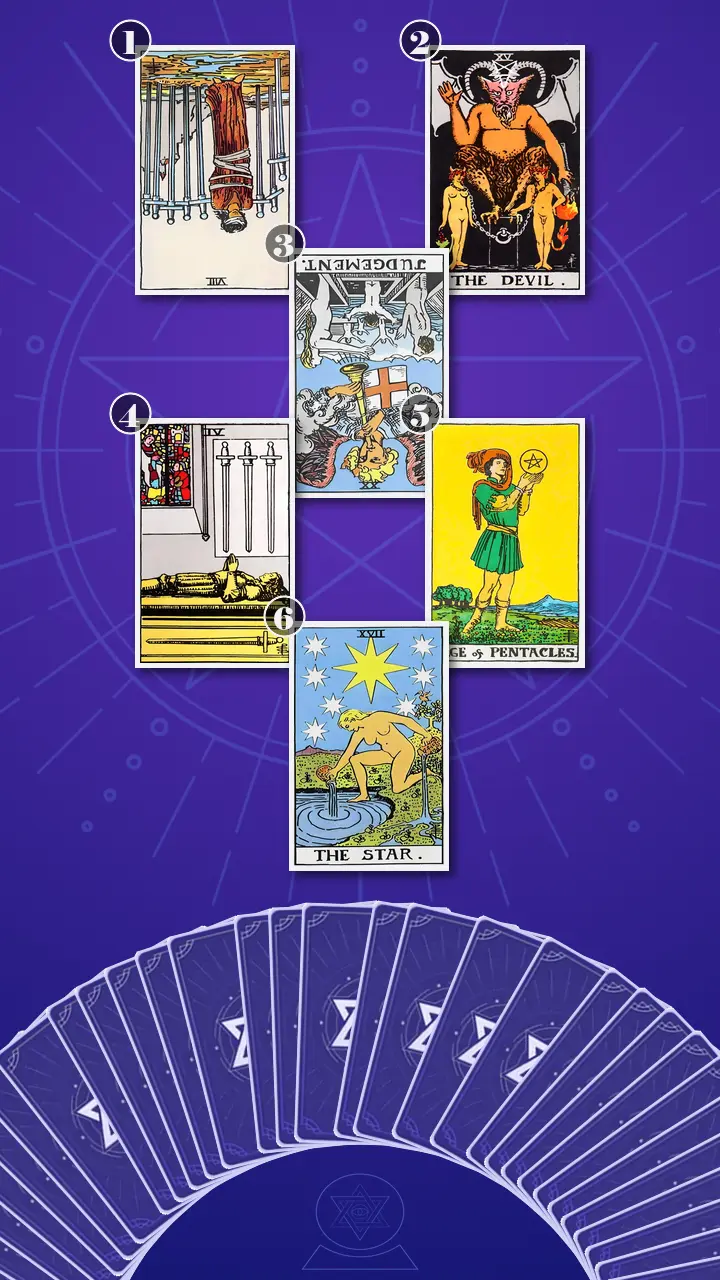
I chose the Transformation Path Grid (6) · Context Edition because this question is built like a self-reinforcing loop. An uncomfortable goal review leads to a dodged check-in; the silence lowers pressure briefly; the larger gap then makes the next review feel even more exposing. This six-card tarot spread for accountability avoidance lets me follow that chain from the visible behaviour to the blockage, the repetitive root, the turning trigger, the practical return, and the integrated practice. It keeps the reading grounded in self-exploration and choice rather than prediction.
I explained the structure to Alex and to anyone listening in through the story. The first card would show the exact moment when an unfinished goal became a dodged message. The second would identify the protective bargain that made silence rewarding in the short term. The third would reach the deeper pattern that made an ordinary review feel like a courtroom. The fourth would offer the interruption, the fifth a concrete accountability action, and the sixth the kind of process-based self-trust that could grow through repeated return.
Reading the Warning Light
Position 1: The Reply That Looked Impossible
'The card I am turning for the presenting cycle, the observable moment when an uncomfortable goal turns into a dodged check-in, is the Eight of Swords, in reversed position,' I said.
The reversed Eight of Swords showed me Alex staring at a check-in thread that was technically open but psychologically locked. The calendar reminder had arrived after missed creative milestones, and every possible reply had been rejected before it was typed: too late, too vague, too embarrassing, or not impressive enough. The blindfold became the assumption that there was no acceptable route back. The loose space between the swords became one available sentence: 'I am behind, and I am checking in before I have a polished update.'
The reversed energy was a blockage beginning to loosen, not freedom already achieved. Alex still treated a painful reply as if it meant there were no options, but the card showed the first opening in that belief. The restriction was partly mental and therefore available for examination. I asked which single sentence could acknowledge the difficulty without adding an apology, a new productivity system, or a complete explanation.
Alex gave a short laugh with no amusement in it. 'That is too accurate. It is almost a little cruel.'
I did not soften the observation into blame. 'I hear why it lands that way,' I replied. 'But this card is not calling you trapped. It is showing the precise second when your mind rules out every reply before you have written one. The route back can be small and still be real.' Alex looked down at their hands, then opened the message again without typing. It was a modest movement, but the screen no longer appeared completely sealed.
Position 2: The Relief of the Mute Button
'The card for the immediate blockage, the thought, feeling, or protective move that makes the check-in harder to face, is The Devil, upright,' I said.
The Devil was the private contract Alex made after an uncomfortable goal review: if they could not report success, they would withhold the report. Muting the reminder created an immediate drop in pressure. The phone became quiet, the shoulders fell for a few seconds, and a fresh Notion template opened in another tab. The relief was real, but so was the cost. The silence kept the goal fused with self-worth and made the next check-in heavier.
The energy here was attachment. The loose chains around the figures did not represent a permanent sentence; they represented a bargain that kept paying out just enough immediate relief to be repeated. In ordinary life, this looked like moving a Google Calendar event from six o'clock to later in the evening, then silently rescheduling it again; watching ProductivityTok; comparing Notion templates; or beginning a cleaner tracker rather than answering the friend, coach, or peer who had asked one simple question.
I remembered my years on Wall Street, where a trade could look profitable if I counted only the immediate payout and ignored the carrying cost. 'Silence lowers the volume now, then turns up the weight of the next reply,' I told Alex. 'Your nervous system is taking the short-term relief. It is not calculating the growing gap yet. That does not make you weak. It means the bargain has a reward, and we can finally see it clearly.'
Alex's fingers tightened around the phone, then loosened. 'I do want accountability,' they said. 'I just do not want it to see me halfway through something.'
I nodded. 'That is the exact point of the pattern. You want structure until structure can see you struggling. The question is not whether accountability should remain in your life. The question is whether it can measure the process without becoming a judgment about your character.' The dark screen reflected Alex's face for a moment, and the unread message remained visible between us.
Position 3: The Weekly Review as a Courtroom
'The card for the repetitive root, the deeper pattern behind repeating the same disappearance after goals become uncomfortable, is Judgement, in reversed position,' I said.
Reversed Judgement turned the Sunday weekly review into a courtroom. The calendar notification became the angel's trumpet. The tracker became evidence. The unfinished week became a verdict about discipline, reliability, and whether change could be trusted. Alex did not wait to hear what the accountability partner would actually say. Their internal judge drafted the feedback before the message was sent.
I asked Alex to complete the sentence silently: 'If I reply now, they will see ___. If they see ___, it proves ___.' Their thumb hovered over the screen. Their breath paused, their eyes lost focus, and for a moment the train seemed to pull away from the room where we were sitting. I could see the old Thursday morning replaying in their face: three missed milestones, a renamed review page, a status update rewritten until it sounded more competent than the week had felt.
Then I brought the interpretation back to observable facts. Alex had opened the Figma file twice. They had completed one rough concept. They had not sent the check-in. Those facts described a week. They did not establish a permanent identity.
'A check-in is a snapshot of the process, not a character reference,' I said. 'The trumpet is calling the pattern into awareness while there is still time to respond. Your internal judge is turning the call into condemnation. We need to separate what happened from the sentence your mind adds afterward.'
Alex's eyes stayed on the card. Their mouth tightened as if they were holding back an explanation, then their shoulders lowered by a fraction. 'I think I have been waiting for the next update to prove I am changing,' they said. 'So every incomplete update feels useless.'
'That is the root,' I said. 'You are asking one message to repair your whole identity before you allow yourself to send it. A review can teach you what happened only if you let it arrive before the story becomes polished enough to hide the evidence.'
When the Four of Swords Kept the Door Open
Position 4: The Pause That Does Not Disappear
The room became quieter when I reached for the fourth card. Outside the window, a streetcar bell sounded once and faded into traffic. 'The card for the turning trigger, the insight or experience that can interrupt the repetition-compulsion loop before avoidance becomes silence, is the Four of Swords, upright,' I said. 'This is also the key card, the antidote in this reading.'
The Four of Swords did not ask Alex to disappear from the problem. It offered a deliberate pause with a known end. The resting figure, the three swords displayed above, and the fourth sword beneath the body showed suspended action with the issue still present. In modern life, that was Alex putting the phone face up, setting a ten-minute timer, noticing the tight chest and the urge to mute the message, and allowing the first wave to settle without opening a new tracker.
The energy was balanced containment. The pause was not an escape hatch and not a demand to disclose more than Alex wanted to share. It was a boundary around the reaction, long enough to observe the shame story and short enough to keep the original commitment visible.
I used my signature lens, Pseudo-Growth Eradication, at that point. I stripped away every polished self-help explanation and audited the actual return on each move. A new tracker created the appearance of preparation but produced no return to the conversation. A ten-minute pause followed by one factual sentence had modest optics and real leverage. I also applied my Potential Actionability Assessment: could Alex perform it in the actual Toronto workday, while tired, with the Figma file unfinished and the phone already in their hand? The pause passed that test because it changed the next action without requiring a personality transplant.
I watched Alex move through the old bargain. The reminder was open, the Figma file was unfinished, and their hand reached toward silence. They wanted the structure, but only after it could see a respectable version of them. In that instant, the unfinished file was not merely a task. It was evidence waiting to be used against them. I let the silence sit long enough for the pattern to become visible.
Stop treating discomfort as proof that you must withdraw; use the open window of the Four of Swords to pause, name what is happening, and return before silence becomes another repetition.
Alex's thumb stopped above the reply box. For one breath, their face emptied and their pupils widened in the blue light. Then their eyes moved to the swords, as though replaying every Sunday review they had avoided. Their jaw tightened. 'But if this is what I have been doing, does that mean I was wrong all along?' Their voice carried a brief flash of anger before dropping into a quieter register. I told them the old strategy had been protecting them from exposure, but protection could still have a cost. A long breath left their chest. Their fingers unclenched, their shoulders sank, and their eyes grew bright without spilling over. They looked less triumphant than unburdened, with the slight dizziness that can follow setting down a weight carried for too long. 'You do not have to disappear until your progress looks respectable,' I said. 'Now, using this new perspective, can you think back to last week and find one moment when a bounded pause might have made the next reply possible?'
The check-in did not need to prove that Alex was disciplined, transformed, or back on track. It only needed to keep the real process visible. Alex could say what happened, name what got in the way, and return before the gap became another verdict. This was the first clear movement from anticipatory shame toward honest re-entry, not a finished transformation but a usable opening.
From One Fact to a Wider Sky
Position 5: The Small Piece of Evidence
'The card for the accountability action, the small and concrete way to return to the check-in without performing success, is the Page of Pentacles, upright,' I said.
The Page of Pentacles stood with one pentacle held at eye level. I translated that single coin into one real piece of evidence: one completed action, one obstacle, and one next experiment. For Alex, it could mean opening the creative file for fifteen minutes on Tuesday, making one rough draft, or asking a coworker for clarification on a blocked task. The card did not ask for a dramatic reset or a cleaner identity. It asked for patient contact with something tangible.
The energy had moved into earth. After the constricted air of the swords and the heavy attachment of The Devil, this upright Page offered balance through a repeatable action. I asked Alex to use the same channel where the check-in normally happened and write: 'Completed: ___. Blocked by: ___. Next experiment: ___.' The message could be three lines. It could be shorter if privacy required it. Its purpose was not to explain an entire life. Its purpose was to give the process one honest point of contact.
'Report one fact, name one obstacle, test one next step,' I said. 'That is enough information for this review.'
Alex copied the structure into their Notes app. Their posture remained careful, but their breathing had steadied. They stared at the blank spaces, then typed one completed action from the week. It was small enough to seem almost embarrassing. I watched them leave it there instead of replacing it with a more impressive example.
Position 6: The Same Channel Under an Open Sky
'The card for the integrated practice, the new relationship with goals and review that answers the consultation question, is The Star, upright,' I said.
The Star showed an exposed figure pouring water into a pool and onto the land, with one foot in each. I read that image as emotional honesty becoming practical continuity. Alex could return to the same check-in channel while the creative goal was still unfinished, allow one small action to nourish the work, and come back the following week without manufacturing a clean success story.
The energy here was renewal through openness, not a promise that every milestone would be met. The water and earth worked together. Feelings became information; information became one grounded next step; the next step created evidence that could be reviewed. This answered the urge to dodge every uncomfortable review with a gentler form of consistency. Self-trust would not mean never missing a target. It would mean being able to tell the truth about a missed target and return to the review.
I asked Alex what it might feel like to arrive at the same weekly meeting without needing the current week to prove they were finally fixed. They looked through the window at the Toronto lights, where wet pavement reflected red and white signals in broken lines. 'Still vulnerable,' they said. 'But less like I have to hide the whole project.'
I nodded. The Star was not asking Alex to become permanently optimistic. It was showing a relationship with hope that could survive an unfinished process. The sky was open because nothing had been concealed from it.
The Dashboard Without the Verdict
The Pattern in Plain Sight
When I placed the six cards together, the story became straightforward. The reversed Eight of Swords showed an available reply treated as impossible. The Devil explained why silence kept repeating: it lowered shame and pressure immediately, so the nervous system learned to reach for the mute button. Reversed Judgement revealed the older meaning underneath: a normal progress review had become a courtroom where an unfinished goal could supposedly prove Alex was unreliable. The Four of Swords introduced a finite pause. The Page of Pentacles gave that pause a small, observable action. The Star showed how repeated honest returns could make accountability informative instead of threatening.
The cognitive blind spot was not simply believing that Alex needed a better system. It was believing that self-trust could be protected by hiding evidence until the next update looked successful. That strategy made the dashboard disappear whenever the warning light appeared, then treated the missing information as proof that the car could not be steered. The transformation direction was clear: replace disappearing until progress looked respectable with a brief, factual check-in at the first sign of discomfort.
I ran the pattern through my Potential Actionability Assessment one more time. The useful question was not whether Alex could become perfectly consistent. It was whether they could create a small behaviour that remained possible on a bad week, could be observed by another person if consented to, and could be repeated without turning disclosure into a punishment. The answer was a bounded pause, a three-line update, and a return to the same channel.
The Evolution KPI Framework
I offered Alex my Evolution KPI Framework, a strict 30-day execution challenge that turns a philosophical realization into measurable behaviour. I made the boundary clear: strict about the container, humane about the result. For the next 30 days, Alex could keep the same weekly check-in time with a trusted friend, coach, peer, or project partner. The key performance indicator would not be flawless output. It would be the number of times Alex returned while unfinished, plus one sentence comparing the feared consequence with what actually happened.
The framework remained consensual and adjustable. Alex could limit the details, ask for a non-shaming response, or pause the arrangement if the other person became coercive. The practice was designed to build agency, not obedience. The real evidence would be simple: I noticed the urge to vanish, I allowed a finite pause, I sent what was true enough to send, and I came back to the same review.
- The Ten-Minute Re-Entry PauseAt the next uncomfortable Google Calendar reminder this week, keep the original event and message thread open, set a ten-minute phone timer, and write down the body signal that appears, such as a tight chest, heavy stomach, or restless hands. When the timer ends, send the accountability partner a factual opening line: I am behind on this and I am checking in before I have a polished update.Use two minutes if ten feels too large, and use a phone timer rather than waiting for motivation. If focusing on the body feels too activating, write I am uncomfortable and will reply at a specific time instead. The pause must have an end time and must not require more disclosure than feels safe.
- The Three-Line ReturnAt the next weekly review, send the actual friend, coach, peer, or project channel three lines: Completed: one observable fact. Blocked by: one condition, including an emotional or logistical obstacle if you choose. Next experiment: one action that can be observed within seven days, such as opening the creative file for fifteen minutes on Tuesday.Draft the message in Notes, then remove any apology or long explanation whose only job is to make you look more reliable. If the full format feels too exposed, send only the completed fact and the next review time. The goal is truthful communication, not total disclosure.
- The 30-Day Same-Channel PracticeAsk the accountability partner to keep the same recurring check-in time for the next 30 days instead of restarting with a new tracker. At each review, record the date and time you returned while unfinished, then write one sentence comparing the prediction with the result: I expected the honest update to ___; what actually happened was ___.Keep the old record private if necessary, but do not erase it to manufacture a clean identity. Agree in advance on what the other person will and will not do with your update. You can adjust or stop the arrangement if it becomes shaming or coercive.

A Reply That Did Not Need Good News
Seven days later, I received a message from Alex while I was making coffee. It read: Completed: opened the Figma file for fifteen minutes. Blocked by: dread after seeing the missed milestone. Next experiment: send the next review before editing the plan.
On Thursday, Alex sent the three lines from a cafe near Spadina. They slept a full night, but woke with the thought, What if I mess it up? The thought stayed. This time, they smiled, opened the original calendar event, and let the next review remain visible.
I did not read that message as proof that the entire pattern had vanished. I read it as the first small piece of evidence that Alex could remain present while unfinished. The cards had not rescued them, and they had not decided Alex's future. Alex had used a pause, told the truth at a tolerable level, and chosen to return. That was the Journey to Clarity: from shame-driven disappearance and short-lived relief toward honest re-entry, process-based accountability, and steadier self-trust.
When an unfinished week makes your chest tighten and your hand reach for the mute button, it can feel safer to hide until you look reliable, even though the hiding is what leaves you feeling least able to trust yourself.
If you allowed one unfinished update to be information rather than a verdict, what small truth might you be willing to bring back to the same check-in channel?