Sunk-Cost Paralysis at 8:47 p.m.: Trading Old Proof for Present Fit

The 8:47 p.m. Tracker and the Gravity of Sunk-Cost Paralysis
If you are a London project coordinator who opens the project tracker after work to count completed tasks instead of asking whether the commitment still fits, a renewal email can turn ordinary uncertainty into full-on Career Pivot Anxiety.
At 8:47 p.m. on a Tuesday, Jordan (name changed for privacy), a 29-year-old non-binary project coordinator, joined my video call from the kitchen table of their rented East London flat. I watched them refresh a Notion tracker while the radiator clicked and the laptop fan whirred. Their phone warmed one palm; their other hand pressed into a shoulder pulled tight toward the ear.
“I want to stop staying,” they told me, “but leaving would make all of this look wasted. I keep calling it patience when it’s really fear of admitting the cost. I need one more sign before I’m allowed to change my mind.”
I heard the contradiction before I touched the cards: Jordan wanted permission to reassess the commitment, yet every completed task, payment, late evening, and saved plan made reassessment feel less permitted. It was like standing with one foot inside a Tube carriage and one on the platform while the warning tone sounded—their chest braced for movement, their shoulders carried the weight of staying, and their stomach kept lurching at the thought of either direction.
“You are not confused about the past; you are trying to make the past pay for the present,” I said. “That doesn’t make you foolish. It means you’ve built a very convincing protection system around something that once mattered.”
I explained that I would not use tarot to tell them whether to stay or leave. A card cannot know the private cost of their work better than they can, and I never turn a difficult cycle into a prophecy. My role was to help distinguish temporary friction from a deeper mismatch, then return the choice to the person who would live it.
“Let’s give this fog a map,” I said. “Not a verdict—a map.”
Choosing a Compass for the Crossroads
I asked Jordan to close the tracker, place both feet on the floor, and take one slow breath without trying to make the tightness disappear. I shuffled while they held one present-tense question: What is this commitment asking of me now? The pause was a focusing tool, not a mystical test they could pass or fail.
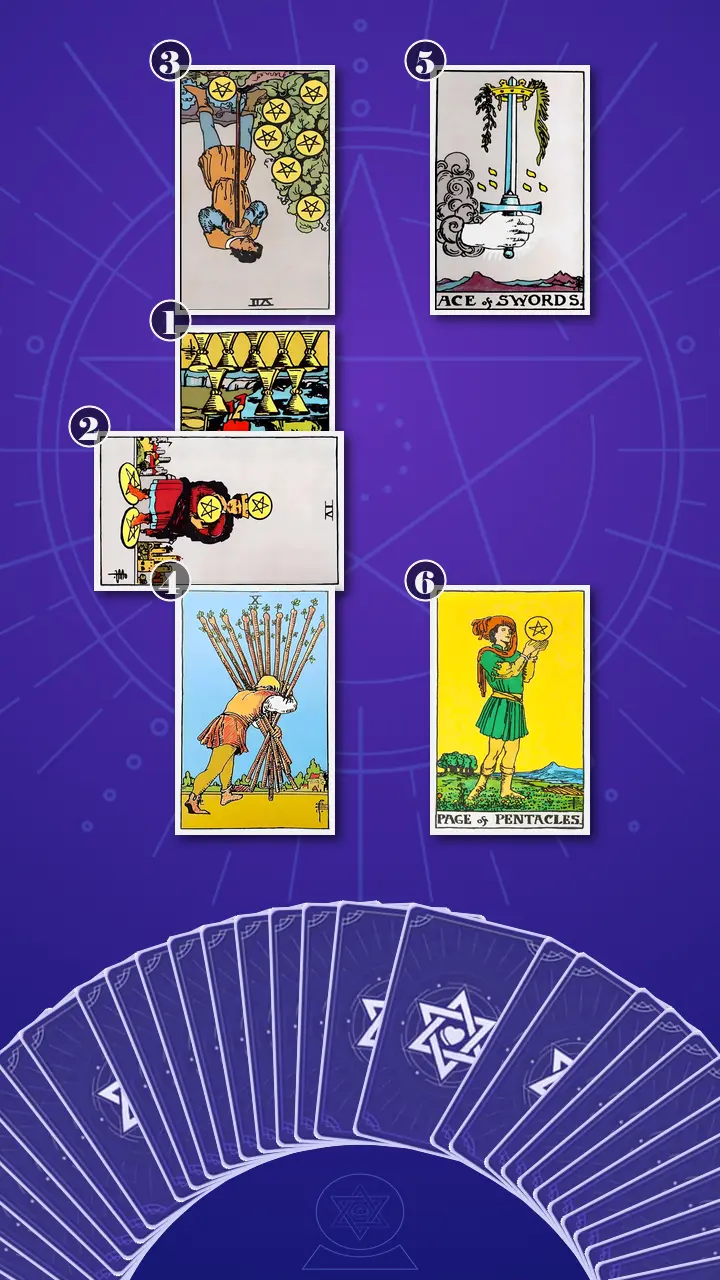
I chose the Decision Cross · Context Edition, a six-card decision spread designed to examine one self-reinforcing loop. A Celtic Cross would have added ten layers when Jordan needed a clean view of a single knot. A simple Past-Present-Future spread would have shown movement through time, but it would not have exposed what the attachment was protecting or what another extension was costing today.
I placed the first card at the centre for the visible staying pattern and crossed it with the attachment that kept the pattern in place. Above and below, two cards would reveal the hidden self-worth fear and the practical cost of continuing. On the right, the final pair would move from decision clarity to a small, bounded experiment. The layout looked like a crossroads with a compact knot in the middle and a narrow path opening at its edge.
For anyone wondering how tarot works in a decision reading, this is the part that matters: I treat the cards as an objective structure for sorting behaviours, beliefs, costs, and available choices. Card meanings in context can make a pattern visible, but they do not take ownership of the decision. Jordan remained the decision-maker throughout.
Reading the Knot at the Centre
Position 1: The Threshold Jordan Kept Revisiting
I turned over the card representing the presenting pattern: how staying because of past investment appeared in Jordan’s current behaviour and emotional energy. It was the Eight of Cups, reversed.
On the card, a cloaked figure stood near eight cups under a moonlit sky. Upright, the image often speaks to recognising emotional incompleteness and moving toward something more truthful. Reversed, the figure seemed caught in repeated return. I saw Jordan’s saved message about changing scope, their old plans still standing behind it, and their habit of reopening the project history whenever the present commitment felt wrong.
“This isn’t a command to leave,” I said. “It shows blocked water energy: you have recognised that something is emotionally incomplete, but the recognition cannot yet become movement. Reopening the archive temporarily quiets the fear of waste, so the threshold keeps resetting.”
I asked, “When you reopen the tracker instead of asking what you need now, what is the exact moment you start looking backward for permission to stay?”
Jordan gave a short, bitter laugh rather than the nod I expected. “That’s too accurate. Almost rude, actually. It’s the renewal email. I see the amount, then I scroll through everything I’ve done so I can make the next payment feel logical.”
I let their humour soften the room without using it to skip the ache beneath it. “Then the card has identified a trigger, not sentenced you to an outcome. Accuracy is useful only if it gives you more choice.”
Position 2: The Full-Body Grip of the Four of Pentacles
I turned over the crossing card, representing the attachment point: what the need to preserve past time, money, effort, and emotional labour was protecting. It was the Four of Pentacles, upright.
The figure pressed one pentacle to the chest, pinned two beneath the feet, and balanced another over the head. I translated that full-body posture into Jordan’s world: old receipts, completed-task screenshots, payment records, and a saved project plan held close as if releasing any of them would release the meaning of the whole commitment.
The earth energy here was in excess. Preservation had become contraction. Jordan was not merely protecting money or work; they were using those resources to protect the original decision from review. The tighter the grip became, the less room remained for current information to circulate.
“When you imagine changing direction,” I asked, “which resource feels impossible to release: the money, the hours, the identity, the promise, or the proof that you were right to begin?”
Their thumb stopped moving along the edge of the phone. Their eyes shifted from me to the tracker, then stayed there as if a private calculation had resumed. Finally, their jaw tightened.
“The proof,” they said. “If I let go, I lose the proof that I was right to begin.”
I nodded. “That’s the centre of the grip. What you want now is being forced to compete with what you think you should protect because it has already cost so much. Protecting your learning is useful. Protecting an old decision from all new evidence is different.”
Position 3: The Harvest That Had to Prove Jordan Was Right
I turned over the card representing the underlying fear: the belief that leaving would prove Jordan had chosen foolishly or could not trust their own judgment. It was the Seven of Pentacles, reversed.
The gardener on the card leaned over a crop, waiting to see whether sustained work had produced enough return. In Jordan’s life, that became the late-night progress check: months of costs, milestones, and completed work examined as if one more result might finally settle an identity question. Reversed, patient assessment had become retroactive proof-seeking.
The evaluative energy was blocked and overextended. Instead of asking whether the crop growing now still deserved care, Jordan kept adding labour so the earlier planting would look wise. The commitment received another month; postponing the review brought immediate relief; the larger investment then made the next review even harder.
“One more milestone can create relief without creating clarity,” I said. “If no future result could go back and edit the past, what would stopping seem to prove about you?”
Jordan swallowed. Their shoulders lifted, held, and lowered only halfway. “That I’m unreliable. That I didn’t know what I was doing. Everyone else seems to know when to pivot, and I’m still trying to make the first plan work.”
“LinkedIn gives you the announcement, not the private cost spreadsheet,” I said. “You’re comparing your entire decision process with somebody else’s clean headline. Changing course does not erase the person who made the earlier choice; it shows that the person has more information now.”
I watched their expression soften and then crease again. The insight did not produce instant relief. First it brought grief: the possibility that effort could be sincere, intelligent, and still not purchase the hoped-for return. I did not rush them past that recognition. Grief was not evidence that staying was correct; it was evidence that the investment had mattered.
Position 4: The Deadline That Blocked the View
I turned over the card representing the cost of continuing: the additional burden and reduced agency created by extending the current pattern. It was the Ten of Wands, upright.
The figure bent beneath ten wands while a town remained visible ahead. I saw Jordan at 6:15 p.m. in the glass meeting room near Old Street, their laptop bag biting into one shoulder while they accepted another deadline and said, “It’s only one more push.” Every new task was meant to justify what had already been completed, yet the load left less attention for evaluating whether the destination still fit.
This was fire in excess: effort without enough space, responsibility without a fresh agreement, movement that consumed the very agency needed to choose the route. The burden did not prove Jordan was committed. It showed that the current arrangement was making discernment harder.
“What are you carrying this week mainly because you’ve already carried so much?” I asked.
“A Friday status deck nobody uses,” they answered immediately. “I keep volunteering to update it because I built the reporting system in the first place.”
I wrote that down. A vague life crisis had just become one observable responsibility. The card had made the cost of continuing physically legible: one recurring task, one shrinking evening, one shoulder that never quite dropped.
When the Ace of Swords Drew a Line Through Yesterday
Position 5: Decision Clarity Without Self-Punishment
I turned over the card representing decision clarity: what became visible when past investment was treated as information rather than an instruction. It was the Ace of Swords, upright, the antidote card of the spread.
As the crowned sword rose above the clouds, the radiator in Jordan’s kitchen stopped clicking. A bus passed outside and cast one clean bar of white light across the wall behind them. For a few seconds, the room seemed to borrow the card’s vertical line.
I described the modern version of the image: Jordan opening a blank note instead of another archive and writing two headings—What this taught me and What I am choosing now. The sword did not delete the old document or pronounce the original choice foolish. Its balanced air energy cut the false link between “I invested a lot” and “I am therefore required to invest more.”
After a decade of working with cycles, I have learned not to confuse one difficult season with permanent truth. I briefly pictured the ephemerides I had studied for years: a loud transit can colour a week, but a pattern that survives repeated cycles deserves to be treated as structure, not weather. I use cycles as context, never as commands.
That is where I applied my Decision Timing Calibration. I separated the pressure of a renewal week, a brutal work sprint, and a comparison-triggering LinkedIn post from the pattern that had persisted across several review dates. Then I used Cyclical Variable Filtering to strip away the temporary noise and retain only the variables with long-term orbital force: current value, current cost, available agency, useful learning, and the direction Jordan wanted their life to support.
The result did not say “leave.” It said the mismatch had lasted longer than the latest difficult week, while the renewal email had merely amplified it. Jordan did not need to let a temporary low tide make the choice, but neither did they need to dismiss a repeated structural signal as a passing mood. Their personal algorithm had been ranking historical investment above present fit; the Ace asked them to change the ranking criteria.
Jordan was still caught in the demand to make a correct decision that would retroactively justify every hour. I watched them glance at the tracker: the history was perfectly visible, their shoulders had tightened again, and the present choice was still waiting.
Do not let yesterday's investment make today's decision; name the present truth and let the Ace of Swords cut a clean line between what was learned and what must continue.
The past can keep its lessons without keeping control of the decision. What you invested tells you what you learned; it does not prove that you must keep paying for the same path.
I watched Jordan’s breath stop halfway in. Their fingers, poised above the warm phone, stayed suspended; the tiny video image became so still that I briefly wondered whether the connection had dropped. Then their eyes moved away from me and lost focus. I could almost see the replay: late deadlines, the saved draft, the tracker opened after every polished career-pivot post. Their mouth tightened. “But doesn’t that mean I was wrong all this time?” they asked, sharper than before. I let the resistance land. “No. It means the earlier choice was made with earlier information.” Their eyes glossed. One fist loosened, then their shoulders dropped in stages, as if a laptop bag had finally reached the floor. A breath left them with a small, shaky laugh. Relief appeared, but so did a brief blankness—the dizzy responsibility of realising that the next choice belonged to them, not the spreadsheet. “Oh,” they said. “That’s kinder. And honestly, scarier.”
I asked, “Now, using this new perspective, think back to last week. Was there a moment when this insight could have made you feel different?”
“Thursday,” Jordan said. “When I agreed to the status deck again. I was asking whether the project had been worth it. I wasn’t asking whether that task was worth another Friday.”
“Exactly,” I said. “The question is not whether the investment was worth it; the question is what the commitment is worth now. Past effort can be evidence of what you learned without becoming proof that you must keep investing.”
I gave them a ten-minute practice, not a permanent verdict. “Write one sentence beginning, ‘What I learned here is…’ and one beginning, ‘What I am choosing now depends on…’ Then stop. You do not need to send the note, make a permanent decision, or explain it to anyone. If your body feels more activated, close the document, look around the room, and return only if and when you choose.”
I named the shift carefully. This was not certainty, and it was not closure on demand. It was the first movement from shame-driven delay toward present-focused discernment: a tight fist opening enough to hold current evidence, cautious relief appearing beside grief, and self-trust beginning through one honest distinction.
Position 6: The Page’s Small Real-World Test
I turned over the final card, representing the bounded experiment: a small present-focused action that could generate evidence without surrendering Jordan’s agency. It was the Page of Pentacles, upright.
The Page studied one pentacle in a cultivated field, with distant mountains still visible. I translated it into one reversible change: reducing a recurring task, asking for a defined scope adjustment, pausing an optional payment, or running a one-week test with one present-day metric. Jordan did not have to make a promise about their entire future in order to learn something accurate about this week.
Here, earth had returned in balance. The Four of Pentacles used earth to immobilise and preserve; the reversed Seven demanded that more investment validate the past. The Page used the same element differently: one concrete subject, one limited trial, and new evidence gathered without turning the experiment into another identity test.
Jordan frowned. “I can already see myself building a twelve-tab Notion dashboard for the experiment and then feeling obligated to maintain that too.”
I smiled. “Then no dashboard. Three short phone notes at most: what happened, what your body did, and what it suggests about present fit. That’s all. A small A/B test for your life is useful only if it stays smaller than the problem.”
Their mouth curved into a tired but genuine smile. I noticed they did not reach for the tracker. “You do not need a permanent answer to collect one honest piece of present-day evidence,” I said. “The Page is not asking you to prove your future. It is asking you to observe your present.”
The Past-Learned, Present-Chosen Path
I read the six cards back to Jordan as one connected story. The reversed Eight of Cups showed emotional recognition held at the threshold. The Four of Pentacles tightened around the history, and the reversed Seven of Pentacles turned evaluation into a demand for retroactive proof. The Ten of Wands showed the practical result: more responsibility, less perspective, and less energy with which to choose. The Ace of Swords separated learning from obligation, while the Page of Pentacles converted that distinction into a small experiment.
The spread reminded me of a route planner insisting that someone keep walking toward the original destination because they had already covered twelve miles. Those miles still counted. They had built stamina, revealed the terrain, and taught the traveller what the road required. But distance already travelled could not decide whether the destination still belonged to them.
I named Jordan’s cognitive blind spot directly. They understood the sunk-cost fallacy in theory; the missing piece was that their spreadsheet counted hours, money, tasks, and possible payoff while excluding current energy, resentment, and available choice. Each new investment was being treated as another vote for continuing, even though it was partly the result of having postponed the review.
The transformation direction was therefore not “be brave and leave” or “be disciplined and stay.” It was to honour what had been learned without treating it as a debt, evaluate present fit with explicit continue, stop, and experiment criteria, and then gather fresh evidence through a reversible step.
Because Jordan had already delayed for months, I did not prescribe another vague period of waiting. I introduced my Orbital Pause Strategy as a calculated container with a start, an end, and rules against reopening the past. Its purpose was to prevent the latest deadline, payment notification, or comparison spike from making an impulsive choice—without allowing the pause itself to become one more indefinite extension.
- Open a Blank Page for a 20-Minute Present-Focused Review Before Friday evening, Jordan would sit at the kitchen table and open a blank document rather than the old project tracker. They would make two columns titled “What this investment has taught me” and “What continuing now costs me,” then write three neutral criteria: one reason to continue, one reason to stop, and one condition that could justify a short experiment. The timer would end the review before any final decision was required. Tip: If writing started to feel like a performance review, Jordan could record three voice notes instead. They would not send, defend, or explain the exercise to anyone, and they could stop if the pressure in their chest or stomach became too intense.
- Turn a 72-Hour Orbital Pause into One Bounded Experiment If the real contractual timing allowed it, Jordan would place a calendar hold exactly 72 hours after the review. During that interval, they would neither renew nor cancel impulsively, add another milestone, or reopen historical evidence. They would track one current metric—usable energy after work—in no more than three phone notes. At the end, they could make one reversible request: “For the next two weeks, I would like to test pausing the Friday status deck so I can learn whether that capacity changes my view of the project.” Tip: If a full 72 hours was unavailable, Jordan could request the shortest practical written pause. No new dashboard was allowed. The test could end early, and its result would be treated as information rather than a verdict on Jordan’s intelligence, loyalty, or worth.
The six-card Decision Cross · Context Edition had done what I wanted it to do: it turned a moral courtroom into a sequence Jordan could examine—pattern, attachment, fear, cost, clarity, experiment. The cards did not choose the path. They helped Jordan see which variables deserved a vote.
A Week Later: One Less Task, One Honest Data Point
A week later, I received a message from Jordan on the Northern line. They had completed the blank-page review, waited through the structured pause without opening the old tracker, and asked their manager to remove the Friday status deck for two weeks. The manager agreed without the confrontation Jordan had rehearsed in their head.
Jordan tracked one measure: how much usable energy remained at 7 p.m. By the third evening, they had enough attention to cook dinner and call a friend without keeping Slack open beside them. The project had not suddenly become right or wrong, but one recurring burden had become visible as a variable rather than an unavoidable fact.
That night they slept through. Their first thought in the morning was, What if I’m wrong? This time, they smiled, made tea, and opened the evidence note—not the archive.
I did not read that message as proof that tarot had solved Jordan’s life. I read it as proof that Jordan had begun to use their own clarity. Their journey had moved from defending the past to observing the present, from demanding certainty to collecting evidence, and from treating change as a verdict to treating choice as a living skill.
If tonight you are lying awake with a tight chest, wanting to stop but afraid that changing direction will make your own effort look foolish, I want you to remember what made this decision so heavy: it was never only about staying or leaving. It was also about whether the earlier version of you was allowed to have chosen sincerely without controlling every version who came after.
So I will leave you with the Ace’s clean line: if you allowed the past to keep its lessons without letting it choose the next step, what one small piece of present-day information—one Page-of-Pentacles data point—would you feel curious enough to notice this week?